


Safe Reinforcement Learning for Multi-agent Systems Based on Relative-degree Decoupling
-
摘要: 针对存在模型不确定性与外部扰动的多智能体协同控制问题, 提出一种基于模型相对阶解耦的安全强化学习框架. 首先, 利用非线性系统中的相对阶理论, 将高阶状态安全约束映射为输入显式出现的仿射不等式; 在凸多面体参数不确定与有界扰动条件下, 进一步给出由有限个线性不等式交集表征的可认证凸安全动作集, 为在线投影与约束求解提供显式可行域. 其次, 为解决单步屏蔽易产生后继不可行的问题, 设计带终端集的滚动安全滤波器: 在每个时刻维护有限时域备份控制序列, 并通过末端约束与终端控制器保证递归可行性与无限时域安全性. 最后, 利用相对阶标准型构建策略分解架构, 以LQR标称控制器提供稳定热启动, 强化学习仅负责对未建模动态进行补偿, 并采用参数共享的独立近端策略优化算法学习补偿量. 卫星编队姿态控制的仿真结果表明: 在执行器效率不确定与扰动条件下, 所提方法能够将约束违规率维持在接近零的水平, 同时实现更快的训练收敛与更低的跟踪误差.Abstract: To address issues in cooperative multi-agent control subject to model uncertainty and external disturbances, this paper proposes a safe reinforcement learning framework based on model relative-degree decoupling. First, utilizing relative-degree theory in nonlinear systems, high-order state safety constraints are mapped into affine inequalities where the control input appears explicitly. Under conditions of convex-polytope parameter uncertainty and bounded disturbances, a certifiable convex safe action set characterized by the intersection of finite linear inequalities is derived to provide an explicit feasible region for online projection and constraint solving. Second, to overcome the issues of subsequent infeasibility often associated with single-step shielding, a receding-horizon safety filter incorporating a terminal set is designed. By maintaining a finite-horizon backup control sequence at each time step, this filter guarantees recursive feasibility and infinite-horizon safety via terminal constraints and a terminal controller. Finally, a policy decomposition architecture is constructed based on the relative-degree normal form. A linear quadratic regulator nominal controller provides a stable warm start, while reinforcement learning is only responsible for compensating for unmodeled dynamics using a parameter-sharing independent proximal policy optimization (IPPO) algorithm to learn the compensation. Simulation results on satellite formation attitude control demonstrate that, under actuator efficiency uncertainty and external disturbances, the proposed method maintains a near-zero constraint violation rate while achieving faster training convergence and reduced tracking error.
-
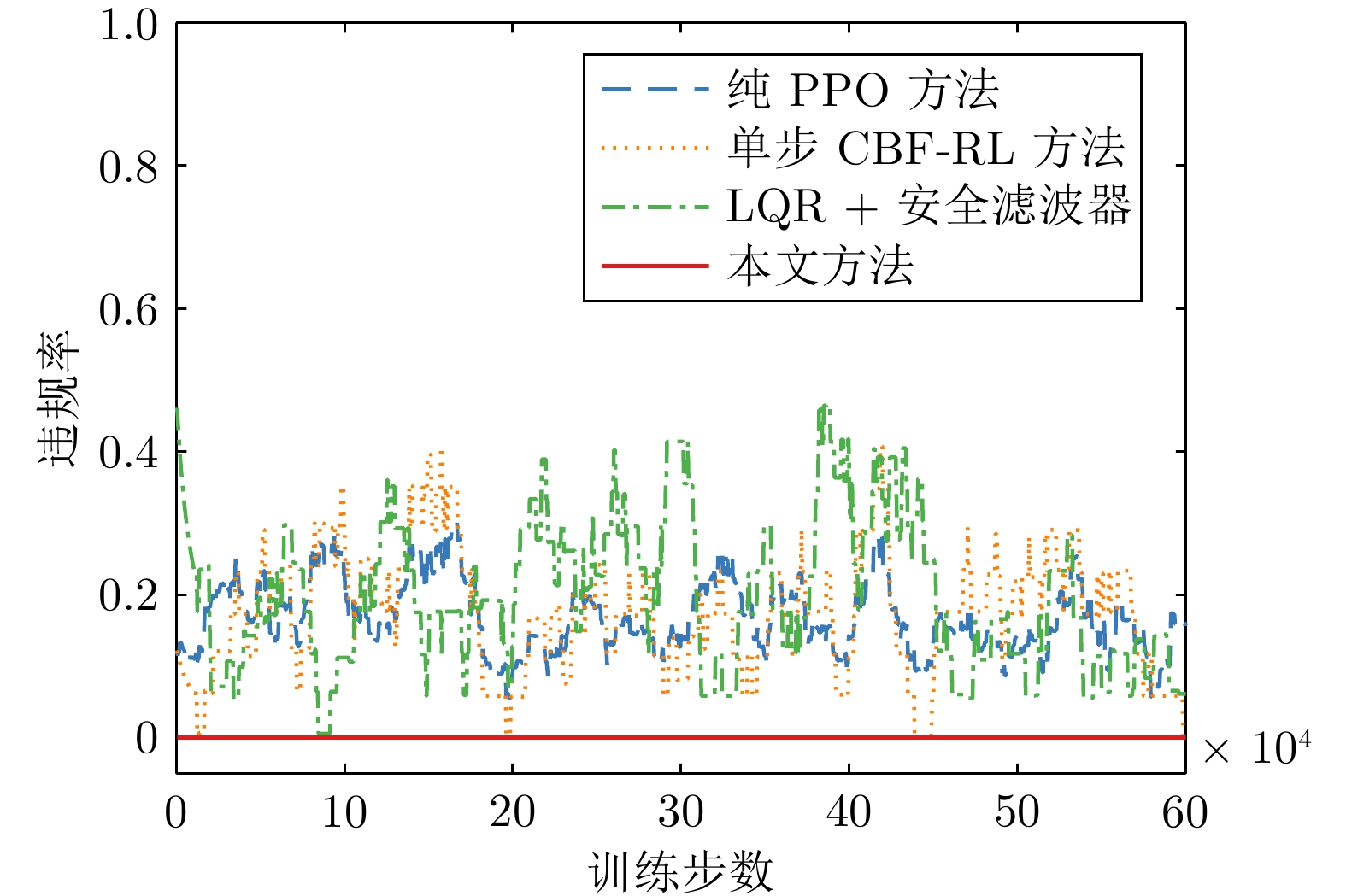
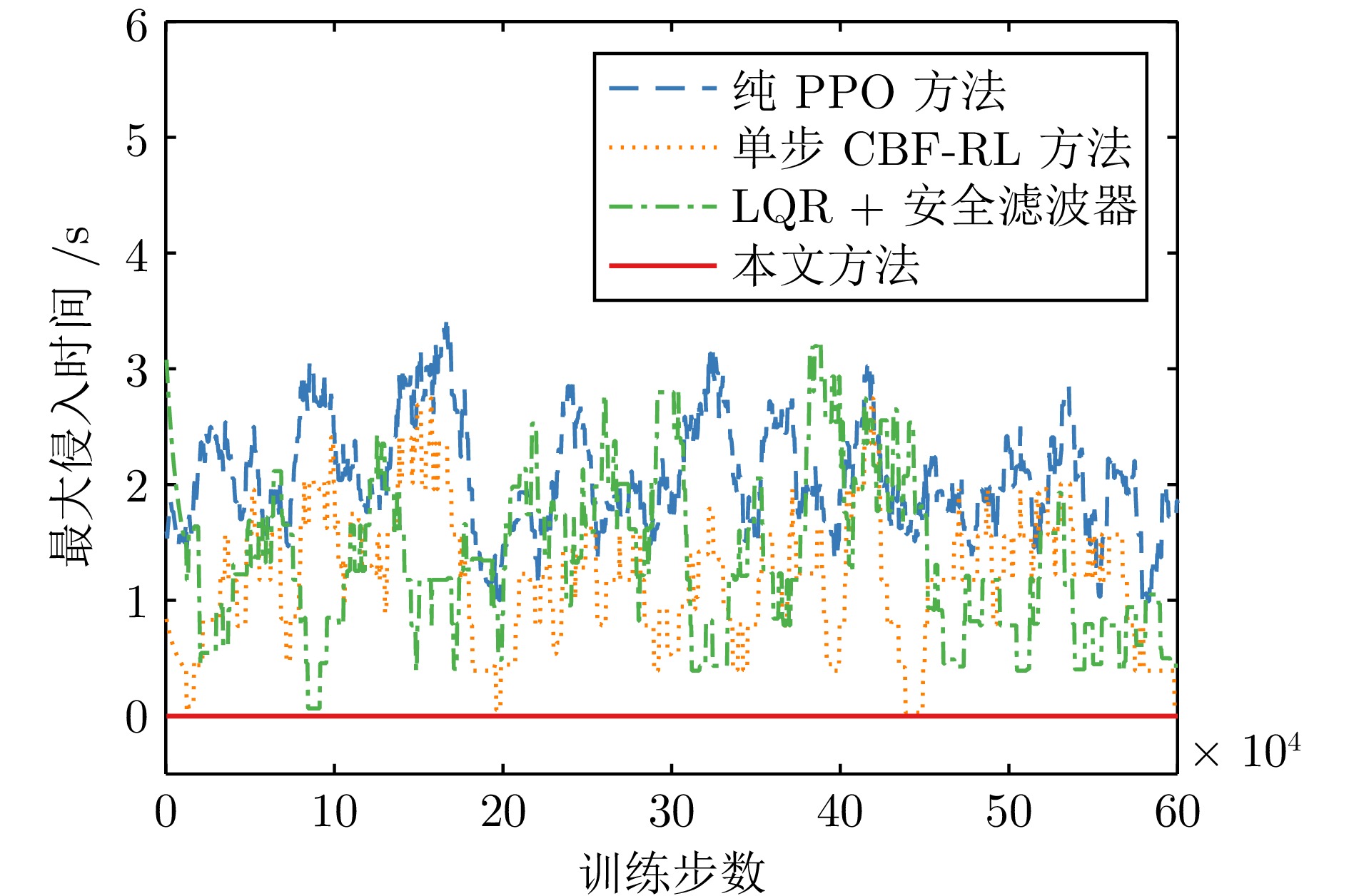
图 4 不同方法的安全约束违规率对比
Fig. 4 Comparison of safety-constraint violation rate for different methods
表 1 训练超参数设置
Table 1 Training hyperparameter settings
参数 符号 取值 智能体数量 $ N $ 4 网络结构 — 2层隐藏层(每层256) 激活函数 — $ \tanh $ 姿态追踪权重 $ w_{{\rm{track}}} $ 8.0 角速度惩罚 $ w_{{\rm{rate}}} $ 0.05 优化器 — Adam Actor学习率 — $ 3\times 10^{-5} $ Critic学习率 — $ 5\times 10^{-4} $ 相对熵早停阈值 — 0.015 预测步长 $ H $ 6  下载: 导出CSV
-
[1] 江碧涛, 温广辉, 周佳玲, 郑德智. 智能无人集群系统跨域协同技术研究现状与展望. 中国工程科学, 2024, 26(1): 117−126 doi: 10.15302/J-SSCAE-2024.01.015Jiang Bi-Tao, Wen Guang-Hui, Zhou Jia-Ling, Zheng De-Zhi. Cross-domain cooperative technology of intelligent unmanned swarm systems: Current status and prospects. Strategic Study of CAE, 2024, 26(1): 117−126 doi: 10.15302/J-SSCAE-2024.01.015 [2] Zhang J, Yang D S, Li W H, Zhang H G, Li G D, Gu P. Resilient output control of multiagent systems with DoS attacks and actuator faults: Fully distributed event-triggered approach. IEEE Transactions on Cybernetics, 2024, 54(12): 7681−7690 doi: 10.1109/TCYB.2024.3404010 [3] Zhou P P, Chen B M. Distributed optimal solutions for multiagent pursuit-evasion games for capture and formation control. IEEE Transactions on Industrial Electronics, 2024, 71(5): 5224−5234 doi: 10.1109/TIE.2023.3283684 [4] Zhao R, Li Y, Gao F, Gao Z H, Zhang T Y. Multi-agent constrained policy optimization for conflict-free management of connected autonomous vehicles at unsignalized intersections. IEEE Transactions on Intelligent Transportation Systems, 2024, 25(6): 5374−5388 doi: 10.1109/TITS.2023.3331723 [5] Guo R, Feng J W, Zhao Y, Huang T W, Liu X Z, Wang J Y. Robust model predictive control for perturbed nonlinear multi-agent systems via dynamic event-triggered scheme. Science China Information Sciences, 2026, 69(4): Article No. 142205 doi: 10.1007/s11432-024-4807-5 [6] Wen G H, Fu J J, Wang B W, Wang X D, Shen H. Robust formation tracking of ASVs with nonconservative collision avoidance: A control barrier function-based approach. IEEE Transactions on Industrial Electronics, 2026, 73(6): 9174−9186 doi: 10.1109/TIE.2025.3649849 [7] Wen G H, Yu W W, Xia Y Q, Yu X H, Hu J Q. Distributed tracking of nonlinear multiagent systems under directed switching topology: An observer-based protocol. IEEE Transactions on Systems, Man, and Cybernetics: Systems, 2017, 47(5): 869−881 doi: 10.1109/TSMC.2016.2564929 [8] Li Y H, Xie G M, Lu Z Q. Revisiting cooperative off-policy multi-agent reinforcement learning. In: Proceedings of the 42nd International Conference on Machine Learning. Vancouver, Canada: PMLR, 2025. Article No. 1439 [9] Mai Y X, Yin Q Y, Ni W C, Xu P, Huang K Q. Constructive conflict-driven multi-agent reinforcement learning for strategic diversity. In: Proceedings of the 34th International Joint Conference on Artificial Intelligence. Montreal, Canada: ijcai.org, 2025. Article No. 24 [10] Li D P, Lou N, Xu Z W, Zhang B, Fan G L. Efficient communication in multi-agent reinforcement learning with implicit consensus generation. In: Proceedings of the 39th AAAI Conference on Artificial Intelligence. Philadelphia, USA: AAAI Press, 2025. 23240−23248 [11] Tessler C, Mankowitz D J, Mannor S. Reward constrained policy optimization. In: Proceedings of the 7th International Conference on Learning Representations. New Orleans, USA: OpenReview.net, 2019. [12] Fulton N, Platzer A. Safe reinforcement learning via formal methods: Toward safe control through proof and learning. In: Proceedings of the 32nd AAAI Conference on Artificial Intelligence. New Orleans, USA: AAAI Press, 2018. 4485−4491 [13] Fisac J F, Lugovoy N F, Rubies-Royo V, Ghosh S, Tomlin C J. Bridging Hamilton-Jacobi safety analysis and reinforcement learning. In: Proceedings of the International Conference on Robotics and Automation (ICRA). Montreal, Canada: IEEE, 2019. 8550−8556 [14] Polymenakos K, Abate A, Roberts S. Safe policy search using Gaussian process models. In: Proceedings of the 18th International Conference on Autonomous Agents and MultiAgent Systems. Montreal, Canada: International Foundation for Autonomous Agents and Multiagent Systems, 2019. 1565−1573 [15] Cheng R, Khojasteh M J, Ames A D, Burdick J W. Safe multi-agent interaction through robust control barrier functions with learned uncertainties. In: Proceedings of the 59th IEEE Conference on Decision and Control (CDC). Jeju, Korea (South): IEEE, 2020. 777−783 [16] Qin Z Y, Zhang K Q, Chen Y X, Chen J K, Fan C C. Learning safe multi-agent control with decentralized neural barrier certificates. In: Proceedings of the 9th International Conference on Learning Representations. Austria: OpenReview.net, 2021.Qin Z Y, Zhang K Q, Chen Y X, Chen J K, Fan C C. Learning safe multi-agent control with decentralized neural barrier certificates. In: Proceedings of the 9th International Conference on Learning Representations. Austria: OpenReview.net, 2021. [17] Ahmad H M S, Sabouni E, Wasilkoff A, Budhraja P, Guo Z J, Zhang S Y, et al. HMARL-CBF-hierarchical multi-agent reinforcement learning with control barrier functions for safety-critical autonomous systems. In: Proceedings of the 39th International Conference on Neural Information Processing Systems. San Diego, USA: 2025.Ahmad H M S, Sabouni E, Wasilkoff A, Budhraja P, Guo Z J, Zhang S Y, et al. HMARL-CBF-hierarchical multi-agent reinforcement learning with control barrier functions for safety-critical autonomous systems. In: Proceedings of the 39th International Conference on Neural Information Processing Systems. San Diego, USA: 2025. [18] Hsu K C, Nguyen D P, Fisac J F. ISAACS: Iterative soft adversarial actor-critic for safety. In: Proceedings of the 5th Learning for Dynamics and Control Conference. Philadelphia, USA: PMLR, 2023. 90−103 [19] Chung S J, Bandyopadhyay S, Foust R, Subramanian G P, Hadaegh F Y. Review of formation flying and constellation missions using nanosatellites. Journal of Spacecraft and Rockets, 2016, 53(3): 567−578 doi: 10.2514/1.A33291 [20] Boumeftah A, Ben Yahia O, Frigon J F, Falco G, Kurt G K. Adaptive detection of on-orbit jamming for securing GEO satellite links. In: Proceedings of the 12th Advanced Satellite Multimedia Systems Conference and the 18th Signal Processing for Space Communications Workshop (ASMS/SPSC). Sitges, Spain: IEEE, 2025. 1−8 [21] Isidori A. Exact linearization methods. Nonlinear Control Systems: An Introduction. London: Springer, 1995. 178−253Isidori A. Exact linearization methods. Nonlinear Control Systems: An Introduction. London: Springer, 1995. 178−253 [22] Xiao W, Belta C. High-order control barrier functions. IEEE Transactions on Automatic Control, 2022, 67(7): 3655−3662 doi: 10.1109/TAC.2021.3105491 [23] Ames A D, Xu X R, Grizzle J W, Tabuada P. Control barrier function based quadratic programs for safety critical systems. IEEE Transactions on Automatic Control, 2017, 62(8): 3861−3876 doi: 10.1109/TAC.2016.2638961 [24] van den Berg J, Lin M, Manocha D. Reciprocal velocity obstacles for real-time multi-agent navigation. In: Proceedings of the IEEE International Conference on Robotics and Automation. Pasadena, USA: IEEE, 2008. 1928−1935 [25] van Wijk D E J, Coogan S, Molnar T G, Majji M, Hobbs K L. Disturbance-robust backup control barrier functions: Safety under uncertain dynamics. IEEE Control Systems Letters, 2024, 8: 2817−2822 doi: 10.1109/LCSYS.2024.3514998 -

 下载:

图(6) / 表(1)
计量
- 文章访问数: 261
- HTML全文浏览量: 175
- PDF下载量: 31
- 被引次数: 0
