


Observer-Based Event-Triggered Time-Varying Formation Tracking Control for Multi-Agent Systems With A Non-Autonomous Leader
-
摘要: 针对有向拓扑下含非自治领导者的多智能体系统, 提出一种基于未知输入观测器的分布式动态事件触发控制方法, 以解决其时变编队跟踪问题. 首先, 利用智能体间的相对输出信息设计未知输入观测器, 以估计智能体之间的相对状态. 在此基础上, 引入动态事件触发机制来确定控制输入的更新时刻, 从而有效降低控制更新频率. 随后, 设计一种时变编队跟踪控制协议, 使得跟随者仅依赖相对输出信息即可实现对非自治领导者的编队跟踪. 通过构造合适的Lyapunov函数, 严格证明了编队跟踪误差的渐近收敛性. 此外, 借助反证法严格排除了芝诺行为的存在. 最后, 数值仿真结果验证了所提方法的有效性.Abstract: This paper investigates the time-varying formation tracking problem for multi-agent systems under directed topology with a non-autonomous leader. A distributed dynamic event-triggered (DET) control method based on an Unknown Input Observer (UIO) is proposed. First, a UIO is designed using the relative output information among agents to estimate their relative states. On this basis, a Dynamic Event-Triggered Mechanism is introduced to determine the update instants of the control input, thereby effectively reducing the control update frequency. Subsequently, a time-varying formation tracking control protocol is designed, enabling followers to achieve formation tracking of the non-autonomous leader using only relative output information. Rigorous Lyapunov-based analysis proves the asymptotic convergence of the formation tracking. Furthermore, the existence of Zeno behavior is rigorously excluded by utilizing a proof by contradiction. Finally, numerical simulations validate the effectiveness of the proposed method.
-
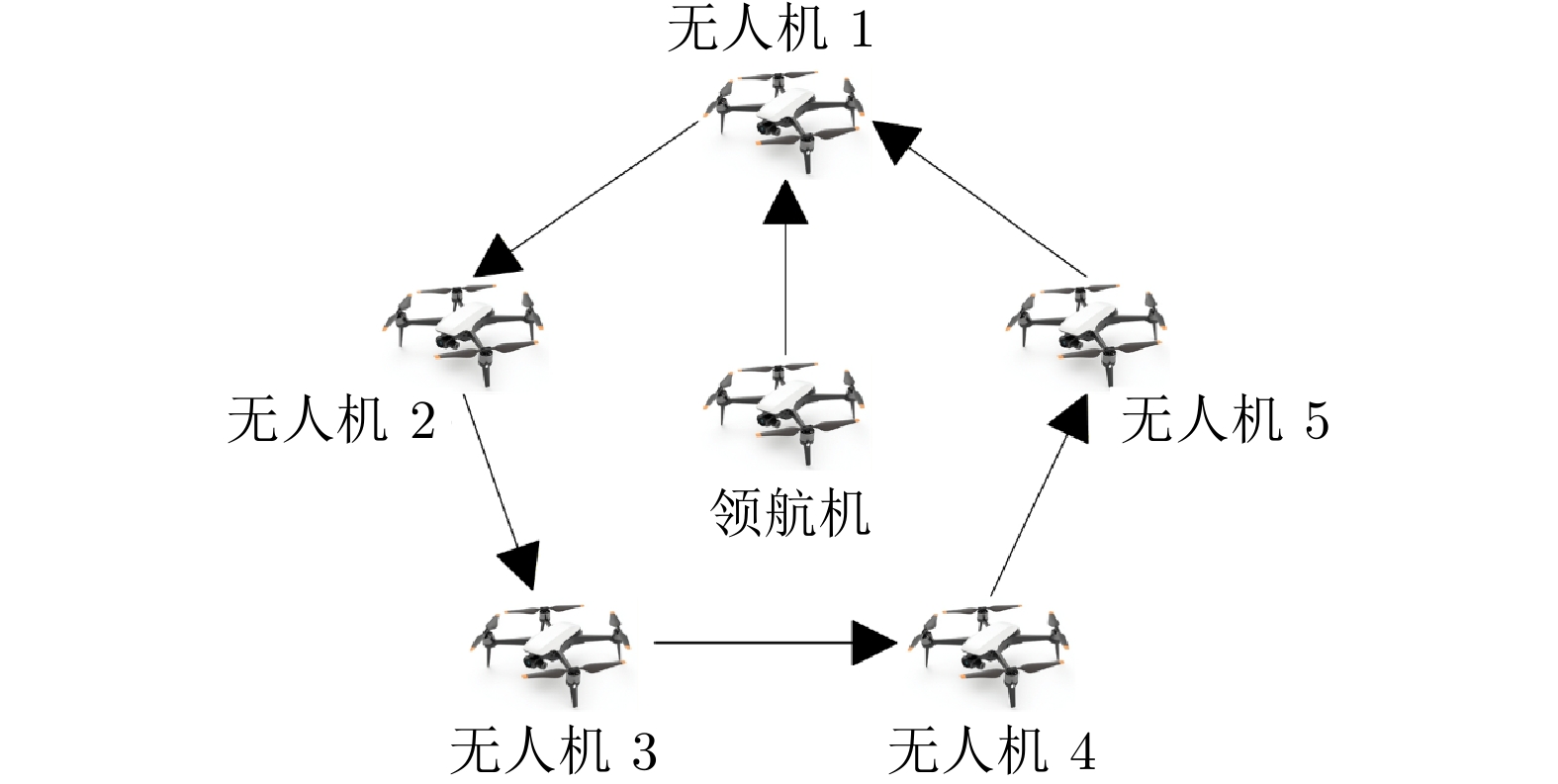
图 1 例$ 1 $通讯拓扑$ {\cal{G}} $
Fig. 1 Communication topology $ {\cal{G}} $ in Example $ 1 $
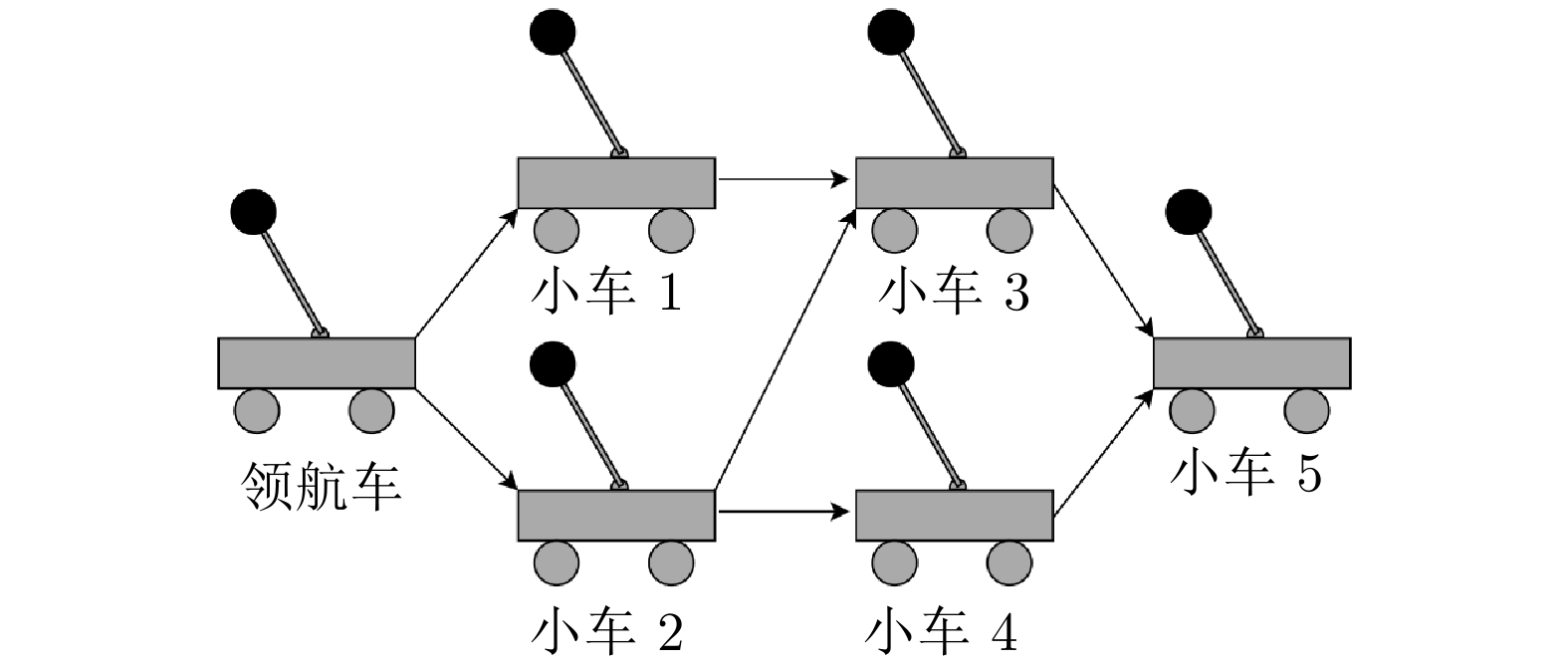
图 7 例$ 2 $通讯拓扑$ {\cal{G}} $
Fig. 7 Communication topology $ {\cal{G}} $ in Example $ 2 $
表 1 不同参数组合下的触发次数与收敛时间
Table 1 Triggering times and convergence time under different parameter combinations
参数 事件触发次数 $ \|\delta(t)\|\leq 0.1 $的时间(s) $ \alpha_k $ $ \beta_k $ 1 2 3 4 5 0.20 0.20 1620 849 1673 812 837 19.1410 0.30 0.20 2081 1071 2136 1091 1019 18.4320 0.40 0.20 2559 1306 2513 1317 1336 17.4650 0.20 0.30 4233 2460 3923 2283 2358 15.8590 0.20 0.25 2786 1473 2706 1506 1452 16.9520  下载: 导出CSV
-
[1] Rezaeimoghaddam P and Al-Anbagi I. Cost-efficient and trust-aware virtual network embedding for dense industrial IoT systems using multiagent systems. IEEE Transactions on Network and Service Management, 2024, 21(1): 1100−1114 doi: 10.1109/TNSM.2023.3307013 [2] Sun J, Lei H B, Zhang J X, Liu L and Shan Q H. Adaptive consensus control of multiagent systems with an unstable high-dimensional leader and switching topologies. IEEE Transactions on Industrial Informatics, 2024, 20(9): 10946−10953 doi: 10.1109/TII.2024.3395661 [3] Liu L N, Huang Y L, and Deng C. Accelerated distributed cooperative energy management for integrated energy systems. IEEE/CAA Journal of Automatica Sinica, 2025, 12(12): 2589−2601 doi: 10.1109/JAS.2025.125489 [4] Wen G H, Wan Y, Zhou J L, D. Zheng D Z and Chen C L P. Distributed robust event-triggered platooning control of connected vehicles with uncertain dynamics: A neuro-adaptive approach. IEEE Transactions on Industrial Informatics, 2025, 21(3): 2570−2579 doi: 10.1109/TII.2024.3508842 [5] 王健安, 闫慧娴, 张君如, 张捷, 李明杰, 赵志诚. 事件触发下多移动机器人抗干扰固定时间预定性能编队. 自动化学报, 2025, 51(7): 1703−1714 doi: 10.16383/j.aas.c230654Wang Jian-An, Yan Hui-Xian, Zhang Jun-Ru, Zhang Jie, Li Ming-Jie, Zhao Zhi-Cheng. Anti-disturbance fixed-time prescribed performance formation control of multi-mobile robots via event-triggered mechanism. Acta Automatica Sinica, 2025, 51(7): 1703−1714 doi: 10.16383/j.aas.c230654 [6] Zhang K, Tian H H, Wang P J, Shan J J and Huang T W. Adaptive NN-based event-triggered consensus for linear multi-agent systems with uncertainties. IEEE Transactions on Control of Network Systems, 2026, 13(1): 521−531 doi: 10.1109/TCNS.2025.3649116 [7] Wu B F, Peng Z X, Wen G G, Yang S C and Huang T W. Sampling-optimization-based adaptive formation tracking with trajectory protection. IEEE Systems Journal, 2023, 17(4): 6449−6459 doi: 10.1109/jsyst.2023.3305358 [8] Liu T R and Chen Y -Y. Formation tracking of spatiotemporal multiagent systems: A decentralized reinforcement learning approach. IEEE Systems, Man, and Cybernetics Magazine, 2024, 10(4): 52−60 doi: 10.1109/MSMC.2024.3401404 [9] Wang W Z, Chen X, Jia J B, Wu K L and Xi M Y. Optimal formation tracking control based on reinforcement learning for multi-UAV systems. Control Engineering Practice, 2023, 141: Article No. 105735 doi: 10.1016/j.conengprac.2023.105735 [10] Zhang B Y, Lv M L, Cui S H, Bu X W and Park J H. Learning-based optimal cooperative formation tracking control for multiple UAVs: A feedforward-feedback design framework. IEEE Transactions on Automation Science and Engineering, 2025, 22: 11−23 doi: 10.1109/TASE.2023.3322028 [11] 温广辉, 余星火, 黄廷文, 周艳. 模型参数不确定下多无人艇系统固定时间二分编队跟踪控制. 自动化学报, 2025, 51(3): 669−677 doi: 10.16383/j.aas.c240473Wen Guang-Hui, Yu Xing-Huo, Huang Ting-Wen, Zhou Yan. Fixed-time bipartite formation tracking control for multi-USV systems with uncertain model parameters. Acta Automatica Sinica, 2025, 51(3): 669−677 doi: 10.16383/j.aas.c240473 [12] Wen G H, Fu J J, Wang B W, Wang X D and Shen H, Robust formation tracking of ASVs with nonconservative collision avoidance: A control barrier function-based approach. IEEE Transactions on Industrial Electronics, DOI: 10.1109/TIE.2025.3649849 [13] Xu L -X, Wang Y -L, Wang X F and Peng C. Distributed active disturbance rejection formation tracking control for quadrotor UAVs. IEEE Transactions on Cybernetics, 2024, 54(8): 4678−4689 doi: 10.1109/TCYB.2023.3324752 [14] Gong X, Basin M V, Feng Z G, Huang T W, and Cui Y K. Resilient time-varying formation-tracking of multi-UAV systems against composite attacks: A two-layered framework. IEEE/CAA Journal of Automatica Sinica, 2023, 10(4): 969−984 doi: 10.1109/JAS.2023.123339 [15] Wen G H, Yu W W, Xia Y Q, Yu X H and Hu J Q. Distributed tracking of nonlinear multiagent systems under directed switching topology: An observer-based protocol. IEEE Transactions on Systems, Man, and Cybernetics: Systems, 2017, 47(5): 869−881 doi: 10.1109/TSMC.2016.2564929 [16] Wang R, Dong X W, Li Q D and Ren Z. Distributed time-varying output formation control for general linear multiagent systems with directed topology. IEEE Transactions on Control of Network Systems, 2019, 6(2): 609−620 doi: 10.1109/TCNS.2018.2863047 [17] Li W H, Zhang H G, Zhou Y and Wang Y C. Bipartite formation tracking for multi-agent systems using fully distributed dynamic edge-event-triggered protocol. IEEE/CAA Journal of Automatica Sinica, 2022, 9(5): 847−853 doi: 10.1109/JAS.2021.1004377 [18] Xin B, Kang Y H and Liu W. Tracking-oriented formation control for unmanned aerial vehicle swarm through output feedback under jointly-connected topologies. IEEE Transactions on Vehicular Technology, 2024, 73(1): 438−449 doi: 10.1109/TVT.2023.3310502 [19] Li J S, Hua Y Z, Yu J L, Dong X W, Feng Z and Ren Z. Resilient time-varying formation tracking control for general linear multiagent systems with a nonautonomous leader and adversarial followers. IEEE Transactions on Cybernetics, 2024, 54(10): 6203−6216 doi: 10.1109/TCYB.2024.3411092 [20] Wang Q, Dong X W, Lv J H and Ren Z. Fully distributed adaptive formation tracking for directed heterogeneous multi-agent systems with unknown input. IEEE Transactions on Circuits and Systems II: Express Briefs, 2023, 70(2): 700−704 [21] Wang P J, Wen G H, Huang T W, Yu W W and Ren Y. Observer-based consensus protocol for directed switching networks with a leader of nonzero inputs. IEEE Transactions on Cybernetics, 2022, 52(1): 630−640 doi: 10.1109/TCYB.2020.2981518 [22] Zhang K, Tian H H, Wang P J and Huang T W. Observer-based dynamic event-triggered consensus of MIMO linear multiagent systems with directed topology. IEEE Transactions on Systems, Man, and Cybernetics: Systems, 2024, 54(9): 5834−5843 doi: 10.1109/TSMC.2024.3411659 [23] Dimarogonas D V, Frazzoli E and Johansson K H. Distributed event-triggered control for multi-agent systems. IEEE Transactions on Automatic Control, 2012, 57(5): 1291−1297 doi: 10.1109/TAC.2011.2174666 [24] Cai Y L, Zhang H G, Duan J and Zhang J. Distributed bipartite consensus of linear multiagent systems based on event-triggered output feedback control scheme. IEEE Transactions on Systems, Man, and Cybernetics: Systems, 2021, 51(11): 6743−6756 doi: 10.1109/TSMC.2020.2964394 [25] Sui S, Shen D Y, Tong S C and Chen C L P. State-observer-based adaptive fuzzy event-triggered formation control for nonlinear multiagent system. IEEE Transactions on Emerging Topics in Computational Intelligence, 2024, 8(5): 3327−3338 doi: 10.1109/TETCI.2024.3377254 [26] Zhang H Y, Huang Y, Zhao N and Shi P. Improved event-triggered adaptive neural network control for multi-agent systems under denial-of-service attacks. Artificial Intelligence Science and Engineering, 2025, 1(2): 122−133 doi: 10.23919/aise.2025.000009 [27] Li B Q, Zhao L H and Wen S P. Periodic event-triggered consensus of stochastic multi-agent systems under switching topology. Artificial Intelligence Science and Engineering, 2025, 1(2): 147−156 doi: 10.23919/AISE.2025.000011 [28] Wei L L, Chen M and Shi S. Dynamic event-triggered consensus cost-based switching control for UAV formation with disturbances. IEEE Transactions on Intelligent Vehicles, 2024, 9(2): 3531−3543 doi: 10.1109/TIV.2023.3344606 [29] Wan Y, Shi X L, Zhao X N and Cao J D. Distributed secure consensus tracking of multiagent systems under hybrid cyberattacks: An event-triggered neuroadaptive approach. IEEE Systems, Man, and Cybernetics Magazine, 2024, 10(4): 77−91 doi: 10.1109/MSMC.2024.3358065 [30] Bao Y G, Zhou J L, Wen G H, Zheng D Z and Li Z X. Event-based reset control for consensus of multiagent systems under denial-of-service attacks: An appointed-time-observer-based approach. IEEE Systems, Man, and Cybernetics Magazine, 2024, 10(4): 116−130 doi: 10.1109/MSMC.2023.3317592 [31] Li M L, Li T S and Liang H J, Distributed gain scheduling dynamic event-triggered semi-global leader-following consensus of input constrained MASs under fixed/switching topologies. IEEE/CAA Journal of Automatica Sinica, DOI: 10.1109/JAS.2025.125417 -

 下载:
下载:

计量
- 文章访问数: 369
- HTML全文浏览量: 200
- 被引次数: 0
