


Predefined-Time Distributed Optimal Power Scheduling for Large-Scale Inverter Air Conditioner Clusters in Demand Response
-
摘要: 本文研究大规模变频空调集群参与需求响应中的最优功率调度问题. 针对现有研究侧重运行经济性最优, 忽略用户舒适需求、快速动态响应能力及用户满意度等关键工程因素的不足, 构建了兼顾舒适约束与动态性能的优化调度框架. 为刻画用户舒适需求, 基于实时室内温度、设定温度及可容许温度偏差构建统一的用户舒适指标, 实现舒适水平的定量表征. 基于此, 提出一种预定义时间最优调度策略, 通过协调各空调单元功率消耗, 确保在满足用户舒适约束的前提下, 集群总功率于预定义时间内精确跟踪需求功率并实现用户满意度最优. 进一步地, 将该方法扩展至阶跃需求情形, 以增强对动态需求目标的适应能力. 最后, 基于李雅普诺夫理论证明了系统收敛性, 数值仿真验证了所提方法的有效性与工程可行性.Abstract: This paper investigates the optimal power scheduling problem of large-scale inverter air conditioner clusters participating in demand response. To address the limitations of existing studies that focus on operational economic optimality while neglecting user comfort requirements, fast dynamic response capability, and user satisfaction, an optimization scheduling framework that accounts for both comfort constraints and dynamic performance is established. To characterize user comfort requirements, a unified user comfort index is constructed based on real-time indoor temperature, set temperature, and allowable temperature deviation, enabling quantitative representation of comfort levels. On this basis, a predefined-time optimal scheduling strategy is proposed. By coordinating the power consumption of individual air-conditioning units, the aggregate cluster power is ensured to accurately track the demand power within a predefined time while satisfying user comfort constraints and achieving optimal user satisfaction. Furthermore, the proposed method is extended to step demand scenarios to enhance adaptability to dynamic demand targets. Finally, system convergence is proven based on Lyapunov theory, and numerical simulations verify the effectiveness and engineering feasibility of the proposed method.
-
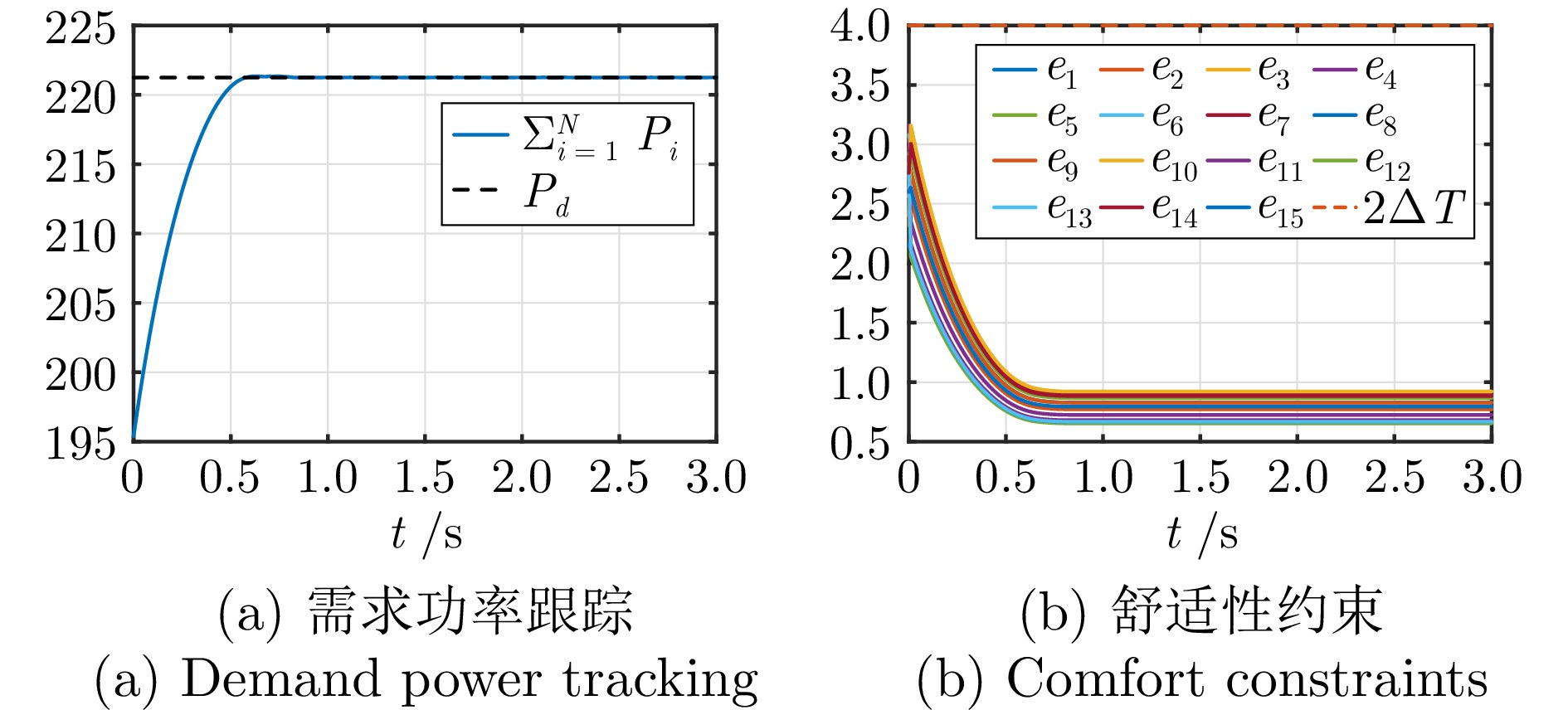
图 4 用户舒适约束和需求功率跟踪的实现
Fig. 4 Implementation of user comfort constraints and demand power tracking
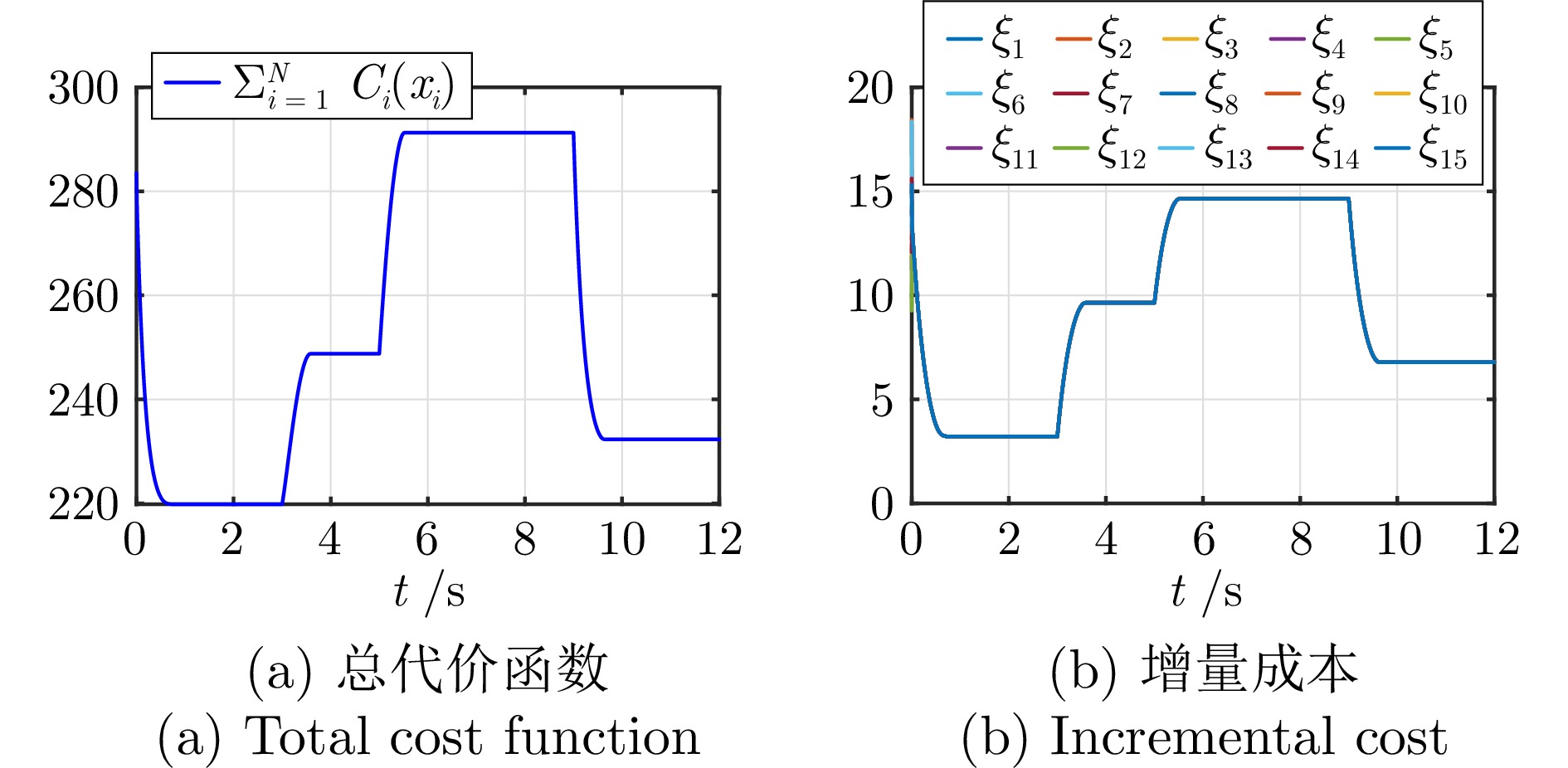
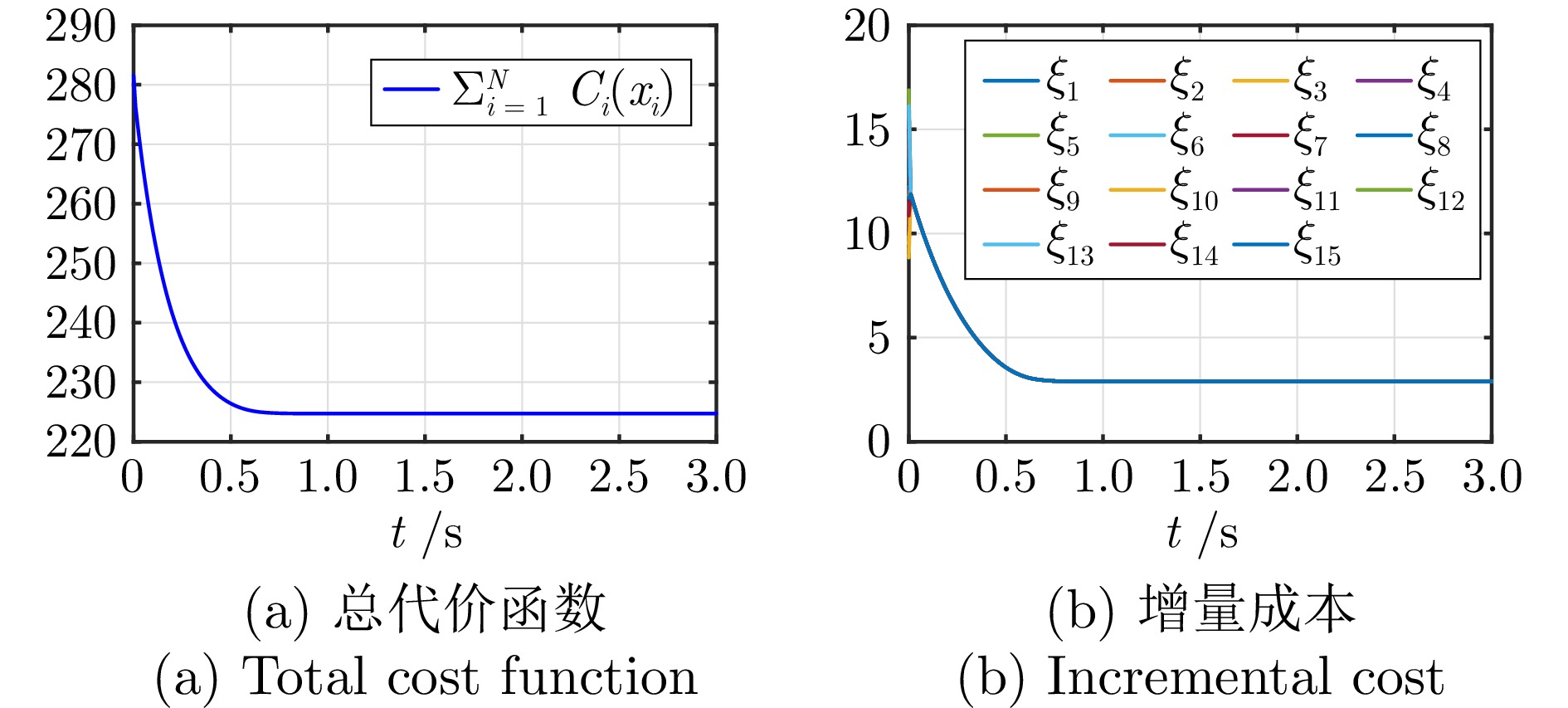
图 5 阶跃需求下总代价与增量成本对比
Fig. 5 Comparison of total cost and incremental cost under step-varying demand
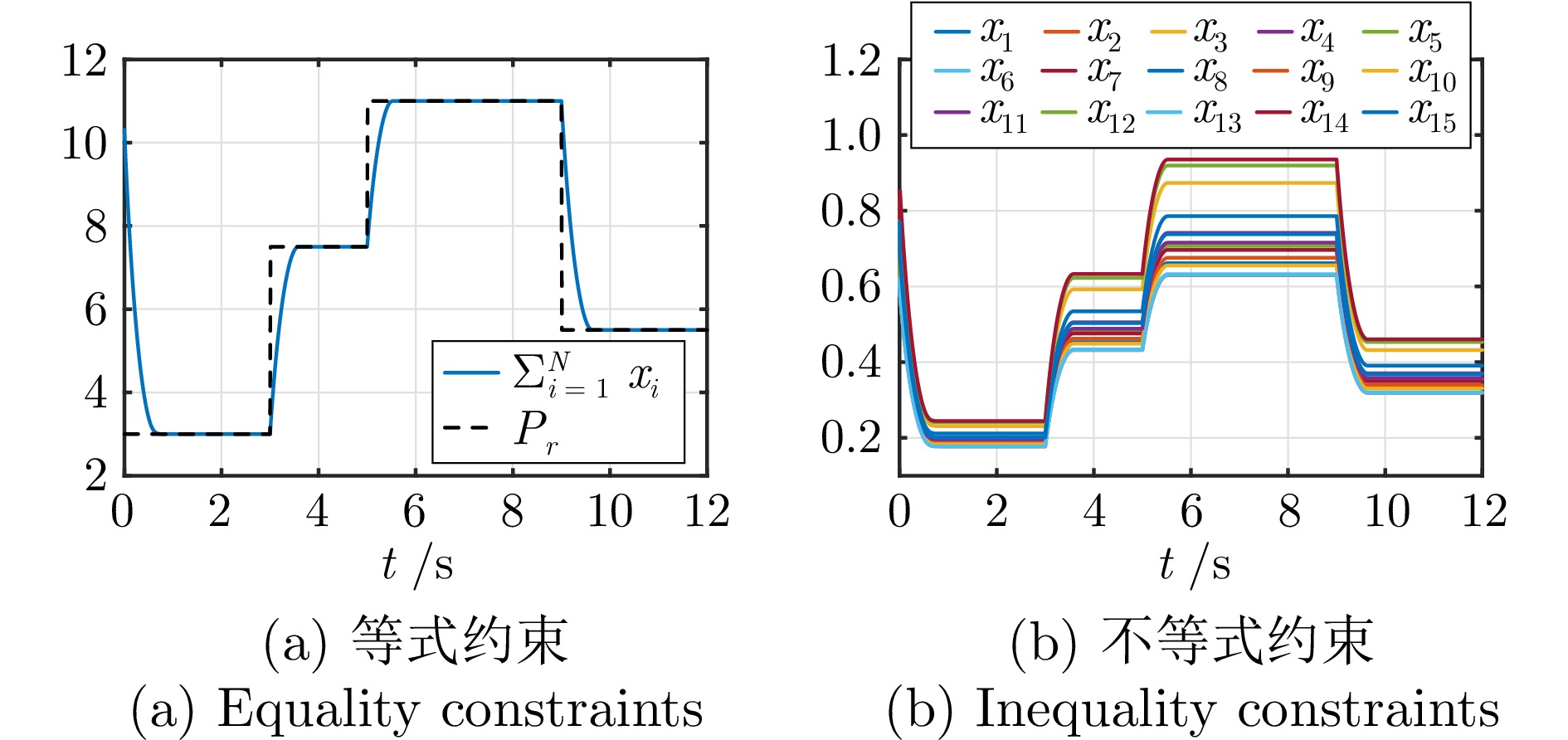
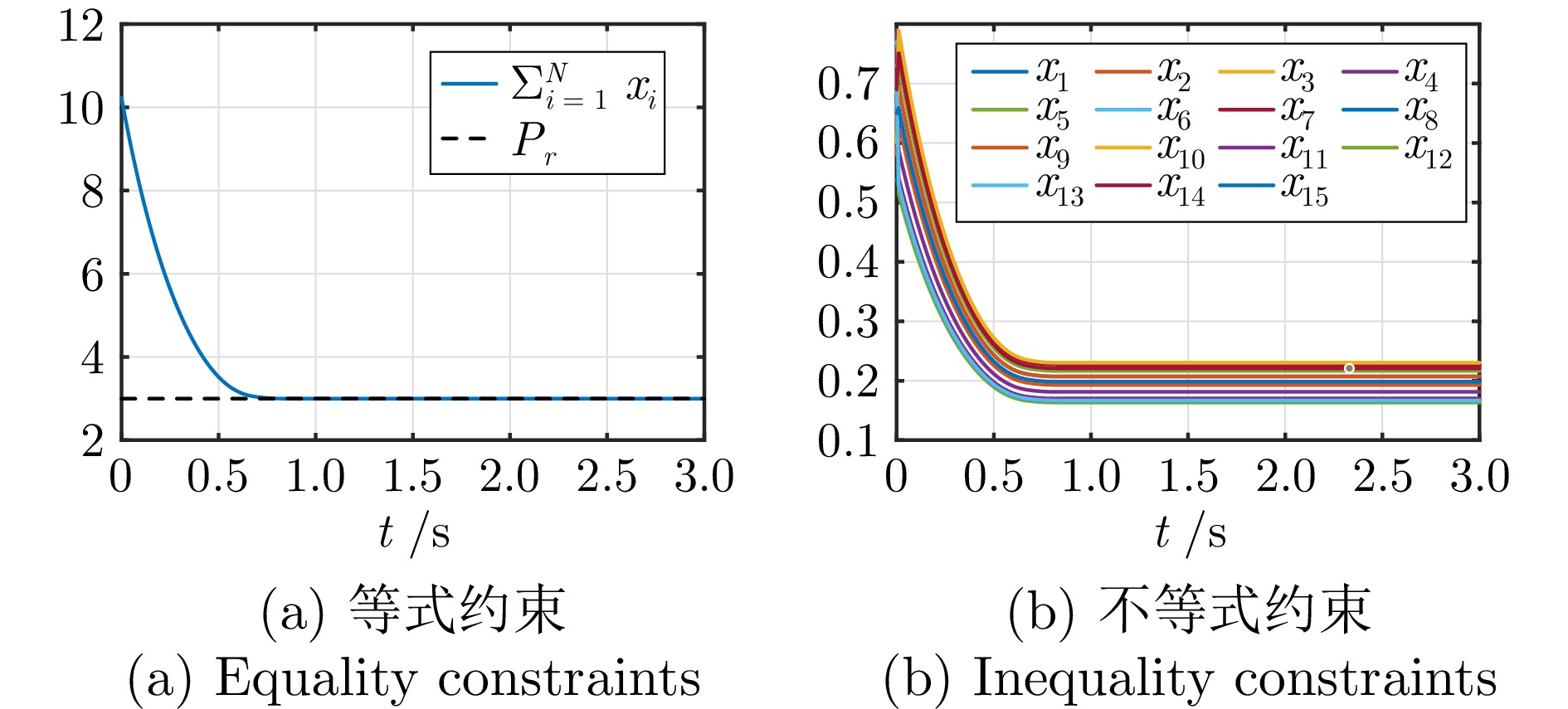
图 6 阶跃需求下状态$ x_i $的运行约束
Fig. 6 Operational constraints of state $ x_i $ under step-varying demand
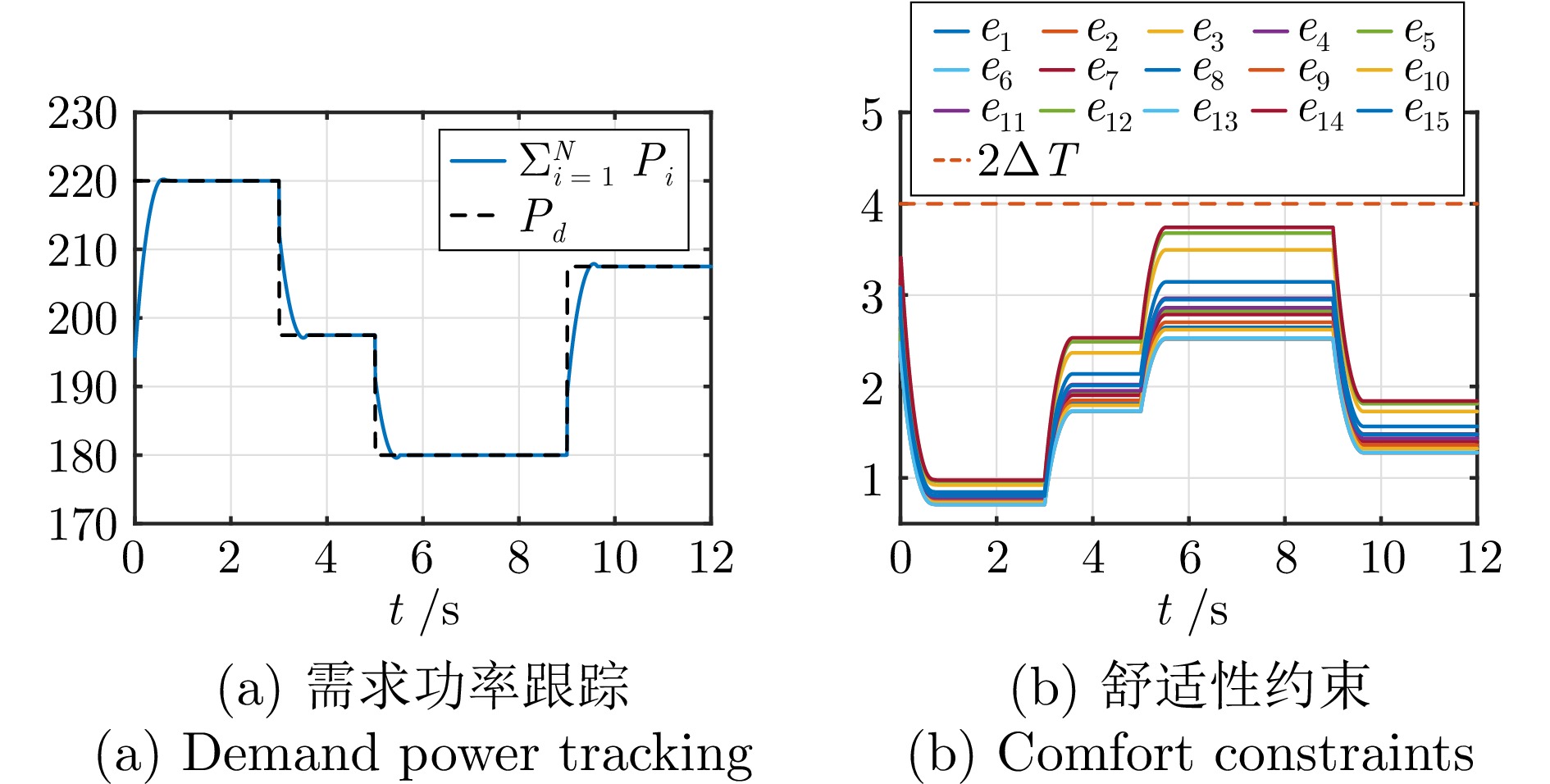
图 7 阶跃需求下用户舒适约束和需求功率跟踪
Fig. 7 User comfort constraints and demand power tracking under step-varying demand
表 1 变频空调的系统参数
Table 1 System parameters of inverter air conditioners
参数 值 单位 $C_{th}$ 0.1 kJ/℃ $R_{th}$ 0.8 ℃/kW $\vartheta_{th}$ 1 $T_s$ U(24, 27) ℃ $x_0$ U(0.54, 0.8) $T_o$ 36 ℃ $\triangle T$ 2 ℃  下载: 导出CSV
-
[1] Chishti F, Murshid S, Singh B. LMMN-based adaptive control for power quality improvement of grid intertie wind-PV system. IEEE Transactions on Industrial Informatics, 2019, 15(9): 4900−4912 doi: 10.1109/TII.2019.2897165 [2] Wang R, Sun Q, Hu W, Xiao J, Zhang H, Wang P. Stability-oriented droop coefficients region identification for inverters within weak grid: An impedance-based approach. IEEE Transactions on Systems, Man, and Cybernetics: Systems, 2021, 51(4): 2258−2268 doi: 10.1109/TSMC.2020.3034243 [3] Reddy S S, Panigrahi B K, Kundu R, Mukherjee R. Energy and spinning reserve scheduling for a wind-thermal power system using CMA-ES with mean learning technique. International Journal of Electrical Power & Energy Systems, 2013, 53: 113−122 doi: 10.1016/j.ijepes.2013.03.032 [4] Li Z, Shahidehpour M, Aminifar F, Alabdulwahab F, Al-Turki Y. Networked microgrids for enhancing the power system resilience. Proceedings of The IEEE, 2017, 105(7): 1289−1310 doi: 10.1109/JPROC.2017.2685558 [5] Anwar M B, Qazi H W, Burke D J, O'Malley M J. Harnessing the flexibility of demand-side resources. IEEE Transaction on Smart Grid, 2019, 10(4): 4151−4163 doi: 10.1109/TSG.2018.2850439 [6] Zhang Z, Xie C, Tong R, Gao S. Identification and control of electric elasticity limit for electric-spring-based flexible loads. IEEE Transactions on Industrial Informatics, 2019, 15(11): 6001−6010 doi: 10.1109/TII.2019.2900196 [7] Ma O, Alkadi N, Cappers P, Denholm P, Dudley J, Goli S. Demand response for ancillary services. IEEE Transactions on Smart Grid, 2013, 4(4): 1988−1995 doi: 10.1109/TSG.2013.2258049 [8] Hafez O, Bhattacharya K. Integrating EV charging stations as smart loads for demand response provisions in distribution systems. IEEE Transactions on Smart Grid, 2018, 9(2): 1096−1106 doi: 10.1109/TSG.2016.2576902 [9] Zhang Z W, Hui H X, Song Y H. Response capacity allocation of air conditioners for peak-valley regulation considering interaction with surrounding microclimate. IEEE Transactions on Smart Grid, 2025, 16(2): 1155−1167 doi: 10.1109/TSG.2024.3482361 [10] Hong J, Hui H, Zhang H, Dai N, Song Y. Event-triggered consensus control of large-scale inverter air conditioners for demand response. IEEE Transactions on Power Systems, 2022, 37(6): 4954−4957 doi: 10.1109/TPWRS.2022.3204215 [11] Coffman A, Bugic A, Barooah P. A unified framework for coordination of thermostatically controlled loads. Automatica, 2023, 152: Article No.111002 doi: 10.1016/j.automatica.2023.111002 [12] Lin S, Lin M, Liu D, Yang F, Li F, Li D, Yang F. An evaluation method for the response flexibility of aggregated inverter air conditioners. International Transactions on Electrical Energy Systems, 2020, 31(1): Article No.e12689 doi: 10.1002/2050-7038.12689/v1/review1 [13] Konno Y, Takahashi R, Alsharif R, Umemura A. Centralized control of large-scale wind farm for system frequency stabilization of the power system. Electrical Engineering in Japan, DOI: 10.1002/eej.23479 [14] 江碧涛, 温广辉, 周佳玲, 郑德智. 智能无人集群系统跨域协同技术研究现状与展望. 中国工程科学, 2024, 26(1): 117−126Jiang Bi-Tao, Wen Guang-Hui, Zhou Jia-Ling, Zheng De-Zhi. Cross-domain cooperative technology of intelligent unmanned swarm systems: Current status and prospects. Strategic Study of CAE, 2024, 26(1): 117−126 [15] 纪良浩, 唐少洪, 郭兴, 解燕. 基于全过程隐私保护的多智能体系统平均一致性. 自动化学报, 2025, 51(6): 1359−1370Ji Liang-Hao, Tang Shao-Hong, Guo Xing, Xie Yan. Average consensus in multi-agent systems based on whole-process privacy protection. Acta Automatica Sinica, 2025, 51(6): 1359−1370 [16] 邵蝉云, 安爱民, 徐承承, 刘向航, 李二超. 非线性多智能体系统的动态事件触发固定时间一致性控制. 自动化学报, 2026, 52(3): 555−577 doi: 10.16383/j.aas.c250304Shao Chan-Yun, An Ai-Min, Xu Cheng-Cheng, Liu Xiang-Hang, Li Er-Chao. Dynamic event-triggered fixed-time consensus control for nonlinear multi-agent systems. Acta Automatica Sinica, 2026, 52(3): 555−577 doi: 10.16383/j.aas.c250304 [17] Li X D, Wen G H, Lv Y Z, Sun C Y, Polycarpou M M. Output consensus tracking of heterogeneous open multi-agent systems under actuator attacks. IEEE Transactions on Control of Network Systems, 2026, 13(1): 423−435 doi: 10.1109/TCNS.2025.3648473 [18] Wen G H, Yu W W, Xia Y Q, Yu X H, Hu J Q. Distributed tracking of nonlinear multi-agent systems under directed switching topology: An observer-based protocol. IEEE Transactions on Systems, Man and Cybernetics, Systems, 2017, 47(5): 869−881 doi: 10.1109/TSMC.2016.2564929 [19] Li Q F, Zhao Y H, Yang Y W, Zhang L T, Chen J. Demand-response-oriented load aggregation scheduling optimization strategy for inverter air conditioner. Energies, 2023, 16(1): Article No.337 doi: 10.3390/en16010337 [20] Hu J Q, Cao J D, Chen M, Yu J, Yao J, Yang S, et al. Load following of multiple heterogeneous TCL aggregators by centralized control. IEEE Transactions on Power Systems, 2017, 32(4): 3157−3167 doi: 10.1109/TPWRS.2016.2626315 [21] Mi Z L, Kong Z M, Huang T, Shi P, Yu Z W, Ding L. Fixed-time hierarchical distributed control for flexible thermostatically controlled loads. IEEE Systems Journal, 2024, 18(2): 1344−1355 doi: 10.1109/JSYST.2024.3366226 [22] Yu Z W, Ding L, Kong Z M, Liu Z W, Hu P, Xiao Y. A distributed coordinated framework with fair comfort level sharing for inverter air conditioner in auxiliary services. IEEE Transactions Smart Grid, 2024, 15(3): 2776−2790 doi: 10.1109/TSG.2023.3321654 [23] Lee T C, Huang J K, Su Y. A unified framework for convergence analysis in social networks. In: Proceedings of the 2024 IEEE 63rd Conference on Decision and Control (CDC). Milan, Italy: IEEE, 2024. 2940-2945 [24] Liu R, Hui H, Chen X, Song Y. Distributed frequency control of heterogeneous energy storage systems considering short-term ability and long-term flexibility. IEEE Transactions on Smart Grid, 2024, 15(6): 5693−5705 doi: 10.1109/TSG.2024.3451614 [25] Chen G, Ren J H, Feng E N. Distributed finite-time economic dispatch of a network of energy resources. IEEE Transactions on Smart Grid, 2017, 8(2): 822−832 doi: 10.1109/tsg.2016.2516017 [26] 温广辉, 余星火, 黄廷文, 周艳. 模型参数不确定下多无人艇系统固定时间二分编队跟踪控制. 自动化学报, 2025, 51(3): 669−677 doi: 10.16383/j.aas.c240473Wen Guang-Hui, Yu Xing-Huo, Huang Ting-Wen, Zhou Yan. Fixed-time bipartite formation tracking control for multi-USV systems with uncertain model parameters. Acta Automatica Sinica, 2025, 51(3): 669−677 doi: 10.16383/j.aas.c240473 [27] Zaery M, Amrr S M, Hussain S M, Abido M A. Distributed optimal power dispatch for islanded DC microgrids based on predefined-time control. IEEE Transactions on Industry Applications, 2025, 61(3): 4730−4743 doi: 10.1109/TIA.2025.3542727 [28] Dou Y, Chi M, Liu Z W, Wen G, Sun Q. Distributed secondary control for voltage regulation and optimal power sharing in DC microgrids. IEEE Transactions on Control Systems Technology, 2022, 30(6): 2561−2572 doi: 10.1109/TCST.2022.3156391 [29] Wang C, Wang B, You F. Demand response for residential buildings using hierarchical nonlinear model predictive control for plug-and-play. Applied Energy, 2024, 6369: Article No.123581 doi: 10.1016/j.apenergy.2024.123581 [30] Su J, Zhang H, Wong C K, Yu L, Tan Z. Hierarchical control of inverter air conditioners for frequency regulation service of islanded microgrids with fair power participation. IEEE Transactions on Smart Grid, 2024, 15(5): 4602−4617 doi: 10.1109/TSG.2024.3382247 [31] Zuo Z Y. Nonsingular fixed-time consensus tracking for second-order multi-agent networks. Automatica, 2015, 54: 305−309 doi: 10.1016/j.automatica.2015.01.021 [32] Chen G, Li Z Y. A fixed-time convergent algorithm for distributed convex optimization in multi-agent systems. Automatica, 2018, 95: 539−543 doi: 10.1016/j.automatica.2018.05.032 [33] Yang A, Liang X, Zhang J, Hou Y, Wang N. Distributed time-varying optimization with coupled constraints: Application in UAV swarm predefined-time cooperative consensus. Aerospace Science and Technology, 2024, 147: Article No.109034 doi: 10.1016/j.ast.2024.109034 [34] Munoz-Vazquez A J, Sanchez-Torres J D, Jimenez-Rodriguez E, Loukianov A J. Predefined-time robust stabilization of robotic manipulators. IEEE/ASME Transactions on Mechatronics, 2019, 24(3): 1033−1040 doi: 10.1109/TMECH.2019.2906289 [35] Li C, Yu X, Yu W, Huang T, Liu Z W. Distributed event-triggered scheme for economic dispatch in smart grids. IEEE Transactions on Industrial Informatics, 2015, 12(5): 1775−1785 doi: 10.1007/978-981-15-6109-2_10 -

 下载:
下载:

计量
- 文章访问数: 368
- HTML全文浏览量: 313
- 被引次数: 0
