


Intelligent Decision Method of Blast Furnace Charging Matrix for Green and Low-carbon
-
摘要: 高炉炼铁工序贡献了钢铁生产流程七成以上的碳排放, 而布料操作直接影响煤气利用率与碳排放水平, 是绿色低碳制造的重要切入点. 然而, 面对高炉内部"黑箱"环境, 现有方法难以预测布料调整对炉况的影响, 只能被动响应. 为此, 提出一种基于炉况感知与深度强化学习的高炉布料矩阵决策方法. 首先, 针对炉况粗精度分类不足以支撑布料决策的问题, 提出炉况健康度9级评分体系, 构建基于时间卷积网络(Temporal Convolutional Network, TCN)的炉况时序分类模型. 其次, 针对布料调整对炉况的影响难以预测的问题, 设计基于改进交叉注意力机制(Cross Attention, CA)的炉况多步预测模型, 捕捉布料矩阵与炉况的时序依赖关系. 最后, 将上述分类与预测模型作为状态空间与奖励函数嵌入深度强化学习框架, 以炉况长期稳定顺行为目标, 构建基于双延迟深度确定性策略梯度算法(Twin Delayed Deep Deterministic policy gradient algorithm, TD3)的布料矩阵决策模型. 在高炉实际生产数据集上的验证结果表明, 该方法能够自动调整布料矩阵, 维持炉况稳定顺行, 为高炉的智能化、低碳化运行提供了可落地的方案.Abstract: The blast furnace (BF) ironmaking process contributes more than 70% of the carbon emissions of the entire steel production process, while the charging operation directly affects gas utilization rate and carbon emission level, making it a critical entry point for green and low-carbon manufacturing. However, due to the "black-box" environment of the BF, existing methods fail to predict the influence of charging adjustments on furnace conditions and can only react passively after deterioration. To tackle this problem, a BF charging matrix decision method based on furnace condition perception and deep reinforcement learning is proposed. First, to overcome the limitation of coarse-grained classification that cannot support charging decisions, a 9-level health scoring system for furnace conditions is established, and a temporal convolutional network (TCN) based time-series classification model for furnace conditions is constructed. Second, to address the difficulty of predicting the effect of charging adjustments on furnace conditions, a multi-step prediction model based on an improved cross-attention (CA) mechanism is designed to capture the temporal dependencies between the charging matrix and furnace conditions. Finally, the above classification and prediction models are embedded as the state space and reward function into a deep reinforcement learning framework. A charging matrix decision model based on the twin delayed deep deterministic policy gradient (TD3) algorithm is then built, where the reward objective is to ensure long-term stable and smooth operation. Validation on an actual BF production dataset demonstrates that the proposed method can automatically adjust the charging matrix, maintain stable and smooth furnace conditions, and provide a practical solution for intelligent and low-carbon BF operation.
-
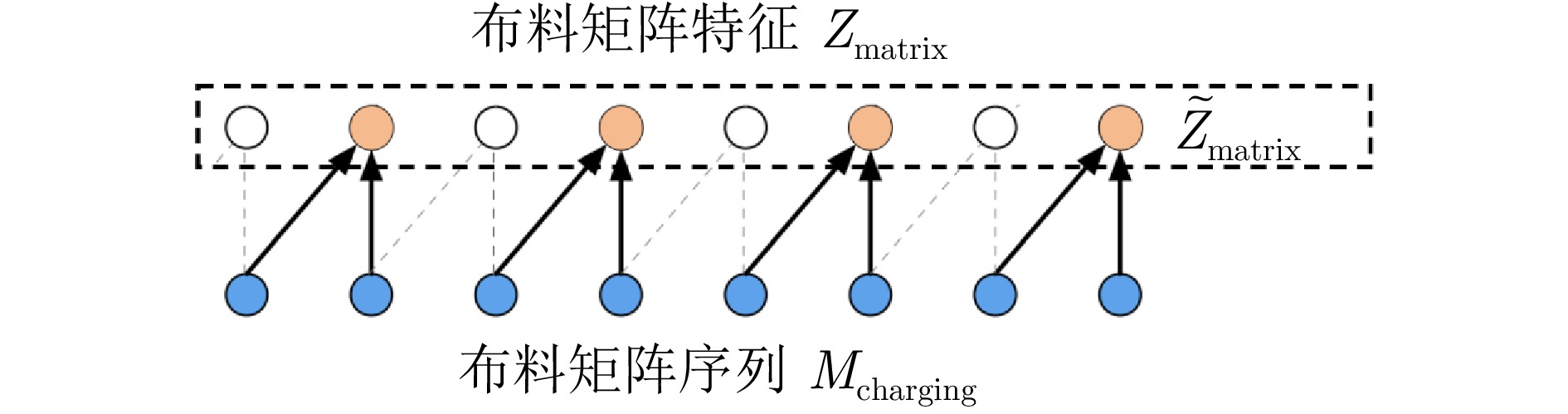
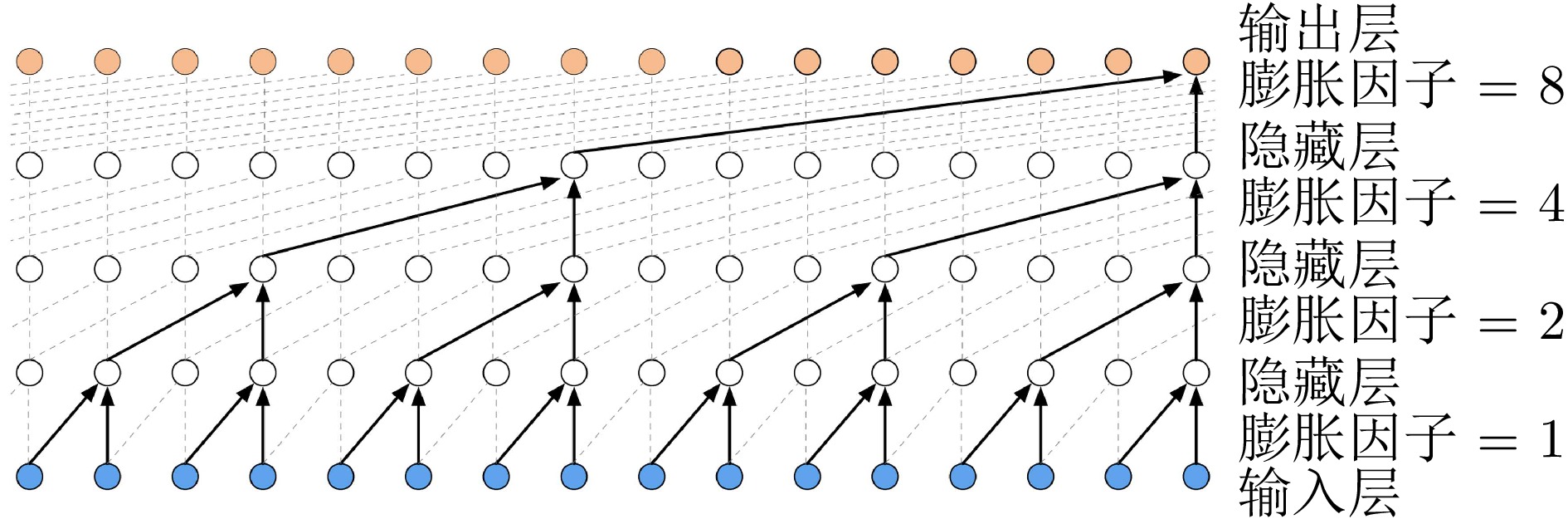
图 5 $ \text{TCN}_\mathrm{matrix} $结构图
Fig. 5 Structure of $ \text{TCN}_\mathrm{matrix} $
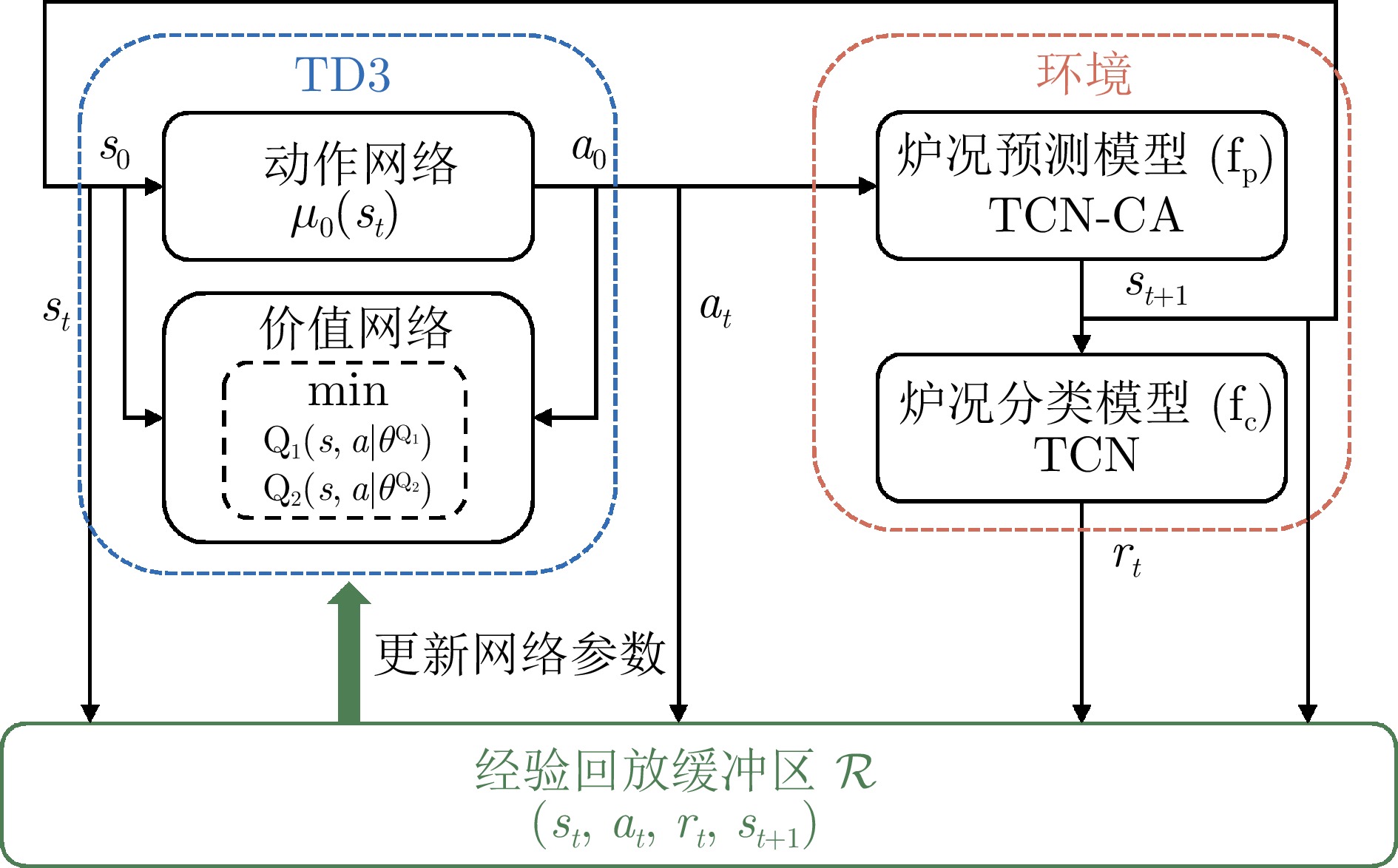
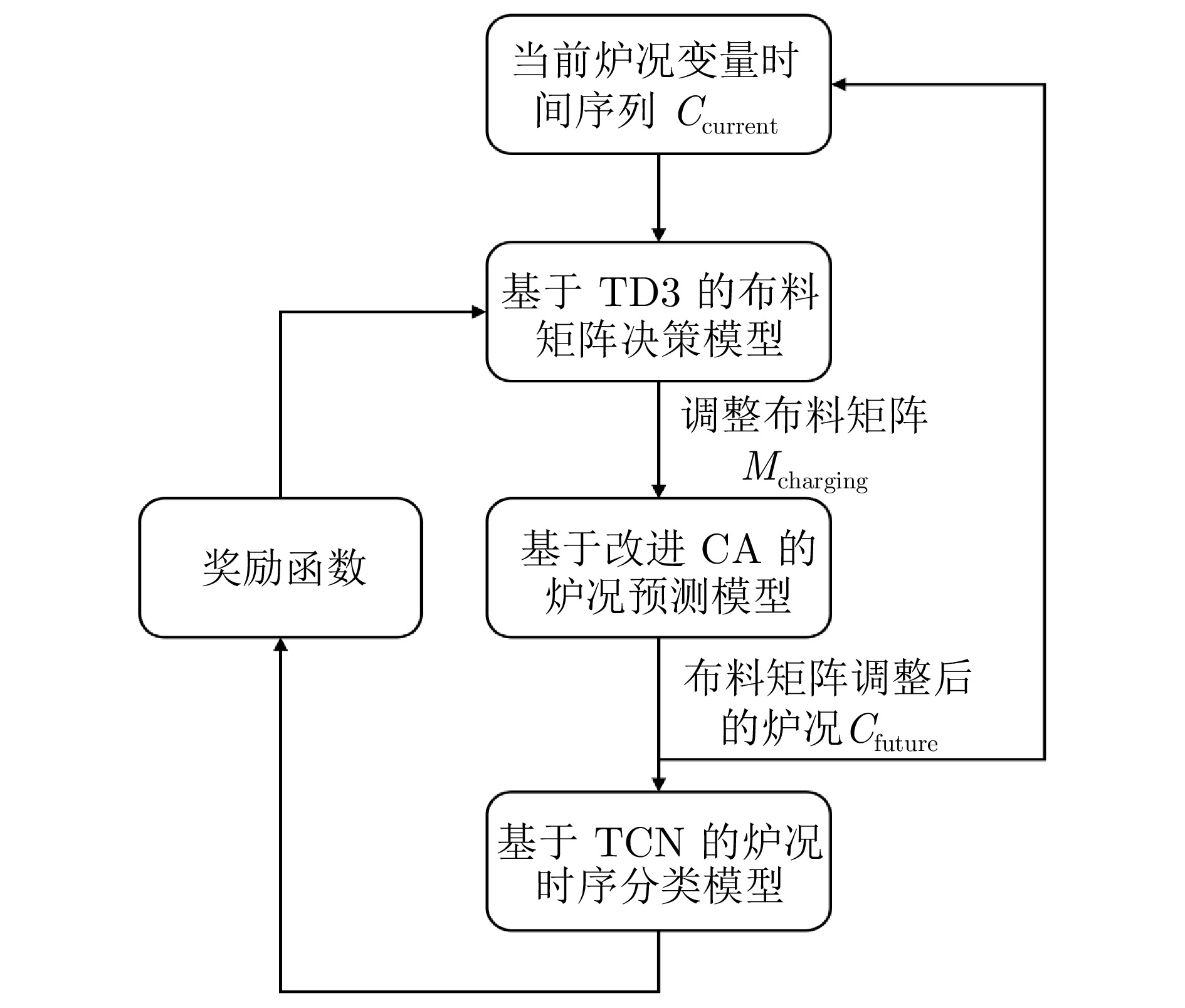
图 7 布料矩阵决策深度强化学习框架图
Fig. 7 Deep reinforcement learning framework diagram for charging matrix decision
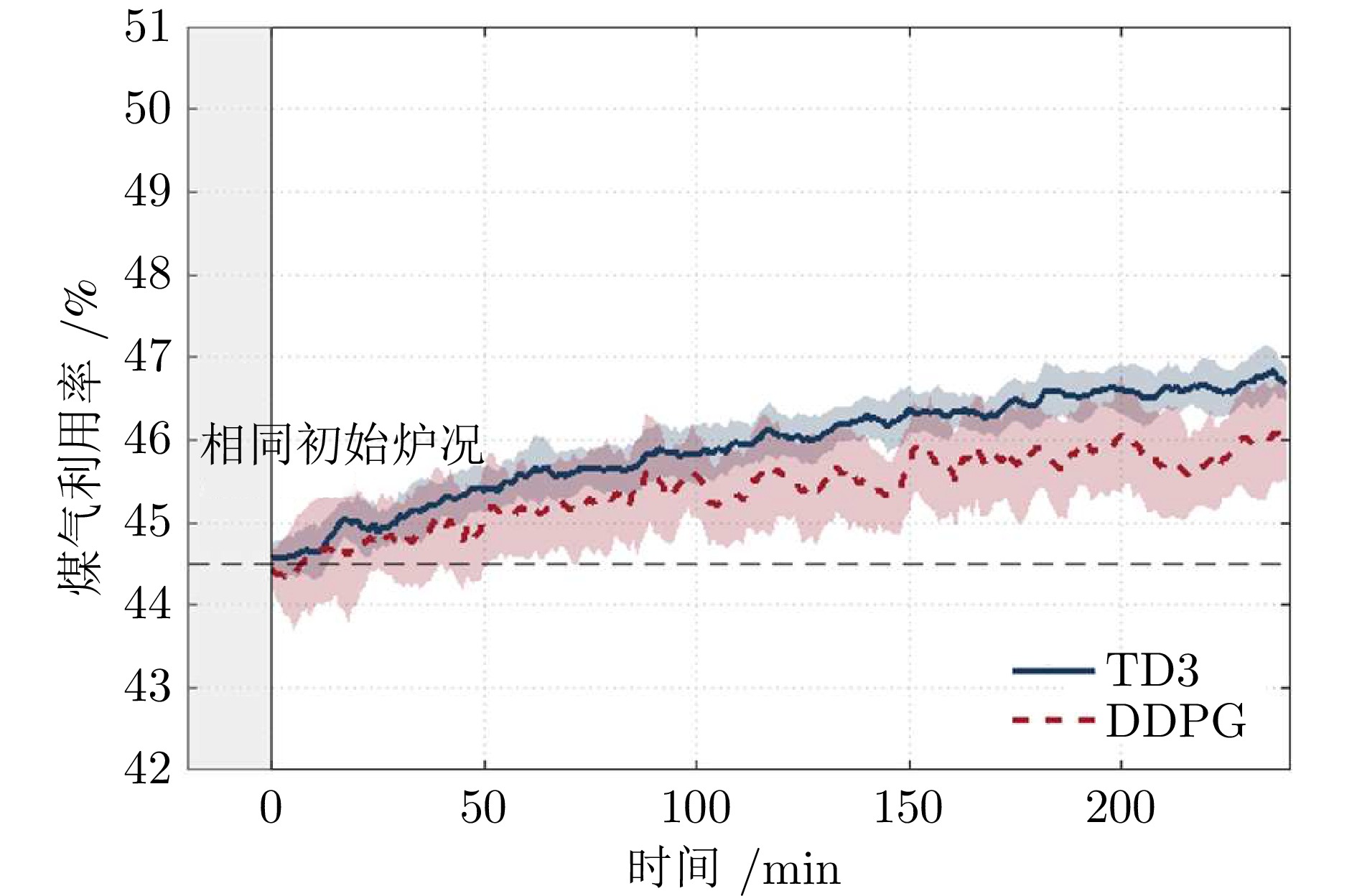
图 16 不同决策方法下的煤气利用率变化对比
Fig. 16 Comparison of gas utilization rate changes under different decision methods
表 1 布料矩阵的调整范围
Table 1 Adjustment range of charging matrix
挡位 1 2 3 4 5 6 7 8 9 10 11 上限 $ O_a $ 41 40 39 38 37 36 33.5 31 29 26 23 $ O_n $ 2 3 4 1 1 1 1 1 1 1 1 $ C_a $ 42 41 40 39 38 37 34.5 32 30 27 24 $ C_n $ 2 3 4 1 1 1 1 1 1 1 1 下限 $ O_a $ 36 35 34 33 32 31 28.5 26 24 21 18 $ O_n $ 1 2 3 0 0 1 1 1 0 0 0 $ C_a $ 36 35 34 33 32 31 28.5 26 24 21 18 $ C_n $ 1 2 3 0 0 1 1 1 1 0 0  下载: 导出CSV
表 2 炉况状态变量及与布料的关系
Table 2 Furnace condition state variables and their relationship with charging operation
变量 定义与单位 受布料调整的影响 对炉况的指示作用 $ P_{\text{top}} $ 炉顶煤气压力($ \mathrm{kPa} $) 布料改变料面形状与煤气通道, 影响$ P_{\text{top}} $分布. 影响煤气流速与料柱稳定性, 稳定顶压利于高产. $ \Delta P $ 炉顶与炉底压力差($ \mathrm{kPa} $) 布料矩阵决定矿焦比径向分布, 改变料柱透气阻力. 反映料柱透气性, 异常压差预示悬料、崩料. $ K $ 风量与压差的比值 布料影响煤气流动路径, 进而改变$ K $. 反映煤气流与料柱的匹配程度. $ \eta_{\text{CO}} $ 煤气中${\mathrm{CO}} _2 $ 占CO与${\mathrm{CO}} _2 $总量的比值 布料影响矿焦接触效率, 改变还原反应程度. 能量效率的核心指标. $ T_{\text{top}} $ 炉顶气体平均温度($ ^\circ C $) 布料改变煤气流分布, 导致$ T_{\text{top}} $变化. 反映炉内热状态, 过高或过低均为异常.
下载: 导出CSV
表 3 炉况健康度9级评分体系
Table 3 9-level health scoring system for furnace conditions
等级 炉况描述 正常 9(优) 炉况极其稳定, 所有关键指标均处于理想范围且保持最优水平. 8(良) 炉况稳定, 个别指标(如水温差)存在微小波动, 整体控制良好. 7(中) 炉况较稳定, 煤气流小幅度波动, 水温差波动频繁, 煤气利用率偏低. 6(差) 炉况稳定性一般, 压差明显偏高、温差波动较大, 控制水平较差. 休风 5 因计划检修、设备维护、炉渣清理或指标突变, 高炉停止冶炼. 异常 4(轻度异常) 指标小范围偏离正常, 需减风、停氧并密切观察. 3(中度异常) 指标偏离较大, 可能出现炉皮过热、发红, 需立即减风停氧. 2(高度异常) 指标严重偏离, 温差过高、炉皮破裂, 可能出现崩料. 故障 1 炉况极端异常, 料线停滞、滑料, 须立即调节, 否则引发安全事故.
下载: 导出CSV
表 4 关键超参数的设定及依据
Table 4 Key hyperparameter settings and their selection basis
模型 参数 取值 调参依据 分类模型 隐藏层层数 8 如式(5), 感受野计算公式 模型时间步 240 对应4小时工作周期 卷积核大小 2 经验值, 捕捉局部依赖 空洞因子 2 经验值, 指数扩张, 扩大感受野 学习率 0.001 验证集调优 分类数 9 炉况健康度9级评分体系 预测模型 注意力维度 $d_k$ 64 经验值[30] FFN输出维度 128 经验值, 平衡表达力与计算量 学习率 0.000 4 验证集调优 决策模型 最大训练轮次 10 000 保证充分收敛 每轮步数 10 匹配工艺周期 学习率 0.001 验证集调优 折扣因子$ \gamma $ 0.99 验证集调优 软更新系数$ \tau $ 0.001 验证集调优 策略噪声$ \epsilon $ 0.2 经验值[31]
下载: 导出CSV
表 5 超参数敏感性分析结果
Table 5 Hyperparameter sensitivity analysis results
分类/预测模型 决策模型 参数 取值 性能指标 参数 取值 性能指标 学习率 0.0002 0.852 $ \gamma $ 0.95 47.21% 0.0005 0.873 0.98 48.05% 0.001 0.885 0.99 48.36% 0.002 0.872 0.995 48.28% $ d_k $ 32 1.68 $ \tau $ 0.0005 48.22% 64 1.42 0.001 48.36% 128 1.44 0.005 48.29% 256 1.52 0.01 47.98%
下载: 导出CSV
表 6 炉况分类性能对比
Table 6 Comparison of furnace condition classification performance
模型 准确率 宏平均F1分数 故障召回率 故障精确率 CNN 0.818$ \pm $0.020 0.788$ \pm $0.021 0.895$ \pm $0.018 0.882$ \pm $0.022 LSTM 0.842$ \pm $0.015 0.821$ \pm $0.017 0.948$ \pm $0.012 0.937$ \pm $0.016 ELM 0.861$ \pm $0.010 0.844$ \pm $0.011 0.962$ \pm $0.008 0.954$ \pm $0.012 TCN 0.885$ \pm $0.008 0.868$ \pm $0.009 1$ \pm $0 0.982$ \pm $0.006
下载: 导出CSV
表 7 模型训练与推理时间对比
Table 7 Comparison of training and inference time
模型 训练时间(min) 单样本推理时间(ms) ELM 2.3 $ \pm $ 0.5 7.0 $ \pm $ 0.4 CNN 26.1 $ \pm $ 3.8 9.6 $ \pm $ 0.6 TCN 63.4 $ \pm $ 5.2 8.7 $ \pm $ 0.5 LSTM 172.5 $ \pm $ 15.3 21.5 $ \pm $ 1.2
下载: 导出CSV
表 8 炉况预测误差($ 10^{-2} $)对比
Table 8 Comparison of prediction errors($ 10^{-2} $) for furnace condition
参数 模型 MAPE RMSE $ P_{\text{top}} $ TCN-CA 1.419$ \pm $0.085 2.757$ \pm $0.165 TCN 1.865$ \pm $0.130 3.343$ \pm $0.234 TCN(无布料矩阵) 2.018$ \pm $0.151 3.758$ \pm $0.282 LSTM 2.195$ \pm $0.176 4.008$ \pm $0.320 ELM 2.568$ \pm $0.205 4.731$ \pm $0.378 $ \Delta P $ TCN-CA 1.880$ \pm $0.113 3.069$ \pm $0.184 TCN 2.403$ \pm $0.168 3.797$ \pm $0.266 TCN(无布料矩阵) 2.621$ \pm $0.183 4.156$ \pm $0.291 LSTM 2.844$ \pm $0.199 4.526$ \pm $0.317 ELM 3.318$ \pm $0.232 5.374$ \pm $0.376 $ K $ TCN-CA 1.670$ \pm $0.100 2.908$ \pm $0.175 TCN 2.142$ \pm $0.150 3.545$ \pm $0.248 TCN(无布料矩阵) 2.312$ \pm $0.162 3.894$ \pm $0.273 LSTM 2.524$ \pm $0.177 4.265$ \pm $0.299 ELM 2.950$ \pm $0.207 5.058$ \pm $0.354 $ \eta_{\text{CO}} $ TCN-CA 1.534$ \pm $0.092 3.994$ \pm $0.240 TCN 2.126$ \pm $0.149 4.958$ \pm $0.347 TCN(无布料矩阵) 2.310$ \pm $0.162 5.436$ \pm $0.381 LSTM 2.492$ \pm $0.174 5.915$ \pm $0.414 ELM 2.922$ \pm $0.204 7.012$ \pm $0.491 $ T_{\text{top}} $ TCN-CA 7.134$ \pm $0.428 9.174$ \pm $0.550 TCN 9.451$ \pm $0.567 11.512$ \pm $0.691 TCN(无布料矩阵) 10.284$ \pm $0.617 12.593$ \pm $0.756 LSTM 11.117$ \pm $0.667 13.718$ \pm $0.823 ELM 13.010$ \pm $0.781 16.270$ \pm $0.976
下载: 导出CSV
表 9 模型训练与预测耗时对比(240步)
Table 9 Comparison of training time and prediction time (240 steps)
模型 训练时间(min) 预测耗时(ms) ELM 3.8 $ \pm $ 0.6 7.0 $ \pm $ 0.4 TCN(无布料矩阵) 51.2 $ \pm $ 4.5 12.0 $ \pm $ 0.6 TCN 74.6 $ \pm $ 6.1 14.2 $ \pm $ 0.7 LSTM 215.3 $ \pm $ 18.7 28.6 $ \pm $ 1.4 TCN-CA 182.6 $ \pm $ 15.8 22.5 $ \pm $ 1.1
下载: 导出CSV
表 10 动作网络输出的布料矩阵时序表
Table 10 Sequence table of the charging matrix output by Actor
时间 布料矩阵 挡位 1 2 3 4 5 6 7 8 9 10 11 0:00 $ O_a $ 41 40 39 38 37 36 33.5 31 29 21 18 $ O_n $ 2 2 3 0 0 1 1 1 0 0 0 $ C_a $ 42 41 40 39 38 37 34.5 32 30 25 24 $ C_n $ 1 2 3 0 0 1 1 1 1 0 0 $\dots$ 4:00 $ O_a $ 41 40 39 38 37 36 33.5 31 24 21 18 $ O_n $ 2 2 3 0 0 1 1 1 1 0 0 $ C_a $ 42 41 40 39 38 37 34.5 32 30 25 24 $ C_n $ 1 2 3 0 0 1 1 1 1 0 0 $\dots$ 8:00 $ O_a $ 41 40 39 38 37 36 33.5 31 29 21 18 $ O_n $ 2 2 3 0 0 1 1 1 0 0 0 $ C_a $ 42 41 40 39 38 37 34.5 32 30 25 24 $ C_n $ 1 2 3 0 0 1 1 1 1 0 0 $\dots$
下载: 导出CSV
表 11 测试集平均煤气利用率对比
Table 11 Comparison of average gas utilization rate on the test set
决策方法 平均煤气利用率(%) 相对提升 DDPG 46.21$ \pm $0.28 — TD3 48.36$ \pm $0.31 +4.65
下载: 导出CSV
-
[1] 李壮年, 柳政根, 储满生, 陈树文. 大型高炉布料模型的研究与应用. 东北大学学报(自然科学版), 2016, 37(5): 658−662 doi: 10.3969/j.issn.1005-3026.2016.05.011Li Zhuang-Nian, Liu Zheng-Gen, Chu Man-Sheng, Chen Shu-Wen. Research and application of burden charging model for large blast furnace. Journal of Northeastern University (Natural Science), 2016, 37(5): 658−662 doi: 10.3969/j.issn.1005-3026.2016.05.011 [2] Chen J S, Zuo H B, Xue Q G, Wang J S. A review of burden distribution models of blast furnace. Powder Technology, 2022Article No. 117055 [3] Yan S, Shen Y S. Model study of central coke charging on ironmaking blast furnace performance. Powder Technology, 2020, 361: 124−135 doi: 10.1016/j.powtec.2019.10.012 [4] Zong Y C, Hu S W, Qin D B, Wang Z X, Zhang C J, Chu J H. Iron-tapping state recognition of blast furnace based on Bi-GRU composite model and post-processing classifier. IEEE Sensors Journal, 2023, 23(18): 22006−22018 doi: 10.1109/JSEN.2023.3300123 [5] Zhang Z, Tang J, Shi Q, Chu M S, Wang M Y, Zhang Z F. Comprehensive status evaluation and prediction of blast furnace based on cascade system and combined model. International Journal of Minerals, Metallurgy and Materials, 2025, 32(12): 2942−2957 doi: 10.1007/s12613-025-3179-6 [6] Zhu X Z, Yang C J, Lou S W, Yang Y L. Knowledge-Based Temporal GCN: A spatial–temporal fault diagnosis method for blast furnace ironmaking process with imbalanced data. IEEE Transactions on Instrumentation and Measurement, 2025, 74: 1−12 doi: 10.1109/tim.2024.3522663 [7] Wu P, Wang Y X, Gao J F, Zhang X J, Lou S W, Yang C J. Multichannel dynamic graph convolutional network-based fault diagnosis and its application in blast furnace ironmaking process. IEEE Sensors Journal, 2023, 23(23): 29293−29302 doi: 10.1109/JSEN.2023.3325353 [8] Xu S Y, Jiang Z H, Chen Z W, Pan D, Yu H Y, Li L L. Blast furnace condition recognizing in the ironmaking process based on prior knowledge and Platt scaling probability. In: Proceedings of the 2024 IEEE International Conference on Industrial Technology, Bristol, United Kingdom: IEEE, 2024. 1-6. [9] Guo K, Zhang Y X, Zhang S, Xiao W D. Classification model for blast furnace status based on multi-source information. Engineering Applications of Artificial Intelligence, 2025Article No. 109728 [10] Liu X J, Li T S, Li H W, Zhang Y J, Li X, Yi F Y. Predictions of blast furnace permeability index based on SVM-RFE+WOA-BiLSTM model. In: Proceedings of the 2025 40th Youth Academic Annual Conference of Chinese Association of Automation, Zhengzhou, China: IEEE, 2025. 1023-1028. [11] Chen Q F, Li Z, Li W J, Guo Y P, An J Q, She J H. Multi-step prediction model of blast furnace permeability index based on multi-time scale. ISA Transactions, DOI: 10.1016/j.isatra.2025.11.036. [12] 刘仕鑫, 尹怡欣, 张森. 基于核超限学习机的高炉透气性指数预测模型. 控制理论与应用, 2023, 40(1): 65−73Liu Shi-Xin, Yin Yi-Xin, Zhang Sen. Prediction model of kernel extreme learning machine for permeability index of blast furnace. Control Theory & Applications, 2023, 40(1): 65−73 [13] 蒋朝辉, 许川, 桂卫华, 蒋珂. 基于最优工况迁移的高炉铁水硅含量预测方法. 自动化学报, 2022, 48(1): 194−206 doi: 10.16383/j.aas.c200980Jiang Zhao-Hui, Xu Chuan, Gui Wei-Hua, Jiang Ke. Prediction method of hot metal silicon content in blast furnace based on optimal smelting condition migration. Acta Automatica Sinica, 2022, 48(1): 194−206 doi: 10.16383/j.aas.c200980 [14] 蒋珂, 蒋朝辉, 谢永芳, 潘冬, 桂卫华. 基于动态注意力深度迁移网络的高炉铁水硅含量在线预测方法. 自动化学报, 2023, 49(5): 949−963 doi: 10.16383/j.aas.c210524Jiang Ke, Jiang Zhao-Hui, Xie Yong-Fang, Pan Dong, Gui Wei-Hua. Online prediction method of blast furnace hot metal silicon content based on dynamic attention deep transfer network. Acta Automatica Sinica, 2023, 49(5): 949−963 doi: 10.16383/j.aas.c210524 [15] Li Z, An J Q, Guo Y P, Zhao G Y, Wu M. Prediction of gas utilization ratio based on singular spectrum analysis, improved PSO and KELM. In: Proceedings of the 2024 36th Chinese Control and Decision Conference. Xi'an, China: IEEE, 2024. 345-350. [16] Zhao G Y, An J Q, Guo Y P, Yang C L, He Y. A multi-time-scale prediction method for blast furnace gas utilization rate based on causality analysis. In: Proceedings of the 2023 China Automation Congress. Chongqing, China: IEEE, 2023. 8475-8480. [17] Zhang T K, Liu C B, Liu Z J, Tan J, Ahmat M. Temporal double graph convolutional network for CO and CO2 prediction in blast furnace gas. IEEE Transactions on Instrumentation and Measurement, 2025, 73: 1−13 doi: 10.1109/tim.2023.3341110 [18] 李艳姣, 张森, 尹怡欣, 张杰. 基于数据驱动的高炉料面优化决策模型研究. 控制理论与应用, 2018, 35(3): 324−334 doi: 10.7641/CTA.2017.70302Li Yan-Jiao, Zhang Sen, Yin Yi-Xin, Zhang Jie. Research on optimization model of blast furnace burden surface based on data driven. Control Theory & Applications, 2018, 35(3): 324−334 doi: 10.7641/CTA.2017.70302 [19] Li Y J, Zhang S, Zhang J, Yin Y X, Xiao W D, Zhang Z Q. Data-driven multiobjective optimization for burden surface in blast furnace with feedback compensation. IEEE Transactions on Industrial Informatics, 2020, 16(4): 2233−2244 doi: 10.1109/TII.2019.2908989 [20] Huang X K, Yang C J, Zhang H W, Lou S W, Gao D L, Kong L Y. Data and knowledge collaborative-driven fault identification and self-healing control action inference framework for blast furnace. Expert Systems with Applications, 2024, 245: 123040 doi: 10.1016/j.eswa.2023.123040 [21] 安剑奇, 赵国宇, 何勇, 李炜俊, 郭云鹏, 吴敏. 数据驱动的多时间尺度高炉煤气利用率模型预测控制. 控制理论与应用, 2025, 42(1): 189−201 doi: 10.7641/CTA.2024.30318An Jian-Qi, Zhao Guo-Yu, He Yong, Li Wei-Jun, Guo Yun-Peng, Wu Min. Data-driven multi-time scale model predictive control for blast furnace gas utilization rate. Control Theory & Applications, 2025, 42(1): 189−201 doi: 10.7641/CTA.2024.30318 [22] Zhu J C, Jiang Z H, Pan D, Yu H Y, Zhou K, Gui W H. Burden surface shape modeling and charging matrix optimization for the blast furnace charging process. IEEE Transactions on Industrial Informatics, 2024, 20(11): 12705−12716 [23] Zhu J C, Jiang Z H, Pan D, Yu H Y, Xu C, Zhou K, et al. An intelligent optimization strategy for blast furnace charging operation considering three-dimensional burden surface shape. IEEE/CAA Journal of Automatica Sinica, 2025, 12(7): 1445−1463 doi: 10.1109/JAS.2025.125192 [24] Jiang K, Jiang Z H, Jiang X D, Xie Y F, Gui W H. Reinforcement learning for blast furnace ironmaking operation with safety and partial observation considerations. IEEE Transactions on Neural Networks and Learning Systems, 2024, 35(3): 3077−3090 doi: 10.1109/TNNLS.2023.3340741 [25] Amorim L L, Mutz F, Paixão T M, Rampinelli V, De Souza A F, Badue C, et al. Blast furnace control by hierarchical similarity search in historical data. Engineering Applications of Artificial Intelligence, DOI: 10.1016/j.engappai.2024.109779. [26] Zhang Y X, Guo K, Yu Z J, Zhang S, Yang Y L, Xiao W D, et al. Soft sensor-driven spatiotemporal-periodic synergistic predictive control for blast furnace gas flow. ISA Transactions, DOI: 10.1016/j.isatra.2025.12.053. [27] Huang Y F, Lai X Z, Zhang K X, An J Q, Chen L F, Wu M. Two-stage decision-making method for burden distribution based on recognition of conditions in blast furnace. IEEE Transactions on Industrial Electronics, 2021, 68(5): 4199−4208 doi: 10.1109/TIE.2020.2982121 [28] Shi L, Zhao G S, Li M X, Ma X. A model for burden distribution and gas flow distribution of bell-less top blast furnace with parallel hoppers. Applied Mathematical Modelling, 2016, 40(23-24): 10254−10273 doi: 10.1016/j.apm.2016.07.024 [29] Bai S, Kolter J Z, Koltun V. An empirical evaluation of generic convolutional and recurrent networks for sequence modeling. arXiv: 1803.01271, 2018. [30] Vaswani A, Shazeer N, Parmar N, Uszkoreit J, Jones L, Gomez A N, et al. Attention is all you need. In: Proceedings of the 31st International Conference on Neural Information Processing Systems. Long Beach, USA: Curran Associates, 2017. 5998-6008. [31] Fujimoto S, Hoof H, Meger D. Addressing function approximation error in actor-critic methods. In: Proceedings of the 35th International Conference on Machine Learning. Stockholm, Sweden: PMLR, 2018. 1587-1596. [32] Lecun Y, Bottou L, Bengio Y, Haffner P. Gradient-based learning applied to document recognition. Proceedings of the IEEE, 1998, 86(11): 2278−2324 doi: 10.1109/5.726791 [33] Hochreiter S, Schmidhuber J. Long short-term memory. Neural Computation, 1997, 9(8): 1735−1780 doi: 10.1162/neco.1997.9.8.1735 [34] Huang G B, Zhu Q Y, Siew C K. Extreme learning machine: theory and applications. Neurocomputing, 2006, 70(1−3): 489−501 doi: 10.1016/j.neucom.2005.12.126 [35] Lillicrap T P, Hunt J J, Pritzel A, Heess N, Erez T, Tassa Y, et al. Continuous control with deep reinforcement learning. arXiv: 1509.02971, 2015. -

 下载:
下载:

计量
- 文章访问数: 16
- HTML全文浏览量: 14
- 被引次数: 0
