


Exploring Stationarity From the Frequency-domain Perspective: Frequency Stationary Subspace Analysis and Its Application to BFIP Monitoring
-
摘要: 非平稳信号的平稳分量提取是信号处理与过程监测的核心问题. 现有平稳子空间分析方法局限于时域二阶平稳性, 难以刻画频域非平稳特征. 为此, 提出频域平稳子空间分析方法(FreqSSA). 该方法以功率谱密度时不变性定义频域平稳性, 揭示时域与频域平稳性的等价及包含关系; 进而构建谱幅度、相位与结构三类频域非平稳统计矩阵, 建立时频联合非平稳统计框架, 并以最小化非对角元素平方和为目标函数实现子空间分离; 最后采用联合对角化策略, 实现正交解混矩阵的高效迭代优化. 真实高炉炼铁数据的实验结果表明, FreqSSA在平稳分量提取精度与过程监测性能上均优于现有主流方法.Abstract: Stationary component extraction from nonstationary signals is a fundamental problem in signal processing and process monitoring. Existing stationary subspace analysis methods are limited to time-domain second-order stationarity and have difficulty characterizing frequency-domain nonstationary characteristics. To address this issue, this paper proposes a frequency-domain stationary subspace analysis method (FreqSSA). The proposed method defines frequency-domain stationarity based on the time-invariance of the power spectral density, and reveals the equivalence and inclusion relations between time-domain and frequency-domain stationarity; Furthermore, three types of frequency-domain nonstationary statistical matrices, namely spectral amplitude, phase, and structural matrices, are constructed to establish a joint time-frequency nonstationary statistical framework. Subspace separation is then achieved by minimizing the sum of squared off-diagonal elements as the objective function; Finally, a joint diagonalization strategy is employed to efficiently iteratively optimize the orthogonal demixing matrix. Experimental results on real-world blast furnace ironmaking data demonstrate that FreqSSA outperforms existing state-of-the-art methods in both stationary component extraction accuracy and process monitoring performance.
-

图 2 各种方法(ICA、SSA和SWNMF)的频域投影与平稳性检验表现
Fig. 2 Frequency-domain projections and stationarity test performances across different methods (ICA, SSA and SWNMF)

图 3 各种方法(SSAE-ISFA、AD-TFM-AT和FreqSSA)的频域投影与平稳性检验表现
Fig. 3 Frequency-domain projections and stationarity test performances across different methods (SSAE-ISFA, AD-TFM-AT and FreqSSA)
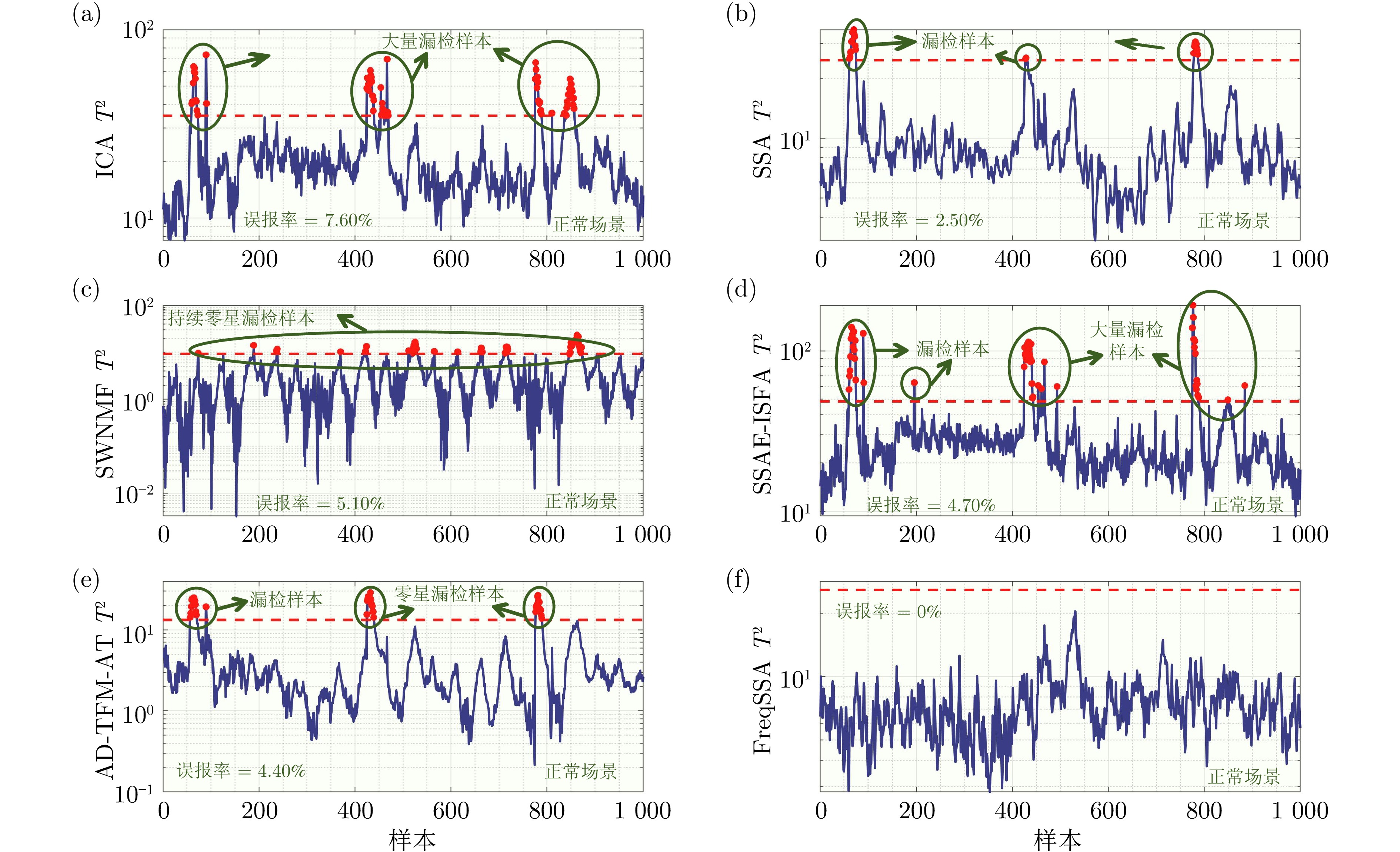
图 4 正常工况N1下各方法过程监测表现
Fig. 4 Process monitoring performances of different methods under normal operating condition N1
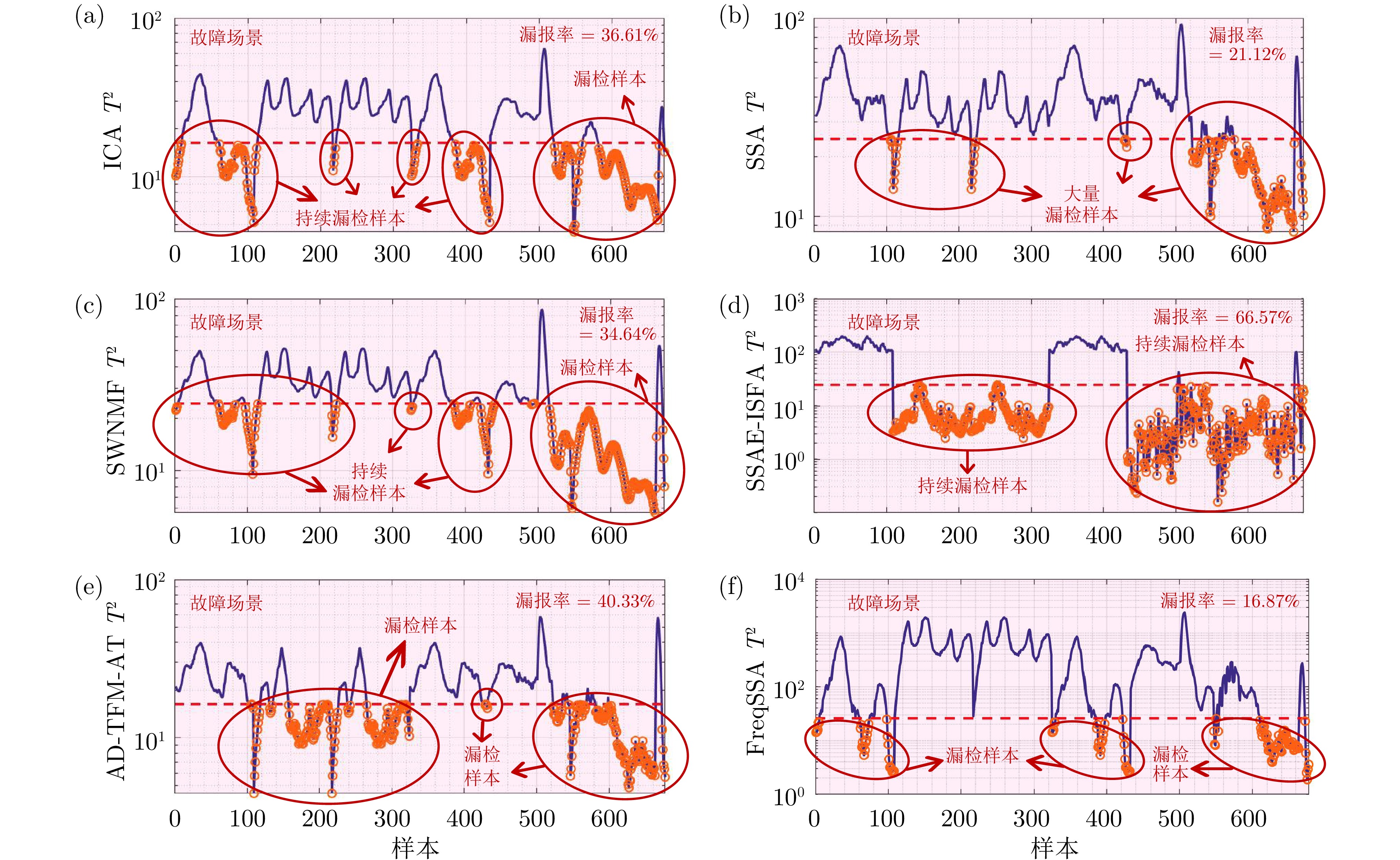
图 5 故障工况F1下各方法过程监测表现
Fig. 5 Process monitoring performances of different methods under fault operating condition F1
表 1 高炉炼铁过程监测变量说明
Table 1 Description of monitored variables in blast furnace ironmaking process
编号 描述 单位 传感器类型 物理意义 $ {\cal{V}}_1 $ 冷风流量 $ 10^4 \;\text{m}^3/\text{s} $ 孔板流量计 反映鼓风系统送入高炉的冷风总量, 直接影响炉内燃烧强度与温度分布 $ {\cal{V}}_2 $ 冷风压力 MPa 压阻式压力变送器 表征鼓风系统克服炉内阻力所需的送风压力, 与炉况透气性密切相关 $ {\cal{V}}_3 $ 总压降 kPa 差压变送器 反映气体从高炉下部上升至上部过程中的总体阻力损失, 直接关联炉内料柱透气性 $ {\cal{V}}_4 $ 热风压力 MPa 压阻式压力变送器 表征经热风炉预热后的送风压力, 是衡量热风系统工作状态的核心指标 $ {\cal{V}}_5 $ 实际风速 m/s 皮托管风速仪 反映风口处鼓风射流对炉缸内物料的搅拌强度, 影响炉缸活跃程度 $ {\cal{V}}_6 $ 透气性指数 — 计算量 综合反映炉内料柱允许气体通过的难易程度, 定义为冷风流量与总压降之比 $ {\cal{V}}_7 $ 阻力指数 — 计算量 表征气体通过料柱时单位流量所遇到的阻力, 定义为总压降与冷风流量平方之比 注: 所有变量的采样间隔均为60 s.  下载: 导出CSV
表 2 各数据集描述
Table 2 Description of each dataset
数据集 样本数 时长 时间段 模型训练集$ T_1 $ 7000 4.86 d 1月3日00:00 $ \sim $ 1月7日20:40 正常测试集$ N_1 $ 1000 16.67 h 1月15日08:00 $ \sim $ 1月16日00:40 故障测试集$ F_1 $ 680 11.33 h 1月25日14:00 $ \sim $ 1月26日01:20 故障测试集$ F_2 $ 550 9.17 h 2月10日09:00 $ \sim $ 2月10日18:10 故障测试集$ F_3 $ 470 7.83 h 3月5日13:00 $ \sim $ 3月5日20:50
下载: 导出CSV
表 3 测试数据集(N1、F1 ~ F3)的误报率和漏报率监测性能表现(%)
Table 3 Monitoring performance of the false alarm rate and missed detection rate for the test data sets (N1, F1 ~ F3) (%)
方法 指标 N1‡ F1 F2 F3 ‡ ICA 误报率 7.60 — — — 漏报率 — 36.61 14.89 61.25 SSA 误报率 2.50 — — — 漏报率 — 21.12 7.08 30.74 SWNMF 误报率 5.10 — — — 漏报率 — 34.64 25.74 51.30 SSAE-ISFA 误报率 4.70 — — — 漏报率 — 66.57 25.28 68.86 AD-TFM-AT 误报率 4.40 — — — 漏报率 — 40.33 20.28 70.29 FreqSSA 误报率 0 — — — 漏报率 — 16.87 5.40 22.00 注: 对于正常测试集N1, 仅评估误报率指标, 该值越低表示性能越好; 对 于故障验证数据集F1 ~ F3, 仅评估漏报率指标, 该值越低表示性能越 好. ‡ 表示各数据集中的正常样本与故障样本均由现场专家验证. “—” 表示对应指标无需计算.
下载: 导出CSV
表 4 各FreqSSA变体的消融实验表现(%)
Table 4 Ablation experiment performance of each FreqSSA variant (%)
方法 指标 N1 F1 F2 F3 FreqSSA-A 误报率 1.60 — — — 漏报率 — 20.50 8.54 28.74 FreqSSA-AF 误报率 0.70 — — — 漏报率 — 18.46 7.57 24.83 FreqSSA-AS 误报率 0.40 — — — 漏报率 — 17.05 6.83 22.81 FreqSSA-GD 误报率 0.20 — — — 漏报率 — 17.77 6.60 22.53 FreqSSA 误报率 0 — — — 漏报率 — 16.87 5.40 22.00
下载: 导出CSV
表 5 模型参数取值
Table 5 Model parameter values
参数 取值范围 最优值 窗长$ L $ (64, 96, 128, 160) 128 滑动步长$ S $ (32, 48, 64, 80) 64 FFT点数$ F $ (128, 192, 256, 320) 256 SC维度$ k $ (1, 2, 3, 4) 2
下载: 导出CSV
表 6 所提出方法在测试数据集中的参数敏感性表现(%)
Table 6 Parameter sensitivity performance of the proposed method in the test dataset (%)
参数 取值 N1|误报率 F1|漏报率 F2|漏报率 F3|漏报率 窗长 64 0.30 18.27 6.94 23.12 96 0.15 17.33 6.28 22.33 128 0 16.87 5.40 22.00 160 0.20 17.52 6.32 22.56 滑动步长 32 0.15 16.92 6.43 21.57 48 0.15 17.33 6.13 22.00 64 0 16.87 5.40 22.00 80 0.20 17.00 5.93 21.75 FFT点数 128 0.15 17.44 6.13 22.48 192 0.05 17.12 5.93 21.88 256 0 16.87 5.40 22.00 320 0.10 16.87 5.85 21.68 SC维度 1 0 26.64 24.92 39.25 2 0 16.87 5.40 22.00 3 3.20 14.93 4.64 20.65 4 8.60 12.59 3.92 19.80
下载: 导出CSV
-
[1] 彭开香, 马亮, 张凯. 复杂工业过程质量相关的故障检测与诊断技术综述. 自动化学报, 2017, 43(3): 349−365 doi: 10.16383/j.aas.2017.c160427Peng Kai-Xiang, Ma Liang, Zhang Kai. Review of quality-related fault detection and diagnosis techniques for complex industrial processes. Acta Automatica Sinica, 2017, 43(3): 349−365 doi: 10.16383/j.aas.2017.c160427 [2] 周平, 赵向志. 面向建模误差PDF形状与趋势拟合优度的动态过程优化建模. 自动化学报, 2021, 47(10): 2402−2411 doi: 10.16383/j.aas.c200001Zhou Ping, Zhao Xiang-Zhi. Optimized modeling of dynamic process oriented towards modeling error PDF shape and goodness of fit. Acta Automatica Sinica, 2021, 47(10): 2402−2411 doi: 10.16383/j.aas.c200001 [3] 黄建才, 蒋朝辉, 桂卫华, 潘冬, 许川, 周科. 基于状态识别的高炉料面视频关键帧提取方法. 自动化学报, 2023, 49(11): 2257−2271 doi: 10.16383/j.aas.c220969Huang Jian-Cai, Jiang Zhao-Hui, Gui Wei-Hua, Pan Dong, Xu Chuan, Zhou Ke. Key frame extraction method of blast furnace burden surface video based on state recognition. Acta Automatica Sinica, 2023, 49(11): 2257−2271 doi: 10.16383/j.aas.c220969 [4] 楼嗣威, 张徐杰, 杨越麟, 李逸, 赵雨辰, 杨春节. 高炉炼铁过程故障检测与诊断综述: 回顾, 现状与展望. 自动化学报, 2025, 51(8): 1739−1759 doi: 10.16383/j.aas.c240660Lou Si-Wei, Zhang Xu-Jie, Yang Yue-Lin, Li Yi, Zhao Yu-Chen, Yang Chun-Jie. Review of fault detection and diagnosis research in blast furnace ironmaking process: Retrospective, status, and prospects. Acta Automatica Sinica, 2025, 51(8): 1739−1759 doi: 10.16383/j.aas.c240660 [5] Ditzler G, Roveri M, Alippi C, Polikar R. Learning in nonstationary environments: A survey. IEEE Computational Intelligence Magazine, 2015, 10(4): 12−25 doi: 10.1109/MCI.2015.2471196 [6] Kruger U, Xie L. Statistical Monitoring of Complex Multivariate Processes: With Applications in Industrial Process Control. Hoboken: John Wiley and Sons, 2012. [7] Lou S W, Yang C J, Wang W B, Zhang H W, Zhao Y C, Wu P. Toward in-depth mastery of statistical properties: Novel stationary moment analysis with application to continuous industrial anomaly detection. IEEE Transactions on Cybernetics, 2025, 55(7): 3417−3430 doi: 10.1109/TCYB.2025.3556598 [8] Chen J H, Zhao C H. Exponential stationary subspace analysis for stationary feature analytics and adaptive nonstationary process monitoring. IEEE Transactions on Industrial Informatics, 2021, 17(12): 8345−8356 doi: 10.1109/TII.2021.3053308 [9] Lee J M, Yoo C, Lee I B. Statistical process monitoring with independent component analysis. Journal of Process Control, 2004, 14(5): 467−485 doi: 10.1016/j.jprocont.2003.09.004 [10] Lin Y L, Kruger U, Gu F S, Ball A, Chen Q. Monitoring nonstationary processes using stationary subspace analysis and fractional integration order estimation. Industrial & Engineering Chemistry Research, 2019, 58(16): 6486−6504 doi: 10.1021/acs.iecr.8b05099 [11] Feng L J, Zhao C H, Huang B. A slow independent component analysis algorithm for time series feature extraction with the concurrent consideration of high-order statistic and slowness. Journal of Process Control, 2019, 84: 1−12 doi: 10.1016/j.jprocont.2019.09.005 [12] Salunkhe V G, Khot S M, Jadhav P S, Yelve N P, Kumbhar M B. Experimental investigation using robust deep VMD-ICA and 1D-CNN for condition monitoring of roller element bearing. Journal of Computing and Information Science in Engineering, 2024, 24(12): Article No. 124501 doi: 10.1115/1.4066595 [13] Lou S W, Yang C J, Wu P, Yang Y L, Kong L Y, Zhang X J. Data-driven joint fault diagnosis based on RMK-ASSA and DBSKNet for blast furnace iron-making process. IEEE Transactions on Automation Science and Engineering, 2024, 21(3): 3826−3841 doi: 10.1109/TASE.2023.3287578 [14] Lou S W, Yang C J, Wu P. A local dynamic broad kernel stationary subspace analysis for monitoring blast furnace ironmaking process. IEEE Transactions on Industrial Informatics, 2023, 19(4): 5945−5955 doi: 10.1109/TII.2022.3198170 [15] Wu D H, Sheng L, Zhou D H, Chen M Y. Dynamic stationary subspace analysis for monitoring nonstationary dynamic processes. Industrial & Engineering Chemistry Research, 2020, 59(47): 20787−20797 doi: 10.1021/acs.iecr.0c04059 [16] Ji H Q, Sheng N, Liu H B, Huang K K. Fault detection and isolation for dynamic non-stationary processes with stationary subspace-based canonical variate analysis. Chemical Engineering Science, 2024, 295: Article No. 120196 doi: 10.1016/j.ces.2024.120196 [17] Wu D H, Zhou D H, Chen M Y. Probabilistic stationary subspace analysis for monitoring nonstationary industrial processes with uncertainty. IEEE Transactions on Industrial Informatics, 2022, 18(5): 3114−3125 doi: 10.1109/TII.2021.3103005 [18] Zhao H X, Xu J Y, Wang P L. Probabilistic stationary subspace regression model for soft sensing of nonstationary industrial processes. The Canadian Journal of Chemical Engineering, 2024, 102(4): 1558−1568 doi: 10.1002/cjce.25151 [19] Zhang H W, Liu Q Q, Jia C. Gaussian mixture model-based Wasserstein stationary subspace analysis for process monitoring. IEEE Transactions on Instrumentation and Measurement, 2024, 73: Article No. 3519411 doi: 10.1109/tim.2024.3365154 [20] Huang K K, Li J X, Wu D H, Liu Y S, Yang C H, Gui W H. Sparse Wasserstein stationary subspace analysis for fault detection and diagnosis of nonstationary industrial processes. ISA Transactions, 2024, 151: 285−295 doi: 10.1016/j.isatra.2024.05.043 [21] Duhamel P, Vetterli M. Fast Fourier transforms: A tutorial review and a state of the art. Signal Processing, 1990, 19(4): 259−299 doi: 10.1016/0165-1684(90)90158-U [22] Wu Y H, Meng X Y, Hu H J, Zhang J R, Dong Y B, Lu D M. Affirm: Interactive mamba with adaptive Fourier filters for long-term time series forecasting. In: Proceedings of the 39th AAAI Conference on Artificial Intelligence. Philadelphia, USA: AAAI, 2025. 21599−21607 [23] Wu X J, Qiu X F, Li Z Y, Wang Y H, Hu J L, Guo C J, et al. CATCH: Channel-aware multivariate time series anomaly detection via frequency patching. In: Proceedings of the 13th International Conference on Learning Representations. Singapore: OpenReview.net, 2025. [24] Wigner E. On the quantum correction for thermodynamic equilibrium. Physical Review, 1932, 40(5): 749−759 doi: 10.1103/PhysRev.40.749 [25] Boashash B, Escudie B. Wigner-Ville analysis of asymptotic signals and applications. Signal Processing, 1985, 8(3): 315−327 doi: 10.1016/0165-1684(85)90109-4 [26] Huang N E, Shen Z, Long S R, Wu M C, Shih H H, Zheng Q N, et al. The empirical mode decomposition and the Hilbert spectrum for nonlinear and non-stationary time series analysis. Proceedings of the Royal Society A: Mathematical, Physical and Engineering Sciences, 1998, 454(1971): 903−995 doi: 10.1098/rspa.1998.0193 [27] Thakur G, Brevdo E, Fučkar N S, Wu H T. The synchrosqueezing algorithm for time-varying spectral analysis: Robustness properties and new paleoclimate applications. Signal Processing, 2013, 93(5): 1079−1094 doi: 10.1016/j.sigpro.2012.11.029 [28] Zhao M H, Kang M, Tang B P, Pecht M. Multiple wavelet coefficients fusion in deep residual networks for fault diagnosis. IEEE Transactions on Industrial Electronics, 2019, 66(6): 4696−4706 doi: 10.1109/TIE.2018.2866050 [29] Lahat D, Jutten C. Joint independent subspace analysis using second-order statistics. IEEE Transactions on Signal Processing, 2016, 64(18): 4891−4904 doi: 10.1109/TSP.2016.2526960 [30] Griffin D, Lim J. Signal estimation from modified short-time Fourier transform. IEEE Transactions on Acoustics, Speech, and Signal Processing, 1984, 32(2): 236−243 doi: 10.1109/TASSP.1984.1164317 [31] de Marchi F, Plumaris M K, Burt E A, Iess L. An algorithm to estimate the power spectral density from Allan deviation. IEEE Transactions on Ultrasonics, Ferroelectrics, and Frequency Control, 2024, 71(4): 506−515 doi: 10.1109/TUFFC.2024.3372395 [32] Chen Z X, Yang Y, He C B, Liu Y B, Liu X Z, Cao Z. Feature extraction based on hierarchical improved envelope spectrum entropy for rolling bearing fault diagnosis. IEEE Transactions on Instrumentation and Measurement, 2023, 72: Article No. 3518912 [33] Odiowei P E P, Cao Y. Nonlinear dynamic process monitoring using canonical variate analysis and kernel density estimations. IEEE Transactions on Industrial Informatics, 2010, 6(1): 36−45 doi: 10.1109/TII.2009.2032654 [34] Lou S W, Yang C J, Liu Z, Zhang H W, Liu C, Wu P. From shallow to deep: A novel correlation network representation regression framework for modeling and monitoring MIQ-driven blast furnace ironmaking processes. IEEE/CAA Journal of Automatica Sinica, 2026, 13(2): 281−299 doi: 10.1109/JAS.2025.125765 [35] Xian Z E, Zhang Z G, Tang F, Zhang L, Huang G. Sliding window nonnegative matrix factorization (SW-NMF) for robustness low-density myoelectric signals decoding against electrodes shift. In: Proceedings of the 9th International IEEE/EMBS Conference on Neural Engineering (NER). San Francisco, USA: IEEE, 2019. 1159−1162 [36] Li C, Wen C L, Zhou Z. An industrial process fault diagnosis method based on independent slow feature analysis and stacked sparse autoencoder network. Journal of the Franklin Institute, 2024, 361(1): 234−247 doi: 10.1016/j.jfranklin.2023.10.004 [37] Li Q Y, Luo H, Cheng H, Deng Y X, Sun W, Li W T, et al. Incipient fault detection in power distribution system: A time-frequency embedded deep-learning-based approach. IEEE Transactions on Instrumentation and Measurement, 2023, 72: Article No. 2507914 [38] Paparoditis E, Politis D N. The asymptotic size and power of the augmented Dickey-Fuller test for a unit root. Econometric Reviews, 2018, 37(9): 955−973 doi: 10.1080/00927872.2016.1178887 -

 下载:
下载:

计量
- 文章访问数: 139
- HTML全文浏览量: 114
- 被引次数: 0
