


A Survey on Failure Modeling, Quantification and Control for Coordination Reliability in Large Language Model-based Multi-agent Systems
-
摘要: 大语言模型多智能体系统(LLM-MAS)为复杂任务求解提供了新的协同范式,但通信冗余、任务停滞、交接失败、验证缺口和拓扑扩展退化等问题持续制约其协同可靠性. 从分布式协同系统视角出发,以协同病理概括交互过程中可重复出现并阻碍任务推进的结构性失效. 通过综合现有实证研究,按照失效直接作用的协同对象及其主导机制,将相关现象归纳为非进展型、依赖型、信息型和拓扑扩展型四类,分析其触发条件、可观测信号、传播关系和干预方向. 四类病理分别对应任务状态、工作流依赖、任务相关信息和交互结构,并通过代表性失效现象的映射呈现其文献覆盖. 在此基础上,梳理动态通信图、Petri网、分散式部分可观测马尔可夫决策过程及通信型多智能体强化学习在信息流、工作流和协同决策分析中的适用边界,提出协同病理诊断与控制参考架构及协同病理指数. 基于公开协作轨迹的经验分析表明,轨迹特征能够提供超出静态任务信息的过程信号,协同病理指数与外部任务表现呈方向一致的关联,为从运行轨迹量化协同健康状态提供了经验依据. 由此形成从失效现象、机制分类和形式化建模到过程量化与协同控制的分析框架,为LLM-MAS协同可靠性的失效分析、过程诊断与系统设计提供参考.Abstract: Large language model-based multi-agent systems (LLM-MAS) provide a new coordination paradigm for solving complex tasks, yet their coordination reliability remains constrained by communication redundancy, task stagnation, handoff failures, verification gaps, and topology-scaling degradation. From the perspective of distributed coordination systems, this paper uses coordination pathology to describe structural failures that recur during interactions and hinder task progress. By synthesizing existing empirical studies, this paper classifies these phenomena according to the coordination object directly affected and the dominant failure mechanism into four categories: Non-progress, dependency, information, and topology-scaling pathologies. It analyzes their triggering conditions, observable signals, propagation relationships, and intervention directions. These categories correspond to task states, workflow dependencies, task-relevant information, and interaction structure. Representative failure phenomena are mapped onto the four categories to show their coverage of the literature. This paper then reviews the applicability of dynamic communication graphs, Petri nets, decentralized partially observable Markov decision processes, and communicative multi-agent reinforcement learning to the analysis of information flow, workflows, and collaborative decision-making, and proposes a coordination pathology diagnosis and control reference architecture and a coordination pathology index. An empirical analysis of public collaboration trajectories shows that trajectory features provide process signals beyond static task information and that the index is associated with external task performance in the expected direction, providing empirical support for quantifying coordination health from execution trajectories. The resulting analytical framework connects failure phenomena, mechanism-based classification, formal modeling, process-level measurement, and coordination control, providing a reference for failure analysis, process diagnosis, and system design for coordination reliability in LLM-MAS.
-
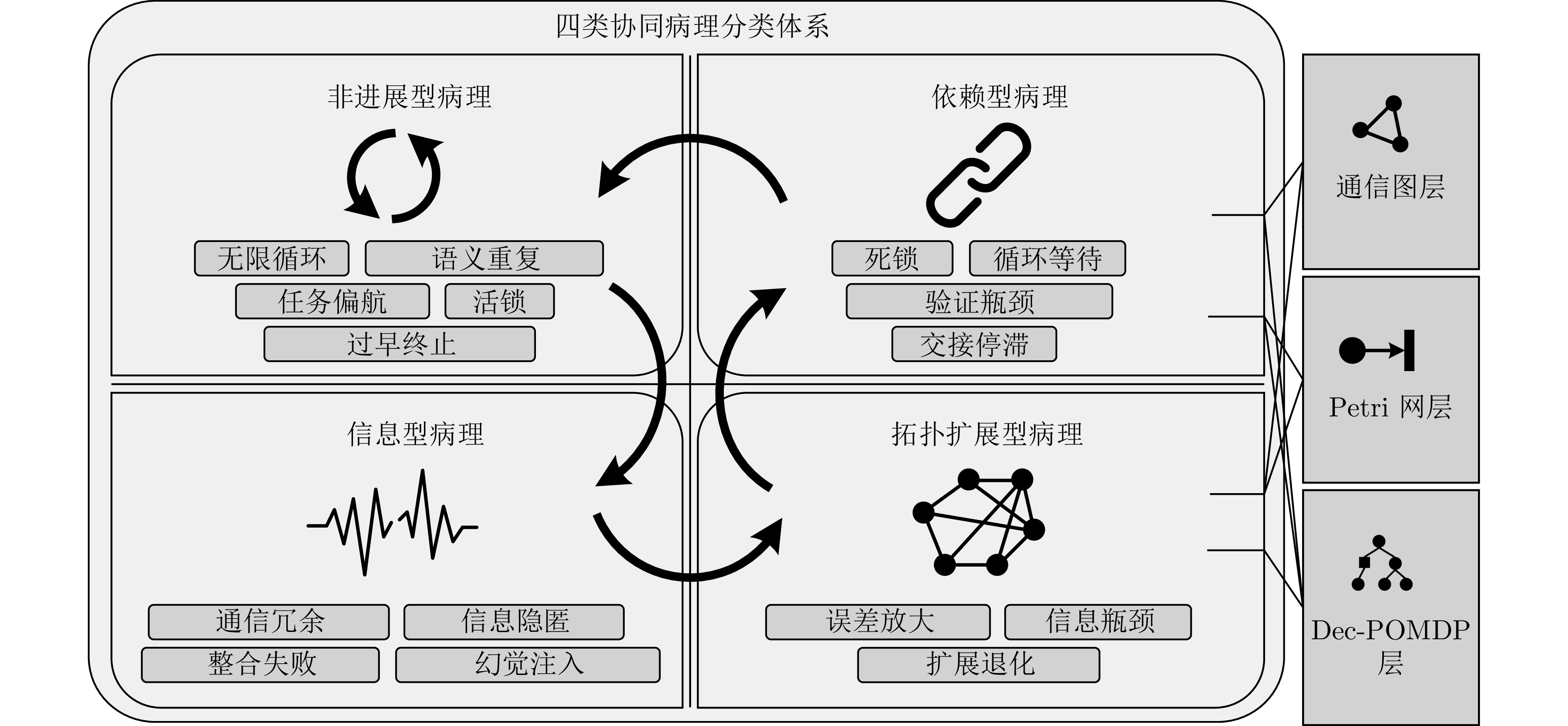
图 1 四类协同病理分类体系及其与三层形式化结构的对应关系
Fig. 1 Taxonomy of four coordination pathology categories and their mapping to the three-layer formal structure
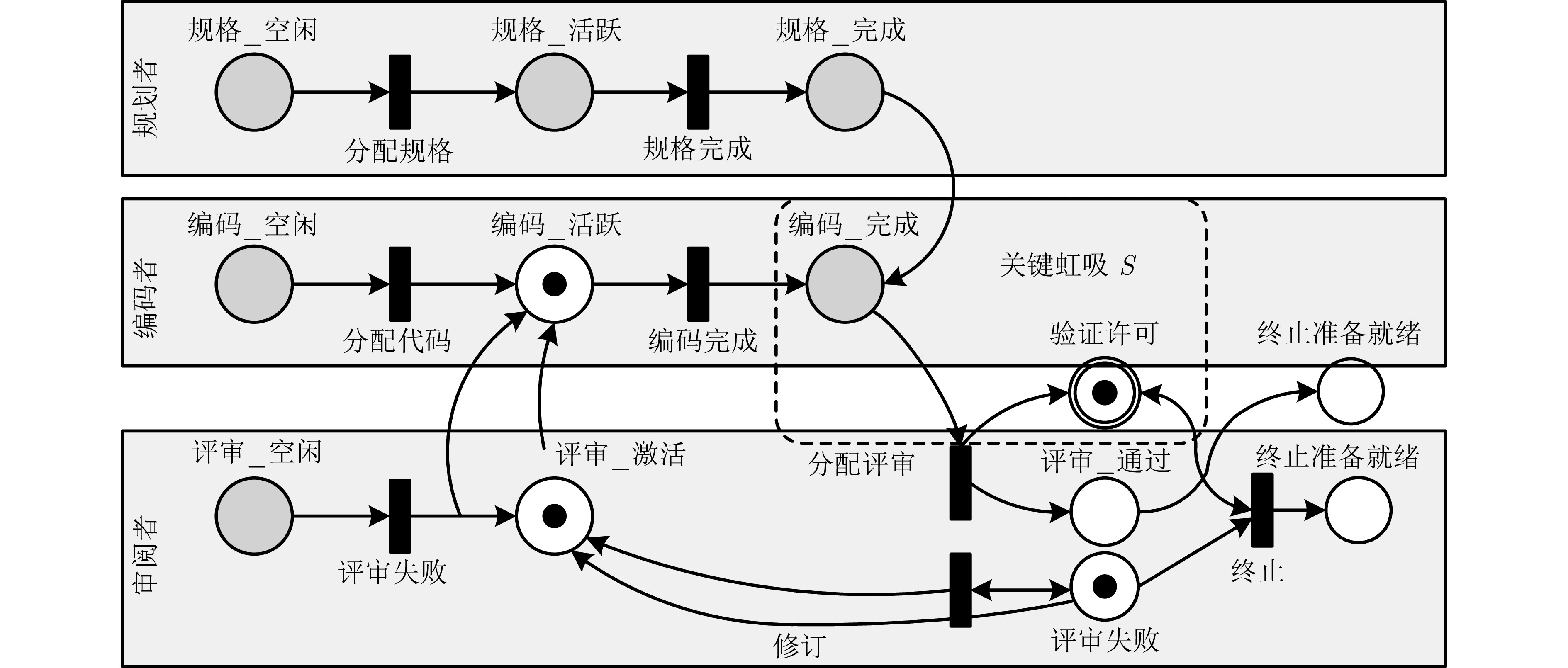
图 2 含死锁潜势的三智能体工作流Petri网模型
Fig. 2 A Petri net model of a three-agent workflow with deadlock potential
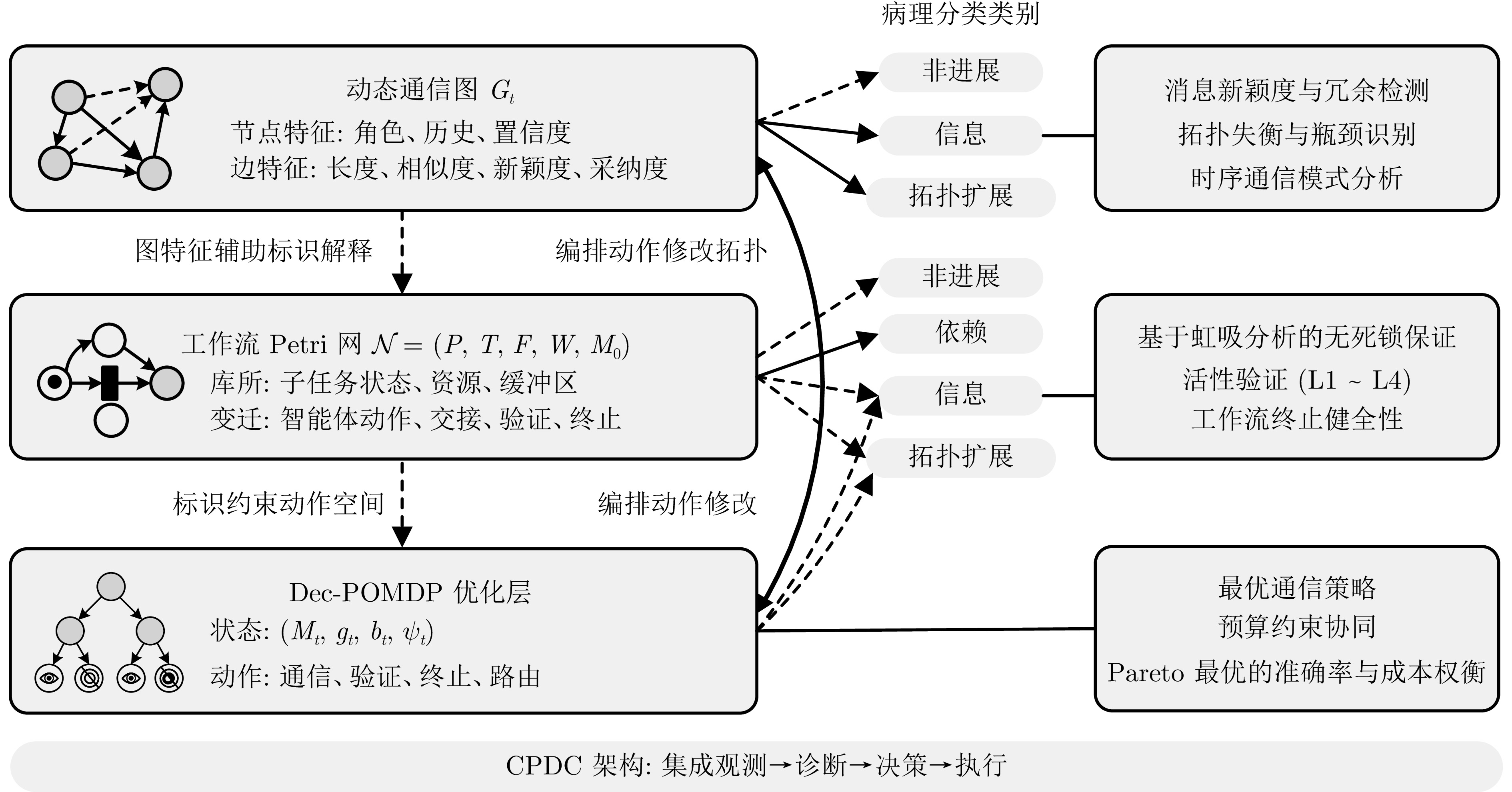
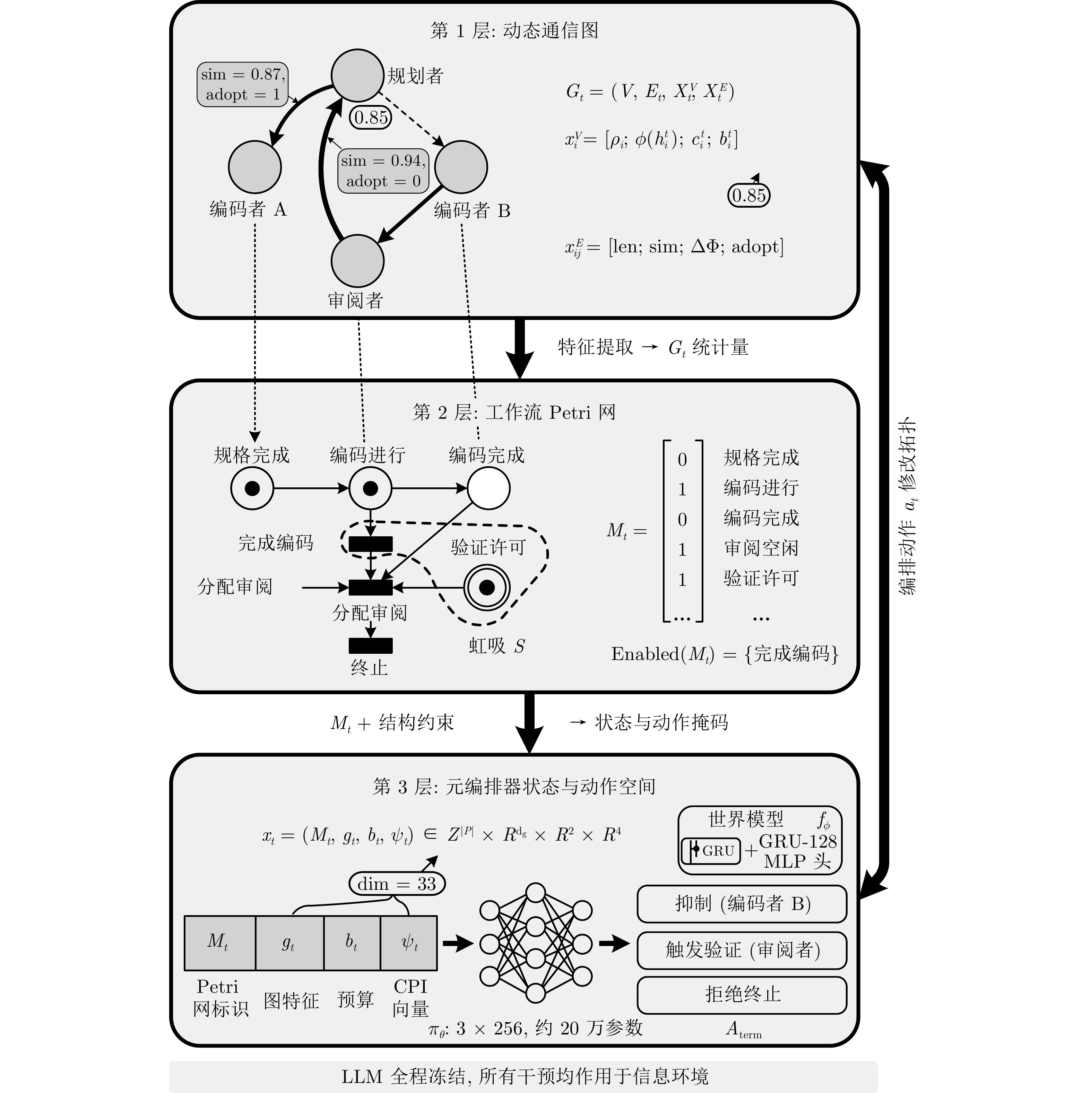
图 3 三层形式化建模框架与四类协同病理的集成关系
Fig. 3 Integration relationships between the three-layer formal modeling framework and the four categories of coordination pathologies
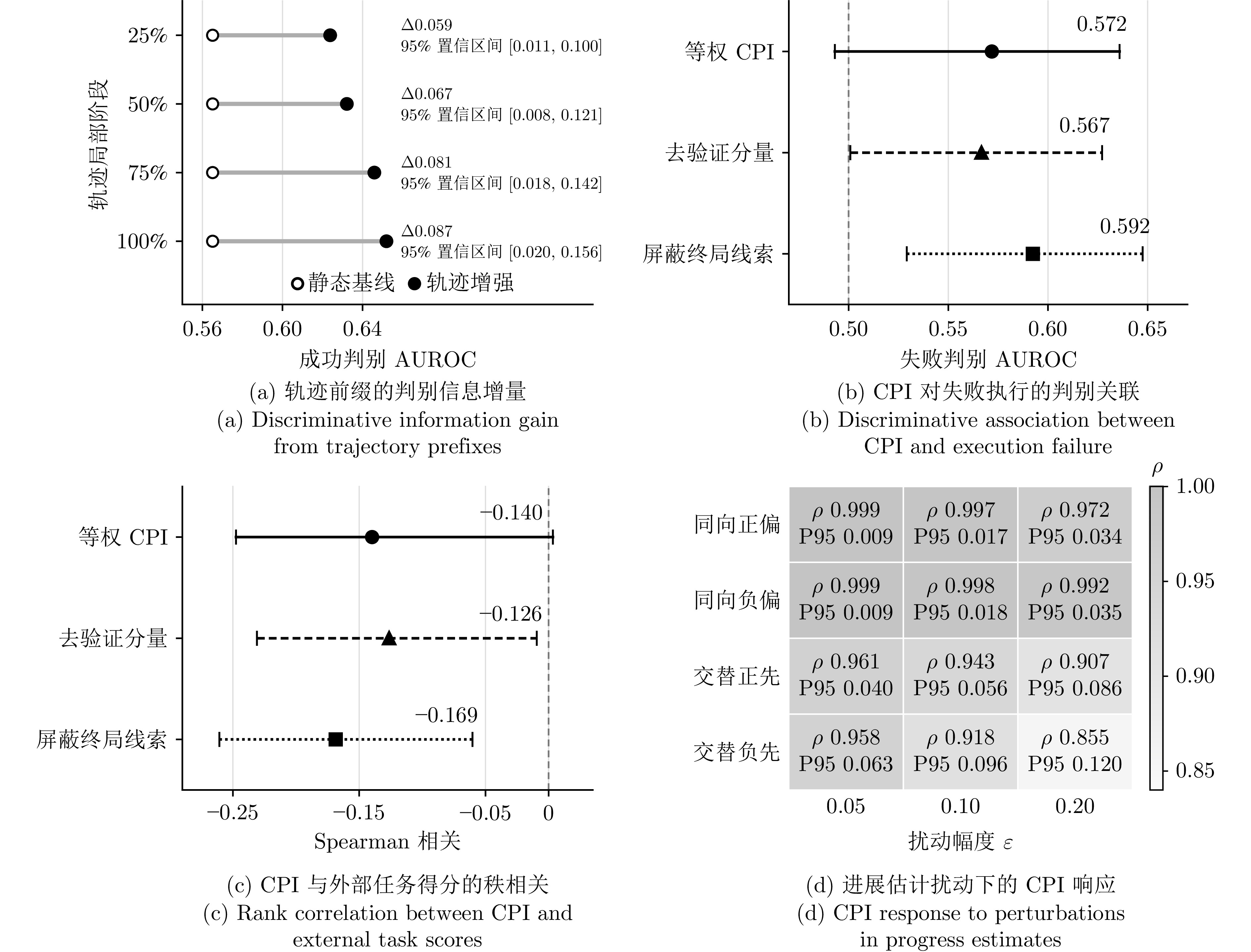
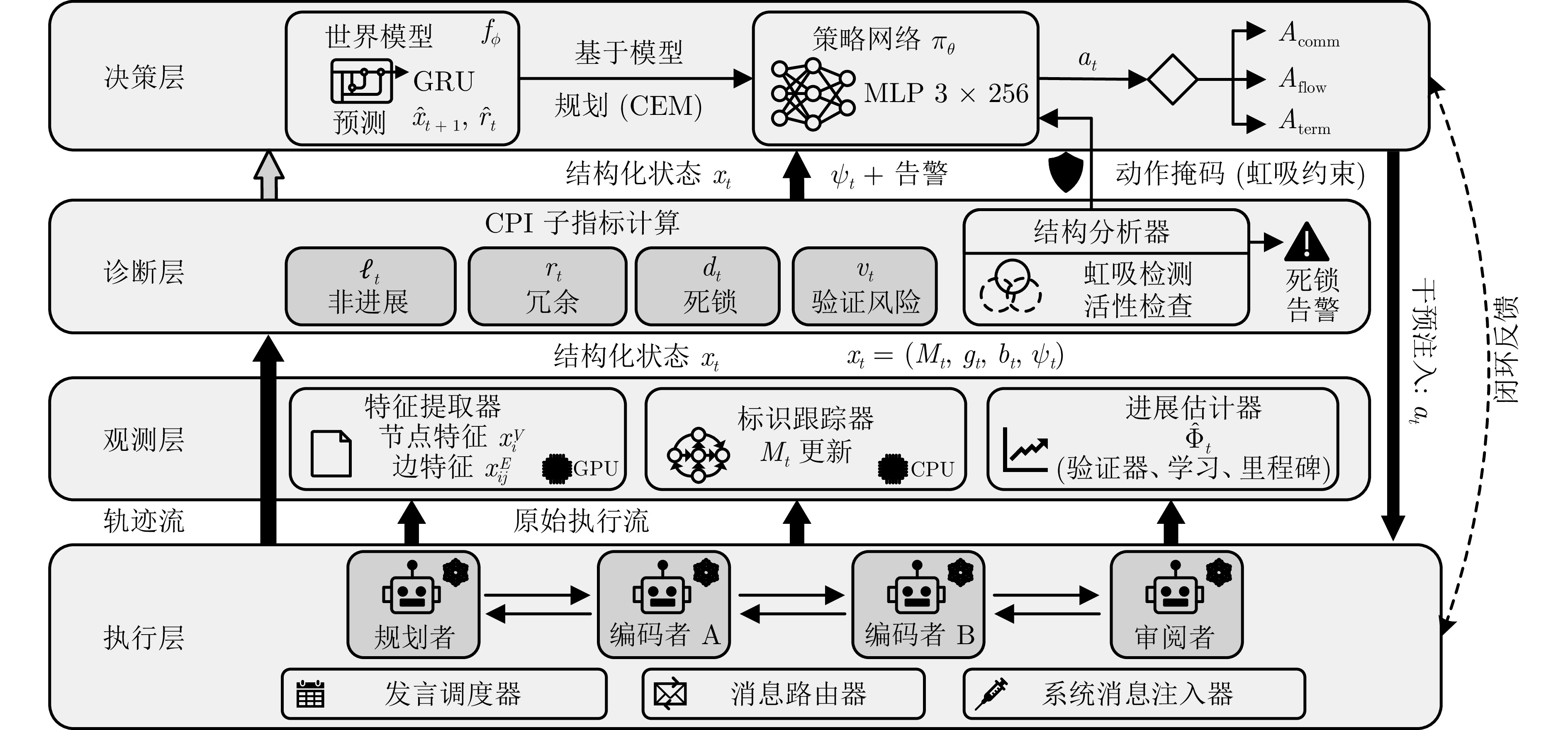
图 6 CPDC参考架构的真实轨迹分析
Fig. 6 Analysis of real-world trajectories for the CPDC reference architecture
表 1 本文与代表性综述的多维对比表
Table 1 A multidimensional comparison of this paper with representative surveys
综述 分析视角与核心机理 失效刻画与形式化映射 量化与诊断粒度 控制与干预视角 核心贡献 Yan等[32] 智能体间通信: 效率、语义落地与可扩展性 围绕通信问题作经验归纳, 未与形式化工具对接 无系统性指标 无 以通信为中心系统梳理LLM-MAS Li等[4] 工作流、基础设施与组织结构 列举落地挑战, 偏经验, 未形式化 无 无 从工作流与基础设施视角综述 He等[26] 软件工程落地: 交接、验证与角色分工 指出落地障碍, 偏经验, 未形式化 无 仅提改进愿景 面向软件工程的落地综述与路线展望 Mohammadi等[59] 智能体评测与基准方法 以结果指标间接反映失效, 未形式化 结果层指标, 不可按病理分解 无 系统整理智能体评测与基准 秦家虎等[13] 博弈与控制交叉, 面向传统多智能体 以博弈与控制理论建模, 不以LLM-MAS协同失效为对象 控制理论指标 有(控制理论) 博弈与控制视角的多智能体协同综述 罗彪等[48] 强化学习控制与决策, 面向传统多智能体强化学习 以MDP与Dec-POMDP建模, 不以协同失效分型为对象 强化学习性能指标 有(强化学习控制) 多智能体强化学习控制与决策综述 Zhang等[58] 执行轨迹上的失败归因 责任主体、关键步骤与故障模块 轨迹级和步骤级诊断 归因驱动的可靠性增强 连接失败归因与改进措施 本文 协同结构与协同病理: 通信、工作流、依赖与拓扑 在MAST等实证分类上再归纳为四类病理, 并显式映射到动态图、Petri网与Dec-POMDP 候选CPI, 按病理可分解、面向在线 监督控制视角, 含动作掩蔽的结构性保证 把协同失效从经验现象转化为可观测、可分解与可进一步验证的建模对象 注: 秦家虎等[13]与罗彪等[48]面向传统多智能体系统, 列入以对照其在形式化建模与控制上的积累. MDP为马尔可夫决策过程(Markov decision process).  下载: 导出CSV
表 2 四类协同病理的判定边界与代表性覆盖
Table 2 Classification boundaries and representative coverage of four categories of coordination pathologies
病理类型 主导受损对象 核心判据 与相邻类别的边界 代表性失效现象 非进展型 任务状态演化 依赖可执行且信息基本充分, 任务状态仍无有效增量 由前置条件受损引起时归入依赖型; 由信息缺陷引起时归入信息型 步骤重复、任务偏航、未识别终止条件、推理与行动失配、过早终止、无限迭代[22, 60−63] 依赖型 工作流依赖 前置条件、责任、触发或资源关系破坏执行可达性 内容已到达但执行关系未激活时归入本类; 内容缺失或失真时归入信息型 不遵从角色规范、循环等待、交接阻塞、验证瓶颈[22, 50, 64−65] 信息型 任务相关信息 消息、记忆、证据或验证状态缺失、失真或未被整合 信息充分且流程可执行而仍无进展时归入非进展型 不遵从任务规范、历史丢失、对话重置、未请求澄清、信息隐匿、忽略协作输入、验证缺失和验证错误[22, 34−35, 66−67] 拓扑扩展型 交互图结构 失效随规模、连接密度、层级或路由结构变化 缺少结构变化证据时采用相应局部机制标签 误差放大、枢纽瓶颈、规模饱和、协调成本激增、结构与任务失配[25, 36−38, 68−70]
下载: 导出CSV
表 3 三种形式化建模框架的系统比较
Table 3 A systematic comparison of three formal modeling frameworks
维度 动态通信图 Petri网与DES Dec-POMDP与MARL 核心抽象 时变有向图$ G_t=(V,\; E_t) $, 具有节点与边特征 二分图$ {{\cal{N}}=(P,\; T,\; F,\; W,\; M_0)} $, 具有托肯动力学 元组$ {\langle D,\; S,\; \{ A_i\} ,\; \{ O_i\} ,\; {\cal{T}},\; R,\; \Omega ,\; \gamma \rangle } $ 建模目标 智能体间通信拓扑结构与消息内容 工作流结构、资源依赖、并发性 部分可观测条件下的序贯决策 主要病理覆盖 信息病理, 拓扑扩展型 非进展, 依赖 所有类型均可通过优化覆盖 关键可分析属性 冗余率、Fiedler连通度、度数分布、时序模式 死锁(虹吸分析)、活性(L1 $ \sim $ L4)、有界性、良构性 最优通信策略、预算分配、帕累托权衡 结构分析 谱分析、强连通分量检测、时序图统计 虹吸、陷阱、库所不变量与变迁不变量、可达性 不适用(无模型或学习动力学) 计算复杂度 每轮多项式时间(图统计量) 结构化子类(S3PR、WF-nets)为多项式时间; 一般情况为PSPACE完全 NEXP-完全(精确求解); 通过CTDE近似可解 LLM-MAS应用 GPTSwarm[38]、DyLAN[71]、CommFormer[73] 至今尚无应用(本文调查中首次提出) MAGRPO[89]、ACC-Collab[90] 语义感知能力 高(自然语言消息嵌入作为边特征) 无(托肯为抽象形式) 间接(通过观测编码) 实时适用性 高(轻量级特征提取) 中等(标记变化时的结构分析) 低(需要学习模型或在线规划) 主要局限性 无法表达逻辑依赖或资源锁 需要显式的工作流规范或发现 精确求解难解; 需要紧凑状态表示 在CPDC中的
集成角色观测层: 特征提取 诊断层: 结构保证 决策层: 策略优化 注: S3PR为带资源的简单顺序进程系统(systems of simple sequential processes with resources), WF-nets为工作流网, PSPACE为多项式空间(polynomial space)复杂度类.
下载: 导出CSV
表 4 现有MAS诊断方法的综合比较
Table 4 A comprehensive comparison of existing diagnostic methods for MAS
方法与工具 实时性 病理类型 可分解性 形式化保证 自动化程度 预测能力 智能体级准确性 步骤级准确性 发表出处 SR、Pass@$ k $ × × × × √ × 不适用 不适用 多种 Token与延迟 ~(在线) × × × √ × 不适用 不适用 多种 AgentBoard KPI √ × 部分 × √ × 不适用 不适用 NeurIPS2024 MultiAgentBench CS、TS 部分 部分 部分 × √ × 不适用 不适用 ACL2025 Kim等协调性 × × √ × √ × 不适用 不适用 arXiv2025 一次性 × × × × √ × 53.5% 14.2% ICML2025 逐步 × × × × √ × 34.4% 20.7% ICML2025 二分搜索 × × × × √ × 42.3% 17.2% ICML2025 AgenTracer-8B × 部分 × × √ × 71.7% 32.4% arXiv2025 交互式调试 √ √ × × × √(人工) 不适用 不适用 CHI2025 智能体作为评判者 × 部分 × × √ × 不适用 不适用 ICML2025 MAST失效分类 × √ 部分 × 部分 × 不适用 不适用 NeurIPS2025 错误智能体韧性 × 部分 × × √ × 不适用 不适用 ICML2025 注: SR为成功率(success rate), CS为协同得分(coordination score), TS为任务得分(task score), Pass@$ k $衡量$ k $次生成中至少一次成功的概率, 不适用表示该指标不属于相应方法的评价对象.
下载: 导出CSV
表 6 协同可靠性的开放问题与研究路线
Table 6 Open questions and a research roadmap for coordination reliability
研究问题 已有基础 关键命题 检验路径 研究目标 过程尺度的跨场景有效性 轨迹前缀增量、CPI外部关联与扰动响应 进展势能的概率含义和CPI的风险排序能否跨场景保持 跨任务、跨骨干、跨规模留出与分层校准 可迁移的过程风险尺度 结构与轨迹联合诊断 动态通信图、Petri网、过程信号 连续风险与离散故障位置能否相互印证 结构恢复、病理一致性与级联顺序评价 可定位的病理诊断 干预效应与策略学习 CPDC动作接口、触发条件 干预能否在给定预算下改善终局结果和过程可靠性 受控比较、因果效应估计与约束策略学习 可归因的控制规律 规模扩展与策略迁移 拓扑特征、元编排状态 控制规律能否跨规模、骨干和框架保持 分层扩展、拓扑适应与跨场景复核 可迁移的协同策略 组合式运行保证 动作屏蔽、误差上界 离散结构条件与概率误差能否统一验证 Petri网、时序逻辑与运行时证书 可核验的安全范围
下载: 导出CSV
-
[1] Guo T, Chen X, Wang Y, Chang R, Pei S, Chawla N V, et al. Large language model based multi-agents: A survey of progress and challenges. In: Proceedings of the 33rd International Joint Conference on Artificial Intelligence. IJCAI Organization, 2024. 8048-8057. [2] Wang L, Ma C, Feng X, Zhang Z, Yang H, Zhang J, et al. A survey on large language model based autonomous agents. Frontiers of Computer Science, 2024, 18(6): 186345 doi: 10.1007/s11704-024-40231-1 [3] Xi Z, Chen W, Guo X, He W, Ding Y, Hong B, et al. The rise and potential of large language model based agents: A survey. Science China Information Sciences, 2025, 68(2): 121101 doi: 10.1007/s11432-024-4222-0 [4] Li X, Wang S, Zeng S, Wu Y, Yang Y. A survey on LLM-based multi-agent systems: Workflow, infrastructure, and challenges. Vicinagearth, 2024, 1(1): 9 doi: 10.1007/s44336-024-00009-2 [5] Park J S, O'Brien J, Cai C J, Morris M R, Liang P, Bernstein M S. Generative agents: Interactive simulacra of human behavior. In: Proceedings of the 36th Annual ACM Symposium on User Interface Software and Technology. New York, USA: ACM, 2023. 1-22. [6] Decker K S. Distributed problem-solving techniques: A survey. IEEE Transactions on Systems, Man, and Cybernetics, 1987, 17(5): 729−740 doi: 10.1109/tsmc.1987.6499280 [7] Stone P, Veloso M. Multiagent systems: A survey from a machine learning perspective. Autonomous Robots, 2000, 8(3): 345−383 doi: 10.1023/A:1008942012299 [8] Wu Q, Bansal G, Zhang J, Wu Y, Li B, Zhu E, et al. AutoGen: Enabling next-gen LLM applications via multi-agent conversations. In: Proceedings of the 1st Conference on Language Modeling. 2024. [9] Hong S, Zhuge M, Chen J, Zheng X, Cheng Y, Wang J, et al. MetaGPT: Meta programming for a multi-agent collaborative framework. In: Proceedings of the 12th International Conference on Learning Representations. 2024. [10] Qian C, Liu W, Liu H, Chen N, Dang Y, Li J, et al. ChatDev: Communicative agents for software development. In: Proceedings of the 62nd Annual Meeting of the Association for Computational Linguistics (Volume 1: Long Papers). Association for Computational Linguistics, 2024. 15174-15186. [11] Fourney A, Bansal G, Mozannar H, Tan C, Salinas E, Zhu E, et al. Magentic-One: A generalist multi-agent system for solving complex tasks. arXiv preprint arXiv: 2411.04468, 2024. [12] 郑逸宁, 余镇, 李不凡, 杨捷, 殷林琪, 印张悦, 等. 大语言模型的工具使用综述. 自动化学报, 2025, 51(11): 2371−2386 doi: 10.16383/j.aas.c240793Zheng Yi-Ning, Yu Zhen, Li Bu-Fan, Yang Jie, Yin Lin-Qi, Yin Zhang-Yue, et al. Survey of tool use in large language models. Acta Automatica Sinica, 2025, 51(11): 2371−2386 doi: 10.16383/j.aas.c240793 [13] 秦家虎, 马麒超, 李曼, 张聪, 付维明, 刘轻尘, 等. 多智能体协同研究进展综述: 博弈和控制交叉视角. 自动化学报, 2025, 51(3): 489−509 doi: 10.16383/j.aas.c240508Qin Jia-Hu, Ma Qi-Chao, Li Man, Zhang Cong, Fu Wei-Ming, Liu Qing-Chen, et al. Recent advances on multi-agent collaboration: A cross-perspective of game and control theory. Acta Automatica Sinica, 2025, 51(3): 489−509 doi: 10.16383/j.aas.c240508 [14] Gottweis J, Weng W H, Daryin A, Tu T, Sirkovic P, Myaskovsky A, et al. Towards an AI co-scientist. arXiv preprint arXiv: 2502.18864, 2025. [15] Swanson K, Wu W, Bulaong N L, Pak J E, Zou J. The Virtual Lab of AI agents designs new SARS-CoV-2 nanobodies. Nature, 2025, 646(8085): 716−723 doi: 10.1038/s41586-025-09442-9 [16] Yu Y, Yao Z, Li H, Deng Z, Jiang Y, Cao Y, et al. FinCon: A synthesized LLM multi-agent system with conceptual verbal reinforcement for enhanced financial decision making. Advances in Neural Information Processing Systems, 2024, 37: 137010−137045 [17] Du Y, Li S, Torralba A, Tenenbaum J B, Mordatch I. Improving factuality and reasoning in language models through multiagent debate. In: Proceedings of the 41st International Conference on Machine Learning. PMLR, 2024, 235: 11733-11763. [18] Madaan A, Tandon N, Gupta P, Hallinan S, Gao L, Wiegreffe S, et al. Self-refine: Iterative refinement with self-feedback. Advances in Neural Information Processing Systems, 2023, 36: 46534−46594 [19] Kim Y, Park C, Jeong H, Chan Y, Xu X, McDuff D, et al. MDAgents: An adaptive collaboration of LLMs for medical decision-making. Advances in Neural Information Processing Systems, 2024, 37: 79410−79452 [20] Chen W, Su Y, Zuo J, Yang C, Yuan C, Chan C M, et al. AgentVerse: Facilitating multi-agent collaboration and exploring emergent behaviors. In: Proceedings of the 12th International Conference on Learning Representations. 2024. [21] Lynch N A. Distributed Algorithms. San Francisco, USA: Morgan Kaufmann, 1996. [22] Cemri M, Pan M Z, Yang S, Agrawal L A, Chopra B, Tiwari R, et al. Why do multi-agent LLM systems fail?. Advances in Neural Information Processing Systems, 2025, 38: 135676−135729 [23] Zhang S, Yin M, Zhang J, Liu J, Han Z, Zhang J, et al. Which agent causes task failures and when? On automated failure attribution of LLM multi-agent systems. In: Proceedings of the 42nd International Conference on Machine Learning. PMLR, 2025, 267: 76583-76599. [24] Xia C S, Deng Y, Dunn S, Zhang L. Agentless: Demystifying LLM-based software engineering agents. arXiv preprint arXiv: 2407.01489, 2024. [25] Kim Y, Gu K, Park C, Park C, Schmidgall S, Heydari A A, et al. Towards a science of scaling agent systems. arXiv preprint arXiv: 2512.08296, 2025. [26] He J, Treude C, Lo D. LLM-based multi-agent systems for software engineering: Literature review, vision, and the road ahead. ACM Transactions on Software Engineering and Methodology, 2025, 34(5): 1−30 doi: 10.1145/3712003 [27] Perrow C. Normal Accidents: Living with High-Risk Technologies. Updated ed. Princeton, USA: Princeton University Press, 2011. [28] Roberts K H. New challenges in organizational research: High reliability organizations. Industrial Crisis Quarterly, 1989, 3(2): 111−125 doi: 10.1177/108602668900300202 [29] Liu X, Yu H, Zhang H, Xu Y, Lei X, Lai H, et al. AgentBench: Evaluating LLMs as agents. arXiv preprint arXiv: 2308.03688, 2023. [30] Xu F F, Song Y, Li B, Tang Y, Jain K, Bao M, et al. TheAgentCompany: Benchmarking LLM agents on consequential real world tasks. Advances in Neural Information Processing Systems, 2025, 38: 10291−10321 [31] Zhu K, Du H, Hong Z, Yang X, Guo S, Wang Z, et al. MultiAgentBench: Evaluating the collaboration and competition of LLM agents. In: Proceedings of the 63rd Annual Meeting of the Association for Computational Linguistics (Volume 1: Long Papers). Association for Computational Linguistics, 2025. 8580-8622. [32] Yan B, Zhou Z, Zhang L, Zhang L, Zhou Z, Miao D, et al. Beyond self-talk: A communication-centric survey of LLM-based multi-agent systems. arXiv preprint arXiv: 2502.14321, 2025. [33] 张栋, 马苏慧, 吕石, 王孟阳, 唐硕. 多智能体系统事件触发一致性研究综述. 北京理工大学学报, 2022, 42(10): 1059−1072 doi: 10.15918/j.tbit1001-0645.2021.222Zhang Dong, Ma Su-Hui, Lü Shi, Wang Meng-Yang, Tang Shuo. Overview on event-triggered consensus of multi-agent systems. Transactions of Beijing Institute of Technology, 2022, 42(10): 1059−1072 doi: 10.15918/j.tbit1001-0645.2021.222 [34] Grötschla F, Müller L, Tönshoff J, Galkin M, Perozzi B. AgentsNet: Coordination and collaborative reasoning in multi-agent LLMs. arXiv preprint arXiv: 2507.08616, 2025. [35] Fischer M J, Lynch N A, Paterson M S. Impossibility of distributed consensus with one faulty process. Journal of the ACM, 1985, 32(2): 374−382 doi: 10.1145/3149.214121 [36] Qian C, Xie Z, Wang Y, Liu W, Zhu K, Xia H, et al. Scaling large language model-based multi-agent collaboration. arXiv preprint arXiv: 2406.07155, 2024. [37] Chen L, Davis J, Hanin B, Bailis P, Stoica I, Zaharia M, et al. Are more LLM calls all you need? Towards the scaling properties of compound AI systems. Advances in Neural Information Processing Systems, 2024, 37: 45767−45790 [38] Zhuge M, Wang W, Kirsch L, Faccio F, Khizbullin D, Schmidhuber J. GPTSwarm: Language agents as optimizable graphs. In: Proceedings of the 41st International Conference on Machine Learning. PMLR, 2024, 235: 62743-62767. [39] Murata T. Petri nets: Properties, analysis and applications. Proceedings of the IEEE, 1989, 77(4): 541−580 doi: 10.1109/5.24143 [40] Esparza J, Nielsen M. Decidability issues for Petri nets: A survey. Bulletin of the European Association for Theoretical Computer Science, 1994, 52: 244−262 [41] Hoare C A R. Communicating sequential processes. In: Jones C B, Misra J, editors. Theories of Programming: The Life and Works of Tony Hoare. New York, USA: ACM, 2021. 157-186. [42] 王戟, 詹乃军, 冯新宇, 刘志明. 形式化方法概貌. 软件学报, 2019, 30(1): 33−61 doi: 10.13328/j.cnki.jos.005652Wang Ji, Zhan Nai-Jun, Feng Xin-Yu, Liu Zhi-Ming. Overview of formal methods. Journal of Software, 2019, 30(1): 33−61 doi: 10.13328/j.cnki.jos.005652 [43] 张文博, 龙环. 向量加法系统验证问题研究综述. 软件学报, 2018, 29(6): 1566−1581 doi: 10.13328/j.cnki.jos.005465Zhang Wen-Bo, Long Huan. State-of-the-art survey on verification of vector addition systems. Journal of Software, 2018, 29(6): 1566−1581 doi: 10.13328/j.cnki.jos.005465 [44] Oliehoek F A, Amato C. A concise introduction to decentralized POMDPs. Cham, Switzerland: Springer International Publishing, 2016. [45] Bernstein D S, Givan R, Immerman N, Zilberstein S. The complexity of decentralized control of Markov decision processes. Mathematics of Operations Research, 2002, 27(4): 819−840 doi: 10.1287/moor.27.4.819.297 [46] Singh A, Jain T, Sukhbaatar S. Learning when to communicate at scale in multiagent cooperative and competitive tasks. arXiv preprint arXiv: 1812.09755, 2018. [47] Zhu C, Dastani M, Wang S. A survey of multi-agent deep reinforcement learning with communication. Autonomous Agents and Multi-Agent Systems, 2024, 38(1): 4 doi: 10.1007/s10458-023-09633-6 [48] 罗彪, 胡天萌, 周育豪, 黄廷文, 阳春华, 桂卫华. 多智能体强化学习控制与决策研究综述. 自动化学报, 2025, 51(3): 510−539 doi: 10.16383/j.aas.c240392Luo Biao, Hu Tian-Meng, Zhou Yu-Hao, Huang Ting-Wen, Yang Chun-Hua, Gui Wei-Hua. Survey on multi-agent reinforcement learning for control and decision-making. Acta Automatica Sinica, 2025, 51(3): 510−539 doi: 10.16383/j.aas.c240392 [49] 殷昌盛, 杨若鹏, 朱巍, 邹小飞, 李峰. 多智能体分层强化学习综述. 智能系统学报, 2020, 15(4): 646−655 doi: 10.11992/tis.201909027Yin Chang-Sheng, Yang Ruo-Peng, Zhu Wei, Zou Xiao-Fei, Li Feng. A survey on multi-agent hierarchical reinforcement learning. CAAI Transactions on Intelligent Systems, 2020, 15(4): 646−655 doi: 10.11992/tis.201909027 [50] Epperson W, Bansal G, Dibia V C, Fourney A, Gerrits J, Zhu E, et al. Interactive debugging and steering of multi-agent AI systems. In: Proceedings of the 2025 CHI Conference on Human Factors in Computing Systems. 2025: 1-15. [51] 张明悦, 金芝, 赵海燕, 罗懿行. 机器学习赋能的软件自适应性综述. 软件学报, 2020, 31(8): 2404−2431 doi: 10.13328/j.cnki.jos.006076Zhang Ming-Yue, Jin Zhi, Zhao Hai-Yan, Luo Yi-Xing. Survey of machine learning enabled software self-adaptation. Journal of Software, 2020, 31(8): 2404−2431 doi: 10.13328/j.cnki.jos.006076 [52] Ramadge P J G, Wonham W M. Supervisory control of a class of discrete event processes. SIAM Journal on Control and Optimization, 1987, 25(1): 206−230 doi: 10.1137/0325013 [53] Li Z, Wu N, Zhou M. Deadlock control of automated manufacturing systems based on Petri nets: A literature review. IEEE Transactions on Systems, Man, and Cybernetics, Part C (Applications and Reviews), 2012, 42(4): 437−462 doi: 10.1109/TSMCC.2011.2160626 [54] Zaghdoud A, Li Z. On deadlock analysis and characterization of labeled Petri nets with undistinguishable and unobservable transitions. Mathematics, 2024, 12(22): 3523 doi: 10.3390/math12223523 [55] Zhang R, Feng Y, Yang Y, Li X, Li H. Polynomial-complexity deadlock avoidance policy for tasks offloading in satellite edge computing with data-dependent constraints and limited buffers. IEEE Transactions on Aerospace and Electronic Systems, 2024, 60(5): 6822−6838 doi: 10.1109/TAES.2024.3409269 [56] Yu C, Velu A, Vinitsky E, Gao J, Wang Y, Bayen A, et al. The surprising effectiveness of PPO in cooperative multi-agent games. Advances in Neural Information Processing Systems, 2022, 35: 24611−24624 [57] Moerland T M, Broekens J, Plaat A, Jonker C M. Model-based reinforcement learning: A survey. Foundations and Trends in Machine Learning, 2023, 16(1): 1−118 doi: 10.1561/2200000086 [58] Zhang Q, Liu B, Lei J, Lu Z, Huang Y, Yang L, et al. From failure attribution to reliability enhancement in LLM-based multi-agent systems: A survey. ResearchGate preprint, 2026. DOI: 10.13140/RG.2.2.25988.49281. [59] Mohammadi M, Li Y, Lo J, Yip W. Evaluation and benchmarking of LLM agents: A survey. In: Proceedings of the 31st ACM SIGKDD Conference on Knowledge Discovery and Data Mining V. 2. New York, USA: ACM, 2025. 6129-6139. [60] Liang T, He Z, Jiao W, Wang X, Wang Y, Wang R, et al. Encouraging divergent thinking in large language models through multi-agent debate. In: Proceedings of the 2024 Conference on Empirical Methods in Natural Language Processing. Association for Computational Linguistics, 2024. 17889-17904. [61] Smit A P, Grinsztajn N, Duckworth P, Barrett T D, Pretorius A. Should we be going MAD? A look at multi-agent debate strategies for LLMs. In: Proceedings of the 41st International Conference on Machine Learning. PMLR, 2024, 235: 45883-45905. [62] Choi H K, Zhu X, Li S. When identity skews debate: Anonymization for bias-reduced multi-agent reasoning. arXiv preprint arXiv: 2510.07517, 2025. [63] Pitre P, Ramakrishnan N, Wang X. ConsensAgent: Towards efficient and effective consensus in multi-agent LLM interactions through sycophancy mitigation. In: Findings of the Association for Computational Linguistics: ACL 2025. Association for Computational Linguistics, 2025. 22112-22133. [64] Phan H N, Nguyen T N, Nguyen P X, Bui N D Q. HyperAgent: Generalist software engineering agents to solve coding tasks at scale. arXiv preprint arXiv: 2409.16299, 2024. [65] Silberschatz A, Galvin P B, Gagne G. Operating System Concepts. 10th ed. Hoboken, USA: Wiley, 2018. [66] Kaesberg L B, Becker J, Wahle J P, Ruas T, Gipp B. Voting or consensus? Decision-making in multi-agent debate. In: Findings of the Association for Computational Linguistics: ACL 2025. Association for Computational Linguistics, 2025. 11640-11671. [67] Bo X, Zhang Z, Dai Q, Feng X, Wang L, Li R, et al. Reflective multi-agent collaboration based on large language models. Advances in Neural Information Processing Systems, 2024, 37: 138595−138631 [68] Li J, Zhang Q, Yu Y, Fu Q, Ye D. More agents is all you need. arXiv preprint arXiv: 2402.05120, 2024. [69] Zhou Y, Chen Y. Adaptive heterogeneous multi-agent debate for enhanced educational and factual reasoning in large language models. Journal of King Saud University Computer and Information Sciences, 2025, 37: 330 doi: 10.1007/s44443-025-00353-3 [70] Huang J T, Zhou J, Jin T, Zhou X, Chen Z, Wang W, et al. On the resilience of LLM-based multi-agent collaboration with faulty agents. In: Proceedings of the 42nd International Conference on Machine Learning. PMLR, 2025, 267: 26202-26226. [71] Liu Z, Zhang Y, Li P, Liu Y, Yang D. A dynamic LLM-powered agent network for task-oriented agent collaboration. In: Proceedings of the 1st Conference on Language Modeling. 2024. [72] Niu Y, Paleja R, Gombolay M. Multi-agent graph-attention communication and teaming. In: Proceedings of the 20th International Conference on Autonomous Agents and Multi-Agent Systems (AAMAS). 2021: 964-973. [73] Hu S, Shen L, Zhang Y, Tao D. Learning multi-agent communication from graph modeling perspective. In: Proceedings of the 12th International Conference on Learning Representations. 2024. [74] Liu Z, Wan L, Sui X, Chen Z, Sun K, Lan X. Deep hierarchical communication graph in multi-agent reinforcement learning. In: Proceedings of the 32nd International Joint Conference on Artificial Intelligence. IJCAI Organization, 2023. 208-216. [75] Das A, Gervet T, Romoff J, Batra D, Parikh D, Rabbat M, et al. TarMAC: Targeted multi-agent communication. In: Proceedings of the 36th International Conference on Machine Learning. PMLR, 2019, 97: 1538-1546. [76] Fiedler M. Algebraic connectivity of graphs. Czechoslovak Mathematical Journal, 1973, 23(2): 298−305 doi: 10.21136/CMJ.1973.101168 [77] van der Aalst W M P. The application of Petri nets to workflow management. Journal of Circuits, Systems and Computers, 1998, 8(1): 21−66 [78] van der Aalst W M P, van Hee K M, ter Hofstede A H M, Sidorova N, Verbeek H M W, Voorhoeve M, et al. Soundness of workflow nets: Classification, decidability, and analysis. Formal Aspects of Computing, 2011, 23(3): 333−363 doi: 10.1007/s00165-010-0161-4 [79] Blondin M, Finkel A, Hofman P, Mazowiecki F, Offtermatt P. Soundness of reset workflow nets. In: Proceedings of the 39th Annual ACM/IEEE Symposium on Logic in Computer Science. New York, USA: ACM, 2024. 1-14. [80] Suvorov N M, Lomazova I A. Verification of data-aware process models: Checking soundness of data Petri nets. Journal of Logical and Algebraic Methods in Programming, 2024, 138: 100953 doi: 10.1016/j.jlamp.2024.100953 [81] 赵文, 袁崇义, 刘刚, 张世琨, 王立福. 基于P/T系统化简方法的工作流过程模型验证. 软件学报, 2004, 15(10): 1423−1430 doi: 10.13328/j.cnki.jos.2004.10.001Zhao Wen, Yuan Chong-Yi, Liu Gang, Zhang Shi-Kun, Wang Li-Fu. Workflow process model verification using reduction method based on P/T system. Journal of Software, 2004, 15(10): 1423−1430 doi: 10.13328/j.cnki.jos.2004.10.001 [82] van der Aalst W M P. Process mining: Data science in action. 2nd ed. Berlin, Germany: Springer, 2016. [83] Nair R, Varakantham P, Tambe M, Yokoo M. Networked distributed POMDPs: A synthesis of distributed constraint optimization and POMDPs. In: Proceedings of the 20th National Conference on Artificial Intelligence. AAAI Press, 2005. 133-139. [84] Koops W, Junges S, Jansen N. Approximate Dec-POMDP solving using multi-agent A*. In: Proceedings of the 33rd International Joint Conference on Artificial Intelligence. IJCAI Organization, 2024. 6743-6751. [85] Sukhbaatar S, Szlam A, Fergus R. Learning multiagent communication with backpropagation. Advances in Neural Information Processing Systems, 2016, 29: 2244−2252 [86] Jiang J, Lu Z. Learning attentional communication for multi-agent cooperation. Advances in Neural Information Processing Systems, 2018, 31: 7254−7264 [87] de Witt C S, Gupta T, Makoviichuk D, Makoviychuk V, Torr P H S, Sun M, et al. Is independent learning all you need in the StarCraft multi-agent challenge? arXiv preprint arXiv: 2011.09533, 2020. [88] Rashid T, Samvelyan M, de Witt C S, Farquhar G, Foerster J, Whiteson S. Monotonic value function factorisation for deep multi-agent reinforcement learning. Journal of Machine Learning Research, 2020, 21(178): 1−51 doi: 10.5555/3455716.3455894 [89] Liu S, Liang Z, Lyu X, Amato C. LLM collaboration with multi-agent reinforcement learning. Proceedings of the AAAI Conference on Artificial Intelligence, 2026, 40(38): 32150−32158 [90] Estornell A, Ton J F, Yao Y, Liu Y. ACC-Collab: An actor-critic approach to multi-agent LLM collaboration. In: Proceedings of the 13th International Conference on Learning Representations. 2025. 90558-90581. [91] Jimenez C E, Yang J, Wettig A, Yao S, Pei K, Press O, et al. SWE-bench: Can language models resolve real-world GitHub issues? In: Proceedings of the 12th International Conference on Learning Representations. 2024. [92] Zhou S, Xu F F, Zhu H, Zhou X, Lo R, Sridhar A, et al. WebArena: A realistic web environment for building autonomous agents. In: Proceedings of the 12th International Conference on Learning Representations. 2024. [93] Ma C, Zhang J, Zhu Z, Yang C, Yang Y, Jin Y, et al. AgentBoard: An analytical evaluation board of multi-turn LLM agents. Advances in Neural Information Processing Systems, 2024, 37: 74325−74362 [94] Zhang G, Wang J, Chen J, Zhou W, Wang K, Yan S. AgenTracer: Who is inducing failure in the LLM agentic systems? arXiv preprint arXiv: 2509.03312, 2025. [95] Zhuge M, Zhao C, Ashley D R, Wang W, Khizbullin D, Xiong Y, et al. Agent-as-a-judge: Evaluate agents with agents. In: Proceedings of the 42nd International Conference on Machine Learning. PMLR, 2025, 267: 80569-80611. [96] Zheng L, Chiang W L, Sheng Y, Zhuang S, Wu Z, Zhuang Y, et al. Judging LLM-as-a-judge with MT-Bench and Chatbot Arena. Advances in Neural Information Processing Systems, 2023, 36: 46595−46623 [97] Khatua A, Zhu H, Tran P, Prabhudesai A, Sadrieh F, Lieberwirth J K, et al. CooperBench: Why coding agents cannot be your teammates yet. arXiv preprint arXiv: 2601.13295, 2026. [98] CooperBench. CooperBench coordination study: Agent trajectories, team-trajectories. Hugging Face, 2026 [Online], available: https://huggingface.co/datasets/CooperBench/team-trajectories, August 4, 2026. [99] Lightman H, Kosaraju V, Burda Y, Edwards H, Baker B, Lee T, et al. Let's verify step by step. In: Proceedings of the 12th International Conference on Learning Representations. 2024. [100] Leemans S J J, Fahland D, van der Aalst W M P. Discovering block-structured process models from event logs containing infrequent behaviour. In: Lohmann N, Song M, Wohed P, editors. Business Process Management Workshops. Lecture Notes in Business Information Processing, Vol. 171. Cham, Switzerland: Springer, 2014. 66-78. [101] 林雷蕾, 闻立杰, 钱忱, 宗瓒, 王建民. 面向过程挖掘的日志划分技术综述. 计算机学报, 2022, 45(9): 1946−1968 doi: 10.11897/SP.J.1016.2022.01946Lin Lei-Lei, Wen Li-Jie, Qian Chen, Zong Zan, Wang Jian-Min. A survey of log division technique in process mining. Chinese Journal of Computers, 2022, 45(9): 1946−1968 doi: 10.11897/SP.J.1016.2022.01946 [102] Sommers D, Menkovski V, Fahland D. Process discovery using graph neural networks. In: Proceedings of the 3rd International Conference on Process Mining. IEEE, 2021. 40-47. [103] Taylor M E, Stone P. Transfer learning for reinforcement learning domains: A survey. Journal of Machine Learning Research, 2009, 10: 1633−1685 [104] You D, Wang S, Seatzu C. A liveness-enforcing supervisor tolerant to sensor-reading modification attacks. IEEE Transactions on Systems, Man, and Cybernetics: Systems, 2022, 52(4): 2398−2411 doi: 10.1109/TSMC.2021.3051096 [105] Dou H, You D, Wang S, Zhou M. Designing liveness-enforcing supervisors for manufacturing systems by using maximally good step graphs of Petri nets. IEEE Transactions on Automation Science and Engineering, 2025, 22: 7312−7323 doi: 10.1109/TASE.2024.3450656 [106] García J, Fernández F. A comprehensive survey on safe reinforcement learning. Journal of Machine Learning Research, 2015, 16(1): 1437−1480 -

 下载:

计量
- 文章访问数: 46
- HTML全文浏览量: 19
- 被引次数: 0
