


Quantized Zeroth-order Distributed Optimization with Variance Reduction and Chebyshev Acceleration
-
摘要: 针对非凸目标函数在量化通信约束下的零阶分布式优化问题, 引入三种机制提升分布式优化算法的适用性: 在梯度估计过程中结合基于伯努利概率触发的方差缩减梯度估计器, 实现每轮期望采样点数为常数的渐近无偏梯度估计, 通过实现采样点数与问题维度的解耦, 减轻采样负担; 采用均匀量化器并结合动态编码-解码机制, 降低分布式通信所需的比特数; 引入带误差补偿的无环切比雪夫加速机制, 降低算法对网络拓扑的依赖并加速收敛. 在梯度追踪框架下, 提出一种考虑量化通信的零阶分布式无环切比雪夫加速算法, 对于光滑且满足梯度主导条件的非凸目标函数, 证明在给定有限迭代时域内量化器以至少$1-\delta$ 的概率不发生饱和, 并在该事件条件下建立优化误差的期望线性收敛界, 得到相应的查询复杂度为$\mathrm{O}(\frac{d\kappa}{1-\sigma}\ln (\frac{1}{\epsilon} ) )$. 该收敛速率在每轮期望采样点数为$\mathrm{O}(1)$的条件下实现. 数值仿真验证了所提算法的有效性.Abstract: This paper investigates the distributed zeroth-order optimization problem for non-convex objective functions under quantized communication constraints. By incorporating a variance-reduced gradient estimator based on Bernoulli probabilistic triggering, a dynamic quantization mechanism, and a loopless Chebyshev acceleration technique, the proposed algorithm addresses practical limitations in distributed optimization. Specifically, a variance-reduced gradient estimator is integrated into the gradient approximation process, achieving asymptotically unbiased gradient estimation with a constant expected number of sampling points per iteration, which is independent of the problem dimension and reduces the sampling burden. A uniform quantizer combined with a dynamic encoding-decoding mechanism is employed to reduce the number of bits required for communication. Furthermore, a loopless Chebyshev acceleration mechanism with error compensation is introduced to mitigate the dependence on network topology and accelerate convergence. Under the gradient tracking framework, a zeroth-order distributed loopless Chebyshev accelerated algorithm considering quantized communication is proposed. For smooth and non-convex objective functions satisfying the gradient dominance condition, it is proved that within a given finite iteration horizon, the quantizer does not saturate with a probability of at least $1-\delta$. Conditioned on this event, an expected linear convergence bound for the optimization error is established, yielding a corresponding query complexity of $\mathrm{O}(\frac{d\kappa}{1-\sigma}\ln (\frac{1}{\epsilon} ) )$. This convergence rate is achieved under the condition that the expected number of sampled points per round is $\mathrm{O}(1)$. Numerical simulations verify the efficiency of the proposed algorithm.
-
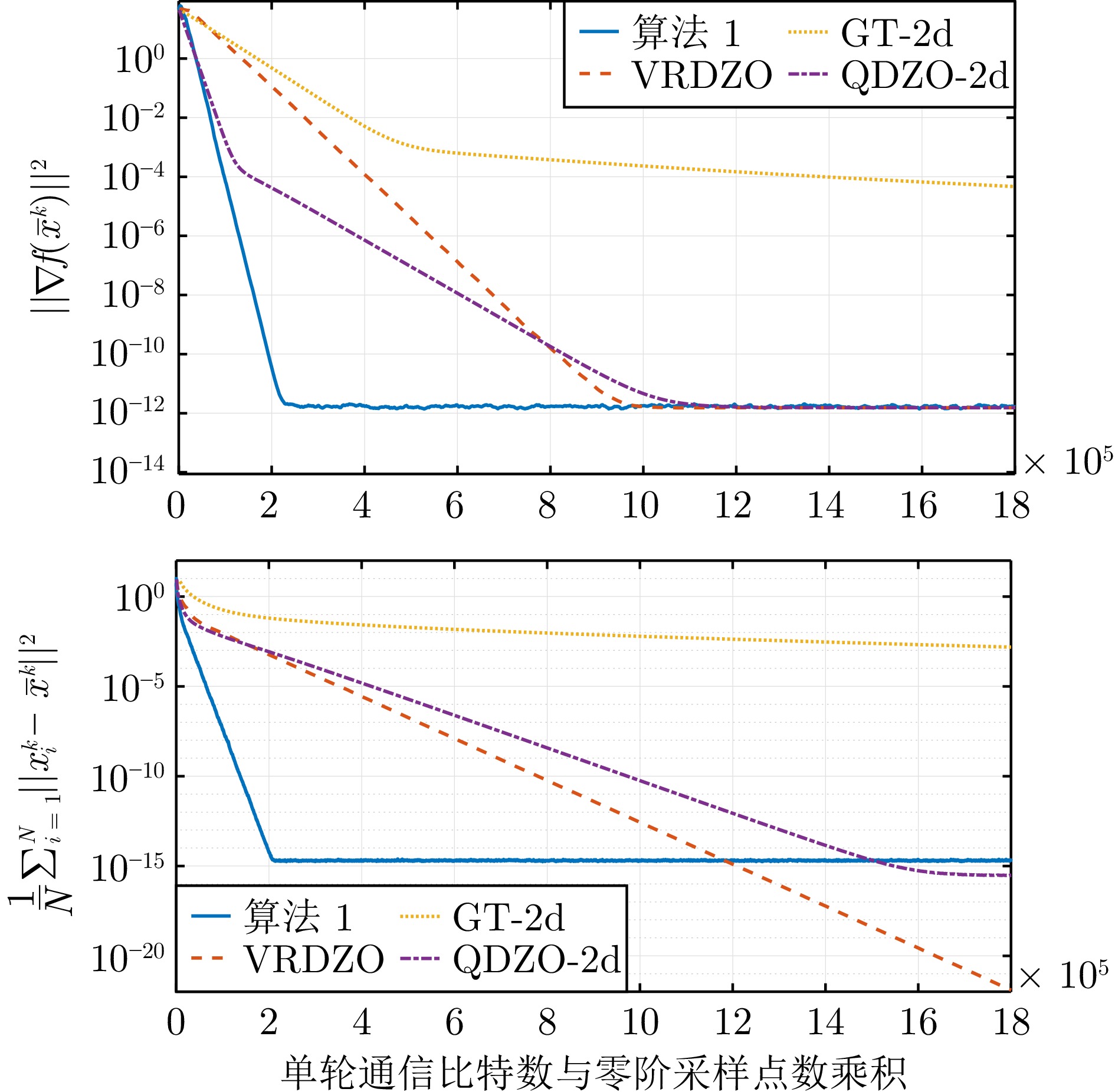
图 1 算法1与已有算法的性能对比
Fig. 1 Performance comparison of Algorithm 1 and existing algorithms
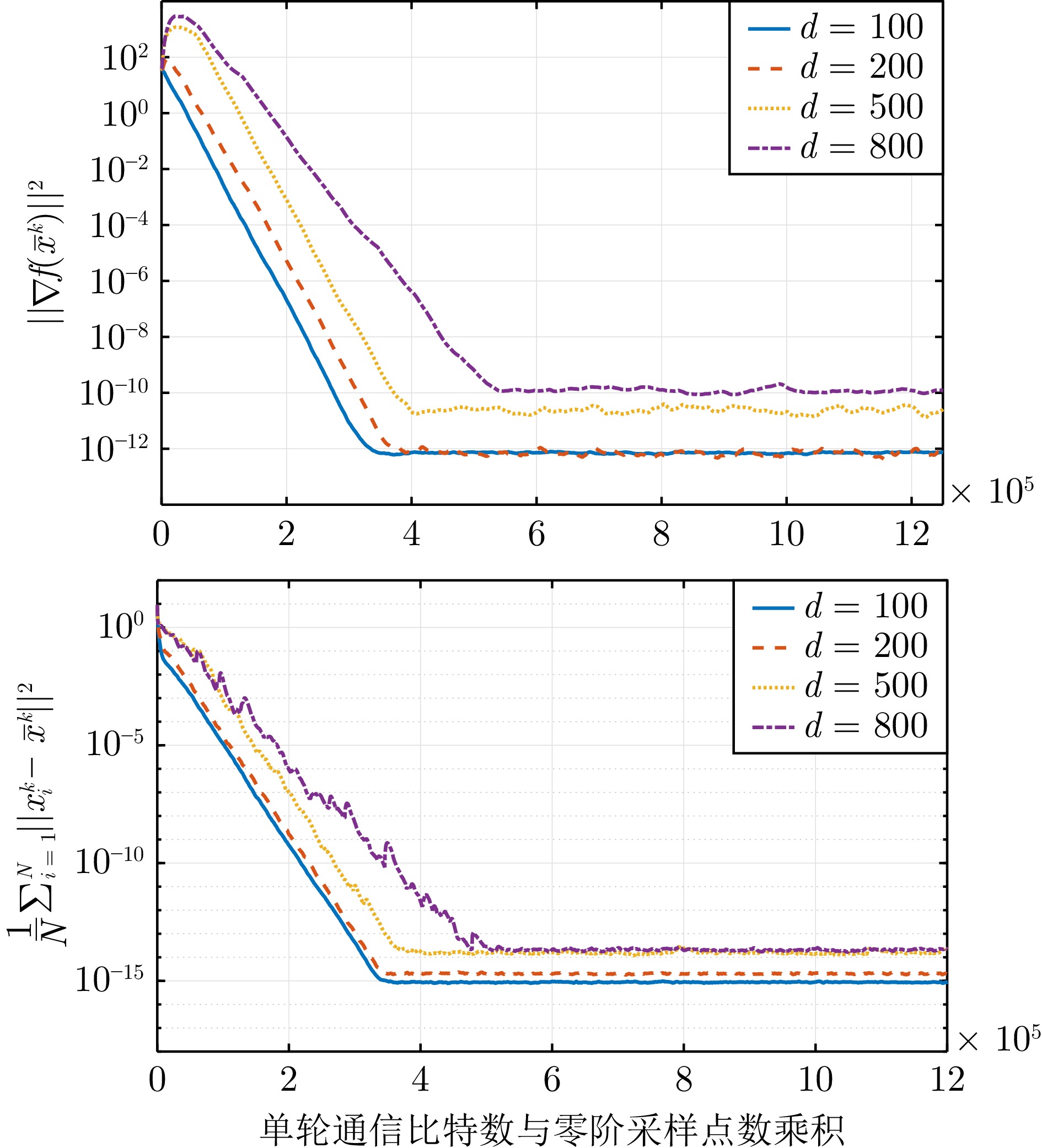
图 3 算法1在不同维度下的性能对比
Fig. 3 Performance comparison of Algorithm 1 under different dimensions
表 1 四种零阶分布式优化算法对比
Table 1 Comparison of four zeroth-order distributed optimization algorithms
 下载: 导出CSV
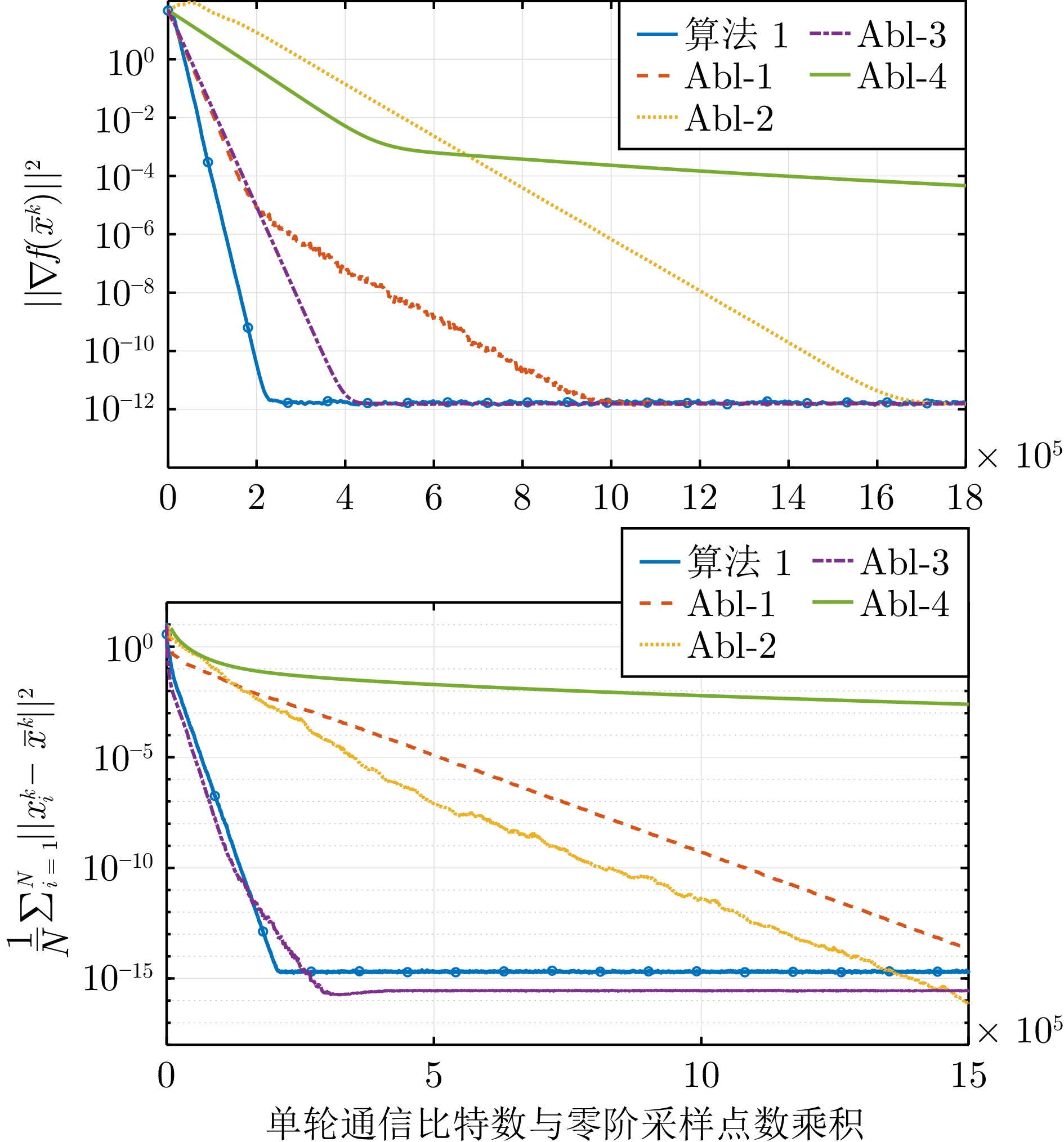
表 2 不同组件对算法性能贡献的消融实验
Table 2 Ablation study on the performance contribution of different components
方差缩减梯度估计 量化通信 切比雪夫加速 算法1 $ \surd $ $ \surd $ $ \surd $ Abl-1 – $ \surd $ $ \surd $ Abl-2 $ \surd $ – $ \surd $ Abl-3 $ \surd $ $ \surd $ – Abl-4 – – –
下载: 导出CSV
-
[1] 杨涛, 徐磊, 易新蕾, 张圣军, 陈蕊娟, 李渝哲. 基于事件触发的分布式优化算法. 自动化学报, 2022, 48(1): 133−143 doi: 10.16383/j.aas.c200838T. Yang, L. Xu, X. Yi, S. Zhang, R. Chen, and Y. Li. Event-triggered distributed optimization algorithms. Acta Automatica Sinica, 2022, 48(1): 133−143 doi: 10.16383/j.aas.c200838 [2] 段志生, 吕跃祖, 段培虎, 杨莹, 王金枝, 温广辉. 多智能体系统协同互估计与控制一体化框架. 自动化学报, 2025, 51(10): 2359−2370 doi: 10.16383/j.aas.c250290Z. Duan, Y. Lv, p. Duan, Y. Yang, J. Wang, and G. Wen. Integrated framework for cooperative mutual estimation and control in multi-agent systems. Acta Automatica Sinica, 2025, 51(10): 2359−2370 doi: 10.16383/j.aas.c250290 [3] M. Lin, G. Yuan, and D. Liu. Federated learning adaptive dynamic programming for massive multiagent mean-field games-based optimal consensus. IEEE Transactions on Cybernetics, 2026, 56(2): 915−926 doi: 10.1109/TCYB.2025.3606528 [4] 李忠奎, 王俊杰, 张云奕, 张硕, 国萌, 孙志勇. 集群协同任务规划的形式逻辑方法: 综述与展望. 自动化学报, 2025, 51(10): 1−21 doi: 10.16383/j.aas.c250223Z. Li, J. Wang, Y. Zhang, S. Zhang, M. Guo, and Z. Sun. Formal logic-based cooperative task planning for multi-robot systems: Survey of recent advances and future directions. Acta Automatica Sinica, 2025, 51(10): 1−21 doi: 10.16383/j.aas.c250223 [5] J. Liu, D. W. C. Ho, and L. Li. A generic algorithm framework for distributed optimization over the time-varying network with communication delays. IEEE Transactions on Automatic Control, 2024, 69(1): 371−378 doi: 10.1109/TAC.2023.3264784 [6] M.-Y. Wan, Y. Xu, and Z.-G. Wu. Dynamic event-triggered resilient control of nonlinear multi-agent systems against asynchronous dos attacks. IEEE Transactions on Automation Science and Engineering, 2025, 22: 13 doi: 10.21203/rs.3.rs-8219905/v1 [7] 侯瑞捷, 李修贤, 易新蕾, 洪奕光, 谢立华. 具有反馈延迟分布式在线复合优化的动态遗憾性能. 自动化学报, 2025, 51(4): 835−856 doi: 10.16383/j.aas.c240414R. Hou, X. Li, X. Yi, Y. Hong, and L. Xie. Dynamic regret for distributed online composite optimization with delayed feedbacks. Acta Automatica Sinica, 2025, 51(4): 835−856 doi: 10.16383/j.aas.c240414 [8] 时侠圣, 杨涛, 林志赟, 王雪松. 基于连续时间的二阶多智能体分布式资源分配算法. 自动化学报, 2021, 47(8): 2050−2060 doi: 10.16383/j.aas.c200968X. Shi, T. Yang, Z. Lin, and X. Wang. Distributed resource allocation algorithm for second-order multi-agent systems in continuous-time. Acta Automatica Sinica, 2021, 47(8): 2050−2060 doi: 10.16383/j.aas.c200968 [9] X. Lian, C. Zhang, H. Zhang, C. -J. Hsieh, W. Zhang, and J. Liu, "Can decentralized algorithms outperform centralized algorithms? A case study for decentralized parallel stochastic gradient descent, " in Advances in Neural Information Processing Systems, vol. 30. Curran Associates, Inc., 2017, pp. 5331–5341. [10] G. Scutari and Y. Sun. Distributed nonconvex constrained optimization over time-varying digraphs. Mathematical Programming, 2019, 176: 497−544 doi: 10.1007/s10107-018-01357-w [11] R. Xin, U. A. Khan, and S. Kar. An improved convergence analysis for decentralized online stochastic non-convex optimization. IEEE Transactions on Signal Processing, 2021, 69: 1842−1858 doi: 10.1109/TSP.2021.3062553 [12] Z. Li, Z. Dong, Z. Liang, and Z. Ding. Surrogate-based distributed optimisation for expensive black-box functions. Automatica, 2021, 125: 109407 doi: 10.1016/j.automatica.2020.109407 [13] S. Malladi, T. Gao, E. Nichani, A. Damian, J. D. Lee, D. Chen, and S. Arora, "Fine-tuning language models with just forward passes, " in Advances in Neural Information Processing Systems, vol. 36. Curran Associates, Inc., 2023, pp. 53 038–53 075. [14] Y. Nesterov and V. Spokoiny. Random gradient-free minimization of convex functions. Foundations of Computational Mathematics, 2017, 17(2): 527−566 doi: 10.1007/s10208-015-9296-2 [15] J. C. Duchi, M. I. Jordan, M. J. Wainwright, and A. Wibisono. Optimal rates for zero-order convex optimization: The power of two function evaluations. IEEE Transactions on Information Theory, 2015, 61(5): 2788−2806 doi: 10.1109/TIT.2015.2409256 [16] A. K. Sahu, D. Jakovetic, D. Bajovic, and S. Kar. (2018) Communication-efficient distributed strongly convex stochastic optimization: Non-asymptotic rates. ArXiv: 1809.02920. [Online]. Available: https://arxiv.org/abs/1809.02920 [17] Y. Tang, J. Zhang, and N. Li. Distributed zero-order algorithms for nonconvex multiagent optimization. IEEE Transactions on Control of Network Systems, 2021, 8(1): 269−281 doi: 10.1109/TCNS.2020.3024321 [18] J. Kiefer and J. Wolfowitz. Stochastic estimation of the maximum of a regression function. The Annals of Mathematical Statistics, 1952462−466 [19] X. Yi, S. Zhang, T. Yang, T. Chai, and K. H. Johansson. Linear convergence of first-and zeroth-order primal-dual algorithms for distributed nonconvex optimization. IEEE Transactions on Automatic Control, 2021, 67(8): 4194−4201 doi: 10.1109/tac.2021.3108501 [20] A. Nedić. Distributed gradient methods for convex machine learning problems in networks: Distributed optimization. IEEE Signal Processing Magazine, 2020, 37(3): 92−101 doi: 10.1109/MSP.2020.2975210 [21] H. Mu, Y. Tang, and Z. Li, "Variance-reduced gradient estimator for nonconvex zeroth-order distributed optimization, " in 2025 American Control Conference (ACC). IEEE, 2025, pp. 1667–1674. [22] 王冰洁, 徐磊, 林宗利, 施阳, 杨涛. 基于自适应动态规划的量化通信下协同最优输出调节. 自动化学报, 2025, 51(4): 813−823 doi: 10.16383/j.aas.c240494B. Wang, L. Xu, Z. Lin, Y. Shi, and T. Yang. Cooperative optimal output regulation under quantized communication based on adaptive dynamic programming. Acta Automatica Sinica, 2025, 51(4): 813−823 doi: 10.16383/j.aas.c240494 [23] L. Roberts. Picture coding using pseudo-random noise. IRE Transactions on Information Theory, 1962, 8(2): 145−154 doi: 10.1109/TIT.1962.1057702 [24] D. Alistarh, D. Grubic, J. Li, R. Tomioka, and M. Vojnovic, "QSGD: Communication-efficient SGD via gradient quantization and encoding, " in Advances in Neural Information Processing Systems, vol. 30. Curran Associates, Inc., 2017, pp. 1710–1721. [25] S. Horváth, D. Kovalev, K. Mishchenko, P. Richtárik, and S. Stich. Stochastic distributed learning with gradient quantization and double-variance reduction. Optimization Methods and Software, 2023, 38(1): 91−106 doi: 10.1080/10556788.2022.2117355 [26] T. Li, M. Fu, L. Xie, and J.-F. Zhang. Distributed consensus with limited communication data rate. IEEE Transactions on Automatic Control, 2011, 56(2): 279−292 doi: 10.1109/TAC.2010.2052384 [27] P. Yi and Y. Hong. Quantized subgradient algorithm and data-rate analysis for distributed optimization. IEEE Transactions on Control of Network Systems, 2014, 1(4): 380−392 doi: 10.1109/TCNS.2014.2357513 [28] Y. Xiong, L. Wu, K. You, and L. Xie. Quantized distributed gradient tracking algorithm with linear convergence in directed networks. IEEE Transactions on Automatic Control, 2023, 68(9): 5638−5645 doi: 10.1109/TAC.2022.3219289 [29] Y. Kajiyama, N. Hayashi, and S. Takai. Linear convergence of consensus-based quantized optimization for smooth and strongly convex cost functions. IEEE Transactions on Automatic Control, 2021, 66(3): 1254−1261 doi: 10.1109/TAC.2020.2989281 [30] L. Xu, X. Yi, C. Deng, Y. Shi, T. Chai, and T. Yang. Quantized zeroth-order gradient tracking algorithm for distributed nonconvex optimization under polyak-łojasiewicz condition. IEEE Transactions on Cybernetics, 2024, 54(10): 5746−5758 doi: 10.1109/TCYB.2024.3384924 [31] K. Scaman, F. Bach, S. Bubeck, Y. T. Lee, and L. Massoulié, "Optimal algorithms for smooth and strongly convex distributed optimization in networks, " in Proceedings of the 34th International Conference on Machine Learning. PMLR, 2017, pp. 3027–3036. [32] H. Li and Z. Lin. Accelerated gradient tracking over time-varying graphs for decentralized optimization. Journal of Machine Learning Research, 2024, 25(274): 1−52 [33] Z. Song, L. Shi, S. Pu, and M. Yan. Optimal gradient tracking for decentralized optimization. Mathematical Programming, 2024, 207(1): 1−53 [34] K. Huang, S. Pu, and A. Nedić. An accelerated distributed stochastic gradient method with momentum. Mathematical Programming, 20251−44 [35] B. T. Polyak. Gradient methods for solving equations and inequalities. USSR Computational Mathematics and Mathematical Physics, 1964, 4(6): 17−32 doi: 10.1016/0041-5553(64)90079-5 [36] S. Łojasiewicz, "A topological property of real analytic subsets, " Coll. du CNRS, Les équations aux dérivées partielles, vol. 117, no. 87-89, p. 2, 1963. [37] W. Shi, Q. Ling, G. Wu, and W. Yin. EXTRA: An exact first-order algorithm for decentralized consensus optimization. SIAM Journal on Optimization, 2015, 25(2): 944−966 doi: 10.1137/14096668X [38] G. Qu and N. Li. Harnessing smoothness to accelerate distributed optimization. IEEE Transactions on Control of Network Systems, 2017, 5(3): 1245−1260 [39] A. Nedić, A. Olshevsky, and W. Shi. Achieving geometric convergence for distributed optimization over time-varying graphs. SIAM Journal on Optimization, 2017, 27(4): 2597−2633 doi: 10.1137/16M1084316 [40] H. Mu, Y. Tang, J. Song, and Z. Li, "Variance-reduced gradient estimator for nonconvex zeroth-order distributed optimization, " IEEE Transactions on Automatic Control, 2026. [Online]. Available: https://doi.org/10.1109/TAC.2026.3711936 [41] L. Xiao, S. Boyd, and S. Lall, "A scheme for robust distributed sensor fusion based on average consensus, " in Fourth International Symposium on Information Processing in Sensor Networks (IPSN 2005). IEEE, 2005, pp. 63–70. -

 下载:

计量
- 文章访问数: 17
- HTML全文浏览量: 12
- 被引次数: 0
