


Differentiated Game Decision-Making for Cooperative Ramp Merging of Intelligent and Connected Vehicles In Mixed Traffic Flow
-
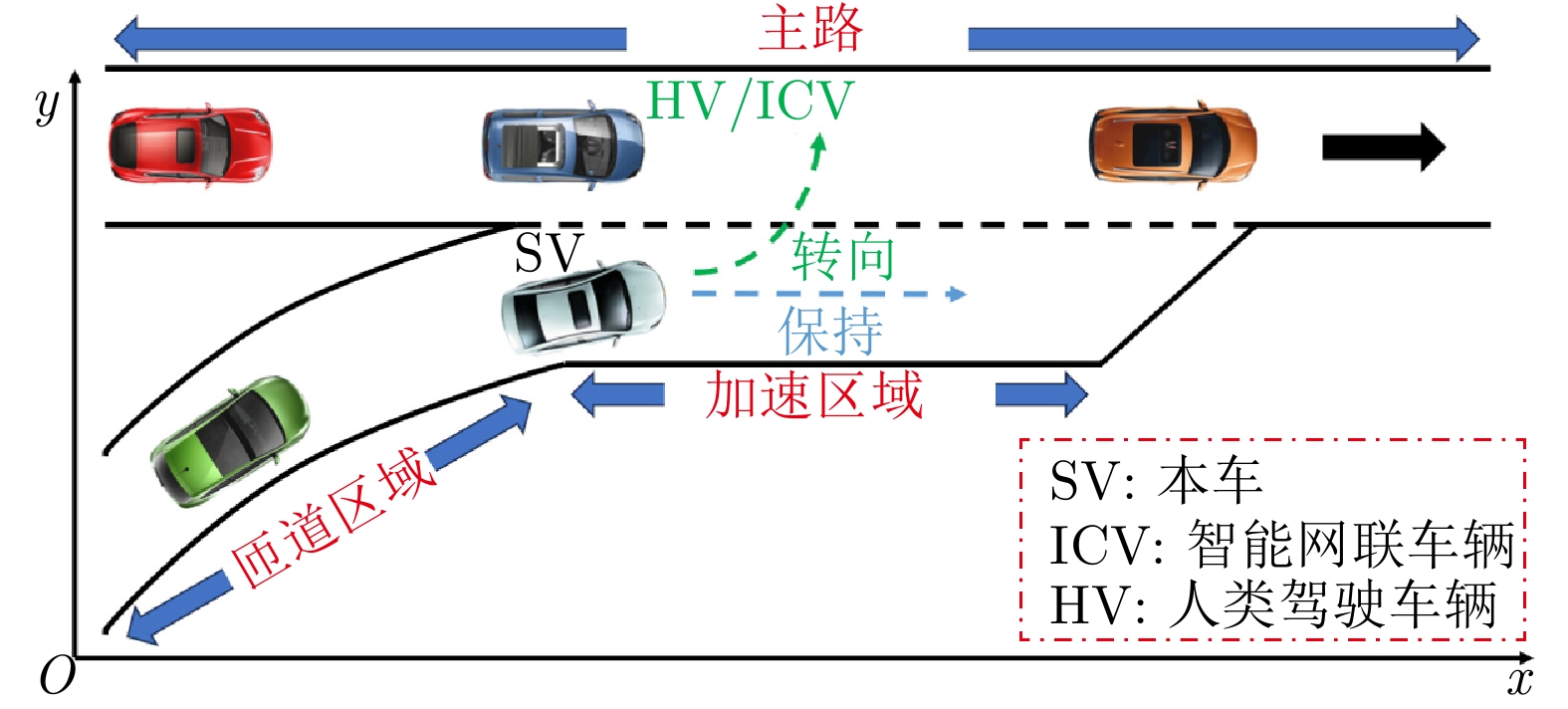
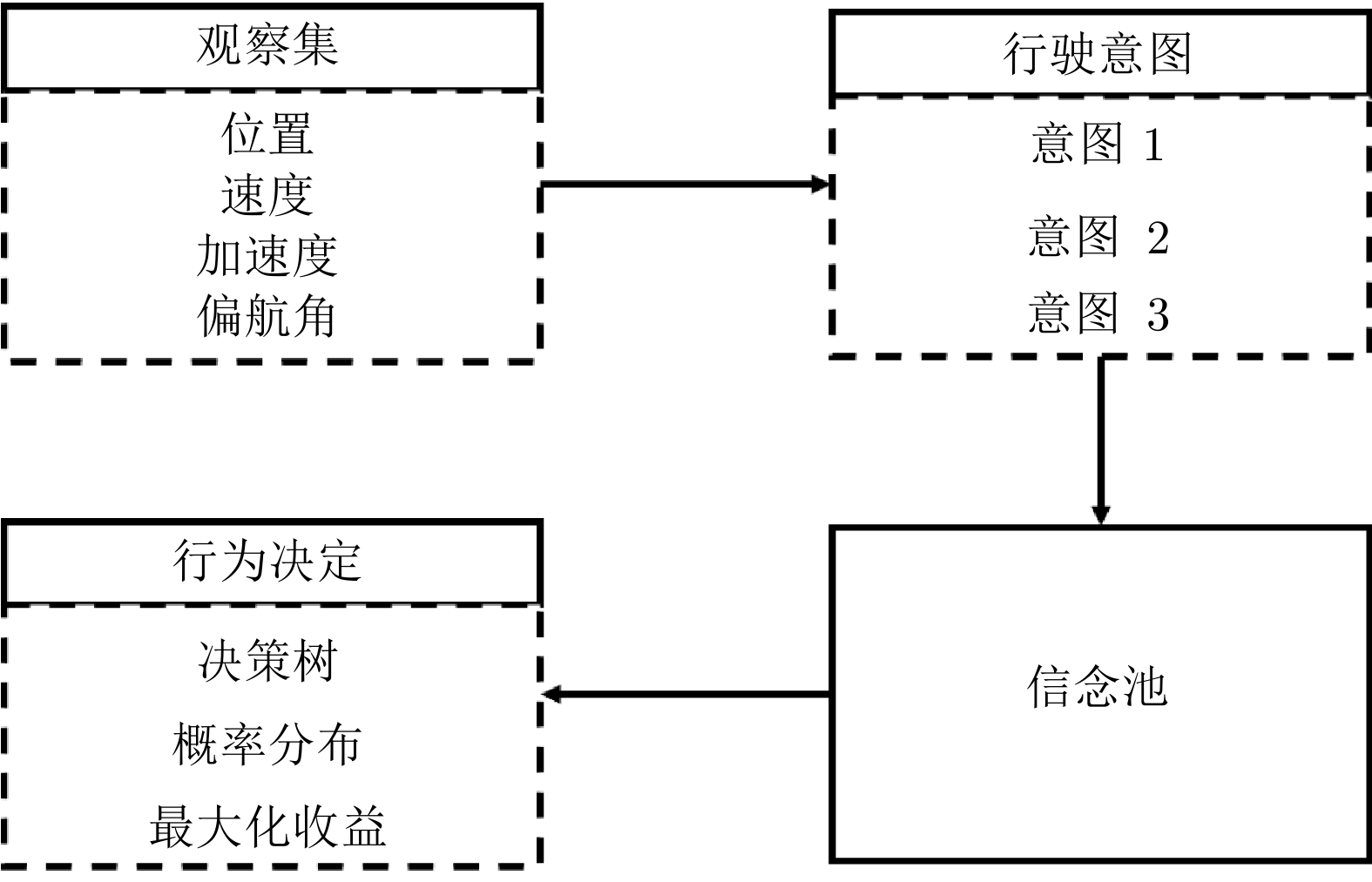
摘要: 基于博弈论的决策模型为实现安全、高效的匝道汇入提供了核心技术支撑; 然而, 现有相关模型局限于只含有智能网联车辆(ICV)}的汇入场景, 未充分考虑人工驾驶车辆(HV)的存在, 与目前ICV与HV混合行驶的现实需求相悖, 难以满足复杂混合交通流下的匝道汇入决策需求. 为此, 针对ICV和HV共存的混合交通流场景, 本文聚焦匝道区域ICV的汇入决策, 提出一种基于博弈理论的差异化汇入决策策略. 首先, 采用静态博弈模型构建ICV间汇入交互机制, 实现ICV间的高效协同汇入, 降低交互冲突. 其次, 采用基于信念池的非合作博弈方法处理ICV与HV的异质交互, 通过信念池动态识别并迭代更新HV驾驶风格, 适应HV驾驶行为的不确定性, 实现二者协同汇入. 同时, 为提升ICV汇入过程中的驾乘舒适度, 引入车间时距参数, 通过该参数平滑调控车辆横向加速度, 减少横向运动波动. 最后, 通过系列仿真验证了策略有效性, 结果表明: 1) ICV间的协同交互有助于提升入口匝道汇入效率; 2) ICV与HV交互时, ICV能够识别邻近HV驾驶模式并生成适应性决策, 有利于改善混合交通流整体行驶效率.Abstract: Decision models based on game theory provide core technical support for the safe and efficient operation of ramp merging scenarios; however, existing related models are limited to merging scenarios containing only intelligent and connected vehicle (ICV), failing to fully consider the existence of human-driven vehicle (HV), which is inconsistent with the current practical demand of mixed driving of ICVs and HVs, making it difficult to meet the ramp merging decision-making requirements under complex mixed traffic flow conditions. To this end, aiming at the mixed traffic flow scenario where ICV and HV coexist, this paper focuses on the merging decision-making of ICVs in the ramp area and proposes a differentiated merging decision strategy based on game theory. Firstly, a static game model is adopted to construct an interaction mechanism for merging between ICVs, so as to realize efficient cooperative merging between ICVs and reduce interaction conflicts. Then, a non-cooperative game method based on belief pool is adopted to handle the heterogeneous interaction between ICV and HV. Based on the belief pool, the driving style of HVs is dynamically identified and iteratively updated, which adapts to the uncertainty of HV driving behaviors and realizes the cooperative merging of the two. Meanwhile, to improve the riding comfort of ICV during the merging process, the time of inter-vehicular parameter is introduced as the core control variable, and the lateral acceleration of the vehicle is smoothly adjusted through this parameter to reduce lateral motion fluctuations. In the end, the effectiveness of the strategy is verified through a series of simulations and the following results can be obtained: 1) The interaction between ICV contributes to enhancing the efficiency of on-ramp merging; 2) While ICV interact with HV, ICV is capable of identifying the driving patterns of neighboring vehicles and making adaptive decisions, helping to improve overall driving efficiency.
-
Key words:
- ramp merging /
- mixed traffic flow /
- static game /
- non-cooperative game /
- belief pool
-
表 1 参与行为概率
Table 1 Probability of behavior of the parties
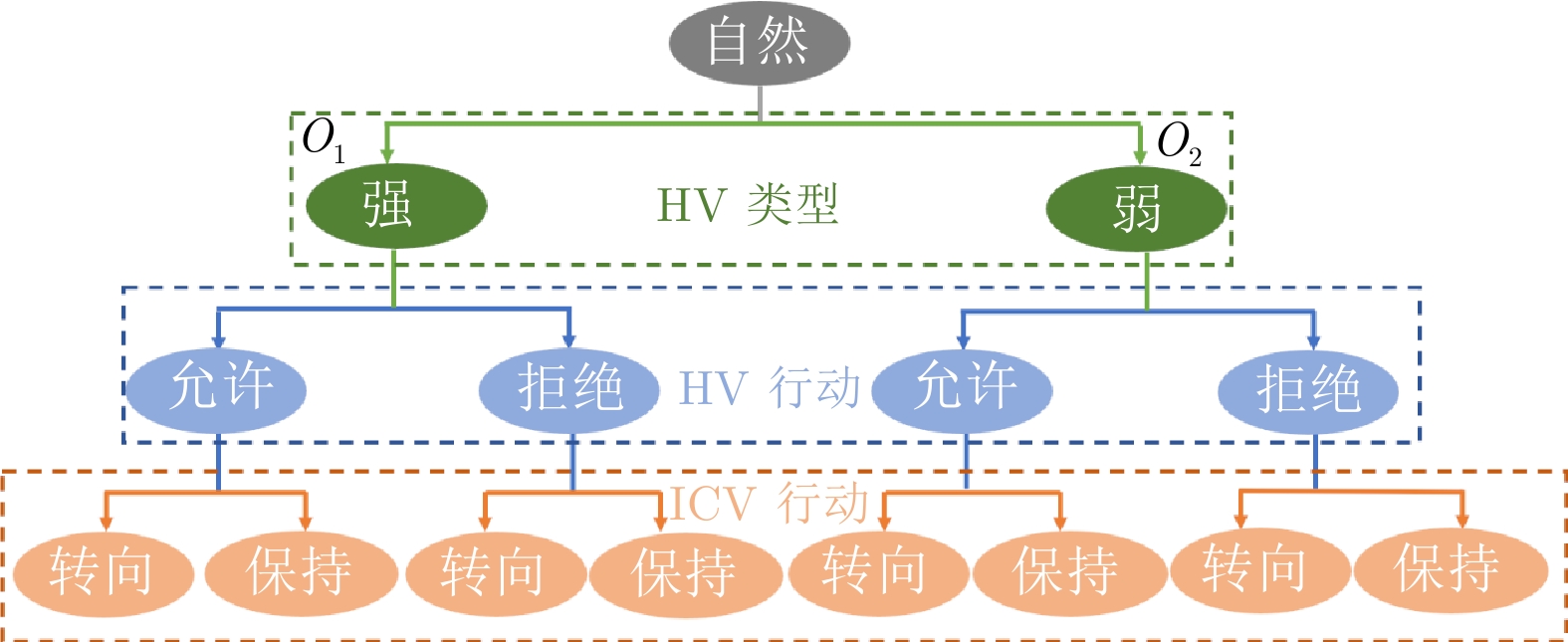
SV行为概率 类型 概率 转向 保持 强 $ O_{1} $ $ \pi_{1} $ $ \pi_{2} $ 弱 $ O_{2} $ $ \xi_{1} $ $ \xi_{2} $ HV行为概率 类型 概率 允许 拒绝 强 $ Z_{1} $ $ \mathcal{E}_{1} $ $ \mathcal{E}_{2} $ 弱 $ Z_{2} $ $ \varUpsilon_{1} $ $ \varUpsilon_{2} $  下载: 导出CSV
表 2 收益矩阵
Table 2 Payoff matrix
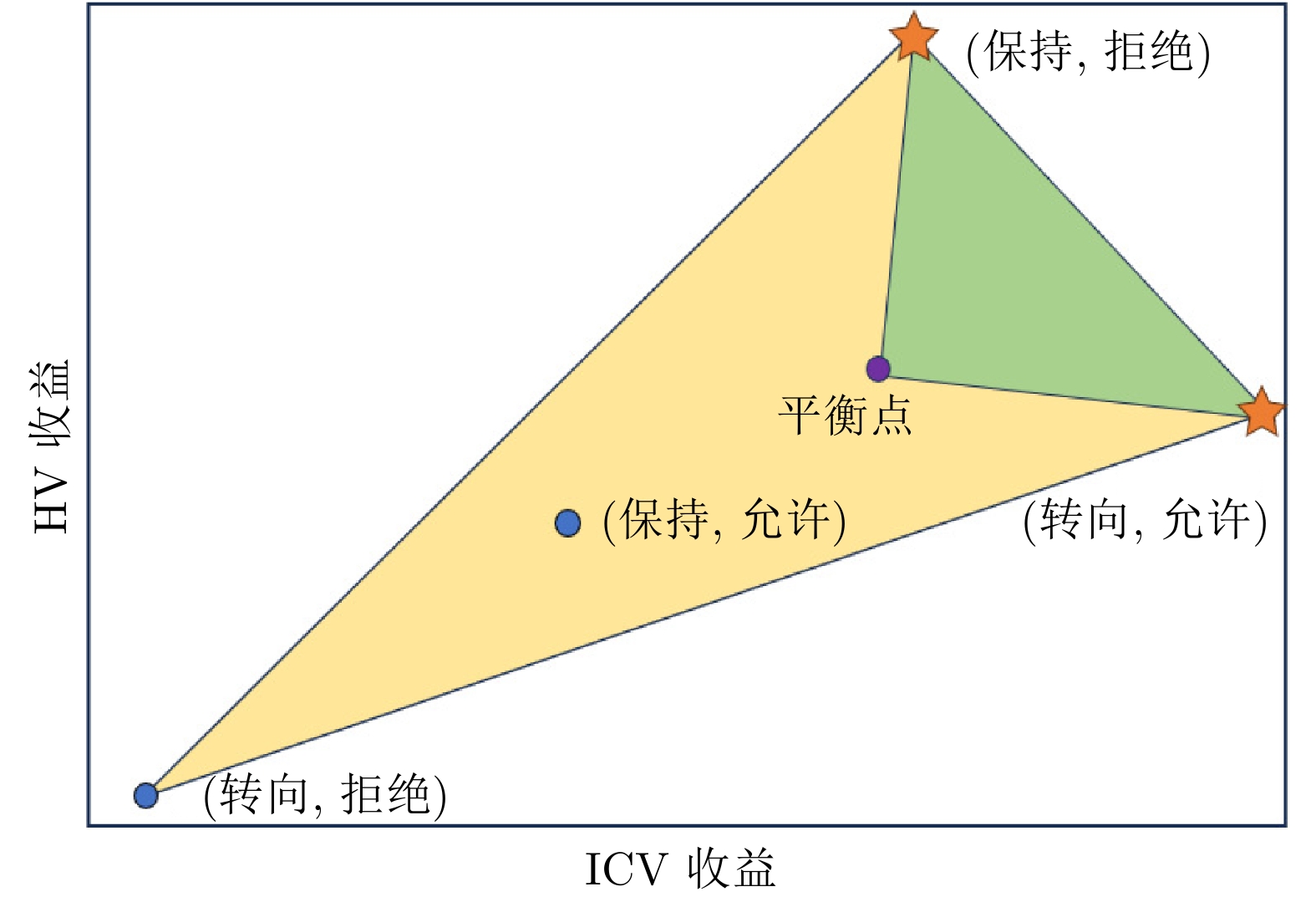
SV GV 允许 拒绝 保持 $\nu_{\scriptscriptstyle SV}^{11},\; \nu_{\scriptscriptstyle GV}^{11}$ $\nu_{\scriptscriptstyle SV}^{12},\; \nu_{\scriptscriptstyle GV}^{12}$ 转向 $\nu_{\scriptscriptstyle SV}^{21},\; \nu_{\scriptscriptstyle GV}^{21}$ $\nu_{\scriptscriptstyle SV}^{22},\; \nu_{\scriptscriptstyle GV}^{22}$
下载: 导出CSV
表 4 仿真中车辆的初始状态
Table 4 Initial state of vehicles in simulation
车辆 初始横向位置(m) 初始速度(m/s) 初始加速度(m/s$^2$) SV 0 10 0.5 ICV 4 11 0
下载: 导出CSV
表 5 仿真中车辆的初始状态
Table 5 Initial state of vehicles in simulation
车辆 初始横向位置
(m)初始速度
(m/s)初始加速度
(m/s$^2$)强弱初始概率 SV 0 10 0 (0.5, 0.5) HV 4 11 0 (0.4, 0.6)
下载: 导出CSV
表 6 仿真中车辆的初始状态
Table 6 Initial state of vehicles in simulation
车辆 初始横向位置
(m)初始速度
(m/s)初始加速度
(m/s$^2$)强弱初始概率 SV 0 10 0.5 (0.5, 0.5) HV 4 11 1 (0.6, 0.4)
下载: 导出CSV
-
[1] J. Zhu, S. Easa, and K. Gao. Merging Control Strategies of Connected and Autonomous Vehicles at Freeway On-Ramps: A Comprehensive Review. J. Intel. Connect. Veh., 2022, 5(2): 99−111 doi: 10.1108/JICV-02-2022-0005 [2] X. Liao, X. Zhao, Z. Wang, K. Han, P. Tiwari, M. J. Barth, and G. Wu. Game Theory-Based Ramp Merging for Mixed Traffic With Unity-SUMO Co-Simulation. IEEE Trans. Syst. Man Cybern. Syst., 2022, 52(9): 5746−5757 doi: 10.1109/TSMC.2021.3131431 [3] Y. Huang, Y. Gu, K. Yuan, S. Yang, T. Liu, and H. Chen. Human Knowledge Enhanced Reinforcement Learning for Mandatory Lane-Change of Autonomous Vehicles in Congested Traffic. IEEE Trans. Intell. Transp. Syst., 2024, 9(2): 3509−3519 [4] Z. He, H. Pei, Y. Guo, D. Yao, Y. Zhang, and L. Li. Comparative Analysis of Cooperative Driving Strategies for CAVs at On-Ramps. IEEE Trans. Veh. Technol., 2023, 72(6): 8099−8104 doi: 10.1109/TVT.2023.3241303 [5] N. Chen, B. van Arem, T. Alkim, and M. Wang. A Hierarchical Model-Based Optimization Control Approach for Cooperative Merging by Connected Automated Vehicles. IEEE Trans. Intell. Transp. Syst., 2021, 22(12): 7712−7725 doi: 10.1109/TITS.2020.3007647 [6] H. Ding, W. Li, N. Xu, and J. Zhang. An Enhanced Eco-Driving Strategy Based on Reinforcement Learning for Connected Electric Vehicles: Cooperative Velocity and Lane-Changing Control. J. Intel. Connect. Veh., 2022, 5(3): 316−332 doi: 10.1108/JICV-07-2022-0030 [7] X. Zhang, L. Wu, H. Liu, Y. Wang, H. Li, and B. Xu. High-Speed Ramp Merging Behavior Decision for Autonomous Vehicles Based on Multiagent Reinforcement Learning. IEEE Internet Things J., 2023, 10(24): 22664−22672 doi: 10.1109/JIOT.2023.3304890 [8] B. Sakhdari and N. L. Azad. Adaptive Tube-Based Nonlinear MPC for Economic Autonomous Cruise Control of Plug-In Hybrid Electric Vehicles. IEEE Trans. Veh. Technol., 2018, 67(12): 11390−11401 doi: 10.1109/TVT.2018.2872654 [9] L. Zhai, C. Wang, Y. Hou, and C. Liu. MPC-Based Integrated Control of Trajectory Tracking and Handling Stability for Intelligent Driving Vehicle Driven by Four Hub Motor. IEEE Trans. Veh. Technol., 2022, 71(3): 2668−2680 doi: 10.1109/TVT.2022.3140240 [10] L. Han, X. Ma, Y. Wang, L. He, Y. Li, and L. Zhang. Safe and Efficient DRL Driving Policies Using Fuzzy Logic for Urban Lane Changing Scenarios. J. Intel. Connect. Veh., 2025, 8(1): 9210054−1 [11] K. Tang, S. Zhu, Y. Xu, and F. Wang. Modeling Drivers' Dynamic Decision-Making Behavior During the Phase Transition Period: An Analytical Approach Based on Hidden Markov Model Theory. IEEE Trans. Intell. Transp. Syst., 2016, 17(1): 206−214 doi: 10.1109/TITS.2015.2462738 [12] P. Pouya and A. M. Madni. Expandable-Partially Observable Markov Decision-Process Framework for Modeling and Analysis of Autonomous Vehicle Behavior. IEEE Syst. J., 2021, 15(3): 3714−3725 doi: 10.1109/JSYST.2020.3010473 [13] Y. Guan, S. E. Li, J. Duan, W. Wang, and B. Cheng. Markov Probabilistic Decision Making of Self-driving Cars in Highway With Random Traffic Flow: A Simulation Study. J. Intel. Connect. Veh., 2018, 1(2): 77−84 doi: 10.1108/JICV-01-2018-0003 [14] S. Xia, H. Min, X. Wu, Y. Fang, W. Wang, Z. Xu, and X. Zhao. On-Ramp Merging Strategy Integrating Dynamic Lane-Changing Decision and Quasi-Uniform B-Spline Trajectory Optimization. IEEE Trans. Veh. Technol., 2024, 73(12): 18333−18347 doi: 10.1109/TVT.2024.3445958 [15] J. Liu, W. Zhao, and C. Xu. An Efficient On-Ramp Merging Strategy for Connected and Automated Vehicles in Multi-Lane Traffic. IEEE Trans. Intell. Transp. Syst., 2022, 23(6): 5056−5067 doi: 10.1109/TITS.2020.3046643 [16] J. Rios-Torres and A. A. Malikopoulos. Automated and Cooperative Vehicle Merging at Highway On-Ramps. IEEE Trans. Intell. Transp. Syst., 2017, 18(4): 780−789 doi: 10.1109/TITS.2016.2587582 [17] W. Xiao and C. G. Cassandras. Decentralized Optimal Merging Control for Connected and Automated Vehicles. Automatica, Jan. 2021, 123: article no. 109333 doi: 10.1016/j.automatica.2020.109333 [18] V. Milanes, J. Godoy, J. Villagra, and J. Perez. Automated On-Ramp Merging System for Congested Traffic Situations. IEEE Trans. Intell. Transp. Syst., 2011, 12(2): 500−508 doi: 10.1109/TITS.2010.2096812 [19] T. Yuan, F. Alasiri, and P. A. Ioannou. Selection of the Speed Command Distance for Improved Performance of a Rule-Based VSL and Lane Change Control. IEEE Trans. Intell. Transp. Syst., 2022, 23(10): 19348−19357 doi: 10.1109/TITS.2022.3157516 [20] J. Ding, L. Li, H. Peng, and Y. Zhang. A Rule-Based Cooperative Merging Strategy for Connected and Automated Vehicles. IEEE Trans. Intell. Transp. Syst., 2020, 21(8): 3436−3446 doi: 10.1109/TITS.2019.2928969 [21] M. A. Makridis, J. Schaniel, and A. Kouvelas. Rule-Based On-Off Traffic Control Strategy for CAVs on Motorway Networks: Assessing Cooperation Level and Driving Homogeneity. IEEE Access., 2023, 11: 35111−35121 doi: 10.1109/ACCESS.2023.3265470 [22] L. Zhang, J. Yang, S. Liao, J. Yao, P. Wang, and X. Zhao, "Research on Merging Strategies of Connected and Autonomous Vehicles Based on The Game Theory under On-ramp Scenarios, " 2022 34th CCDC, 2022, pp. 1004-1009. [23] C. Wei, Y. He, H. Tian, and Y. Lv. Game Theoretic Merging Behavior Control for Autonomous Vehicle at Highway On-Ramp. IEEE Trans. Intell. Transp. Syst., 2022, 23(11): 21127−21136 doi: 10.1109/TITS.2022.3174659 [24] M. Liu, Y. Wan, F. L. Lewis, S. Nageshrao, and D. Filev. A Three-Level Game-Theoretic Decision-Making Framework for Autonomous Vehicles. IEEE Trans. Intell. Transp. Syst., 2022, 23(11): 20298−20308 doi: 10.1109/TITS.2022.3172926 [25] D. Li, J. Zhang, and G. Liu. Autonomous Driving Decision Algorithm for Complex Multi-Vehicle Interactions: An Efficient Approach Based on Global Sorting and Local Gaming. IEEE Trans. Intell. Transp. Syst., 2024, 25(7): 6927−6937 doi: 10.1109/TITS.2023.3346048 [26] L. Cai, H. Guan, Q. H. Xu, X. Jia, and J. Zhan. Game-Theoretic Decision-Making Method and Motion Planning for Autonomous Vehicles in Overtaking. IEEE Trans. Intell. Transp. Syst., 2024, 25(8): 9693−9709 doi: 10.1109/TITS.2024.3378162 [27] P. Hang, C. Lv, Y. Xing, C. Huang, and Z. Hu. Human-Like Decision Making for Autonomous Driving: A Noncooperative Game Theoretic Approach. IEEE Trans. Intell. Transp. Syst., 2021, 22(4): 2076−2087 doi: 10.1109/TITS.2020.3036984 [28] A. Liniger and J. Lygeros. A Noncooperative Game Approach to Autonomous Racing. IEEE Trans. Control Syst. Technol., 2020, 28(3): 884−897 doi: 10.1109/TCST.2019.2895282 [29] Y. Liu, C. Zong, C. Dai, H. Zheng, and D. Zhang. Behavioral Decision-Making Approach for Vehicle Platoon Control: Two Noncooperative Game Models. IEEE Trans. Transp. Electrif., 2023, 9(3): 4626−4638 doi: 10.1109/TTE.2023.3237929 [30] D. Wu, Z. Li, C. Du, C. Liu, Y. Li, and X. Xu. Lane Changing Control of Autonomous Vehicle With Integrated Trajectory Planning Based on Stackelberg Game. IEEE Open J. Intell. Transp. Syst., 2024, 5: 810−825 doi: 10.1109/OJITS.2024.3509462 [31] S. Jing, F. Hui, X. Zhao, J. Rios-Torres, and A. J. Khattak. Cooperative Game Approach to Optimal Merging Sequence and on-Ramp Merging Control of Connected and Automated Vehicles. IEEE Trans. Intell. Transp. Syst., 2019, 20(11): 4234−4244 doi: 10.1109/TITS.2019.2925871 [32] R. Chen and Z. Yang. Cooperative Ramp Merging Strategy at Multi-Lane Area for Automated Vehicles. IEEE Trans. Veh. Technol., 2024, 73(10): 14326−14340 doi: 10.1109/TVT.2024.3401232 [33] P. Huang, H. Ding, Z. Sun, and H. Chen. A Game-Based Hierarchical Model for Mandatory Lane Change of Autonomous Vehicles. IEEE Trans. Intell. Transp. Syst., 2024, 25(9): 11256−11268 doi: 10.1109/TITS.2024.3363156 -

 下载:

计量
- 文章访问数: 7
- HTML全文浏览量: 8
- 被引次数: 0
