


Taking Large Language Models as a Reference: Time Series Foundation Models from a Dynamical System Perspective - A Survey and Future Outlook
-
摘要: 时间序列数据广泛存在于工业、金融、医疗等关键领域, 以连续观测刻画动力系统的演化规律. 随着以大语言模型(LLMs)为代表的基础模型取得突破, 研究者在大规模时序数据上预训练时序基础模型(TSFMs), 以实现跨任务和跨领域泛化. 研究表明, TSFMs在多种时序任务中表现优异, 在实验室基准测试中展现出超越传统任务专用模型的潜力. 然而, 与技术范式和应用生态成熟的LLMs相比, TSFMs仍处于探索阶段, 通用能力体系和应用模式尚未成熟, "实验室增益"与"产业部署"之间存在结构性差距. 以LLMs为参照, 从底层动力系统视角对比两类模型的发展路径、数据基础和应用生态, 剖析制约TSFMs落地的深层原因. 进一步将文本序列与时间序列分别置于语言系统与动力系统框架下, 揭示二者在自治性、演化机制共享性和语义可解释性上的根本差异. 据此指出TSFMs面临任务解空间条件化和时序语义抽象性两大核心挑战, 并梳理相关技术进展、局限与未来方向.Abstract: Time series data are widespread in key domains including industry, finance, and healthcare, capturing dynamical system evolution through continuous observations. Breakthroughs in foundation models such as large language models (LLMs) have inspired the pretraining time series foundation models (TSFMs) on large-scale time series data for cross-task and cross-domain generalization. TSFMs excel across time series tasks and may surpass traditional task-specific models in laboratory benchmarks. However, unlike LLMs with mature technical paradigms and application ecosystems, TSFMs remain exploratory, with incomplete general capability systems and application paradigms and a structural gap between laboratory gains and industrial deployment. With LLMs as a reference, development paths, data foundations, and application ecosystems are compared from an underlying dynamical system perspective to examine deep-seated barriers to TSFM deployment. Text sequences and time series are framed within language and dynamical systems, respectively, revealing fundamental differences in autonomy, shared evolutionary mechanisms, and semantic interpretability. Two core challenges for TSFMs are identified: Task solution space conditionalization and semantic abstraction of time series. Related technical progress, limitations, and future directions are reviewed.
-
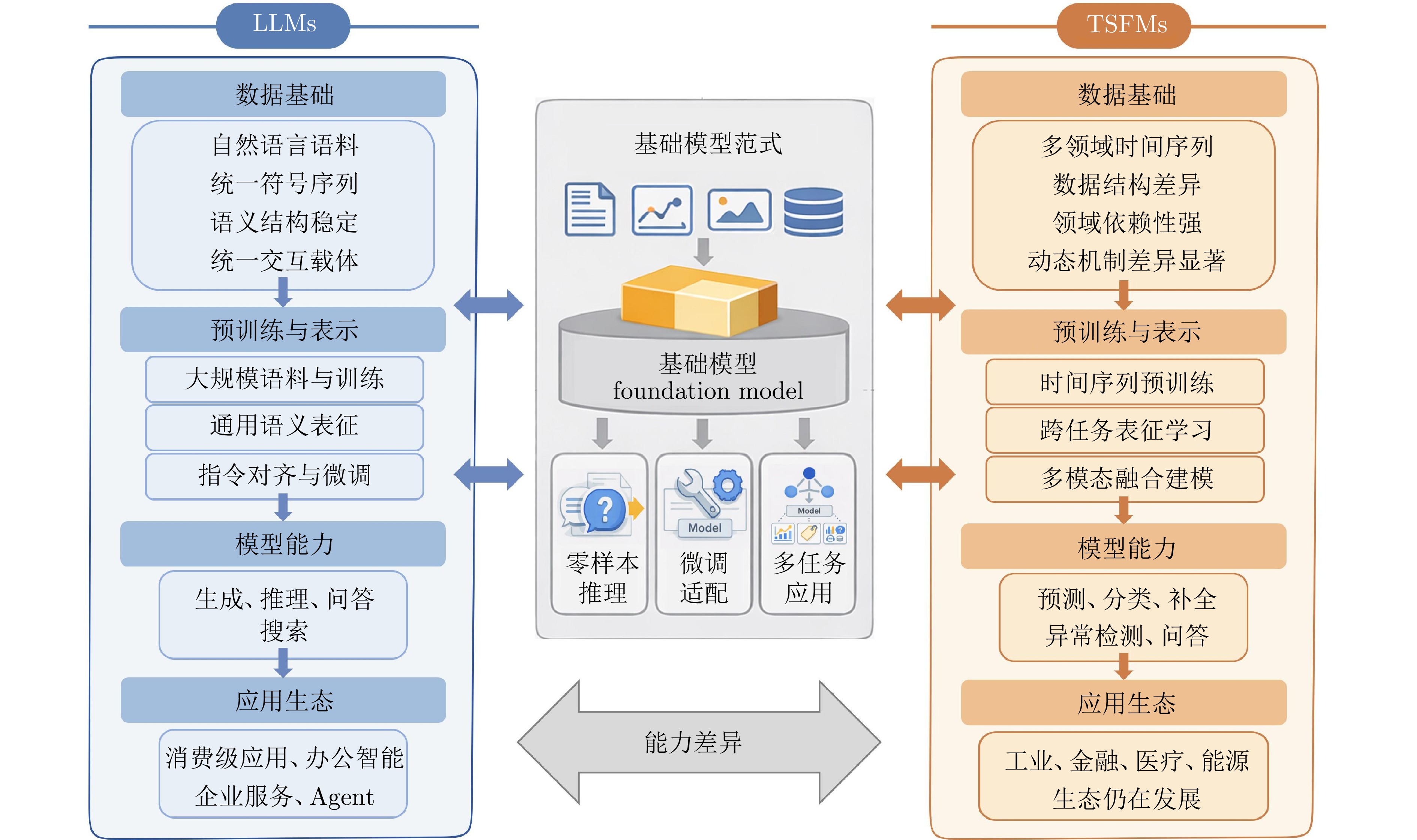
图 1 LLMs与TSFMs的基础模型范式对比
Fig. 1 Comparison of foundation model paradigms of LLMs and TSFMs
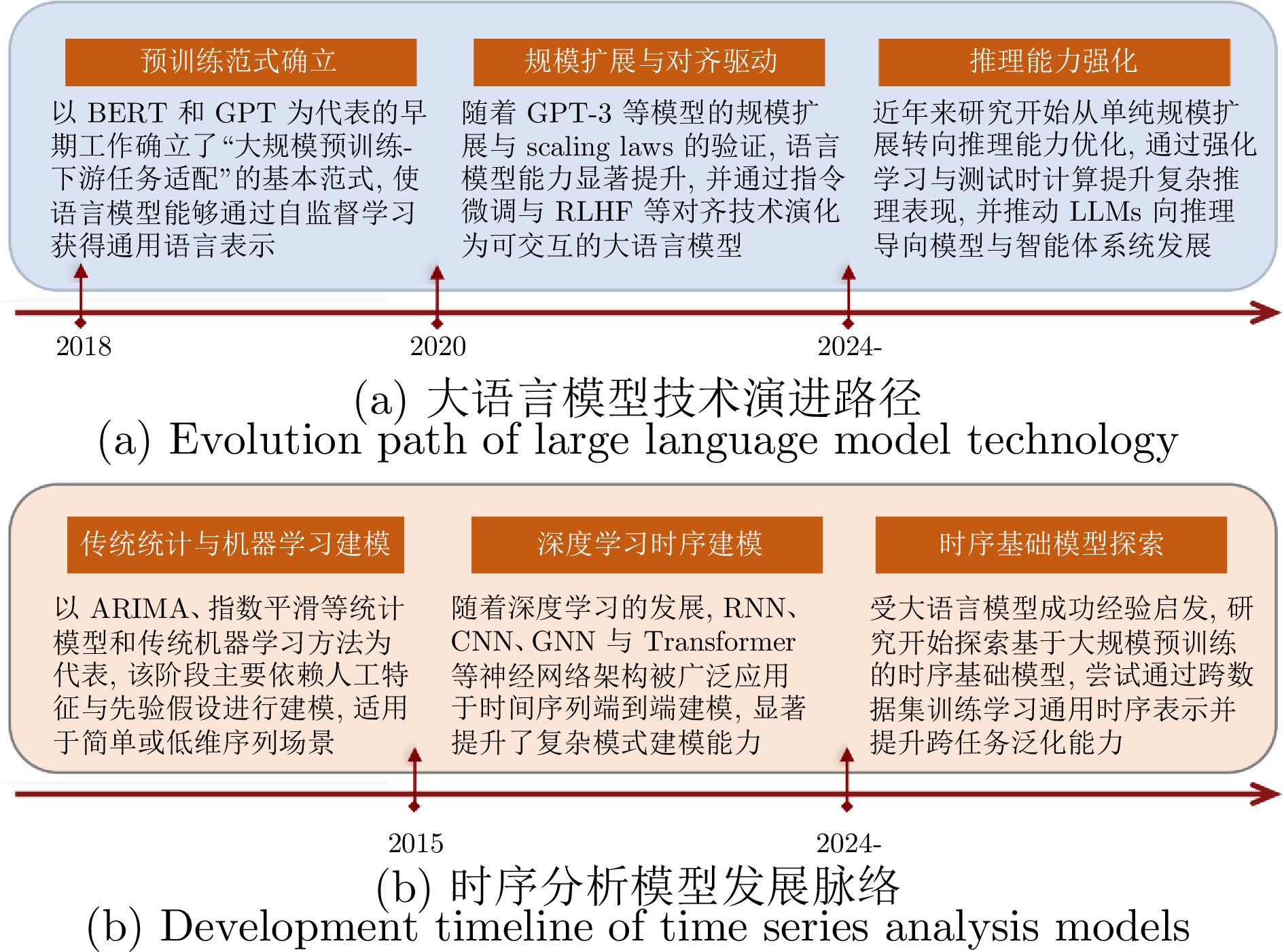
图 3 大语言模型与时序分析模型的发展阶段对照
Fig. 3 Comparison of the developmental stages of large language models and time series analysis models
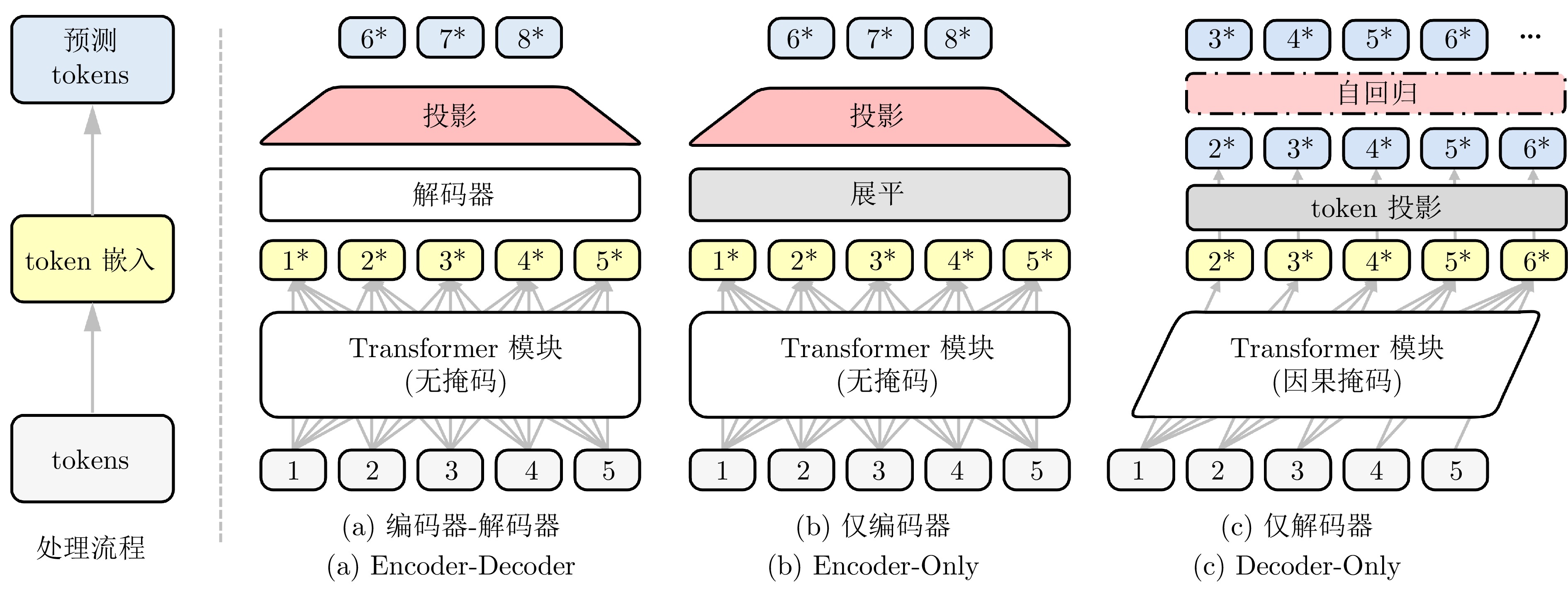
图 5 三类Transformer架构范式(预测任务)
Fig. 5 Three Transformer architecture paradigms for forecasting tasks
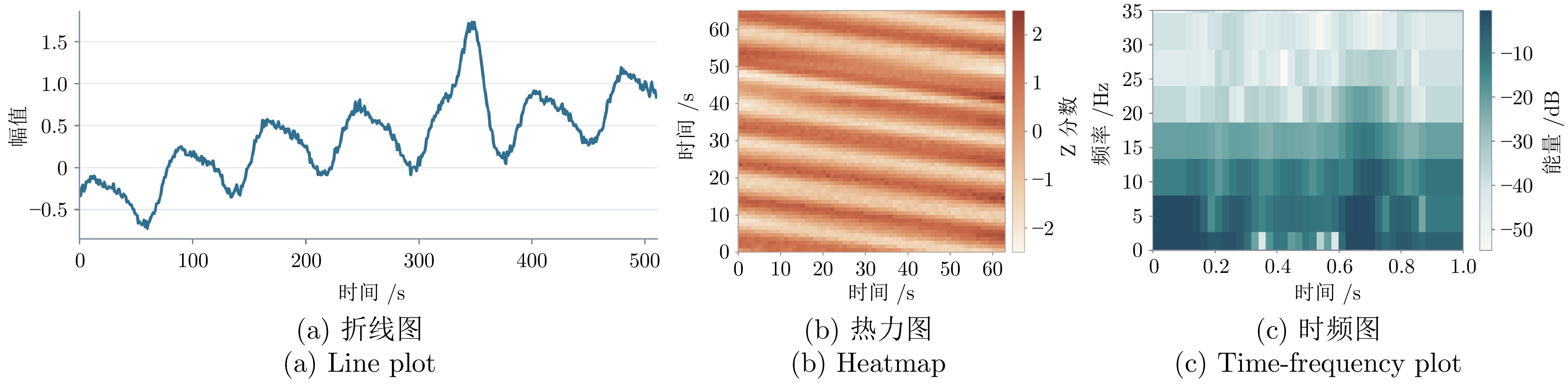
图 6 同一时间序列的三类图像化编码示例
Fig. 6 Examples of three image encoding methods for the same time series
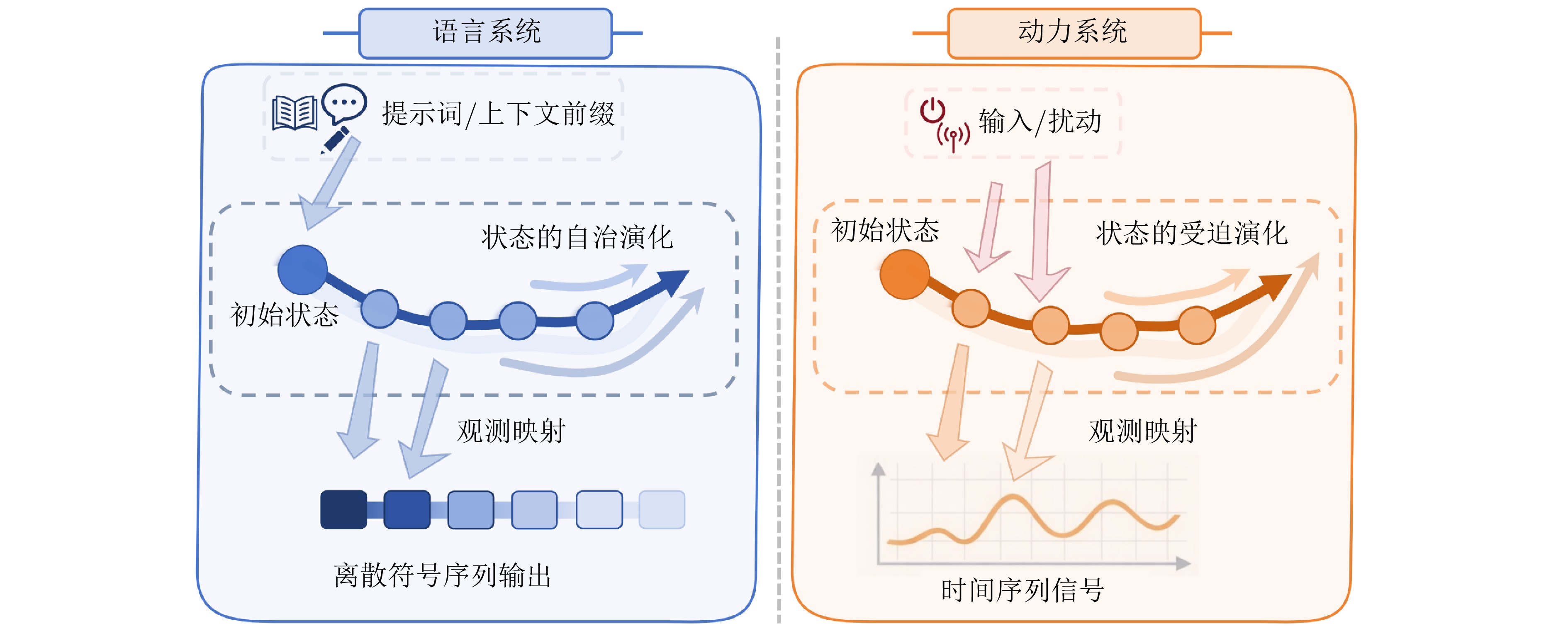
图 7 语言系统与动力系统的序列生成机制对照
Fig. 7 Comparison of sequence generation mechanisms between language systems and dynamical systems
表 1 本文与相关综述的对比
Table 1 Comparison between this survey and related surveys
综述 年份 发表平台 分析角度 原生构建 跨模态迁移 LLMs参照 序列生成机制 可解释性 文献数量 Jin[17] 2023 arXiv 数据类型 √ √ × × × 65 Jiang[18] 2024 IJCAI 方法论 × √ × × × 21 Zhang[19] 2024 IJCAI 方法论 × √ × × × 37 Jin[20] 2024 ICML 方法论 × √ × × × 46 Liang[16] 2024 KDD 方法论 √ √ × × × 83 Kottapalli[21] 2025 arXiv 方法论 √ √ × × × 15 Ye[22] 2025 arXiv 挑战 √ √ × × × 91 本文 2026 - 动力系统 √ √ √ √ √ 212  下载: 导出CSV
表 2 原生时序基础模型预训练语料来源概览
Table 2 Overview of pretraining corpus sources for native time series foundation models
工作 语料名称 语料类型 构建方式 时间点数 TimesFM[72] - 真实+合成 融合GoogleTrends、WikiPageviews及M4、Electricity、Traffic、Weather等公开数据, 并结合合成时间序列构建大规模多粒度预训练语料 $>100 $ B MOMENT[24] Time-series Pile 真实 汇集多个公开时间序列数据集(如电力、交通、气象、医疗等), 统一格式并清洗后构建多数据集预训练语料库 $>1 $ B Moirai[73] LOTSA 真实 汇集多个公开时间序列数据集(如Monash、GluonTS等), 统一格式构建大规模开放语料库 $>27 $ B Timer[74] UTSD 真实 聚合多个公开数据集, 并统一转换为单序列格式用于生成式预训练 1 B Time-MoE[75] Time-300B 真实+合成 汇集多个公开时序数据集并统一清洗处理, 结合合成数据扩充规模 $>300 $ B Sundial[76] TimeBench 真实+合成 汇集公开与研究数据集(Chronos、LOTSA、物联网等), 并通过KernelSynth生成数据增强 1 T Lag-Llama[77] - 真实 汇集多个公开时间序列数据集, 并通过滑动窗口采样构建训练样本 - TSPulse[78] - 真实 整合多样化公开数据集, 覆盖诊断等特定任务场景 - Chronos[79] - 真实+合成 汇集多个公开数据集, 并通过TSMixup与KernelSynth生成增强数据 $>1 $ B ForecastPFN[80] - 合成 基于先验分布生成合成序列(趋势+季节性+噪声), 用于先验拟合网络预训练 $>0.06 $ B CauKer[81] - 合成 高斯过程生成合成序列, 并通过结构因果模型增强因果特性 $>5 $ B Panda[82] Chaotic Dynamical Systems Dataset 合成 基于混沌动力系统的常微分方程数值求解生成时间序列 $>0.1 $ B
下载: 导出CSV
表 3 不同时间序列分词实现方式及优势比较
Table 3 Comparison of implementations and advantages of time series tokenization methods
类型 实现 优势 局限 图示 Point
级分词将每个时间步视为独立token, 对原始序列直接建模 保留完整时序信息, 可融合时间戳、频率等附加特征 token数量随序列长度增长, 长序列计算开销较高 
Patch
级分词将序列划分为固定长度片段, 经线性投影后输入模型 保留局部语义结构并减少token数量, 降低计算复杂度 固定分段可能破坏细粒度时序信息, 对Patch大小较敏感 
Quantization
级分词通过量化将连续时间序列映射为离散token 利用成熟的离散token建模范式, 具备较好扩展性 离散化可能带来信息损失, 量化策略设计较复杂  下载: 导出CSV
表 4 三类主流架构范式对比分析
Table 4 Comparative analysis of three mainstream architecture paradigms
架构类型 代表模型 结构特点 建模方式 优势 局限性 适用场景 仅编码器 MOMENT[24],
Moirai[73]由编码器堆叠构成, 对历史序列进行整体编码 基于双向注意力和掩码重建机制学习全局上下文表征, 并通过任务头完成下游任务 表征能力强, 训练稳定, 可适配多类任务, 架构通用性较好 生成建模能力相对受限, 灵活预测通常依赖额外任务头或解码模块 分类、异常检测、表征学习、预测等 仅解码器 Timer[74],
TimesFM[72]由解码器堆叠构成, 采用因果注意力约束 基于自回归生成范式, 根据历史观测逐步预测未来序列 预测形式灵活, 支持变长输入与预测步长, 契合生成式预训练范式 长期预测中可能存在误差累积或推理效率问题 时间序列预测、零样本预测、生成式建模 编码器−解码器 TTM[88],
TOTEM[93]由编码器和解码器两部分组成, 将上下文编码与条件生成解耦 编码器提取历史上下文表征, 解码器基于该表征进行条件生成或预测 兼具表征学习与生成建模能力, 任务适配灵活 结构复杂, 参数量和计算开销较高, 训练与部署成本较大 多任务预测、条件生成、通用时序建模
下载: 导出CSV
表 6 系统视角下LLMs与TSFMs的核心差异
Table 6 Core differences between LLMs and TSFMs from a systems perspective
对比维度 LLMs TSFMs 建模效果差异 序列生成本质 以离散符号生成为核心, 主要受语言规则与上下文约束 以连续状态演化为核心, 持续受输入、工况与对象特性影响 LLMs更容易纳入统一生成框架; TSFMs通常需要结合具体对象与场景建模 规律共享程度 语法语义规则较稳定, 跨语境共享性较强 不同领域和阶段差异明显, 共享规律有限 LLMs更易学习通用规律; TSFMs规律更分散, 跨场景迁移更难 条件依赖方式 条件主要体现为上下文、提示词和任务指令 条件除历史观测外, 还包括输入、扰动和工况切换 TSFMs条件依赖更强, 解空间更容易呈现显著条件化 序列语义属性 文本天然具有可交流语义, 输入输出和评价较统一 数值序列语义不显式, 解释依赖任务背景和领域知识 LLMs更易支持统一交互与解释; TSFMs在解释与使用上门槛更高 通用化路径 易于围绕统一符号体系组织预训练、建模与交互 难以同时统一表征单元、训练目标和交互方式 TSFMs难直接复用LLMs的通用化路径, 关键受条件化与语义抽象不足制约
下载: 导出CSV
表 7 LLMs和TSFMs在应用生态层面的对照
Table 7 Comparison of LLMs and TSFMs at the application ecosystem level
比较维度 LLMs TSFMs 对比 代表产品 ChatGPT; Gemini; Claude; 豆包; DeepSeek TimeGPT; Chronos LLMs: 已形成通用产品入口; TSFMs: 以预测服务为主 服务供给形态 模型即服务平台超100个; 提供模型部署、微调、评测等服务[171] 应用程序编程接口; 托管部署; Marketplace服务[172] LLMs: 已形成平台级服务市场; TSFMs: 以产品级服务供给为主 应用规模 ChatGPT周活用户超过八亿[173]; Google Workspace生成式人工智能使用者超过十万[174] 尚无公开统计数据 LLMs: 已形成大规模用户基础; TSFMs: 未见相关统计数据
下载: 导出CSV
-
[1] 王璐瑶, 曹渊, 刘博涵, 曾恩, 刘坤, 夏元清. 时间序列分类模型的集成对抗训练防御方法. 自动化学报, 2025, 51(1): 144−160 doi: 10.16383/j.aas.c240050Wang Lu-Yao, Cao Yuan, Liu Bo-Han, Zeng En, Liu Kun, Xia Yuan-Qing. Ensemble adversarial training defense for time series classification models. Acta Automatica Sinica, 2025, 51(1): 144−160 doi: 10.16383/j.aas.c240050 [2] 赵春晖, 胡赟昀, 郑嘉乐, 陈军豪. 数据驱动的燃煤发电装备运行工况监控——现状与展望. 自动化学报, 2022, 48(11): 2611−2633 doi: 10.16383/j.aas.c200993Zhao Chun-Hui, Hu Yun-Yun, Zheng Jia-Le, Chen Jun-Hao. Data-driven operating monitoring for coal-fired power generation equipment: the state of the art and challenge. Acta Automatica Sinica, 2022, 48(11): 2611−2633 doi: 10.16383/j.aas.c200993 [3] 任伟杰, 韩敏. 多元时间序列因果关系分析研究综述. 自动化学报, 2021, 47(1): 64−78 doi: 10.16383/j.aas.c180189Ren Wei-Jie, Han Min. Survey on causality analysis of multivariate time series. Acta Automatica Sinica, 2021, 47(1): 64−78 doi: 10.16383/j.aas.c180189 [4] Zhu K, Zhao C H, Huang B. Breaking information granularity heterogeneity: a mutual information-inspired causal discovery framework for multi-rate time series. IEEE Transactions on Knowledge and Data Engineering, 2025, 37(12): 7001−7015 doi: 10.1109/TKDE.2025.3618763 [5] 张晨, 孔祥玉, 胡昌华. 独立慢特征分析建模方法及其在动态故障检测中的应用. 自动化学报, 2025, 51(11): 2520−2533 doi: 10.16383/j.aas.c250134Zhang Chen, Kong Xiang-Yu, Hu Chang-Hua. Independent-slow feature analysis modelling method and its application in dynamic fault detection. Acta Automatica Sinica, 2025, 51(11): 2520−2533 doi: 10.16383/j.aas.c250134 [6] Song P Y, Zhao C H. Slow down to go better: a survey on slow feature analysis. IEEE Transactions on Neural Networks and Learning Systems, 2024, 35(3): 3416−3436 doi: 10.1109/TNNLS.2022.3201621 [7] Wang Y X, Wu H X, Dong J X, Liu Y, Long M S, Wang J M. Deep time series models: a comprehensive survey and benchmark. IEEE Transactions on Pattern Analysis and Machine Intelligence, 2026, DOI: 10.1109/TPAMI.2026.3690845 [8] Yu W K, Zhao C H. Broad convolutional neural network based industrial process fault diagnosis with incremental learning capability. IEEE Transactions on Industrial Electronics, 2020, 67(6): 5081−5091 doi: 10.1109/TIE.2019.2931255 [9] 陈俊英, 席月芸, 李朝阳. 多尺度局部特征和Transformer全局学习融合的发动机剩余寿命预测. 自动化学报, 2024, 50(9): 1818−1830 doi: 10.16383/j.aas.c230634Chen Jun-Ying, Xi Yue-Yun, Li Zhao-Yang. Prediction of aeroengine remaining life by combining multi-scale local features and Transformer global learning. Acta Automatica Sinica, 2024, 50(9): 1818−1830 doi: 10.16383/j.aas.c230634 [10] 赵健程, 赵春晖. 面向全量测点耦合结构分析与估计的工业过程监测方法. 自动化学报, 2024, 50(8): 1517−1538 doi: 10.16383/j.aas.c220090Zhao Jian-Cheng, Zhao Chun-Hui. An industrial process monitoring method based on total measurement point coupling structure analysis and estimation. Acta Automatica Sinica, 2024, 50(8): 1517−1538 doi: 10.16383/j.aas.c220090 [11] Zhou T, Niu P, Sun L, Jin R. One fits all: power general time series analysis by pretrained LM. In: Proceedings of the 37th International Conference on Neural Information Processing Systems. New Orleans, USA: Curran Associates Inc., 2023. 36: 43322-43355 [12] 柴铮, 汪嘉业, 赵春晖, 丁进良, 孙优贤. 面向工业监控典型监督任务的深度迁移学习方法: 现状、挑战与展望. 中国科学: 信息科学, 2023, 53: 821−840 doi: 10.1360/SSI-2022-0328Chai Zheng, Wang Jia-Ye, Zhao Chun-Hui, Ding Jin-Liang, Sun You-Xian. Deep transfer learning methods for typical supervised tasks in industrial monitoring: state-of-the-art, challenges, and perspectives. Scientia Sinica Informationis, 2023, 53: 821−840 doi: 10.1360/SSI-2022-0328 [13] Raffel C, Shazeer N, Roberts A, Lee K, Narang S, Matena M, et al. Exploring the limits of transfer learning with a unified text-to-text transformer. Journal of Machine Learning Research, 2020, 21(140): 1−67 [14] Hu E, Shen Y, Wallis P, Allen-Zhu Z, Li Y, Wang S, et al. LoRA: low-rank adaptation of large language models. In: Proceedings of the International Conference on Learning Representations. Virtual Event, 2022. [15] Zhao W X, Zhou K, Li J Y, Tang T Y, Wang X L, Hou Y P, et al. A survey of large language models. Frontiers of Computer Science, 2026, 20: Article No. 2012627 doi: 10.1007/s11704-026-60308-3 [16] Liang Y, Wen H, Nie Y, Jiang Y, Jin M, Song D, et al. Foundation models for time series analysis: a tutorial and survey. In: Proceedings of the 30th ACM SIGKDD Conference on Knowledge Discovery and Data Mining. Barcelona, Spain: Association for Computing Machinery, 2024. 6555-6565 [17] Jin M, Wen Q S, Liang Y X, Zhang C L, Xue S Q, Wang X, et al. Large models for time series and spatio-temporal data: a survey and outlook. arXiv preprint arXiv: 2310.10196, 2023. [18] Jiang Y S, Pan Z J, Zhang X K, Garg S, Schneider A, Nevmyvaka Y, et al. Empowering time series analysis with large language models: a survey. In: Proceedings of the 33rd International Joint Conference on Artificial Intelligence. Jeju, South Korea: International Joint Conferences on Artificial Intelligence Organization, 2024. 8095-8103 [19] Zhang X Y, Chowdhury R R, Gupta R K, Shang J B. Large language models for time series: a survey. In: Proceedings of the 33rd International Joint Conference on Artificial Intelligence. Jeju, South Korea: International Joint Conferences on Artificial Intelligence Organization, 2024. 8335-8343 [20] Jin M, Zhang Y F, Chen W, Zhang K X, Liang Y X, Yang B, et al. Position: what can large language models tell us about time series analysis. In: Proceedings of the 41st International Conference on Machine Learning. Vienna, Austria: PMLR, 2024. 22260-22276 [21] Kottapalli S R K, Hubli K, Chandrashekhara S, Jain G, Hubli S, Botla G, et al. Foundation models for time series: a survey. arXiv preprint arXiv: 2504.04011, 2025. [22] Ye J X, Yu Y Z, Zhang W Q, Wang L, Li J, Tsung F. Empowering time series analysis with foundation models: a comprehensive survey. arXiv preprint arXiv: 2405.02358, 2024. [23] Williams A R, Ashok A, Marcotte É, Zantedeschi V, Subramanian J, Riachi R, et al. Context is key: a benchmark for forecasting with essential textual information. In: Proceedings of the 42nd International Conference on Machine Learning. Vancouver, Canada: PMLR, 2025. 66887-66944 [24] Goswami M, Szafer K, Choudhry A, Cai Y, Li S, Dubrawski A. MOMENT: a family of open time-series foundation models. In: Proceedings of the 41st International Conference on Machine Learning. Vienna, Austria: PMLR, 2024. 16115-16152 [25] Ouyang L, Wu J, Jiang X, Almeida D, Wainwright C L, Mishkin P, et al. Training language models to follow instructions with human feedback. In: Proceedings of the 36th International Conference on Neural Information Processing Systems. New Orleans, USA: Curran Associates Inc., 2022. 27730-27744 [26] Devlin J, Chang M W, Lee K, Toutanova K. BERT: pre-training of deep bidirectional transformers for language understanding. In: Proceedings of the 2019 Conference of the North American Chapter of the Association for Computational Linguistics: Human Language Technologies, Volume 1 (Long and Short Papers). Minneapolis, Minnesota, USA: Association for Computational Linguistics, 2019. 4171-4186 [27] Radford A, Narasimhan K, Salimans T, Sutskever I. Improving Language Understanding by Generative Pre-Training, Technical Report, OpenAI, United States, 2018. [28] Lewis M, Liu Y H, Goyal N, Ghazvininejad M, Mohamed A, Levy O, et al. BART: denoising sequence-to-sequence pre-training for natural language generation, translation, and comprehension. In: Proceedings of the 58th Annual Meeting of the Association for Computational Linguistics. Virtual Event: Association for Computational Linguistics, 2020. 7871-7880 [29] Radford A, Wu J, Child R, Luan D, Amodei D, Sutskever I. Language Models Are Unsupervised Multitask Learners, Technical Report, OpenAI, United States, 2019. [30] Brown T B, Mann B, Ryder N, Subbiah M, Kaplan J, Dhariwal P, et al. Language models are few-shot learners. In: Proceedings of the 34th International Conference on Neural Information Processing Systems. Virtual Event: Curran Associates Inc., 2020. 1877-1901 [31] Kojima T, Gu S X, Reid M, Matsuo Y, Iwasawa Y. Large language models are zero-shot reasoners. In: Proceedings of the 36th International Conference on Neural Information Processing Systems. New Orleans, USA: Curran Associates Inc., 2022. 22199-22213 [32] OpenAI. Introducing ChatGPT[Online], available: https://openai.com/zh-Hans-CN/index/chatgpt/, March 19, 2026 [33] Glaese A, McAleese N, Trebacz M, Aslanides J, Firoiu V, Ewalds T, et al. Improving alignment of dialogue agents via targeted human judgements. arXiv preprint arXiv: 2209.14375, 2022. [34] OpenAI, Achiam J, Adler S, Agarwal S, Ahmad L, Akkaya I, et al. GPT-4 technical report. arXiv preprint arXiv: 2303.08774, 2023. [35] Bian S, Yan M H, Venkataraman S. Scaling inference-efficient language models. In: Proceedings of the 42nd International Conference on Machine Learning. Vancouver, Canada: PMLR, 2025. 267: 4303-4323 [36] DeepSeek-AI, Guo D Y, Yang D J, Zhang H W, Song J X, Wang P Y. DeepSeek-R1: incentivizing reasoning capability in LLMs via reinforcement learning. arXiv preprint arXiv: 2501.12948, 2025. [37] OpenAI. Introducing GPT-5[Online], available: https://openai.com/zh-Hans-CN/gpt-5/, March 19, 2026 [38] Google. Introducing Gemini 3[Online], available: https://deepmind.google/models/gemini/, March 19, 2026 [39] Anthropic. Introducing Claude Opus 4.6[Online], available: https://www.anthropic.com/news/claude-opus-4-6, March 19, 2026 [40] Yue J Q, Zhao C H, Zhao J C, Huang B. Enabling generalized zero-shot learning towards unseen domains by intrinsic learning from redundant LLM semantics. Neural Networks, 2026, 193: Article No. 107997 doi: 10.1016/j.neunet.2025.107997 [41] Kumar P. Large language models (LLMs): survey, technical frameworks, and future challenges. Artificial Intelligence Review, 2024, 57(10): Article No. 260 doi: 10.1007/s10462-024-10888-y [42] Li B X, Zhao C H. Self-reflection enhances large language models towards substantial academic response. npj Artificial Intelligence, 2025, 1(1): Article No. 42 doi: 10.1038/s44387-025-00045-3 [43] Thirunavukarasu A J, Ting D S J, Elangovan K, Gutierrez L, Tan T F, Ting D S W. Large language models in medicine. Nature Medicine, 2023, 29(8): 1930−1940 doi: 10.1038/s41591-023-02448-8 [44] Zhao J C, Yue J Q, Zhao C H, Chen C. Adjust to reality: LLM-driven test-time semantic adjustment for zero-shot fault diagnosis. Control Engineering Practice, 2025, 164: Article No. 106406 doi: 10.1016/j.conengprac.2025.106406 [45] Wei J, Bosma M, Zhao V Y, Guu K, Yu A W, Lester B, et al. Finetuned language models are zero-shot learners. In: Proceedings of the 10th International Conference on Learning Representations. Virtual Event, 2022. [46] Guu K, Lee K, Tung Z, Pasupat P, Chang M. Retrieval augmented language model pre-training. In: Proceedings of the 37th International Conference on Machine Learning. Virtual Event: PMLR, 2020. 3929-3938 [47] Zhao J C, Zhao C H, Yue J Q. Align knowledge with time-series: cross-modal domain knowledge activation for LLM-enabled zero-shot fault diagnosis. Journal of Process Control, 2025, 155: Article No. 103534 doi: 10.1016/j.jprocont.2025.103534 [48] Chai Z, Zhao C H. Multiclass oblique random forests with dual-incremental learning capacity. IEEE Transactions on Neural Networks and Learning Systems, 2020, 31(12): 5192−5203 doi: 10.1109/TNNLS.2020.2964737 [49] Masini R P, Medeiros M C, Mendes E F. Machine learning advances for time series forecasting. Journal of Economic Surveys, 2023, 37(1): 76−111 doi: 10.1111/joes.12429 [50] Chang S C, Chen X, Zhao C H. Flexible clockwork recurrent neural network for multirate industrial soft sensor. Journal of Process Control, 2022, 119: 86−100 doi: 10.1016/j.jprocont.2022.09.008 [51] Luo D H, Wang X. ModernTCN: a modern pure convolution structure for general time series analysis. In: Proceedings of the 12th International Conference on Learning Representations. Vienna, Austria, 2024. [52] Wang S Y, Wu H X, Shi X M, Hu T G, Luo H K, Ma L T, et al. TimeMixer: decomposable multiscale mixing for time series forecasting. In: Proceedings of the 12th International Conference on Learning Representations. Vienna, Austria, 2024. [53] Chen J W, Zhao C H. Multi-lag and multi-type temporal causality inference and analysis for industrial process fault diagnosis. Control Engineering Practice, 2022, 124: Article No. 105174 doi: 10.1016/j.conengprac.2022.105174 [54] Jin M, Koh H Y, Wen Q S, Zambon D, Alippi C, Webb G I, et al. A survey on graph neural networks for time series: forecasting, classification, imputation, and anomaly detection. IEEE Transactions on Pattern Analysis and Machine Intelligence, 2024, 46(12): 10466−10485 doi: 10.1109/TPAMI.2024.3443141 [55] Ren J Y, Zhao C H. Discovering invariance from variations: invariant-specific bi-graph neural network for multi-source transfer learning with application to industrial soft sensor. IEEE Transactions on Instrumentation and Measurement, 2025, 74: Article No. 2526812 doi: 10.1109/tim.2025.3565340/mm1 [56] Yan T J, Gong H H, He Y P, Zhan Y F, Xia Y Q. Probabilistic time series modeling with decomposable denoising diffusion model. In: Proceedings of the 41st International Conference on Machine Learning. Vienna, Austria: PMLR, 2024. 55759-55777 [57] Zhao L J Y, Song P Y, Zhao C H. Causal similarity learning with multi-level predictive relation aggregation for grouped root cause diagnosis of industrial faults. Control Engineering Practice, 2025, 154: Article No. 106140 doi: 10.1016/j.conengprac.2024.106140 [58] Zhou H Y, Zhang S H, Peng J Q, Zhang S, Li J X, Xiong H, et al. Informer: beyond efficient transformer for long sequence time-series forecasting. In: Proceedings of the 35th AAAI Conference on Artificial Intelligence. Virtual Event: AAAI Press, 2021. 11106-11115 [59] Zhu K, Song P Y, Zhao C H. Fuzzy state-driven cross-time spatial dependence learning for multivariate time-series anomaly detection. IEEE Transactions on Neural Networks and Learning Systems, 2025, 36(3): 4532−4544 doi: 10.1109/TNNLS.2024.3371109 [60] Liu Y, Hu T G, Zhang H R, Wu H X, Wang S Y, Ma L T, et al. iTransformer: inverted transformers are effective for time series forecasting. In: Proceedings of the 12th International Conference on Learning Representations. Vienna, Austria, 2024. [61] Chen J H, Song P Y, Zhao C H, Min X. Hybrid probabilistic slow feature analysis of continuous and binary data for dynamic process monitoring. IEEE Transactions on Systems, Man, and Cybernetics: Systems, 2024, 54(12): 7848−7860 doi: 10.1109/TSMC.2024.3462755 [62] Kim T, Kim J, Tae Y, Park C, Choi J, Cho J. Reversible instance normalization for accurate time-series forecasting against distribution shift. In: Proceedings of the 10th International Conference on Learning Representations. Virtual Event, 2022. [63] Chai Z, Wang J Y, Zhao C H. Walk before you can run: sampling-rate-aware sequential knowledge transfer for multirate process anomaly detection. IEEE Transactions on Automation Science and Engineering, 2025, 22: 8725−8737 doi: 10.1109/TASE.2024.3488272 [64] Zhang W J, Yin C L, Liu H, Zhou X F, Xiong H. Irregular multivariate time series forecasting: a transformable patching graph neural networks approach. In: Proceedings of the 41st International Conference on Machine Learning. Vienna, Austria: PMLR, 2024. 60179-60196 [65] Zhu K, Zhao C H. When causality meets missing data: fusing key information to bridge causal discovery and imputation in time series via bidirectional meta-learning. Information Fusion, 2025, 117: Article No. 102811 doi: 10.1016/j.inffus.2024.102811 [66] Chien J T, Chen Y H. Learning continuous-time dynamics with attention. IEEE Transactions on Pattern Analysis and Machine Intelligence, 2023, 45(2): 1906−1918 doi: 10.1109/TPAMI.2022.3162711 [67] Chen J W, Zhao C H. Addressing information asymmetry: deep temporal causality discovery for mixed time series. IEEE Transactions on Pattern Analysis and Machine Intelligence, 2025, 47(7): 5723−5741 doi: 10.1109/TPAMI.2025.3553957 [68] Wang M, Zhou D H, Chen M Y. Hybrid variable monitoring: an unsupervised process monitoring framework with binary and continuous variables. Automatica, 2023, 147: Article No. 110670 doi: 10.1016/j.automatica.2022.110670 [69] Chen J H, Zhao C H, Song P Y, Min X. Unified low-dimensional subspace analysis of continuous and binary variables for industrial process monitoring. IEEE Transactions on Cybernetics, 2025, 55(3): 1135−1146 doi: 10.1109/TCYB.2024.3524827 [70] Chen J H, Wang H, Zhao C H, Min X. Hybrid input-output probabilistic slow feature analysis for adaptive process monitoring. Control Engineering Practice, 2025, 157: Article No. 106254 doi: 10.1016/j.conengprac.2025.106254 [71] Chen J W, Zhao C H. Addressing spatial-temporal heterogeneity: general mixed time series analysis via latent continuity recovery and alignment. In: Proceedings of the 38th International Conference on Neural Information Processing Systems. Vancouver, Canada: Curran Associates Inc., 2024. 17910-17946 [72] Das A, Kong W H, Sen R, Zhou Y C. A decoder-only foundation model for time-series forecasting. In: Proceedings of the 41st International Conference on Machine Learning. Vienna, Austria: PMLR, 2024. 1955-2005 [73] Woo G, Liu C H, Kumar A, Xiong C M, Savarese S, Sahoo D. Unified training of universal time series forecasting transformers. In: Proceedings of the 41st International Conference on Machine Learning. Vienna, Austria: PMLR, 2024. 53140-53164 [74] Liu Y, Zhang H R, Li C Y, Huang X D, Wang J M, Long M S. Timer: generative pre-trained transformers are large time series models. In: Proceedings of the 41st International Conference on Machine Learning. Vienna, Austria: PMLR, 2024. 32369-32399 [75] Shi X M, Wang S Y, Nie Y Q, Li D Q, Ye Z, Wen Q S, et al. Time-MoE: billion-scale time series foundation models with mixture of experts. In: Proceedings of the 13th International Conference on Learning Representations. Singapore, 2025. [76] Liu Y, Qin G, Shi Z Y, Chen Z, Yang C Y, Huang X D, et al. Sundial: a family of highly capable time series foundation models. In: Proceedings of the 42nd International Conference on Machine Learning. Vancouver, Canada: PMLR, 2025. 39295-39317 [77] Rasul K, Ashok A, Williams A R, Khorasani A, Adamopoulos G, Bhagwatkar R, et al. Lag-Llama: towards foundation models for time series forecasting. arXiv preprint arXiv: 2310.08278, 2023. [78] Ekambaram V, Kumar S, Jati A, Mukherjee S, Sakai T, Dayama P, et al. TSPulse: tiny pre-trained models with disentangled representations for rapid time-series analysis. In: Proceedings of the 14th International Conference on Learning Representations. Rio de Janeiro, Brazil, 2026. [79] Ansari A F, Stella L, Turkmen C, Zhang X Y, Mercado P, Shen H B, et al. Chronos: learning the language of time series. Transactions on Machine Learning Research, 2024. [80] Dooley S, Khurana G S, Mohapatra C, Naidu S, White C. ForecastPFN: synthetically-trained zero-shot forecasting. In: Proceedings of the 37th International Conference on Neural Information Processing Systems. New Orleans, USA: Curran Associates Inc., 2023. 2403-2426 [81] Xie S, Feofanov V, Zhang J F, Palpanas T, Redko I. CauKer: classification time series foundation models can be pretrained on synthetic data. In: Proceedings of the 14th International Conference on Learning Representations. Rio de Janeiro, Brazil, 2026. [82] Lai J B, Bao A, Gilpin W. Panda: a pretrained forecast model for universal representation of chaotic dynamics. In: Proceedings of the 14th International Conference on Learning Representations. Rio de Janeiro, Brazil, 2026. [83] Dai Q Y, Zhao C H, Huang B. M2D-VAE: self-supervised probabilistic temporal-spatial latent representation learning for unsupervised industrial operational applications under missing value interference. IEEE Transactions on Neural Networks and Learning Systems, 2025, 36(7): 12214−12227 doi: 10.1109/TNNLS.2024.3477968 [84] Chen J H, Zhao C H, Ding J L. A flexible probabilistic framework with concurrent analysis of continuous and categorical data for industrial fault detection and diagnosis. IEEE Transactions on Industrial Informatics, 2023, 19(10): 10578−10590 doi: 10.1109/TII.2023.3240591 [85] Gao S, Koker T, Queen O, Hartvigsen T, Tsiligkaridis T, Zitnik M. UNITS: a unified multi-task time series model. In: Proceedings of the 38th International Conference on Neural Information Processing Systems. Vancouver, Canada: Curran Associates Inc., 2024. 140589-140631 [86] Liu Y, Qin G, Huang X D, Wang J M, Long M S. Timer-XL: long-context transformers for unified time series forecasting. In: Proceedings of the 13th International Conference on Learning Representations. Singapore, 2025. [87] Ren C R, Lu Y, Huang T J, Zheng H W, Zhu H D, Li Y Y, et al. TimeCAP: a channel-aware pre-training framework for multivariate time series forecasting. In: Proceedings of the 40th AAAI Conference on Artificial Intelligence. Singapore, Singapore: AAAI Press, 2026. 40(30): 25108-25116 [88] Ekambaram V, Jati A, Dayama P, Mukherjee S, Nguyen N H, Gifford W M, et al. Tiny time mixers (TTMs): fast pre-trained models for enhanced zero/few-shot forecasting of multivariate time series. In: Proceedings of the 38th International Conference on Neural Information Processing Systems. Vancouver, Canada: Curran Associates Inc., 2024. 37: 74147-74181 [89] Cheng H Y, Wu X J, Shu Y, Rao Z W, Pan L J, Yang B, et al. CoRA: boosting time series foundation models for multivariate forecasting through correlation-aware adapter. In: Proceedings of the 14th International Conference on Learning Representations. Rio de Janeiro, Brazil, 2026. [90] Han L, Liu Y, Li L, Deng Q W, Jiang J, Sun Y B, et al. UniCA: unified covariate adaptation for time series foundation model. In: Proceedings of the 14th International Conference on Learning Representations. Rio de Janeiro, Brazil, 2026. [91] Darlow L N, Deng Q W, Hassan A, Asenov M, Singh R, Joosen A, et al. DAM: towards a foundation model for forecasting. In: Proceedings of the 12th International Conference on Learning Representations. Vienna, Austria, 2024. [92] Wang Y H, Qiu Y Y, Chen P, Shu Y, Rao Z W, Pan L J, et al. LightGTS: a lightweight general time series forecasting model. In: Proceedings of the 42nd International Conference on Machine Learning. Vancouver, Canada: PMLR, 2025. 64109-64126 [93] Talukder S, Yue Y, Gkioxari G. TOTEM: TOkenized Time Series EMbeddings for general time series analysis. Transactions on Machine Learning Research, 2024. [94] Garza A, Challu C, Mergenthaler-Canseco M. TimeGPT-1. arXiv preprint arXiv: 2310.03589, 2023. [95] Liu X, Liu J C, Woo G, Aksu T, Liang Y X, Zimmermann R, et al. Moirai-MoE: empowering time series foundation models with sparse mixture of experts. In: Proceedings of the 42nd International Conference on Machine Learning. Vancouver, Canada: PMLR, 2025. 38940-38962 [96] Yu A N, Maddix D C, Han B R, Zhang X Y, Ansari A F, Zhang X. Understanding transformers for time series: rank structure, flow-of-ranks, and compressibility. In: Proceedings of the 14th International Conference on Learning Representations. Rio de Janeiro, Brazil, 2026. [97] Bao A, Vattikuti V H, Lai J B, Gilpin W. Universal redundancies in time series foundation models. In: Proceedings of the 43rd International Conference on Machine Learning. Seoul, South Korea: PMLR, 2026. 6433-6465 [98] Zhu K, Zhao C H. Towards the disappearing truth: fine-grained joint causal influences learning with hidden variable-driven causal hypergraphs in time series. In: Proceedings of the 38th AAAI Conference on Artificial Intelligence. Vancouver, Canada: AAAI Press, 2024. 38(15): 17167-17174 [99] Song P Y, Zhao C H, Huang B. MPGE and RootRank: a sufficient root cause characterization and quantification framework for industrial process faults. Neural Networks, 2023, 161: 397−417 doi: 10.1016/j.neunet.2023.01.030 [100] Cao D F, Ye W, Zhang Y Z, Liu Y. TimeDiT: general-purpose diffusion transformers for time series foundation model. arXiv preprint arXiv: 2409.02322, 2024. [101] Fu Y S, Shao Z Z, Yu C Q, Li Y J, Xu Y J, Cheng X Q, et al. Zeus: towards tuning-free foundation model for time series analysis. In: Proceedings of the 43rd International Conference on Machine Learning. Seoul, South Korea: PMLR, 2026. [102] Feofanov V, Wen S K, Xie S F, Roschmann S, Alonso M, Guo H B, et al. Mantis: lightweight foundation model for time series classification. In: Proceedings of the 43rd International Conference on Machine Learning. Seoul, South Korea: PMLR, 2026. 30692-30719 [103] Zhu X K, Carpentier L, Verbeke M. When foundation models are one-liners: limitations and future directions for time series anomaly detection. In: Proceedings of the 14th International Conference on Learning Representations. Rio de Janeiro, Brazil, 2026. [104] Kim J, Yoon S, Ko Y M, Kim S I, Tae J. Complexity- and statistics-guided anomaly detection in time series foundation models. In: Proceedings of the 14th International Conference on Learning Representations. Rio de Janeiro, Brazil, 2026. [105] Gil N M, O'Donncha F, Gifford W M, Zhou N J, Patel D C, Vaculin R. Adaptive conformal anomaly detection with time series foundation models for signal monitoring. In: Proceedings of the 14th International Conference on Learning Representations. Rio de Janeiro, Brazil, 2026. [106] Liu X, Cheng D Z, Fu Z N, Zhang L, Wu H, Song A G. Sensor-prompt tuning: aligning time series foundational models with motion sensors for few-shot activity recognition. IEEE Transactions on Mobile Computing, 2026, 25(7): 11227−11243 doi: 10.1109/TMC.2026.3664424 [107] Zhao L F, Shen Y Y, Liu Z Y, Wang X, Deng J J. Less is more: unlocking specialization of time series foundation models via structured pruning. In: Proceedings of the 39th International Conference on Neural Information Processing Systems. San Diego, USA: Curran Associates Inc., 2026. 38: 171877-171902 [108] Zhang X, Wang P, Wang W. Lost in the non-convex loss landscape: how to fine-tune the large time series model? In: Proceedings of the 14th International Conference on Learning Representations. Rio de Janeiro, Brazil, 2026. [109] Zhang H Y, Xu C, Zhang Y F, Zhang Z, Wang L, Tan T N, et al. TimeRAF: retrieval-augmented foundation model for zero-shot time series forecasting. IEEE Transactions on Knowledge and Data Engineering, 2025, 37(09): 5654−5665 doi: 10.1109/TKDE.2025.3579137 [110] Faw M, Sen R, Zhou Y C, Das A. In-context fine-tuning for time-series foundation models. In: Proceedings of the 42nd International Conference on Machine Learning. Vancouver, Canada: PMLR, 2025. 16355-16374. [111] Xu L L, Li Z Y, He X, Yu Z Y, Wen D Z, Sun M Z, et al. See more, forecast better and faster: enhancing time series foundation models via inference-time plug-and-play downsampling. In: Proceedings of the 43rd International Conference on Machine Learning. Seoul, South Korea: PMLR, 2026. [112] Li S Y, Chen Y Z, Zhu Z J, Pan Y X, Guo Y, Huang M, et al. TimeRFT: stimulating generalizable time series forecasting for TSFMs via reinforcement finetuning. arXiv preprint arXiv: 2605.00015, 2026. [113] Na J, Trirat P, Park C, Lee J G. Time-PEFT: temporal and multichannel complexity-based fine-tuning for time-series foundation models. In: Proceedings of the 43rd International Conference on Machine Learning. Seoul, South Korea: PMLR, 2026. [114] Zhang T X, Ouyang B, Shu Y, Chen X Y, Guo C J, Yang B. SwiftTS: a swift selection framework for time series pre-trained models via multi-task meta-learning. In: Proceedings of the 14th International Conference on Learning Representations. Rio de Janeiro, Brazil, 2026. [115] 李宝学, 赵春晖, 宿家浩. 个性化定制: 面向工业过程监测的模型智能推荐系统与基准. 中国科学: 信息科学, 2025, 55: 1766−1782 doi: 10.1360/SSI-2025-0092Li Bao-Xue, Zhao Chun-Hui, Xiu Jia-Hao. Personalized customization: industrial model recommendation system and benchmark for time series monitoring tasks. Scientia Sinica Informationis, 2025, 55: 1766−1782 doi: 10.1360/SSI-2025-0092 [116] Alnegheimish S, Nguyen L, Berti-Equille L, Veeramachaneni K. Can large language models be anomaly detectors for time series? In: Proceedings of the 2024 IEEE 11th International Conference on Data Science and Advanced Analytics. San Diego, California, USA: IEEE, 2024. 1-10 [117] Gruver N, Finzi M, Qiu S K, Wilson A G. Large language models are zero-shot time series forecasters. In: Proceedings of the 37th International Conference on Neural Information Processing Systems. New Orleans, USA: Curran Associates Inc., 2023. 19622-19635 [118] Wang C S, Qi Q, Wang J Y, Sun H F, Zhuang Z R, Wu J M, et al. ChatTime: a unified multimodal time series foundation model bridging numerical and textual data. In: Proceedings of the 39th AAAI Conference on Artificial Intelligence. Philadelphia, Pennsylvania, USA: AAAI Press, 2025. 39(12): 12694-12702 [119] Xue H, Salim F D. PromptCast: a new prompt-based learning paradigm for time series forecasting. IEEE Transactions on Knowledge and Data Engineering, 2024, 36(11): 6851−6864 doi: 10.1109/TKDE.2023.3342137 [120] Liu H X, Zhao Z Y, Wang J D, Kamarthi H, Prakash B A. LSTPrompt: large language models as zero-shot time series forecasters by long-short-term prompting. In: Findings of the Association for Computational Linguistics: ACL 2024. Bangkok, Thailand: Association for Computational Linguistics, 2024. 7832-7840 [121] Wang X L, Feng M K, Qiu J, Gu J J, Zhao J H. From news to forecast: integrating event analysis in LLM-based time series forecasting with reflection. In: Proceedings of the 38th International Conference on Neural Information Processing Systems. Vancouver, Canada: Curran Associates Inc., 2024. 58118-58153 [122] Wang J H, Cheng M Y, Mao Q Y, Zhou Y T, Wang D Y, Liu Q, et al. TableTime: reformulating time series classification as training-free table understanding with large language models. In: Proceedings of the 34th ACM International Conference on Information and Knowledge Management. Seoul, South Korea: Association for Computing Machinery, 2025. 3009-3019. [123] Spathis D, Kawsar F. The first step is the hardest: pitfalls of representing and tokenizing temporal data for large language models. Journal of the American Medical Informatics Association, 2024, 31(9): 2151−2158 doi: 10.1093/jamia/ocae090 [124] Li B X, Zhao C H. S2S-FDD: bridging industrial time series and natural language for explainable zero-shot fault diagnosis. In: Proceedings of 2025 CAA Symposium on Fault Detection, Supervision, and Safety for Technical Processes (SAFEPROCESS). Urumqi, China: IEEE, 2025. 1-6 [125] Yang J Y, Guay M, Cao Z X, Zhao C H. TimeSeries2Report prompting enables adaptive large language model management of lithium-ion batteries. arXiv preprint arXiv: 2512.16453, 2025. [126] Hou D F, Yue J Q, Zhao C H. Words towards explainability: caption label-free learning via dual loop agentic time series captioning. In: Proceedings of the 43rd International Conference on Machine Learning. Seoul, South Korea: PMLR, 2026. [127] Merrill M A, Tan M T, Gupta V, Hartvigsen T, Althoff T. Language models still struggle to zero-shot reason about time series. In: Proceedings of the 2024 Conference on Empirical Methods in Natural Language Processing. Miami, Florida, USA: Association for Computational Linguistics, 2024. 3512-3533 [128] Cheng J G, Yang C W, Cai W L, Liang Y X, Wen Q S, Wu Y K. Nuwats: a foundation model mending every incomplete time series. arXiv preprint arXiv: 2405.15317, 2024. [129] Cao D F, Jia F R, Arik S O, Pfister T, Zheng Y X, Ye W, et al. TEMPO: prompt-based generative pre-trained transformer for time series forecasting. In: Proceedings of the 12th International Conference on Learning Representations. Vienna, Austria, 2024. [130] Lee G, Yu W C, Shin K, Cheng W, Chen H F. TimeCAP: learning to contextualize, augment and predict time series events with large language model agents. In: Proceedings of the 39th AAAI Conference on Artificial Intelligence. Philadelphia, Pennsylvania, USA: AAAI Press, 2025. 18082-18090 [131] Chang C, Wang W Y, Peng W C, Chen T F. LLM4TS: aligning pre-trained LLMs as data-efficient time-series forecasters. ACM Transactions on Intelligent Systems and Technology, 2025, 16(3): Article No. 60 doi: 10.1145/3719207 [132] Liu P Y, Guo H, Dai T, Li N Q, Bao J G, Ren X D, et al. CALF: aligning LLMs for time series forecasting via cross-modal fine-tuning. In: Proceedings of the 39th AAAI Conference on Artificial Intelligence. Philadelphia, Pennsylvania, USA: AAAI Press, 2025. 39(18): 18915-18923 [133] Jin M, Wang S Y, Ma L T, Chu Z X, Zhang J Y, Shi X M, et al. Time-LLM: time series forecasting by reprogramming large language models. In: Proceedings of the 12th International Conference on Learning Representations. Vienna, Austria, 2024. [134] Liu H, Zhang X X, Yang C, Zhu X B. Semantic-enhanced time-series forecasting via large language models. In: Proceedings of the 14th International Conference on Learning Representations. Rio de Janeiro, Brazil, 2026. [135] Sun C X, Li H Y, Li Y L, Hong S D. TEST: text prototype aligned embedding to activate LLM's ability for time series. In: Proceedings of the 12th International Conference on Learning Representations. Vienna, Austria, 2024. [136] Chen J L, Zhao Z Y, Nurbek G, Feng A, Maatouk A, Tassiulas L, et al. TRACE: grounding time series in context for multimodal embedding and retrieval. In: Proceedings of the 39th International Conference on Neural Information Processing Systems. San Diego, USA: Curran Associates Inc., 2025. 38: 2440-2472 [137] Liu X, Hu J F, Li Y, Diao S Z, Liang Y X, Hooi B. UniTime: a language-empowered unified model for cross-domain time series forecasting. In: Proceedings of the ACM Web Conference 2024. Singapore: Association for Computing Machinery, 2024. 4095-4106 [138] Niu W Z, Xie Z X, Sun Y R, He W, Xu M, Hao C. LangTime: a language-guided unified model for time series forecasting with proximal policy optimization. In: Proceedings of the 42nd International Conference on Machine Learning. Vancouver, Canada: PMLR, 2025. 46712-46734 [139] Ni J C, Zhao Z M, Shen C A, Tong H H, Song D J, Cheng W, et al. Harnessing vision models for time series analysis: a survey. In: Proceedings of the 34th International Joint Conference on Artificial Intelligence. Montreal, Canada: International Joint Conferences on Artificial Intelligence Organization, 2025. 10612-10620 [140] Namura N, Ichikawa Y. Training-free time-series anomaly detection: leveraging image foundation models. arXiv preprint arXiv: 2408.14756, 2024. [141] Li Z K, Li S Y, Yan X F. Time series as images: vision transformer for irregularly sampled time series. In: Proceedings of the 37th International Conference on Neural Information Processing Systems. New Orleans, USA: Curran Associates Inc., 2023. 49187-49204 [142] Yang L X, Wang Y, Fan X Q, Cohen I, Chen J D, Zhang Z J. ViTime: foundation model for time series forecasting powered by vision intelligence. Transactions on Machine Learning Research, 2025. [143] Shen C A, Yu W C, Zhao Z M, Song D J, Cheng W, Chen H F, et al. Multi-modal view enhanced large vision models for long-term time series forecasting. In: Proceedings of the 39th International Conference on Neural Information Processing Systems. San Diego, USA: Curran Associates Inc., 2025. 38: 2473-2505 [144] He Z L, Alnegheimish S, Reimherr M. Harnessing vision-language models for time series anomaly detection. In: Proceedings of the 40th AAAI Conference on Artificial Intelligence. Singapore: AAAI Press, 2026. 40(26): 21690-21698. [145] Zhong S R, Ruan W L, Jin M, Li H, Wen Q S, Liang Y X. Time-VLM: exploring multimodal vision-language models for augmented time series forecasting. In: Proceedings of the 42nd International Conference on Machine Learning. Vancouver, Canada: PMLR, 2025. 78478-78497 [146] Lyu S S, Zhong S R, Ruan W L, Liu Q X, Wen Q S, Xiong H, et al. OccamVTS: distilling vision models to 1% parameters for time series forecasting. In: Proceedings of the 40th AAAI Conference on Artificial Intelligence. Singapore, Singapore: AAAI Press, 2026. 40(29): 24216-24225 [147] Xu X X, Wang H R, Liang Y Q, Yu P S, Zhao Y, Shu K. Can multimodal LLMs perform time series anomaly detection. In: Proceedings of the ACM Web Conference 2026. Dubai, United Arab Emirates: Association for Computing Machinery, 2026. 5392-5403 [148] Li Z, Qiu X F, Chen P, Wang Y H, Cheng H Y, Shu Y, et al. TSFM-Bench: a comprehensive and unified benchmark of foundation models for time series forecasting. In: Proceedings of the 31st ACM SIGKDD Conference on Knowledge Discovery and Data Mining. Toronto, Canada: Association for Computing Machinery, 2025. 5595-5606 [149] Aksu T, Woo G, Liu J C, Liu X, Liu C H, Savarese S, et al. Gift-eval: a benchmark for general time series forecasting model evaluation. arXiv preprint arXiv: 2410.10393, 2024. [150] Yao Q R, Yang C H H, Jiang R H, Liang Y X, Jin M, Pan S R. Towards neural scaling laws for time series foundation models. In: Proceedings of the 13th International Conference on Learning Representations. Singapore, 2025. [151] Karaouli N, Coquenet D, Fromont E, Mermillod M, Reyboz M. How foundational are foundation models for time series forecasting? arXiv preprint arXiv: 2510.00742, 2025. [152] Liu P F, Yuan W Z, Fu J L, Jiang Z B, Hayashi H, Neubig G. Pre-train, prompt, and predict: a systematic survey of prompting methods in natural language processing. ACM Computing Surveys, 2023, 55(9): 1−35 [153] Li X L, Liang P. Prefix-tuning: optimizing continuous prompts for generation. In: Proceedings of the 59th Annual Meeting of the Association for Computational Linguistics and the 11th International Joint Conference on Natural Language Processing (Volume 1: Long Papers). Virtual Event: Association for Computational Linguistics, 2021. 4582-4597 [154] Baker S R, Bloom N, Davis S J. Measuring economic policy uncertainty. The Quarterly Journal of Economics, 2016, 131(4): 1593−1636 doi: 10.1093/qje/qjw024 [155] Zhao C H, Huang B. A full-condition monitoring method for nonstationary dynamic chemical processes with cointegration and slow feature analysis. AIChE Journal, 2018, 64(5): 1662−1681 doi: 10.1002/aic.16048 [156] Jiang Q C, Yan X F, Huang B. Review and perspectives of data-driven distributed monitoring for industrial plant-wide processes. Industrial & Engineering Chemistry Research, 2019, 58(29): 12899−12912 doi: 10.1021/acs.iecr.9b02391 [157] 赵春晖, 余万科, 高福荣. 非平稳间歇过程数据解析与状态监控-回顾与展望. 自动化学报, 2020, 46(10): 2072−2091 doi: 10.16383/j.aas.c190586Zhao Chun-Hui, Yu Wan-Ke, Gao Fu-Rong. Data analytics and condition monitoring methods for nonstationary batch processes - current status and future. Acta Automatica Sinica, 2020, 46(10): 2072−2091 doi: 10.16383/j.aas.c190586 [158] Yang J Y, Zhao C H. Dual-scale nonstationary representation for degradation tracking and aging-informed monitoring of lithium-ion battery system. IEEE Transactions on Industrial Electronics, 2026, 73(6): 9459−9471 doi: 10.1109/TIE.2026.3654860 [159] Liu Y K, Tian Y J, Liu D Y, Li H H, Yi A B, Wang Y P, et al. A novel dual gated recurrent unit neural network based on error compensation integrated with Kalman filter for the state of charge estimation of parallel battery modules. Journal of Power Sources, 2025, 635: Article No. 236508 doi: 10.1016/j.jpowsour.2025.236508 [160] Yang J Y, Chen X, Zhao C H. Toward the ensemble consistency: condition-driven ensemble balance representation learning and nonstationary anomaly detection for battery energy storage system. Applied Energy, 2025, 381: Article No. 125160 doi: 10.1016/j.apenergy.2024.125160 [161] Zhao C H. Perspectives on nonstationary process monitoring in the era of industrial artificial intelligence. Journal of Process Control, 2022, 116: 255−272 doi: 10.1016/j.jprocont.2022.06.011 [162] Kaistha N. Liquid level control in a recycle loop. Journal of Process Control, 2021, 104: 11−27 doi: 10.1016/j.jprocont.2021.05.014 [163] Callaway D S, Hiskens I A. Achieving controllability of electric loads. Proceedings of the IEEE, 2011, 99(1): 184−199 doi: 10.1109/JPROC.2010.2081652 [164] Huang T, Zhao C H, Zhang H R. Dynamic modeling and characteristic analysis of dry/wet state transition process for supercritical thermal power unit. Energy, 2025, 336: Article No. 138443 doi: 10.1016/j.energy.2025.138443 [165] Bengio Y, Ducharme R, Vincent P, Jauvin C. A neural probabilistic language model. Journal of Machine Learning Research, 2003, 3: 1137−1155 [166] Durbin J, Koopman S J. Time Series Analysis by State Space Methods. Second edition. Oxford: Oxford University Press, 2012. [167] Särkkä S. Bayesian Filtering and Smoothing. Cambridge: Cambridge University Press, 2014. [168] Pham Q, Liu C H, Sahoo D, Hoi S. Learning fast and slow for online time series forecasting. In: Proceedings of the 11th International Conference on Learning Representations. Kigali, Rwanda, 2023. [169] Feng L J, Zhao C H. Fault description based attribute transfer for zero-sample industrial fault diagnosis. IEEE Transactions on Industrial Informatics, 2021, 17(3): 1852−1862 doi: 10.1109/TII.2020.2988208 [170] Laato S, Tiainen M, Islam A K M N, Mäntymäki M. How to explain AI systems to end users: a systematic literature review and research agenda. Internet Research, 2022, 32(7): 1−31 doi: 10.1108/intr-08-2021-0600 [171] 中国信息通信研究院. 人工智能产业发展研究报告(2025年), 技术报告No. 202516, 中国信息通信研究院, 中国, 2026.China Academy of Information and Communications Technology. Artificial Intelligence Industry Development Report (2025), Technical Report No. 202516, China Academy of Information and Communications Technology, China, 2026. [172] Nixtla. Enterprise AI forecasting[Online], available: https://www.nixtla.io, March 24, 2026 [173] OpenAI. 1 million business customers: the fastest-growing business platform in history[Online], available: https://openai.com/index/1-million-businesses-putting-ai-to-work/, March 24, 2026 [174] Google. Google Workspace enables the future of AI-powered work for every business[Online], available: https://workspace.google.com/blog/product-announcements/empowering-businesses-with-AI, March 24, 2026 [175] Ansari A F, Shchur O, Küken J, Auer A, Han B, Mercado P, et al. Chronos-2: from univariate to universal forecasting. arXiv preprint arXiv: 2510.15821, 2025. [176] Wang S Y, Chen P, Wang Y H, Qiu W H, Guo C J, Yang B, et al. Unlocking the value of text: event-driven reasoning and multi-level alignment for time series forecasting. In: Proceedings of the 14th International Conference on Learning Representations. Rio de Janeiro, Brazil, 2026. [177] Hu S Y, Jin J X, Shu Y, Chen P, Yang B, Guo C J. Towards multimodal time series anomaly detection with semantic alignment and condensed interaction. In: Proceedings of the 14th International Conference on Learning Representations. Rio de Janeiro, Brazil, 2026. [178] Jia F R, Wang K, Zheng Y X, Cao D F, Liu Y. GPT4MTS: prompt-based large language model for multimodal time-series forecasting. In: Proceedings of the 38th AAAI Conference on Artificial Intelligence. Vancouver, Canada: AAAI Press, 2024. 38(21): 23343-23351 [179] Liu H X, Xu S Q, Zhao Z Y, Kong L K, Kamarthi H, Sasanur A B, et al. Time-MMD: multi-domain multimodal dataset for time series analysis. In: Proceedings of the 38th International Conference on Neural Information Processing Systems. Vancouver, Canada: Curran Associates Inc., 2024. 37: 77888-77933 [180] Arango S P, Mercado P, Kapoor S, Ansari A F, Stella L, Shen H B, et al. ChronosX: adapting pretrained time series models with exogenous variables. In: Proceedings of the 28th International Conference on Artificial Intelligence and Statistics. Valencia, Spain: PMLR, 2025. 2242-2250 [181] Kamarthi H, Prakash B A. Large pre-trained time series models for cross-domain time series analysis tasks. In: Proceedings of the 38th International Conference on Neural Information Processing Systems. Vancouver, Canada: Curran Associates Inc., 2024. 56190-56214 [182] Wang Y H, Qiu Y Y, Chen P, Zhao K, Rao Z W, Pan L J, et al. Towards a general time series forecasting model with unified representation and adaptive transfer. In: Proceedings of the 42nd International Conference on Machine Learning. Vancouver, Canada: PMLR, 2025. 64127-64151 [183] Fei J R, Yi K, Wang A X, Wen Q S, Zhu X X, Fan W. Olivia: harmonizing time series foundation models with power spectral density. In: Proceedings of the 43rd International Conference on Machine Learning. Seoul, South Korea: PMLR, 2026. [184] Gong P L, Eldele E, Wu M, Chen Z H, Li X L, Zhang D Q. Bridging distribution gaps in time series foundation model pretraining with prototype-guided normalization. IEEE Transactions on Neural Networks and Learning Systems, 2026, 37(9): 4770−4784 doi: 10.1109/TNNLS.2026.3673975 [185] Chen S C, Long G D, Blumenstein M, Jiang J. FeDaL: federated dataset learning for general time series foundation models. In: Proceedings of the 14th International Conference on Learning Representations. Rio de Janeiro, Brazil, 2026. [186] Li B X, Zhao C H. Federated zero-shot industrial fault diagnosis with cloud-shared semantic knowledge base. IEEE Internet of Things Journal, 2023, 10(13): 11619−11630 doi: 10.1109/JIOT.2023.3243401 [187] Huang N, Wang H S, He Z H, Zitnik M, Zhang X. Repurposing foundation model for generalizable medical time series classification. In: Proceedings of the 14th International Conference on Learning Representations. Rio de Janeiro, Brazil, 2026. [188] Yin S K, Fu C Y, Zhao S R, Li K, Sun X, Xu T, et al. A survey on multimodal large language models. National Science Review, 2024, 11(12): Article No. nwae403 doi: 10.1093/nsr/nwae403 [189] Xie Z, Li Z Y, He X, Xu L L, Wen X D, Zhang T Y, et al. ChatTS: aligning time series with LLMs via synthetic data for enhanced understanding and reasoning. Proceedings of the VLDB Endowment, 2025, 18(8): 2385−2398 doi: 10.14778/3742728.3742735 [190] Wang Y L, Lei P X, Song J, Hao Y Z, Chen T, Zhang Y X, et al. ITFormer: bridging time series and natural language for multi-modal QA with large-scale multitask dataset. In: Proceedings of the 42nd International Conference on Machine Learning. Vancouver, Canada: PMLR, 2025. 63324-63344 [191] Kong Y X, Yang Y Y, Hwang Y, Du W J, Zohren S, Wang Z Y, et al. TimeMQA: time series multi-task question answering with context enhancement. In: Proceedings of the 63rd Annual Meeting of the Association for Computational Linguistics (Volume 1: Long Papers). Vienna, Austria: Association for Computational Linguistics, 2025. 29736-29753 [192] Zhang H C, Yang C H, Han J, Qin L Y, Wang X L. TempoGPT: enhancing time series reasoning in multi-modal language model via quantizing embedding. Neurocomputing, 2026, 664: Article No. 132035 doi: 10.1016/j.neucom.2025.132035 [193] Guan T, Meng Z J, Li D Q, Wang S Y, Yang C H H, Wen Q S, et al. TimeOmni-1: incentivizing complex reasoning with time series in large language models. In: Proceedings of the 14th International Conference on Learning Representations. Rio de Janeiro, Brazil, 2026. [194] Koa K J L, Chen J, Ma Y S, Zheng H H, Chua T S. Reasoning on time-series for financial technical analysis. In: Proceedings of the 14th International Conference on Learning Representations. Rio de Janeiro, Brazil, 2026. [195] Langer P, Kaar T, Rosenblattl M, Xu M, Chow W, Maritsch M, et al. OpenTSLM: time-series language models for reasoning over multivariate medical text- and time-series data. In: Proceedings of the 43rd International Conference on Machine Learning. Seoul, South Korea: PMLR, 2026. [196] Zhou J H, Li D, Li L, Chen Z M, Wu S Y, Ye H Z, et al. Enhancing LLM reasoning for time series classification by tailored thinking and fused decision. In: Proceedings of the 14th International Conference on Learning Representations. Rio de Janeiro, Brazil, 2026. [197] Zeng K, Quan W B, Ma Q L. Time-CoT: hierarchical reasoning with temporal semantic codes for multivariate time series classification. In: Proceedings of the 43rd International Conference on Machine Learning. Seoul, South Korea: PMLR, 2026. [198] Luo Y C, Zhou Y T, Cheng M Y, Wang J H, Wang D Y, Pan T Y, et al. Time series forecasting as reasoning: a slow-thinking approach with reinforced LLMs. arXiv preprint arXiv: 2506.10630, 2025. [199] Yang Y Y, Liu Z C, Song L, Ying K, Wang Z G, Bamford T, et al. Time-RA: towards time series reasoning for anomaly diagnosis with LLM feedback. arXiv preprint arXiv: 2507.15066, 2025. [200] Tao X Y, Cheng M Y, Guo Z, Yu S, Liu Y G, Liu Q, et al. MemCast: memory-driven time series forecasting with experience-conditioned reasoning. In: Proceedings of the 43rd International Conference on Machine Learning. Seoul, South Korea: PMLR, 2026. [201] Zhou J H, Li D, Li B X, Zhang X, Meng E L, Li L, et al. Time series reasoning via process-verifiable thinking data synthesis and scheduling for tailored LLM reasoning. In: Proceedings of the 43rd International Conference on Machine Learning. Seoul, South Korea: PMLR, 2026. [202] Ni J T, Wang S Y, He Q, Jin M, Jin W. STReasoner: empowering LLMs for spatio-temporal reasoning in time series via spatial-aware reinforcement learning. arXiv preprint arXiv: 2601.03248, 2026. [203] Li S R, Xiao S H, Joshi M, Metwally A, McDuff D, Wang W, et al. HEARTS: benchmarking LLM reasoning on health time series. In: Proceedings of the 43rd International Conference on Machine Learning. Seoul, South Korea: PMLR, 2026. [204] He C, Huang X, Jiang G W, Li Z Y, Lian D F, Xie H, et al. GTM: a general time-series model for enhanced representation learning of time-series data. In: Proceedings of the 14th International Conference on Learning Representations. Rio de Janeiro, Brazil, 2026. [205] Linderman S W, Johnson M J, Miller A C, Adams R P, Blei D M, Paninski L. Bayesian learning and inference in recurrent switching linear dynamical systems. In: Proceedings of the 20th International Conference on Artificial Intelligence and Statistics. Fort Lauderdale, Florida, USA: PMLR, 2017. 914-922 [206] Kayaalp M, Turkmen C, Shchur O, Mercado P, Ansari A F, Bohlke-Schneider M, et al. Test-time efficient pretrained model portfolios for time series forecasting. arXiv preprint arXiv: 2510.06419, 2025. [207] Zhao L J Y, Li B X, Zhao C H. Addressing external distorted heterogeneity: input-output disentangled causal representation for mixed time series. Journal of Process Control, 2025, 154: Article No. 103521 doi: 10.1016/j.jprocont.2025.103521 [208] Wang C S, Qi Q, Rao Z W, Pan L J, Wang J Y, Liao J X. ChronoSteer: bridging large language model and time series foundation model via synthetic data. arXiv preprint arXiv: 2505.10083, 2025. [209] Yu F X, Zhao H Y, Zhou T Y. TS-Reasoner: aligning time series foundation models with LLM reasoning. arXiv preprint arXiv: 2510.03519, 2025. [210] Wu X J, Jin J X, Qiu W H, Chen P, Shu Y, Yang B, et al. Aurora: towards universal generative multimodal time series forecasting. In: Proceedings of the 14th International Conference on Learning Representations. Rio de Janeiro, Brazil, 2026. [211] Chen P, Wang S, Hu S, Wu X J, Shu Y, Rao Z W, et al. Empowering time series analysis with large-scale multimodal pretraining. arXiv preprint arXiv: 2602.05646, 2026. [212] Qiao Z Z, Pan S, Wang A, Zhukova V, Liu Y, Jiang X D, et al. It's TIME: towards the next generation of time series forecasting benchmarks. In: Proceedings of the 43rd International Conference on Machine Learning. Seoul, South Korea: PMLR, 2026. -

 下载:

计量
- 文章访问数: 16
- HTML全文浏览量: 14
- 被引次数: 0
