


Safety-assured Fixed-time Control for Space Robot under Asymmetric Output Constraints
-
摘要: 针对具有随机扰动和非对称输出约束的空间机器人系统, 提出一种基于二阶滑模的保安全固定时间控制器. 首先, 结合动量守恒定理和拉格朗日方程推导出姿态受控、位置不控的空间机器人系统的动力学模型. 其次, 对包含系统随机扰动和非线性动力项在内的集总扰动上限进行估计, 并引入一种分段正切型障碍Lyapunov函数以解决空间机器人的非对称输出约束问题, 再借助加幂积分法和扰动补偿法设计了一种二阶滑模保安全固定时间控制方案. 最后, 通过Lyapunov准则证明了空间机器人误差跟踪系统的固定时间稳定性, 详细的数值仿真进一步验证了所设计控制方案在时间与空间两个维度上的可行性和安全性.Abstract: For the space robot with stochastic perturbations and asymmetric output constraints, a safety-assured fixed-time controller based on second-order sliding mode is proposed in this research. First, by combining the momentum conservation theorem and the Lagrange equation, the dynamic model of the space robot system, in which the base attitude is controlled while the base position is uncontrolled, is derived. Then, the upper bound of the lumped disturbance which includes the stochastic perturbations and the nonlinear dynamic terms of the system is estimated, and a piecewise tangent-type barrier Lyapunov function is introduced to address the asymmetric output constraint problem of the space robot. Furthermore, by means of the power-addition-integral method and the disturbance compensation approach, a second-order sliding mode safety-assured fixed-time control scheme is designed. The fixed-time stability of the error tracking system of the space robot is proven via the Lyapunov criterion, and the detailed numerical simulations further confirm the feasibility and reliability of the designed control scheme in both time and space dimensions.
-
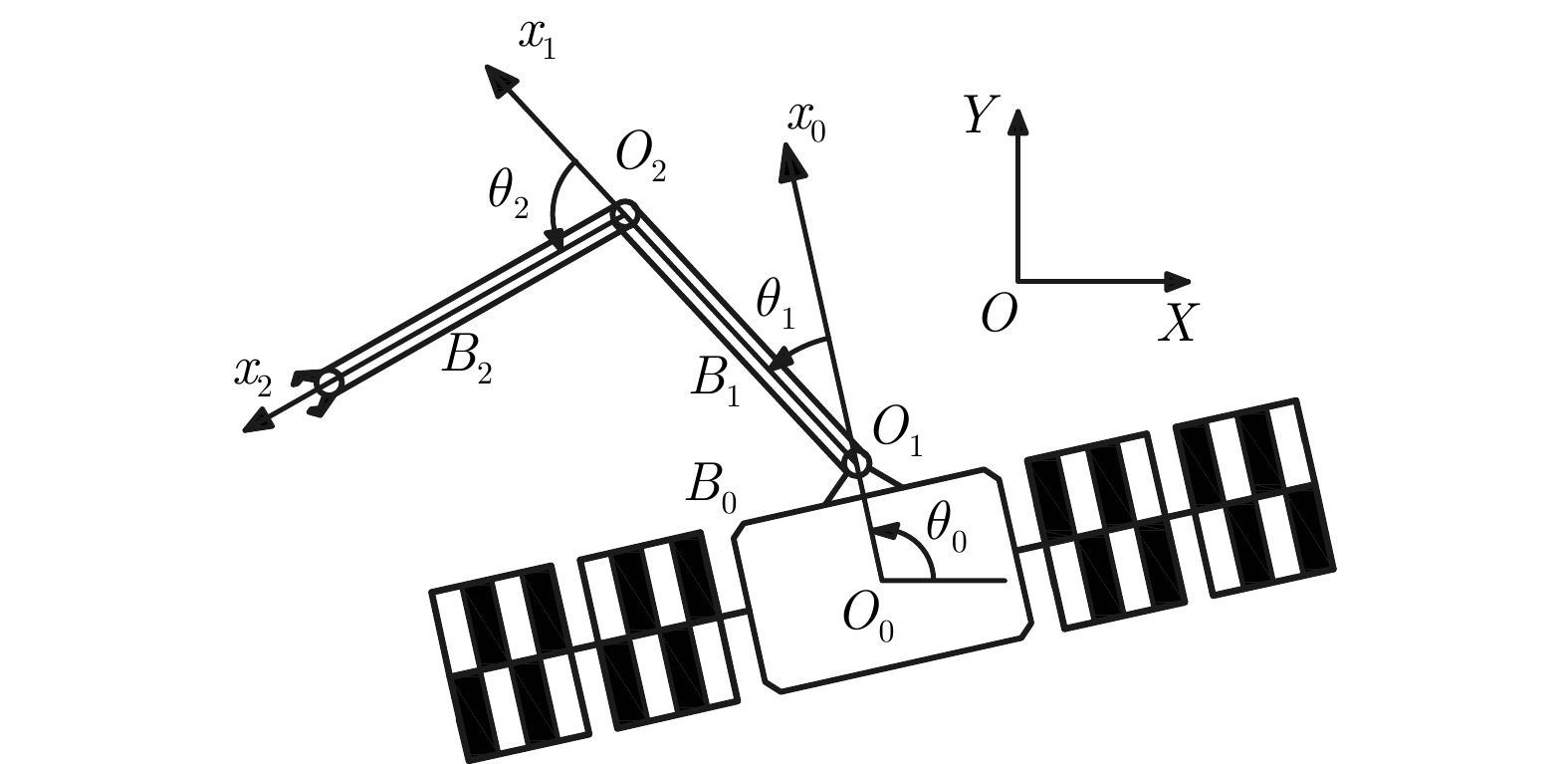
图 1 姿态受控空间机器人平面结构
Fig. 1 Two-dimensional layout of the attitude-controlled space robot
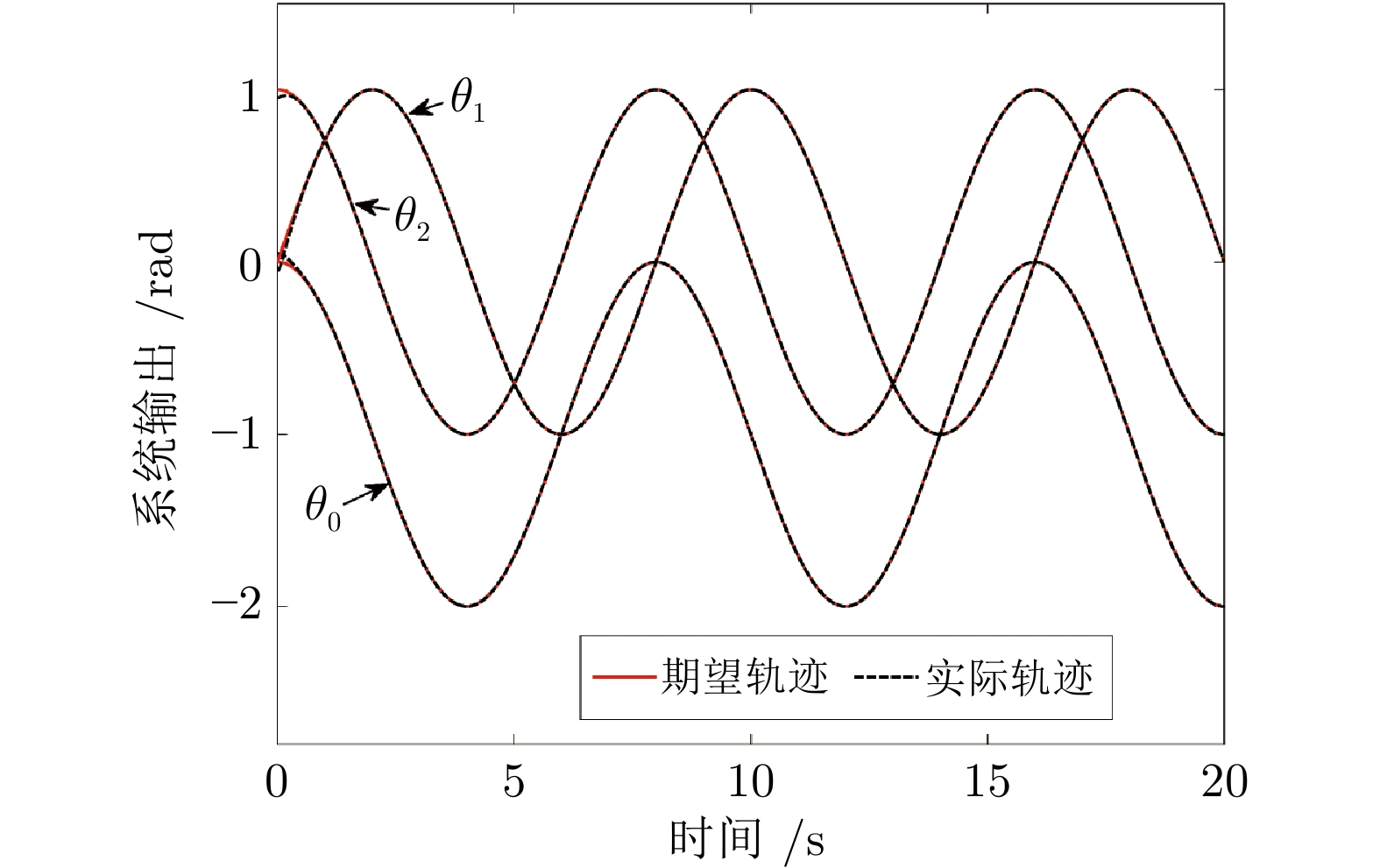
图 2 本文方法的状态变量时间响应(情景一)
Fig. 2 Time responses of the state variables in the proposed method (Scenario 1)
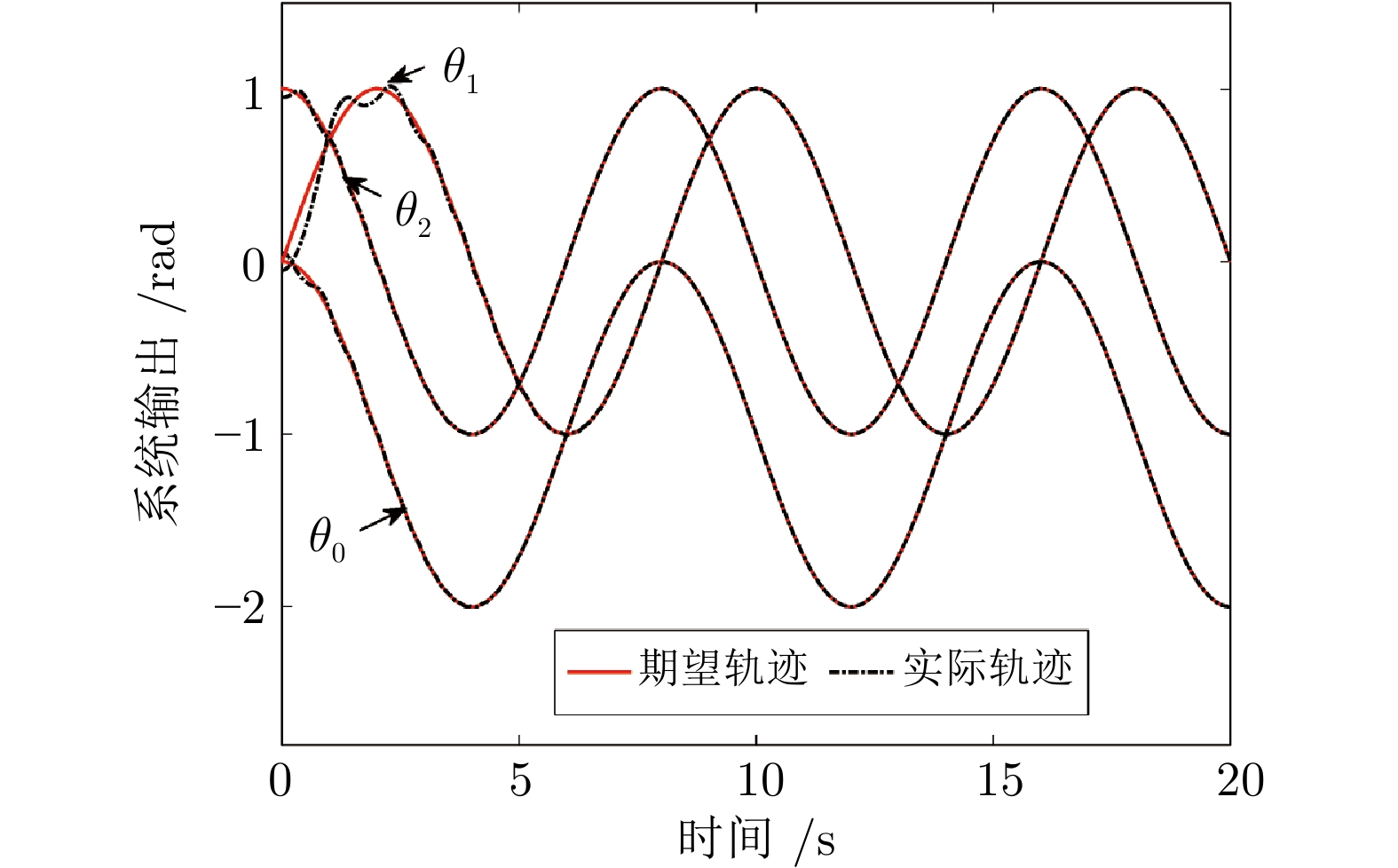
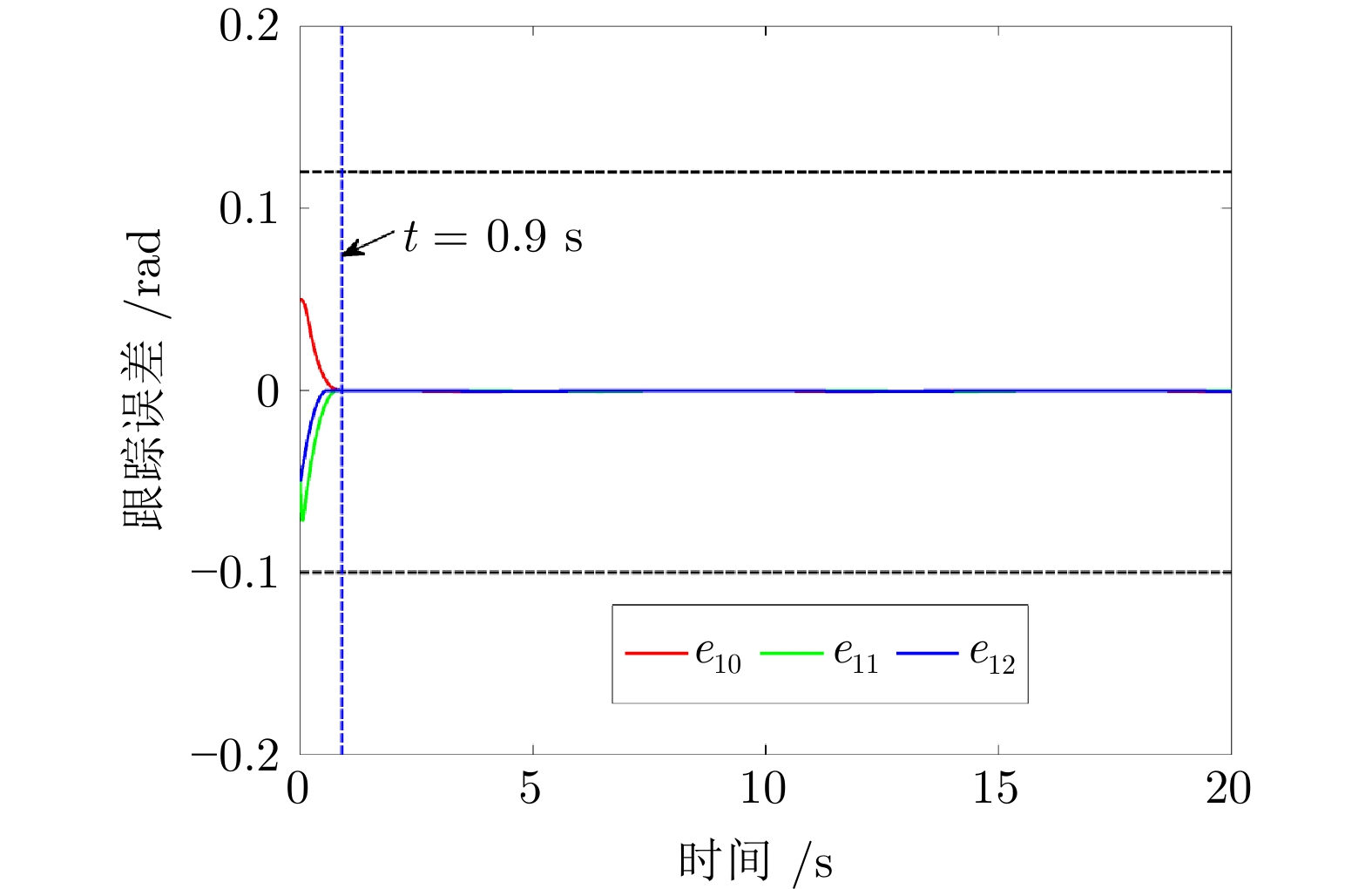
图 5 本文方法的跟踪误差时间响应(情景一)
Fig. 5 Time responses of the tracking errors in the proposed method (Scenario 1)
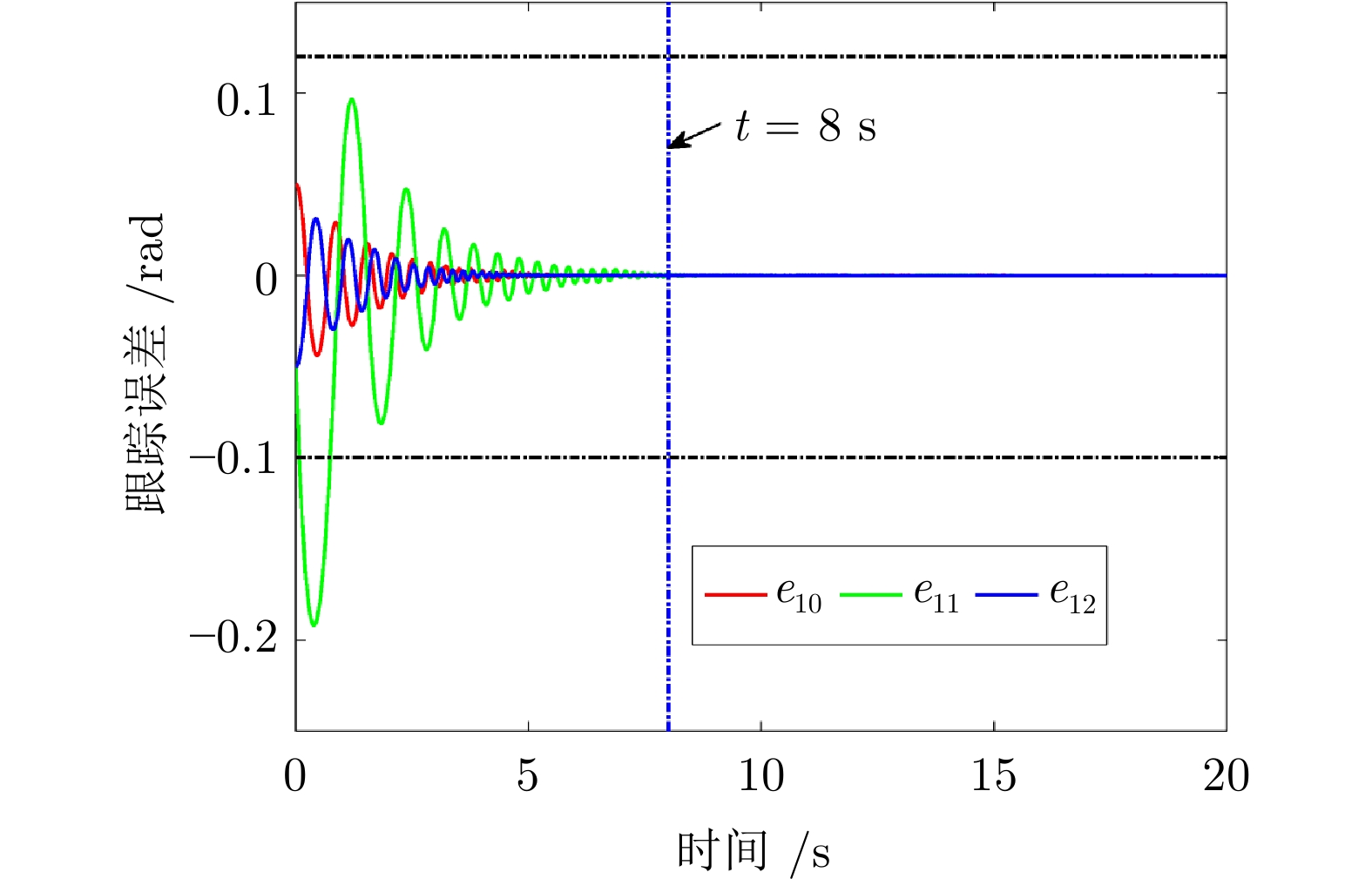
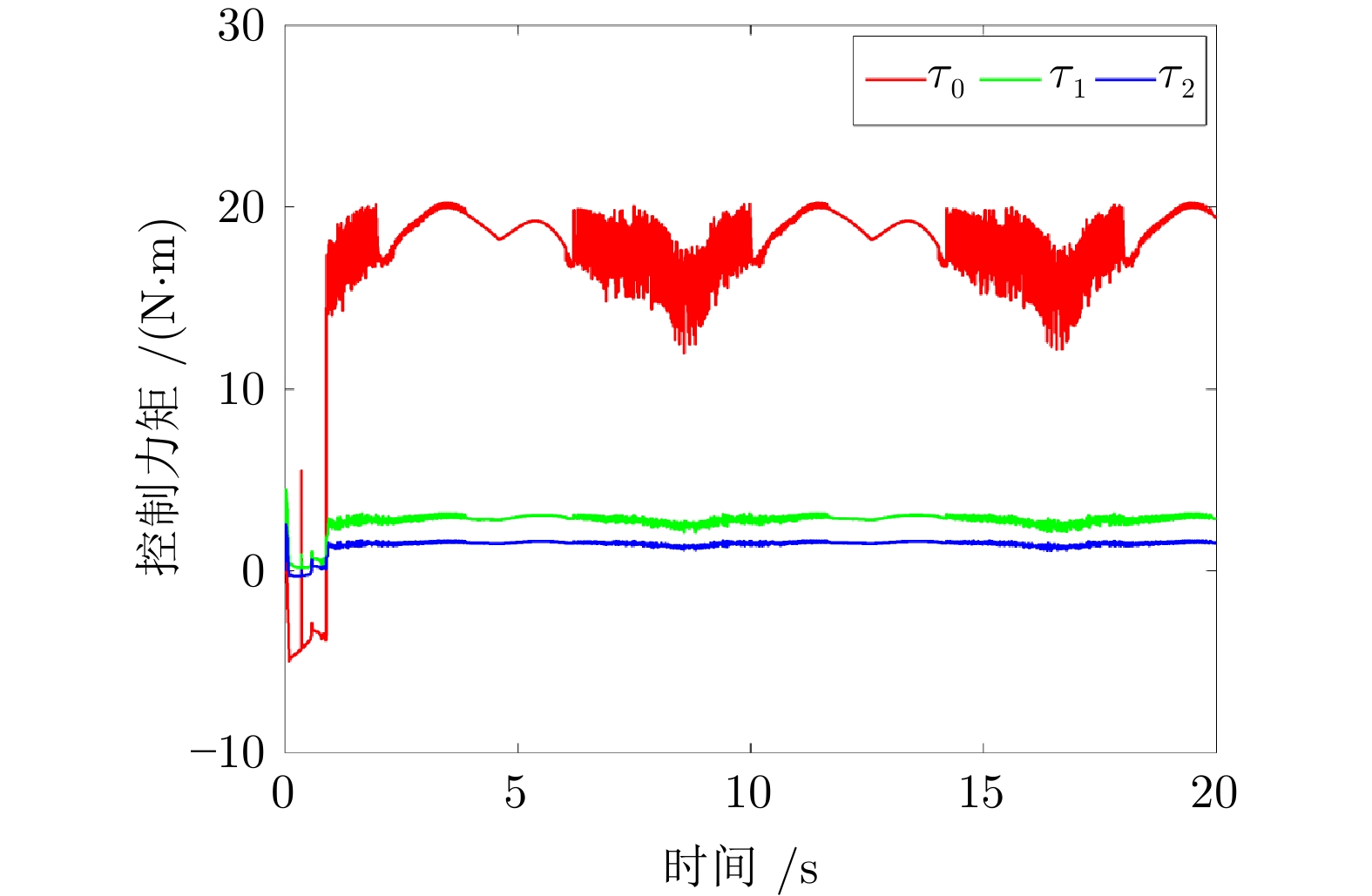
图 8 本文方法的控制力矩时间响应(情景一)
Fig. 8 Time responses of the control torques in the proposed method (Scenario 1)
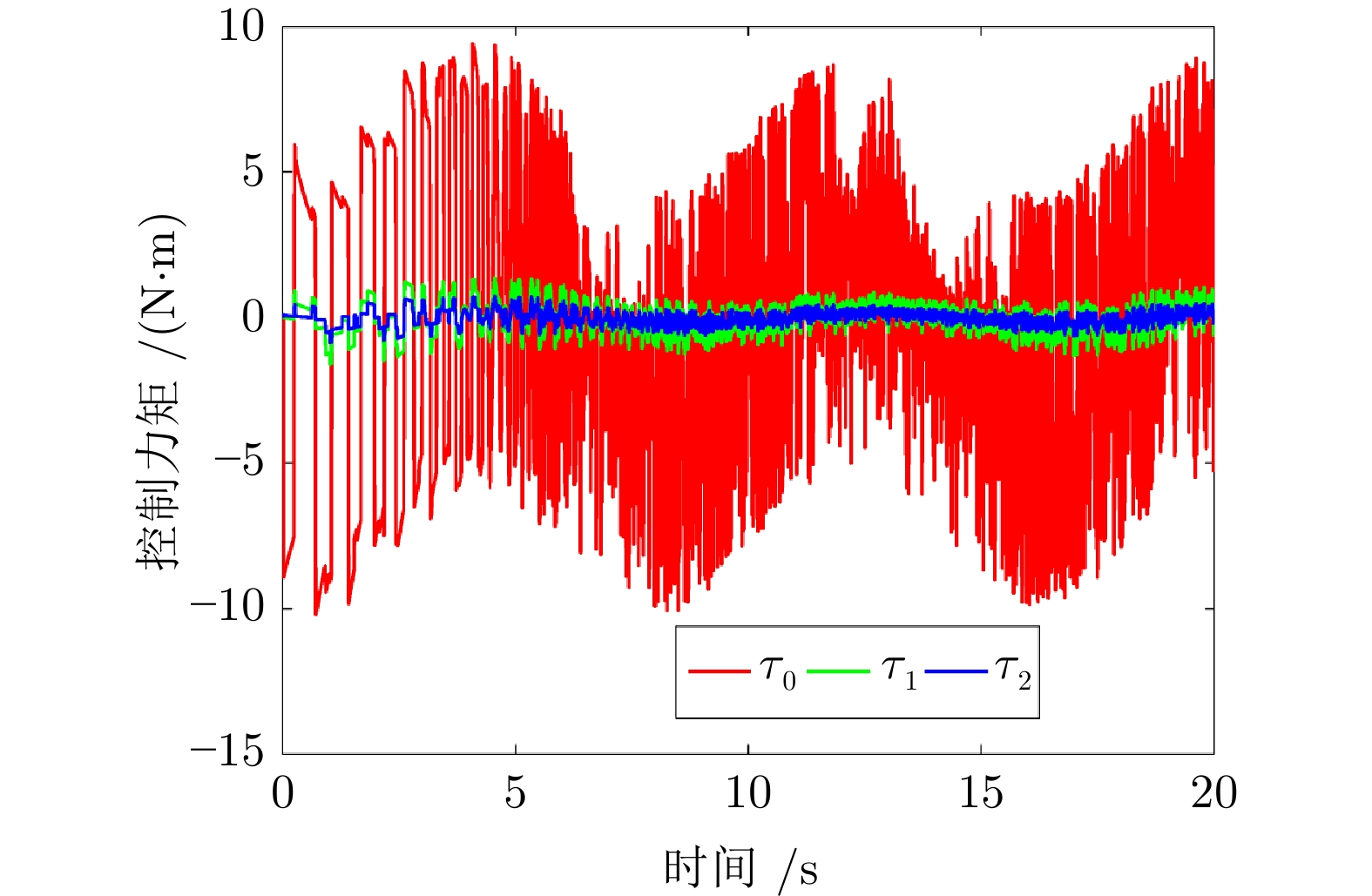
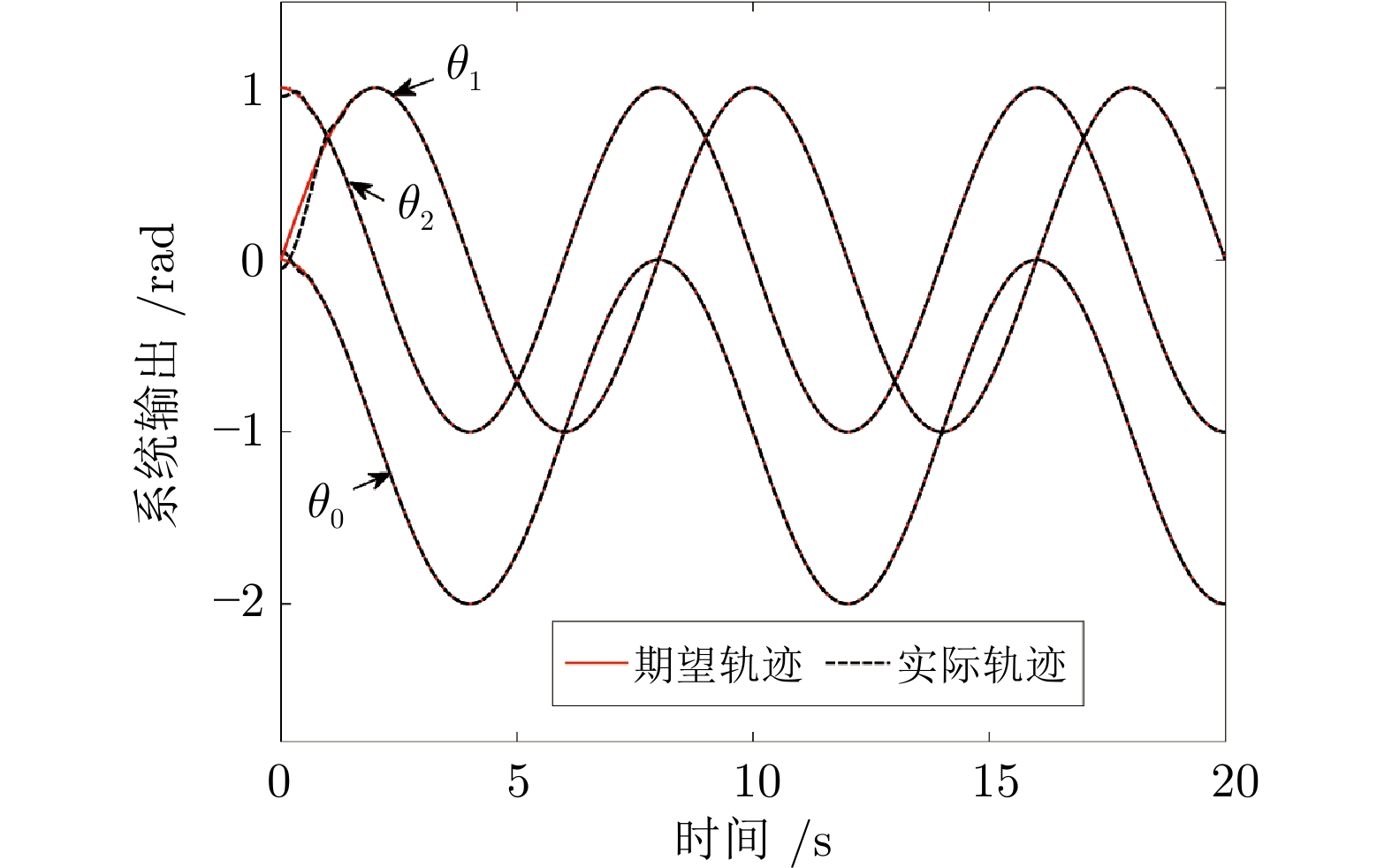
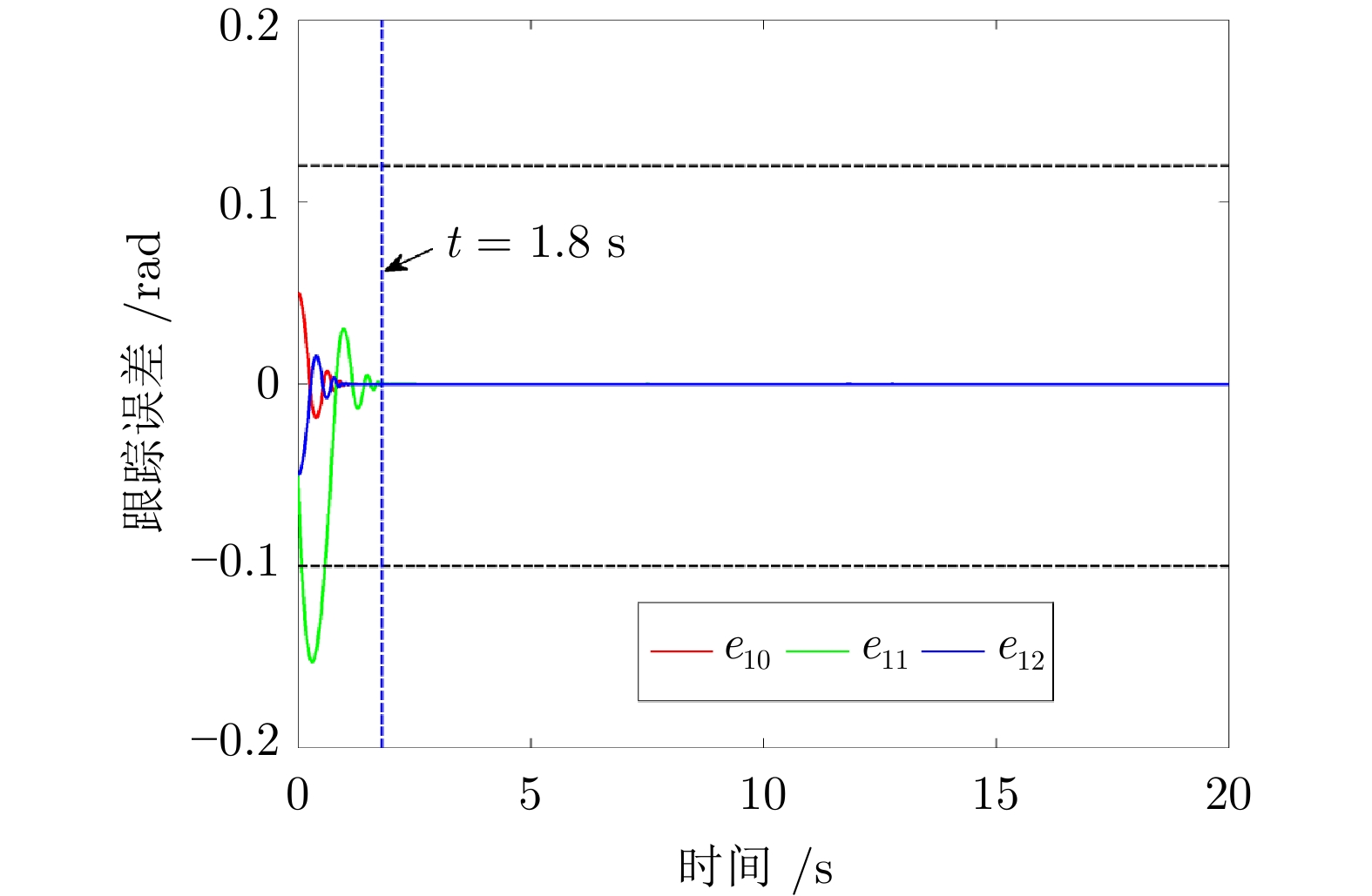
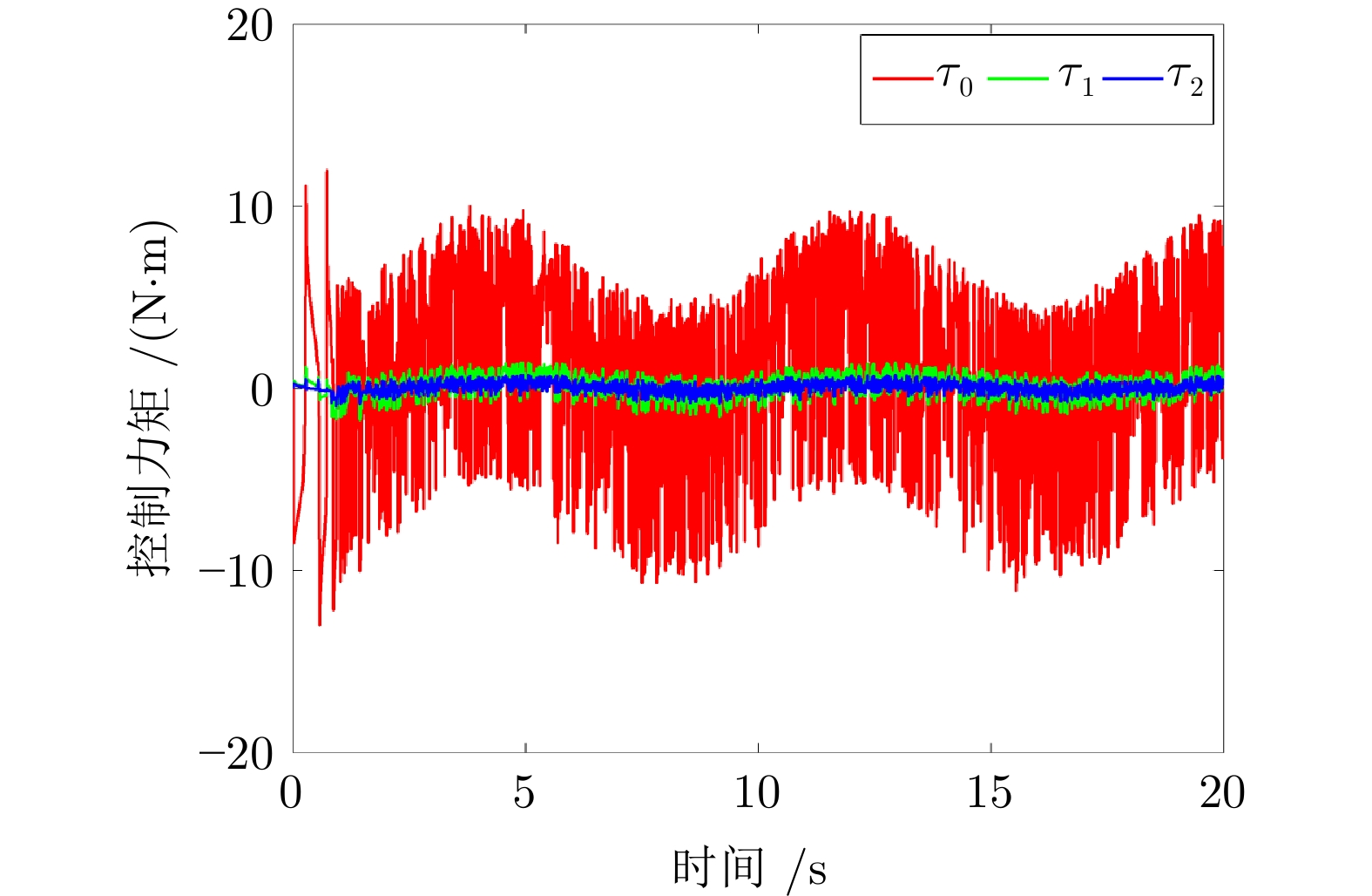
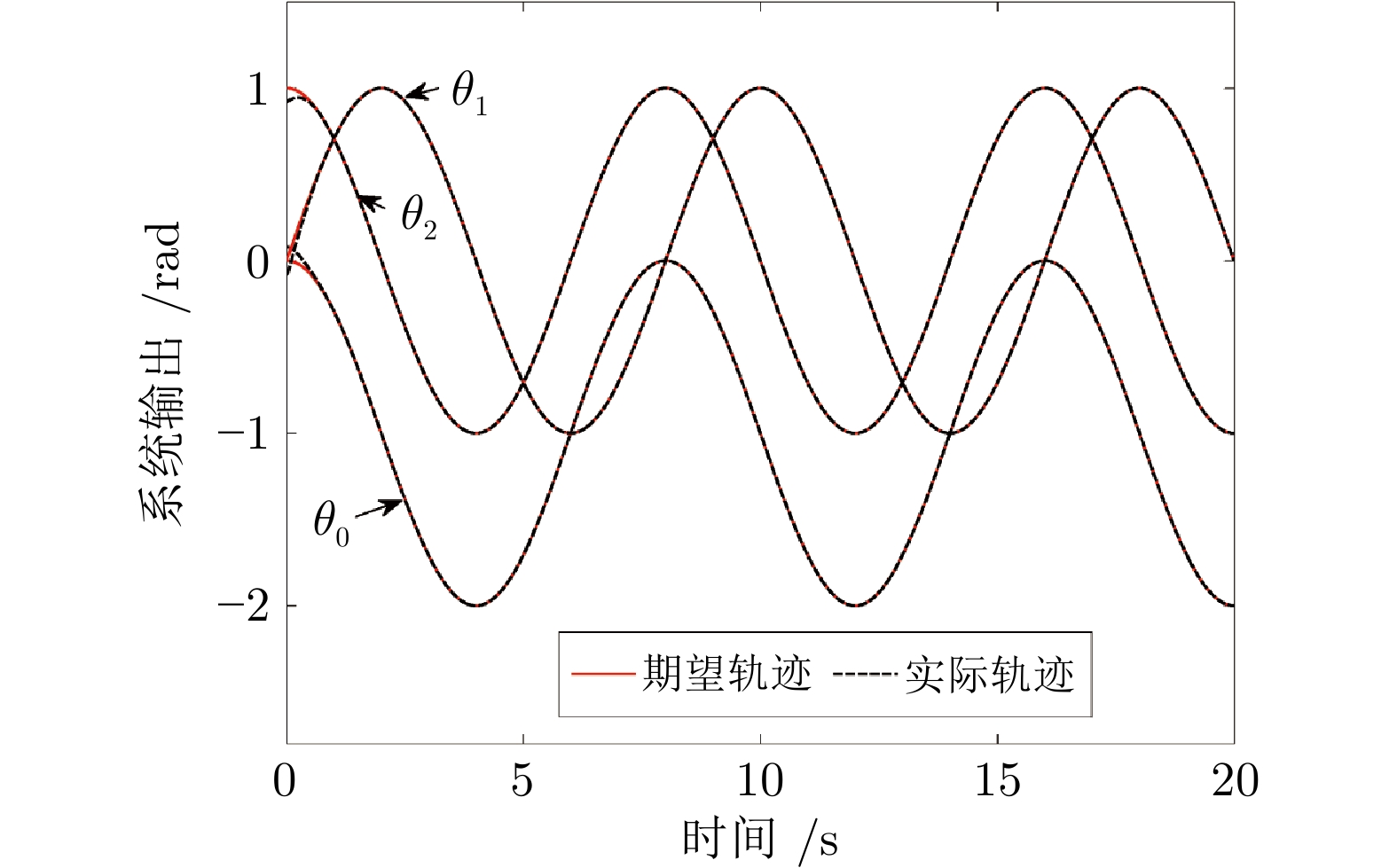
图 11 本文方法的状态变量时间响应(情景二)
Fig. 11 Time responses of the state variables in the proposed method (Scenario 2)
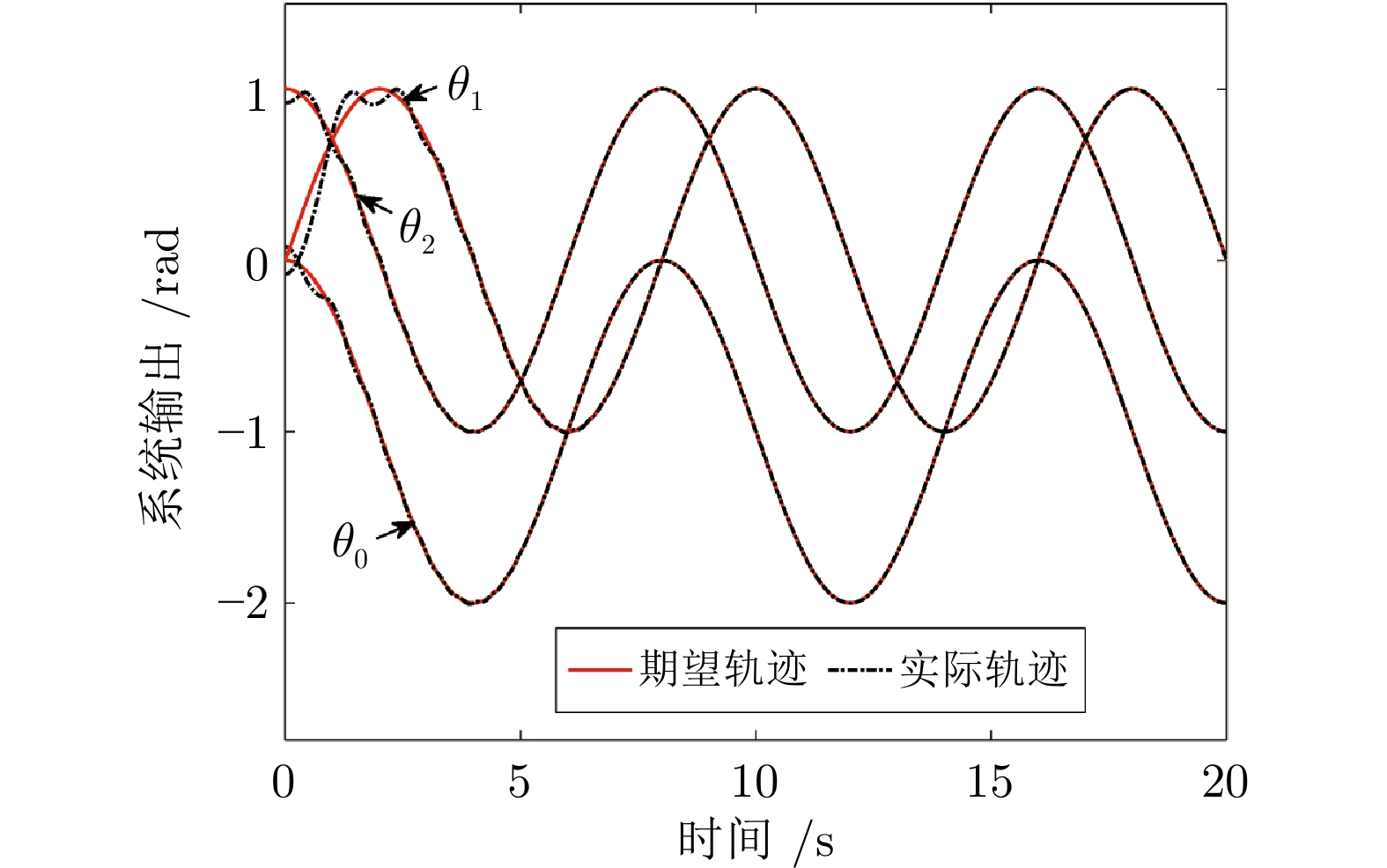
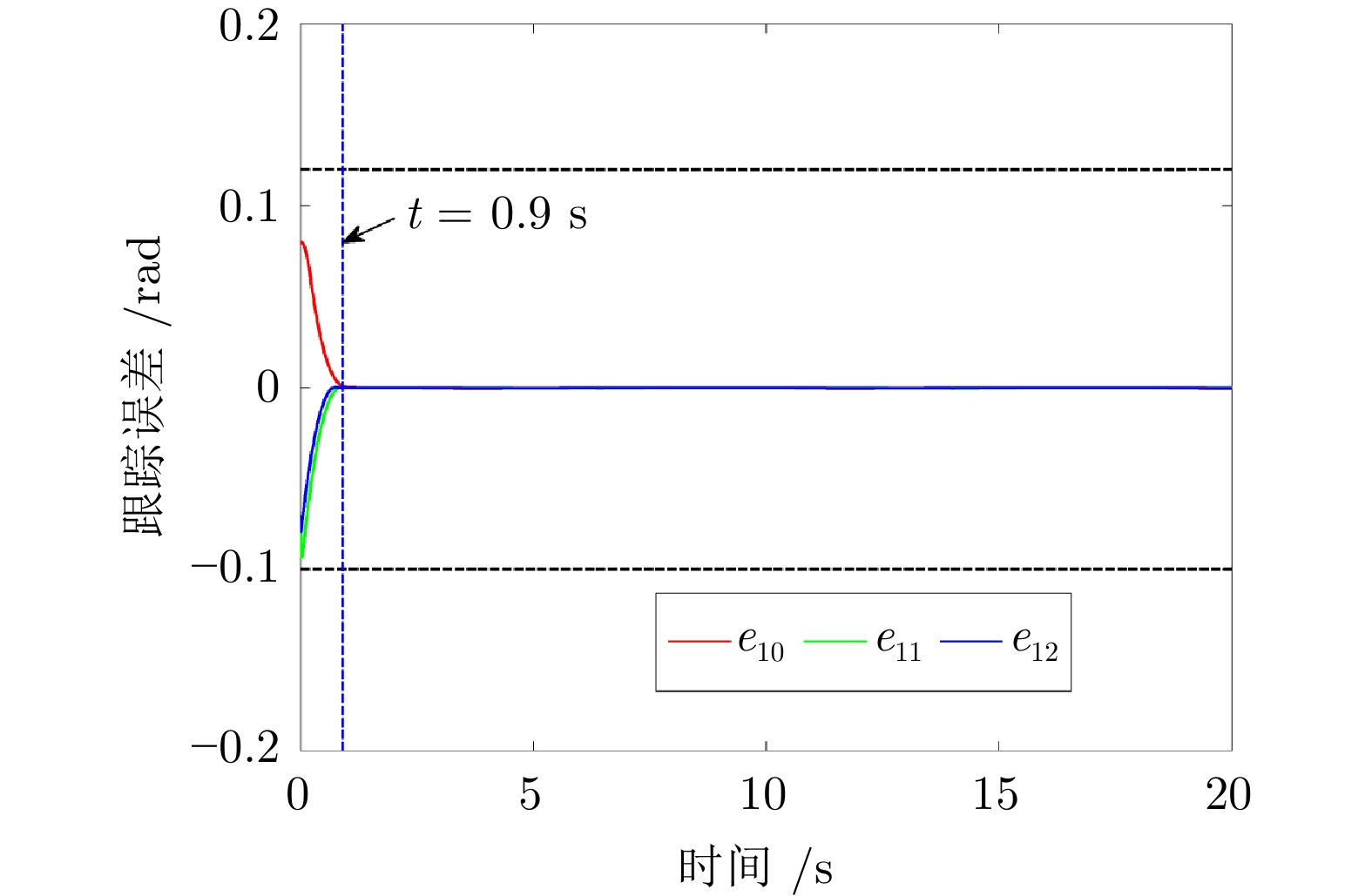
图 14 本文方法的跟踪误差时间响应(情景二)
Fig. 14 Time responses of the tracking errors in the proposed method (Scenario 2)
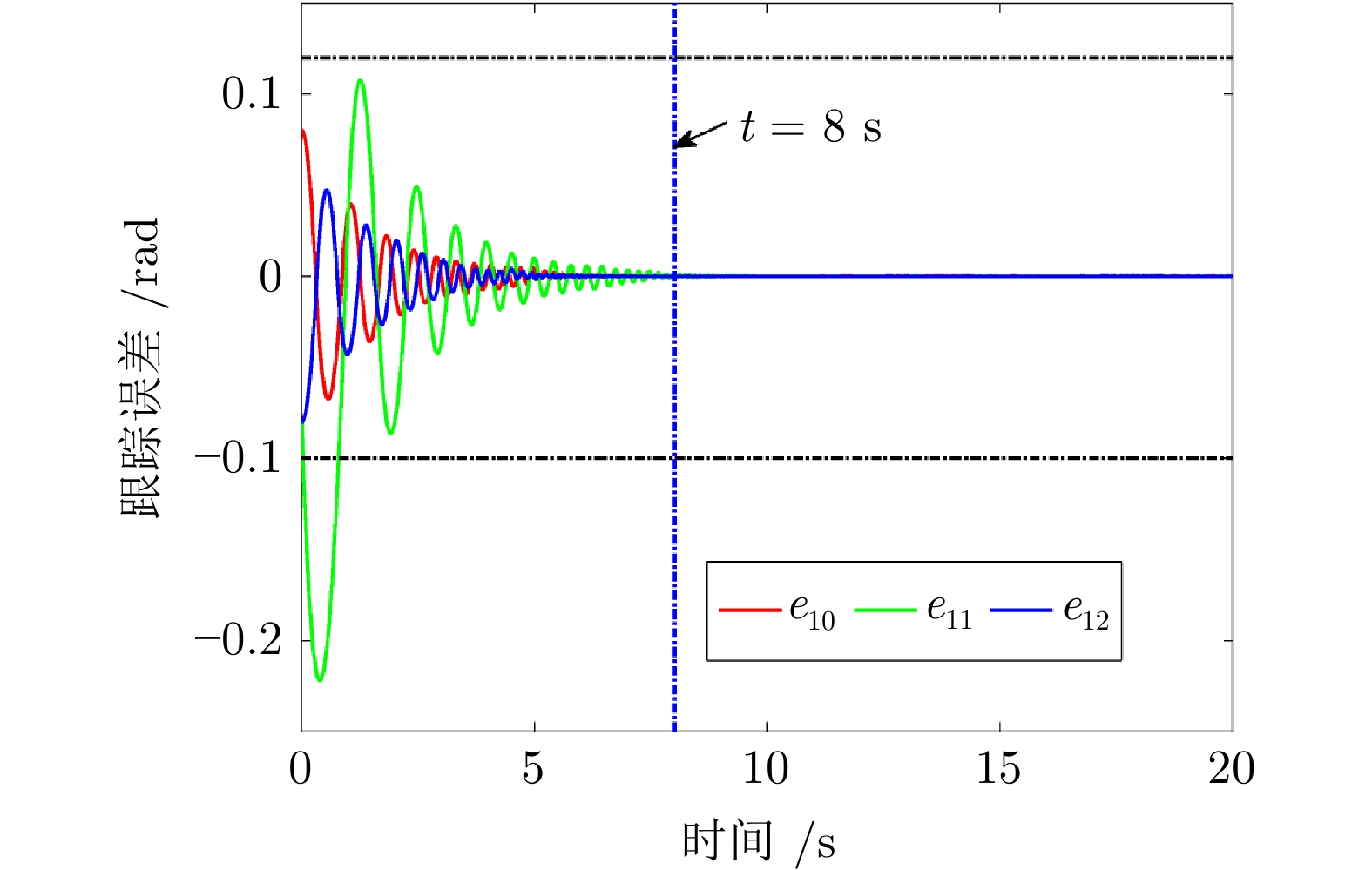
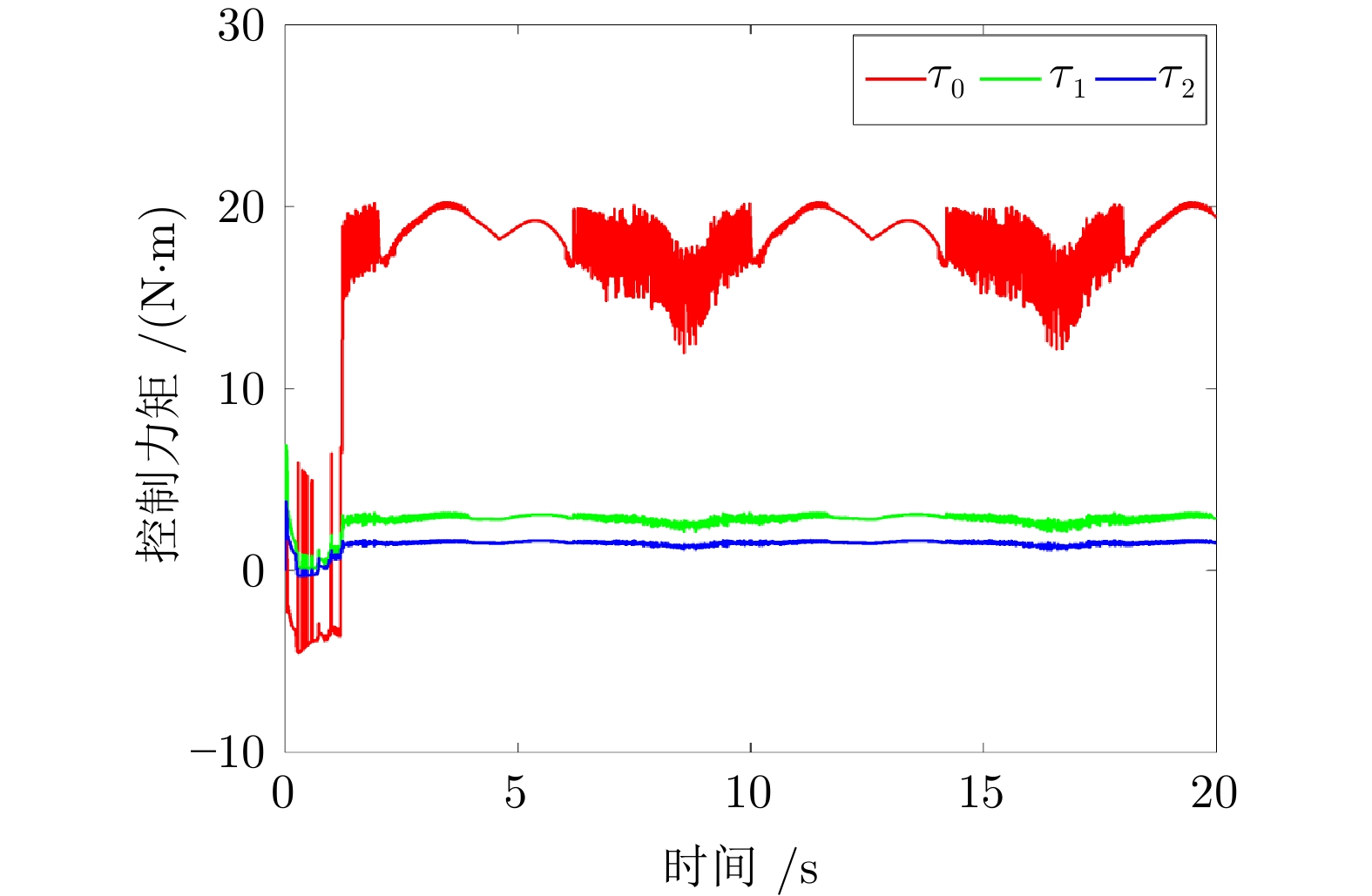
图 17 本文方法的控制力矩时间响应(情景二)
Fig. 17 Time responses of the control torques in the proposed method (Scenario 2)
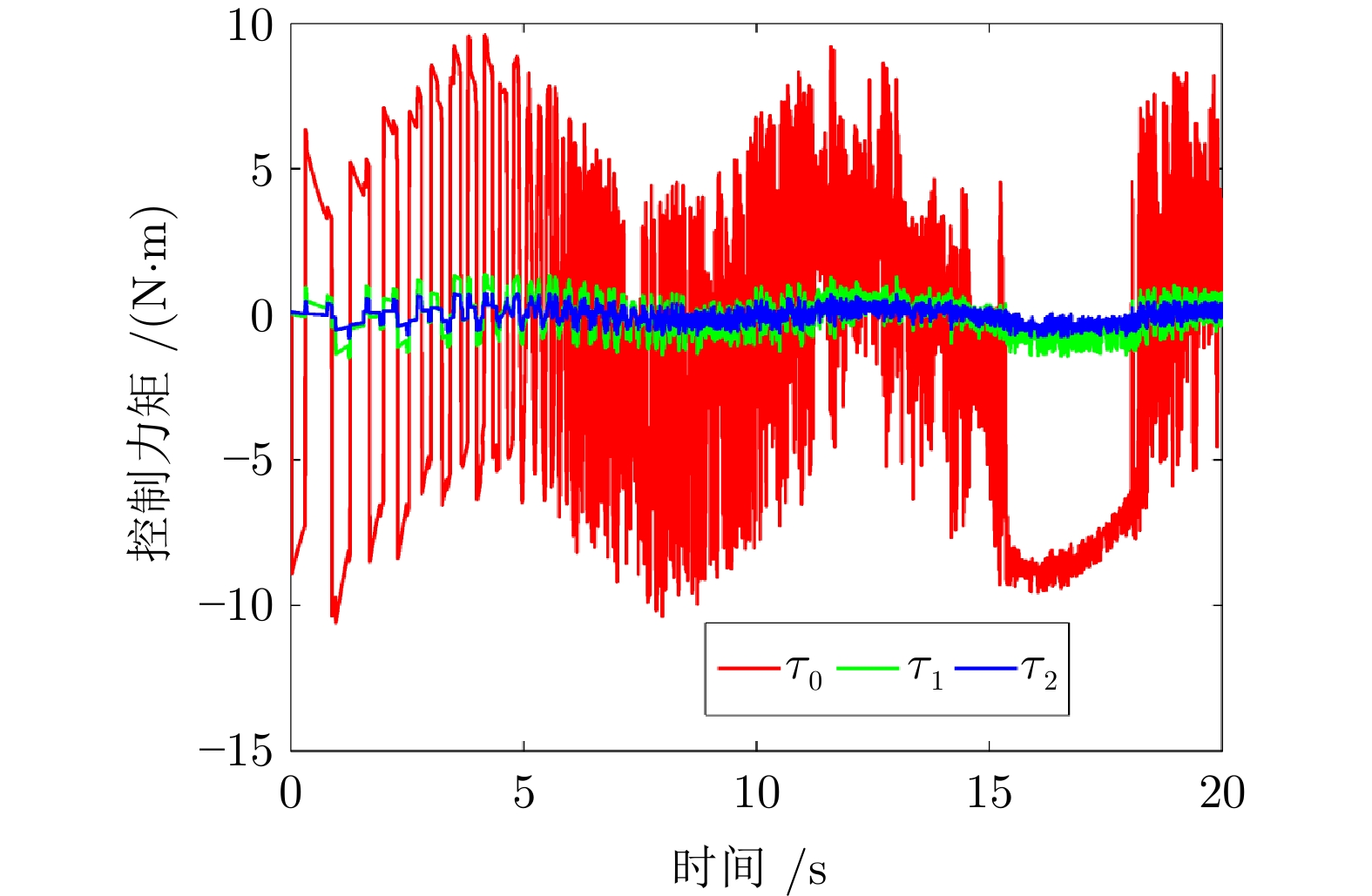
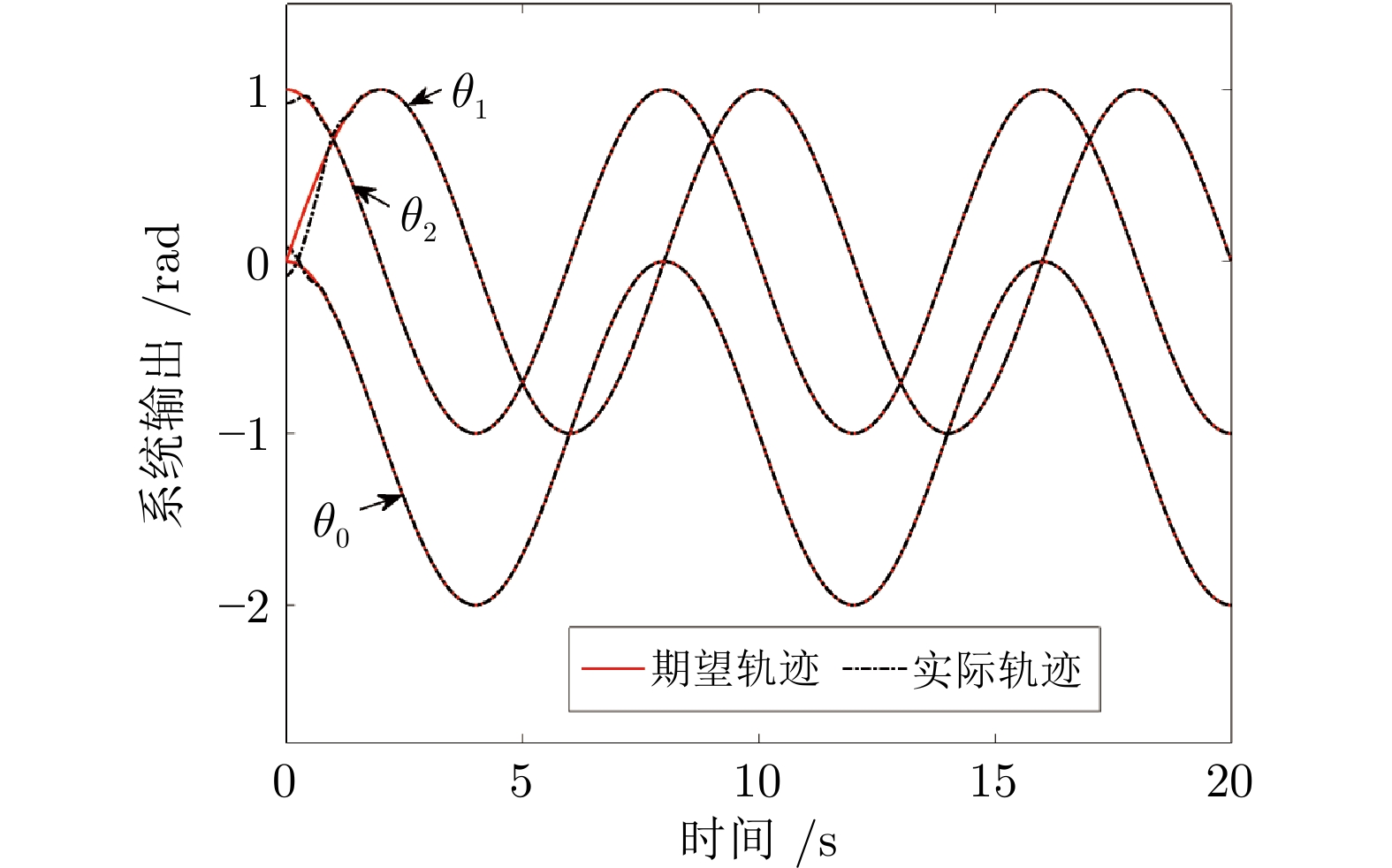
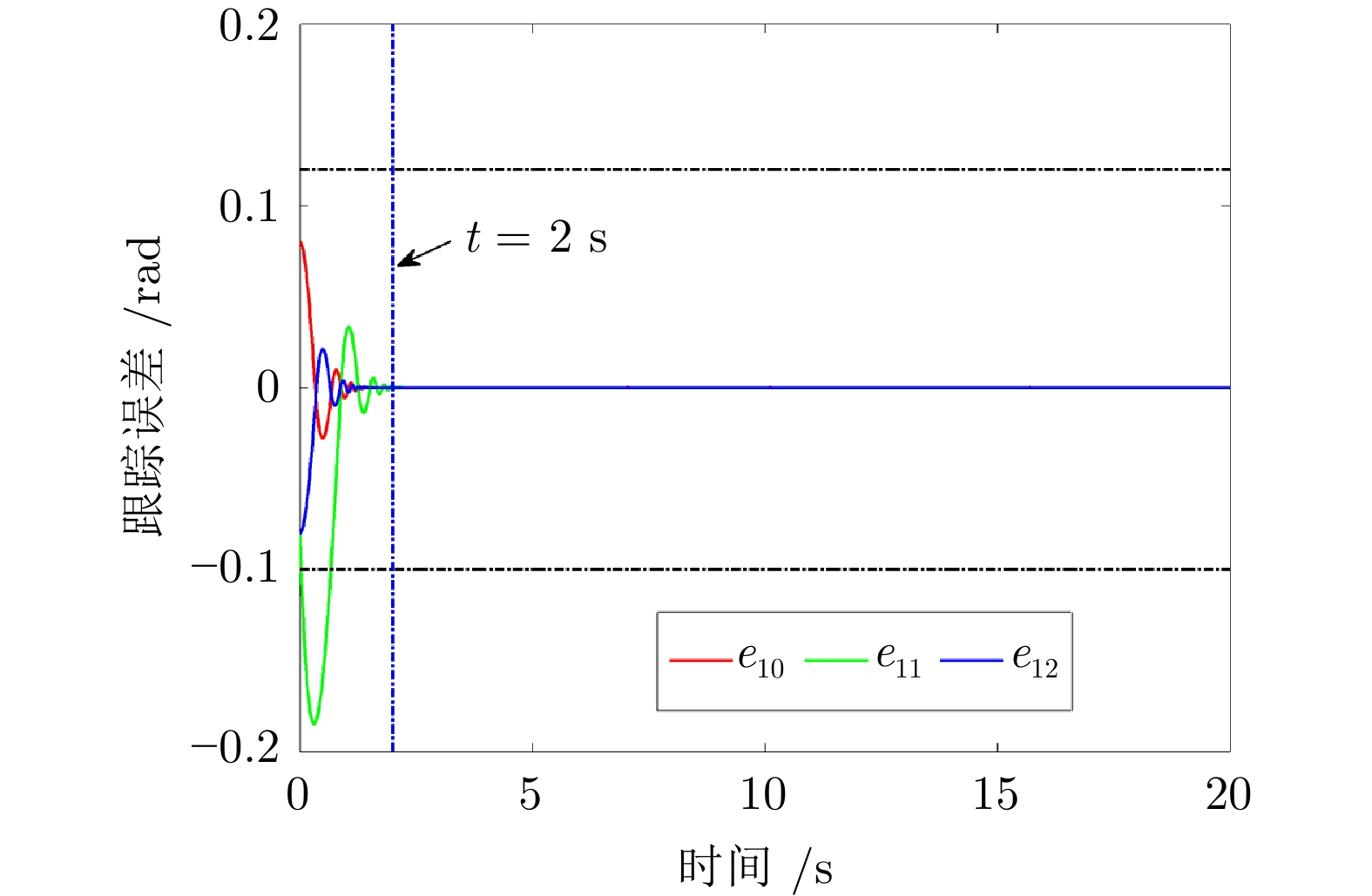
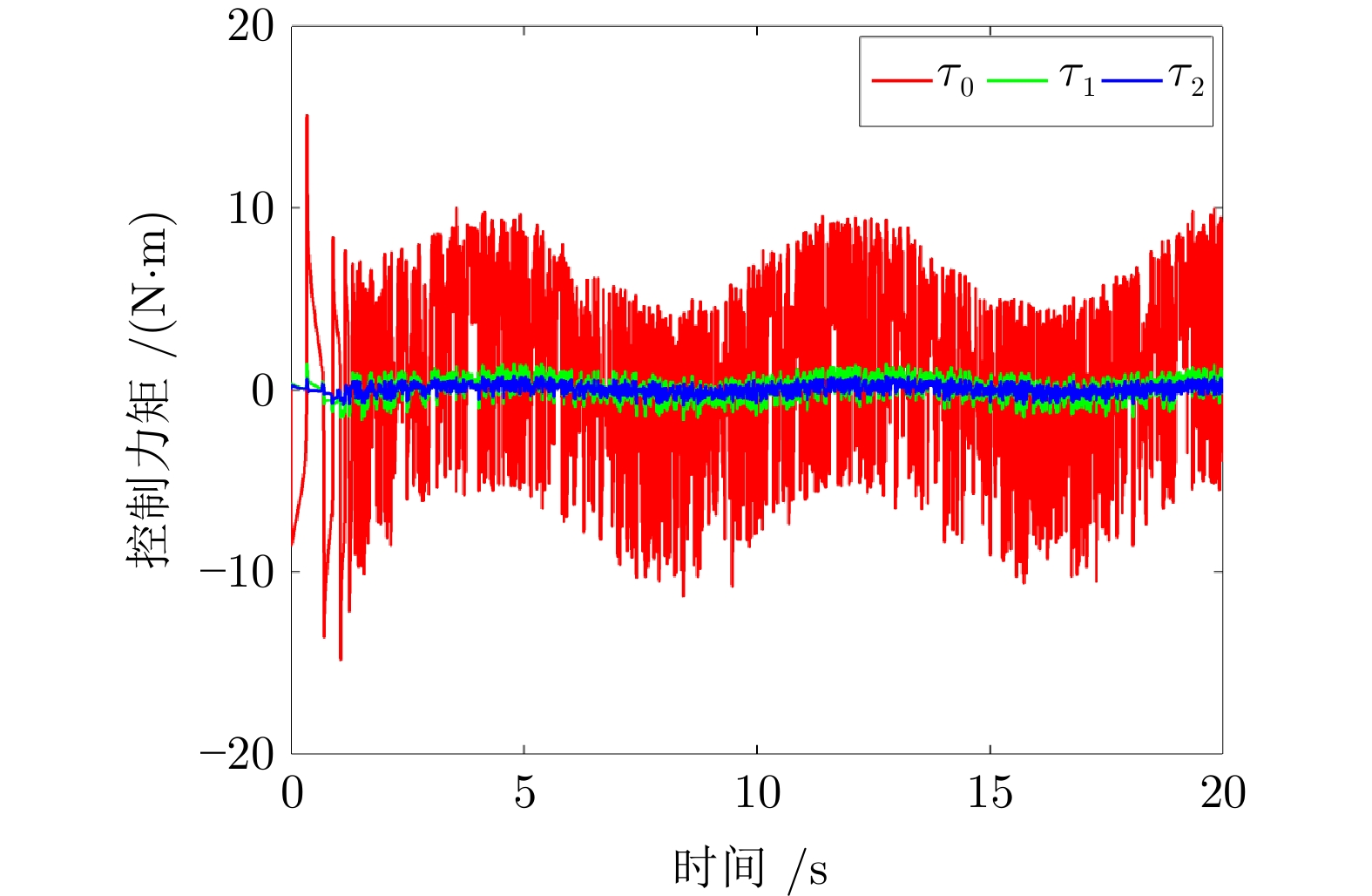
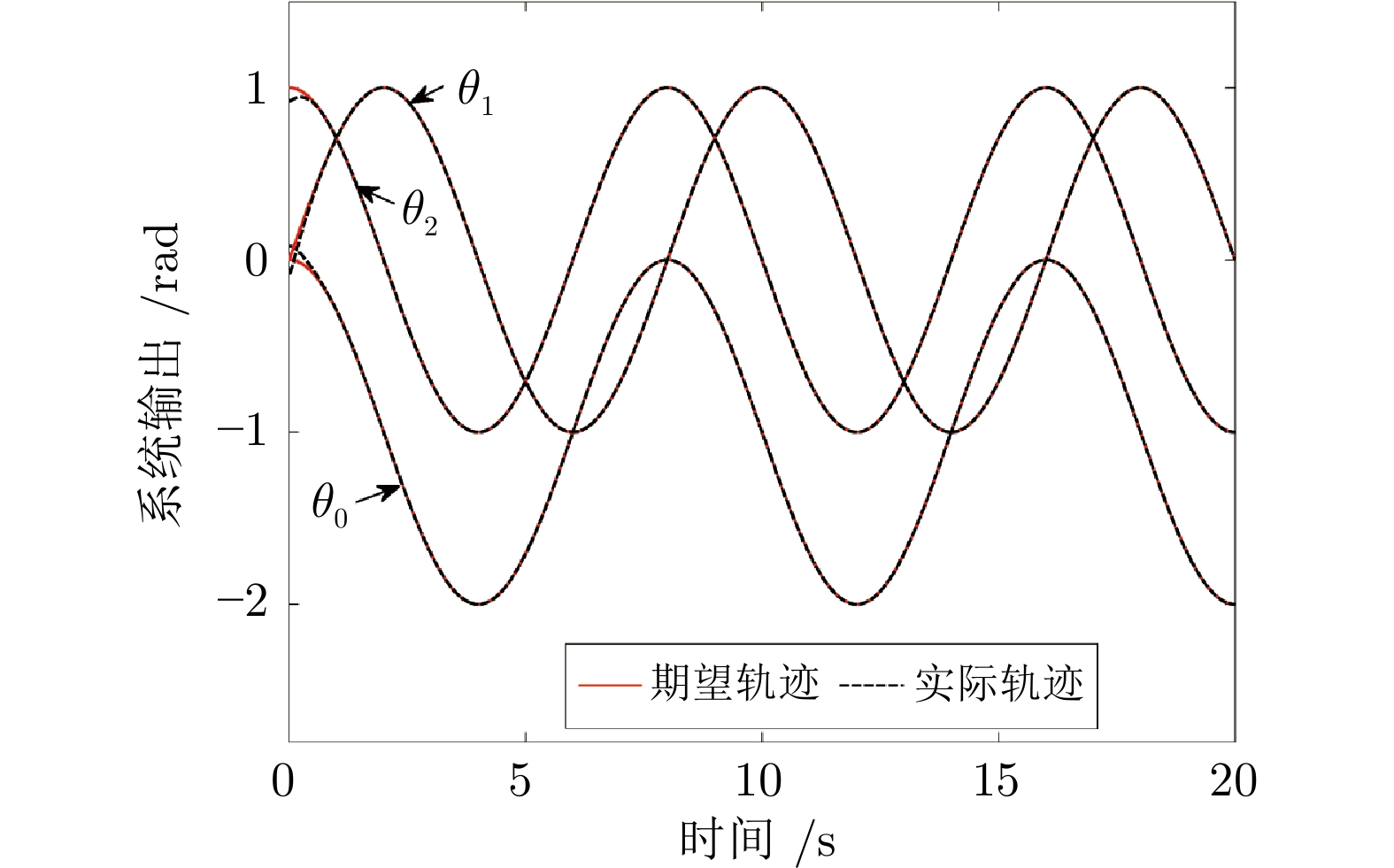
图 20 本文方法的状态变量时间响应(情景三)
Fig. 20 Time responses of the state variables in the proposed method (Scenario 3)
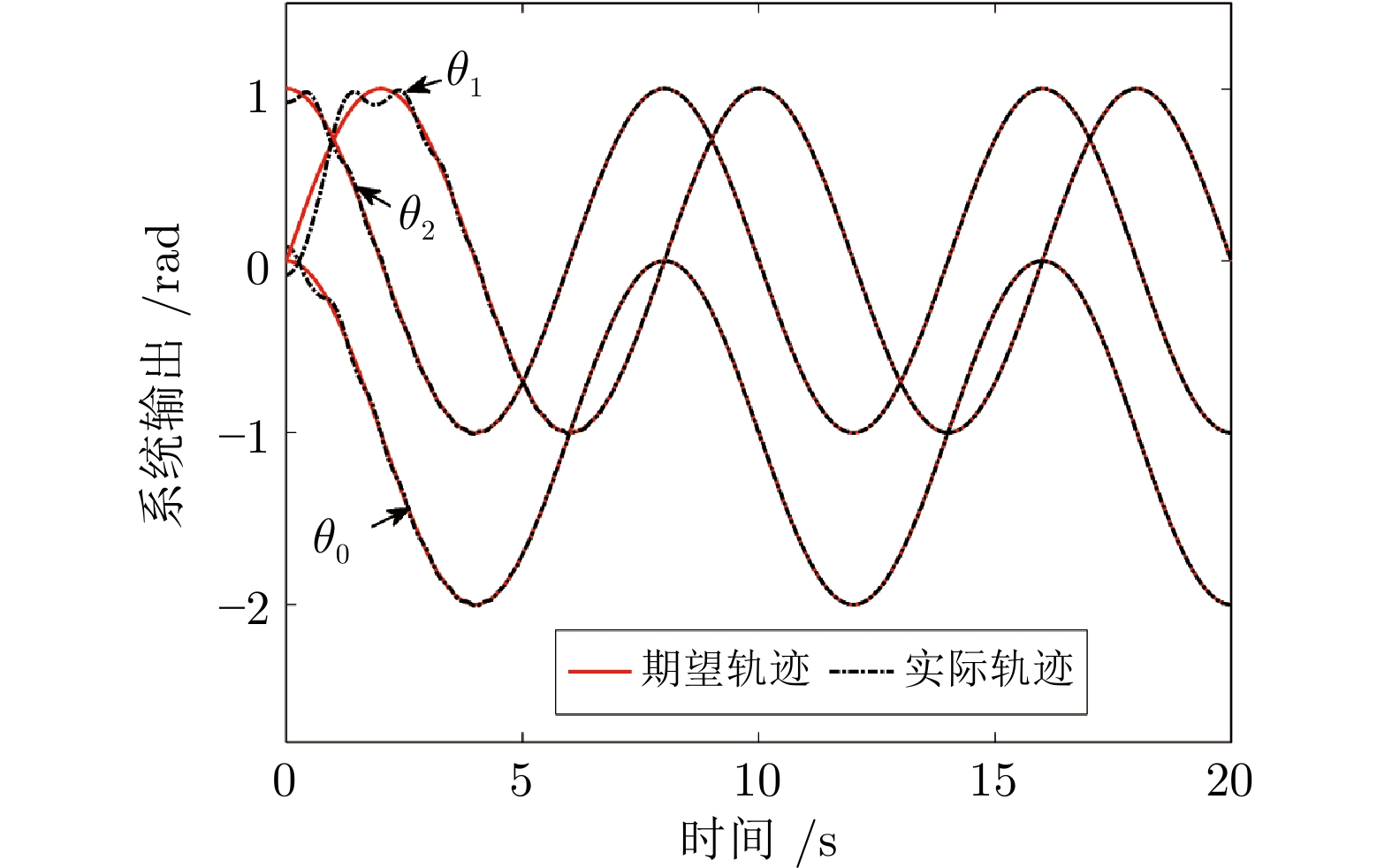
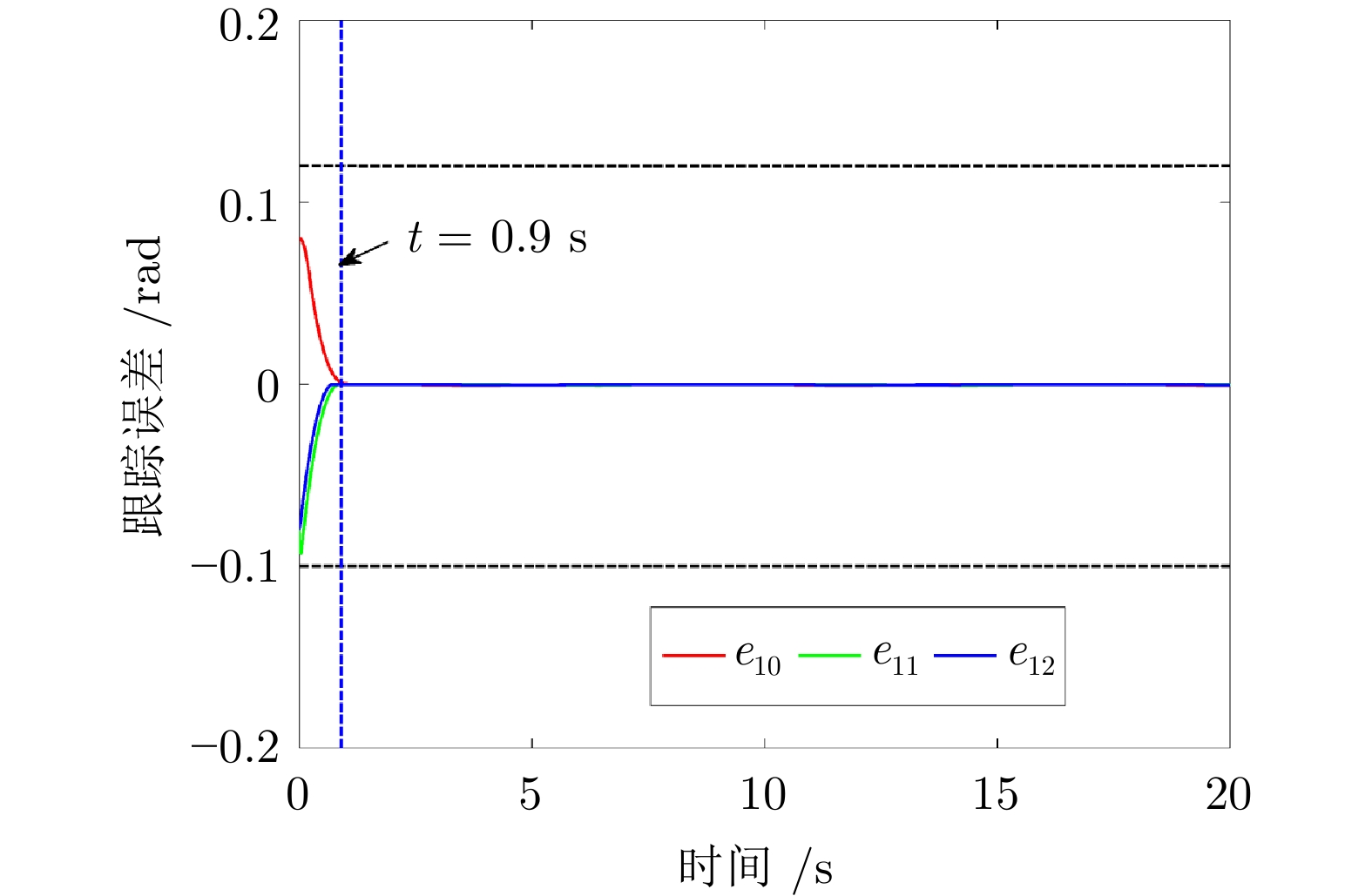
图 23 本文方法的跟踪误差时间响应(情景三)
Fig. 23 Time responses of the tracking errors in the proposed method (Scenario 3)
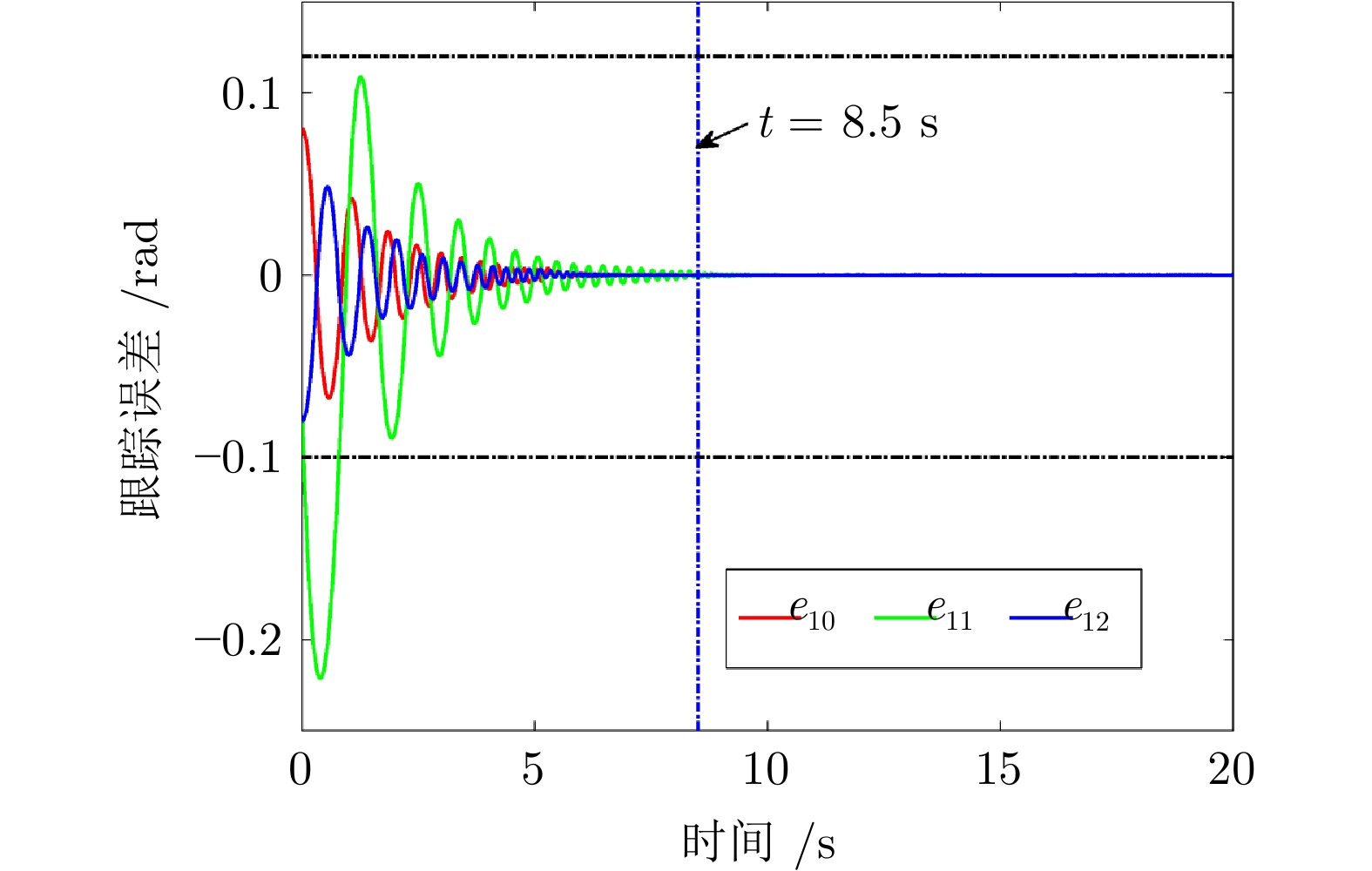
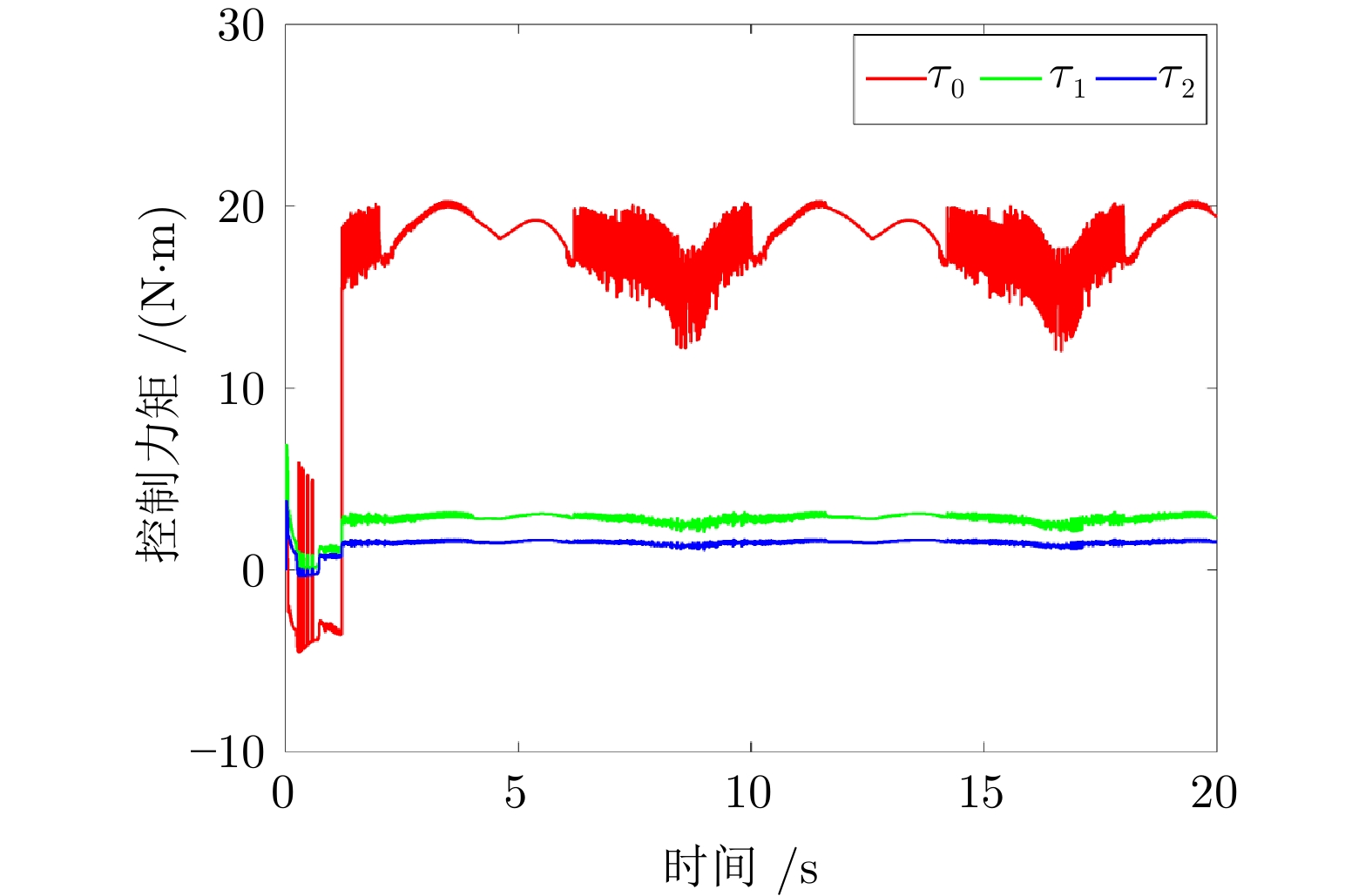
图 26 本文方法的控制力矩时间响应(情景三)
Fig. 26 Time responses of the control torques in the proposed method (Scenario 3)
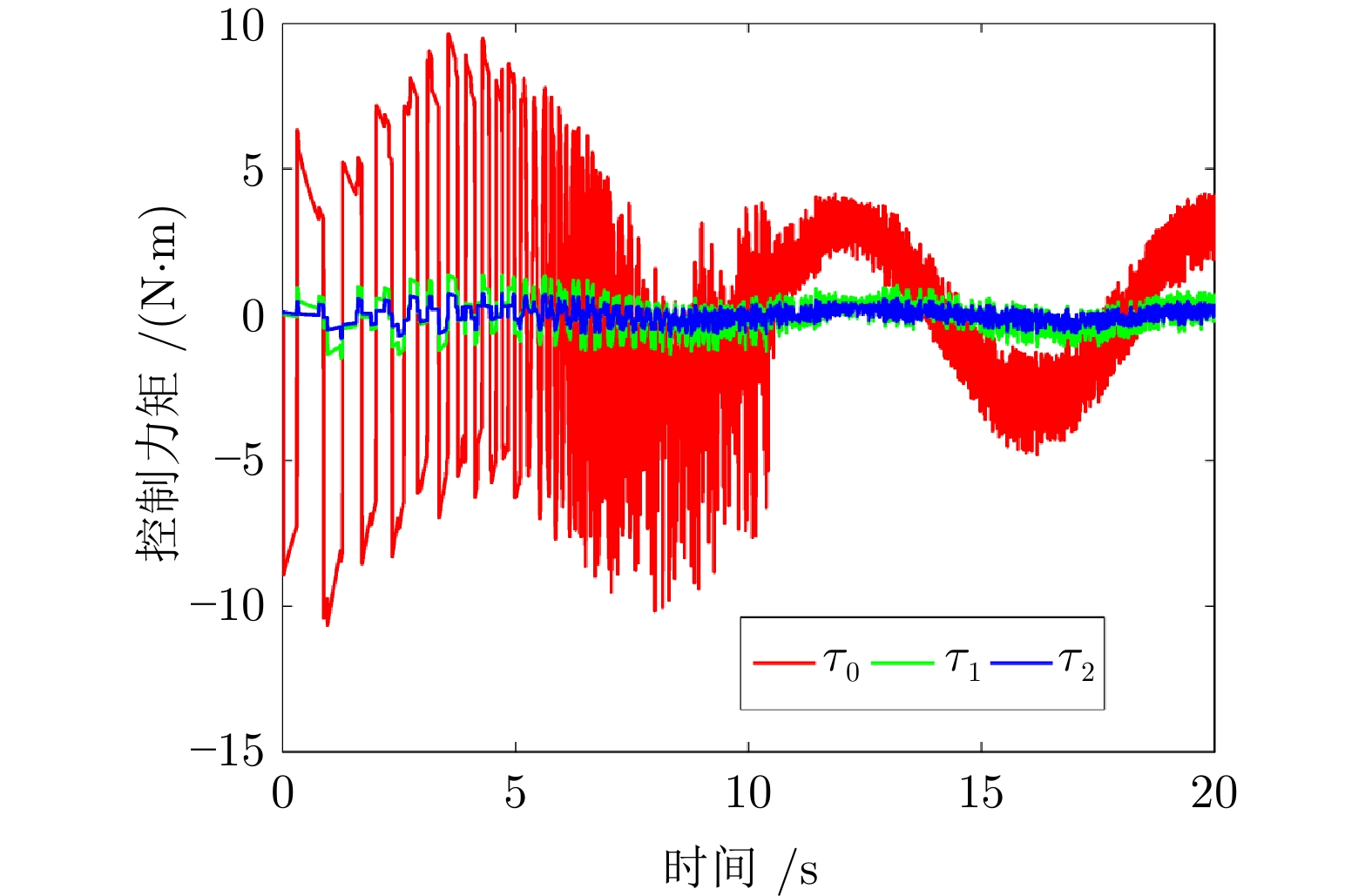
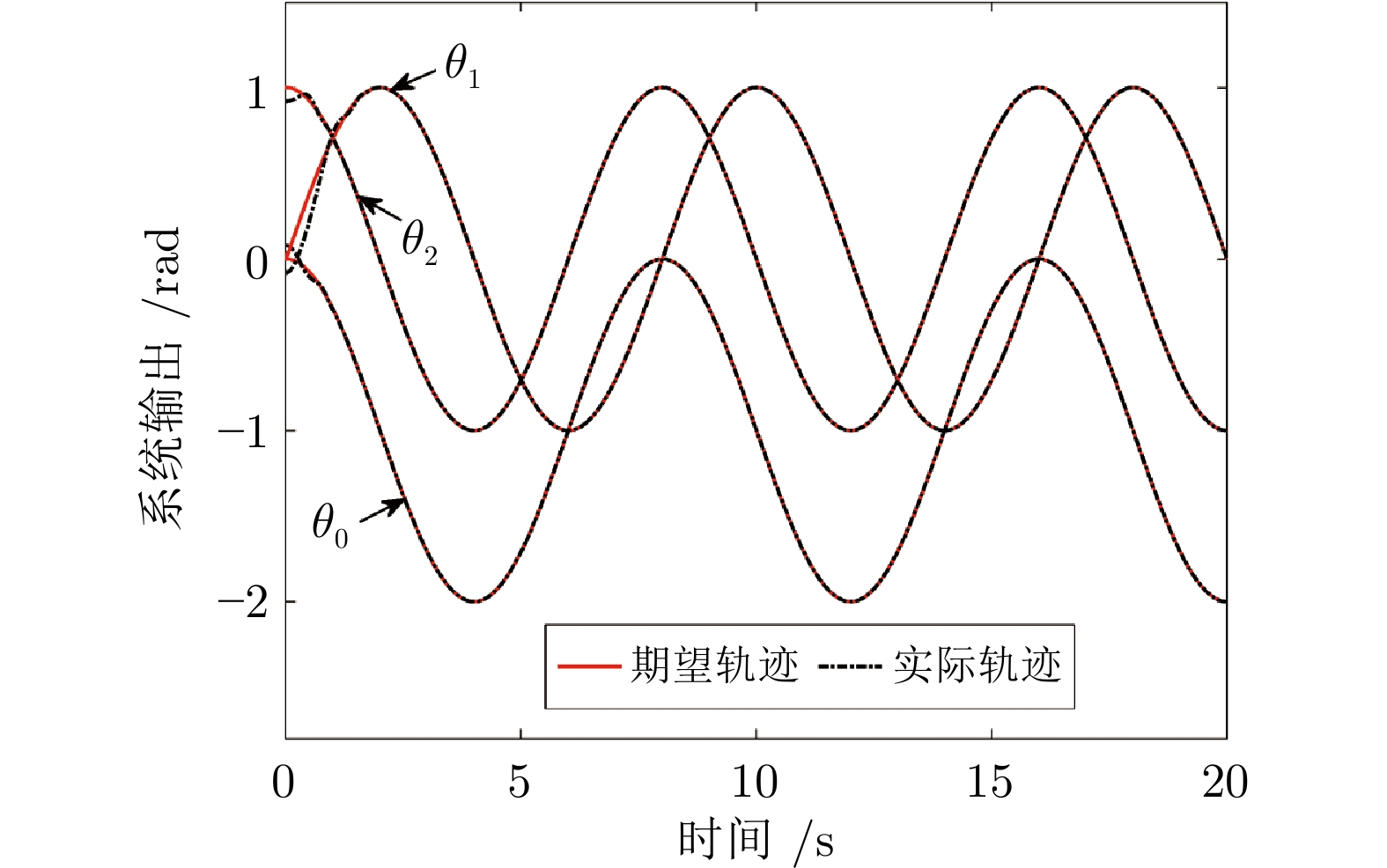
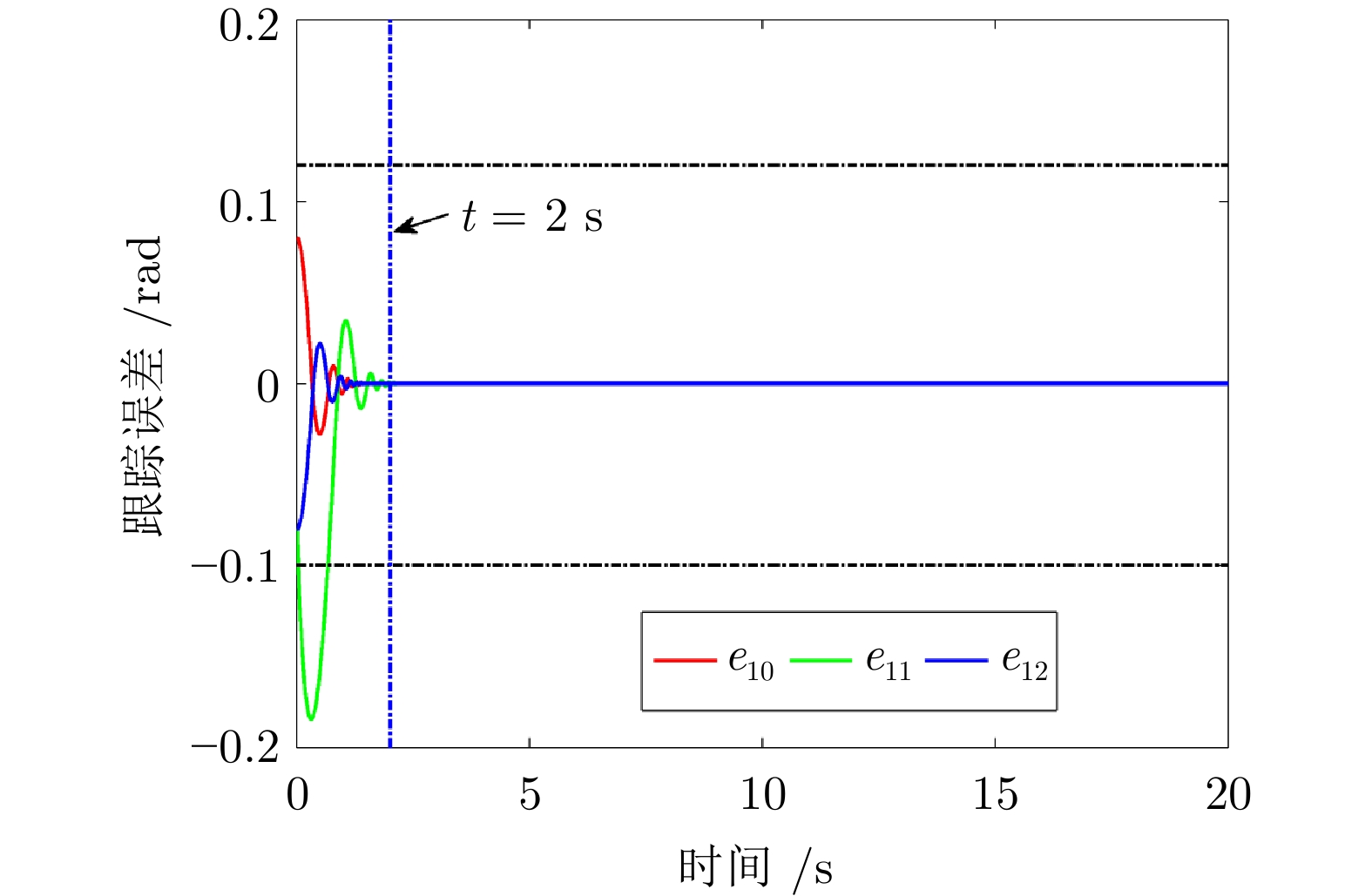
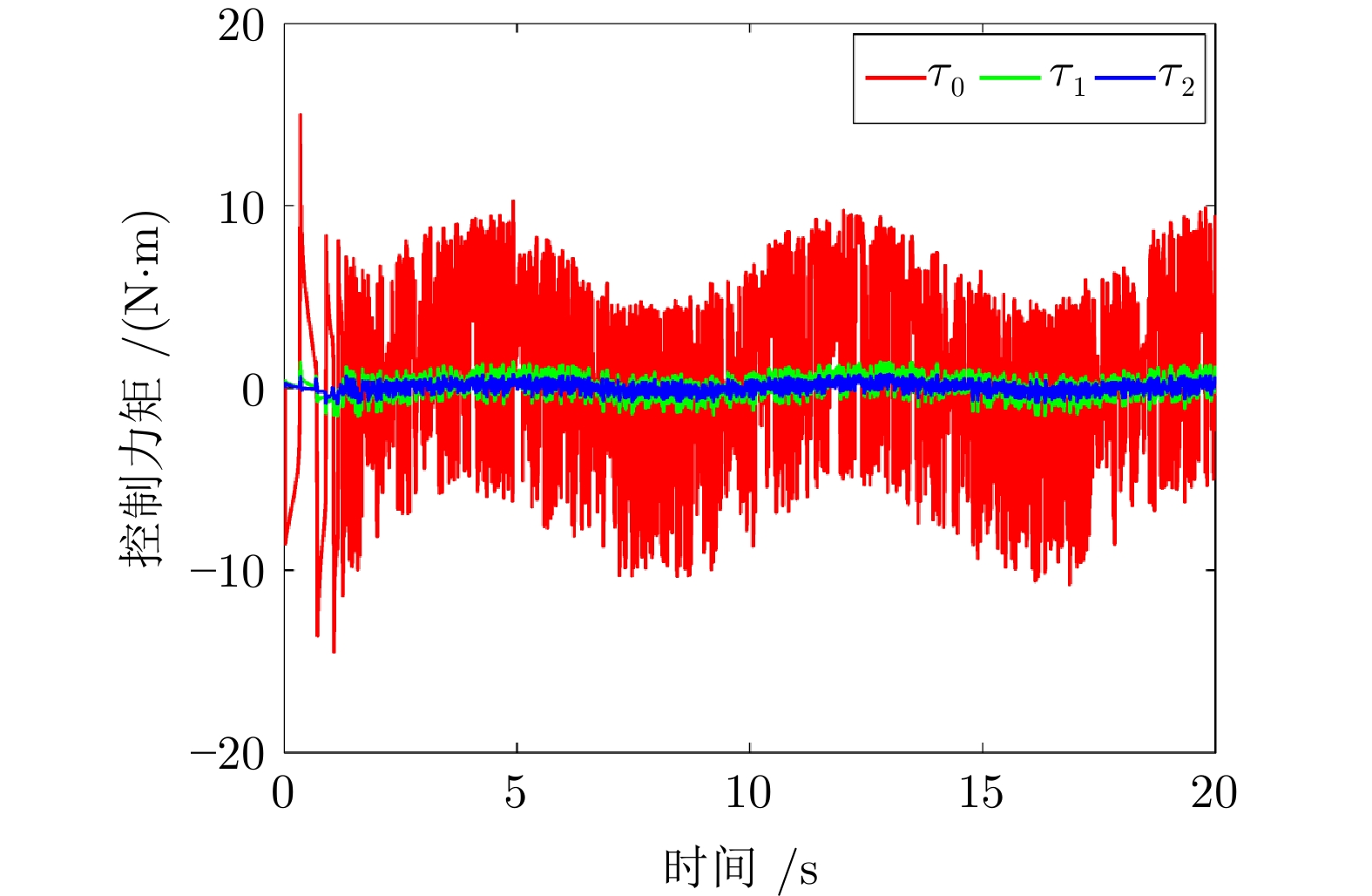
表 1 空间机器人系统的物理参数
Table 1 Physical parameters of the space robot system
物理量 参数值及单位 基座质量$ m_0 $ 4$ \mathrm{kg} $ 机械臂$ B_1/B_2 $质量$ m_1/m_2 $ 0.3$ \mathrm{kg} $ 旋转中心$ O_0 $与$ O_1 $之间的距离$ l_0 $ 0.15$ \mathrm{m} $ 机械臂$ B_1/B_2 $的轴向长度$ l_1/l_2 $ 0.3$ \mathrm{m} $ 基座中心转动惯量$ J_0 $ 3.4$ \mathrm{kg\cdot m^2} $ 机械臂$ B_1/B_2 $中心转动惯量$ J_1/J_2 $ 0.1$ \mathrm{kg\cdot m^2} $  下载: 导出CSV
表 2 控制方法的参数选取
Table 2 Parameter selections of the control methods
控制方法 参数选取 本文方法 $ \begin{array}{l}{\eta_{1}=1.00,\; \eta_{2}=0.20,\; \mu=1.00,\;\omega=1.00}\\{ \sigma=-0.40,\; \nu=1.00} \end{array}$ 文献[25] $ \begin{array}{l}{k_1=1.00,\; k_2=1.20,\; \alpha=1.00,\;\beta=0.80}\\{a_1=1.10,\; a_2=0.70,\; \gamma_1=1.30,\; \gamma_2=0.90}\\{k=0.20}\end{array} $ 文献[26] $\begin{array}{l} {k_1=1.00,\; k_2=1.20,\; \alpha_1=1.00,\;\beta_1=0.50}\\{\alpha_2=0.70,\; \beta_2=0.80,\; \gamma_1=1.30,\; \gamma_2=0.90}\\{ k=0.20,\; \eta=0.01} \end{array}$
下载: 导出CSV
表 3 不同控制方法跟踪误差的RMSE值(rad)
Table 3 The RMSE values of the tracking errors of different control methods(rad)
下载: 导出CSV
-
[1] Liu Y C, Jin Z H, Teng L. PSO-based time optimal rapid orientation for micronano space robot. IEEE Transactions on Aerospace and Electronic Systems, 2023, 59(2): 1921−1934 doi: 10.1109/taes.2022.3207124 [2] 金伟成, 陈提, 胡海岩. 含动力学奖励的航天器编队深度强化学习控制. 自动化学报, 2025, 51(10): 2283−2292 doi: 10.16383/j.aas.c250202Jin Wei-Cheng, Chen Ti, Hu Hai-Yan. Deep reinforcement learning control for spacecraft formation with dynamical reward. Acta Automatica Sinica, 2025, 51(10): 2283−2292 doi: 10.16383/j.aas.c250202 [3] Tchon K, Zadarnowska K. Normal form approach in the motion planning of space robots: a case study. Nonlinear Dynamics, 2021, 105(3): 2229−2245 doi: 10.1007/s11071-021-06437-9 [4] Zhao Y K, Zhang F, Huang P F. Dynamic closing point determination for space debris capturing via tethered space net robot. IEEE Transactions on Aerospace and Electronic Systems, 2022, 58(5): 4251−4260 doi: 10.1109/TAES.2022.3159626 [5] 龚凯, 贾英民. 空间机器人预设性能约束下的鲁棒跟踪控制. 控制理论与应用, 2024, 41(7): 1246−1254Gong Kai, Jia Ying-Min. Robust tracking control of space robots with prescribed performance. Control Theory and Applications, 2024, 41(7): 1246−1254 [6] Zhang T, Shi P, Li W L, Yue X K. Discrete nonsingular terminal sliding mode control for trajectory tracking of space manipulators with mismatched multiple disturbances and noisy measurements. Aerospace Science and Technology, 2024, 144(1): 1−13 doi: 10.1016/j.ast.2023.108766 [7] Guo C D, Liu F, Hu Q. Backstepping recursive decentralized finite-time trajectory tracking control for space parallel robots with a Bricard mechanism. IEEE Transactions on Aerospace and Electronic Systems, 2025, 61(3): 7512−7526 doi: 10.1109/TAES.2025.3539641 [8] Jin R Y, Rocco P, Geng Y H. Observer-based fixed-time tracking control for space robots in task space. Acta Astronautica, 2021, 184(1): 35−45 [9] Yang M, Liu G J, Zhou Z Y, Liu G Y. Safe fuzzy-CBF: A monitoring approach for deep reinforcement learning navigation agents. IEEE Transactions on Automation Science and Engineering, 2026, 23: 10041−10056 doi: 10.1109/TASE.2026.3695304 [10] Xie J J, Hu L, Tan Y Z, Yang J. CBF-based hierarchical quadratic programs with guaranteed feasibility for safety-critical systems. IEEE Transactions on Automation Science and Engineering, 2025, 22: 23687−23699 doi: 10.1109/TASE.2025.3629713 [11] Zhang J X, Ding J L, Chai T Y. Fault-tolerant prescribed performance control of wheeled mobile robots: A mixed-gain adaptation approach. IEEE Transactions on Automatic Control, 2024, 69(8): 5500−5507 doi: 10.1109/TAC.2024.3365726 [12] Wu Y, Chen M, Li H Y, Chadli M. Event-triggered-based adaptive nn cooperative control of six-rotor uavs with finite-time prescribed performance. IEEE Transactions on Automation Science and Engineering, 2024, 21(2): 1867−1877 doi: 10.1109/TASE.2023.3241182 [13] Fuentes-Aguilar R Q, Chairez I. Adaptive tracking control of state constraint systems based on differential neural networks: A barrier Lyapunov function approach. IEEE Transactions on Neural Networks and Learning Systems, 2020, 31(12): 5390−5401 doi: 10.1109/TNNLS.2020.2966914 [14] Yang X Y, Zhang X L, Cao J D, Liu H. Adaptive neural network iterative learning pi control of fractional-order nonlinear systems using generalized barrier Lyapunov function. IEEE Transactions on Cybernetics, 2026, 56(4): 2162−2175 doi: 10.1109/TCYB.2025.3634145 [15] Ding S H, Park J H, Chen C C. Second-order sliding mode controller design with output constraint. Automatica, 2020, 112(1): Article No. 108704 [16] Wang A Q, Liu L, Qiu J B, Feng G. Event-triggered adaptive fuzzy output-feedback control for nonstrict-feedback nonlinear systems with asymmetric output constraint. IEEE Transactions on Cybernetics, 2022, 52(1): 712−722 doi: 10.1109/TCYB.2020.2974775 [17] Rath J J, Defoort M, Sentouh C, Karimi H R, Veluvolu K C. Output-constrained robust sliding mode based nonlinear active suspension control. IEEE Transactions on Industrial Electronics, 2020, 67(12): 10652−10662 doi: 10.1109/TIE.2020.2978693 [18] Xiong X G, Chen H, Lou Y J, Liu Z C, Kamal S, Yamamoto M. Implicit discrete-time adaptive first-order sliding mode control with predefined convergence time. IEEE Transactions on Circuits and Systems II: Express Briefs, 2021, 68(12): 3562−3566 [19] Basin M. Finite-and fixed-time convergent algorithms: design and convergence time estimation. Annual Reviews in Control, 2019, 48(1): 209−221 [20] Polyakov A. Fixed-time stabilization via second order sliding mode control. IFAC Proceedings Volumes, 2012, 45(9): 254−258 doi: 10.3182/20120606-3-NL-3011.00109 [21] Ding S H, Li S H, Zheng W X. Nonsmooth stabilization of a class of nonlinear cascaded systems. Automatica, 2012, 48(10): 2597−2606 doi: 10.1016/j.automatica.2012.06.060 [22] Qian C J, Lin W. A continuous feedback approach to global strong stabilization of nonlinear systems. IEEE Transactions on Automatic Control, 2001, 46(7): 1061−1079 doi: 10.1109/9.935058 [23] Ding S H, Li S H. Second-order sliding mode controller design subject to mismatched term. Automatica, 2017, 77(1): 388−392 doi: 10.1016/j.automatica.2016.07.038 [24] Lei R H, Chen L. Observer-based adaptive sliding mode fault-tolerant control for the underactuated space robot with joint actuator gain faults. Kybernetika, 2021, 57(1): 160−173 doi: 10.14736/kyb-2021-1-0160 [25] Yang L, Yang J. Nonsingular fast terminal sliding mode control for nonlinear dynamical systems. International Journal of Robust and Nonlinear Control, 2011, 26(16): 1865−1879 [26] 田野, 蔡远利, 邓逸凡. 一种快速收敛的固定时间非奇异终端滑模控制方法. 中国惯性技术学报, 2020, 28(5): 677−685Tian Ye, Cai Yuan-Li, Deng Yi-Fan. A fast-nonsingular terminal sliding mode control method with fixed-time stability guarantees. Journal of Chinese Inertial Technology, 2020, 28(5): 677−685 -

 下载:
下载:

计量
- 文章访问数: 118
- HTML全文浏览量: 73
- 被引次数: 0
