


GAM-SGR: Graph Structure Information-augmented Multimodal Large Language Models for Scene Graph Reasoning
-
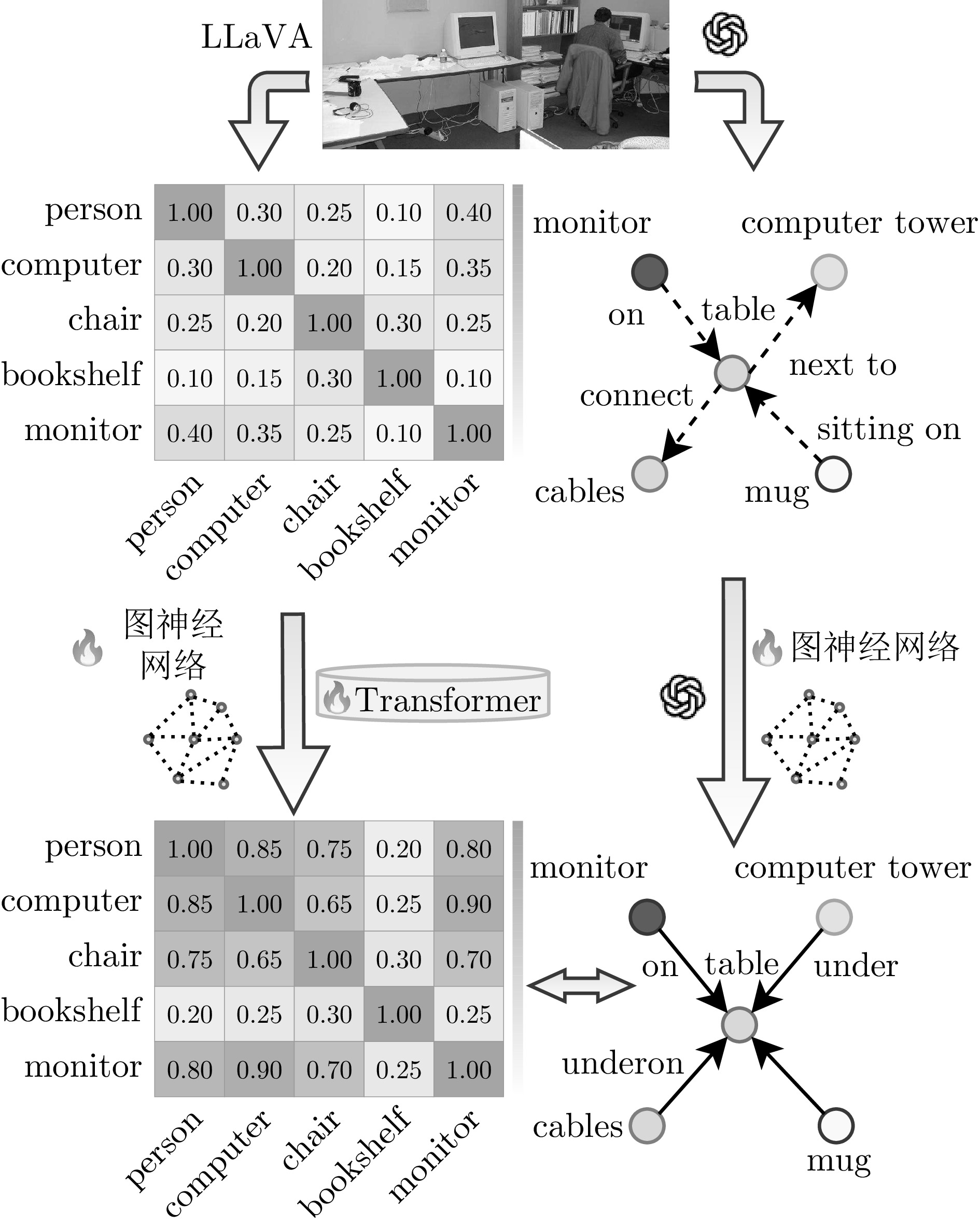
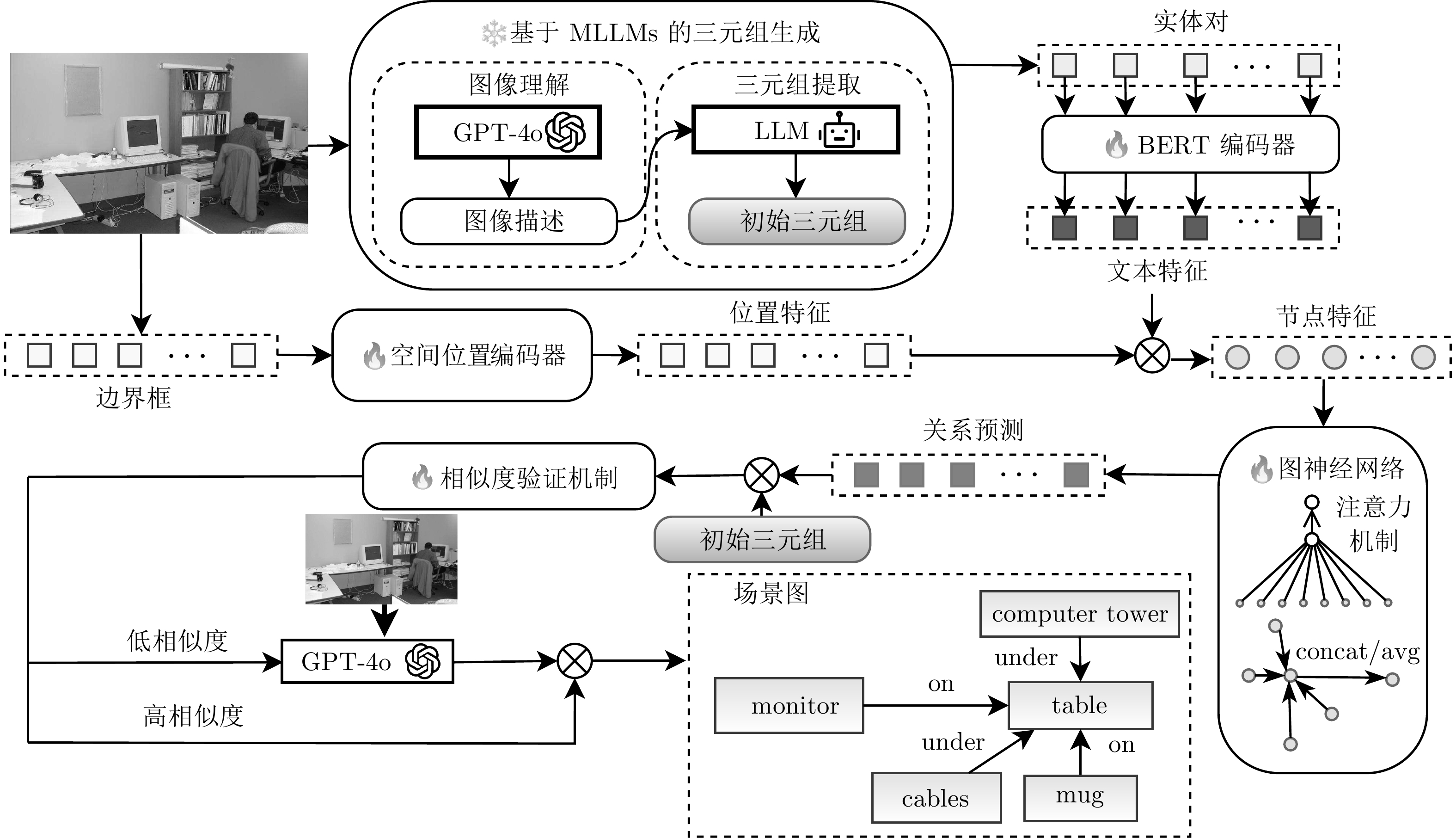
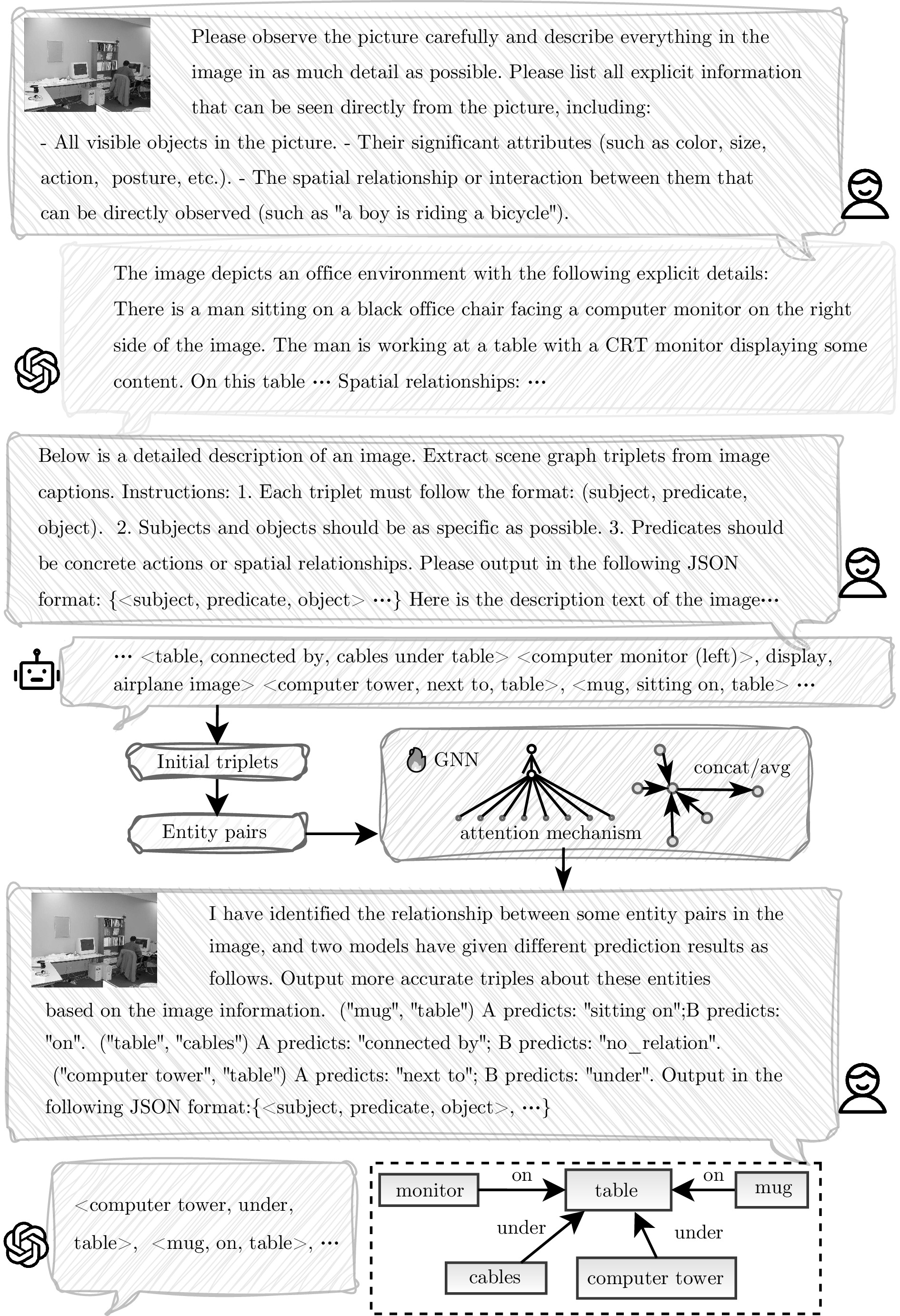
摘要: 多模态大模型(MLLMs)在场景图生成中面临关系幻觉与任务针对性推理不足的问题. 为此, 提出基于图结构信息增强的多模态大模型场景图推理方法(GAM-SGR), 使MLLMs显式关注图结构信息. 其核心是引入图标记, 以深度耦合视觉、拓扑与语言信息. 对于开源MLLMs, 提出参数高效的联合微调方法, 增强其对图结构信息的注意力. 图结构信息由图神经网络提取, 改进的Transformer层用于视觉−语言信息与图结构信息的融合推理. 对于闭源MLLMs, 由于无法调整其内部参数和结构来改变注意力, 因而通过指令提示将生成的场景图与图神经网络的关系推理结果交叉验证, 引导模型关注与关系有关的图像内容. 实验表明, GAM-SGR提升了开源模型的场景图推理性能, 稳健抑制了闭源模型的关系幻觉, 并表现出良好的泛化能力. 关系幻觉率指标评估进一步表明, 该方法在多种骨干模型上均显著降低了幻觉率.Abstract: Multimodal large language models (MLLMs) face relational hallucinations and insufficient task-specific reasoning in scene graph generation. We propose graph structure information-augmented multimodal large language models for scene graph reasoning (GAM-SGR), which enables MLLMs to explicitly attend to graph structure information. Its core is the introduction of graph tokens to deeply couple visual, topological, and linguistic information. For open-source MLLMs, a parameter-efficient joint fine-tuning method is proposed to enhance attention to graph structure information. Graph neural networks extract graph structure information, and improved Transformer layers fuse graph structure information with visual-language information for reasoning. For closed-source MLLMs, whose internal parameters and structures cannot be modified to change attention, instruction prompts cross-verify generated scene graphs against relational reasoning results from graph neural networks, directing attention to relation-relevant image content. Experiments show that GAM-SGR improves scene graph reasoning performance for open-source models, robustly suppresses relational hallucinations in closed-source models, and generalizes well. Evaluation using the relation hallucination rate metric further shows significant reductions in hallucinations across multiple backbone models.
-
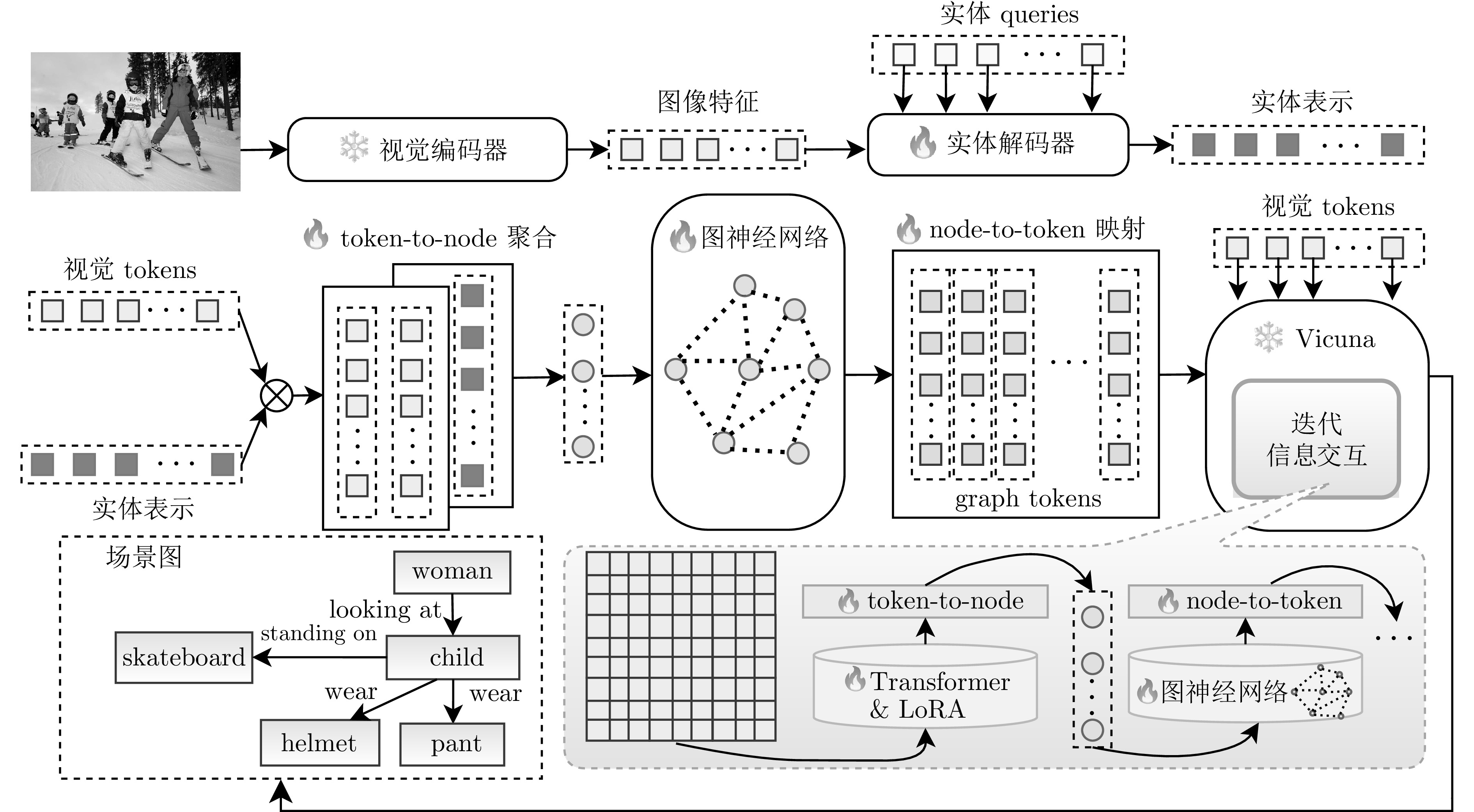
图 2 基于图结构信息的高效参数微调方法
Fig. 2 Parameter-efficient fine-tuning method based on graph structure information
表 1 在Visual Genome测试集上的对比实验(%)
Table 1 Comparative experiments on the Visual Genome test set (%)
方法 骨干模型 $ \mathrm{AP}_{50} $ PredCLS SGCLS SGDET $ \mathrm{R}@20 $ $ \mathrm{R}@50 $ $ \mathrm{mR}@20 $ $ \mathrm{mR}@50 $ $ \mathrm{R}@20 $ $ \mathrm{R}@50 $ $ \mathrm{mR}@20 $ $ \mathrm{mR}@50 $ $ \mathrm{R}@20 $ $ \mathrm{R}@50 $ $ \mathrm{mR}@20 $ $ \mathrm{mR}@50 $ MOTIFS[23] — 20.0 58.5 65.2 10.8 14.0 32.9 35.8 6.3 7.7 21.4 27.2 4.2 5.7 KERN[48] — 20.0 59.1 65.8 — 17.7 32.2 36.7 — 9.4 22.3 27.1 — 6.4 PCPL[49] — — — 50.8 — 35.2 — 27.6 — 18.6 — 14.6 — 9.5 GB-Net[50] — — — 66.6 — 19.3 — 38.0 — 9.6 — 26.4 — 6.1 RelDN[51] — — 66.9 68.4 — — 36.1 36.8 — — 21.1 28.3 — — VCTree-TDE[52] — 28.1 39.1 49.9 17.2 23.3 22.8 28.8 8.9 11.8 14.3 19.6 6.3 9.3 GPS-Net[53] — — 67.6 69.7 17.4 21.3 41.8 42.3 10.0 11.8 22.3 28.9 6.9 8.7 SVRP[54] — — — — — 24.3 — — — 12.5 — — — 10.5 VS3[55] — — — — — — 27.8 36.6 — — — — — — BGNN[56] — 29.0 — 59.2 — 30.4 — 37.4 — 14.3 23.3 31.0 7.5 10.7 BGT-Net[57] — 28.1 60.9 67.1 16.8 20.6 41.7 45.9 10.4 12.8 25.5 32.8 5.7 7.8 IMP[22] — — 58.5 65.2 — 9.8 31.7 34.6 — 5.8 14.6 20.7 — 3.8 CISC[58] — — 42.1 53.2 — — 23.3 27.8 — — 7.7 11.4 — — G-RCNN[24] — 24.8 — 54.2 — — — 29.6 — — — 11.4 — — FCSGG[59] — 28.5 33.4 41.0 4.9 6.3 19.0 23.5 3.7 3.7 16.1 21.3 2.7 3.6 SGTR[60] — 29.6 62.1 65.5 19.2 21.0 30.1 33.4 7.9 11.0 17.9 20.6 7.1 15.8 RelTR[61] — 26.4 63.1 64.2 20.0 21.2 29.0 36.6 7.7 11.4 21.2 27.5 6.8 10.8 LLaVA-SpaceSGG[62] LLaVA 27.0 62.9 64.0 20.7 21.1 30.1 37.8 8.5 11.3 22.5 29.3 7.6 13.0 SGTR+RAHP[31] Qwen2-VL 28.1 64.9 65.1 20.6 21.6 32.1 38.2 8.8 11.5 26.0 35.2 8.9 15.9 VS3+LLM4SGG[63] Qwen2-VL 27.8 64.8 68.1 21.5 22.2 33.6 39.8 8.4 11.0 24.0 27.1 6.9 10.2 PGSG[64] Qwen2-VL 28.2 65.2 68.9 22.0 22.5 35.1 40.3 8.5 11.7 25.3 28.8 7.9 13.3 SDSGG[65] Qwen2-VL 27.6 64.9 66.1 20.7 21.4 33.1 35.4 8.0 10.9 24.1 27.9 7.1 10.9 IndVisSGG[66] GPT-4o 27.9 65.1 67.3 21.4 21.9 34.9 37.9 8.5 11.0 22.0 28.3 7.5 11.9 GAM-SGR (本文方法) GPT-4o 30.1 67.9 70.1 21.1 22.0 43.1 43.8 10.5 13.3 26.1 34.9 8.1 15.5 GAM-SGR (本文方法) LLaVA 32.3 68.8 72.0 23.6 24.2 45.2 45.8 11.1 15.3 28.9 37.9 10.0 18.2 GAM-SGR (本文方法) Qwen2-VL 35.1 69.9 73.2 25.9 27.0 46.1 47.0 12.5 16.0 29.8 38.2 11.0 18.9 注: 粗体表示同列最大值; “—”表示原文献未报告该项或未标注骨干模型.  下载: 导出CSV
表 2 在Open Images V6测试集上的对比实验(%)
Table 2 Comparative experiments on the Open Images V6 test set (%)
方法 骨干模型 $ \mathrm{R}@50 $ $ \mathrm{wmAP}_{\mathrm{rel}} $ $ \mathrm{wmAP}_{\mathrm{phr}} $ RelDN — 73.08 32.16 33.39 VCTree — 75.34 33.21 34.31 GPS-Net — 74.81 32.85 33.98 BGNN — 74.98 33.51 34.15 G-RCNN — 74.51 33.15 34.21 SGTR — 59.91 36.98 38.73 RelTR — 71.66 34.19 37.46 GAM-SGR (本文方法) LLaVA 80.19 42.76 43.99 GAM-SGR (本文方法) GPT-4o 77.24 40.35 42.01
下载: 导出CSV
表 3 在Panoptic Scene Graph测试集上的对比实验(%)
Table 3 Comparative experiments on the Panoptic Scene Graph test set (%)
方法 骨干模型 新类别 $ \mathrm{R}@20 $ $ \mathrm{R}@50 $ $ \mathrm{mR}@50 $ LLaVA-SpaceSGG LLaVA 19.5 31.7 5.9 SGTR+RAHP Qwen2-VL 20.3 33.2 6.3 VS3+LLM4SGG Qwen2-VL 20.5 34.0 6.2 PGSG Qwen2-VL 18.9 30.1 5.1 SDSGG Qwen2-VL 19.6 27.1 4.2 IndVisSGG GPT-4o 21.4 33.9 6.0 GAM-SGR (本文方法) GPT-4o 22.0 33.7 5.7 GAM-SGR (本文方法) LLaVA 24.0 35.0 6.6 GAM-SGR (本文方法) Qwen2-VL 25.8 37.9 7.5
下载: 导出CSV
表 4 GAM-SGR在不同闭源骨干网络下的泛化性与稳定性评估(Visual Genome测试集, SGDET设置) (%)
Table 4 Generalization and stability evaluation of GAM-SGR with different closed-source backbone networks (Visual Genome test set, SGDET setting) (%)
骨干网络 方法 $ \mathrm{R}@50 $ $ \mathrm{mR}@50 $ RHR GPT-4V 原生模型 24.8 3.5 14.8 GPT-4V +GAM-SGR 34.0 ($ \uparrow9.2 $) 14.9 ($ \uparrow11.4 $) 7.2 ($ \downarrow7.6 $) Claude-3-Opus 原生模型 25.9 3.9 12.2 Claude-3-Opus +GAM-SGR 35.3 ($ \uparrow9.4 $) 16.1 ($ \uparrow12.2 $) 6.3 ($ \downarrow5.9 $) GPT-4o 原生模型 25.4 3.2 12.5 GPT-4o +GAM-SGR 34.9 ($ \uparrow9.5 $) 15.5 ($ \uparrow12.3 $) 6.1 ($ \downarrow6.4 $)
下载: 导出CSV
表 5 消融实验(SGDET设置) (%)
Table 5 Ablation experiments (SGDET setting) (%)
类型 GNN PosEnc PEFT Bi-Dir $ \mathrm{R}@20 $ $ \mathrm{R}@50 $ $ \mathrm{mR}@20 $ $ \mathrm{mR}@50 $ 闭源 $ \checkmark $ $ \checkmark $ — — 26.1 34.9 8.1 15.5 闭源 $ \checkmark $ $ \times $ — — 22.7 ($ \downarrow3.4 $) 29.4 ($ \downarrow5.5 $) 6.5 ($ \downarrow1.6 $) 11.8 ($ \downarrow3.7 $) 闭源 $ \times $ $ \times $ — — 19.9 ($ \downarrow6.2 $) 25.4 ($ \downarrow9.5 $) 2.4 ($ \downarrow5.7 $) 3.2 ($ \downarrow12.3 $) 开源 — — $ \checkmark $ $ \checkmark $ 28.9 37.9 10.0 18.2 开源 — — $ \times $ $ \times $ 18.2 ($ \downarrow10.7 $) 24.9 ($ \downarrow13.0 $) 2.4 ($ \downarrow7.6 $) 3.1 ($ \downarrow15.1 $) 开源 — — $ \checkmark $ $ \times $ 23.5 ($ \downarrow5.4 $) 30.0 ($ \downarrow7.9 $) 6.6 ($ \downarrow3.4 $) 13.0 ($ \downarrow5.2 $) 注: $ \checkmark $、$\times $分别表示保留和移除该项, “—”表示不适用.
下载: 导出CSV
表 6 场景图双向交互层选择配置的对比消融实验(Visual Genome测试集, SGDET设置)
Table 6 Comparative ablation experiments on scene graph bidirectional interaction layer configurations (Visual Genome test set, SGDET setting)
交互层配置 层数 $ \mathrm{R}@50 $ (%) $ \mathrm{mR}@50 $ (%) 时延(s) 2、4、6、8 4 26.3 7.9 0.21 24、26、28、30 4 30.1 8.8 0.22 1$ \sim $32 32 38.5 19.1 0.58 6、12、18、24 (本文方法) 4 37.9 18.2 0.23
下载: 导出CSV
表 7 外部GNN组件注入不同比例预测噪声时GAM-SGR最终性能的鲁棒性测试(%)
Table 7 Robustness test of the final performance of GAM-SGR under different prediction noise proportions injected into the external GNN component (%)
噪声比例 关系预测准确率 $ \mathrm{mR}@50 $ 变化 0 68.5 18.9 0 10 61.2 15.4 −3.5 20 54.8 15.2 −3.7 30 47.3 14.6 −4.3 注: 变化以本表 0% 噪声时的18.9% 为基准计算.
下载: 导出CSV
表 8 在Visual Genome和Panoptic Scene Graph测试集上的RHR对比(%)
Table 8 Comparison of RHR on the Visual Genome and Panoptic Scene Graph test sets (%)
骨干模型 搭载前 搭载后 变化 LLaVA 17.4 6.8 −10.6 Qwen2-VL 15.3 6.5 −8.8 GPT-4o 12.5 6.1 −6.4 注: 变化为搭载后减去搭载前的RHR.
下载: 导出CSV
表 9 GAM-SGR在GPT-4o骨干网络下的推理效率与成本评估
Table 9 Inference efficiency and cost evaluation of GAM-SGR with the GPT-4o backbone network
方法 二次推理
比例(%)平均耗时
(s)标记
消耗成本增加
(%)RHR
(%)原生GPT-4o 0 1.25 450000 0 12.5 GAM-SGR 23.2 1.47 489000 8.7 6.1
下载: 导出CSV
-
[1] Johnson J, Krishna R, Stark M, Li L J, Shamma D A, Bernstein M S, et al. Image retrieval using scene graphs. In: Proceedings of the IEEE Conference on Computer Vision and Pattern Recognition (CVPR). Boston, USA: IEEE, 2015. 3668−3678 [2] Shiny S, Abisheak A, Balaji P, Rohit K. Image captioning using scene graph generation. In: Proceedings of the International Conference on Wireless Communications Signal Processing and Networking (WiSPNET). Chennai, India: IEEE, 2025. 1−5 [3] Nguyen K, Tripathi S, Du B, Guha T, Nguyen T Q. In defense of scene graphs for image captioning. In: Proceedings of the IEEE/CVF International Conference on Computer Vision (ICCV). Montreal, Canada: IEEE, 2021. 1387−1396 [4] Gao L Z, Wang B, Wang W M. Image captioning with scene-graph based semantic concepts. In: Proceedings of the 10th International Conference on Machine Learning and Computing. Macau, China: ACM, 2018. 225−229 [5] Souza B, Aasan M, Pedrini H, Rivera A R. SelfGraphVQA: A self-supervised graph neural network for scene-based question answering. In: Proceedings of the IEEE/CVF International Conference on Computer Vision Workshops (ICCVW). Paris, France: IEEE, 2023. 4642−4647 [6] Yoon S, Kang W Y, Jeon S, Lee S, Han C J, Park J, et al. Image-to-image retrieval by learning similarity between scene graphs. In: Proceedings of the 35th AAAI Conference on Artificial Intelligence. Virtual Event: AAAI Press, 2021. 10718−10726 [7] Ashual O, Wolf L. Specifying object attributes and relations in interactive scene generation. In: Proceedings of the IEEE/CVF International Conference on Computer Vision (ICCV). Seoul, South Korea: IEEE, 2019. 4560−4568 [8] Johnson J, Gupta A, Li F F. Image generation from scene graphs. In: Proceedings of the IEEE/CVF Conference on Computer Vision and Pattern Recognition. Salt Lake City, USA: IEEE, 2018. 1219−1228 [9] Wang Z C, You H X, Li L H, Zareian A, Park S, Liang Y Q, et al. SGEITL: Scene graph enhanced image-text learning for visual commonsense reasoning. In: Proceedings of the 36th AAAI Conference on Artificial Intelligence. Virtual Event: AAAI Press, 2022. 5914−5922 [10] Liu H T, Li C Y, Li Y H, Lee Y J. Improved baselines with visual instruction tuning. In: Proceedings of the IEEE/CVF Conference on Computer Vision and Pattern Recognition (CVPR). Seattle, USA: IEEE, 2024. 26286−26296 [11] Li J N, Li D X, Savarese S, Hoi S. BLIP-2: Bootstrapping language-image pre-training with frozen image encoders and large language models. In: Proceedings of the 40th International Conference on Machine Learning. Honolulu, USA: PMLR, 2023. 19730−19742 [12] Radford A, Kim J W, Hallacy C, Ramesh A, Goh G, Agarwal S, et al. Learning transferable visual models from natural language supervision. In: Proceedings of the 38th International Conference on Machine Learning. Virtual Event: PMLR, 2021. 8748−8763 [13] Li J N, Selvaraju R R, Gotmare A D, Joty S, Xiong C M, Hoi S C H. Align before fuse: Vision and language representation learning with momentum distillation. In: Proceedings of the 35th International Conference on Neural Information Processing Systems. Virtual Event: Curran Associates Inc., 2021. Article No. 742 [14] Bai Z C, Wang P C, Xiao T J, He T, Han Z B, Zhang Z, et al. Hallucination of multimodal large language models: A survey. arXiv preprint arXiv: 2404.18930, 2025. [15] Sun S L, Lin Z L, Wu X H. Hallucinations of large multimodal models: Problem and countermeasures. Information Fusion, 2025, 118: Article No. 102970 doi: 10.1016/j.inffus.2025.102970 [16] Han K, Wang Y H, Guo J Y, Tang Y H, Wu E H. Vision GNN: An image is worth graph of nodes. In: Proceedings of the 36th International Conference on Neural Information Processing Systems. New Orleans, USA: Curran Associates Inc., 2022. Article No. 603 [17] Lin X, Ding C X, Zhan Y B, Li Z J, Tao D C. HL-Net: Heterophily learning network for scene graph generation. In: Proceedings of the IEEE/CVF Conference on Computer Vision and Pattern Recognition (CVPR). New Orleans, USA: IEEE, 2022. 19454−19463 [18] Krishna R, Zhu Y K, Groth O, Johnson J, Hata K, Kravitz J, et al. Visual Genome: Connecting language and vision using crowdsourced dense image annotations. International Journal of Computer Vision, 2017, 123(1): 32−73 doi: 10.1007/s11263-016-0981-7 [19] Kuznetsova A, Rom H, Alldrin N, Uijlings J, Krasin I, Pont-Tuset J, et al. The Open Images dataset V4: Unified image classification, object detection, and visual relationship detection at scale. International Journal of Computer Vision, 2020, 128(7): 1956−1981 doi: 10.1007/s11263-020-01316-z [20] Yang J K, Ang Y Z, Guo Z J, Zhou K Y, Zhang W, Liu Z W. Panoptic Scene Graph generation. In: Proceedings of the 17th European Conference on Computer Vision. Tel Aviv, Israel: Springer, 2022. 178−196 [21] Lu C W, Krishna R, Bernstein M, Li F F. Visual relationship detection with language priors. In: Proceedings of the 14th European Conference on Computer Vision. Amsterdam, The Netherlands: Springer, 2016. 852−869 [22] Xu D F, Zhu Y K, Choy C B, Li F F. Scene graph generation by iterative message passing. In: Proceedings of the IEEE Conference on Computer Vision and Pattern Recognition (CVPR). Honolulu, USA: IEEE, 2017. 3097−3106 [23] Zellers R, Yatskar M, Thomson S, Choi Y. Neural motifs: Scene graph parsing with global context. In: Proceedings of the IEEE/CVF Conference on Computer Vision and Pattern Recognition. Salt Lake City, USA: IEEE, 2018. 5831−5840 [24] Yang J W, Lu J S, Lee S, Batra D, Parikh D. Graph R-CNN for scene graph generation. In: Proceedings of the 15th European Conference on Computer Vision. Munich, Germany: Springer, 2018. 690−706 [25] Zhang J, Kalantidis Y, Rohrbach M, Paluri M, Elgammal A, Elhoseiny M. Large-scale visual relationship understanding. In: Proceedings of the 33rd AAAI Conference on Artificial Intelligence. Honolulu, USA: AAAI Press, 2019. 9185−9194 [26] Tang K H, Zhang H W, Wu B Y, Luo W H, Liu W. Learning to compose dynamic tree structures for visual contexts. In: Proceedings of the IEEE/CVF Conference on Computer Vision and Pattern Recognition (CVPR). Long Beach, USA: IEEE, 2019. 6612−6621 [27] Jiang B W, Zhuang Z J, Shivakumar S S, Taylor C J. Enhancing scene graph generation with hierarchical relationships and commonsense knowledge. In: Proceedings of the IEEE/CVF Winter Conference on Applications of Computer Vision (WACV). Tucson, USA: IEEE, 2025. 8883−8894 [28] Wu S Q, Fei H, Chua T S. Universal scene graph generation. In: Proceedings of the IEEE/CVF Conference on Computer Vision and Pattern Recognition (CVPR). Nashville, USA: IEEE, 2025. 14158−14168 [29] Li R J, Zhang S Y, Lin D H, Chen K, He X M. From pixels to graphs: Open-vocabulary scene graph generation with vision-language models. In: Proceedings of the IEEE/CVF Conference on Computer Vision and Pattern Recognition (CVPR). Seattle, USA: IEEE, 2024. 28076−28086 [30] Chen Z Y, Wu J L, Lei Z, Zhang Z X, Chen C W. Expanding scene graph boundaries: Fully open-vocabulary scene graph generation via visual-concept alignment and retention. In: Proceedings of the 18th European Conference on Computer Vision. Milan, Italy: Springer, 2024. 108−124 [31] Liu T, Li R J, Wang C Y, He X M. Relation-aware hierarchical prompt for open-vocabulary scene graph generation. In: Proceedings of the 39th AAAI Conference on Artificial Intelligence. Philadelphia, USA: AAAI Press, 2025. 5576−5584 [32] Houlsby N, Giurgiu A, Jastrzebski S, Morrone B, de Laroussilhe Q, Gesmundo A, et al. Parameter-efficient transfer learning for NLP. In: Proceedings of the 36th International Conference on Machine Learning. Long Beach, USA: Proceedings of Machine Learning Research, 2019. 2790−2799 [33] Hu E J, Shen Y L, Wallis P, Allen-Zhu Z, Li Y Z, Wang S A, et al. LoRA: Low-rank adaptation of large language models. In: Proceedings of the 10th International Conference on Learning Representations. Virtual Event: OpenReview.net, 2022. 1−13 [34] Lester B, Al-Rfou R, Constant N. The power of scale for parameter-efficient prompt tuning. In: Proceedings of the Conference on Empirical Methods in Natural Language Processing. Punta Cana, Dominican Republic: Association for Computational Linguistics, 2021. 3045−3059 [35] ben Zaken E, Goldberg Y, Ravfogel S. BitFit: Simple parameter-efficient fine-tuning for Transformer-based masked language-models. In: Proceedings of the 60th Annual Meeting of the Association for Computational Linguistics (Volume 2: Short Papers). Dublin, Ireland: Association for Computational Linguistics, 2022. 1−9 [36] Zhou X T, He J, Ke Y H, Zhu G Y, Basulto V G, Pan J. An empirical study on parameter-efficient fine-tuning for multimodal large language models. In: Proceedings of the Findings of the Association for Computational Linguistics. Bangkok, Thailand: Association for Computational Linguistics, 2024. 10057−10084 [37] Li M, Zhong J K, Li C X, Li L Z Z, Lin N, Sugiyama M. Vision-language model fine-tuning via simple parameter-efficient modification. In: Proceedings of the Conference on Empirical Methods in Natural Language Processing. Miami, USA: Association for Computational Linguistics, 2024. 14394−14410 [38] Prottasha N J, Chowdhury U R, Mohanto S, Nuzhat T, Sami A A, Ali M S, et al. PEFT A2Z: Parameter-efficient fine-tuning survey for large language and vision models. arXiv preprint arXiv: 2504.14117, 2025. [39] Ebrahimi S, Arik S O, Nama T, Pfister T. CROME: Cross-modal adapters for efficient multimodal LLM. arXiv preprint arXiv: 2408.06610, 2024. [40] Zheng K N, Chen J K, Yan Y B, Zou X, Zhou H Y, Hu X M. Reefknot: A comprehensive benchmark for relation hallucination evaluation, analysis and mitigation in multimodal large language models. In: Proceedings of the Findings of the Association for Computational Linguistics. Vienna, Austria: Association for Computational Linguistics, 2025. 6193−6212 [41] Jiang C Y, Jia H R, Dong M F, Ye W, Xu H Y, Yan M, et al. Hal-Eval: A universal and fine-grained hallucination evaluation framework for large vision language models. In: Proceedings of the 32nd ACM International Conference on Multimedia. Melbourne, Australia: ACM, 2024. 525−534 [42] Gong B Y, Zheng F Y, Kong F, Zhou J W, Lu J. Attention at rest stays at rest: Breaking visual inertia to mitigate relation hallucinations. In: Proceedings of the 15th International Conference on Learning Representations. San Francisco, USA: OpenReview.net, 2027. 1−34 [43] Xu Z X, Liu C Z, Wei Q Y, Wu J C, Zou J, Wang X E, et al. More thinking, less seeing? Assessing amplified hallucination in multimodal reasoning models. In: Proceedings of the 39th Annual Conference on Neural Information Processing Systems. San Diego, USA: Curran Associates Inc., 2025. 1−28 [44] Xu Z X, Wang Z H, Qian Z, Shi D C, Tang F L, Hu M, et al. Thinking in uncertainty: Mitigating hallucinations in MLRMs with latent entropy-aware decoding. In: Proceedings of the IEEE/CVF Conference on Computer Vision and Pattern Recognition. Denver, USA: IEEE, 2026. 11064−11075 [45] Veličković P, Cucurull G, Casanova A, Romero A, Liò P, Bengio Y. Graph attention networks. In: Proceedings of the 6th International Conference on Learning Representations. Vancouver, Canada: OpenReview.net, 2018. 1−12 [46] Zhang S, Tong H H, Xu J J, Maciejewski R. Graph convolutional networks: A comprehensive review. Computational Social Networks, 2019, 6(1): Article No. 11 doi: 10.1186/s40649-019-0069-y [47] Hamilton W L, Ying R, Leskovec J. Inductive representation learning on large graphs. In: Proceedings of the 31st International Conference on Neural Information Processing Systems. Long Beach, USA: Curran Associates Inc., 2017. 1025−1035 [48] Chen T S, Yu W H, Chen R Q, Lin L. Knowledge-embedded routing network for scene graph generation. In: Proceedings of the IEEE/CVF Conference on Computer Vision and Pattern Recognition (CVPR). Long Beach, USA: IEEE, 2019. 6156−6164 [49] Yan S T, Shen C, Jin Z M, Huang J Q, Jiang R X, Chen Y W, et al. PCPL: Predicate-correlation perception learning for unbiased scene graph generation. In: Proceedings of the 28th ACM International Conference on Multimedia. Seattle, USA: ACM, 2020. 265−273 [50] Zareian A, Karaman S, Chang S F. Bridging knowledge graphs to generate scene graphs. In: Proceedings of the 16th European Conference on Computer Vision. Glasgow, UK: Springer, 2020. 606−623 [51] Zhang J, Shih K J, Elgammal A, Tao A, Catanzaro B. Graphical contrastive losses for scene graph parsing. In: Proceedings of the IEEE/CVF Conference on Computer Vision and Pattern Recognition (CVPR). Long Beach, USA: IEEE, 2019. 11527−11535 [52] Tang K H, Niu Y L, Huang J Q, Shi J X, Zhang H W. Unbiased scene graph generation from biased training. In: Proceedings of the IEEE/CVF Conference on Computer Vision and Pattern Recognition (CVPR). Seattle, USA: IEEE, 2020. 3713−3722 [53] Lin X, Ding C X, Zeng J Q, Tao D C. GPS-Net: Graph property sensing network for scene graph generation. In: Proceedings of the IEEE/CVF Conference on Computer Vision and Pattern Recognition (CVPR). Seattle, USA: IEEE, 2020. 3743−3752 [54] He T, Gao L L, Song J K, Li Y F. Towards open-vocabulary scene graph generation with prompt-based finetuning. In: Proceedings of the 17th European Conference on Computer Vision. Tel Aviv, Israel: Springer, 2022. 56−73 [55] Zhang Y, Pan Y W, Yao T, Huang R, Mei T, Chen C W. Learning to generate language-supervised and open-vocabulary scene graph using pre-trained visual-semantic space. In: Proceedings of the IEEE/CVF Conference on Computer Vision and Pattern Recognition (CVPR). Vancouver, Canada: IEEE, 2023. 2915−2924 [56] Li R J, Zhang S Y, Wan B, He X M. Bipartite graph network with adaptive message passing for unbiased scene graph generation. In: Proceedings of the IEEE/CVF Conference on Computer Vision and Pattern Recognition (CVPR). Nashville, USA: IEEE, 2021. 11104−11114 [57] Dhingra N, Ritter F, Kunz A. BGT-Net: Bidirectional GRU Transformer network for scene graph generation. In: Proceedings of the IEEE/CVF Conference on Computer Vision and Pattern Recognition Workshops (CVPRW). Nashville, USA: IEEE, 2021. 2150−2159 [58] Wang W B, Wang R P, Shan S G, Chen X L. Exploring context and visual pattern of relationship for scene graph generation. In: Proceedings of the IEEE/CVF Conference on Computer Vision and Pattern Recognition (CVPR). Long Beach, USA: IEEE, 2019. 8180−8189 [59] Liu H Y, Yan N, Mortazavi M, Bhanu B. Fully convolutional scene graph generation. In: Proceedings of the IEEE/CVF Conference on Computer Vision and Pattern Recognition (CVPR). Nashville, USA: IEEE, 2021. 11541−11551 [60] Li R J, Zhang S Y, He X M. SGTR: End-to-end scene graph generation with Transformer. In: Proceedings of the IEEE/CVF Conference on Computer Vision and Pattern Recognition (CVPR). New Orleans, USA: IEEE, 2022. 19464−19474 [61] Cong Y R, Yang M Y, Rosenhahn B. RelTR: Relation Transformer for scene graph generation. IEEE Transactions on Pattern Analysis and Machine Intelligence, 2023, 45(9): 11169−11183 doi: 10.1109/TPAMI.2023.3268066 [62] Xu M J, Wu M Y, Zhao Y Z, Li J C L, Ou W F. LLaVA-SpaceSGG: Visual instruct tuning for open-vocabulary scene graph generation with enhanced spatial relations. In: Proceedings of the IEEE/CVF Winter Conference on Applications of Computer Vision (WACV). Tucson, USA: IEEE, 2025. 6362−6372 [63] Kim K, Yoon K, Jeon J, In Y, Moon J, Kim D, et al. LLM4SGG: Large language models for weakly supervised scene graph generation. In: Proceedings of the IEEE/CVF Conference on Computer Vision and Pattern Recognition (CVPR). Seattle, USA: IEEE, 2024. 28306−28316 [64] Li L, Ji W, Wu Y M, Li M Z, Qin Y, Wei L N, et al. Panoptic scene graph generation with semantics-prototype learning. In: Proceedings of the 38th AAAI Conference on Artificial Intelligence. Vancouver, Canada: AAAI Press, 2024. 3145−3153 [65] Chen G K, Li J, Wang W G. Scene graph generation with role-playing large language models. In: Proceedings of the 38th International Conference on Neural Information Processing Systems. Vancouver, Canada: Curran Associates Inc., 2024. Article No. 4203 [66] Wang Z X, Yan Z J, Li S F, Liu J H. IndVisSGG: VLM-based scene graph generation for industrial spatial intelligence. Advanced Engineering Informatics, 2025, 65: Article No. 103107 doi: 10.1016/j.aei.2024.103107 -

 下载:

计量
- 文章访问数: 112
- HTML全文浏览量: 152
- 被引次数: 0
