


-
摘要: 个性化自适应学习是当前智能教育发展的核心. 以往的学习模型在识别学习者个体差异、整合认知与情感因素、适应多样学习任务等方面存在理论瓶颈, 导致个性化学习在教育场景中缺乏解释力、泛化性与适应性, 难以充分满足个性化学习的复杂情境. 为此, 首先梳理个性化学习与人工智能技术融合的发展历程, 分析认知、情感与任务三大因素在个性化自适应学习中的关键作用以及以往研究存在的局限. 在此基础上提出认知−情感−任务(CAT)学习理论模型, 并通过多模态数据采集与分析方法, 在外语学习场景中分析不同任务难度下学习者认知与情感加工状态的变化, 对CAT学习理论模型进行初步的实证. 该理论为个性化自适应学习研究提供更具整合性的理论支撑, 对当前的智能教育发展具有一定的指导意义.
-
关键词:
- 个性化自适应学习 /
- 认知−情感−任务学习理论 /
- 多模态技术 /
- 认知加工 /
- 情感加工
Abstract: Personalized adaptive learning is essential to the current development of intelligent education. However, previous learning models face theoretical limitations in identifying learners' individual differences, integrating cognitive and affective factors, and adapting to diverse learning tasks. This results in limited explanatory power, generalizability, and adaptability of personalized learning in education scenarios, leading to the failure to address the complexity of personalized learning scenarios. To address these issues, this paper first reviews the development history of integration between personalized learning and artificial intelligence technologies. Then, this paper analyzes the key roles of cognition, affect, and task, as well as the limitations of previous research in personalized adaptive learning, and propose the cognition-affect-task (CAT) learning theory model based on them. Using multimodal data acquisition and analysis methods, this study further analyzes changes in learners' cognitive and affective processing states across different levels of task difficulty in foreign language learning scenarios. The results provide a preliminary empirical validation of the CAT learning theory model. This theory offers a more integrative theoretical foundation for research on personalized adaptive learning and has certain guiding significance for the current development of intelligent education. -
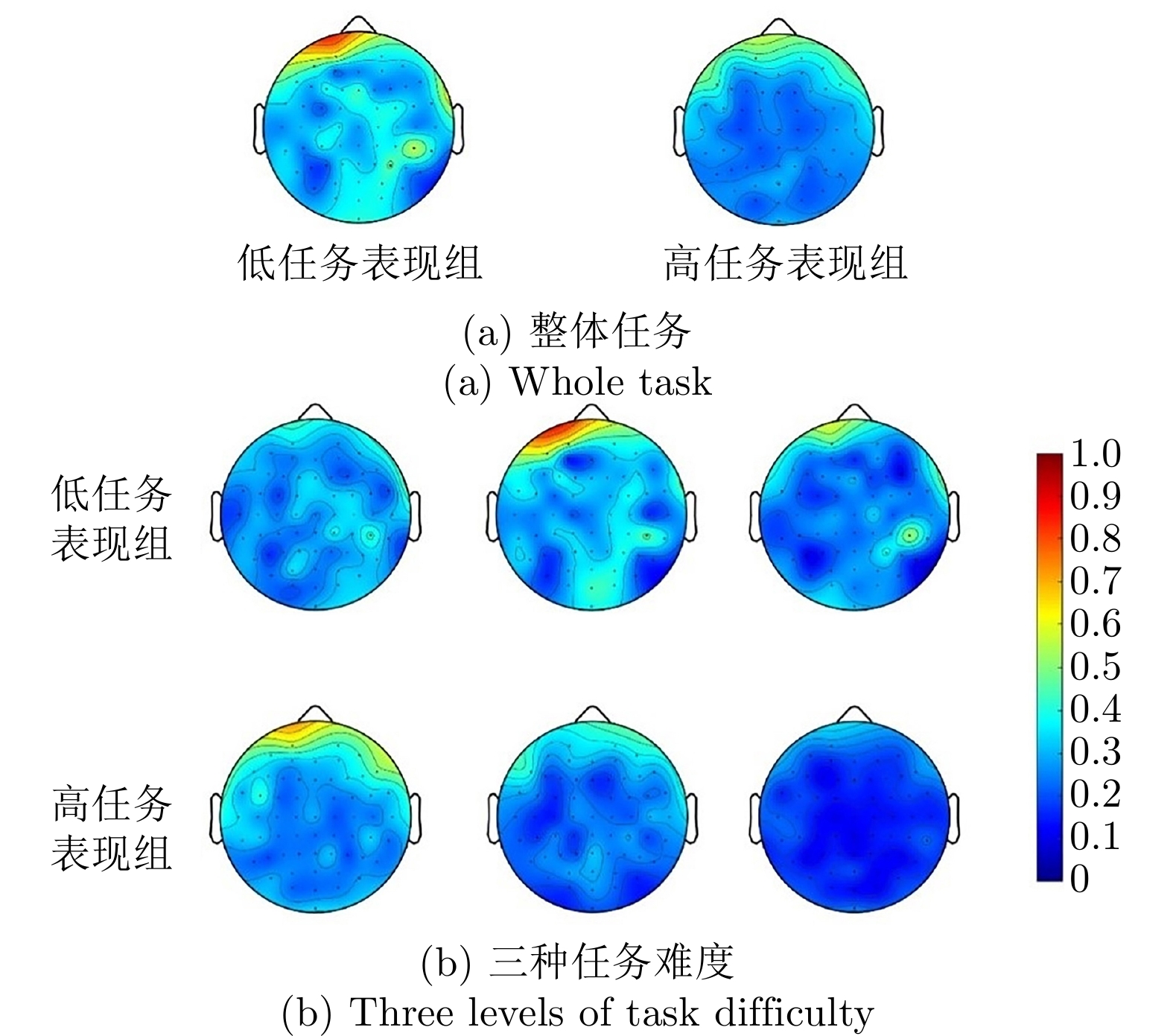
图 3 高、低任务表现组的认知负荷标准差脑拓扑地形图
Fig. 3 Brain topographic map of cognitive load SD in the high and low task performance groups
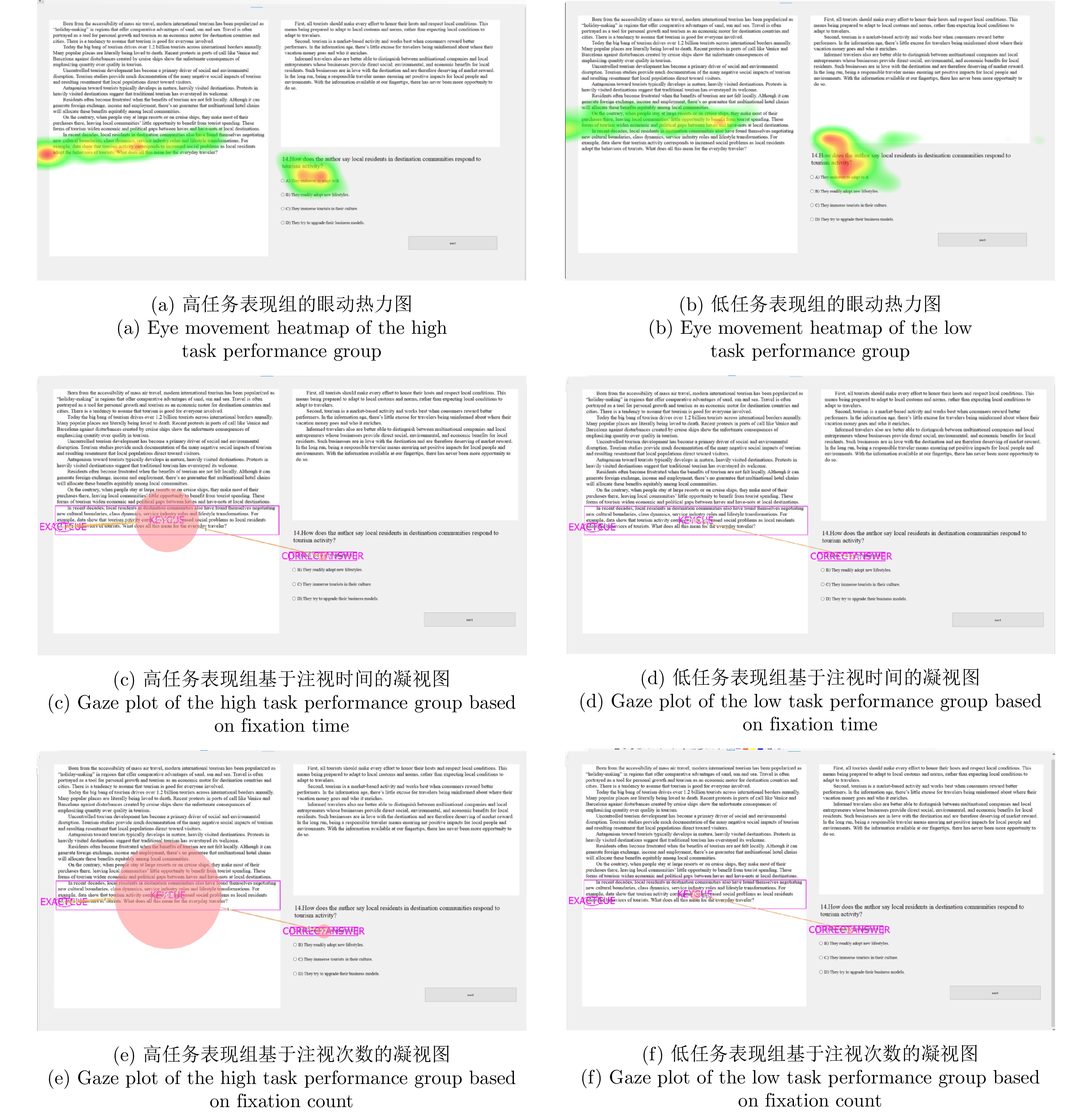
图 4 不同阅读任务表现水平下的眼动热力图与凝视图
Fig. 4 Eye movement heatmaps and gaze plots at different levels of reading task performance
表 1 个性化自适应学习系统面临的挑战及转机
Table 1 Challenges and opportunities for personalized adaptive learning system
挑战 转机 现有系统多依赖单一的认知或情感因素, 难以应对学习者复杂的情感变化和个体差异. 建立整合认知、情感与任务的学习模型, 确保个性化适应具有更强的可解释性与适应性. 现有系统在捕捉学习者复杂情感变化时依赖单一模态的数据, 难以全面反馈学习状态. 通过使用多模态数据采集技术, 从多个维度检测学习者的状态, 提升系统对学习者状态刻画的精准性与有效性. 现有系统评估片面、应用场景趋于单一、知识路径设计过于粗略, 个性化学习体验难以全面覆盖. 将不同学科理论与方法交叉融合, 从多学科视角分析学习过程, 整合理论模型与多模态技术实现精细化干预.  下载: 导出CSV
表 2 CAT学习理论在语言学习领域的理论基础
Table 2 Theoretical foundations of the CAT learning theory in language learning
CAT维度 以往理论模型 提出者 提出年份 理论描述 认知(C) 工作记忆模型(working memory model) Baddeley 和 Hitch[44] 1974 解释短期记忆和长期记忆之间的交互作用. 建构整合模型(construction-integration model) Kintsch[45] 1998 描述理解过程中如何综合词汇、语法和上下文信息. 情感(A) 情感过滤假说(affective filter hypothesis) Krashen[46] 1982 指出积极的情感状态有助于学习效果,
而负面情感状态可能阻碍学习.社会教育模型(socio-educational model) Gardner 和 Lambert[47] 1972 强调内在动机和外在动机对语言学习的重要性. 任务(T) 最近发展区理论(zone of proximal development) Vygotsky[48] 1978 任务难度需要与学习者的语言水平相匹配, 以促进学习.
下载: 导出CSV
表 3 认知负荷标准差与阅读得分的Pearson相关分析
Table 3 Pearson correlation analysis between cognitive load SD and reading scores
EEG通道 r 值 p 值 AFz 0.585 0.036 TP10 0.579 0.038
下载: 导出CSV
表 4 低任务表现组与高任务表现组在三种等级任务难度下的认知负荷(均值与标准差) $ t $检验分析
Table 4 $ t $-test analysis of cognitive load (mean and SD) between the low task performance group and the high task performance group under three levels of task difficulty
任务难度 低任务表现组 高任务表现组 显著性区域(p < 0.05) 均值 低 $ 2.036\pm0.676 $ $ 1.922\pm0.511 $ — 中 $ 2.011\pm0.776 $ $ 1.827\pm0.624 $ — 高 $ 1.995\pm0.597 $ $ 1.814\pm0.572 $ — 标准差 低 $ 0.279\pm0.095 $ $ 0.294\pm0.092 $ F4、TP10 中 $ 0.312\pm0.284 $ $ 0.249\pm0.176 $ — 高 $ 0.254\pm0.141 $ $ 0.165\pm0.064 $ F3、FT7、Cz、C2、CPz、Pz、O2
下载: 导出CSV
表 5 不同英语阅读理解难度下的情绪唤醒变化
Table 5 Changes in emotional arousal under different levels of English reading comprehension difficulty
任务难度 EDA样本均值 EDA平均峰值幅度 低 $ 0.219\pm0.051 $ $ 0.217\pm0.151 $ 中 $ 0.552\pm0.139 $ $ 0.580\pm0.224 $ 高 $ 0.719\pm0.286 $ $ 0.721\pm0.273 $
下载: 导出CSV
表 6 低任务表现组与高任务表现组在三种任务难度下的情绪唤醒$ t $检验分析
Table 6 $ t $-test analysis of emotional arousal between the low task performance group and the high task performance group under three levels of task difficulty
皮肤电特征 任务难度 低任务表现组 高任务表现组 p 值 EDA样本均值 低 $ 0.220\pm0.059 $ $ 0.218\pm0.047 $ 0.962 中 $ 0.582\pm0.163 $ $ 0.526\pm0.120 $ 0.456 高 $ 0.631\pm0.330 $ $ 0.797\pm0.236 $ 0.280 EDA平均峰值幅度 低 $ 0.212\pm0.089 $ $ 0.222\pm0.197 $ 0.906 中 $ 0.533\pm0.235 $ $ 0.620\pm0.220 $ 0.470 高 $ 0.775\pm0.206 $ $ 0.674\pm0.328 $ 0.493
下载: 导出CSV
表 7 眼动变化的$ t $检验分析结果
Table 7 Results of $ t $-test analysis of eye movement changes
眼动特征 低任务表现组 高任务表现组 $ t $ 值 $ p $ 值 注视频率(次/s) 2.837 ± 0.276 2.678 ± 0.487 0.643 0.536 注视时长中位数(ms) 247.400 ± 13.203 219.334 ± 12.454 3.624 0.006 平均扫视速度(pixel/s) 2.643 ± 0.503 2.337 ± 0.411 1.113 0.294 注视路径长度(pixel) 51587.058 ±12953.631 63553.328 ±30560.790 −0.811 0.438 兴趣区域首次注视时间(ms) 17808.750 ±5756.980 32836.000 ±19655.351 −1.467 0.193
下载: 导出CSV
表 8 眼动特征与阅读得分的Pearson相关分析
Table 8 Pearson correlation analysis between eye movement features and reading scores
眼动特征 相关性 眼动特征 相关性 总注视次数(次) 0.283 注视−扫视比 −0.583 注视频率(次/s) −0.564 平均扫视长度(pixel) 0.192 平均注视时间(ms) −0.121 平均扫视速度(pixel/s) 0.421 兴趣区域首次注视
时间(ms)−0.766$ ^{*} $ 兴趣区域总注视
时间(ms)−0.419 注: $ ^{*}\;\text{表示}\ p<0.05 \quad $
下载: 导出CSV
表 9 英语阅读的多模态实验对CAT理论的验证
Table 9 Validation of the CAT theory by a multimodal experiment in English reading
维度 测量方法 结果 支持CAT理论的证据 认知负荷 脑电图(EEG) 高任务表现的学习者在低任务难度下认知负荷变化较大,
在高任务难度下认知负荷相对稳定.支持CAT理论的认知方面,
显示了认知负荷如何随任务难度变化.情绪唤起 皮肤电活动(EDA) 情绪唤醒随任务难度升高,
且高任务表现的学习者平均峰值幅度更低.支持CAT理论的情感方面,
强调情绪唤起在学习中的作用.视觉注意力 眼动追踪(eye-tracking) 高任务表现的学习者更多地集中在关键信息上. 支持CAT理论的注意力方面,
强调对关键信息的视觉注意力的重要性.任务难度 结合认知负荷、情绪唤起和
视觉注意力的综合分析任务难度影响认知负荷和情绪反应,
从而影响学习效果.证明了任务难度与认知和情感因素之间的相互作用,
验证了CAT理论的综合方法.
下载: 导出CSV
-
[1] 杨宗凯, 郑永和, 田锋, 黄昌勤, 孙建文. 面向智慧教育的学习者认知与情感计算. 北京: 科学出版社, 2025.Yang Zong-Kai, Zheng Yong-He, Tian Feng, Huang Chang-Qin, Sun Jian-Wen. Cognitive and Affective Computing for Learners in Smart Education. Beijing: Science Press, 2025. [2] Yang J F, Shi G J, Zhu W J, Sun Y. Intelligent technologies in smart education: A comprehensive review of transformative pillars and their impact on teaching and learning methods. Humanities and Social Sciences Communications, 2025, 12(1): Article No. 1239 doi: 10.1057/s41599-025-05444-0 [3] Liu S, Li Q, Shen X X, Sun J W, Yang Z K. Automated discovery of symbolic laws governing skill acquisition from naturally occurring data. Nature Computational Science, 2024, 4(5): 334−345 doi: 10.1038/s43588-024-00629-0 [4] 刘三女牙, 杨宗凯, 李卿. 计算教育学: 内涵与进路. 教育研究, 2020, 41(3): 152−159Liu San-Nyu-Ya, Yang Zong-Kai, Li Qing. Computational education: Connotations and approaches. Educational Research, 2020, 41(3): 152−159 [5] 杨宗凯. 人工智能赋能教与学研究: 现状、挑战与进路. 华中师范大学学报(人文社会科学版), 2023, 62(5): 5−9 doi: 10.19992/j.cnki.1000-2456.2023.05.001Yang Zong-Kai. Research on AI-empowered teaching and learning: Status, challenges and approaches. Journal of Central China Normal University (Humanities and Social Sciences), 2023, 62(5): 5−9 doi: 10.19992/j.cnki.1000-2456.2023.05.001 [6] Yang Z K. Empowering teaching and learning with artificial intelligence. Frontiers of Digital Education, 2024, 1(1): 1−3 [7] Merino-Campos C. The impact of artificial intelligence on personalized learning in higher education: A systematic review. Trends in Higher Education, 2025, 4(2): Article No. 17 doi: 10.3390/higheredu4020017 [8] 叶俊民, 尹兴翰, 于爽, 刘清堂, 罗晟. 生成式人工智能赋能学习分析: 价值内涵、实践框架及发展路向. 电化教育研究, 2025, 46(1): 86−92 doi: 10.13811/j.cnki.eer.2025.01.012Ye Jun-Min, Yin Xing-Han, Yu Shuang, Liu Qing-Tang, Luo Sheng. Generative artificial intelligence empowering learning analytics: Value implications, practical framework and developmental direction. E-education Research, 2025, 46(1): 86−92 doi: 10.13811/j.cnki.eer.2025.01.012 [9] 杨宗凯, 吴砥, 郑旭东. 教育信息化2.0: 新时代信息技术变革教育的关键历史跃迁. 教育研究, 2018, 39(4): 16−22Yang Zong-Kai, Wu Di, Zheng Xu-Dong. ICT in education 2.0: Key historical transition of ICT in education in the new era. Educational Research, 2018, 39(4): 16−22 [10] 新华社. 教育部发布4项行动助推人工智能赋能教育 [Online], available: https://www.news.cn/tech/20240329/a7b3fc1c17fe49f596462522dd2dbb5f/c.html, 2024-03-29Xinhua. China launches AI campaign to empower education [Online], available: https://english.news.cn/20240329/636143c0d1904f999b2cc56a7105df06/c.html, March 29, 2024 [11] Panadero E. A review of self-regulated learning: Six models and four directions for research. Frontiers in Psychology, 2017, 8: Article No. 422 doi: 10.3389/fpsyg.2017.00422 [12] Pekrun R. The control-value theory of achievement emotions: Assumptions, corollaries, and implications for educational research and practice. Educational Psychology Review, 2006, 18(4): 315−341 doi: 10.1007/s10648-006-9029-9 [13] Chi M T H, Wylie R. The ICAP framework: Linking cognitive engagement to active learning outcomes. Educational Psychologist, 2014, 49(4): 219−243 doi: 10.1080/00461520.2014.965823 [14] Sweller J. Cognitive load theory. Psychology of Learning and Motivation, 2011, 55: 37−76 doi: 10.1017/cbo9780511844744.001 [15] Tan C X, Han R J, Ye R G, Chen K N. Adaptive learning recommendation strategy based on deep Q-learning. Applied Psychological Measurement, 2020, 44(4): 251−266 doi: 10.1177/0146621619858674 [16] Shemshack A, Spector J M. A systematic literature review of personalized learning terms. Smart Learning Environments, 2020, 7(1): Article No. 33 doi: 10.1186/s40561-020-00140-9 [17] Klašnja-Milićević A, Vesin B, Ivanović, Budimac Z. E-learning personalization based on hybrid recommendation strategy and learning style identification. Computers & Education, 2011, 56(3): 885−899 doi: 10.1016/j.compedu.2010.11.001 [18] Forero-Corba W, Negre B F. Techniques and applications of machine learning and artificial intelligence in education: A systematic review. RIED-Revista Iberoamericana de Educación a Distancia, 2024, 27(1): 209−223 [19] Katuka G A, Chakraburty S, Lee H, Dhama S, Earle-Randell T, Celepkolu M, et al. Integrating natural language processing in middle school science classrooms: An experience report. In: Proceedings of the 55th ACM Technical Symposium on Computer Science Education. Portland, USA: ACM, 2024. 639−645 [20] Fortuna A, Prasetya F, Samala A D, Rawas S, Criollo-C S, Kaya D, et al. Artificial intelligence in personalized learning: A global systematic review of current advancements and shaping future opportunities. Social Sciences & Humanities Open, 2025, 12: Article No. 102114 doi: 10.1016/j.ssaho.2025.102114 [21] Lee G G, Zhai X M. Using ChatGPT for science learning: A study on pre-service teachers' lesson planning. IEEE Transactions on Learning Technologies, 2024, 17: 1643−1660 doi: 10.1109/TLT.2024.3401457 [22] Bai H R, Lui W C, Khiatani P V. Promoting student engagement with GPTutor: An intelligent tutoring system powered by generative AI. International Journal of Educational Technology in Higher Education, 2025, 22(1): Article No. 77 doi: 10.1186/s41239-025-00571-9 [23] Dong Z A, Dai Z L, Lv X W, Chen J Y. Learning from long-term engagement: Adaptive tutoring dialogue planning for personalized education. In: Proceedings of the 40th AAAI Conference on Artificial Intelligence. Singapore: AAAI, 2026. 237−245 [24] Popescu E, Bǎdicǎ C, Moraret L. WELSA: An intelligent and adaptive web-based educational system. In: Proceedings of the 3rd International Symposium on Intelligent Distributed Computing. Ayia Napa, Cyprus: Springer, 2009. 175−185 [25] Yun Y, Dai H, An R, Zhang Y P, Shang X Q. Doubly constrained offline reinforcement learning for learning path recommendation. Knowledge-Based Systems, 2024, 284: Article No. 111242 doi: 10.1016/j.knosys.2023.111242 [26] Lee U, Park Y, Kim Y, Choi S, Kim H. MonaCoBERT: Monotonic attention based ConvBERT for knowledge tracing. In: Proceedings of the 20th International Conference on Intelligent Tutoring Systems. Thessaloniki, Greece: Springer, 2024. 107−123 [27] Katz S, Albacete P, Chounta I A, Jordan P, McLaren B M, Zapata-Rivera D. Linking dialogue with student modelling to create an adaptive tutoring system for conceptual physics. International Journal of Artificial Intelligence in Education, 2021, 31(3): 397−445 doi: 10.1007/s40593-020-00226-y [28] AlGhamdi E M, Li Y H, Gašević D, Chen G L. Leveraging prompt-based LLMs for automated scoring and feedback generation in higher education. Computers & Education, 2026, 243: Article No. 105511 doi: 10.1016/j.compedu.2025.105511 [29] van Rosmalen P, Vogten H, van Es R, Passier H, Poelmans P, Koper R. Authoring a full life cycle model in standards-based, adaptive e-learning. Educational Technology & Society, 2006, 9(1): 72−83 [30] Yaghmaie M, Bahreininejad A. A context-aware adaptive learning system using agents. Expert Systems With Applications, 2011, 38(4): 3280−3286 doi: 10.1016/j.eswa.2010.08.113 [31] Zhu B, Chau K T, Mokmin N A M. Optimizing cognitive load and learning adaptability with adaptive microlearning for in-service personnel. Scientific Reports, 2024, 14(1): Article No. 25960 doi: 10.1038/s41598-024-77122-1 [32] du Plooy E, Casteleijn D, Franzsen D. Personalized adaptive learning in higher education: A scoping review of key characteristics and impact on academic performance and engagement. Heliyon, 2024, 10(21): Article No. e39630 doi: 10.1016/j.heliyon.2024.e39630 [33] Shi L. The integration of advanced AI-enabled emotion detection and adaptive learning systems for improved emotional regulation. Journal of Educational Computing Research, 2025, 63(1): 173−201 doi: 10.1177/07356331241296890 [34] Morshead R W. Taxonomy of educational objectives handbook II: Affective domain. Studies in Philosophy and Education, 1965, 4(1): 164−170 [35] Ku H Y, Sullivan H J. Student performance and attitudes using personalized mathematics instruction. Educational Technology Research and Development, 2002, 50(1): 21−34 doi: 10.1007/BF02504959 [36] Hernández Y, Arroyo-Figueroa G, Sucar L E. A model of affect and learning for intelligent tutors. Journal of Universal Computer Science, 2015, 21(7): 912−934 [37] Sargazi M T, Darejeh A, Delaramifar M, Mashayekh S. Toward an artificial intelligence-based decision framework for developing adaptive e-learning systems to impact learners' emotions. Interactive Learning Environments, 2024, 32(7): 3665−3685 doi: 10.1080/10494820.2023.2188398 [38] Boughida A, Kouahla M N, Lafifi Y. emoLearnAdapt: A new approach for an emotion-based adaptation in e-learning environments. Education and Information Technologies, 2024, 29(12): 15269−15323 doi: 10.1007/s10639-023-12429-6 [39] Fredricks J A, Blumenfeld P C, Paris A H. School engagement: Potential of the concept, state of the evidence. Review of Educational Research, 2004, 74(1): 59−109 doi: 10.3102/00346543074001059 [40] Zeitlhofer I, Zumbach J, Schweppe J. Complexity affects performance, cognitive load, and awareness. Learning and Instruction, 2024, 94: Article No. 102001 doi: 10.1016/j.learninstruc.2024.102001 [41] Swain M. The inseparability of cognition and emotion in second language learning. Language Teaching, 2013, 46(2): 195−207 doi: 10.1017/S0261444811000486 [42] Cho M. Task complexity, modality, and working memory in L2 task performance. System, 2018, 72: 85−98 doi: 10.1016/j.system.2017.10.010 [43] Tabari M A, Khajavy G H, Goetze J. Mapping the interactions between task sequencing, anxiety, and enjoyment in L2 writing development. Journal of Second Language Writing, 2024, 65: Article No. 101116 doi: 10.1016/j.jslw.2024.101116 [44] Baddeley A D, Hitch G J. Working memory. Psychology of Learning and Motivation, 1974, 8: 47−89 doi: 10.4135/9781036235390.n2 [45] Kintsch W. Comprehension: A Paradigm for Cognition. Cambridge: Cambridge University Press, 1998. [46] Krashen S D. Principles and Practice in Second Language Acquisition. Oxford: Pergamon, 1982. [47] Gardner R C, Lambert W E. Attitudes and Motivation in Second Language Learning. Rowley: Newbury House Publishers, 1972. [48] Vygotsky L S. Mind in Society: The Development of Higher Psychological Processes. Cambridge: Harvard University Press, 1978. [49] Schmidt R W. The role of consciousness in second language learning. Applied Linguistics, 1990, 11(2): 129−158 [50] Baddeley A. Working memory. Science, 1992, 255(5044): 556−559 doi: 10.1126/science.1736359 [51] Swain M. Three functions of output in second language learning. Principle and Practice in Applied Linguistics: Studies in Honour of H. G. Widdowson. Oxford: Oxford University Press, 1995. 125−144 [52] 陈靓影, 罗珍珍, 徐如意. 课堂教学环境下学生学习兴趣智能化分析. 电化教育研究, 2018, 39(8): 91−96 doi: 10.13811/j.cnki.eer.2018.08.014Chen Jing-Ying, Luo Zhen-Zhen, Xu Ru-Yi. Intelligent analysis of students' interest in class. E-education Research, 2018, 39(8): 91−96 doi: 10.13811/j.cnki.eer.2018.08.014 [53] Dörnyei Z. Motivational Strategies in the Language Classroom. Cambridge: Cambridge University Press, 2001. [54] Horwitz E K, Horwitz M B, Cope J A. Foreign language classroom anxiety. The Modern Language Journal, 1986, 70(2): 125−4132 doi: 10.1111/j.1540-4781.1986.tb05256.x [55] Saengpakdeejit R, Intaraprasert C. Reading strategies in foreign language academic reading: A qualitative investigation. Theory and Practice in Language Studies, 2014, 4(12): 2599−2608 doi: 10.4304/tpls.4.12.2599-2608 [56] Lee-Thompson L C. An investigation of reading strategies applied by American learners of Chinese as a foreign language. Foreign Language Annals, 2008, 41(4): 702−721 doi: 10.1111/j.1944-9720.2008.tb03326.x [57] Lau K L, Chan D W. Reading strategy use and motivation among Chinese good and poor readers in Hong Kong. Journal of Research in Reading, 2003, 26(2): 177−190 doi: 10.1111/1467-9817.00195 [58] Kang H J. Understanding online reading through the eyes of first and second language readers: An exploratory study. Computers & Education, 2014, 73: 1−8 doi: 10.1016/j.compedu.2013.12.005 [59] Lin L C, Yu W Y. A think-aloud study of strategy use by EFL college readers reading Chinese and English texts. Journal of Research in Reading, 2015, 38(3): 286−306 doi: 10.1111/1467-9817.12012 [60] Guo X, Zhu T S, Wu C N, Bao Z L, Liu Y. Emotional activity is negatively associated with cognitive load in multimedia learning: A case study with EEG signals. Frontiers in Psychology, 2022, 13: Article No. 889427 doi: 10.3389/fpsyg.2022.889427 [61] Walter C, Rosenstiel W, Bogdan M, Gerjets P, Spüler M. Online EEG-based workload adaptation of an arithmetic learning environment. Frontiers in Human Neuroscience, 2017, 11: Article No. 286 doi: 10.3389/fnhum.2017.00286 [62] Zhou Y, Xu T, Cai Y P, Wu X J, Dong B. Monitoring cognitive workload in online videos learning through an EEG-based brain-computer interface. In: Proceedings of the 4th International Conference on Learning and Collaboration Technologies. Vancouver, Canada: Springer, 2017. 64−73 [63] Pei L S, Jong M S Y, Shang J J, Ouyang G. Design and validation of an electroencephalogram-supported approach to tracking real-time cognitive load variations for adaptive video-based learning. British Journal of Educational Technology, 2025, 56(4): 1553−1572 doi: 10.1111/bjet.13535 [64] Brouwer A M, Hogervorst M A, van Erp J B F, Heffelaar T, Zimmerman P H, Oostenveld R. Estimating workload using EEG spectral power and ERPs in the n-back task. Journal of Neural Engineering, 2012, 9(4): Article No. 045008 doi: 10.1088/1741-2560/9/4/045008 [65] Raufi B, Longo L. An evaluation of the EEG alpha-to-theta and theta-to-alpha band ratios as indexes of mental workload. Frontiers in Neuroinformatics, 2022, 16: Article No. 861967 doi: 10.3389/fninf.2022.861967 [66] Huang C. Achievement goals and achievement emotions: A meta-analysis. Educational Psychology Review, 2011, 23(3): 359−388 doi: 10.1007/s10648-011-9155-x [67] Wadlinger H A, Isaacowitz D M. Fixing our focus: Training attention to regulate emotion. Personality and Social Psychology Review, 2011, 15(1): 75−102 doi: 10.1177/1088868310365565 [68] Rose H, Harbon L. Self-regulation in second language learning: An investigation of the kanji-learning task. Foreign Language Annals, 2013, 46(1): 96−107 doi: 10.1111/flan.12011 [69] Falout J, Elwood J, Hood M. Demotivation: Affective states and learning outcomes. System, 2009, 37(3): 403−417 doi: 10.1016/j.system.2009.03.004 [70] Pilipović V, Glušac T. Age-related decline in the use of affective learning strategies. British and American Studies, 2016, 22: 233−242 [71] Ellis R. Task-Based Language Learning and Teaching. Oxford: Oxford University Press, 2003. [72] Nunan D. Task-Based Language Teaching. Cambridge: Cambridge University Press, 2004. [73] Sweller J. Cognitive load during problem solving: Effects on learning. Cognitive Science, 1988, 12(2): 257−285 doi: 10.1207/s15516709cog1202_4 [74] Seufert T, Hamm V, Vogt A, Riemer V. The interplay of cognitive load, learners' resources and self-regulation. Educational Psychology Review, 2024, 36(2): Article No. 50 doi: 10.1007/s10648-024-09890-1 [75] Decarli G, Zasso S, Franchin L. Could the impact of emotional states on learning in children vary with task difficulty? Journal of Experimental Child Psychology, 2025, 251: Article No. 106122 doi: 10.1016/j.jecp.2024.106122 [76] Yang E, Ryu J, Choi H, Kim I. The impact of task complexity and self-regulated supports on cognitive load and emotional engagement through multimodal analysis in the metaverse learning environment. Frontiers in Psychology, 2026, 17: Article No. 1805065 doi: 10.3389/fpsyg.2026.1805065 [77] Chang C C, Yang S T. Interactive effects of scaffolding digital game-based learning and cognitive style on adult learners' emotion, cognitive load and learning performance. International Journal of Educational Technology in Higher Education, 2023, 20(1): Article No. 16 doi: 10.1186/s41239-023-00385-7 [78] Redifer J L, Bae C L, Zhao Q. Self-efficacy and performance feedback: Impacts on cognitive load during creative thinking. Learning and Instruction, 2021, 71: Article No. 101395 doi: 10.1016/j.learninstruc.2020.101395 [79] Benedek M, Kaernbach C. A continuous measure of phasic electrodermal activity. Journal of Neuroscience Methods, 2010, 190(1): 80−91 doi: 10.1016/j.jneumeth.2010.04.028 [80] Siyanova-Chanturia A, Conklin K, Schmitt N. Adding more fuel to the fire: An eye-tracking study of idiom processing by native and non-native speakers. Second Language Research, 2011, 27(2): 251−272 doi: 10.1177/0267658310382068 [81] Rahman M L, Files B T, Oiknine A H, Pollard K A, Khooshabeh P, Song C Y, et al. Combining neural and behavioral measures enhances adaptive training. Frontiers in Human Neuroscience, 2022, 16: Article No. 787576 doi: 10.3389/fnhum.2022.787576 [82] Braithwaite J J, Watson D G, Jones R, Rowe M. A guide for analysing electrodermal activity (EDA) & skin conductance responses (SCRs) for psychological experiments. Psychophysi-ology, 2013, 49(1): 1017−1034 [83] Garrett D D, Epp S M, Kleemeyer M, Lindenberger U, Polk T A. Higher performers upregulate brain signal variability in response to more feature-rich visual input. NeuroImage, 2020, 217: Article No. 116836 doi: 10.1016/j.neuroimage.2020.116836 [84] Mather M, Sutherland M R. Arousal-biased competition in perception and memory. Perspectives on Psychological Science, 2011, 6(2): 114−133 doi: 10.1177/1745691611400234 [85] Liu Y Y, Wei L, Liu K J, Chen Z J, Chen Z, Tang C, et al. Leveraging eye movement for instructing robust video-based facial expression recognition. IEEE Transactions on Affective Computing, 2025, 16(4): 3404−3420 doi: 10.1109/TAFFC.2025.3599859 [86] Liu Y Y, Wang W B, Zhan Y B, Feng S Z, Liu K J, Chen Z. Pose-disentangled contrastive learning for self-supervised facial representation. In: Proceedings of the IEEE/CVF Conference on Computer Vision and Pattern Recognition (CVPR). Vancouver, Canada: IEEE, 2023. 9717−9728 [87] 张发勇, 刘袁缘, 李杏梅, 覃杰. 基于多视角深度网络增强森林的表情识别. 计算机辅助设计与图形学学报, 2018, 30(12): 2318−2326 doi: 10.3724/SP.J.1089.2018.17154Zhang Fa-Yong, Liu Yuan-Yuan, Li Xing-Mei, Qin Jie. Multi-view deep neural network enhanced forests for facial expression recog-nition. Journal of Computer-Aided Design & Computer Graphics, 2018, 30(12): 2318−2326 doi: 10.3724/SP.J.1089.2018.17154 [88] Jiang Z J, Chiang F K. A systematic review and meta-analysis of research on eye-tracking of K-12 students during scientific text-picture reading. Educational Research Review, 2025, 49: Article No. 100745 doi: 10.1016/j.edurev.2025.100745 [89] Romine W, Schroeder N, Banerjee T, Graft J. Toward mental effort measurement using electrodermal activity features. Sensors, 2022, 22(19): 7363 doi: 10.3390/s22197363 [90] Pijeira-Díaz H J, Drachsler H, Kirschner P A, Järvelä S. Profiling sympathetic arousal in a physics course: How active are students? Journal of Computer Assisted Learning, 2018, 34(4): 397−408 doi: 10.1111/jcal.12271 [91] Eti N, Mosia M, Egara F O. The role of AI-driven personalised learning in enhancing mathematics problem-solving skills: A systematic review. Frontiers in Computer Science, 2026, 8: Article No. 1813431 doi: 10.3389/fcomp.2026.1813431 [92] 郭利明, 汪灶文, 郑勤华. 生成式人工智能赋能科学探究学习: 价值内涵、实践框架与实践方略. 电化教育研究, 2026, 47(3): 78−84 doi: 10.13811/j.cnki.eer.2026.03.010Guo Li-Ming, Wang Zao-Wen, Zheng Qin-Hua. Generative artificial intelligence enabling scientific inquiry-based learning: Value connotation, practical framework and implementation strategies. E-education Research, 2026, 47(3): 78−84 doi: 10.13811/j.cnki.eer.2026.03.010 [93] 廖梦怡, 陈靓影, 王广帅, 彭世新. 融合多模态数据的自闭症谱系障碍儿童智能化识别及其有效性. 科学通报, 2021, 66(20): 2618−2628 doi: 10.1360/TB-2020-1635Liao Meng-Yi, Chen Jing-Ying, Wang Guang-Shuai, Peng Shi-Xin. Intelligent identification of children with autism spectrum disorder integrating multimodal data and its effectiveness. Chinese Science Bulletin, 2021, 66(20): 2618−2628 doi: 10.1360/TB-2020-1635 [94] 陈靓影, 王广帅, 刘乐元, 张坤, 彭世新, 蔡畅, 等. 人工智能技术增强的孤独症儿童教育干预. 北京: 科学出版社, 2023.Chen Jing-Ying, Wang Guang-Shuai, Liu Le-Yuan, Zhang Kun, Peng Shi-Xin, Cai Chang, et al. Artificial Intelligence-Enhanced Adaptive Intervention for Individuals With Autism. Beijing: Science Press, 2023. [95] Lan M, Zhou X F. A qualitative systematic review on AI empowered self-regulated learning in higher education. npj Science of Learning, 2025, 10(1): Article No. 21 doi: 10.1038/s41539-025-00319-0 -

 下载:
下载:

计量
- 文章访问数: 285
- HTML全文浏览量: 522
- 被引次数: 0
