


-
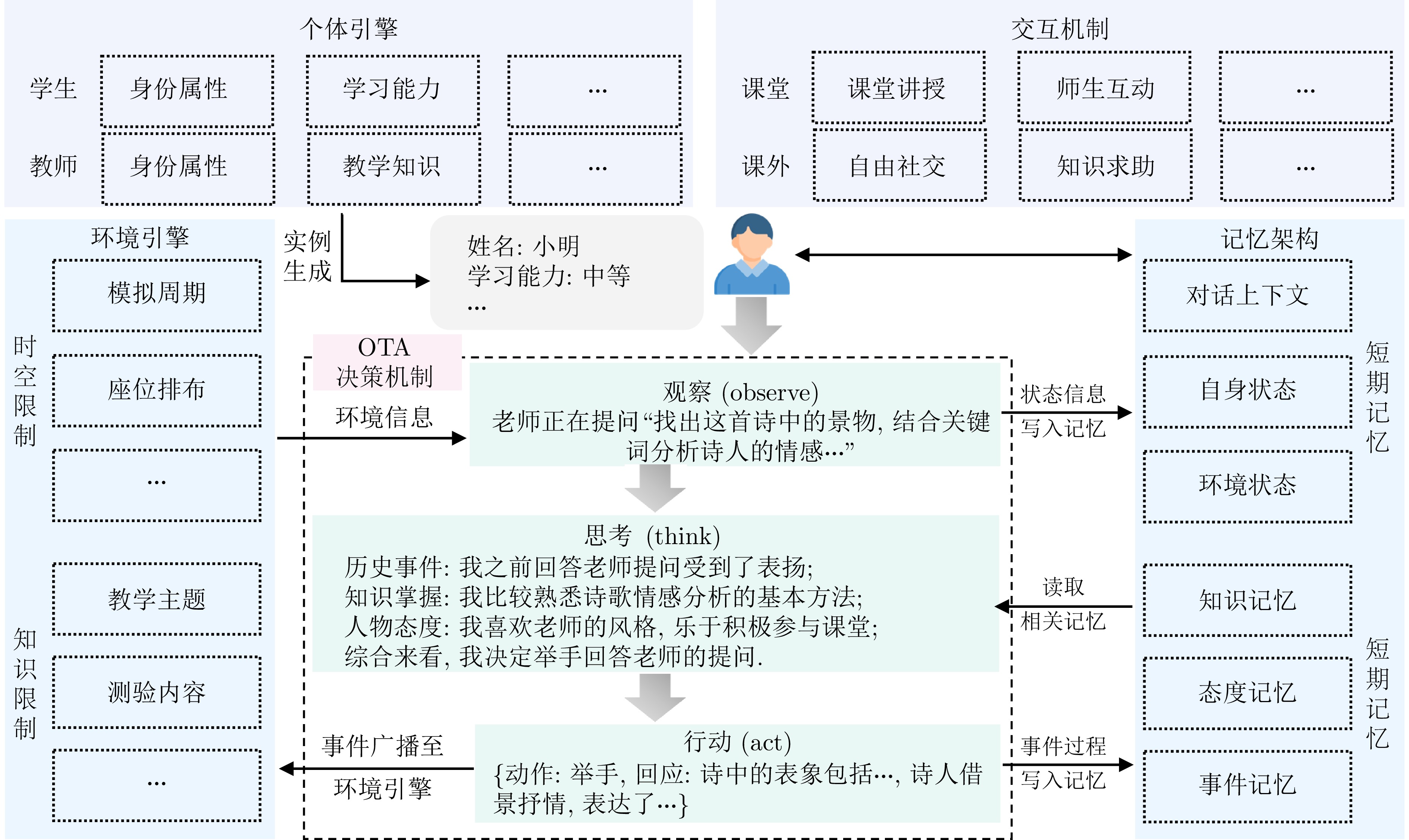
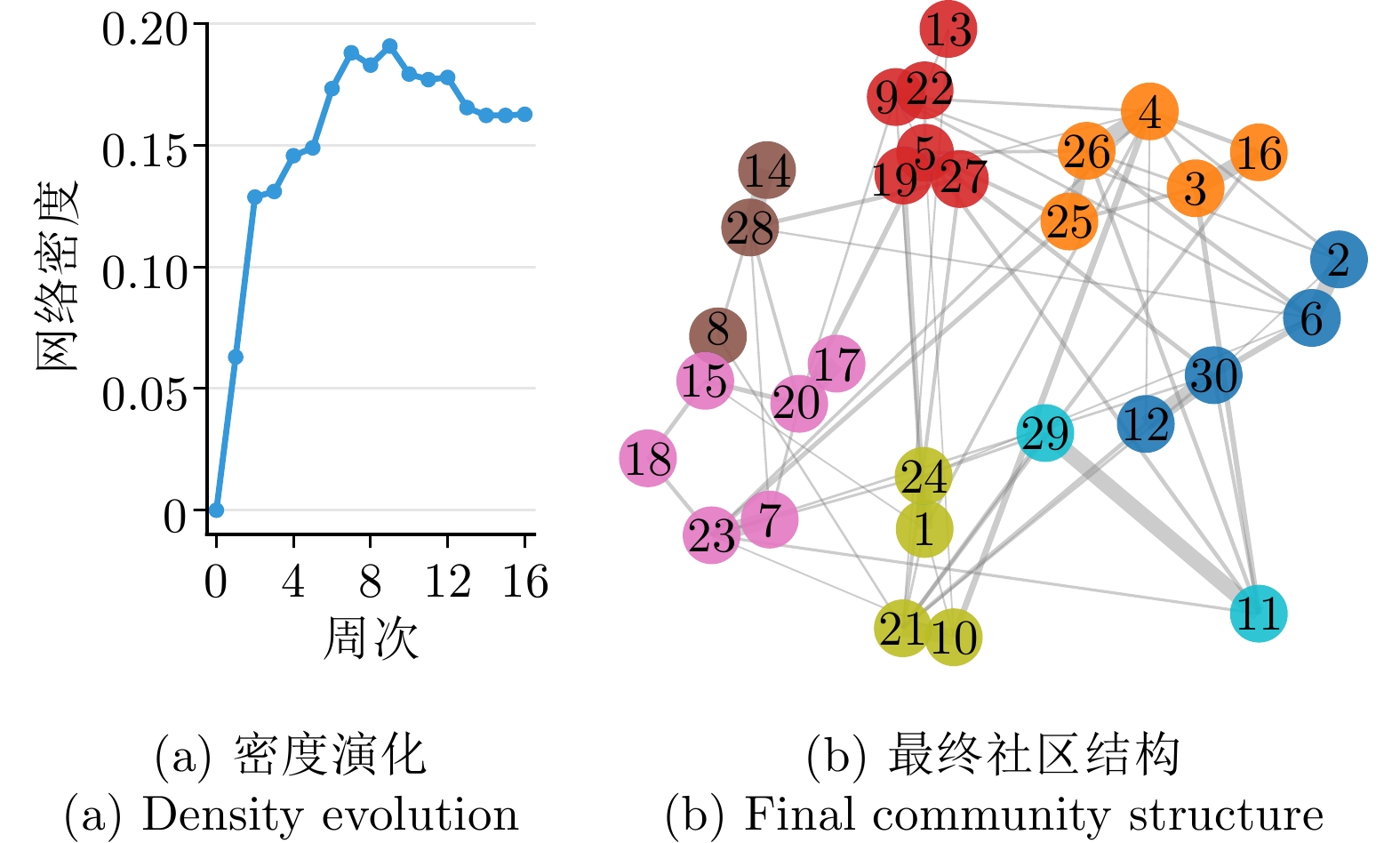
摘要: 教育研究长期面临全过程追踪难、多变量易混淆、反事实实验受限等方法论困境, 制约着对复杂教育现象的深入理解. 大语言模型驱动的智能体技术为突破传统教育研究范式局限、构建灵活可控的教育研究仿真环境提供新思路. 提出一种支持长周期多尺度分析的课堂仿真建模框架AgentClass, 构建包含1名教师与30名学生智能体的课堂环境, 模拟出80天周期内课堂教学与课间社交的演化. 该框架通过分层记忆架构与“观察—思考—行动”决策机制驱动智能体的持续演化与群体涌现. 实验结果表明, AgentClass在微观层面维持个体行为合理性, 在宏观层面实现社交网络从空图自发演化为稳定社区结构, 在效应复现方面能够成功复现大鱼小池效应, 并通过反事实干预提供其形成机制的分析线索. AgentClass以其支持全过程记录、单变量操控、反事实实验等能力, 为探索人工智能驱动的教育科学研究新范式提供一种具有潜力的工具.
-
关键词:
- 智能体 /
- 课堂仿真 /
- 智能教育 /
- 人工智能驱动的教育科学研究
Abstract: Educational research has long faced methodological challenges, including difficulties in full-process tracking, confounding among multiple variables, and constraints on counterfactual experimentation. These challenges hinder a deeper understanding of complex educational phenomena. Large language model-driven agent technology offers new approaches to overcoming the limitations of traditional educational research paradigms and constructing flexible and controllable simulation environments for educational research. This paper proposes AgentClass, an agent-based class simulation framework that supports long-term, multi-scale analysis. It constructs a simulated class environment with one teacher agent and thirty student agents, simulating the evolution of both instructional interactions and peer social interactions over an 80-day period. The framework employs a hierarchical memory architecture and an observe-think-act decision mechanism to drive continuous individual evolution and collective emergence. Experimental results show that AgentClass maintains plausible individual behavior at the micro level, enables social networks to spontaneously evolve from empty graphs into stable community structures at the macro level, and, in terms of effect reproduction, successfully reproduces the big-fish-little-pond effect with analytical insights into its formation mechanism through counterfactual interventions. By supporting full-process recording, single-variable manipulation, and counterfactual experimentation, AgentClass serves as a promising tool for exploring the new paradigm of AI for education science.-
Key words:
- agent /
- class simulation /
- smart education /
- AI for education science
-
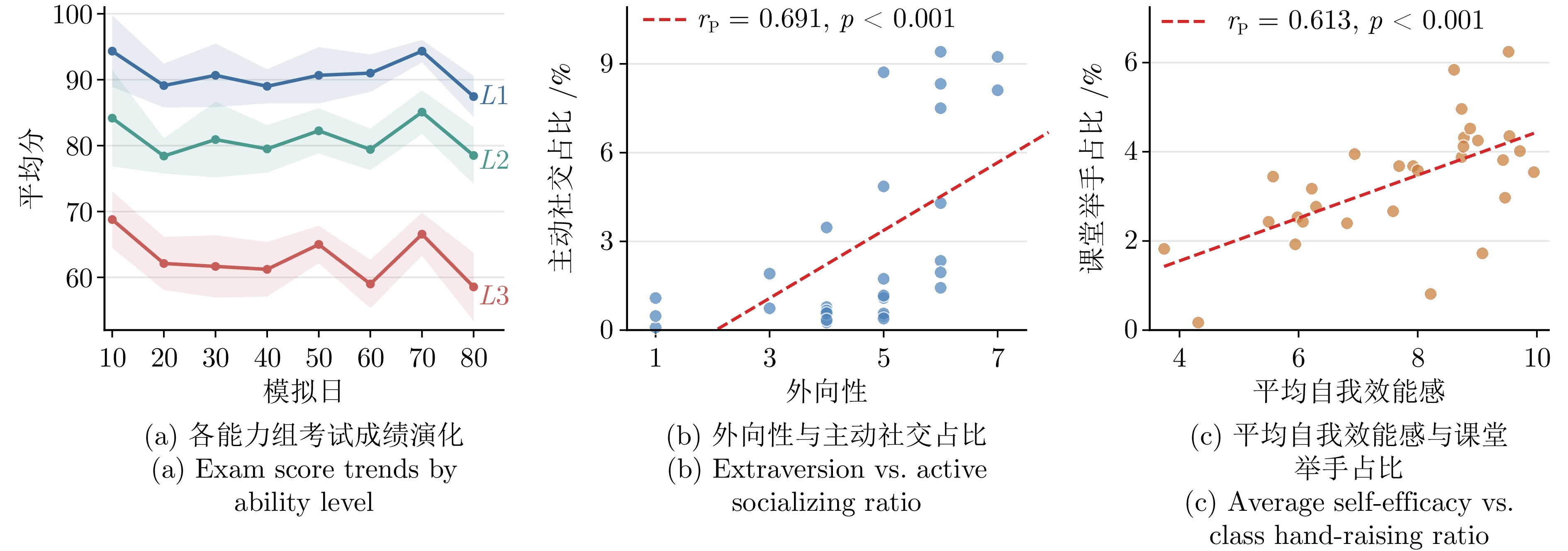
图 2 智能体个体行为合理性的量化验证
Fig. 2 Quantitative validation of individual agent behavior plausibility
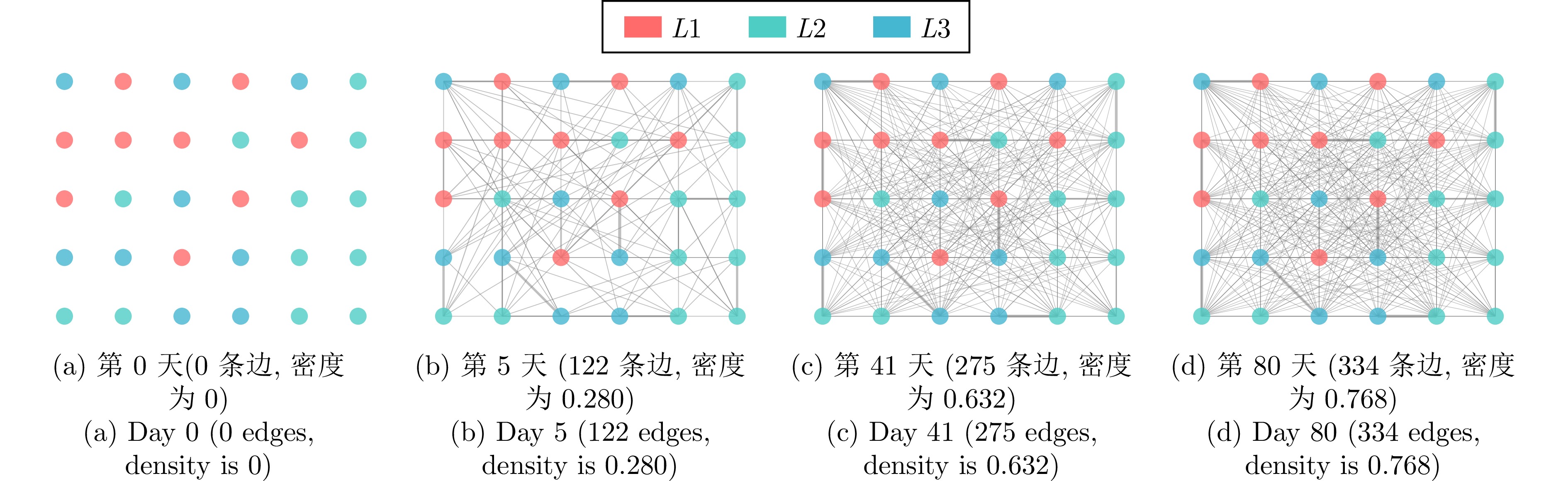
图 3 累计互动网络在四个时间截面上的演化快照
Fig. 3 Evolution snapshots of the cumulative interaction network at four time points
表 1 代表性课堂多智能体模拟系统的关键特征对比
Table 1 Comparison of key characteristics among representative multi-agent class simulation systems
系统 学生数 模拟周期 长周期状态演化 课堂交互 课间社交 反事实实验 教育效应复现 涌现现象 在线课堂或抽象课堂 SimClass[18] 4 1节课 $ \times $ $ \checkmark $ $ \times $ $ \times $ $ \times $ $ \checkmark $ MathVC[19] 2 1节课 $ \times $ $ \checkmark $ $ \times $ $ \times $ $ \times $ $ \times $ EduAgent[20] – 1节课 $ \times $ $ \times $ $ \times $ $ \times $ $ \times $ $ \times $ Classroom simulacra[21] – – $ \times $ $ \times $ $ \times $ $ \times $ $ \times $ $ \times $ LearnerAgent[22] 4 12个月 $ \checkmark $ $ \times $ $ \times $ $ \times $ $ \times $ $ \checkmark $ 线下物理课堂 EduVerse[23] 6 4节课 $ \checkmark $ $ \checkmark $ $ \times $ $ \times $ $ \times $ $ \checkmark $ AI-Agent school[24] 40 5天 $ \checkmark $ $ \checkmark $ $ \checkmark $ $ \times $ $ \times $ $ \times $ AgentClass 30 80天 $ \checkmark $ $ \checkmark $ $ \checkmark $ $ \checkmark $ $ \checkmark $ $ \checkmark $  下载: 导出CSV
表 2 智能体个体行为合理性的主观评估结果
Table 2 Subjective evaluation results of individual agent behavior plausibility
基座模型 配置 情境合理性评分$ \uparrow $ 人格一致性评分$ \uparrow $ 状态一致性评分$ \uparrow $ 人类偏好比例$ \uparrow $ Qwen2.5-7B-Instruct AgentClass 7.89 ± 1.92 8.12 ± 1.49 8.20 ± 1.36 83.2% w/o课间社交 6.35 ± 2.09 6.29 ± 1.88 6.38 ± 1.90 8.5% w/o记忆架构 4.67 ± 1.22 2.01 ± 0.81 3.62 ± 0.72 2.3% w/o OTA决策机制 5.28 ± 2.81 5.33 ± 2.30 5.12 ± 2.57 6.0% Qwen2.5-32B-Instruct AgentClass 8.53 ± 1.13 8.48 ± 1.08 8.45 ± 1.03 87.5% w/o课间社交 7.16 ± 1.70 7.41 ± 1.83 6.48 ± 1.65 6.3% w/o记忆架构 5.30 ± 0.68 3.04 ± 0.94 4.26 ± 0.51 0.9% w/o OTA决策机制 5.74 ± 1.98 5.62 ± 1.65 5.97 ± 1.82 5.4%
下载: 导出CSV
表 3 不同能力分布下观察对象的学业自我概念得分
Table 3 Academic self-concept scores of the observed student under different ability distributions
组别 能力分布 ($L1$:$L2$:$L3$) Qwen2.5-7B-Instruct Qwen2.5-32B-Instruct A 5:20:5 5.5 5.4 B 9:12:9 5.1 4.9 C 10:10:10 5.0 4.6 D 30:0:0 3.5 3.4
下载: 导出CSV
表 4 案例分析: A组与D组中观察对象的访谈结果对比
Table 4 Case study: Interview result comparison of the observed student in Groups A and D
访谈维度 A组 D组 能力自评 我觉得自己语文还可以, 虽然比不上几个特别厉害的同学, 但在班上算中等偏上吧 说不上好也说不上差, 大家水平都差不多, 我也就那样 比较对象 我经常和周明、李强他们比, 感觉我跟他们差距不大, 有时候考得比他们还好 没什么特别想比的人, 反正大家成绩都差不多 课堂体验 老师有时候会叫我回答问题, 挺有成就感的 感觉老师对我们班上每个人的关注度都类似 学习动机 我觉得再努力一点应该能进步, 下次争取考得更好 和其他同学成绩差不多, 每次都能考一个中间名次 社交反馈 有同学会来找我讨论题目, 我觉得自己还是有点用的 来找我讨论的同学不多, 我也不太主动找别人
下载: 导出CSV
表 5 反事实实验中观察对象的学业自我概念变化
Table 5 Changes in the observed student's academic self-concept in counterfactual experiments
干预条件 描述 Qwen2.5-7B-Instruct Qwen2.5-32B-Instruct 原始 A组完整模拟 5.5 5.4 干预1) 不公开考试成绩 5.3 5.0 干预2) 干预1) + 禁止成绩传播 5.0 4.8 干预3) 干预2) + 教师不提问 4.8 4.5 干预4) 干预3) + 禁止社交 4.6 4.3
下载: 导出CSV
表 6 80天仿真的计算成本统计
Table 6 Computational cost statistics for the 80-day simulation
基座模型 token消耗(千万) GPU小时数 Qwen2.5-7B-Instruct 2.589 56.5 Qwen2.5-32B-Instruct 2.674 129.6
下载: 导出CSV
-
[1] 刘三女牙, 郝晓晗, 李卿. 教育科研新范式: 人工智能驱动的教育科学研究. 教育研究, 2024, 45(3): 147−159Liu San-Nyu-Ya, Hao Xiao-Han, Li Qing. A new paradigm of educational research: A research into AI-driven educational science. Educational Research, 2024, 45(3): 147−159 [2] 孙建文. AI4LS: 智能时代学习科学研究新范式. 华中师范大学学报(人文社会科学版), 2025, 64(3): 154−162 doi: 10.19992/j.cnki.1000-2456.2025.03.013Sun Jian-Wen. AI4LS: A new research paradigm of learning sciences in the age of intelligence. Journal of Central China Normal University (Humanities and Social Sciences), 2025, 64(3): 154−162 doi: 10.19992/j.cnki.1000-2456.2025.03.013 [3] 缪青海, 王兴霞, 杨静, 赵勇, 王雨桐, 陈圆圆, 等. 从基础智能到通用智能: 基于大模型的GenAI和AGI之现状与展望. 自动化学报, 2024, 50(4): 674−687Miao Qing-Hai, Wang Xing-Xia, Yang Jing, Zhao Yong, Wang Yu-Tong, Chen Yuan-Yuan, et al. From foundation intelligence to general intelligence: The state-of-art and perspectives of GenAI and AGI based on foundation models. Acta Automatica Sinica, 2024, 50(4): 674−687 [4] Binz M, Akata E, Bethge M, Brändle F, Callaway F, Coda-Forno J, et al. A foundation model to predict and capture human cognition. Nature, 2025, 644(8078): 1002−1009 doi: 10.1038/s41586-025-09215-4 [5] Webb T, Holyoak K J, Lu H J. Emergent analogical reasoning in large language models. Nature Human Behaviour, 2023, 7(9): 1526−1541 doi: 10.1038/s41562-023-01659-w [6] Strachan J W A, Albergo D, Borghini G, Pansardi O, Scaliti E, Gupta S, et al. Testing theory of mind in large language models and humans. Nature Human Behaviour, 2024, 8(7): 1285−1295 doi: 10.1038/s41562-024-01882-z [7] Gao C, Lan X C, Li N, Yuan Y, Ding J T, Zhou Z L, et al. Large language models empowered agent-based modeling and simulation: A survey and perspectives. Humanities and Social Sciences Communications, 2024, 11(1): Article No. 1259 doi: 10.1057/s41599-024-03611-3 [8] Grossmann I, Feinberg M, Parker D C, Christakis N A, Tetlock P E, Cunningham W A. AI and the transformation of social science research. Science, 2023, 380(6650): 1108−1109 doi: 10.1126/science.adi1778 [9] Li N, Gao C, Li M Y, Li Y, Liao Q M. EconAgent: Large language model-empowered agents for simulating macroeconomic activities. In: Proceedings of the 62nd Annual Meeting of the Association for Computational Linguistics (Volume 1: Long Papers). Bangkok, Thailand: Association for Computational Linguistics, 2024. 15523-15536 [10] Yang Y Z, Zhang Y F, Wu M H, Zhang K D, Zhang Y M, Yu H H, et al. TwinMarket: A scalable behavioral and social simulation for financial markets. In: Proceedings of the 39th Annual Conference on Neural Information Processing Systems. San Diego, USA: Curran Associates, Inc., 2025. 63469-63519 [11] Hou A B, Du H R, Wang Y C, Zhang J Y, Wang Z X, Liang P P, et al. Can a society of generative agents simulate human behavior and inform public health policy? A case study on vaccine hesitancy. In: The 2nd Conference on Language Modeling. Montreal, Canada, 2025. [12] Yang Z Y, Zhang Z B, Zheng Z R, Jiang Y X, Gan Z Y, Wang Z Y, et al. OASIS: Open agent social interaction simulations with one million agents. arXiv preprint arXiv: 2411.11581, 2025. [13] Piao J H, Yan Y W, Zhang J, Li N, Yan J B, Lan X C, et al. AgentSociety: Large-scale simulation of LLM-driven generative agents advances understanding of human behaviors and society. arXiv preprint arXiv: 2502.08691, 2026. [14] Wang L, Li Y Z, Wu J C, Gao H Y, Bo X H, Chen X, et al. LLM agents as social scientists: A human-AI collaborative platform for social science automation. arXiv preprint arXiv: 2604.01520, 2026. [15] Park J S, O'Brien J, Cai C J, Morris M R, Liang P, Bernstein M S. Generative agents: Interactive simulacra of human behavior. In: Proceedings of the 36th Annual ACM Symposium on User Interface Software and Technology. San Francisco, USA: ACM, 2023. 1-22 [16] Hao Z X, Cao J, Li R M, Yu J F, Liu Z Y, Zhang Y. Mapping student-AI interaction dynamics in multi-agent learning environments: Supporting personalized learning and reducing performance gaps. Computers & Education, 2026, 241: Article No. 105472 doi: 10.1016/j.compedu.2025.105472 [17] Sanyal D, Maiti A, Maharana U, Kumar D, Mali A, Giles C L, et al. Investigating pedagogical teacher and student LLM agents: Genetic adaptation meets retrieval-augmented generation across learning styles. In: Proceedings of the 2025 Conference on Empirical Methods in Natural Language Processing. Suzhou, China: Association for Computational Linguistics, 2025. 13348-13389 [18] Zhang Z Y, Zhang-Li D, Yu J F, Gong L L, Zhou J C, Hao Z X, et al. Simulating classroom education with LLM-empowered agents. In: Proceedings of the 2025 Conference of the Nations of the Americas Chapter of the Association for Computational Linguistics: Human Language Technologies (Volume 1: Long Papers). Albuquerque, USA: Association for Computational Linguistics, 2025. 10364-10379 [19] Yue M R, Lyu W H, Suh J, Zhang Y X, Yao Z Y. MathVC: An LLM-simulated multi-character virtual classroom for mathematics education. arXiv preprint arXiv: 2404.06711, 2025. [20] Xu S L, Zhang X Y, Qin L H. EduAgent: Generative student agents in learning. arXiv preprint arXiv: 2404.07963, 2024. [21] Xu S L, Wen H N, Pan H Y, Dominguez D, Hu D Y, Zhang X Y. Classroom simulacra: Building contextual student generative agents in online education for learning behavioral simulation. In: Proceedings of the 2025 CHI Conference on Human Factors in Computing Systems. Yokohama, Japan: ACM, 2025. 1-26 [22] Yuan Y, Zhao L L, Chen W, Zheng G T, Zhang K, Zhang M D, et al. Simulating human-like learning dynamics with LLM-empowered agents. arXiv preprint arXiv: 2508.05622, 2025. [23] Ma Y P, Hu S Y, Zhu B Y, Wang Y P, Kang Y X, Liu S Q, et al. EduVerse: A user-defined multi-agent simulation space for education scenario. arXiv preprint arXiv: 2510.05650, 2025. [24] Jin S, Wang H M, Gao Z Q, Yang Y B, Bao C J, Wang C L. Evolution in simulation: AI-Agent school with dual memory for high-fidelity educational dynamics. In: Findings of the Association for Computational Linguistics: EMNLP 2025. Suzhou, China: Association for Computational Linguistics, 2025. 5843-5857 [25] 秦龙, 武万森, 刘丹, 胡越, 尹全军, 阳东升, 等. 基于大语言模型的复杂任务自主规划处理框架. 自动化学报, 2024, 50(4): 862−872 doi: 10.16383/j.aas.c240088Qin Long, Wu Wan-Sen, Liu Dan, Hu Yue, Yin Quan-Jun, Yang Dong-Sheng, et al. Autonomous planning and processing framework for complex tasks based on large language models. Acta Automatica Sinica, 2024, 50(4): 862−872 doi: 10.16383/j.aas.c240088 [26] 郑逸宁, 余镇, 李不凡, 杨捷, 殷林琪, 印张悦, 等. 大语言模型的工具使用综述. 自动化学报, 2025, 51(11): 2371−2386 doi: 10.16383/j.aas.c240793Zheng Yi-Ning, Yu Zhen, Li Bu-Fan, Yang Jie, Yin Lin-Qi, Yin Zhang-Yue, et al. Survey of tool use in large language models. Acta Automatica Sinica, 2025, 51(11): 2371−2386 doi: 10.16383/j.aas.c240793 [27] Argyle L P, Busby E C, Fulda N, Gubler J R, Rytting C, Wingate D. Out of one, many: Using language models to simulate human samples. Political Analysis, 2023, 31(3): 337−351 doi: 10.1017/pan.2023.2 [28] Cui Z Y, Li N, Zhou H K. A large-scale replication of scenario-based experiments in psychology and management using large language models. Nature Computational Science, 2025, 5(8): 627−634 doi: 10.1038/s43588-025-00840-7 [29] Bhatia S, van Baal S T, Wang F Y, Walasek L. Computational analysis of 100 K choice dilemmas: Decision attributes, trade-off structures, and model-based prediction. Proceedings of the National Academy of Sciences, 2025, 122(17): Article No. e2406489122 doi: 10.1073/pnas.2406489122 [30] Schelling T C. Dynamic models of segregation. The Journal of Mathematical Sociology, 1971, 1(2): 143−186 doi: 10.1080/0022250x.1971.9989794 [31] Macal C M, North M J. Agent-based modeling and simulation. In: Proceedings of the 2009 Winter Simulation Conference. Austin, USA: IEEE, 2009. 86-98 [32] Epstein J M, Axtell R. Growing Artificial Societies: Social Science from the Bottom Up. Washington: Brookings Institution Press, 1996. [33] Zhang X N, Lin J Y, Mou X Y, Yang S Y, Liu X W, Sun L B, et al. SocioVerse: A world model for social simulation powered by LLM agents and a pool of 10 million real-world users. arXiv preprint arXiv: 2504.10157, 2025. [34] 孙建文, 陈麒戎, 李伏清, 罗亚威, 李卿, 沈筱譞, 等. PsyINN: 面向教育数据挖掘的心理信息神经网络. 计算机学报, 2026, 49(5): 1027−1045 doi: 10.11897/SP.J.1016.2026.01027Sun Jian-Wen, Chen Qi-Rong, Li Fu-Qing, Luo Ya-Wei, Li Qing, Shen Xiao-Xuan, et al. PsyINN: A psychology-informed neural network for educational data mining. Chinese Journal of Computers, 2026, 49(5): 1027−1045 doi: 10.11897/SP.J.1016.2026.01027 [35] Liu J Y, Huang Z Y, Xiao T, Sha J, Wu J Z, Liu Q, et al. SocraticLM: Exploring Socratic personalized teaching with large language models. In: Proceedings of the 38th Annual Conference on Neural Information Processing Systems. Vancouver, Canada: Curran Associates, Inc., 2024. 85693-85721 [36] Gao W B, Liu Q, Yue L N, Yao F Z, Lv R, Zhang Z, et al. Agent4Edu: Generating learner response data by generative agents for intelligent education systems. In: Proceedings of the 39th AAAI Conference on Artificial Intelligence. Philadelphia, USA: AAAI, 2025. 23923-23932 [37] Markel J M, Opferman S G, Landay J A, Piech C. GPTeach: Interactive TA training with GPT-based students. In: Proceedings of the 10th ACM Conference on Learning @ Scale. Copenhagen, Denmark: ACM, 2023. 226-236 [38] Atkinson R C, Shiffrin R M. Human memory: A proposed system and its control processes. Psychology of Learning and Motivation, Vol. 2. New York: Academic Press, 1968. 89-195 [39] Bandura A. Self-efficacy: Toward a unifying theory of behavioral change. Psychological Review, 1977, 84(2): 191−215 doi: 10.1037//0033-295x.84.2.191 [40] Baldwin M W. Relational schemas and the processing of social information. Psychological Bulletin, 1992, 112(3): 461−484 doi: 10.1037/0033-2909.112.3.461 [41] Wentzel K R. Social relationships and motivation in middle school: The role of parents, teachers, and peers. Journal of Educational Psychology, 1998, 90(2): 202−209 doi: 10.1037/0022-0663.90.2.202 [42] Black P, Wiliam D. Assessment and classroom learning. Assessment in Education: Principles, Policy & Practice, 1998, 5(1): 7−74 doi: 10.1080/0969595980050102 [43] Bloom B S, Engelhart M D, Furst E J, Hill W H, Krathwohl D R. Taxonomy of Educational Objectives, Handbook I: The Cognitive Domain. New York: David McKay, 1956. [44] Anderson L W, Krathwohl D R. A Taxonomy for Learning, Teaching, and Assessing: A Revision of Bloom's Taxonomy of Educational Objectives: Complete Edition. New York: Addison Wesley Longman, 2001. [45] Yang A, Yang B S, Zhang B C, Hui B Y, Zheng B, Yu B W, et al. Qwen2.5 technical report. arXiv preprint arXiv: 2412.15115, 2025. [46] Kwon W, Li Z, Zhuang S, Sheng Y, Zheng L, Yu C H, et al. Efficient memory management for large language model serving with PagedAttention. In: Proceedings of the 29th Symposium on Operating Systems Principles. Koblenz, Germany: ACM, 2023. 611-626 [47] Piao J H, Yan Y W, Li N, Zhang J, Li Y. Exploring large language model agents for piloting social experiments. In: The 2nd Conference on Language Modeling. Montreal, Canada, 2025. [48] Marsh H W. The big-fish-little-pond effect on academic self-concept. Journal of Educational Psychology, 1987, 79(3): 280−295 [49] Marsh H W, Hau K T. Big-fish-little-pond effect on academic self-concept: A cross-cultural (26-country) test of the negative effects of academically selective schools. American Psychologist, 2003, 58(5): 364−376 doi: 10.1037/0003-066X.58.5.364 [50] Festinger L. A theory of social comparison processes. Human Relations, 1954, 7(2): 117−140 doi: 10.1177/001872675400700202 [51] Serapio-García G, Safdari M, Crepy C, Sun L, Fitz S, Romero P, et al. A psychometric framework for evaluating and shaping personality traits in large language models. Nature Machine Intelligence, 2025, 7(12): 1954−1968 doi: 10.1038/s42256-025-01115-6 -

 下载:

计量
- 文章访问数: 13
- HTML全文浏览量: 5
- 被引次数: 0
