


A Look-ahead Multi-perspective Visual Reasoning Framework for Diagram Question Answering
-
摘要: 针对多模态大模型在抽象度示意图(如几何、电路、科学图表)理解中面临的视觉感知静态化挑战, 提出一种基于前瞻性机制的多视角视觉推理框架. 该方法旨在模拟人类“慢思考”的认知机理, 通过引入相对注意力与信息增益门控, 实现对关键视觉线索的主动搜索与去噪; 利用逻辑置信度与视觉相关性进行双维质量评估, 构建“观察–假设–验证”的动态闭环推理系统. 实验表明, 该方法在多学科的示意图推理数据集上显著优于现有主流方法, 在并未引入过多计算开销的同时, 大幅提升了复杂示意图问答的准确率与鲁棒性.Abstract: To address the static visual perception challenge faced by multimodal large models in understanding abstract diagrams (such as geometry, circuits, and scientific charts), a multi-perspective visual reasoning framework based on a look-ahead mechanism is proposed. Aiming to simulate the cognitive mechanism of human “slow thinking”, this method achieves the active search and denoising of key visual clues by introducing relative attention and information gain gating; Furthermore, it utilizes a dual-dimensional quality evaluation of logical confidence and visual relevance to construct a dynamic “observation-hypothesis-verification” closed-loop reasoning system. Experiments demonstrate that this method significantly outperforms existing mainstream approaches on multidisciplinary diagram reasoning datasets, substantially improving the accuracy and robustness of complex diagram question answering without introducing excessive computational overhead.
-
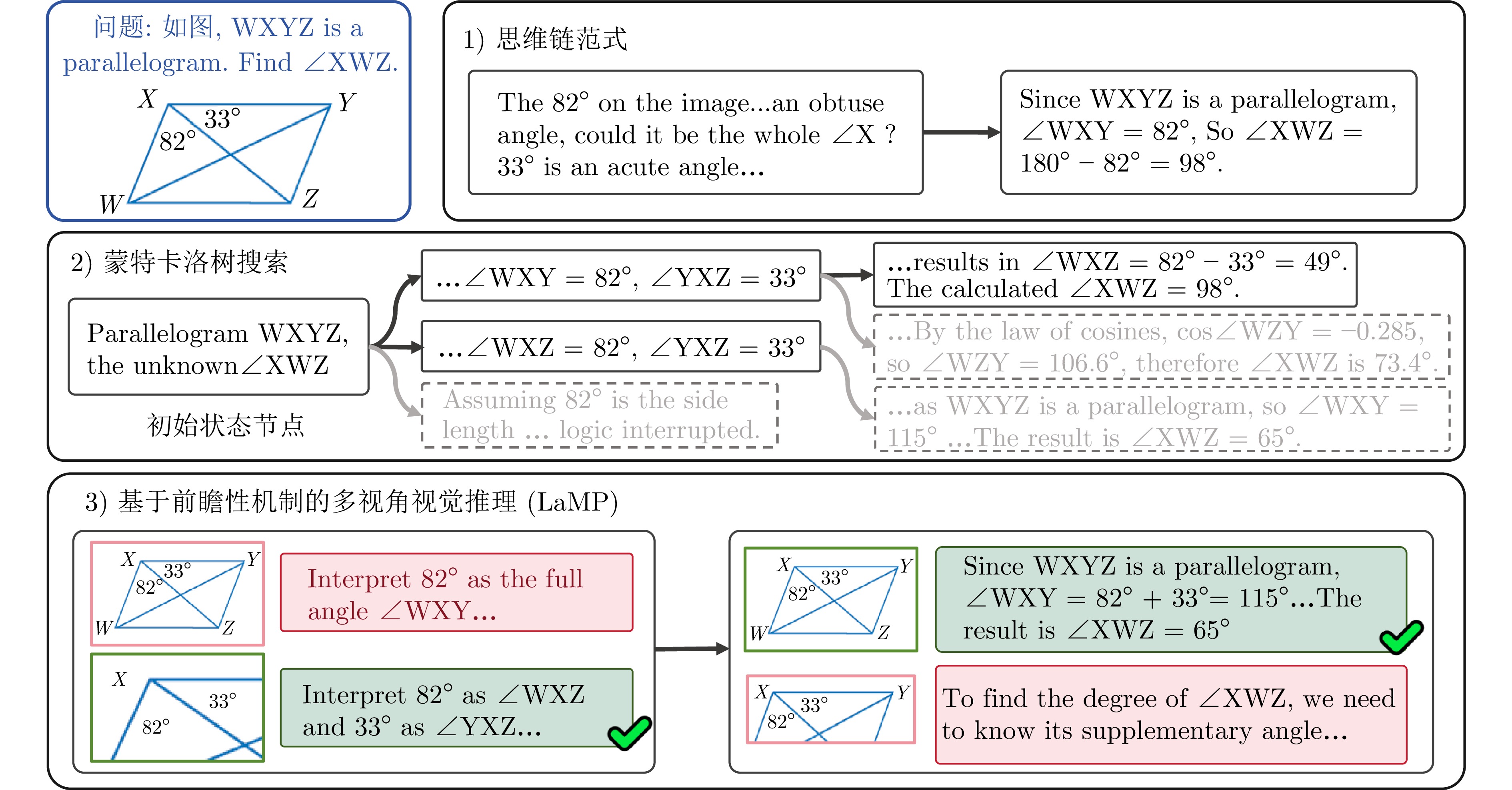
图 1 不同视觉推理机制在求解几何问题上的对比
Fig. 1 Comparison of different visual reasoning mechanisms in solving geometry problem
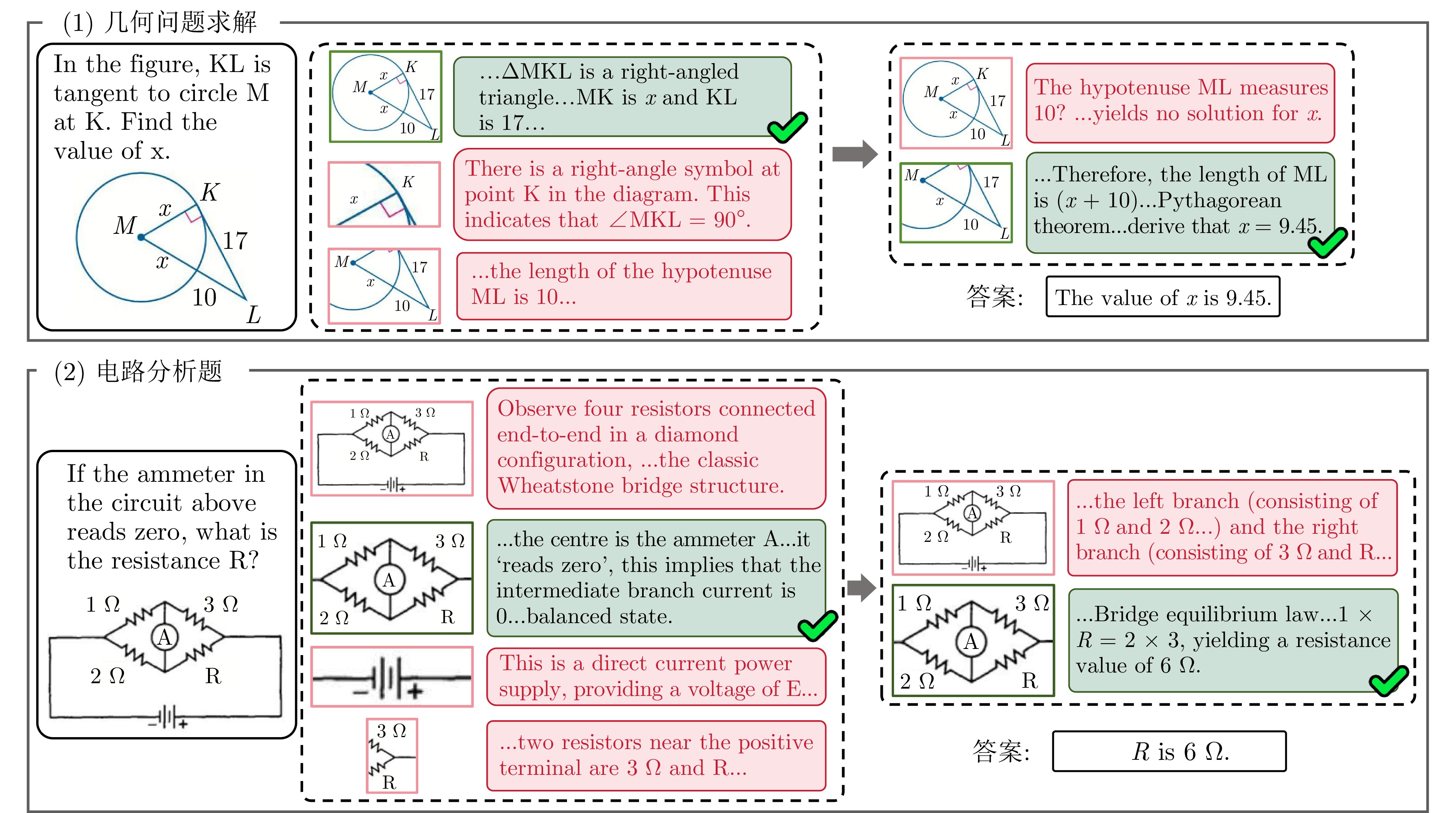
图 4 LaMP方法在示意图问题求解中的多视角探索与局部验证案例分析
Fig. 4 A case analysis on the LaMP method for multi-perspective exploration and local verification in diagram problem-solving
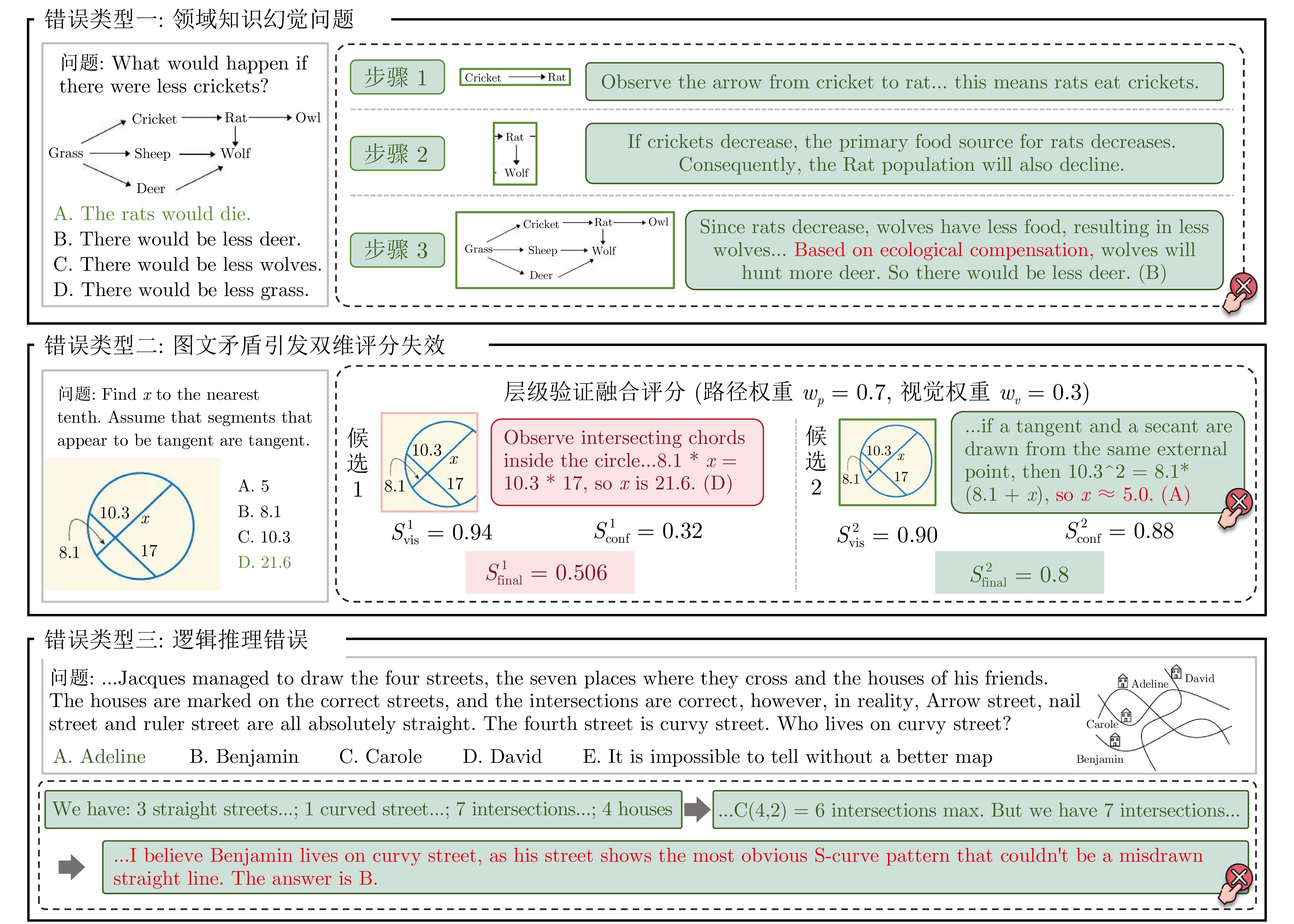
图 5 LaMP方法在示意图问题求解中的局限性分析
Fig. 5 Analysis of limitations of the LaMP method in diagram problem-solving
表 1 不同方法在两大类视觉推理基准上的性能对比(Acc. (%))
Table 1 Performance comparison of different methods on two major categories of visual reasoning benchmarks (Acc. (%))
数理推理 多学科综合 模型方法 MathVista MathVision PhysReason AI2D SciQA MMStar M3CoT Avg. Qwen2.5-VL-7B-Instruct Baseline 68.20 18.09 14.35 80.51 74.42 63.87 59.62 54.16 MCTS 69.60 18.75 16.27 81.87 78.09 66.20 60.87 55.95 Pred. Dec. 69.90 19.73 18.65 82.67 78.68 65.67 61.34 56.67 ICoT 47.50 10.53 15.73 81.35 77.24 42.07 61.17 47.95 DyFo 68.40 16.78 14.75 80.93 76.95 64.47 61.26 54.80 LaMP 70.80 24.34 21.76 84.07 81.95 69.80 62.68 59.34 InternVL2.5-8B-Instruct Baseline 64.40 22.00 11.58 81.61 76.15 60.47 57.16 53.34 MCTS 65.00 24.67 14.21 82.97 79.67 62.00 58.24 55.25 Pred. Dec. 65.40 25.00 17.16 83.74 80.37 62.40 58.76 56.12 ICoT 42.90 16.12 13.57 82.25 78.63 39.40 58.50 47.34 DyFo 64.70 20.39 12.08 81.96 77.89 61.47 58.58 53.87 LaMP 67.10 28.62 19.35 84.84 82.10 65.67 59.32 58.15 Qwen2.5-VL-32B-Instruct Baseline 74.70 25.33 19.42 83.29 78.83 69.47 62.81 59.13 MCTS 76.20 27.31 21.38 84.68 80.76 70.60 64.15 60.73 Pred. Dec. 76.60 27.96 22.76 85.17 81.95 71.07 64.62 61.45 ICoT 58.70 21.05 20.76 84.03 79.77 54.60 63.93 54.69 DyFo 75.60 24.67 20.35 83.52 78.93 70.07 64.32 59.64 LaMP 77.70 30.59 25.43 85.87 84.33 72.87 66.35 63.31  下载: 导出CSV
表 2 不同推理方法在各基座模型上的计算成本(FLOPs)对比
Table 2 Comparison of the computational cost (FLOPs) of different reasoning methods across different base models
基座模型 Baseline MCTS Pred. Dec. ICoT DyFo LaMP Qwen2.5-VL-7B 8.35e+12 4.05e+14 1.85e+14 1.88e+13 1.98e+13 1.54e+14 InternVL2.5-8B 1.02e+13 4.58e+14 2.09e+14 2.21e+13 2.38e+13 1.87e+14 Qwen2.5-VL-32B 3.59e+13 1.79e+15 8.17e+14 8.07e+13 8.63e+13 6.38e+14
下载: 导出CSV
表 3 各推理方法的计算成本、推理时间与准确率综合 对比(Qwen2.5-VL-7B-Instruct, A100)
Table 3 Comprehensive comparison of computational cost, inference time and accuracy for different reasoning methods (Qwen2.5-VL-7B-Instruct, A100)
方法 FLOPs 时间开销(s) Avg. (%) 准确率增益 Baseline 8.35e+12 ~ 3 54.16 — ICoT 1.88e+13 ~ 8 47.95 −6.21 DyFo 1.98e+13 ~ 12 54.80 +0.64 LaMP 1.54e+14 ~ 68 59.34 +5.18 Pred. Dec. 1.85e+14 ~ 81 56.67 +2.51 MCTS 4.05e+14 ~ 170 55.95 +1.79
下载: 导出CSV
表 4 LaMP各阶段计算开销与时间分解(Qwen2.5-VL-7B-Instruct, 4样本/迭代 × 5轮有效迭代)
Table 4 Computational cost and time breakdown for each stage of LaMP (Qwen2.5-VL-7B-Instruct, 4 samples/iteration × 5 effective iterations)
阶段 FLOPs FLOPs
占比单卡(s) 四卡(s) 阶段一: 视觉多样性采样 1.48e+13 9.6% ~ 7 ~ 7 阶段二: 自适应门控 — — $< $ 1 $< $ 1 阶段三: 多视角生成与质量评估 1.39e+14 90.4% ~ 58 ~ 21 阶段四: 推理链动态扩展与决策 — — $< $ 1 $< $ 1 I/O与图像预处理 — — ~ 2 ~ 2 合计 1.54e+14 100.0% ~ 68 ~ 31
下载: 导出CSV
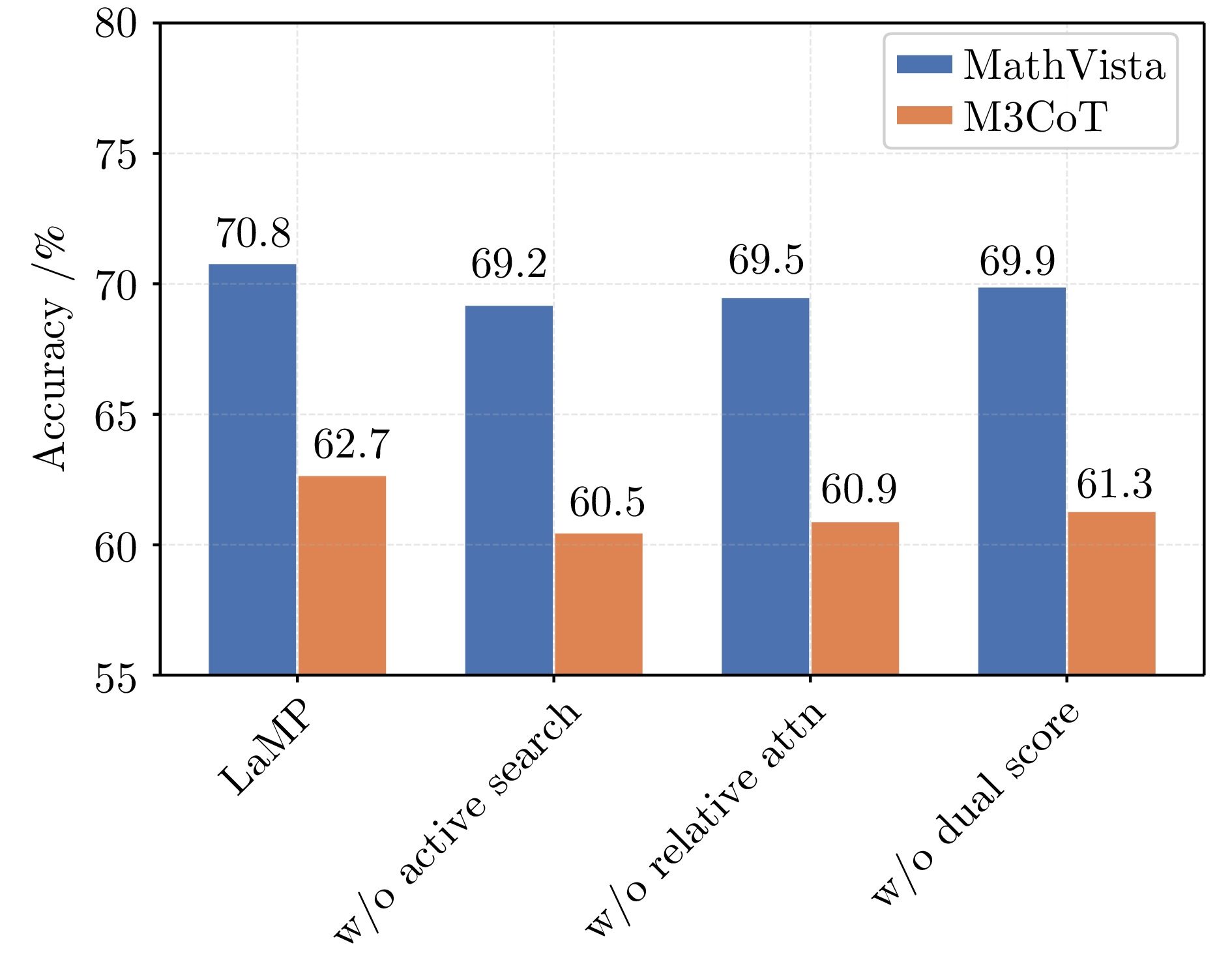
表 5 变体级组合消融实验结果 (Qwen2.5-VL-7B- Instruct, Acc. (%))
Table 5 Results of variant-level combinatorial ablation study (Qwen2.5-VL-7B-Instruct, Acc. (%))
变体A 变体B MathVista M3CoT $\checkmark $ $\checkmark $ 70.80 62.68 $\checkmark $ × 69.40 60.91 × $\checkmark $ 69.80 61.82 × × 68.30 59.80
下载: 导出CSV
表 6 跨方法组件替换实验结果(Qwen2.5-VL-7B-Instruct, Acc. (%))
Table 6 Results of cross-method component replacement experiments (Qwen2.5-VL-7B-Instruct, Acc. (%))
组合方式 MathVista M3CoT DyFo + Predictive Decoding 69.00 60.96 DyFo + LaMP变体B (前瞻评估) 69.70 61.73 LaMP变体A (视觉感知)+ Predictive Decoding 69.40 61.30 Full LaMP (变体A + 变体B) 70.80 62.68
下载: 导出CSV
表 7 前瞻深度$ L $和推理路径数量$ K $对实验结果的影响分析
Table 7 Analysis of the impact of lookahead depth $ L $ and reasoning path number $ K $ on the experimental results
前瞻步数 MathVista
Acc. (%)M3CoT
Acc. (%)FLOPs 采样数 MathVista
Acc. (%)M3CoT
Acc. (%)FLOPs $ L=3 $ 69.40 60.65 9.50e+13 $ K=1 $ 68.90 60.48 8.70e+13 $ L=4 $ 70.20 61.91 1.25e+14 $ K=2 $ 70.10 61.73 1.22e+14 $ L=5 $ 70.80 62.68 1.54e+14 $ K=3 $ 70.80 62.68 1.54e+14 $ L=6 $ 71.00 63.07 1.79e+14 $ K=4 $ 71.20 63.55 1.83e+14 $ L=7 $ 71.10 63.42 2.02e+14 $ K=5 $ 71.50 64.06 2.10e+14
下载: 导出CSV
表 8 逻辑置信度$ w_p $与视觉相关性$ w_v $在不同数据集上的敏感性分析(Qwen2.5-VL-7B-Instruct, Acc. (%))
Table 8 Sensitivity analysis of logical confidence $ w_p $ and visual relevance $ w_v $ on different datasets (Qwen2.5-VL-7B-Instruct, Acc. (%))
$ w_v $ $ w_p $ MathVista (数学) PhysReason (物理) SciQA-IMG (多学科) 0.1 0.9 70.20 20.21 80.48 0.2 0.8 70.50 21.05 81.23 0.3 0.7 70.80 21.76 81.95 0.4 0.6 70.60 21.28 81.61 0.5 0.5 70.10 20.47 80.83
下载: 导出CSV
表 9 候选区域生成核心参数敏感性分析(Qwen2.5-VL-7B-Instruct, MathVista) (%)
Table 9 Sensitivity analysis of core parameters for candidate region generation (Qwen2.5-VL-7B-Instruct, MathVista) (%)
候选数$ M $ 3 5 10 15 20 Acc. 69.3 69.9 70.8 70.6 70.3 裁剪比例$ \rho_{\min} $ 0.1 0.2 0.3 0.4 0.5 Acc. 69.5 70.2 70.8 70.1 69.4
下载: 导出CSV
表 10 信息增益门控阈值$ \theta $的敏感性分析 (Qwen2.5-VL-7B-Instruct, $ K=3 $)
Table 10 Sensitivity analysis of information gain gating threshold $ \theta $ (Qwen2.5-VL-7B-Instruct, $ K=3 $)
$ \theta $ MathVista
Acc. (%)M3CoT
Acc. (%)FLOPs 0.6 70.10 61.95 1.76e+14 0.8 70.50 62.34 1.64e+14 1.0 70.80 62.68 1.54e+14 1.2 70.30 62.12 1.38e+14 1.4 69.50 61.52 1.15e+14
下载: 导出CSV
表 11 不同注意力提取策略的性能对比(Qwen2.5-VL-7B, Acc. (%))
Table 11 Performance comparison of different attention extraction strategies (Qwen2.5-VL-7B, Acc. (%))
注意力提取策略 MathVista M3CoT 前1/3层平均 69.30 61.04 中间1/3层平均 69.80 61.65 后1/3层平均 70.30 62.17 全体层平均 70.00 61.82 最后一层Top-4头 70.50 62.34 最后一层全头平均 70.80 62.68
下载: 导出CSV
表 12 多视图输入策略对比(Qwen2.5-VL-7B-Instruct, $ K=3 $, $ \theta=1.0 $, Acc. (%))
Table 12 Comparison of multi-view input strategies (Qwen2.5-VL-7B-Instruct, $ K=3 $, $ \theta=1.0 $, Acc. (%))
策略 MathVista M3CoT 多图联合输入 69.70 61.73 单视图独立推理 70.80 62.68
下载: 导出CSV
-
[1] 缪青海, 王兴霞, 杨静, 赵勇, 王雨桐, 陈圆圆, 等. 从基础智能到通用智能: 基于大模型的GenAI和AGI之现状与展望. 自动化学报, 2024, 50(4): 674−687 doi: 10.16383/j.aas.c240156Miao Qing-Hai, Wang Xing-Xia, Yang Jing, Zhao Yong, Wang Yu-Tong, Chen Yuan-Yuan, et al. From foundation intelligence to general intelligence: The state-of-art and perspectives of GenAI and AGI based on foundation models. Acta Automatica Sinica, 2024, 50(4): 674−687 doi: 10.16383/j.aas.c240156 [2] Liu H T, Li C Y, Wu Q Y, Lee Y J. Visual instruction tuning. In: Proceedings of Advances in Neural Information Processing Systems (NeurIPS). Vancouver, BC, Canada: Curran Associates, 2024. 34892−34916 [3] Cui C, Ma Y S, Cao X, Ye W Q, Zhou Y, Liang K Z, et al. A survey on multimodal large language models for autonomous driving. In: Proceedings of the IEEE Conference on Computer Vision and Pattern Recognition (CVPR). Seattle, WA, USA: IEEE, 2024. 958−979 [4] Lu P, Bansal H, Xia T, Liu J C, Li C Y, Hajishirzi H, et al. MathVista: Evaluating mathematical reasoning of foundation models in visual contexts. In: Proceedings of the International Conference on Learning Representations (ICLR). Vienna, Austria: OpenReview.net, 2024. 23439−23554 [5] Yue X, Ni Y S, Zhang K, Zheng T Y, Liu R Q, Zhang G, et al. MMMU: A massive multi-discipline multimodal understanding and reasoning benchmark for expert AGI. In: Proceedings of the IEEE Conference on Computer Vision and Pattern Recognition (CVPR). Seattle, WA, USA: IEEE, 2024. 9556−9567 [6] Guan T R, Liu F X, Wu X Y, Xian R Q, Li Z X, Liu X Y, et al. HallusionBench: An advanced diagnostic suite for entangled language hallucination and visual illusion in large vision-language models. In: Proceedings of the IEEE Conference on Computer Vision and Pattern Recognition (CVPR). Seattle, WA, USA: IEEE, 2024. 14375−14385 [7] Zhang X Y, Zhang L L, Wu Y R, Wang S W, Wu W J, Huang M Y, et al. Memory-enriched thought-by-thought framework for complex diagram question answering. Computer Vision and Image Understanding, 2025: Article No. 104608 [8] Wang S W, Zhang L L, Zhu L J, Qin T, Yap K H, Zhang X Y, et al. CoG-DQA: Chain-of-guiding learning with large language models for diagram question answering. In: Proceedings of the IEEE Conference on Computer Vision and Pattern Recognition (CVPR). Seattle, WA, USA: IEEE, 2024. 13969−13979. [9] Wang L, Hu Y, He J B, Xu X, Liu N, Liu H, et al. T-SciQ: Teaching multimodal chain-of-thought reasoning via large language model signals for science question answering. In: Proceedings of the AAAI Conference on Artificial Intelligence (AAAI). Vancouver, BC, Canada: AAAI Press, 2024. 19162−19170 [10] Li Y F, Du Y F, Zhou K, Wang J P, Zhao W X, Wen J R. Evaluating object hallucination in large vision-language models. In: Proceedings of the Conference on Empirical Methods in Natural Language Processing (EMNLP). Singapore: Association for Computational Linguistics, 2023. 249−260 [11] Yin S K, Fu C Y, Zhao S R, Xu T, Wang H, Sui D H, et al. Woodpecker: Hallucination correction for multimodal large language models. Science China Information Sciences, 2024, 67(12): Article No. 220105 doi: 10.1007/s11432-024-4251-x [12] Wei J, Wang X, Schuurmans D, Bosma M, Ichter B, Xia F, et al. Chain-of-thought prompting elicits reasoning in large language models. In: Proceedings of Advances in Neural Information Processing Systems (NeurIPS). New Orleans, LA, USA: Curran Associates, 2022. 24824−24837 [13] Yao S Y, Yu D, Zhao J, Shafran I, Griffiths T, Cao Y, et al. Tree of thoughts: Deliberate problem solving with large language models. In: Proceedings of Advances in Neural Information Processing Systems (NeurIPS). New Orleans, LA, USA: Curran Associates, 2023. 11809−11822 [14] Hao S B, Gu Y, Ma H D, Hong J, Wang Z, Wang D, et al. Reasoning with language model is planning with world model. In: Proceedings of the Conference on Empirical Methods in Natural Language Processing (EMNLP). Singapore: Association for Computational Linguistics, 2023. 8154−8173 [15] Ma C, Zhao H T, Zhang J L, He J X, Kong L P. Non-myopic generation of language models for reasoning and planning. In: Proceedings of the International Conference on Learning Representations (ICLR). Singapore: OpenReview.net, 2025. 35031−35058. [16] Wang X Z, Wei J, Schuurmans D, Le Q, Chi E, Narang S, et al. Self-consistency improves chain of thought reasoning in language models. In: Proceedings of the International Conference on Learning Representations (ICLR). Kigali, Rwanda: OpenReview.net, 2023. [17] Kahneman, D. Thinking, Fast and Slow. New York: Farrar, Straus and Giroux, 2011. [18] 卢经纬, 郭超, 戴星原, 缪青海, 王兴霞, 杨静, 等. 问答ChatGPT之后: 超大预训练模型的机遇和挑战. 自动化学报, 2023, 49(4): 705−717Lu Jing-Wei, Guo Chao, Dai Xing-Yuan, Miao Qing-Hai, Wang Xing-Xia, Yang Jing, et al. The ChatGPT after: Opportunities and challenges of very large scale pre-trained models. Acta Automatica Sinica, 2023, 49(4): 705−717 [19] 朱嘉骏, 包美凯, 张凯, 刘烨, 刘淇. 基于多源知识注入的常识问答方法研究. 计算机工程与科学, 2025, 47(2): 349−360 doi: 10.3969/j.issn.1007-130X.2025.02.017Zhu Jia-Jun, Bao Mei-Kai, Zhang Kai, Liu Ye, Liu Qi. A commonsense question answering method based on multi-source knowledge infusion. Computer Engineering and Science, 2025, 47(2): 349−360 doi: 10.3969/j.issn.1007-130X.2025.02.017 [20] Shinn N, Cassano F, Gopinath A, Narasimhan K, Yao S Y. Reflexion: Language agents with verbal reinforcement learning. In: Proceedings of Advances in Neural Information Processing Systems (NeurIPS). New Orleans, LA, USA: Curran Associates, 2023. 8634−8652 [21] Lightman H, Kosaraju V, Burda Y, Edwards H, Baker B, Lee T, et al. Let's verify step by step. In: Proceedings of the International Conference on Learning Representations (ICLR). Vienna, Austria: OpenReview.net, 2024. 39578−39601. [22] 王全子昂, 王仁振, 孟德宇, 徐宗本. 面向大模型时代的持续学习方法论演变. 自动化学报, 2025, 52(8): 1493−1519Wang Quan-Zi-Ang, Wang Ren-Zhen, Meng De-Yu, Xu Zong-Ben. The evolution of continual learning methodologies in the era of large models. Acta Automatica Sinica, 2025, 52(8): 1493−1519 [23] Ha D, Schmidhuber J. Recurrent world models facilitate policy evolution. In: Proceedings of Advances in Neural Information Processing Systems (NeurIPS). Montréal, QC, Canada: Curran Associates, 2018. 2455−2467 [24] Yao S Y, Zhao J, Yu D, Du N, Shafran I, Narasimhan K R, et al. ReAct: Synergizing reasoning and acting in language models. In: Proceedings of the International Conference on Learning Representations (ICLR). Kigali, Rwanda: OpenReview.net, 2023. [25] 郑逸宁, 余镇, 李不凡, 杨捷, 殷林琪, 印张悦, 等. 大语言模型的工具使用综述. 自动化学报, 2025, 51(11): 2371−2386 doi: 10.16383/j.aas.c240793Zheng Yi-Ning, Yu Zhen, Li Bu-Fan, Yang Jie, Yin Lin-Qi, Yin Zhang-Yue, et al. Survey of tool use in large language models. Acta Automatica Sinica, 2025, 51(11): 2371−2386 doi: 10.16383/j.aas.c240793 [26] Hu Y S, Shi W J, Fu X Y, Roth D, Ostendorf M, Zettlemoyer L, et al. Visual sketchpad: Sketching as a visual chain of thought for multimodal language models. In: Proceedings of Advances in Neural Information Processing Systems (NeurIPS). Vancouver, BC, Canada: Curran Associates, 2024, 139348−139379 [27] Qi J, Ding M, Wang W H, Bai Y S, Lv Q S, Hong W Y, et al. CogCoM: A visual language model with chain-of-manipulations reasoning. In: Proceedings of the International Conference on Learning Representations (ICLR). Vienna, Austria: OpenReview. net, 2024. 11090−11110. [28] 张慧, 梁姝彤, 李明轩, 田永林, 葛经纬, 于慧, 等. 视觉–语言–动作模型综述: 从前史到前沿. 自动化学报, 2025, 51(9): 1922−1950 doi: 10.16383/j.aas.c250417Zhang Hui, Liang Shu-Tong, Li Ming-Xuan, Tian Yong-Lin, Ge Jing-Wei, Yu Hui, et al. Vision-language-action models: From the early foundations to the state-of-the-art. Acta Automatica Sinica, 2025, 51(9): 1922−1950 doi: 10.16383/j.aas.c250417 [29] Dai W L, Li J N, Li D X, Tiong A, Zhao J Q, Wang W S, et al. InstructBLIP: Towards general-purpose vision-language models with instruction tuning. In: Proceedings of Advances in Neural Information Processing Systems (NeurIPS). New Orleans, LA, USA: Curran Associates, 2023. 49250−49267. [30] Wang K, Pan J T, Shi W K, Lu Z M, Ren H X, Zhou A J, et al. Measuring multimodal mathematical reasoning with MathVision dataset. In: Proceedings of Advances in Neural Information Processing Systems (NeurIPS). Vancouver, BC, Canada: Curran Associates, 2024. 95095−95169 [31] Zhang X Y, Dong Y X, Wu Y R, Huang J X, Jia C Y, Fernando B, et al. PhysReason: A comprehensive benchmark towards physics-based reasoning. In: Proceedings of the Annual Meeting of the Association for Computational Linguistics (ACL). Vienna, Austria: Association for Computational Linguistics, 2025. 16593−16615. [32] Kembhavi A, Salvato M, Kolve E, Seo M, Hajishirzi H, Farhadi A. A diagram is worth a dozen images. In: Proceedings of the European Conference on Computer Vision (ECCV). Amsterdam, The Netherlands: Springer, 2016. 235−251 [33] Lu P, Mishra S, Xia T L, Qiu L, Chang K W, Zhu S C, et al. Learn to explain: Multimodal reasoning via thought chains for science question answering. In: Proceedings of Advances in Neural Information Processing Systems (NeurIPS). New Orleans, LA, USA: Curran Associates, 2022. 2707−2721 [34] Chen L, Li J S, Dong X Y, Zhang P, Zang Y H, Chen Z H, et al. Are we on the right way for evaluating large vision-language models? In: Proceedings of Advances in Neural Information Processing Systems (NeurIPS). Vancouver, BC, Canada: Curran Associates, 2024. 27056−27087 [35] Chen Q G, Qin L B, Zhang J, Chen Z, Xu X, Che W X. M3CoT: A novel benchmark for multi-domain multi-step multi-modal chain-of-thought. In: Proceedings of the Annual Meeting of the Association for Computational Linguistics (ACL). Bangkok, Thailand: Association for Computational Linguistics, 2024. 8199−8221 [36] Li G, Xu J L, Zhao Y Z, Peng Y X. DyFo: A training-free dynamic focus visual search for enhancing LMMs in fine-grained visual understanding. In: Proceedings of the IEEE Conference on Computer Vision and Pattern Recognition (CVPR). Nashville, TN, USA: IEEE, 2025. 9098−9108 [37] Gao J, Li Y Q, Cao Z Q, Li W J. Interleaved-modal chain-of-thought. In: Proceedings of the IEEE Conference on Computer Vision and Pattern Recognition (CVPR). Nashville, TN, USA: IEEE, 2025. 19520−19529 -

 下载:
下载:

计量
- 文章访问数: 270
- HTML全文浏览量: 292
- PDF下载量: 29
- 被引次数: 0
