


-
摘要: 图不变表示学习致力于为图分类任务学习跨环境稳定的判别性表示, 是提升图神经网络分布外泛化能力的关键途径. 为实现这一目标, 现有研究通常通过提取不变子图来削弱环境相关噪声的干扰. 然而, 在子图构造过程中, 这类方法大多依赖固定比例的Top-K策略或随机采样机制, 难以适应不同图在结构特性及边重要性分布上的差异, 导致所选子图在不同样本之间缺乏一致性与稳定性, 进而影响表示学习效果. 针对这一问题, 从图结构特性与边重要性分布的差异出发, 提出一种自适应稳定子图的图不变表示学习方法. 具体而言, 该方法基于边重要性分布的统计特性, 对子图规模进行自适应建模, 并结合指数滑动平均策略实现训练过程中的平滑更新, 从而在不同图实例上动态提取结构稳定的不变子图. 在此基础上, 进一步引入特征掩码与结构掩码生成机制, 在节点属性与边结构层面构造扰动视图, 并通过对比学习约束跨视图表示一致性, 从而在结构依赖与不变性约束之间实现有效平衡, 增强模型对稳定判别信息的关注. 实验结果表明, 所提方法在合成数据与真实数据集的多种分布外场景下均优于现有方法, 验证了其在自适应结构建模与稳健表示学习方面的有效性.Abstract: Graph invariant representation learning aims to learn discriminative representations that are stable across environments for graph classification tasks and is a key approach to improving the out-of-distribution generalization capability of graph neural networks. To achieve this goal, existing studies usually extract invariant subgraphs to reduce the interference of environment-related noise. However, during subgraph construction, most methods rely on fixed-ratio Top-K strategies or random sampling mechanisms, making it difficult to adapt to differences in structural characteristics and edge-importance distributions among different graphs. Consequently, the selected subgraphs lack consistency and stability across samples, thereby affecting representation learning performance. To address this problem, a graph invariant representation learning method based on adaptive stable subgraphs is proposed, starting from the differences in graph structural characteristics and edge-importance distributions. Specifically, the method adaptively models subgraph size based on the statistical characteristics of edge-importance distributions and combines this with an exponential moving average strategy to achieve smooth updates during training, thereby dynamically extracting structurally stable invariant subgraphs from different graph instances. On this basis, feature mask and structure mask generation mechanisms are further introduced to construct perturbed views at the node-attribute and edge-structure levels. Contrastive learning is used to constrain cross-view representation consistency, thereby effectively balancing structural dependency and invariance constraints and enhancing the model's focus on stable discriminative information. Experimental results show that the proposed method outperforms existing methods across various out-of-distribution scenarios on synthetic and real-world datasets, verifying its effectiveness in adaptive structure modeling and robust representation learning.
-
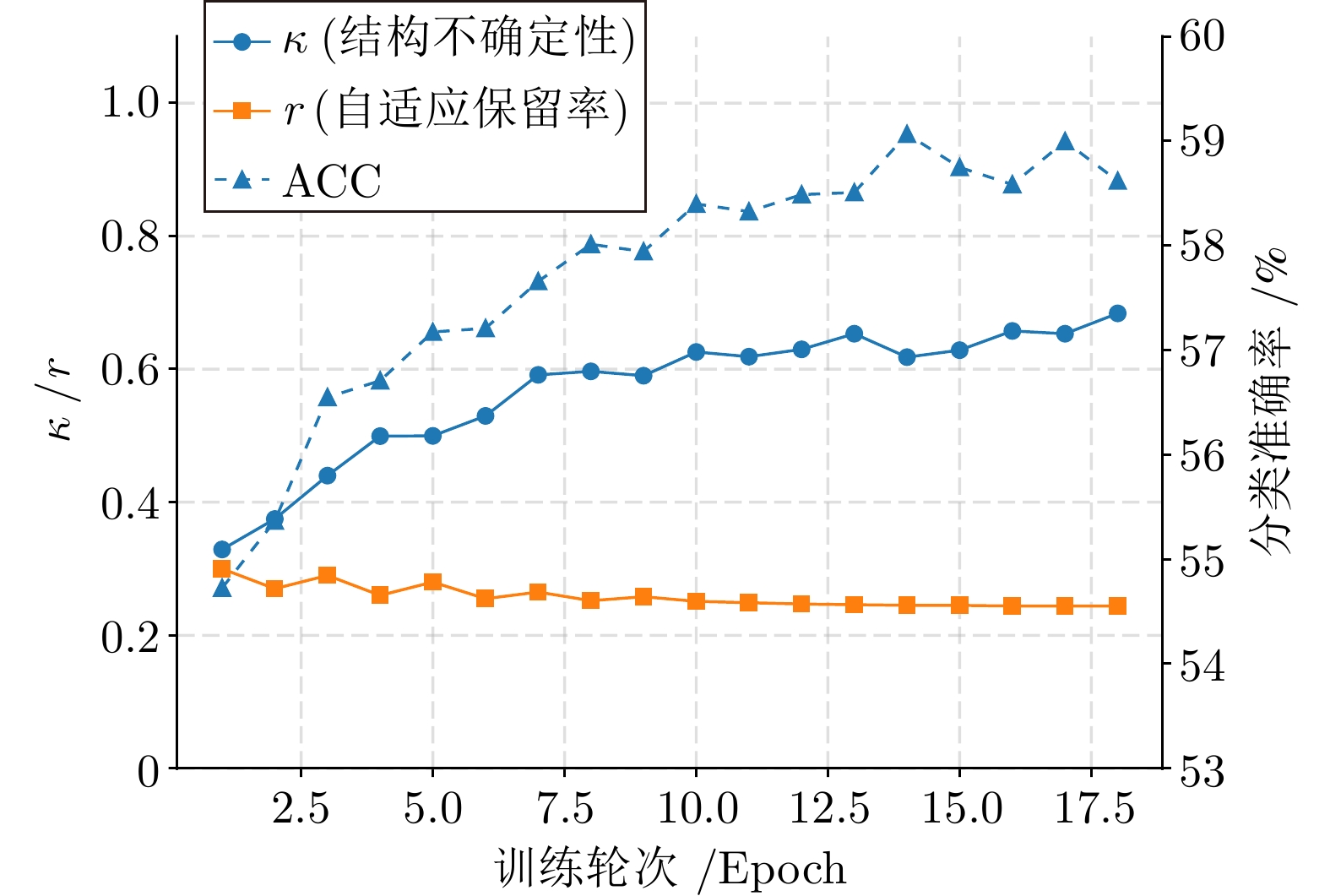
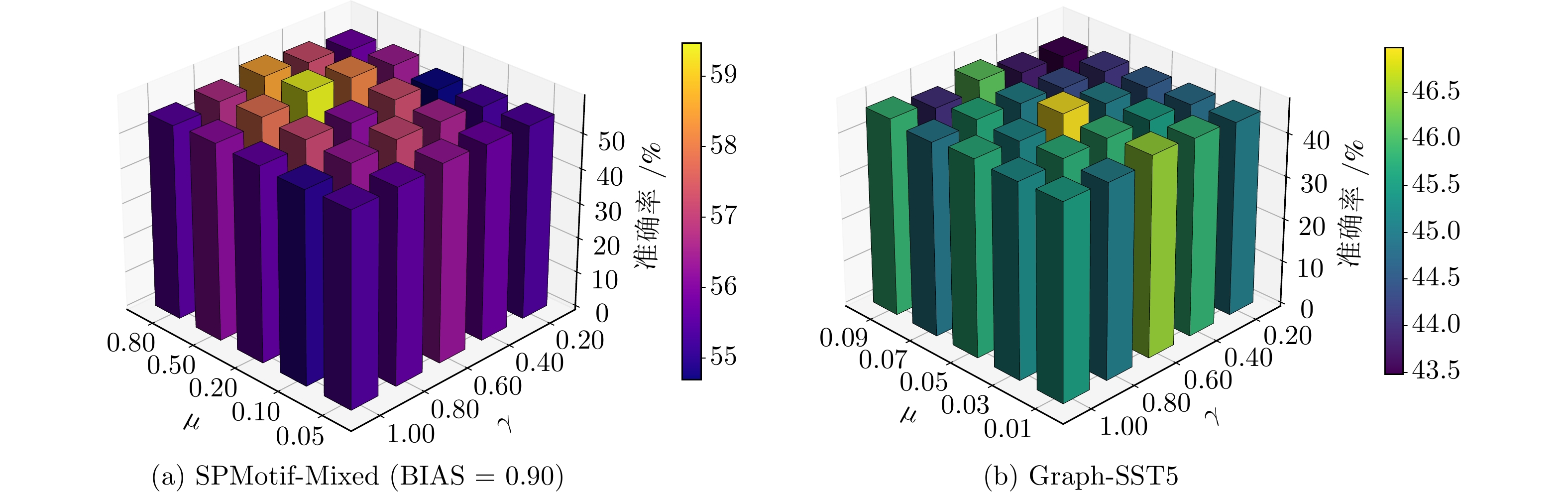
图 5 $ \kappa $、保留率与模型性能关系分析
Fig. 5 Relationship among $ \kappa $, retention rate and model performance
表 1 在合成数据集上的图分类结果
Table 1 Graph classification results on synthetic datasets
数据集 SPMOTIF-MIXED BIAS = 0.33 BIAS = 0.60 BIAS = 0.90 评价指标 ACC ERM $ 58.18 \pm 4.30 $ $ 49.29 \pm 8.17 $ $ 41.36 \pm 3.29 $ IRM $ 58.20 \pm 1.97 $ $ 49.29 \pm 3.67 $ $ 40.73 \pm 1.93 $ V-REX $ 57.82 \pm 5.93 $ $ 48.25 \pm 2.79 $ $ 43.27 \pm 1.32 $ SUGAR $ 70.27 \pm 4.18 $ $ 69.75 \pm 3.34 $ $ 50.42 \pm 4.58 $ DIR $ 67.28 \pm 4.06 $ $ 51.66 \pm 14.10 $ $ 38.58 \pm 5.88 $ GSAT $ 70.22 \pm 3.26 $ $ 69.65 \pm 4.23 $ $ 50.29 \pm 3.81 $ CIGA $ 72.42 \pm 4.80 $ $ 70.83 \pm 7.54 $ $ 54.25 \pm 5.38 $ IGM $ 70.47 \pm 3.66 $ $ 72.44 \pm 6.38 $ $ 49.53 \pm 4.29 $ EQuAD $ 73.06 \pm 3.58 $ $ 71.32 \pm 6.55 $ $ 53.68 \pm 3.74 $ PrunE $ 75.84 \pm 3.12 $ $ 72.61 \pm 4.03 $ $ 56.91 \pm 3.27 $ ASIG $ \mathbf{76.36}\pm\mathbf{2.49} $ $ \mathbf{74.17}\pm\mathbf{4.28} $ $ \mathbf{59.47}\pm\mathbf{3.62} $  下载: 导出CSV
表 2 OOD方法在真实世界图的复杂分布变化上的泛化性能
Table 2 Generalization performance of OOD methods under complex distribution shifts in real-world graphs
数据集 DRUG-ASSAY DRUG-SCA DRUG-SIZE CMNIST-SP GRAPH-SST5 评价指标 AUC ACC ERM $ 71.79 \pm 0.27 $ $ 68.85 \pm 0.62 $ $ 66.70 \pm 1.08 $ $ 13.96 \pm 5.48 $ $ 43.89 \pm 1.73 $ IRM $ 72.12 \pm 0.49 $ $ 68.69 \pm 0.65 $ $ 66.54 \pm 0.42 $ $ 31.58 \pm 9.52 $ $ 43.69 \pm 1.26 $ V-REX $ 72.05 \pm 1.25 $ $ 68.92 \pm 0.98 $ $ 66.33 \pm 0.74 $ $ 10.29 \pm 0.46 $ $ 43.28 \pm 0.52 $ SUGAR $ 71.84 \pm 0.55 $ $ 68.29 \pm 0.71 $ $ 66.51 \pm 0.91 $ $ 48.13 \pm 1.16 $ $ 44.72 \pm 1.57 $ DIR $ 68.25 \pm 1.40 $ $ 63.91 \pm 1.36 $ $ 60.40 \pm 1.42 $ $ 15.50 \pm 8.65 $ $ 41.12 \pm 1.96 $ GSAT $ 70.59 \pm 0.43 $ $ 66.45 \pm 0.50 $ $ 66.70 \pm 0.37 $ $ 43.38 \pm 5.44 $ $ 45.09 \pm 1.34 $ CIGA $ 73.17 \pm 0.39 $ $ 69.70 \pm 0.27 $ $ 67.78 \pm 0.76 $ $ 44.91 \pm 4.31 $ $ 45.25 \pm 1.27 $ IGM $ 73.07 \pm 0.89 $ $ 68.32 \pm 0.48 $ $ 67.99 \pm 1.26 $ $ 47.93 \pm 3.62 $ $ 43.79 \pm 1.49 $ EQuAD $ 72.98 \pm 0.32 $ $ 69.78 \pm 0.35 $ $ 68.06 \pm 0.18 $ $ 48.23 \pm 4.15 $ $ 44.76 \pm 0.89 $ PrunE $ 73.42 \pm 0.44 $ $ 70.15 \pm 0.79 $ $ 69.34 \pm 0.63 $ $ 49.82 \pm 3.41 $ $ 44.61 \pm 1.98 $ ASIG $ \mathbf{73.89} \pm\mathbf{0.51} $ $ \mathbf{71.46} \pm\mathbf{0.37} $ $ \mathbf{69.76} \pm\mathbf{0.43} $ $ \mathbf{51.61} \pm\mathbf{4.97} $ $ \mathbf{46.98} \pm\mathbf{1.58} $
下载: 导出CSV
表 3 损失函数消融对实验结果影响
Table 3 Impact of loss function ablation on experimental results
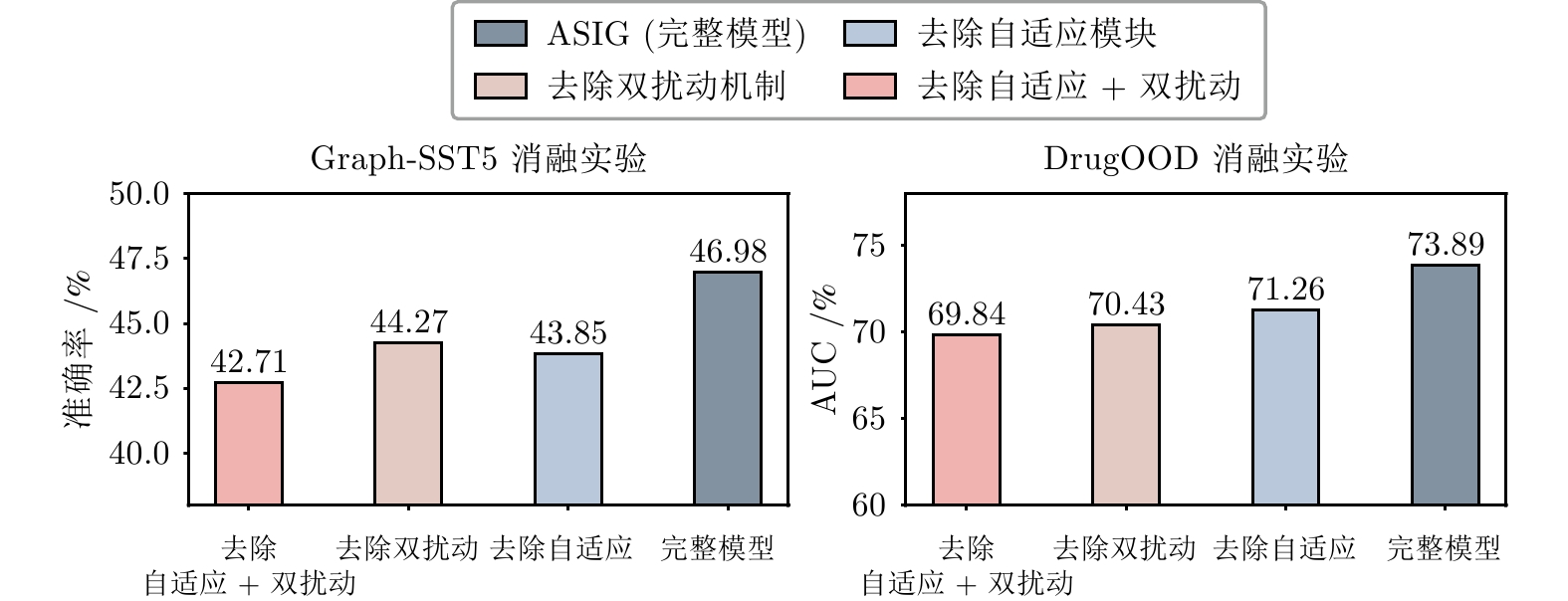
配置/数据集 Graph-SST5 DrugOOD 完整模型 46.98 73.89 去互信息损失 43.27 71.52 去对比一致性损失 41.06 69.83 去所有损失 39.45 68.21
下载: 导出CSV
表 4 自适应子图选择策略对比实验
Table 4 Comparison experiments of adaptive subgraph selection strategies
数据集/方法 Gumbel-Softmax Top-K ASIG SPMotif-Mixed (BIAS = 0.90) 56.39 59.47 DRUG-SIZE 67.83 69.76 Graph-SST5 43.57 46.98
下载: 导出CSV
-
[1] Kipf T N, Welling M. Semi-supervised classification with graph convolutional networks. In: Proceedings of the 5th International Conference on Learning Representations. Toulon, France: OpenReview.net, 2017. 1–14 [2] Wu F, Souza A, Zhang T Y, Fifty C, Yu T, Weinberger K. Simplifying graph convolutional networks. In: Proceedings of the 36th International Conference on Machine Learning. Long Beach, USA: PMLR, 2019. 6861–6871 [3] Hamilton W L, Ying Z T, Leskovec J. Inductive representation learning on large graphs. In: Proceedings of the 31st International Conference on Neural Information Processing Systems. Long Beach, USA: Curran Associates, Inc., 2017. 1025–1035 [4] Buterez D, Janet J P, Kiddle S J, Oglic D, Liò P. Transfer learning with graph neural networks for improved molecular property prediction in the multi-fidelity setting. Nature Communications, 2024, 15(1): Article No. 1517 doi: 10.1038/s41467-024-45566-8 [5] Ibrahim O A S, Younis E M G, Mohamed E A, Ismail W N. Revisiting recommender systems: An investigative survey. Neural Computing and Applications, 2025, 37(4): 2145−2173 doi: 10.1007/s00521-024-10828-5 [6] Li H Y, Wang X, Zhang Z W, Zhu W W. Out-of-distribution generalization on graphs: A survey. IEEE Transactions on Pattern Analysis and Machine Intelligence, 2025, 47(11): 10490−10512 doi: 10.1109/TPAMI.2025.3593897 [7] Arjovsky M, Bottou L, Gulrajani I, Lopez-Paz D. Invariant risk minimization. arXiv preprint arXiv: 1907.02893, 2019. [8] Krueger D, Caballero E, Jacobsen J H, Zhang A, Binas J, Zhang D H, et al. Out-of-distribution generalization via risk extrapolation (REx). In: Proceedings of the 38th International Conference on Machine Learning. Virtual Event: PMLR, 2021. 5815–5826 [9] Wu Y X, Wang X, Zhang A, He X N, Chua T S. Discovering invariant rationales for graph neural networks. arXiv preprint arXiv: 2201.12872, 2022. [10] Li H Y, Zhang Z W, Wang X, Zhu W W. Learning invariant graph representations for out-of-distribution generalization. In: Proceedings of the 36th International Conference on Neural Information Processing Systems. New Orleans, USA: Curran Associates, Inc., 2022. 11828–11841 [11] Jia T R, Li H Y, Yang C, Tao T, Shi C. Graph invariant learning with subgraph co-mixup for out-of-distribution generalization. In: Proceedings of the 38th AAAI Conference on Artificial Intelligence. Vancouver, Canada: AAAI Press, 2024. 8562–8570 [12] Miao S Q, Liu M, Li P. Interpretable and generalizable graph learning via stochastic attention mechanism. In: Proceedings of the 39th International Conference on Machine Learning. Baltimore, USA: PMLR, 2022. 15524–15543 [13] Chen Y Q, Zhang Y G, Bian Y T, Yang H, Ma K, Xie B H, et al. Learning causally invariant representations for out-of-distribution generalization on graphs. In: Proceedings of the 36th International Conference on Neural Information Processing Systems. New Orleans, USA: Curran Associates, Inc., 2022. 22131–22148 [14] Fan S H, Wang X, Mo Y H, Shi C, Tang J. Debiasing graph neural networks via learning disentangled causal substructure. In: Proceedings of the 36th International Conference on Neural Information Processing Systems. New Orleans, USA: Curran Associates, Inc., 2022. 24934–24946 [15] Li X E, Gui S R, Luo Y Z, Ji S W. Graph structure and feature extrapolation for out-of-distribution generalization. arXiv preprint arXiv: 2306.08076, 2023. [16] Guo K, Wen H Z, Jin W, Guo Y M, Tang J L, Chang Y. Investigating out-of-distribution generalization of GNNs: an architecture perspective. In: Proceedings of the 30th ACM SIGKDD Conference on Knowledge Discovery and Data Mining. New York, USA: Association for Computing Machinery, 2024. 932–943 [17] Zhu Y, Shi H Z, Zhang Z S, Tang S L. MARIO: Model agnostic recipe for improving OOD generalization of graph contrastive learning. In: Proceedings of the ACM Web Conference 2024. New York, USA: Association for Computing Machinery, 2024. 300–311 [18] Sadeghi A, Ma M, Li B C, Giannakis G B. Distributionally robust semi-supervised learning over graphs. arXiv preprint arXiv: 2110.10582, 2021. [19] Muandet K, Balduzzi D, Schölkopf B. Domain generalization via invariant feature representation. In: Proceedings of the 30th International Conference on Machine Learning. Atlanta, USA: PMLR, 2013. 10–18 [20] Sun Q Y, Peng H, Li J X, Wu J, Ning Y X, Yu P S, et al. SUGAR: Subgraph neural network with reinforcement pooling and self-supervised mutual information mechanism. In: Proceedings of The Web Conference 2021. Ljubljana, Slovenia: Association for Computing Machinery, 2021. 2081–2091 [21] Bengio Y, Deleu T, Rahaman N, Ke N R, Lachapelle S, Bilaniuk O, et al. A meta-transfer objective for learning to disentangle causal mechanisms. In: Proceedings of the 8th International Conference on Learning Representations. Addis Ababa, Ethiopia: OpenReview.net, 2020. 1–26 [22] Yuan H, Yu H Y, Gui S R, Ji S W. Explainability in graph neural networks: A taxonomic survey. IEEE Transactions on Pattern Analysis and Machine Intelligence, 2023, 45(5): 5782−5799 doi: 10.1109/tpami.2022.3204236 [23] Ji Y F, Zhang L, Wu J X, Wu B Z, Li L Q, Huang L K, et al. DrugOOD: Out-of-distribution dataset curator and benchmark for AI-aided drug discovery-A focus on affinity prediction problems with noise annotations. In: Proceedings of the 37th AAAI Conference on Artificial Intelligence. Washington, USA: AAAI Press, 2023. 8023–8031 [24] Vapnik V. The Nature of Statistical Learning Theory. New York: Springer-Verlag, 2013. [25] Yao T J, Chen Y Q, Chen Z H, Hu K, Shen Z Q, Zhang K. Empowering graph invariance learning with deep spurious infomax. In: Proceedings of the 41st International Conference on Machine Learning. Vienna, Austria: PMLR, 2024. 56860–56884 [26] Yao T J, Li H X, Chen Y Q, Liu T L, Song L, Xing E P, et al. Pruning spurious subgraphs for graph out-of-distribution generalization. In: Proceedings of the 39th International Conference on Neural Information Processing Systems. San Diego, USA: Curran Associates, Inc., 2025. 35960–35991 -

 下载:

计量
- 文章访问数: 13
- HTML全文浏览量: 9
- 被引次数: 0
