


Prediction of CO2 Emission Concentration of MSWI Process Driven by Mixed Virtual-real Data
-
摘要: CO2排放浓度动态预测是助力实现双碳战略的关键环节之一, 但城市固废焚烧(MSWI)过程受限于燃料与工况波动及数据噪声等多种因素, 传统数据驱动或机理驱动难以实现高精度建模. 针对该问题, 提出虚实数据混合驱动的CO2排放浓度预测方法. 首先, 依据CO2的产生机理特性通过耦合多软件构建数值仿真模型并结合双重正交实验获取虚拟机理数据; 然后, 在采用虚拟机理数据构建基于改进决策树的可解释主模型的基础上, 以真实过程数据为输入得到主模型残差数据后再采用区间三型模糊宽度学习系统构建残差补偿模型, 得到虚实驱动主补机制模型; 接着, 为捕获CO2排放的动态特性, 基于长短期神经网络构建真实数据驱动时序特性模型; 最后, 通过改进岭回归实现上述虚实模型输出的动态融合, 得到CO2排放浓度的预测结果. 基于北京某MSWI电厂实际数据验证了模型的有效性和合理性.Abstract: The dynamic prediction of CO2 emission concentration is one of the key links to help realize the dual carbon strategy. However, the municipal solid waste incineration (MSWI) process is limited by various factors such as fuel and working condition fluctuations and data noise, and it is difficult to achieve high-precision modeling by traditional data-driven or mechanism-driven. To solve this problem, this paper proposes a prediction method of CO2 emission concentration driven by mixed virtual-real data. Firstly, according to the characteristics of CO2 production mechanism, a numerical simulation model was constructed by coupling multi-software and the virtual mechanism data were obtained by double orthogonal experiment; Then, on the basis of the interpretable improved decision tree-based main model constructed by using the virtual mechanism data, the residual data of the main model was obtained by using real process data as input, and the residual compensation model was constructed by using interval type-3 fuzzy broad learning system to obtain the virtual-real driven main-complement mechanism model; Next, in order to capture the dynamic characteristics of CO2 emission, a real data-driven time series characteristic model was constructed based on long short-term neural network. Finally, the dynamic fusion of the above virtual-real model outputs was realized by improved ridge regression, and the prediction results of CO2 emission concentration were obtained. Based on the actual data of a MSWI power plant in Beijing, the validity and rationality of the model are verified.
-
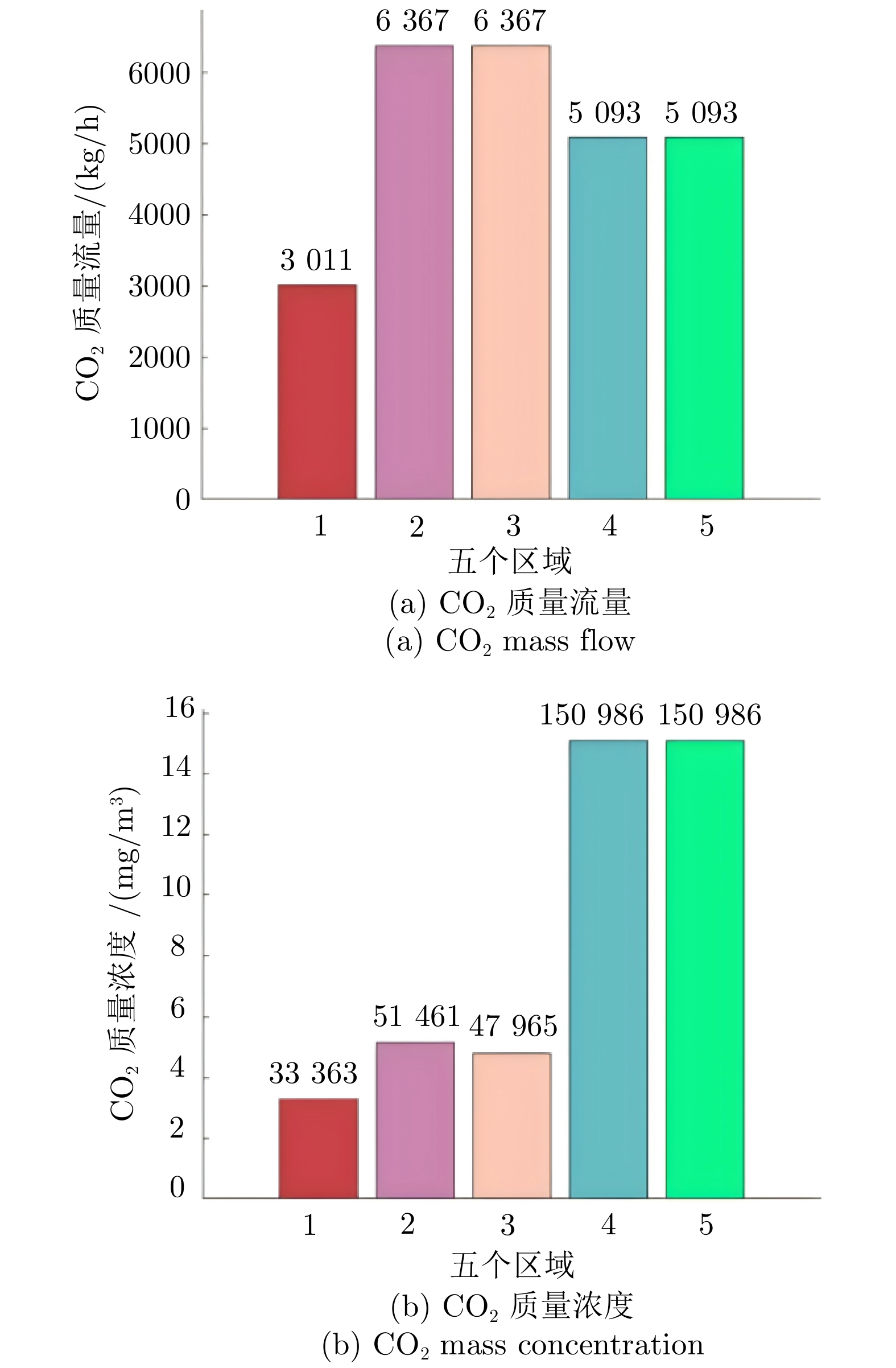
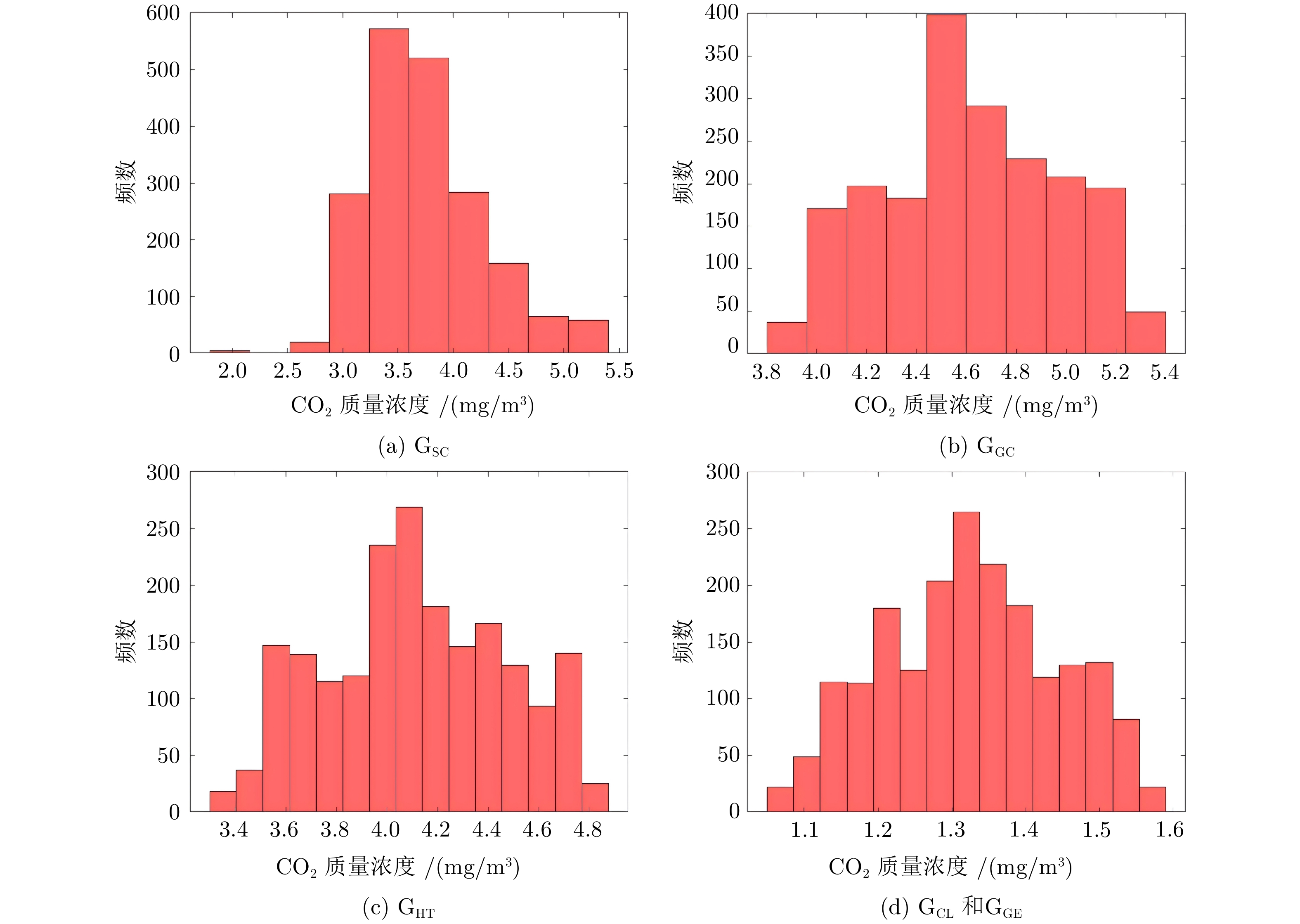
图 7 不同位置CO2质量浓度以及质量流量
Fig. 7 CO2 mass concentration and mass flow at different locations
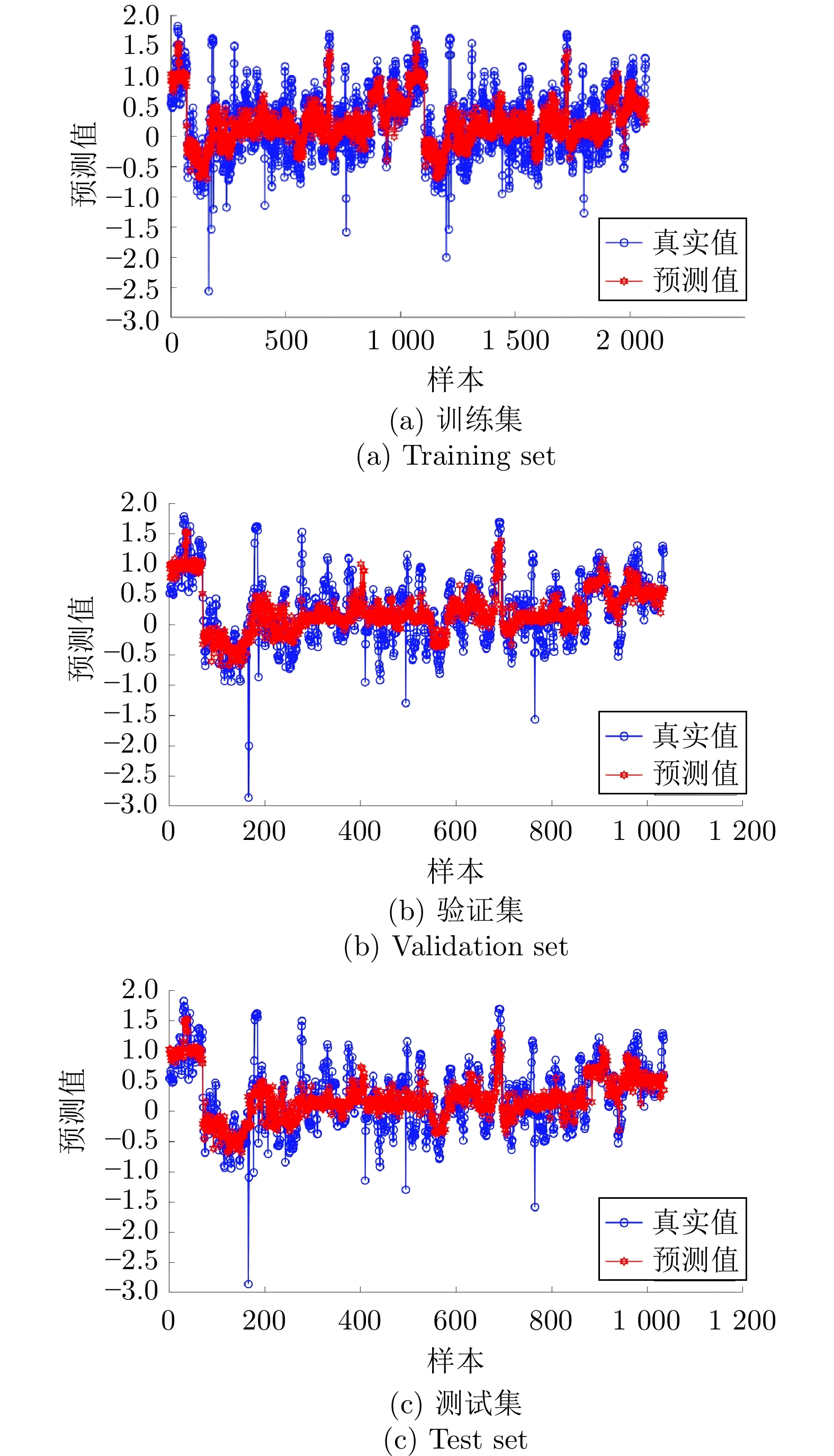
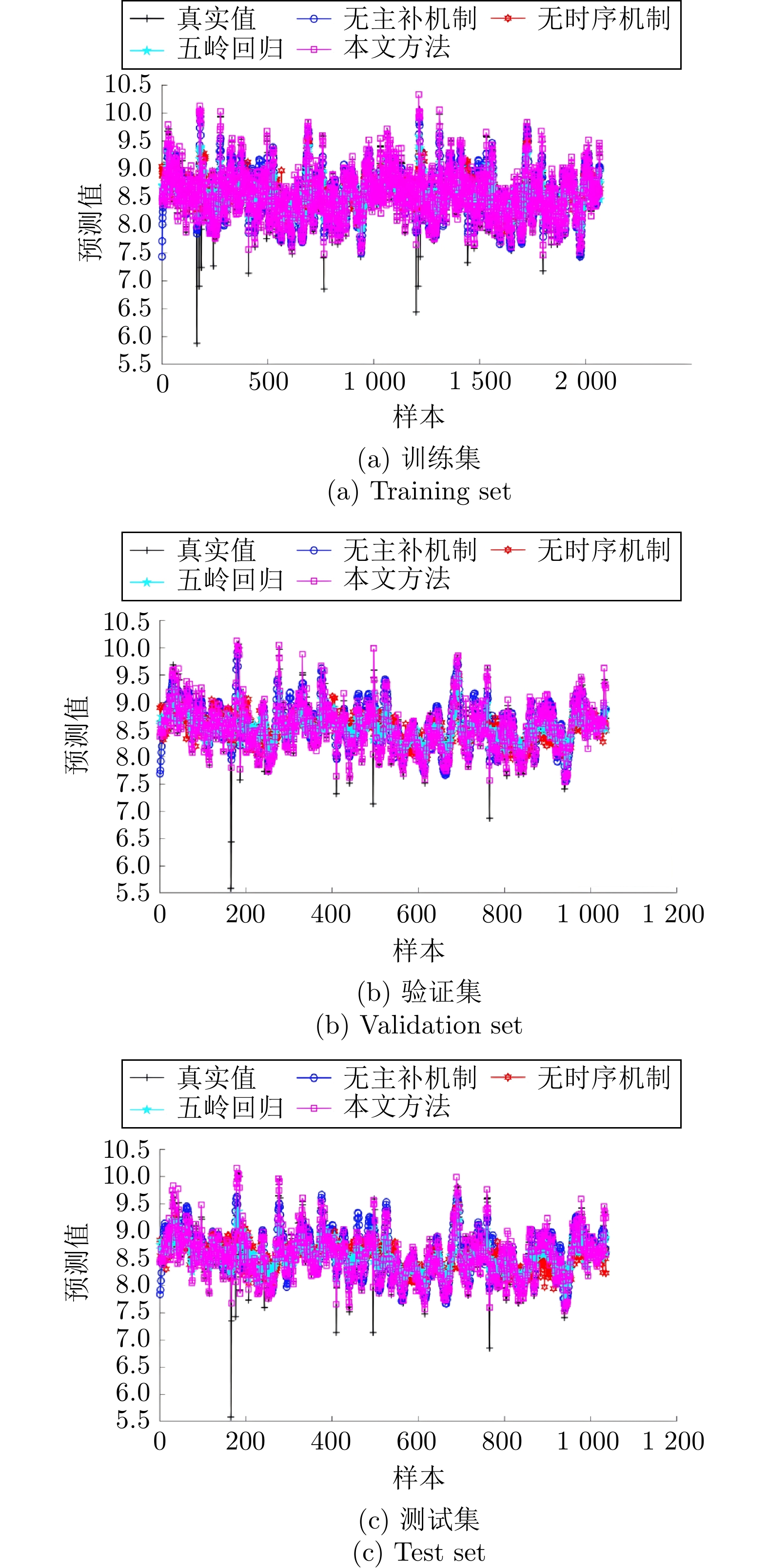
图 9 虚实驱动主补机制建模模块的拟合曲线
Fig. 9 The fitting curve of the virtual-real driven main-complement mechanism modeling module
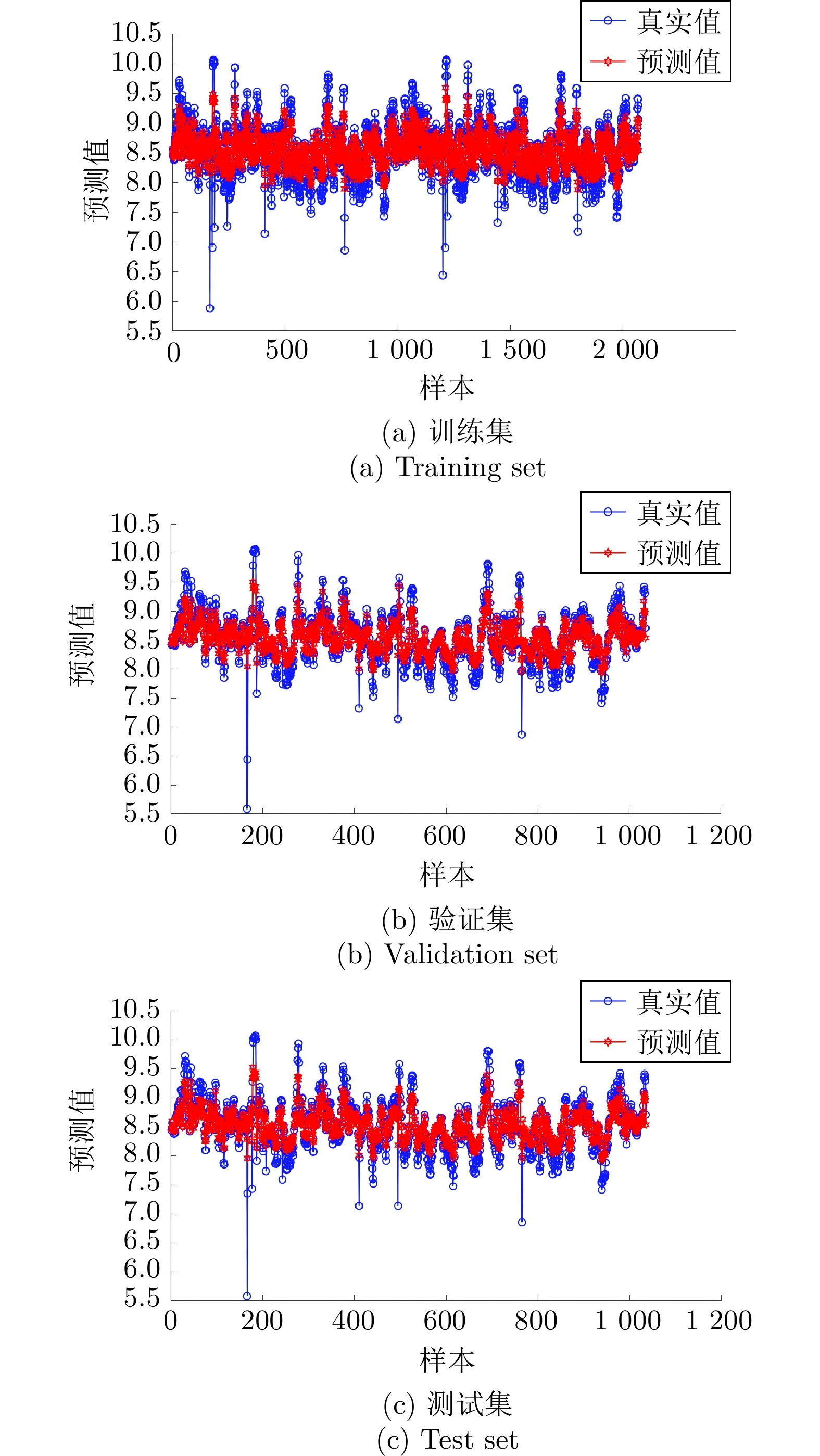
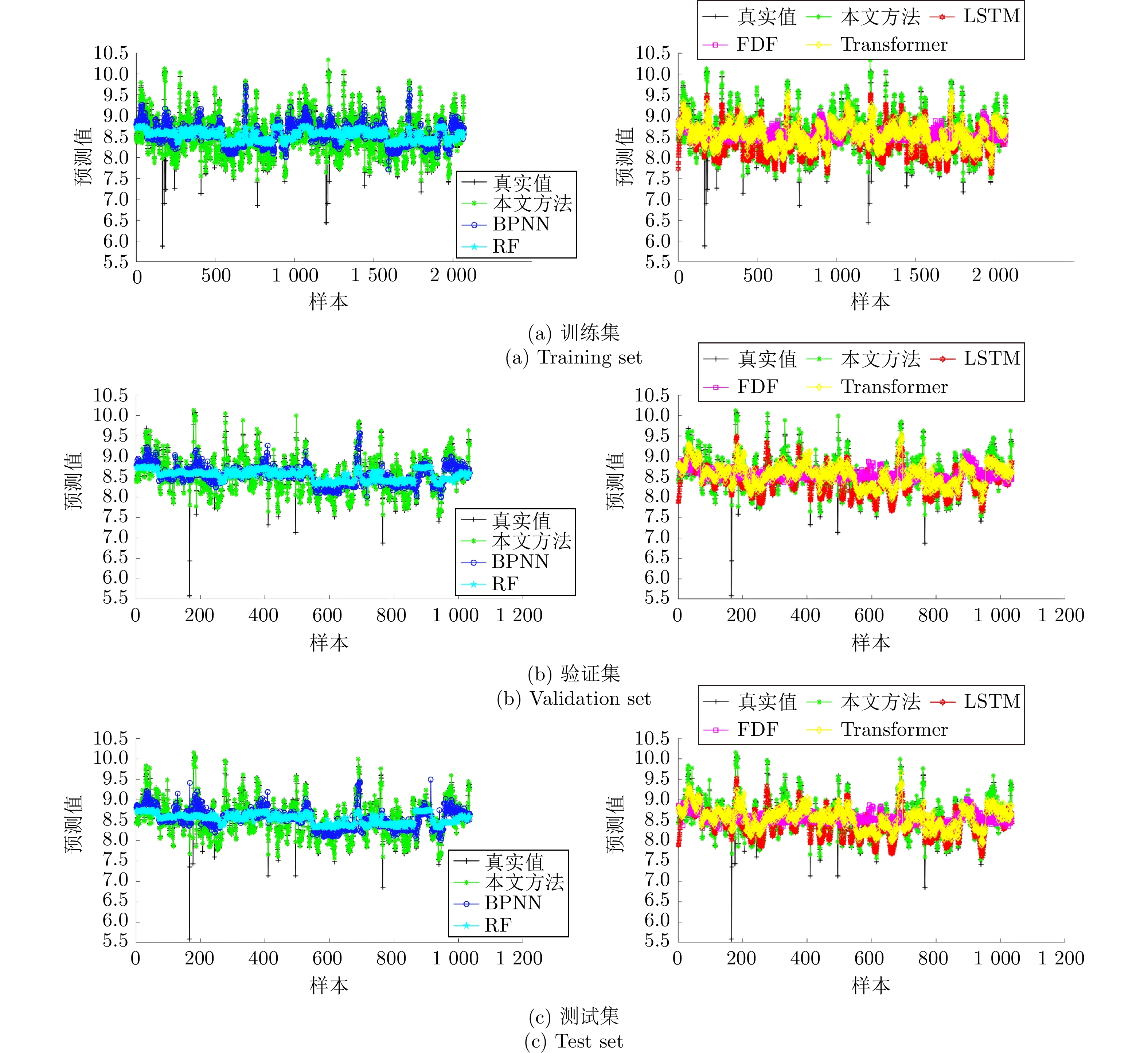
图 10 真实数据驱动时序特性建模模块的拟合曲线
Fig. 10 The fitting curve of the real data driven time series characteristic modeling module
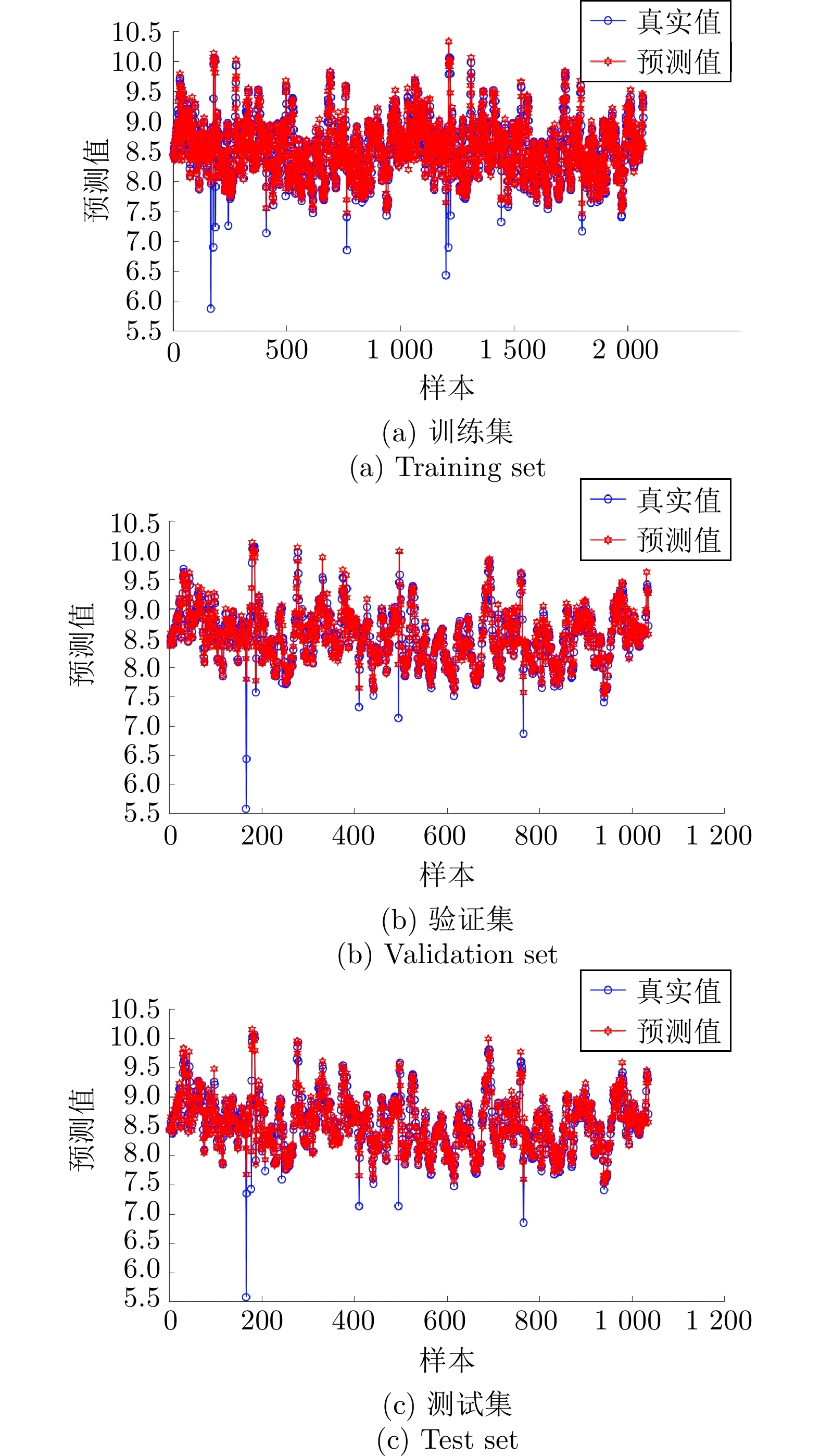
图 11 虚实输出动态融合模块的拟合曲线
Fig. 11 The fitting curve of the virtual-real output dynamic fusion module
表 1 焚烧炉的规格和基准工况运行参数表
Table 1 Specification and baseline operating condition parameter table of incinerators
参数 值 单位 额定处理量 800 t/d 实际处理量 624 t/d 炉排类型 往复式逆推 − 炉排长×宽 $11.0\times 12.9$ m 炉排速度 8 m/h 一次风量 65 400 Nm3/h 二次风量 7 500 Nm3/h 一次风温度 200 ℃ 一次风分布 24.31/43.35/19.27/13.07 −  下载: 导出CSV
表 2 MSW成分分析
Table 2 MSW component analysis
项目 值 单位 工业分析 水分M 49.70 % 固定碳FC 7.82 % 挥发分V 32.22 % 灰分ASH 10.26 % 元素分析 C 65.62 % H 8.09 % N 1.12 % Cl 0.09 % S 0.11 % O 24.93 %
下载: 导出CSV
表 4 输入Aspen Plus的气体组分
Table 4 Gas components input to Aspen Plus
气体组分 值(mol%) 气体组分 值(mol%) CH4 0.021 96 CO 0.021 04 CO2 0.078 78 O2 0.061 32 N2 0.564 90 H2O 0.355 80 H2 0.022 04 NO 0.032 32
下载: 导出CSV
表 5 正交实验参数信息
Table 5 Orthogonal experimental parameter information
10因素5水平 5因素5水平 参数 因素 单位 水平-1 水平-2 操纵变量 炉排速度 m/h 7.0, 7.5, 8.0, 8.5, 9.0 −0.1 给料量 t/h 24.2, 24.7, 25.2, 25.7, 26.2 +0.1 干燥段风量 Nm3/h 16 080, 16 440, 16 800, 17 160, 17 520 +1.8 燃烧1段风量 Nm3/h 28 620, 29 280, 29 940, 30 600, 31 260 +3.2 燃烧2段风量 Nm3/h 12 660, 12 960, 13 260, 13 560, 13 860 +1.4 燃烬段风量 Nm3/h 8 640, 8 820, 9 000, 9 180, 9 360 +1 微观参数 颗粒大小 mm 15, 20, 25, 30, 35 / 颗粒混合系数 / $2{\rm{e}}^{-6},\;3{\rm{e}}^{-6},\;4{\rm{e}}^{-6},\;5{\rm{e}}^{-6},\;6{\rm{e}}^{-6}$ / 组分参数 水分含量 % 48.00, 49.75, 51.50, 53.25, 55.00 / C : H : O比率 % (58.0 : 7.5 : 33.0), (59.0 : 7.5 : 32.0), (60.0 : 7.5 : 31.0), (61.0 : 7.5 : 30.0), (62.0 : 7.5 : 29.0) /
下载: 导出CSV
表 6 虚实驱动主补机制建模模块超参数设置
Table 6 Virtual-real driven main-complement mechanism modeling module hyperparameter setting
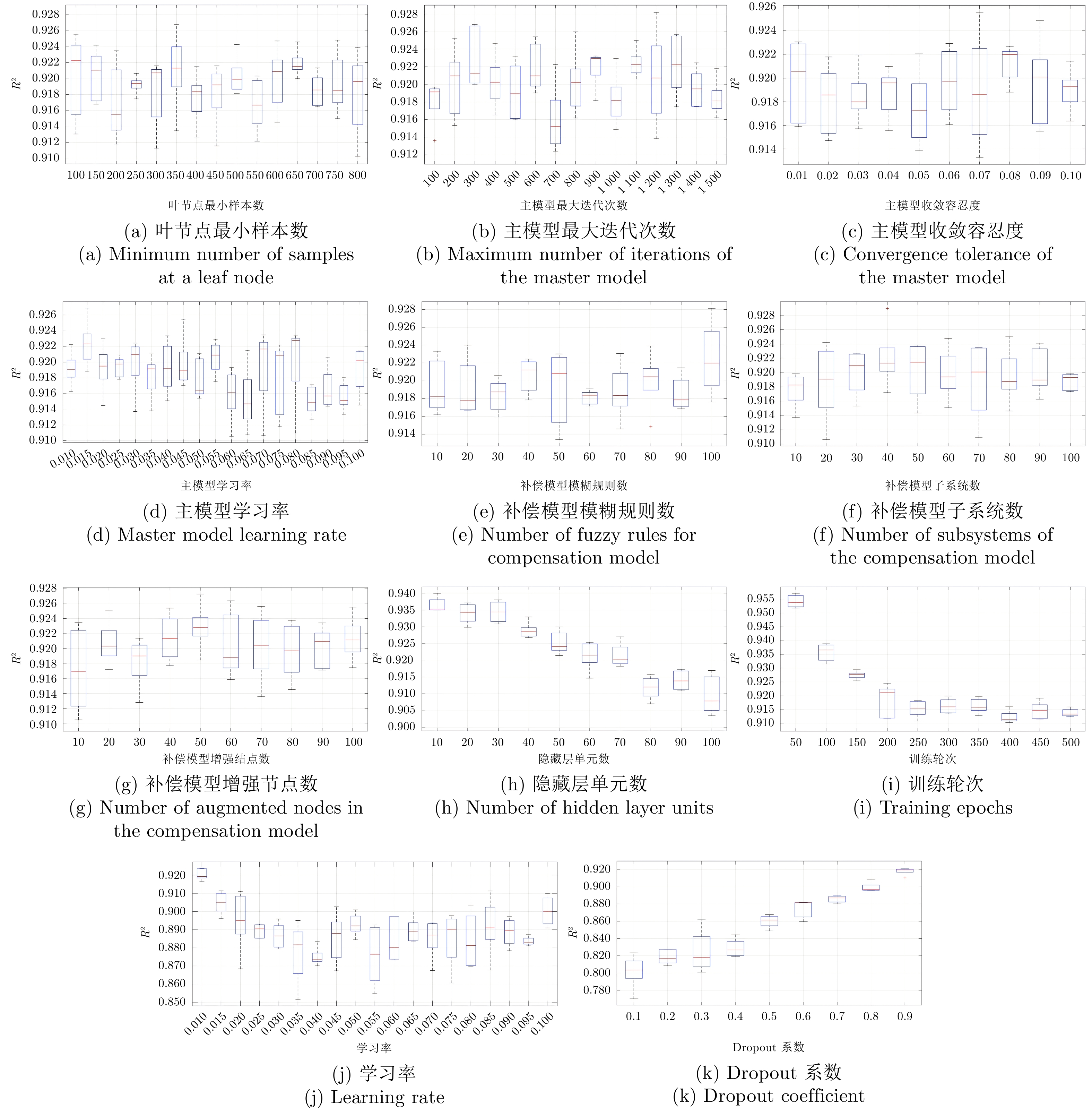
模型超参数 符号 取值 叶节点最小样本数 $N_{{\rm{samples}}}^{{\rm{Main}}}$ 400 主模型最大迭代次数 $N_{{\rm{iter}}}^{{\rm{Main}}}$ 1 000 主模型收敛容忍度 $N_{{\rm{tol}}}^{{\rm{Main}}}$ 0.01 主模型学习率 $N_{{\rm{learn}}}^{{\rm{Main}}}$ 0.02 补偿模型模糊规则数 $N_{{\rm{rule}}}^{{\rm{Com}}}$ 50 补偿模型子系统数 $N_{\mathrm{IT3FS}}^{{\rm{Com}}}$ 50 补偿模型增强节点数 $N_{{\rm{enh}}}^{{\rm{Com}}}$ 50
下载: 导出CSV
表 7 虚实驱动主补机制建模模块实验结果
Table 7 Experimental results of virtual-real driven main-complement mechanism modeling module
方法 数据集 RMSE MAE $R^2$ 平均值 方差 平均值 方差 平均值 方差 本文 训练集 0.402 0 $2.3{\rm{e}}{-}05$ 0.304 1 $2.7{\rm{e}}{-}05$ 0.455 2 $1.9{\rm{e}}{-}04$ 验证集 0.409 7 $1.2{\rm{e}}{-}04$ 0.313 7 $8.2{\rm{e}}{-}05$ 0.426 0 $9.5{\rm{e}}{-}04$ 测试集 0.408 9 $8.3{\rm{e}}{-}05$ 0.314 1 $8.3{\rm{e}}{-}05$ 0.430 2 $6.7{\rm{e}}{-}04$
下载: 导出CSV
表 8 真实数据驱动时序特性建模模块超参数设置
Table 8 Hyperparameter settings of real data driven time series characteristics modeling module
模型超参数 符号 取值 隐藏层单元数 $N_{{\rm{unit}}}^{{\rm{LSTM}}}$ 64 训练轮次 $N_{{\rm{epo}}}^{{\rm{LSTM}}}$ 300 学习率 $N_{{\rm{learn}}}^{{\rm{LSTM}}}$ 0.01 Dropout系数 $N_{{\rm{drop}}}^{{\rm{LSTM}}}$ 0.2
下载: 导出CSV
表 9 真实数据驱动时序特性建模模块实验结果
Table 9 Experimental results of real data driven time series characteristics modeling module
方法 数据集 RMSE MAE $R^2$ 平均值 方差 平均值 方差 平均值 方差 本文 训练集 0.213 2 4.5e-06 0.155 4 2.9e-06 0.784 7 1.7e-05 验证集 0.221 5 4.8e-06 0.156 0 3.4e-06 0.771 1 2.0e-05 测试集 0.218 9 4.8e-06 0.156 2 2.9e-06 0.776 2 2.0e-05
下载: 导出CSV
表 10 虚实输出动态融合模块实验结果
Table 10 Experimental results of virtual-real output dynamic fusion module
方法 数据集 RMSE MAE $R^2$ 平均值 方差 平均值 方差 平均值 方差 本文 训练集 0.109 1 1.760e-05 0.057 5 8.940e-06 0.943 5 1.840e-05 验证集 0.124 7 2.230e-05 0.061 1 1.062e-05 0.927 3 2.990e-05 测试集 0.120 5 1.823e-05 0.059 9 8.930e-06 0.932 0 2.250e-05
下载: 导出CSV
表 11 岭回归融合算法的分配权重
Table 11 Assigned weights for ridge regression fusion algorithm
分量 权重 主模型预测值 0.186 2 补偿模型预测值 0.152 7 炉排速度 0.012 3 热值 0.148 3 进料量 0.014 5 干燥段风量 −0.013 6 燃烧1段风量 0.042 1 燃烧2段风量 0.009 6 燃烬段风量 −0.008 4 一次风量 0.006 8 时序模型模型 0.424 9
下载: 导出CSV
表 12 对比实验统计结果
Table 12 Statistical results of the comparative experiment
方法 数据集 RMSE MAE $R^2$ 平均值 方差 平均值 方差 平均值 方差 BPNN 训练集 0.386 9 $7.560{\rm{e}}{-}06$ 0.293 9 $1.600{\rm{e}}{-}05$ 0.291 4 $1.000{\rm{e}}{-}04$ 验证集 0.397 2 $4.420{\rm{e}}{-}06$ 0.298 6 $2.840{\rm{e}}{-}06$ 0.263 7 $5.950{\rm{e}}{-}05$ 测试集 0.400 9 $4.070{\rm{e}}{-}05$ 0.302 3 $3.090{\rm{e}}{-}06$ 0.249 5 $5.770{\rm{e}}{-}04$ LSTM 训练集 0.262 5 $6.390{\rm{e}}{-}05$ 0.183 7 $4.770{\rm{e}}{-}05$ 0.673 3 $3.920{\rm{e}}{-}04$ 验证集 0.294 8 $5.790{\rm{e}}{-}04$ 0.212 3 $4.670{\rm{e}}{-}05$ 0.592 2 $4.580{\rm{e}}{-}03$ 测试集 0.289 7 $2.510{\rm{e}}{-}05$ 0.205 8 $1.840{\rm{e}}{-}04$ 0.607 1 $0.188{\rm{e}}{-}03$ RF 训练集 0.421 0 $6.250{\rm{e}}{-}06$ 0.321 4 $2.590{\rm{e}}{-}06$ 0.160 9 $9.700{\rm{e}}{-}05$ 验证集 0.426 1 $3.130{\rm{e}}{-}06$ 0.322 7 $1.340{\rm{e}}{-}06$ 0.153 1 $4.990{\rm{e}}{-}05$ 测试集 0.428 5 $3.970{\rm{e}}{-}06$ 0.324 2 $2.740{\rm{e}}{-}06$ 0.149 7 $1.080{\rm{e}}{-}04$ FDF 训练集 0.467 6 $2.850{\rm{e}}{-}04$ 0.361 9 $1.740{\rm{e}}{-}04$ $-$0.036 1 $5.620{\rm{e}}{-}03$ 验证集 0.469 8 $2.720{\rm{e}}{-}04$ 0.361 3 $1.720{\rm{e}}{-}04$ $-$0.030 6 $5.250{\rm{e}}{-}03$ 测试集 0.473 2 $2.650{\rm{e}}{-}04$ 0.364 6 $2.310{\rm{e}}{-}04$ $-$0.045 93 $5.120{\rm{e}}{-}03$ Transformer 训练集 0.343 5 $1.800{\rm{e}}{-}07$ 0.258 8 $8.000{\rm{e}}{-}08$ 0.441 4 $1.280{\rm{e}}{-}06$ 验证集 0.362 8 $7.200{\rm{e}}{-}06$ 0.269 3 $2.650{\rm{e}}{-}06$ 0.385 9 $8.450{\rm{e}}{-}05$ 测试集 0.354 9 $3.920{\rm{e}}{-}06$ 0.269 2 $8.000{\rm{e}}{-}08$ 0.412 1 $4.050{\rm{e}}{-}05$ 本文 训练集 0.109 1 $1.760{\rm{e}}{-}05$ 0.057 5 $8.940{\rm{e}}{-}06$ 0.943 5 $1.840{\rm{e}}{-}05$ 验证集 0.124 7 $2.230{\rm{e}}{-}05$ 0.061 1 $1.062{\rm{e}}{-}05$ 0.927 3 $2.990{\rm{e}}{-}05$ 测试集 0.120 5 $1.823{\rm{e}}{-}05$ 0.059 9 $8.930{\rm{e}}{-}06$ 0.932 0 $2.250{\rm{e}}{-}05$
下载: 导出CSV
表 13 消融实验结果
Table 13 Results of ablation experiments
方法 数据集 RMSE MAE $R^2$ 平均值 方差 平均值 方差 平均值 方差 无虚实驱动主补机制建模模块 训练集 0.199 7 $1.420{\rm{e}}{-}05$ 0.135 3 $9.260{\rm{e}}{-}06$ 0.811 1 $5.010{\rm{e}}{-}05$ 验证集 0.264 8 $8.160{\rm{e}}{-}05$ 0.187 0 $9.150{\rm{e}}{-}05$ 0.672 4 $5.110{\rm{e}}{-}04$ 测试集 0.275 4 $1.850{\rm{e}}{-}05$ 0.194 6 $8.450{\rm{e}}{-}05$ 0.645 8 $1.220{\rm{e}}{-}04$ 无真实数据驱动时序特性建模模块 训练集 0.385 3 $3.830{\rm{e}}{-}06$ 0.294 3 $6.500{\rm{e}}{-}06$ 0.297 0 $5.100{\rm{e}}{-}05$ 验证集 0.408 1 $2.380{\rm{e}}{-}05$ 0.316 9 $1.650{\rm{e}}{-}05$ 0.223 0 $3.440{\rm{e}}{-}04$ 测试集 0.407 6 $4.440{\rm{e}}{-}05$ 0.315 7 $4.650{\rm{e}}{-}05$ 0.225 9 $5.970{\rm{e}}{-}04$ 无真实输出动态融合模块 训练集 0.263 7 $1.460{\rm{e}}{-}05$ 0.196 7 $4.700{\rm{e}}{-}06$ 0.670 6 $9.070{\rm{e}}{-}05$ 验证集 0.274 8 $1.640{\rm{e}}{-}05$ 0.202 6 $1.090{\rm{e}}{-}05$ 0.648 4 $8.430{\rm{e}}{-}05$ 测试集 0.273 5 $3.420{\rm{e}}{-}05$ 0.202 6 $2.520{\rm{e}}{-}05$ 0.650 6 $2.240{\rm{e}}{-}04$ 本文 训练集 0.109 1 $1.760{\rm{e}}{-}05$ 0.057 5 $8.940{\rm{e}}{-}06$ 0.943 5 $1.840{\rm{e}}{-}05$ 验证集 0.124 7 $2.230{\rm{e}}{-}05$ 0.061 1 $1.062{\rm{e}}{-}05$ 0.927 3 $2.990{\rm{e}}{-}05$ 测试集 0.120 5 $1.823{\rm{e}}{-}05$ 0.059 9 $8.930{\rm{e}}{-}06$ 0.932 0 $2.250{\rm{e}}{-}05$
下载: 导出CSV
表 14 超参数分析区间设置
Table 14 Setting of hyperparameter analysis range
模型超参数 符号 范围 叶节点最小样本数 $N_{{\rm{samples}}}^{{\rm{Main}}}$ $[100,\;800]$ 主模型最大迭代次数 $N_{{\rm{iter}}}^{{\rm{Main}}}$ $[100,\; 1 500]$ 主模型收敛容忍度 $N_{{\rm{tol}}}^{{\rm{Main}}}$ $[0.01,\; 0.10]$ 主模型学习率 $N_{{\rm{learn}}}^{{\rm{Main}}}$ $[0.001,\; 0.100]$ 补偿模型模糊规则数 $N_{{\rm{rule}}}^{{\rm{Com}}}$ $[10,\;100]$ 补偿模型子系统数 $N_{\mathrm{IT3FS}}^{{\rm{Com}}}$ $[10,\;100]$ 补偿模型增强节点数 $N_{{\rm{enh}}}^{{\rm{Com}}}$ $[10,\;100]$ 隐藏层单元数 $N_{{\rm{unit}}}^{{\rm{LSTM}}}$ $[10,\;100]$ 训练轮次 $N_{{\rm{epo}}}^{{\rm{LSTM}}}$ $[50,\;500]$ 学习率 $N_{{\rm{learn}}}^{{\rm{LSTM}}}$ $[0.001,\; 0.100]$ Dropout系数 $N_{{\rm{drop}}}^{{\rm{LSTM}}}$ $[0.1,\; 1.0]$
下载: 导出CSV
A1 符号说明
A1 Symbolic description
符号 含义 $\xi _{\rm{GE}}$ 燃烧效率 $\gamma_{\rm{CO}}$ CO的浓度 $\gamma_{{\rm{CO}}_2}$ CO2的浓度 ϕ 床层空隙率 $V_{\rm{g}}$ 气体速度 $V_{\rm{s}}$ 固体颗粒速度 $V_{\rm{B}}$ 移动边界的速度 $S_{\rm{sg}}$ 固体转化为气体的转化速率 $S_{\rm{s}}$ 质量源项 $\rho_{\rm{g}}$ 气体的密度 $\rho_{\rm{sb}}$ 多孔介质的密度 $\rho_{\rm{s}}$ MSW的固体密度 $p_{\rm{g}}$ 气体压力 $F\left(v\right)$ 固体对流体流动的阻力 σ 床内的法向应力张量 τ 床内的切向应力张量 A 随机扰动 $H_{\rm{g}}$ 气体焓 $H_{\rm{s}}$ 固相焓 $T_{\rm{s}}$ 固体温度 $T_{\rm{g}}$ 气体温度 $Q_{\rm{h}}$ 气体的热损益 $Q_{\rm{sh}}$ 固相热源项 $q_{\rm{r}}$ 辐射热通量 $S_{\rm{a}}$ 颗粒表面积 $\dot{h}_{\rm{s}}$ 对流换热系数 $\lambda_{\rm{s}}$ 有效导热系数 $\lambda_{\rm{g}}$ 热分散系数 $\lambda_0$ 有效热扩散系数 $d_{\rm{p}}$ 颗粒直径 $C_{\rm{pg}}$ 混合气体的比热容 $R_{\rm{evp}}$ 水分蒸发反应速率 $H_{\rm{evp}}$ 固体水分蒸发热 $\dot{h}$ 固体和气体之间对流传质系数 $C_{\mathrm{w,\;s}}$ 固相中的水分浓度 $C_{\mathrm{w,\;g}}$ 气相中的水分浓度 $Q_{\rm{cr}}$ 对流换热和辐射换热固体吸收的热量 $\xi_{\rm{s}}$ 固体辐射率 $\sigma_{\rm{b}}$ 玻尔兹曼辐射常数 $T_{\rm{env}}$ 环境温度 $R_{\rm{v}}$ 挥发分反应速率 $v_\infty$ 挥发分的最终产率 v 挥发分在t时刻的释放量 $R_{\rm{g}}$ 通用气体常数 $A_{\rm{v}}$ 挥发分燃烧速率的指前因子 $E_{\rm{v}}$ 活化能 $C_{\rm{mix}}$ 经验常数 $C_{\left(\cdot\right)}$ 气态反应物的质量分数 $D_{\rm{g}}$ 气体的质量扩散系数 $R_{\rm{C}}$ 焦炭燃烧的反应速率 S 反应中的化学计量系数 $P_{{\rm{O}}_2}$ 氧的分压 $k_{\rm{r}}$ 化学动力学的速率常数 $k_{\rm{d}}$ 扩散引起的速率常数 $\mathrm{G_{SC}}$ 固相燃烧区的出口烟气 $\mathrm{G_{GC}}$ 气相燃烧区的出口烟气 $\mathrm{G_{HT}}$ 换热区的出口烟气 $\mathrm{G_{CL}}$ 烟气净化区的出口烟气 $\mathrm{G_{GE}}$ 烟气排放区的出口烟气 $x_{\rm{feed}}$ 给料量 $x_{\rm{speed}}$ 炉排速度 $x_{\mathrm{air1}}$ 干燥段风量 $x_{\mathrm{air2}}$ 燃烧1段风量 $x_{\mathrm{air3}}$ 燃烧2段风量 $x_{\mathrm{air4}}$ 燃烬段风量 $x_{\rm{particle}}$ 粒径 $x_{\rm{mix}}$ 颗粒混合系数 $x_{\rm{moisture}}$ 水分含量 $x_{\rm{other}}$ 其他变量 $D^{\rm{MD}}$ 虚拟机理数据 $X^{\rm{MD}}$ 虚拟机理数据特征 $y^{\rm{MD}}$ 虚拟机理数据目标值 $R_k^{\rm{Left}}\left(s\right)$ 第k个节点上使用分割阈值s形成的左子树 $R_k^{\rm{Right}}\left(s\right)$ 第k个节点上使用分割阈值s形成的右子树 $N_k^{\rm{Left}}$ 第k个节点上划分得到的左子树样本数量 $N_k^{\rm{Right}}$ 第k个节点上划分得到的右子树样本数量 $x_{k,\;J,\;m}^{\rm{Left}}$ 第k个节点上左子树中第J个样本中的第m个特征 $x_{k,\;J,\;m}^{\rm{Right}}$ 第k个节点上右子树中第J个样本中的第m个特征 $y_{k,\;J}^{\rm{Left}}$ 第k个节点上左子树中第J个样本的目标值 $y_{k,\;J}^{\rm{Right}}$ 第k个节点上右子树中第J个样本的目标值 $\Omega\left(s\right)$ 分割阈值s划分后的损失函数值 $\mu_k^{\rm{Left}}$ 第k个节点上左子树的目标值均值 $\mu_k^{\rm{Right}}$ 第k个节点上右子树的目标值均值 $R_k$ 子空间 $N_k$ 第k个子空间内的总样本数 $w_k^{\left(t\right)}$ 第t次迭代下第k个子空间内样本权重 λ 正则项系数 ${\bf{H}}_k^{\left(t\right)}$ 海森矩阵 $\nabla {\cal{L}}_k^{\left(t\right)}\left(w_k^{\left(t\right)}\right)$ 目标函数梯度 $\Delta w_k^{\left(t\right)}$ 权重变化量 $\Delta G_k^{\left(t\right)}$ 梯度变化量 $N_{\rm{tol}}^{\rm{Main}}$ 收敛容忍度 $I\left(\cdot\right)$ 指示函数 $e^{\rm{PD}}$ 主模型残差 $X^{\rm{PD}}$ 真实过程数据集输入特征 $N_{\rm{PD}}$ $X^{\rm{PD}}$的样本数量 $x_{n,\;M}^{\rm{PD}}$ $x_n^{\rm{PD}}$的第M个特征 $N_\mathrm{IT3FS}$ IT3FS子系统数量 $\overline{\mu}_{\tilde{A}_m^l|\mu _\delta =\overline{\alpha}_g}\left(x_{n,\;m}^{\rm{PD}}\right)$ 第m个输入特征在水平切片等级为$\overline{\alpha}_g$时模糊隶属函数$\tilde{A}_m^l$的上界 $\overline{\mu}_{\tilde{A}_m^l|\mu _\delta=\underline{\alpha}_g}\left(x_{n,\;m}^{\rm{PD}}\right)$ 第m个输入特征在水平切片等级为$\underline{\alpha}_g$时模糊隶属函数$\tilde{A}_m^l$的上界 $\underline{\mu}_{\tilde{A}_m^l|\mu _\delta=\overline{\alpha}_g}\left(x_{n,\;m}^{\rm{PD}}\right)$ 第m个输入特征在水平切片等级为$\overline{\alpha}_g$时模糊隶属函数$\tilde{A}_m^l$的下界 $\underline{\mu}_{\tilde{A}_m^l|\mu _\delta=\underline{\alpha}_g}\left(x_{n,\;m}^{\rm{PD}}\right)$ 第m个输入特征在水平切片等级为$\underline{\alpha}_g$时模糊隶属函数$\tilde{A}_m^l$的下界 $\left[\underline{\alpha_g},\;\overline{\alpha}_g\right]$ 二级隶属度的不确定性 $C_{\tilde{A}_m^l}$ 模糊隶属函数$\tilde{A}_m^l$的中心 $\underline{\sigma}_{V_m}$ 模糊隶属函数$\tilde{A}_m^l$的下宽度 $\overline{\sigma}_{V_m}$ 模糊隶属函数$\tilde{A}_m^l$的上宽度 $\underline{w}_l$ 第l条规则的后件参数 $W_{n}^{\rm{Enhan}}$ IT3FS层与增强层中第$n_{\rm{Enhan}}$个增强节点连接权值 $\beta_{n}^{\rm{Enhan}}$ IT3FS层与增强层中第$n_{\rm{Enhan}}$个增强节点偏置 $W_f$ IT3FS层和增强层与输出层之间的连接权值 $A^+$ 广义逆矩阵 E 模型真值 ${\boldsymbol{I}}$ 单位矩阵 $E_t$ t时刻的损失 $\hat{y}_\mathrm{Time,\;t}$ t时刻的预测值 $y_t^{\rm{PD}}$ t时刻的真值 $f_{\rm{min}}\left(\cdot\right)$ 最小值 $f_{\rm{max}}\left(\cdot\right)$ 最大值 a 标准化下限 b 标准化上限 $f_t$ t时刻遗忘门的过程值 $g_t$ t时刻遗忘门的输出值 σ sigmoid函数 $w^{fx}$ 遗忘门对应的权重 $W^{\rm{fh}}$ 遗忘门对应的权重 $b^f$ 遗忘门对应的偏置 $\odot$ 哈达玛积 $i_t$ t时刻输入门的过程值 $\hat{c}_t$ t时刻单元状态更新值 $\tanh$ tanh函数 $w^{ix}$ 输入门对应的权重 $W^{\rm{ih}}$ 输入门对应的权重 $b^i$ 输入门对应的偏置 $w^{cx}$ 单元更新状态对应的权重 $W^{ch}$ 单元更新状态对应的权重 $b^c$ 单元更新状态对应的偏置 $o_t$ t时刻输出门的过程值 $w^{ox}$ 输出门对应的权重 $W^{oh}$ 输出门对应的权重 $b^o$ 输出门对应的偏置 ${\boldsymbol{v}}^{\rm{T}}$ 输出层的权重 $b_v$ 输出层的偏置 $\eta^{\left(t\right)}$ 动态更新学习率 $e^{\left(t\right)}$ 预测误差 $N_{\rm{learn}}^{\rm{Main}}$ 主模型学习率 $N_{\rm{rule}}^{\rm{Com}}$ 模糊规则数 $N_{\rm{enh}}^{\rm{Com}}$ 增强节点数 $N_{\rm{unit}}^{\rm{LSTM}}$ LSTM隐藏单元数 $N_{\rm{epo}}^{\rm{LSTM}}$ LSTM训练轮次 $N_{\rm{learn}}^{\rm{LSTM}}$ LSTM学习率 $N_{\rm{drop}}^{\rm{LSTM}}$ LSTM的dropout参数 $\hat{y}$ 模型预测值 $M_{\rm{LHV}}$ MSW低位热值 $M_{\rm{C}}$ MSW中C的质量分数 $M_{\rm{H}}$ MSW中H的质量分数 $M_{\rm{O}}$ MSW中O的质量分数 $\bar{V}_{\rm{Process}}^{\rm{Ori}}$ 炉排速度均值 $V_{\rm{Process}}^{\rm{Ori}}$ 炉排速度样本实际值 $V_{\rm{Process}}^{\rm{Trans}}$ 单位统一转换后的炉排速度 $C_Q$ CO2的质量浓度 $m_{\rm{gas}}$ CO2的质量流量 $V_{\rm{total}}$ 混合烟气的总体积流量 $C_{\rm{V}}$ CO2的体积分数
下载: 导出CSV
B1 缩写词及其含义
B1 Abbreviations and their meanings
缩写词 中文全称 英文全称 MSWI 城市固废焚烧 Municipal solid waste incineration IT3FBLS 区间三型模糊宽度学习系统 Interval type-3 fuzzy broad learning system LSTM 长短期神经网络 Long short-term memory MSW 城市固废 Municipal solid waste CO2 二氧化碳 Carbon dioxide DD DD Data-driven XGBoost 极限梯度提升 Extreme gradient boosting ARIMA 自回归积分滑动平均模型 Autoregressive integrated moving average FLIC 床层固废燃烧模拟软件 Fluid dynamic incinerator code Aspen Plus 过程工程先进系统 Advanced system for process engineering plus Catboost 分类提升 Categorical boosting MD 机理驱动 Mechanism-driven DXN 二噁英 Dioxin CE 燃烧效率 Combustion efficiency GS 炉排速度 Grate speed FC 给料量 Feeding capacity PA 一次风量 Primary airflow LHV 低位热值 Lower heat value BPNN 反向传播神经网络 Back propagation neural network RF 随机森林 Random forest FDF 模糊决策森林 Fuzzy decision forest GBDT 梯度提升决策树 Gradient boosting decision tree
下载: 导出CSV
-
[1] 汤健, 王天峥, 孙明俊, 等. 城市固废焚烧过程AI安全赋能智慧化发展与展望[J/OL]. 控制工程, 2026, 1-28Tang Jian, Wang Tian-Zheng, Sun Ming-Jun, et al. Review of AI Technology Research on End-edge-cloud Collaborative Safety Empowerment for Municipal Solid Waste Incineration. Control Engineering of China, 2026, 1-28. [2] Kammen D M, Sunter D A. City-integrated renewable energy for urban sustainability. Science, 2016, 352(6288): 922−928 doi: 10.1126/science.aad9302 [3] 汤健, 夏恒, 余文, 乔俊飞. 城市固废焚烧过程智能优化控制研究现状与展望. 自动化学报, 2023, 49(10): 2019−2059 doi: 10.16383/j.aas.c220810Tang Jian, Xia Heng, Yu Wen, Qiao Jun-Fei. Research Status and Prospects of Intelligent Optimization Control for Municipal Solid Waste Incineration Process. Acta Automatica Sinica, 2023, 49(10): 2019−2059 doi: 10.16383/j.aas.c220810 [4] Xia H, Tang J, Aljerf L, Cui C L, Gao B Y, Ukaogo P O. Dioxin emission modeling using feature selection and simplified DFR with residual error fitting for the grate-based MSWI process. Waste Management, 2023, 168: 256−271 doi: 10.1016/j.wasman.2023.05.056 [5] Gao X D, Zhang K, Ji D Q, Ma H M, Meng Y, Jiang S, Tian W, Tang Y H, He L, Liu C H, Lau H C, Chen Z X. A proposed layout of CO2 capture utilization and storage for coal fired power plants in China. Fuel, 2025, 401: 135723 doi: 10.1016/j.fuel.2025.135723 [6] Cao Y P, Mirzaliev S, Hamza F, Gulzar F, Ming J. Financing sustainable energy: Cost-benefit analysis of CO2 reduction in China. Energy Strategy Reviews, 2025, 58: 101667 doi: 10.1016/j.esr.2025.101667 [7] 柴天佑, 钱锋, 管晓宏, 等. 面向双碳目标的自动化和智能化理论与技术. 中国科学基金, 2024, 38(04): 560−570 doi: 10.16262/j.cnki.1000-8217.2024.04.003Chai Tian-You, Qian Feng, Guan Xiao-Hong, et al. Theory and Technology of Automation and Intelligence for Dual Carbon Target. Bulletin of National Natural Science Foundation of China, 2024, 38(04): 560−570 doi: 10.16262/j.cnki.1000-8217.2024.04.003 [8] Taheri S, Razban A. Learning-based CO2 concentration prediction: Application to indoor air quality control using demand-controlled ventilation. Building and Environment, 2021, 205: 108164 doi: 10.1016/j.buildenv.2021.108164 [9] Pan S Y, Shi X D, Dong B B, et al. Multivariate time series prediction for CO2 concentration and flowrate of flue gas from biomass-fired power plants. Fuel, 2024, 359: 130344 doi: 10.1016/j.fuel.2023.130344 [10] Kumar S. A novel hybrid machine learning model for prediction of CO2 using socio-economic and energy attributes for climate change monitoring and mitigation policies. Ecological Informatics, 2023, 77: 102253 doi: 10.1016/j.ecoinf.2023.102253 [11] Zhang Y T, Pakrashi A, Dev S. Multi-regional CO2 emission forecasting using advanced machine learning and temporal feature engineering. Environmental Modelling & Software, 2026, 195: 106728 doi: 10.1016/j.envsoft.2025.106728 [12] Ge Y D, Zhang R, Wang Z, Yan B B, Tao J Y, Song Y J, Mu L, Su H, Chen G Y. Optimization of Gompertz model with machine learning towards applicable and accurate simulation of anaerobic digestion. Energy, 2025, 333: 137395 doi: 10.1016/j.energy.2025.137395 [13] Yan M, Hui S C, Jiang N, Li Ni. A review on data-driven prognostics and health management for wind turbine systems. Engineering Applications of Artificial Intelligence, 2025, 159: 111484 doi: 10.1016/j.engappai.2025.111484 [14] Zhang Y T, Pakrashi A, Dev S. Multi-regional CO2 emission forecasting using advanced machine learning and temporal feature engineering. Environmental Modelling & Software, 2025106728 [15] Zhou G L, Mao L N, Bao T W, Zhuang F P. Machine learning-driven CO2 emission forecasting for light-duty vehicles in China. Transportation Research Part D: Transport and Environment, 2024, 137: 104502 doi: 10.1016/j.trd.2024.104502 [16] Wen T X, Liu Y Z, Bai Y, Liu H Y. Modeling and forecasting CO2 emissions in China and its regions using a novel ARIMA-LSTM model. Heliyon, 2023, 9(11): e21241 doi: 10.1016/j.heliyon.2023.e21241 [17] Li Y, Shi K, Zhu M Y, Li H Y, Guo Y L, Miao S, Ou W, Zheng Z B. Data-driven models for forecasting algal biomass in a large and deep reservoir. Water Research, 2025, 270. [18] Wyper P, Antiochos S, DeVore C. A universal model for solar eruptions. Nature, 2017, 544: 452−455 doi: 10.1038/nature22050 [19] 阳春华, 孙备, 李勇刚, 等. 复杂生产流程协同优化与智能控制. 自动化学报, 2023, 49(03): 528−539 doi: 10.16383/j.aas.c220737Yang Chun-Hua, Sun Bei, Li Yong-Gang, Huang Ke-Ke, Gui Wei-Hua. Cooperative optimization and intelligent control of complex production processes. Acta Automatica Sinica, 2023, 49(03): 528−539 doi: 10.16383/j.aas.c220737 [20] Dang H, Xu R S, Zhang J L, Wang M Y, Zhang J Y. Interaction mechanism and kinetic modeling of anthracite and power plant biomass waste during CO2 co-gasification process. Energy, 2025, 325: 136115 doi: 10.1016/j.energy.2025.136115 [21] Shafeeyan M S, Daud W M W, Shamiri A. A review of mathematical modeling of fixed-bed columns for carbon dioxide adsorption. Chemical Engineering Research and Design, 2014, 92(5): 961−988 doi: 10.1016/j.cherd.2013.08.018 [22] Wang A, Rish S K, Jenkins D R, Tahmasebi A. Mechanism of metallurgical coke gasification in CO2 and H2O using a reaction-diffusion model. Chemical Engineering Journal, 2025, 512: 162471 doi: 10.1016/j.cej.2025.162471 [23] Cen X, Hong B Y, Yang Y X, Wu Z, Zhao Z H, Yang J. A high-precision and interpretable prediction method of the gas-solid erosion rate in elbows based on hybrid mechanism-data-driven models. Measurement, 2025, 251: 117251 doi: 10.1016/j.measurement.2025.117251 [24] Zhang Y A, Yan G W, Xiao S Y, Wang F, Zhao G J, Ma S X. Mechanism- and data-driven based dynamic hybrid modeling for multi-condition processes. Chemometrics and Intelligent Laboratory Systems, 2025, 260: 105353 doi: 10.1016/j.chemolab.2025.105353 [25] Shen W H, Hu X J, Liu J L, Li S J, Wang H D. A pre-trained multi-step prediction informer for ship motion prediction with a mechanism-data dual-driven framework. Engineering Applications of Artificial Intelligence, 2025, 139: 109523 doi: 10.1016/j.engappai.2024.109523 [26] Liang M Y, Zheng Y, Li S Y. Towards hybrid modeling with mechanistic and real-time data embed iterative co-optimization for industrial processes. Journal of Process Control, 2025, 155: 103567 doi: 10.1016/j.jprocont.2025.103567 [27] Wang X L, Cao J F, Cao Y. A hybrid mechanism modeling and data-driven method for energy prediction and optimization for a class of industrial robots. Measurement, 2026, 258: 119227 doi: 10.1016/j.measurement.2025.119227 [28] Yan Z Q, Chu Z J, Hui J Z, Donald H, Lv J X, Xu Z G. Prediction, assessment and optimization of energy consumption in selective laser melting using hybrid mechanism-based and data-driven approaches. Measurement, 2026, 257: 118895 doi: 10.1016/j.measurement.2025.118895 [29] Zhu F L, Zhu O, Han M Y, Liu W F, Guo X N, Hou T T, Zhao L Q, Xu C J, Zhong P A. A hybrid process-data driven framework for real-time hydrological forecasting with interpretable deep learning. Journal of Hydrology, 2025, 662: 134082 doi: 10.1016/j.jhydrol.2025.134082 [30] Pu J C, Chun W D, Yang H. Low carbon strategy and coordination for a two-echelon automotive supply chain considering dual credit policy. Computers & Industrial Engineering, 2024, 192. [31] Liu Y, Wang J L. Spatiotemporal patterns and drivers of carbon emissions from municipal solid waste treatment in China. Waste Management, 2023, 168. [32] Zhang S R, Jiang X G, Lv G J, Liu B X, Jin Y Q, Yan J H. SO2, NOx, HF, HCl and PCDD/Fs emissions during Co-combustion of bituminous coal and pickling sludge in a drop tube furnace. Fuel, 2016, 186: 91−99 doi: 10.1016/j.fuel.2016.08.061 [33] Chen J K, Tang J, Xia H, Yu W, Qiao J F. Modelling the furnace temperature field of a municipal solid waste incinerator using the numerical simulation and the deep forest regression algorithm. Fuel, 2023, 347. [34] Wehrung Q, Pastero L, Bernasconi D, Cotellucci A, Bruno M, Cavagna S, Destefanis E, Caviglia C, Pavese A. Impact of Operational Parameters on the CO2 Absorption Rate in Ca(OH)2 Aqueous Carbonation-Implications for Process Efficiency. Energy & Fuels, 2024, 38(17): 16678−16691 [35] Hosokai S, Matsuoka K, Kuramoto K, Suzuki Y. Modification of Dulong's formula to estimate heating value of gas, liquid and solid fuels. Fuel Process Technol, 2016, 152: 399−405 doi: 10.1016/j.fuproc.2016.06.040 [36] T/CAEPI 47-2022. 固定污染源二氧化碳排放连续监测系统技术要求. 中国环境保护产业协会, 2022. -

 下载:
下载:


计量
- 文章访问数: 99
- HTML全文浏览量: 95
- 被引次数: 0
