


A Survey of Foundation Models for Wearable Biosignals: Modeling Paradigms and Adaptation Algorithms
-
摘要: 可穿戴生理信号被视为人体生理与行为的“数字语言”, 在多种临床与健康监测环境中蕴含丰富的诊断与预后价值. 近年来, 基础模型的快速发展从根本上重塑了可穿戴生理信号建模范式, 并在多种下游任务中取得了显著性能提升. 此类方法通过大规模数据预训练或针对目标任务的高效微调, 学习具备跨任务、跨模态泛化能力的表征, 使其能够在心电图、脑电图、惯性测量单元、光体积描记等多模态可穿戴生理信号分析任务中实现有效迁移. 尽管已有综述分别从医学影像、通用时间序列或生理序列数据层面对基础模型展开讨论, 但在方法论范式层面仍缺乏深入剖析, 即基础模型为何能够在可穿戴生理序列任务中发挥作用, 以及其背后如何实现有效提升. 为弥补这一空白, 以方法论范式为核心的分类视角, 对可穿戴生理信号基础模型的关键组成要素进行系统化、全景式梳理, 包括基础模型的演化、模型架构、预训练范式、适配范式、数据模态以及应用场景等. 此外, 选取不同预训练范式, 并在脑电图、心电图、惯性测量单元以及眼电图四类数据集上开展大规模实验, 系统地分析了不同预训练策略对可穿戴信号的优势与不足. 总体而言, 该综述旨在整合可穿戴生理信号基础模型的最新研究进展, 强调其理论基础、方法创新以及关键挑战, 为相关人员提供系统的参考框架与发展指引. 相关代码已公开于:
https://github.com/Learning-FM/BioFM .Abstract: Wearable physiological signals are regarded as the “digital language’’ of human physiology and behavior, carrying rich diagnostic and prognostic value across clinical and health-monitoring scenarios. In recent years, the rapid advancement of foundational models has fundamentally reshaped the modeling paradigm of wearable physiological signals and has led to notable performance improvements across a wide range of downstream tasks. These methods rely on large-scale pre-training or task-specific efficient fine- tuning to learn representations with strong cross-task and cross-modal generalization capability, enabling effective transfer to data. Although existing reviews have examined foundational models from the perspectives of medical imaging, general time-series analysis, or physiological data modeling, they lack in-depth methodological analysis, specifically, why foundational models are effective for wearable physiological signal tasks and how such performance improvements are achieved. To address this gap, this survey adopts a methodology-centered classification perspective and systematically organizes the key components of wearable physiological foundational models, including model evolution, architectural design, pre-training paradigms, adaptation paradigms, data modalities, and application scenarios. Furthermore, we conduct large-scale experiments using representative pre-training paradigms across four categories of datasets-electroencephalogram, electrocardiogram, inertial measurement unit, and electrooculogram-to analyze the strengths and limitations of different pre-training strategies for wearable signals. Overall, this survey consolidates the latest progress in foundational models for wearable physiological signals, highlighting their theoretical foundations, methodological innovations, and key challenges, thereby providing a structured reference framework for future research and development. The related code is available at:https://github.com/Learning-FM/BioFM . -
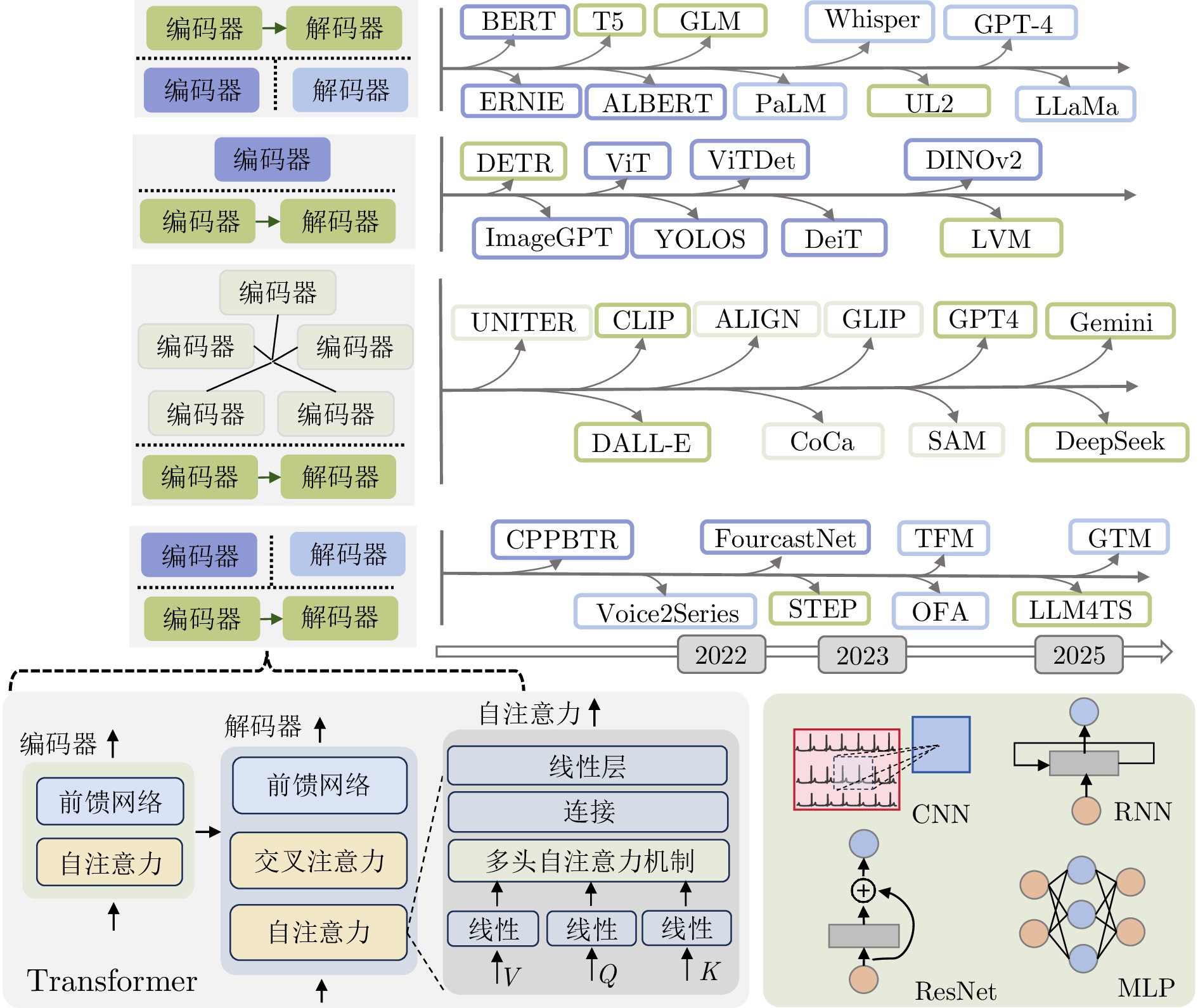
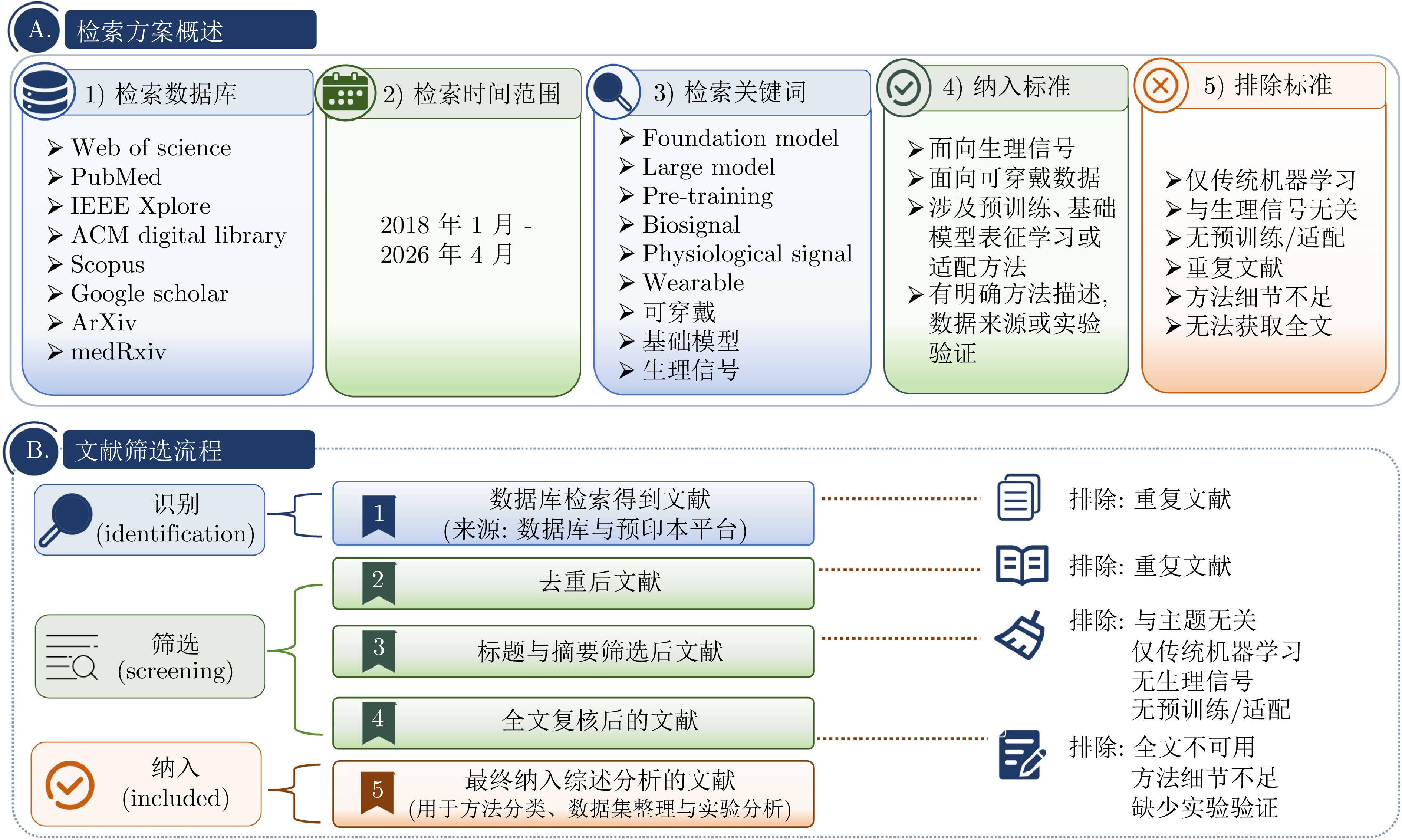
图 2 基础模型的架构及演变轨迹
Fig. 2 Architectures and evolutionary trajectories of foundation models
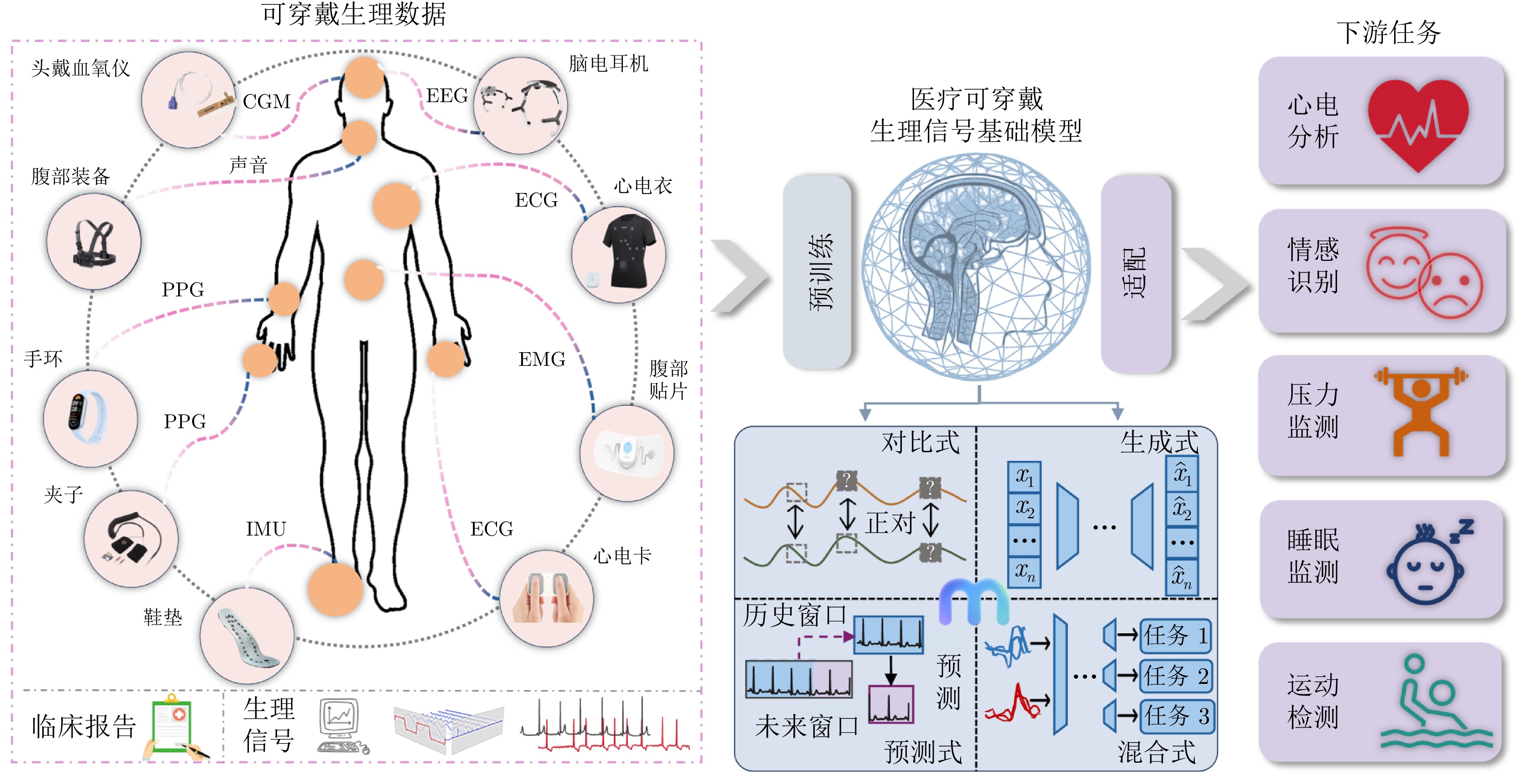
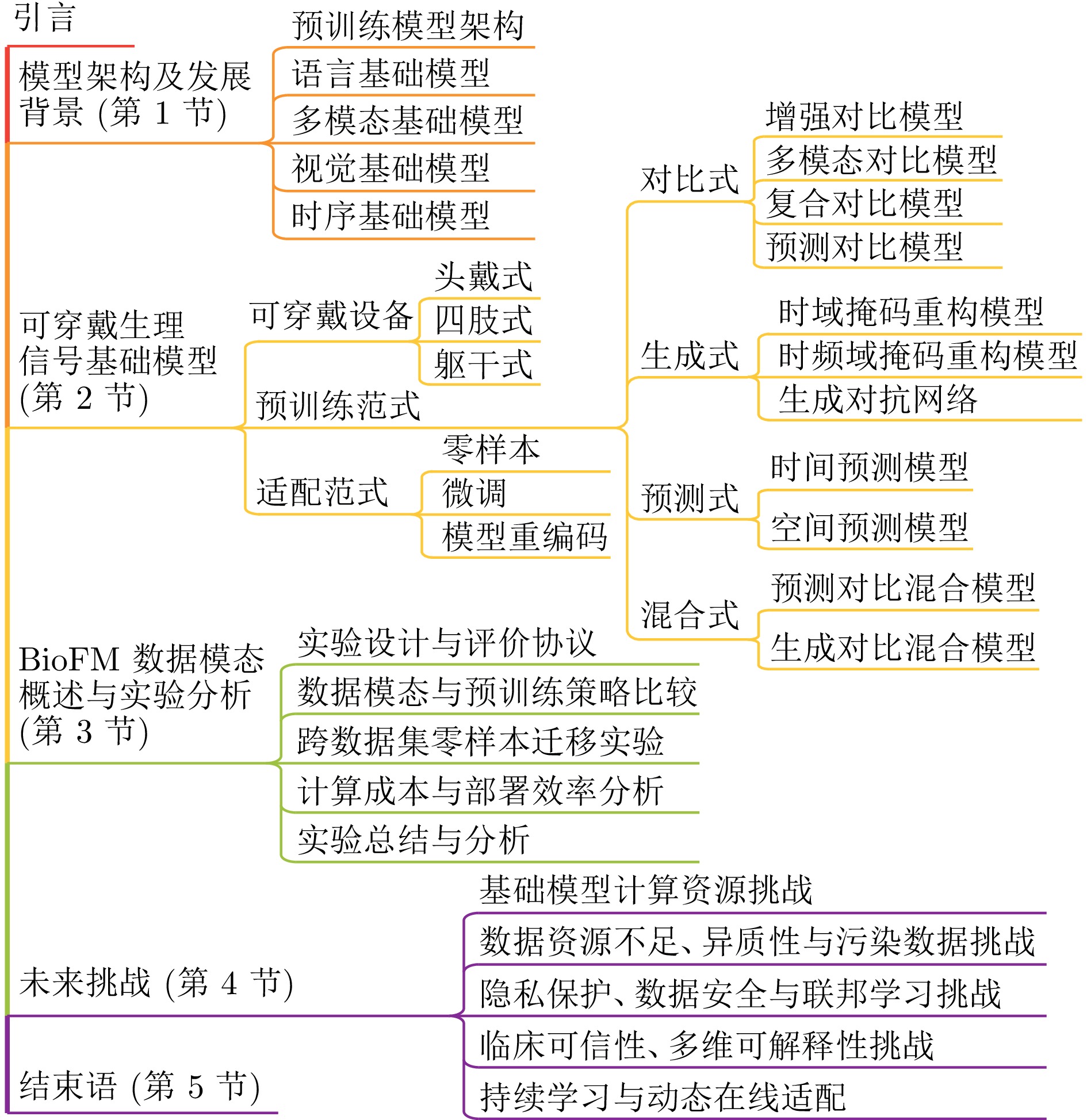
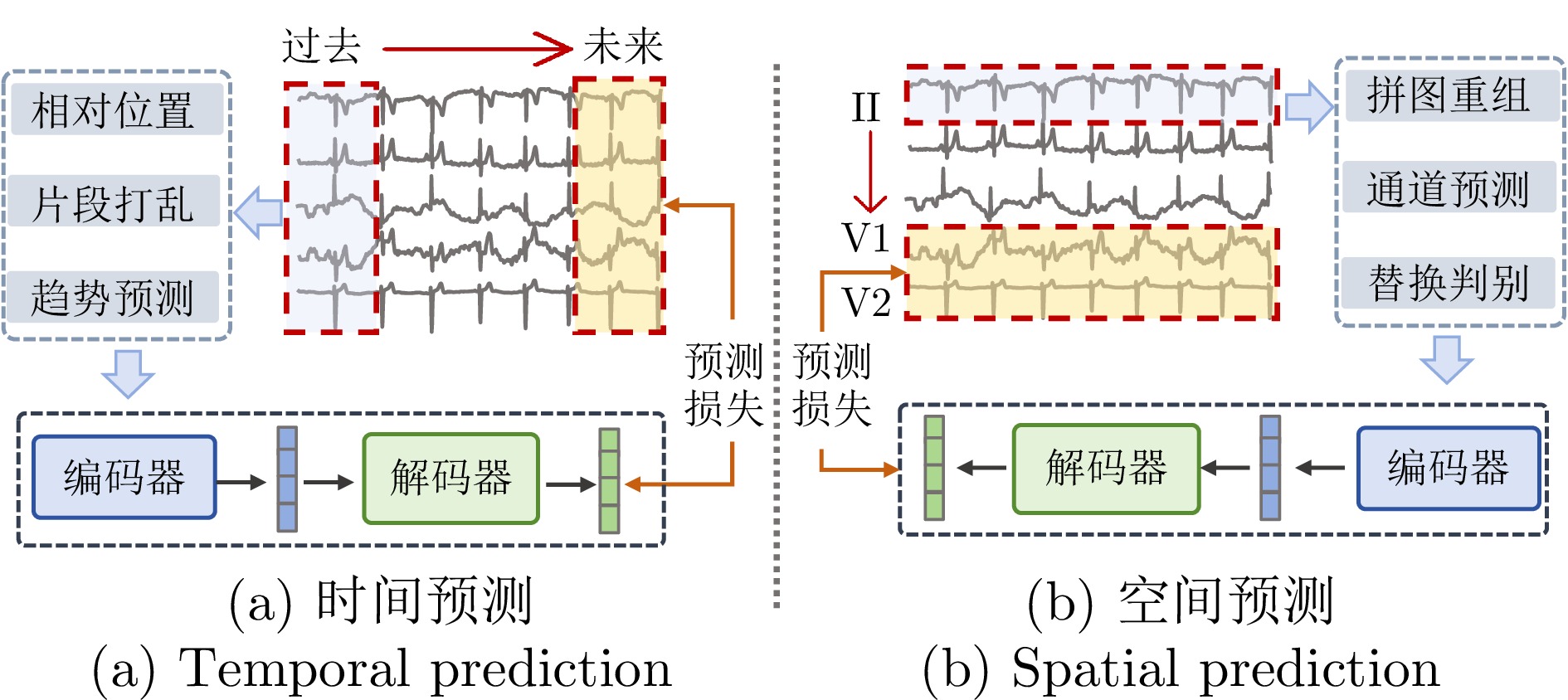
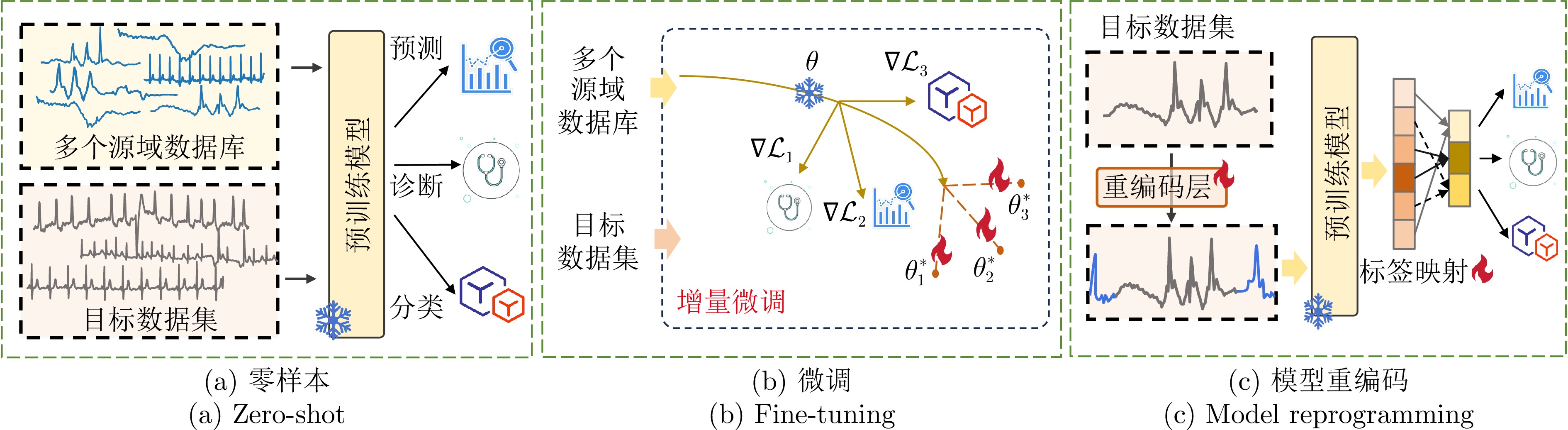
图 4 可穿戴生理信号基础模型概述图
Fig. 4 Overview diagram of foundation models for wearable biosignals
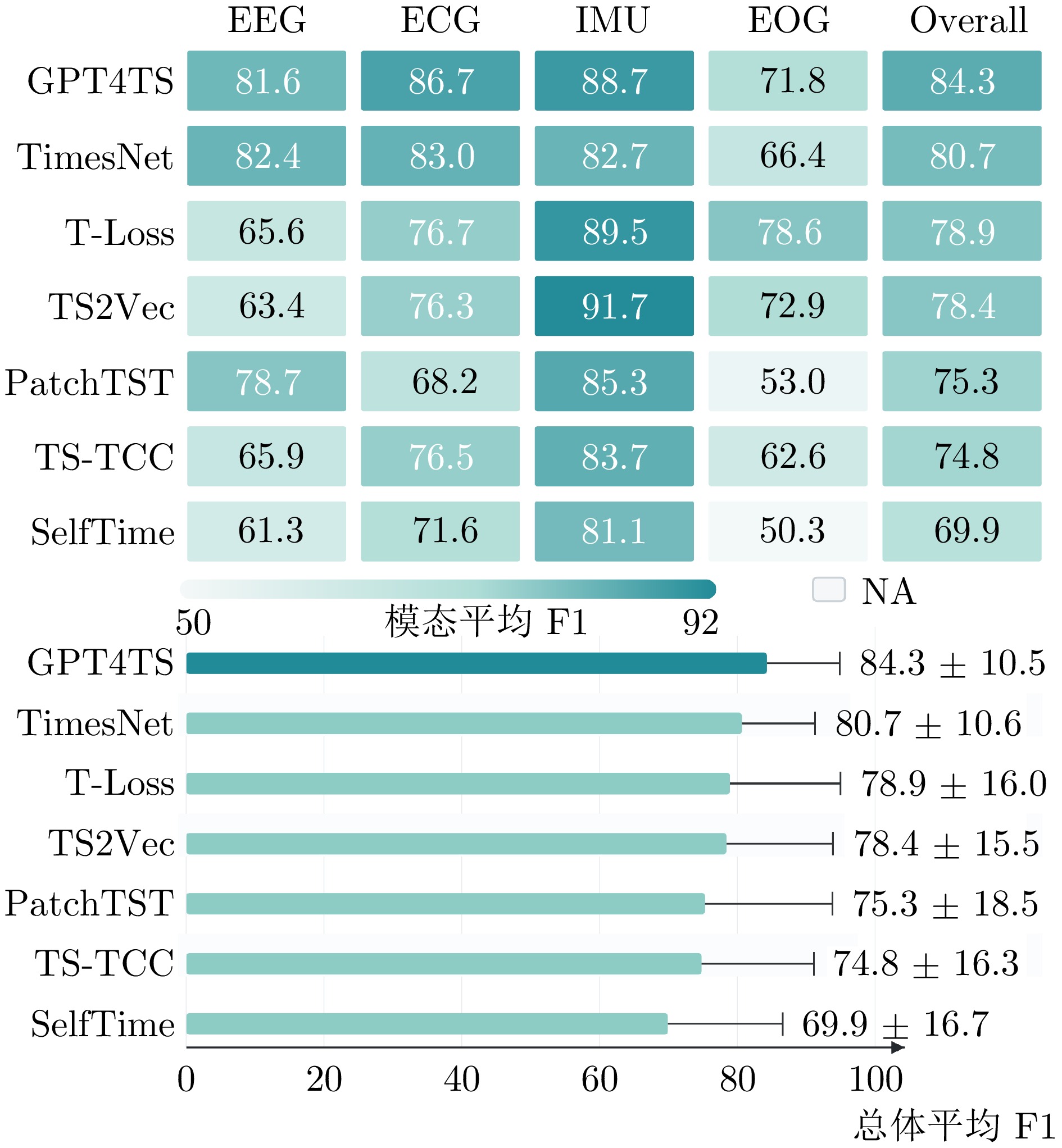
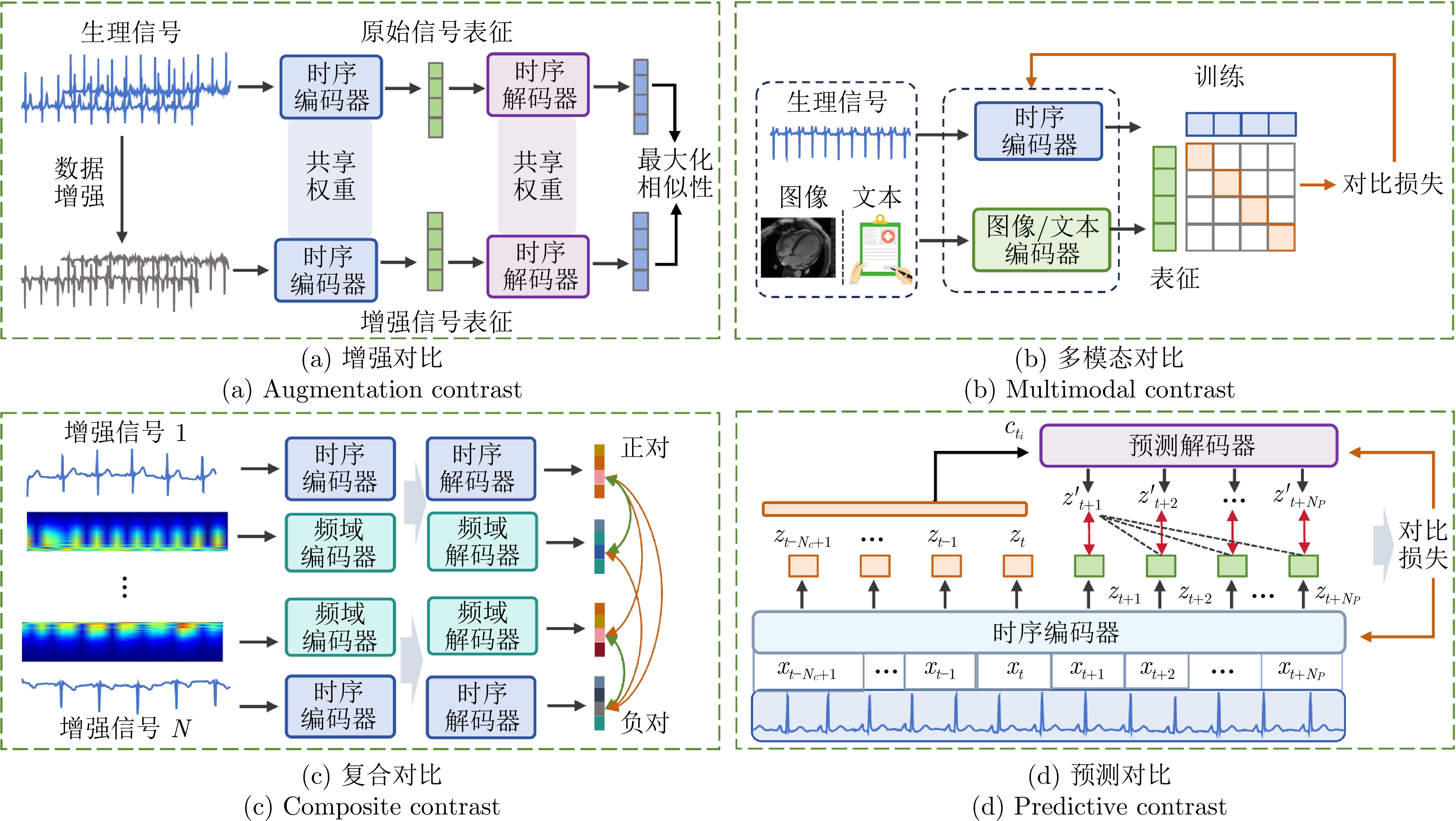
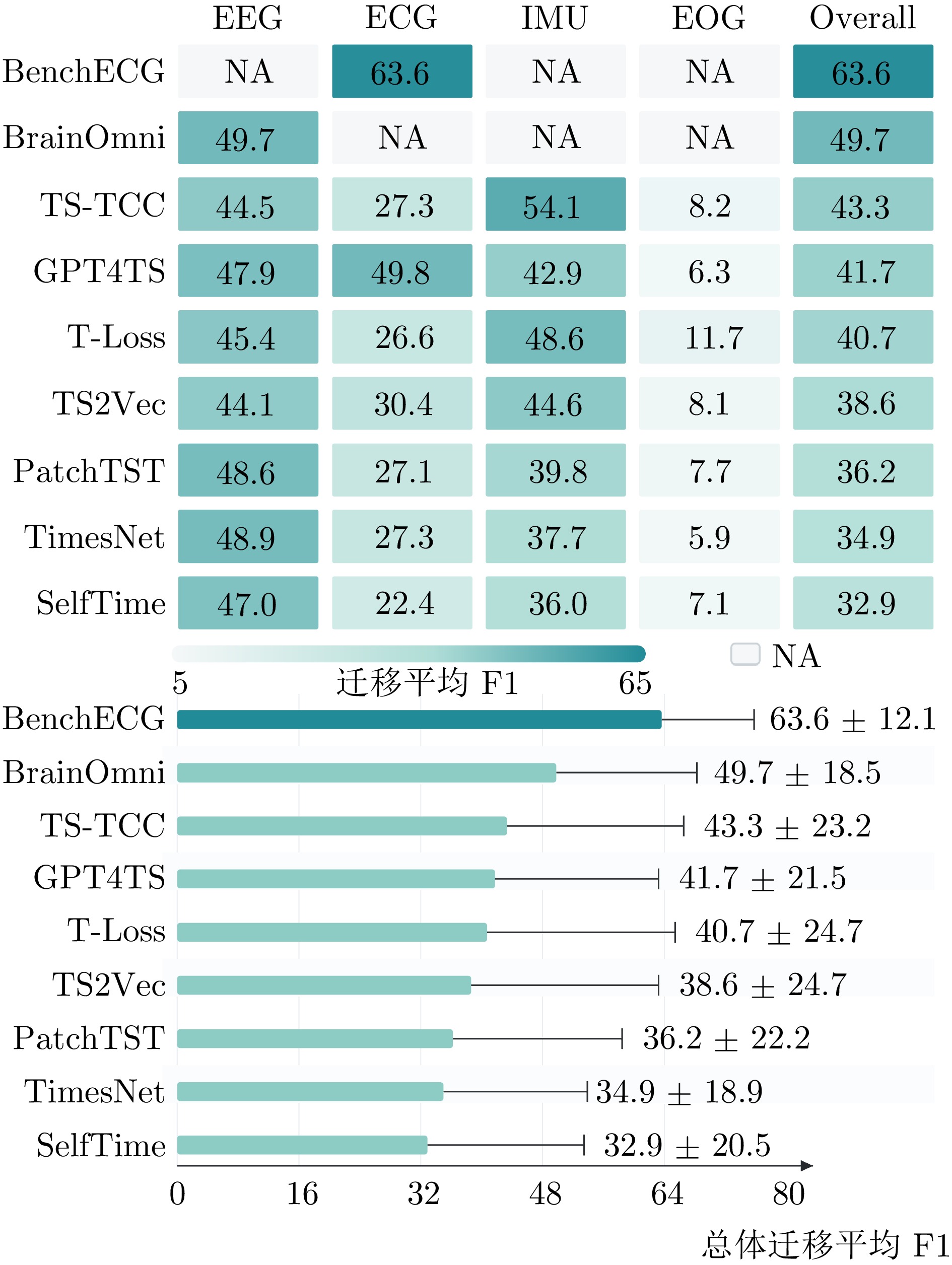
图 9 不同模型的模态平均性能与整体稳定性 (%)
Fig. 9 Average performance across modalities and overall stability of different models (%)
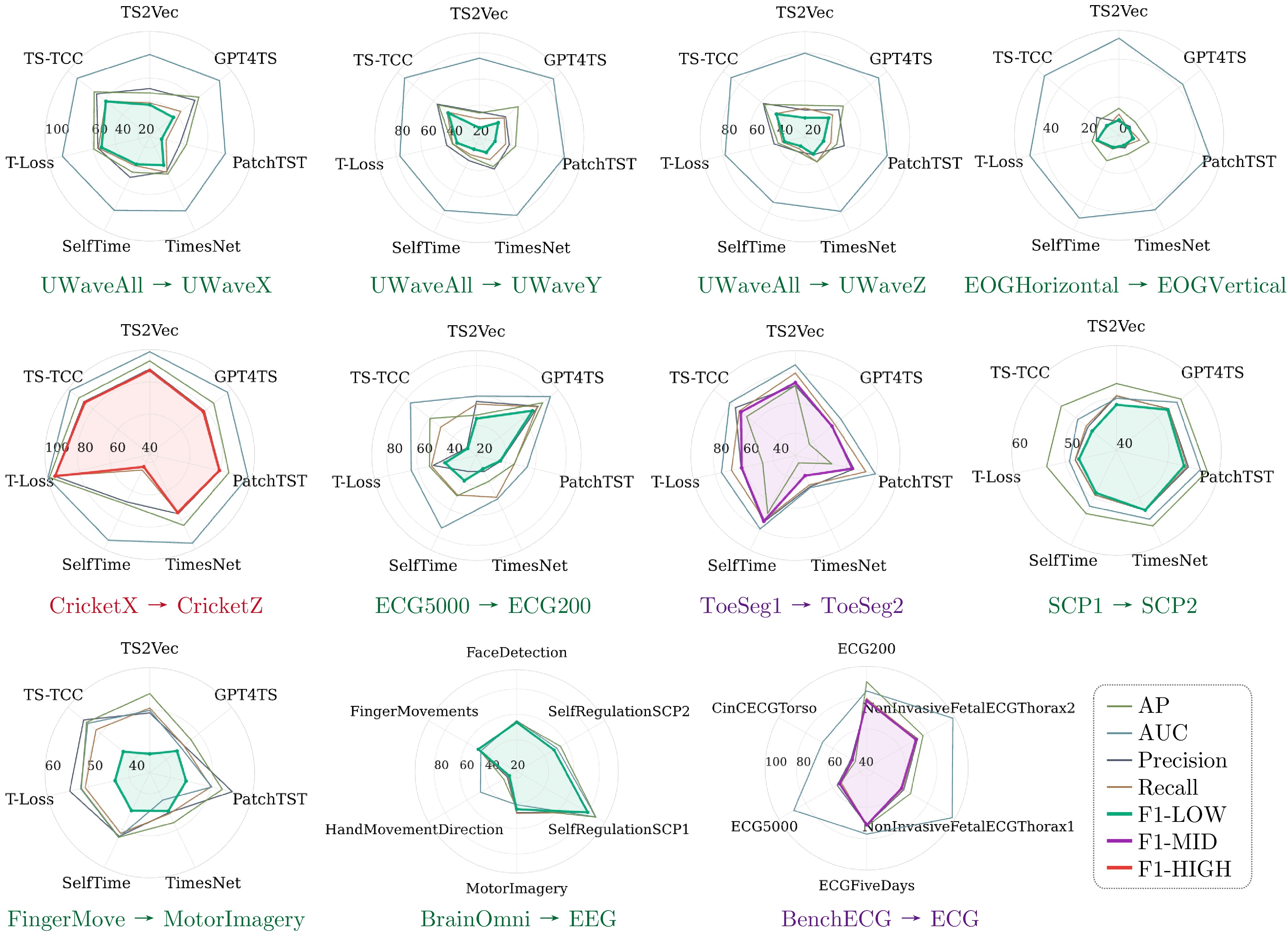
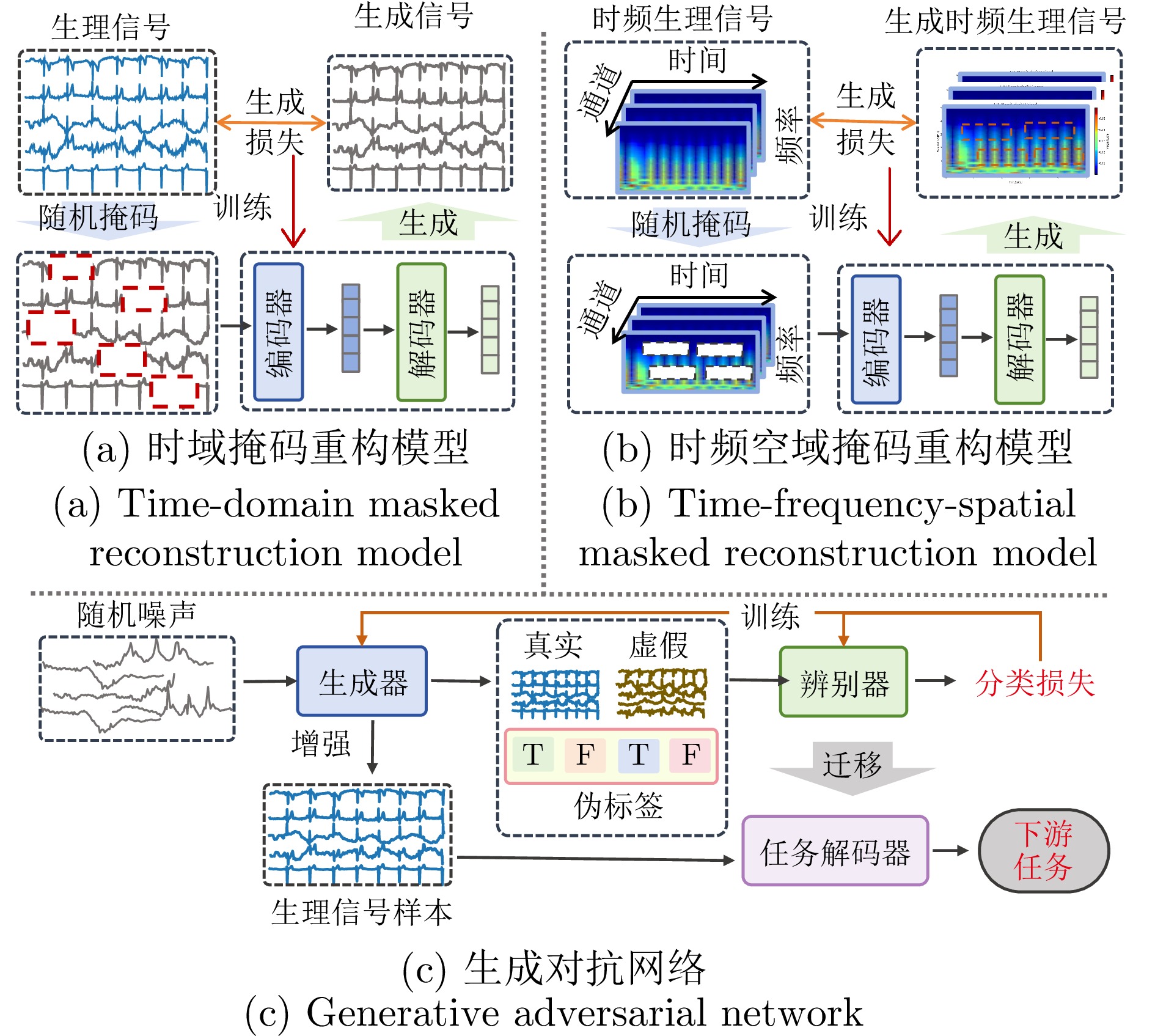
图 11 跨数据集迁移任务下不同模型的多指标性能对比雷达图
Fig. 11 Radar chart comparison of multi-metric performance for different models under cross-dataset transfer tasks
表 1 基础模型综述对比
Table 1 Comparative review of foundation models
文献 发表时间 主要贡献 预训练技术 关注点 实验 对比式 生成式 预测式 混合式 设备 适配 数据 架构 [14] 2024 1) 构建基于数据模态的TSFMs分类体系
2) 从预训练视角构建方法论分析框架
3) 展望TSFMs跨模态时序融合发展方向√ √ × √ × √ × √ × [27] 2024 1) 系统化时间序列预训练模型分类框架
2) 在统一实验设置下开展大规模实验实证
3) 提炼未来研究方向: 数据集、模型等√ √ √ × × × √ √ √ [28] 2024 1) 明确提出医疗多模态基础模型总体框架
2) 梳理数据集、模型架构与临床应用系统
3) 汇总应用场景提出面向未来的研究方向√ √ × √ × × √ √ × [29] 2024 1) 综述医疗大语言模型的理论方法与应用
2) 回顾生成、预训练与自回归等技术演进
3) 全景式讨论医疗大模型挑战与前景× √ × × × √ × √ × [30] 2025 1) 系统梳理医疗FM的发展脉络与分类
2) 综述临床NL√、医学视觉等多领域应用
3) 明确医疗FM的机会与挑战√ √ × × × × × × × [31] 2024 1) 总结全面最新的心电基础模型
2) 提出方法论为中心的模型架构
3) 总结问题展望心电基础模型的发展前景√ √ × √ × √ × √ × [32] 2025 1) 提出适配视角的BioFM三层结构体系
2) 分析不同来源模型的机制差异与适配
3) 提出跨来源融合的未来发展趋势√ √ × × × √ √ √ × [33] 2025 1) 提出可穿戴数据驱动的基础模型管线
2) 归纳并分类当前代表性BioFM模型
3) 分析关键挑战并提出未来发展方向√ √ √ × √ √ × × × 本文 1) 构建BioFM的全景技术框架
2) 以方法论范式为核心的分类体系
3) 梳理多模态生理信号数据集与实验结果√ √ √ √ √ √ √ √ √  下载: 导出CSV
表 2 健康监测的可穿戴设备总结
Table 2 Summary of wearable devices for health monitoring
文献 设备名称 设备类型 传感器 应用场景 [1] Alcon 隐形眼镜 头戴 CGM 通过泪液检测血糖 [77] Google 眼镜 头戴 Acc; ECG 心率监测、呼吸频率监测 [78] Thermal 耳环 头戴 ECG; Acc 监测饮食、运动、压力 [79] 脑电耳机 头戴 EEG 神经监测 [80] Apple 手表 四肢 ECG; PPG; TEMP 血压、体温、心电图监测 [1] Gluco Wise 夹子 四肢 CGM; 无线电波 血糖检测 [81] Kardia 表带 四肢 ECG 心率检测、呼吸检测 [82] Ava 手环 四肢 Acc; EDA; PPG; HR; TEMP 睡眠、压力检测 [83] Oura 戒指 四肢 Acc; PPG; HR; Gyro; TEMP 睡眠检测, 呼吸检测 [84] Embrace 手表 四肢 Acc; EDA; Gyro; TEMP 癫痫检测 [85] Surro Sense Rx手表、鞋垫 四肢 压力; TEMP 糖尿病足溃疡检测 [79] Feel 手环 四肢 EDA; PPG; HR; TEMP 体温、皮肤电、心律失常诊断 [86] Surro Gait Rx 手表鞋垫 四肢 压力 动态步态监测 [87] 唯理手持心电卡 四肢 ECG 心电图监测 [88] Lifevest 背心 躯干 ECG 心电图监测 [89] AbStats 腹部装备 躯干 音响; 气压 腹痛、腹部检测 [90] G-Tech 腹部贴片 躯干 EMG 胃肌电活动检测 [91] ADAMM-RSM 胸部贴片 躯干 声音; HR; TEMP 哮喘检测 [92] ZioPatch 贴片 躯干 ECG 心电图监测、心律失常诊断 [93] NUVANT MCT 贴片 躯干 ECG 心电图监测、心律失常诊断 [94] Vital 胸部贴片 躯干 Acc; ECG 心电图检测 [95] 善行心电衣 躯干 ECG 心电图监测 注: ECG: 心电图; EDA: 皮肤电活动; TEMP: 皮肤温度; HR: 心率; CGM: 连续血糖检测; PPG: 光体积描记术信号; Acc: 加速度计; Gyro: 陀螺仪; EMG: 肌电图; IMU: 惯性测量单元; EHRs: 临床文本; EOG: 眼动图; ALT: 测高计; PSG: 多导睡眠图; fMRI: 脑功能成像; SpO2: 血氧饱和度; HRV: 心率变异性; EEG: 脑电图; ABP: 动态血压
下载: 导出CSV
表 3 对比式预训练模型汇总
Table 3 Summary of contrastive pre-trained models
文献 模型 主干网络 预训练策略 预训练数据集 适配数据集 数据类型 下游任务 [34] sCL-ST ResNet 增强对比 CSPC; G12EC;
INCART; PTB-XLPTB-XL ECG; EHRs 心律失常分类 [35] KED Transformer 多模态对比 MIMIC-IV-ECG PTB-XL; Chapman; CPSC2018 ECG; EHRs 心律失常分类 [43] SleepFM CNN 多模态对比 PSG PSG ECG; EEG;
呼吸睡眠呼吸暂停 [44] 3KG CNN 增强对比 PhysioNet2020 PhysioNet2020 ECG 心律失常分类 [46] TF-C ResNet 复合对比 SLEEPEEG; HAR EPILEPSY; GESTURE ECG; EEG; EMG 心律; 癫痫; 睡眠 [48] CPC ResNet + MLP 预测对比 CinC2020; Ribeiro;
ChapmanPTB-XL ECG 心脏异常分类 [50] BenchECG LSTM 增强对比 CODE; INCART PTB-XL; CPSC2018;
MIT-BIH; CODE-15%ECG; PPG 心律失常分类
年龄估计[99] TS2Vec CNN 增强对比 UCR; UEA UCR; UEA ECG; EEG; IMU 心律; 癫痫; 动作 [100] T-Loss CNN 增强对比 UCR; UEA UCR; UEA EEG; IMU 癫痫检测 [101] SelfTime CNN 增强对比 CricketX;
UWaveGestureLibraryAllCricketX;
UWaveGestureLibraryAllIMU 动作识别 [102] sEHR-ECG-
TextTransformer 多模态对比 Mayo Clinic EHRs Mayo Clinic EHRs; Chapman;
PhysioNet2020;ECG; EHRs 心律失常分类 [103] SSMs S4 with FCE 预测对比 CinC PTB-XL; Chapman ECG 心律失常分类 [104] SimCLR ResNet 增强对比 PTB-XL; Chapman PTB-XL; Chapman; Ribeiro ECG 心律失常分类 [105] SSL-KD ResNet 预测对比 CinC CinC ECG 心律失常分类 [106] ISL Transformer 复合对比 AHMS AHMS ECG; PPG 年龄; 体重 [107] ASTCL CNN + Transformer 预测对比 Chapman; CPSC2018;
CODE; PTB-XL; CMIChapman; CMI; PTB-XL;
CODE; CPSC2018ECG 心脏异常;
去噪[108] ETP ResNet + Transformer 多模态对比 PTB-XL; CPSC2018 PTB-XL; CPSC2018 ECG;
报告心律失常分类 [109] JCDCL CNN 复合对比 NFH PTB-XL; CPSC2018 ECG 心脏异常分类 [110] MRC CNN 增强对比 NFH Chapman; CPSC2018 ECG 心律失常分类 [111] METS Transformer 多模态对比 MIMIC-III; PTB-XL PTB-XL; MIT-BIH ECG; 报告 心律失常分类 [112] CLOCS CNN 增强对比 Oxford University
Hospitals ECGPhysioNet 2017;
PTB-XL; ChapmanECG 心律失常分类 [113] TS-TCC CNN 预测对比 UCR Archive 2018 Epilepsy; PTB-ECG; HAR ECG; EEG; IMU 癫痫; 心电; 动作 [114] Pulse-PPG CNN 增强对比 MOODS MOODS; SDB;
PPG-DaLiA;
WESAD; PPG-BPPPG 压力; 活动;
心率睡眠[115] DCL Transformer +
CNN预测对比 MAHNOB-HCI; CASE PsPM-FR; WESAD; ASCERTAIN DREAMER; D1NAMO ECG 情绪识别;
血糖估计[116] BIOT Transformer 增强对比 SHHS; PREST; HAR; TUEV; PTB-XL;
IIIC Seizure; Cardiology;
CHB-MIT; TUABCHB-MIT;
IIIC Seizure;
PTB-XL; HARECG;
EEG;
HRV心律失常检测; 癫痫检测;
动作识别[117] PaPaGei CNN 增强对比 VitalDB; MIMIC-III; MESA VitalDB; MIMIC-III; VV; MESA; SDB; nuMom2B; WESAD ECSMP; PPG-BP; PPGDaLiA EEG;
PPG睡眠检测;
呼吸暂停; 妊娠阶段; 胎龄[118] RelCon CNN 增强对比 AHMS AHMS; Gait 回归;
Opportunity; Motion Sense; PAMAP2; HHARIMU 步态、移动能力评估 [119] SiamQua-lity ResNet +
CNN增强对比 UCSF TROIKA; PPG-DaLiA; WESAD; PulseDB; BIDMC; Stanford AF PPG; ECG;
IMU; EDAICU临床监护
下载: 导出CSV
表 4 生成式预训练模型汇总
Table 4 Summary of generative pre-trained models
文献 模型 主干网络 预训练策略 预训练数据集 适配数据集 数据类型 下游任务 [36] ECG-GPT Transformer 生成对抗 YNHHS MSHSUK; Biobank; HMH; CODE; PTB-XL; LRH; ECG; 报告 心脏诊断 [37] GPT-PPG2 Transformer 时域信号掩码重构 内部构建 WESAD; DaLiA; BIDMC; PulseDB; CinC2015; Stanford PPG 血压、呼吸估计;
房颤检测[71] GPT4TS Transformer 生成模型 UEA UEA EEG 癫痫检测 [123] CSFM Transformer 掩码重构 MIMIC-III-WD; MIMIC-IV-ECG; CODE PTB-XL; SimBand; VitalDB; VTaC;
CODE-15; ECG-QAECG; PPG; 文本 生命体征、临床结局预测 [124] BrainOmni Transformer 掩码重构 MEG-MAS; OMEGA; CC700 TUAB; TUEV; MDD; FACED; PD31; ASD74 EEG; MEG 抑郁识别;
帕金森识别[125] ECG-MAE Transformer 掩码重构 CinC2020 CinC2020 ECG 心脏诊断 [126] EEGFormer Transformer 时频重构 TUH EEG Corpus TUAB; TUAR; TUSL; TUSZ EEG 癫痫检测 [127] MTECG Transformer 时域重构 Fuwai; CinC PTB-XL; CinC; Fuwai ECG ECG分类 [128] Brant Transformer 时频空域重构 SEEG SEEG; MAYO; FNUSA EEG 癫痫检测 [129] HeartBEiT Transformer 嵌入掩码重构 MSHS MSHS; PTB-XL ECG 射血检测 [130] MassMIB Transformer + CNN 时间频率域重构 PTB-XL; CPSC; Chapman PTB-XL; CPSC; Chapman ECG 心律失常分类; [131] ST-MEM Transformer 时频空间域重构 Chapman; Ningbo; CODE PTB-XL; CPSC2018; PhysioNet 2017 ECG 心律失常,
心肌梗死检测[132] HeartLang Transformer 嵌入掩码重构 MIMIC-IV-ECG PTB-XL; CPSC2018; Chapman; Ningbo ECG 心脏疾病、
心律失常分类[133] SelfPAB Transformer 时间频率域重构 HUNT4 HARTH; Opportunity; HAR70+; PAMAP2 IMU 人体活动识别 [134] PatchTST Transformer 嵌入级掩码重构 UEA UEA EEG 情绪识别 [135] LSM Transformer 时域信号掩码重构 Fitbit Sense; Pixel Watch 内部构建 Acc; ALT; TEMP 运动检测;
活动识别[136] MaeFE Transformer 时域信号掩码重构 CPSC2018; PTB-XL; Ningbo CPSC2018; PTB-XL ECG 心律失常、
心肌梗死分类[137] MAE-ECG Transformer + CNN 时域信号掩码重构 PTB-XL; Chap-man; CPSC2018; PTB-XL; CPSC2018; Chapman ECG ECG分类 [139] BrainWave Transformer 时频空间域重构 CCEP; CAP; HMC; Siena; SRM; TUEG; Sleep-EDF; PD; AD; IowaDataset; Schizophrenia; Stroke; UNMDataset AD; CHB-MIT; MDD; Schizophrenia; Absence; Atonic; Clonic; Mayo-Clinic; FNUSA; ADHD; Apnea-ECG; Depression EEG 癫痫检测; 阿尔茨海默病诊断; 抑郁症诊断; 精神分裂诊断; 睡眠呼吸暂停检测 [140] LaBraM Transformer 时域嵌入掩码重构 BCI Competition IV-1; Emobrain; Grasp and Lift EEG Challenge TUAB; TUEV EEG 情绪识别; 步态预测 [141] HuBERT-ECG Transformer 时域嵌入掩码重构 Ribeiro; CPSC; CPSC-Extra; PTB; PTB-XL; Georgia; Chapman; Ningbo; Hefei; SPH; MIMIC-IV ECG Ribeiro; CPSC; CPSC-Extra; PTB; PTB-XL; Georgia; Chapman; Ningbo; Hefei; SPH; MIMIC-IV ECG; SaMi-Trop; Cardio-Learning ECG 心律失常检测; 心脏疾病多标签诊断; 心血管事件预测
下载: 导出CSV
表 5 预测式预训练模型汇总
Table 5 Summary of predictive pre-trained models
文献 模型 主干网络 预训练策略 预训练数据集 适配数据集 数据类型 下游任务 [38] Neuro-gpt Transformer 时间预测 TUH EEG; BCI 2000 EEG 脑机接口 [39] MBrain CNN 空间预测 SEEG; TUSZ SEEG; TUSZ EEG 睡眠监测 [45] ECGRAG Transformer 时间预测 PTB-XL; Apnea-ECG PTB-XL; Apnea-ECG ECG 睡眠心律检测 [47] SleepNet ResNet 时间预测 UK Biobank Raine Study; Cohort IMU 睡眠识别 [51] GMSS GCN 空间预测 SEED; SEED-IV; MPED SEED; SEED-IV; MPED EEG 情绪识别;
人机情感交互[143] SSL-TS CNN 时间预测 PhysioNet 2018; TUH EEG PhysioNet 2018; TUH EEG EEG 睡眠病理分类 [144] CinCSEM Transformer 时间预测 MIT-BIH; EDB CinC 2021; Georgia; Chapman; PTB-XL; Ningbo ECG 心律失常分类 [145] TimesNet ResNet 时间预测 UCR; UEA UCR; UEA ECG 心律失常分类 [146] RP CNN 时间预测 PhysioNet 2018 PhysioNet Challenge 2018; TUH EEG EEG 睡眠分期;
脑病理检测[147] TRMINet CNN 时间预测 BCI Competition III-IV BCI Competition IV EEG 运动想象 [148] CASSL CNN 时间预测 SleepEDF-20; CHB-MIT SleepEDF-20; CHB-MIT EEG 癫痫监测 [149] ECG-Age ResNet 时间预测 CODE CODE; ELSA-Brasil; SaMi-Trop ECG 生理年龄估计;
心血管健康监测[150] MOTOR Transformer 时间预测 EHR-OMOP; MIMIC-IV; MERATIVE EHR-OMOP; MIMIC-IV; MERATIVE EHRs 心梗、中风、
癌症预测[151] SSL-HAR ResNet 时间预测 UK Biobank Capture-24; ADL; MJFF-LR;PAMAP2; Rowlands; Opportunity; WISDM IMU 人类活动识别; 数字健康监测 [152] GPT-PPG Transformer 时间预测 UCSF ICU Stanford AF; WESAD; DaLiA; TROIKA; BIDMC; PulseDB PPG; Acc; 呼吸 呼吸率估计; PPG信号质量; 运动伪影 [153] NeuroLM Transformer 时频预测 TUEG; SEED; BCI Competition IV-1; Brain Invader; Inria; SJTU EmoBrain Lab; Trujillo; Emobrain; Grasp&Lift; Siena Scalp EEG TUAB; TUEV;
SEED; HMC;
Workload; TUSLEEG 医疗诊断;
情绪计算;
脑机接口;
认知状态监测[154] BrainGPT Transformer 时间预测 DEAP; FACED; EDF;
SEED-IV; SEED-V; IMG; MIBCI; BCIC4-1; SPE; EEGMat; STEW; HMCDEAP; EDF; IMG; SEED-IV; SEED-V; MIBCI; SPE; BCIC4-1; EEGMat; STEW; FACED; HMC EEG 情绪识别;
运动想象;
心理负荷;
睡眠分期
下载: 导出CSV
表 6 混合式预训练模型汇总
Table 6 Summary of hybrid pre-trained models
文献 模型 主干网络 预训练策略 预训练数据集 适配数据集 数据类型 下游任务 [7] LSM-2 Transformer 重构预测 Google收集 Metabolic Study;
Activity StudyPPG; Acc; EDA; ALT; TEMP 高血压、焦虑运动检测; [40] SignalGPT Transformer 生成预测 CODE-test CODE-test ECG; EEG; EMG; EOG 医疗报告生成
AI诊断辅助[41] LCM Transformer 重构对比 PhysioMI; TSU SSVEP; SEED BCIC-2A; BCIC-2B EEG 心律失常; 癫痫、情绪检测; 运动识别 [156] ETHOS Transformer 生成预测 MIMIC-IV MIMIC-IV EHRs 健康轨迹 [157] MultiMAE Transformer 生成对比 PhysioNet 2018 PhysioNet 2018 EEG; EOG; EMG; ECG 睡眠分期; 年龄分类 [158] LSM Transformer 生成预测 Fitbit Sense; NMT; Pixel Watch Exercise Detection;
Activity RecognitionPPG; Acc;
EDA; ALT; TEMP运动与活动识别 [159] BFM Transformer 生成预测 MOABB; NMT; MOABB EEG; fMRI 脑疾病检测 [160] SensorLM Transformer 生成对比 Fitbit Sense; Pixel Watch Activity; Metabolic PPG; Acc; EDA; ALT; 活动、代谢健康风险信号 [161] SleepFM2 Transformer 生成预测 SleepFM500K Sleep-EDF Expanded;
WESAD; SHHS; ISRUC-Sleep; PhysioNet 2018; CPSC2021 Sleep;EEG; EOG; EMG; PPG; ECG; Acc 睡眠分期;
健康监测;
情绪、睡眠状态识别[162] EMG-FM Transformer 重构预测 Ninapro DB6、DB7; EMG2Pose; Ninapro DB5; EPN-612; UCI EMG; Meta Discrete Gestures; Silent Speech; Ninapro DB8; SilentSpeech sEMG 手势识别;
运动回归;
静音语音;
人机接口[163] PSG-LlaVA Transformer 生成对比 ISRUC-S1; MASS-SS3; SHHS-1 ISRUC-S1; MASS-SS3; SHHS-1 EEG; EOG; EMG; ECG 睡眠分期 [164] SleepFounder ResNet 预测生成 HSP; BTH; AHGUCM; BHH; IMBH SHHS; WSC; SSPH; SRRSH; BCG ECG; EEG; SpO2 睡眠监测与多系统健康评估 [165] PHLLM Transformer 对比生成 Sleep Case;
Fitness Case;Professional; PROMIS; Examinations; HR; HRV; 呼吸; 文本 睡眠健康评估;
运动负荷
下载: 导出CSV
表 8 BioFM在EEG数据集上预训练的实验结果 (%)
Table 8 Pre-training experimental results of BioFM on EEG datasets (%)
模型 FaceDetection FingerMovements HandMovementDirection Pre Rec F1 AUC AP Pre Rec F1 AUC AP Pre Rec F1 AUC AP TS2Vec 52.84 52.74 52.24 53.70 53.66 52.66 52.64 52.52 52.60 54.33 27.49 31.00 27.05 58.21 37.61 TS-TCC 69.44 68.82 68.58 76.14 75.53 50.32 50.46 48.78 50.50 52.87 37.62 37.50 37.45 68.32 48.27 TimesNet 88.95 88.86 88.83 92.97 92.82 78.63 77.75 77.37 84.24 84.95 76.25 73.28 73.48 89.52 81.73 T-Loss 52.68 52.61 52.33 53.49 52.26 54.07 53.91 53.59 51.69 54.61 7.89 25.10 11.36 49.83 31.96 SelfTime 49.66 49.66 49.49 50.81 50.55 50.10 50.10 49.92 46.58 53.57 29.79 30.07 27.79 56.63 32.94 PatchTST 52.65 54.84 53.72 52.18 51.78 73.27 68.79 69.89 78.80 77.90 34.88 34.96 33.74 63.74 42.57 GPT4TS 90.22 86.42 88.12 92.63 92.50 77.19 70.65 73.16 79.36 79.65 78.81 77.27 76.87 90.01 84.71 模型 MotorImagery SelfRegulationSCP1 SelfRegulationSCP2 TS2Vec 52.92 52.90 52.70 54.68 52.58 74.63 74.32 74.25 81.38 82.32 51.57 51.58 51.01 55.09 56.53 TS-TCC 53.95 53.95 53.94 49.10 50.86 84.70 83.16 82.99 91.98 93.01 47.34 48.68 41.27 53.19 58.30 TimesNet 78.80 78.13 77.77 84.92 84.61 87.99 87.53 87.50 93.74 93.18 81.86 81.58 81.51 84.98 83.99 T-Loss 42.15 51.66 44.13 53.47 55.90 78.07 77.66 77.58 87.02 88.49 52.76 52.63 52.01 53.37 55.10 SelfTime 51.37 50.51 45.55 53.35 55.03 72.70 72.70 72.70 78.70 79.79 48.69 48.16 46.32 50.26 53.57 PatchTST 75.62 64.61 69.11 81.41 80.68 88.23 87.07 87.47 93.51 94.20 54.72 66.84 56.92 55.12 57.38 GPT4TS 76.83 78.93 77.63 82.77 84.83 92.88 87.81 90.13 95.71 95.59 65.56 67.37 66.15 70.46 70.80
下载: 导出CSV
表 10 BioFM在ECG数据集上的预训练实验结果 (%)
Table 10 Pre-training experimental results of BioFM on ECG datasets (%)
模型 ECG200 CinCECGTorsor ECG5000 Pre Rec F1 AUC AP Pre Rec F1 AUC AP Pre Rec F1 AUC AP TS2Vec 90.91 90.69 90.50 95.92 97.20 99.73 99.72 99.72 100 100 74.03 60.29 64.58 87.01 61.85 TS-TCC 79.98 79.46 78.37 91.36 95.92 99.79 99.79 99.79 100 100 67.80 59.63 62.49 95.06 66.97 TimesNet 93.18 91.44 92.03 97.53 98.70 98.89 98.87 98.87 99.95 99.79 78.20 70.57 72.54 97.47 75.92 T-Loss 84.92 83.95 84.2 94.25 97.18 99.59 99.58 99.58 99.99 99.98 66.68 56.10 59.50 95.81 95.79 SelfTime 77.96 77.92 76.47 86.72 90.97 82.87 81.48 81.05 96.59 91.35 73.74 48.86 53.44 85.50 54.78 PatchTST 93.88 92.36 93.05 95.41 97.70 99.86 99.86 99.86 100 100 45.75 48.56 45.43 85.89 50.99 GPT4TS 95.11 95.47 95.11 97.77 98.91 100 100 100 99.99 99.97 77.91 80.14 77.22 93.34 65.91 模型 ECGFiveDays NonInvasiveFetalECGThorax1 NonInvasiveFetalECGThorax2 Pre Rec F1 Pre Rec F1 Pre Rec F1 Pre Rec F1 Pre Rec F1 TS2Vec 100 100 100 100 100 88.46 88.18 88.08 99.45 89.86 95.38 95.18 95.17 99.90 97.27 TS-TCC 99.78 99.77 99.77 100 100 91.64 90.88 90.54 99.81 95.64 94.17 93.46 93.30 99.87 96.71 TimesNet 100 100 100 100 100 94.06 93.50 93.42 99.79 96.50 95.28 95.00 94.93 99.85 97.44 T-Loss 100 100 100 100 100 94.14 93.92 93.88 99.91 97.14 94.75 94.50 94.48 99.87 96.72 SelfTime 97.81 97.62 97.62 99.42 98.72 89.93 89.95 89.78 99.51 91.00 86.23 84.39 83.45 99.56 91.59 PatchTST 100 99.78 99.89 100 100 92.04 91.19 90.95 99.79 95.99 92.54 91.86 91.67 99.80 95.77 GPT4TS 100 100 100 100 100 96.47 96.19 96.19 99.54 88.59 97.15 96.96 96.91 99.40 85.03
下载: 导出CSV
表 14 BioFM在UCR Archive 2018的子数据集上预训练的实验结果 (%)
Table 14 Pre-training experimental results of BioFM on the subdatasets of UCR archive 2018 (%)
模型 EOGHorizontalSignal EOGVerticalSignal Pre Rec F1 AUC AP Pre Rec F1 AUC AP TS2Vec 74.61 72.46 72.92 94.96 75.89 68.77 67.32 67.39 94.51 73.10 TS-TCC 64.28 63.18 62.61 93.34 67.85 59.86 59.87 58.95 92.15 65.33 TimesNet 70.93 66.26 66.44 92.77 71.77 67.35 62.77 61.39 92.41 70.51 T-Loss 80.52 78.52 78.57 97.70 86.49 67.73 66.51 65.96 92.76 67.42 SelfTime 53.42 50.03 50.33 88.45 53.88 46.06 48.12 44.41 88.80 55.48 PatchTST 56.41 55.88 52.95 92.94 65.17 49.99 50.53 44.28 91.06 63.82 GPT4TS 74.53 72.67 71.77 93.95 68.77 76.63 75.23 74.81 93.29 66.04
下载: 导出CSV
表 7 单模态EEG数据集
Table 7 Single-modality EEG datasets
数据集名称 模态 记录数量 采样率 通道 标签 描述 BCI 2000[38] EEG 109人 160 Hz 64 左/右手; 脚; 基线 开源 BCI 运动, 想象数据集 FaceDetection[100] EEG 9 414条 250 HZ 62 人脸; 打乱 判断受试者是人脸图片或打乱图 FingerMovements[100] EEG 416条 100 HZ 50 左手; 右手 感知器神经网络分类 HandMovementDirection[100] EEG 234条 200 Hz 10 上/下/左/右 受试者用手腕操作摇杆 MotorImagery[100] EEG 378条 250 Hz 64 左小指/舌头 运动想象 EEG SelfRegulationSCP1[100] EEG 561条 256 Hz 6 正向调节; 负向调节 健康受试者控制光标上下 SelfRegulationSCP2[100] EEG 380条 256 Hz 7 向上; 向下 ALS病人控制光标移动 Epilepsy[46] EEG 11 500条 173.61 Hz 1 发作; 非发作 癫痫发作检测 TUEV[116] EEG 11 2491 条256 Hz 23 癫痫; 伪迹; 背景电活动 临床事件类型分类 TUSL[126] EEG 245条 256 Hz 23 背景电活动; 癫痫 癫痫及慢化事件检测 TUSZ[126] EEG 5 612条 250 Hz 19 发作; 不发作 癫痫发作检测 SEED[138] EEG 51人 1000 Hz62 正向/中性/负向情绪 视频诱发情绪识别 BCI Competition IV-1[140] EEG 7人 1000 Hz59 左手; 右手; 脚 经典运动想象任务 EmoBrain[140] EEG 16人 1024 Hz64 高兴; 惊讶; 恐惧; 愤怒 多模态情绪数据库 SleepEDF[148] EEG 20人 100 Hz 2 Wake/N1/N2/N3/REM 睡眠分期 CHB-MIT[148] EEG 24人 256 Hz 23 发作; 不发作 癫痫检测 Trujillo[153] EEG 22人 256 Hz 64 睁眼; 闭眼 静息状态脑电 Siena Scalp EEG[153] EEG 14人 512 Hz 31 正常; 癫痫 临床脑电, 含癫痫发作记录 SJTU EmoBrain Lab[153] EEG 140 +人 1000 Hz62 情绪; 睡眠 上海交大多模态EEG数据集 Inria BCI[153] EEG 26人 600 Hz 56 目标/非目标 视觉刺激P300, 脑机接口 HMC[154] EEG 13.7 w条 256 Hz 4 Wake/N1/N2/N3/REM 自动睡眠阶段识别 DEAP[154] EEG 32人 128 Hz 32 高/低唤醒; 高/低愉悦 情绪诱发实验, 情感识别 FACED[154] EEG 27.6 k条 1000 Hz30 9 类细粒度情绪标签 精细情绪识别大数据集 MIBCI[154] EEG 10.5 k条 512 Hz 64 左手; 右手 运动想象任务 EEGMat[154] EEG 1.0 k条 500 Hz 19 高/低工作负荷 心理工作负荷任务 STEW[154] EEG 3.3 k条 128 Hz 14 低/中/高负荷 双任务并行负荷实验 EDF[154] EEG 19.5 k条 100 Hz 2 Wake/N1/N2/N3/REM 睡眠分期任务 IMG[154] EEG 7.6 k条 1000 Hz122 5类想象词语 跨模态想象语音任务 SPE[154] EEG 1.3 k条 256 Hz 64 语音; 非语音 想象语音分类 注: Wake: 清醒期; N1: 浅睡期; N2: 轻度睡眠; N3: 深睡期; REM: 快速眼动睡眠; k: 千; w: 万; M: 百万
下载: 导出CSV
表 9 单模态ECG数据集
Table 9 Single-modality ECG datasets
数据集名称 模态 记录数量 采样率 通道 标签 描述 PTB-XL[35] ECG 21 837条 500 Hz 12 NORM; MI; CD; HYP; STTC 大规模临床ECG数据集 Chapman[35] ECG >10 000条 500 Hz 12 AF; GSVT; SB; SR 节律分类 MIMIC-IV-ECG[35] ECG 80w条 500 Hz 12 RR间期; QRS起止 公开多导联心电数据库 CODE[107] ECG 24w条 300 - 1000 Hz12 年龄 用于生存分析 MIT-BIH[111] ECG 48条 500 Hz 2 NORM; PVC; PAC; 室性逸搏 心律失常数据集 PTB-ECG[113] ECG 5 000+条 500 Hz 12 MI; NORM 心脏异常检测 ECG200[113] ECG 200 条 - 1 NORM; MI 心电图单次心跳波形分类任务 CinCECGTorso[113] ECG 1 420 条 - 1 4 个不同人员 多个躯干表面 ECG 站点 ECG5000[113] ECG 5 000 条 - 1 5 类 源自 PhysioNet 的心衰数据库 ECGFiveDays[113] ECG 135 条 - 1 2 类 心电图波形分类 NonInvasiveFetalECGThorax1/2[113] ECG 3 765 条 500 Hz 1 RR; QT间期; 心率 胸部电极记录非侵入式胎儿ECG PhysioNet 2017[113] ECG 8 528条 200 Hz 1 NORM; AF; 噪声 心律失常分类 Apnea-ECG[139] ECG 34 243条 100 Hz 1 窒息; 非窒息 利用 ECG 检测呼吸暂停 Georgia[141] ECG 10 344条 500 Hz 12 NORM; 其他 美国东南地区的12导联ECG数据 Ningbo[144] ECG 34 905条 500 Hz 12 SB; AF; GSVT; SR 宁波市第一医院12导联开放数据集 EDB[144] ECG 90条 500HZ 2 NORM; ABERR; NPC; PAC 含 ST 段与 T 波异常 注: NORM: 正常; MI: 心肌梗死; CD: 传导阻滞; HYP: 心室肥大; STTC: ST段异常; AF: 房颤; PAC: 房性早搏; PVC: 室性早搏; ABERR: 房性或结性逸搏; NPC: 结交逸搏; GSVT: 室上性心动过速; SB: 窦性心动过缓; SR:窦性心律;
下载: 导出CSV
表 11 单模态IMU数据集
Table 11 Single-modality IMU datasets
数据集名称 模态 记录数量 采样率 通道 标签 描述 CricketX/Y/Z[113] IMU 780条 - 3 12类裁判信号 演员表演板球动作加速度计数据 GunPoint[113] IMU 200条 - 1 拔枪; 指点 手部轨迹的单维位置时间序列 InlineSkate[113] IMU 650条 - 1 7类滑行动作 滑旱冰动作的传感器序列 ToeSegmentation1/2[113] IMU 434条 - 1 正常; 异常 用于动作阶段分割 UWaveGestureLibraryAll/X/Y/Z[113] IMU 447条 100 Hz 3 8类手势 PDA设备的3轴加速度手势库 GesturePebbleZ[113] IMU 302条 100 Hz 1 6类手势 智能手表的Z轴手势加速度序列 HAR[116] IMU 10 299条 50 Hz 6 走; 坐; 躺; 上下楼梯 动作识别 Gait回归[118] IMU 359人 100 Hz 3 步速; 双支撑时长; 受控场景步行实验 CricketX/Y/Z[113] IMU 780条 - 3 12类裁判信号 演员表演板球动作加速度计数据 GunPoint[113] IMU 200条 - 1 拔枪; 指点 手部轨迹的单维位置时间序列 InlineSkate[113] IMU 650条 - 1 7类滑行动作 滑旱冰动作的传感器序列 ToeSegmentation1/2[113] IMU 434条 - 1 正常; 异常 用于动作阶段分割 UWaveGestureLibraryAll/X/Y/Z[113] IMU 447条 100 Hz 3 8类手势 PDA设备的3轴加速度手势库 GesturePebbleZ[113] IMU 302条 100 Hz 1 6类手势 智能手表的Z轴手势加速度序列 HAR[116] IMU 10 299条 50 Hz 6 走; 坐; 躺; 上下楼梯 动作识别 Gait回归[118] IMU 359人 100 Hz 3 步速; 双支撑时长; 受控场景步行实验 HHAR[118] IMU 9人 100 Hz 3 骑; 坐; 上下楼梯; 站; 走 智能手机采集的人体活动数据 Motion Sense[118] IMU 24人 50 Hz 3 上下楼梯; 坐; 站; 走; 跑 智能手机腰部固定的运动场景 Opportunity[118] IMU 3.9 k条 30 Hz 15 开门; 关门; 拾物; 擦桌 半自由场景活动识别 PAMAP2[118] IMU 2.9 k条 100 Hz 9 走; 跑; 骑车; 打扫; 躺; 坐; 站 实验室活动 UK Biobank[151] IMU 70 w人 100 Hz 3 年龄; 性别; BMI; 健康 最大规模的腕戴加速度数据集 Capture-24[151] IMU 57.3 w条 100 Hz 3 睡眠; 久坐; 轻度/中高强度活动 自然生活环境记录 Rowlands[151] IMU 3.6 w条 100 Hz 3 坐; 站; 走; 跑; 骑车等 13类姿态/动作, 实验室活动任务 WISDM[151] IMU 2.8 w条 50 Hz 3 走; 上下楼; 打字; 刷牙等 18类姿态/动作, 半自由活动 MJFF-LR[151] IMU 1.2 w条 100 Hz 3 静息; 敲击; 行走; 转身等 12 类任务, 临床病患运动数据 ADL[151] IMU 0.6 k条 50 Hz 3 躺; 坐; 站; 走; 跑 日常生活活动
下载: 导出CSV
表 12 BioFM在IMU数据集上预训练的实验结果 (%)
Table 12 Pre-training experimental results of BioFM on IMU datasets (%)
模型 CricketX CricketY CricketZ Pre Rec F1 AUC AP Pre Rec F1 AUC AP Pre Rec F1 AUC AP TS2Vec 82.60 82.18 81.94 96.32 83.93 82.30 81.67 81.64 98.53 89.45 85.18 84.49 84.49 98.28 89.48 TS-TCC 72.91 71.92 71.70 95.36 77.58 67.68 67.61 67.17 94.60 72.46 69.52 68.74 68.78 93.95 72.22 TimesNet 74.62 73.08 72.59 95.13 79.53 74.80 71.92 71.64 96.06 80.13 79.92 78.08 77.66 96.76 84.68 T-Loss 78.07 77.44 77.36 97.28 84.42 76.97 75.77 75.62 97.67 85.22 79.52 78.97 78.68 97.26 83.81 SelfTime 73.76 73.21 72.94 93.94 72.32 65.38 61.67 60.48 94.52 68.63 67.55 66.28 65.46 94.73 72.63 PatchTST 79.09 77.69 77.30 96.68 83.13 77.60 76.15 76.17 96.46 83.24 78.93 77.82 77.28 97.06 85.52 GPT4TS 78.89 77.95 77.73 94.68 77.74 79.44 75.13 74.74 95.44 78.95 80.33 76.67 76.74 94.84 77.83 模型 GunPoint InlineSkate ToeSegmentation1 TS2Vec 99.50 99.50 99.50 100 100 65.11 65.03 65.03 92.24 74.45 96.46 96.37 96.29 99.42 99.40 TS-TCC 88.46 85.00 84.65 99.56 99.56 43.59 40.38 39.49 76.38 42.26 86.19 82.84 82.23 94.05 93.52 TimesNet 99.52 99.50 99.50 99.90 99.90 60.92 55.95 55.74 87.79 66.95 81.82 79.95 79.49 88.59 88.87 T-Loss 97.62 97.50 97.50 99.75 100 66.36 65.48 65.13 91.80 70.81 96.42 96.37 96.25 99.26 98.85 SelfTime 92.10 91.50 91.46 98.45 98.50 26.85 24.91 18.23 73.33 37.16 88.62 87.87 88.04 95.80 95.33 PatchTST 100 98.00 98.97 100 100 80.02 77.70 77.94 96.36 87.40 77.85 83.02 79.67 86.92 87.56 GPT4TS 98.05 99.00 98.51 99.80 99.82 65.88 64.99 63.74 85.52 59.52 87.51 93.05 89.99 95.00 95.78 TS2Vec 94.46 92.69 93.31 98.61 95.55 96.89 96.87 96.87 99.46 98.19 84.28 84.66 84.37 97.69 88.82 TS-TCC 84.42 65.86 68.66 75.58 66.41 97.32 97.28 97.28 99.83 99.34 83.18 83.07 82.99 96.99 86.98 TimesNet 86.67 75.90 78.07 84.11 78.86 96.09 95.91 95.89 99.75 98.86 87.97 88.26 87.83 97.88 91.47 T-Loss 94.27 91.98 92.61 98.20 92.88 94.88 94.82 94.82 99.70 98.57 84.01 84.62 84.17 97.81 89.01 SelfTime 91.13 80.29 83.75 93.55 88.33 82.28 82.39 82.25 96.41 85.81 73.71 74.15 71.88 95.59 80.77 PatchTST 77.29 53.06 62.00 87.13 77.26 98.83 98.82 98.82 99.96 99.78 89.32 89.33 89.05 98.74 93.77 GPT4TS 79.28 66.67 71.39 82.20 78.00 98.39 98.33 98.30 99.42 97.06 88.23 88.26 88.12 95.98 81.87 模型 UWaveGestureLibraryY UWaveGestureLibraryZ GesturePebbleZ TS2Vec 78.53 78.52 78.39 96.48 85.04 79.91 80.26 79.98 97.17 85.36 96.30 96.05 96.04 99.85 99.36 TS-TCC 73.49 73.61 73.33 95.17 77.46 77.63 77.80 77.50 96.30 82.24 91.63 91.19 91.07 98.97 96.21 TimesNet 81.76 81.18 81.02 97.18 86.61 83.00 82.79 82.39 97.12 87.74 85.44 84.73 84.11 98.30 93.73 T-Loss 78.39 78.47 78.31 96.75 84.71 79.31 79.66 79.36 97.31 85.49 59.78 58.84 58.58 87.06 63.49 SelfTime 64.62 61.75 60.26 92.46 69.31 70.87 69.88 68.16 95.35 76.22 88.23 85.23 84.97 98.27 93.55 PatchTST 83.42 83.23 83.19 97.90 89.68 85.57 85.55 85.33 98.29 90.55 85.02 84.64 84.31 96.58 89.07 GPT4TS 83.75 82.85 82.78 95.26 76.47 83.33 83.12 82.84 94.68 74.26 94.55 93.6 93.63 98.86 96.66
下载: 导出CSV
表 13 多模态生理信号数据集
Table 13 Multimodal physiological signal datasets
数据集名称 模态 数量 采样率 通道 标签 描述 AHMS[106] ECG; PPG 24 w 64Hz; 512 Hz 1/4 年龄; BMI; 性别; 疾病; 药物 监测高血压、糖尿病、心律失常、哮喘、抑郁等健康状况 UCR Archive 2018[113] ECG; EOG; EMG; PPG; IMU; TEMP 128类 10 - 200 Hz 1 子集任务标签 生理信号; 传感器信号 SDB[114] PPG; SpO2 146人 62.5 Hz 1 正常; 异常 睡眠呼吸障碍 PPG-DaLiA[114] PPG; IMU 15人 64 Hz 1/9 跑; 骑; 开; 坐; 站等 体力活动识别、心率估计 SHHS[116] EEG/EOG/ECG/PPG 5.7 k 人 125 Hz 1/2 呼吸暂停; 睡眠分期 呼吸事件检测 TROIKA[119] PPG; Acc 12人 125 Hz 4 心率 运动状态下手腕PPG心率估计 PulseDB[119] ECG; PPG; ABP 5.3 k人 125 Hz 3 收缩压/舒张压 临床无袖血压估计 BIDMC[119] PPG; ECG; 呼吸 53条 125 Hz 1 HR; 间期; SpO2 多模态时间序列生理波形数据 PhysioNet 2018[146] EEG; EOG; EMG 1 983人 100 Hz 12 W/N1/N2/N3/REM 受试者整夜多导睡眠脑电记录 Newcastle Cohort[47] IMU; PSG 10 + 条 30 Hz 3 Wake/N1/N2/N3/REM 睡眠实验室采集 Leicester Cohort[47] IMU; PSG 53人 30 Hz 3 Wake/N1/N2/N3/REM 独立人群外部验证 UCSF ICU[152] PPG; ECG 2.4 w人 40 Hz 1/7 质量好; 质量坏 PPG 信号质量/伪影分类研究 Sleep-EDF Expanded[161] EEG; EOG; EMG 197条 100 Hz 1/2 Wake/N1/N2/N3/REM 睡眠分期 ISRUC-Sleep[161] EEG/EOG/EMG/ECG 100 人 200 Hz 1/2/6 睡眠阶段、睡眠障碍 睡眠障碍检测 CPSC2021 Sleep[161] ECG; PPG; Acc 1w +人 100 Hz 1/3 睡眠阶段; 体动事件 可穿戴睡眠分析 Ninapro DB7[162] sEMG; IMU 22人 2 000 12 40种动作 20健全者和2截肢者运动标注 ISRUC-S1[163] EEG/EOG/EMG/ECG 100人 200 Hz 12 Wake/N1/N2/N3/REM 实验室多夜 PSG 监测 MASS-SS3[163] EEG/EOG/EMG/ECG 62人 256 Hz 27 Wake/N1/N2/N3/REM 多导睡眠数据库 WSC[164] ECG, 呼吸 1 123人 4 Hz 2 Wake/N1/N2/N3/REM 年龄回归、性别二分类 SSPH[164] ECG, 呼吸 6 609人 4 Hz 2 Wake/N1/N2/N3/REM 上海六院睡眠分期与呼吸 SRRSH[164] ECG, 呼吸 4 014人 4 Hz 2 Wake/N1/N2/N3/REM 浙大邵逸精神类疾病诊断 BCG[164] ECG, 呼吸 2 179人 4 Hz 2 Wake/N1/N2/N3/REM 睡眠分期、年龄、性别
下载: 导出CSV
表 15 固定原始输入规模下不同模型的计算成本与部署效率比较
Table 15 Comparison of computational cost and deployment efficiency of different models with fixed original input size
Model P/ M MACs/ G FLOPs/ G GM-I/ MB GM-T/ MB L/ ms TS2Vec 0.637 0.381 0.762 146.79 196.56 0.566 TS-TCC 0.132 0.015 0.031 18.58 25.71 0.075 TimesNet 7.224 12.652 25.305 87.79 374.89 3.066 T-Loss 0.249 0.333 0.665 152.55 215.67 0.552 SelfTime 0.009 0.000515 0.001030 17.33 17.78 0.061 PatchTST 0.409 0.034 0.068 29.44 46.65 0.463 GPT4TS 82.398 3.286 6.571 483.11 721.80 1.100 BenchECG 57.021 0.113 0.227 514.50 1354.49 3.093 BrainOmni 13.475 2.001 4.003 103.67 592.12 3.630
下载: 导出CSV
-
[1] Dunn J, Runge R, Snyder M. Wearables and the medical revolution. Personalized medicine, 2018, 15(5): 429−448. doi: 10.2217/pme-2018-0044 [2] Gayathri K S, Easwarakumar K S, Elias S. Probabilistic ontology based activity recognition in smart homes using Markov Logic Network. Knowledge-Based Systems, 2017, 121: 173−184. doi: 10.1016/j.knosys.2017.01.025 [3] Lupiani E, Juarez J M, Palma J, et al. Monitoring elderly people at home with temporal case-based reasoning. Knowledge-Based Systems, 2017, 134: 116−134. doi: 10.1016/j.knosys.2017.07.025 [4] 韩涵, 黄训华, 常慧慧, 等. 心电领域中的自监督学习方法综述. 计算机科学与探索, 2024, 18(07): 1683−1704. doi: 10.3778/j.issn.1673-9418.2310043Han Han, Huang Xun-Hua, Chang Hui-Hui, et al. Review of Self-supervised Learning Methods in Field of ECG. Computer Science and Exploration, 2024, 18(07): 1683−1704 (in Chinese) doi: 10.3778/j.issn.1673-9418.2310043 [5] X. Gu et al. , “Beyond supervised learning for pervasive healthcare, ” IEEE Rev. Biomed. Eng. , 2023. [6] de Arriba-Pérez, M. Caeiro-Rodríguez, and J. M. Santos-Gago. Collection and processing of data from wrist wearable devices in heterogeneous and multiple-user scenarios. Sensors, 16(9): 1538, 2016. [7] Xu M A, Narayanswamy G, Ayush K, et al. LSM-2: Learning from Incomplete Wearable Sensor Data[J]. arXiv preprint arXiv: 2506.05321, 2025. [8] 席亮, 王瑞东, 樊好义, 等. 基于样本关联感知的无监督深度异常检测模型. 计算机学报, 2021, 44(11): 2317−2331. doi: 10.11897/SP.J.1016.2021.02317Xi Liang, Wang Rui-Dong, Fan Hao-Yi, et al. Unsupervised Deep Anomaly Detection Model Based on Sample Association Awareness. Chinese Journal of Computers, 2021, 44(11): 2317−2331 (in Chinese) doi: 10.11897/SP.J.1016.2021.02317 [9] Awais M, Naseer M, Khan S, et al. Foundation models defining a new era in vision: a survey and outlook[J]. IEEE Transactions on Pattern Analysis and Machine Intelligence, 2025. [10] Ferrara. Large language models for wearable sensor-based human activity recognition, health monitoring, and behavioral modeling: a survey of early trends, datasets, and challenges. Sensors, 24(15): 5045, 2024. [11] 缪青海, 王兴霞, 杨静, 等. 从基础智能到通用智能: 基于大模型的GenAI和AGI之现状与展望[J]. 自动化学报, 2024, 50(04): 674–687. DOI: 10.16383/j.aas.c240156.Miao Qinghai, Wang Xingxia, Yang Jing, et al. From Foundation Intelligence to General Intelligence: The State-of-Art andPerspectives of GenAI and AGI Based on Foundation Models. Acta Automatica Sinica, 2024, 50(04): 674–687 (in Chinese). [12] R. Bommasani et al. , “On the opportunities and risks of foundation models, ” arXiv preprint arXiv: 2108.07258, 2021. [13] 徐正斐, 辛欣. 基于大语言模型的中文实体链接实证研究[J]. 自动化学报, 2025, 51(02): 327–342. DOI: 10.16383/j.aas.c240069.Xu Zhengfei, Xin Xin. An Empirical Study of Chinese Entity Linking Based on Large Language Model. Acta Automatica Sinica, 2025, 51(02): 327–342 (in Chinese). [14] Liang Y, Wen H, Nie Y, et al. Foundation models for time series analysis: A tutorial and survey[C]//Proceedings of the 30th ACM SIGKDD conference on knowledge discovery and data mining. 2024: 6555-6565. [15] J. Devlin, M. -W. Chang, K. Lee, and K. Toutanova, “Bert: Pretraining of deep bidirectional transformers for language understanding, ” arXiv preprint arXiv: 1810.04805, 2018. [16] Z. Lan, M. Chen, S. Goodman, K. Gimpel, P. Sharma, and R. Soricut, “Albert: A lite bert for self-supervised learning of language representations, ” in ICLR, 2019. [17] Hugo Touvron, Matthieu Cord, Matthijs Douze, Francisco Massa, Alexandre Sablayrolles, and Herv ́e J ́egou. Training data-efficient image transformers &distillation through attention, 2021. [18] Yanghao Li, Hanzi Mao, Ross Girshick, and Kaiming He. Exploring plain vision transformer backbones for object detection, 2022. [19] Yen-Chun Chen, Linjie Li, Licheng Yu, Ahmed El Kholy, Faisal Ahmed, Zhe Gan, Yu Cheng, and Jingjing Liu. Uniter: Universal image-text representation learning. In European conference on computer vision, pages 104–120. Springer, 2020. [20] Chao Jia, Yinfei Yang, Ye Xia, Yi-Ting Chen, Zarana Parekh, Hieu Pham, Quoc Le, Yun-Hsuan Sung, Zhen Li, and Tom Duerig. Scaling up visual and vision-language representation learning with noisy text supervision. In International conference on machine learning, pages 4904–4916. PMLR, 2021. [21] Achiam J, Adler S, Agarwal S, et al. Gpt-4 technical report[J]. arXiv preprint arXiv: 2303.08774, 2023. [22] H. Touvron, T. Lavril, G. Izacard, X. Martinet, M. -A. Lachaux, T. Lacroix, B. Rozi`ere, N. Goyal, E. Hambro, F. Azhar et al. , “Llama: Open and efficient foundation language models, ” arXivpreprint arXiv: 2302.13971, 2023. [23] Dosovitskiy A, Beyer L, Kolesnikov A, et al. An image is worth 16x16 words: Transformers for image recognition at scale[J]. arXiv preprint arXiv: 2010.11929, 2020. [24] Fang Y, Liao B, Wang X, et al. You only look at one sequence: Rethinking transformer in vision through object detection. Advances in Neural Information Processing Systems, 2021, 34: 26183−26197. [25] Gemini Team, Rohan Anil, Sebastian Borgeaud, Yonghui Wu, Jean-Baptiste Alayrac, Jiahui Yu, Radu Soricut, Johan Schalkwyk, Andrew M Dai, Anja Hauth, et al. Gemini: a family of highly capable multimodal models. arXiv preprint arXiv: 2312.11805, 2023. [26] Chang C, Peng W C, Chen T F. Llm4ts: Two-stage fine-tuning for time-series forecasting with pre-trained llms[J]. CoRR, 2023. [27] Ma Q, Liu Z, Zheng Z, et al. A survey on time-series pre-trained models[J]. IEEE Transactions on Knowledge and Data Engineering, 2024. [28] Sun K, Xue S, Sun F, et al. Medical multimodal foundation models in clinical diagnosis and treatment: Applications, challenges, and future directions[J]. Artificial Intelligence in Medicine, 2025: 103265. [29] Zheng Y, Gan W, Chen Z, et al. Large language models for medicine: a survey. International Journal of Machine Learning and Cybernetics, 2025, 16(2): 1015−1040. doi: 10.1007/s13042-024-02318-w [30] Khan W, Leem S, See K B, et al. A comprehensive survey of foundation models in medicine[J]. IEEE Reviews in Biomedical Engineering, 2025. [31] Han Y, Liu X, Zhang X, et al. Foundation models in electrocardiogram: A review[J]. arXiv preprint arXiv: 2410.19877, 2024. [32] Gu X, Shu Y, Han J, et al. Foundation Models for Biosignals: A Survey[J]. Authorea Preprints, 2025. [33] Lee S A, Akamatsu K. Foundation Models for Physiological Signals: Opportunities and Challenges[J]. 2025. [34] Le D, Truong S, Brijesh P, et al. sCL-ST: Supervised contrastive learning with semantic transformations for multiple lead ECG arrhythmia classification. IEEE journal of biomedical and health informatics, 2023, 27(6): 2818−2828. doi: 10.1109/JBHI.2023.3246241 [35] Tian Y, Li Z, Jin Y, et al. Foundation model of ECG diagnosis: Diagnostics and explanations of any form and rhythm on ECG[J]. Cell Reports Medicine, 2024, 5(12). [36] Akshay Khunte, Veer Sangha, Evangelos K Oikonomou, Lovedeep S Dhingra, Arya Aminorroaya, Andreas Coppi, Sumukh Vasisht Shankar, Bobak J Mortazavi, Deepak L Bhatt, Harlan M Krumholz, et al. Automated diagnostic reports from images of electrocardiograms at the point-of-care. medRxiv, 2024. [37] Chen Z, Ding C, Modhe N, et al. Adapting a generative pretrained transformer achieves SOTA performance in assessing diverse physiological functions using only photoplethysmography signals: a GPT-PPG approach[C]//AAAI 2024 spring symposium on clinical foundation models. 2024. [38] Cui W, Jeong W, Thölke P, et al. Neuro-gpt: Developing a foundation model for eeg[J]. arXiv preprint arXiv: 2311.03764, 2023, 107. [39] Donghong Cai, Junru Chen, Yang Yang, Teng Liu, and Yafeng Li. 2023. MBrain: A Multi-channel Self-Supervised Learning Framework for Brain Signals. arXiv preprint arXiv: 2306.13102 (2023). [40] Liu C, Ma Y, Kothur K, et al. BioSignal Copilot: Leveraging the power of LLMs in drafting reports for biomedical signals[J]. medRxiv, 2023: 2023.06. 28.23291916. [41] Chen C S, Chen Y J, Tsai A H W. Large cognition model: Towards pretrained eeg foundation model[J]. arXiv preprint arXiv: 2502.17464, 2025. [42] Xu M, Yin W, Cai D, et al. A survey of resource-efficient llm and multimodal foundation models[J]. arXiv preprint arXiv: 2401.08092, 2024. [43] Thapa R, He B, Kjaer M R, et al. Sleepfm: Multi-modal representation learning for sleep across ecg, eeg and respiratory signals[C]//AAAI 2024 Spring Symposium on Clinical Foundation Models. 2024. [44] Bryan Gopal, Ryan Han, Gautham Raghupathi, Andrew Ng, Geoff Tison, and Pranav Rajpurkar. 3kg: Contrastive learning of 12-lead electrocardiograms using physiologically-inspired augmentations. In Machine Learning for Health, pages 156–167. PMLR, 2021. [45] Yu H, Guo P, Sano A. Zero-shot ECG diagnosis with large language models and retrieval-augmented generation[C]//Machine learning for health (ML4H). PMLR, 2023: 650-663. [46] Zhang X, Zhao Z, Tsiligkaridis T, et al. Self-supervised contrastive pre-training for time series via time-frequency consistency. Advances in neural information processing systems, 2022, 35: 3988−4003. [47] Yuan H, Plekhanova T, Walmsley R, et al. Self-supervised learning of accelerometer data provides new insights for sleep and its association with mortality. NPJ digital medicine, 2024, 7(1): 86. doi: 10.1038/s41746-024-01065-0 [48] Temesgen Mehari and Nils Strodthoff. Self-supervised representation learning from 12-lead ecg data. Computers in biology and medicine, 141: 105114, 2022. [49] Q. Jin, B. Dhingra, W. Cohen, and X. Lu. Probing biomedical embeddings from language models. In Workshop on Evaluating Vector Space Representations for NLP, pages 82–89, 2019. [50] Lunelli R, Nicolson A, Pröll S M, et al. BenchECG and xECG: a benchmark and baseline for ECG foundation models[J]. arXiv preprint arXiv: 2509.10151, 2025. [51] Yang Li, Ji Chen, Fu Li, Boxun Fu, Hao Wu, Youshuo Ji, Yijin Zhou, Yi Niu, Guangming Shi, and Wenming Zheng. 2022. GMSS: Graph-based multi-task self-supervised learning for EEG emotion recognition. IEEE Transactions on Affective Computing (2022). [52] Kim K J, Shin D H. An acceptance model for smart watches: Implications for the adoption of future wearable technology. Internet Research, 2015, 25(4): 527−541. doi: 10.1108/IntR-05-2014-0126 [53] Z. Zhang, X. Han, Z. Liu, X. Jiang, M. Sun, and Q. Liu, “ERNIE: Enhanced language representation with informative entities, ” in ACL, 2019, pp. 1441–1451. [54] C. Raffel, N. Shazeer, A. Roberts, K. Lee, S. Narang, M. Matena, Y. Zhou, W. Li, and P. J. Liu, “Exploring the limits of transfer learning with a unified text-to-text transformer, ” The Journal of Machine Learning Research, vol. 21, no. 1, pp. 5485–5551, 2020. [55] T. Shen, Y. Mao, P. He, G. Long, A. Trischler, and W. Chen, “Exploiting structured knowledge in text via graph-guided representation learning, ” in EMNLP, 2020, pp. 8980–8994. [56] Y. Tay, M. Dehghani, V. Q. Tran, X. Garcia, J. Wei, X. Wang, H. W. Chung, D. Bahri, T. Schuster, S. Zheng et al. , “Ul2: Unifying language learning paradigms, ” in ICLR, 2022. [57] T. Brown, B. Mann, N. Ryder, M. Subbiah, J. D. Kaplan, P. Dhariwal, A. Neelakantan, P. Shyam, G. Sastry, A. Askell et al. , “Language models are few-shot learners, ” Advances in neural information processing systems, vol. 33, pp. 1877–1901, 2020. [58] Aakanksha Chowdhery, Sharan Narang, Jacob Devlin, Maarten Bosma, Gaurav Mishra, Adam Roberts, Paul Barham, Hyung Won Chung, Charles Sutton, Sebastian Gehrmann, et al. Palm: Scaling language modeling with pathways. Journal of Machine Learning Research, 24(240): 1–113, 2023. [59] Alec Radford, Jong Wook Kim, Tao Xu, Greg Brockman, Christine McLeavey, and Ilya Sutskever. Robust speech recognition via large-scale weak supervision. In International Conference on Machine Learning, pages 28492–28518. PMLR, 2023. [60] Mark Chen, Alec Radford, Rewon Child, Jeffrey Wu, Heewoo Jun, David Luan, and Ilya Sutskever. Generative pretraining from pixels. In International conference on machine learning, pages 1691–1703. PMLR, 2020. [61] Oquab M, Darcet T, Moutakanni T, et al. Dinov2: Learning robust visual features without supervision[J]. arXiv preprint arXiv: 2304.07193, 2023. [62] Nicolas Carion, Francisco Massa, Gabriel Synnaeve, Nicolas Usunier, Alexander Kirillov, and Sergey Zagoruyko. End-to-end object detection with transformers, 2020. [63] Yutong Bai, Xinyang Geng, Karttikeya Mangalam, Amir Bar, Alan Yuille, Trevor Darrell, Jitendra Malik, and Alexei A Efros. Sequential modeling enables scalable learning for large vision models, 2023. [64] Jiahui Yu, Zirui Wang, Vijay Vasudevan, Legg Yeung, Mojtaba Seyedhosseini, and Yonghui Wu. Coca: Contrastive captioners are image-text foundation models. arXiv preprint arXiv: 2205.01917, 2022. [65] Liunian Harold Li, Pengchuan Zhang, Haotian Zhang, Jianwei Yang, Chunyuan Li, Yiwu Zhong, Lijuan Wang, Lu Yuan, Lei Zhang, Jenq-Neng Hwang, et al. Grounded language-image pre-training. In Proceedings of the IEEE/CVF Conference on Computer Vision and Pattern Recognition, pages 10965–10975, 2022. [66] Alexander Kirillov, Eric Mintun, Nikhila Ravi, Hanzi Mao, Chloe Rolland, Laura Gustafson, Tete Xiao, Spencer Whitehead, Alexander C Berg, Wan-Yen Lo, et al. Segment anything. arXiv preprint arXiv: 2304.02643, 2023. [67] Aditya Ramesh, Mikhail Pavlov, Gabriel Goh, Scott Gray, Chelsea Voss, Alec Radford, Mark Chen, and Ilya Sutskever. Zero-shot text-to-image generation. In International Conference on Machine Learning, pages 8821–8831. PMLR, 2021. [68] Alec Radford, Jong Wook Kim, Chris Hallacy, Aditya Ramesh, Gabriel Goh, Sandhini Agarwal, Girish Sastry, Amanda Askell, Pamela Mishkin, Jack Clark, et al. Learning transferable visual models from natural language supervision. In International conference on machine learning, pages 8748–8763. PMLR, 2021. [69] Liu A, Feng B, Xue B, et al. Deepseek-v3 technical report[J]. arXiv preprint arXiv: 2412.19437, 2024. [70] Chao-Han Huck Yang, Yun-Yun Tsai, and Pin-Yu Chen. 2021. Voice2series: Reprogramming acoustic models for time series classification. In International conference on machine learning. PMLR, 11808–11819. [71] Tian Zhou, Peisong Niu, Xue Wang, Liang Sun, and Rong Jin. 2023. One Fits All: Power General Time Series Analysis by Pretrained LM. Advances in Neural Information Processing Systems (2023). [72] Pathak J, Subramanian S, Harrington P, et al. Fourcastnet: A global data-driven high-resolution weather model using adaptive fourier neural operators[J]. arXiv preprint arXiv: 2202.11214, 2022. [73] Xue H, Salim F D. Promptcast: A new prompt-based learning paradigm for time series forecasting. IEEE Transactions on Knowledge and Data Engineering, 2023, 36(11): 6851−6864. doi: 10.1109/tkde.2023.3342137 [74] Zezhi Shao, Zhao Zhang, Fei Wang, and Yongjun Xu. 2022. Pre-training enhanced spatial-temporal graph neural network for multivariate time series forecasting. In Proceedings of the 28th ACM SIGKDD Conference on Knowledge Discovery and Data Mining. 1567–1577. [75] Wang X, Wang D, Chen L, et al. Building transportation foundation model via generative graph transformer[C]//2023 IEEE 26th International Conference on Intelligent Transportation Systems (ITSC). IEEE, 2023: 6042-6047. [76] Lin Y, Hu J, Guo S, et al. GTM: General Trajectory Modeling with Auto-regressive Generation of Feature Domains[J]. CoRR, 2024. [77] Martinez H P, Bengio Y, Yannakakis G N. Learning deep physiological models of affect. IEEE Computational intelligence magazine, 2013, 8(2): 20−33. doi: 10.1109/MCI.2013.2247823 [78] Xue Q S, Liu Y, Breda J, et al. Thermal Earring: Low-power Wireless Earring for Longitudinal Earlobe Temperature Sensing. Proceedings of the ACM on Interactive, Mobile, Wearable and Ubiquitous Technologies, 2024, 7(4): 1−28. doi: 10.1145/3631450 [79] Verwulgen S, Lacko D, Justine H, et al. Determining comfortable pressure ranges for wearable EEG headsets[C]//International Conference on Applied Human Factors and Ergonomics. Cham: Springer International Publishing, 2018: 11-19. [80] Khushhal A, Nichols S, Evans W, et al. Validity and reliability of the Apple Watch for measuring heart rate during exercise. Sports medicine international open, 2017, 1(06): E206−E211. [81] Halcox J P J, Wareham K, Cardew A, et al. Assessment of remote heart rhythm sampling using the AliveCor heart monitor to screen for atrial fibrillation: the REHEARSE-AF study. Circulation, 2017, 136(19): 1784−1794. doi: 10.1161/CIRCULATIONAHA.117.030583 [82] Shilaih M, Clerck V, Falco L, et al. Pulse rate measurement during sleep using wearable sensors, and its correlation with the menstrual cycle phases, a prospective observational study. Scientific reports, 2017, 7(1): 1294. doi: 10.1038/s41598-017-01433-9 [83] de Zambotti M, Rosas L, Colrain I M, et al. The sleep of the ring: comparison of the ŌURA sleep tracker against polysomnography. Behavioral sleep medicine, 2019, 17(2): 124−136. doi: 10.1080/15402002.2017.1300587 [84] Poh M Z, Loddenkemper T, Reinsberger C, et al. Convulsive seizure detection using a wrist‐worn electrodermal activity and accelerometry biosensor. Epilepsia, 2012, 53(5): e93−e97. doi: 10.1111/j.1528-1167.2012.03444.x [85] Schlachetzki J C M, Barth J, Marxreiter F, et al. Wearable sensors objectively measure gait parameters in Parkinson’s disease. PloS one, 2017, 12(10): e0183989. doi: 10.1371/journal.pone.0183989 [86] Vienneau J, Bauman J, Nigg S, et al. Investigating the Effects of the SurroGait Rxâ „¢ Device on Postural Stability, Gait, and MSIS-29 Outcomes in People with Multiple Sclerosis. Biomedical Journal of Scientific & Technical Research, 2018, 2(1): 2329−2336. doi: 10.26717/bjstr.2018.02.000689 [87] 杭州质子科技有限公司. 心电卡(卡帕奇): 201730301360. X [P]. 2018-01-16.Hangzhou Proton Technology Co. , Ltd. ECG Card (KAPACCI): 201730301360. X [P]. 2018-01-16. [88] Chung M K, Szymkiewicz S J, Shao M, et al. Aggregate national experience with the wearable cardioverter-defibrillator: event rates, compliance, and survival. Journal of the American College of Cardiology, 2010, 56(3): 194−203. doi: 10.1016/j.jacc.2010.04.016 [89] Spiegel B M R, Kaneshiro M, Russell M M, et al. Validation of an acoustic gastrointestinal surveillance biosensor for postoperative ileus. Journal of Gastrointestinal Surgery, 2014, 18(10): 1795−1803. doi: 10.1007/s11605-014-2597-y [90] Dua M M, Malhotra L, Navalgund A R, et al. Monitoring of gastric myoelectric activity after pancreaticoduodenectomy. Gastroenterology, 2017, 152(5): S1293−S1294. doi: 10.1016/s0016-5085(17)34317-2 [91] Rhee H, Belyea M J, Sterling M, et al. Evaluating the validity of an automated device for asthma monitoring for adolescents: correlational design. Journal of medical Internet research, 2015, 17(10): e234. doi: 10.2196/jmir.4975 [92] Turakhia M P, Hoang D D, Zimetbaum P, et al. Diagnostic utility of a novel leadless arrhythmia monitoring device. The American journal of cardiology, 2013, 112(4): 520−524. doi: 10.1016/j.amjcard.2013.04.017 [93] Engel J M, Mehta V, Fogoros R, et al. Study of arrhythmia prevalence in NUVANT Mobile Cardiac Telemetry system patients[C]//2012 annual International Conference of the IEEE engineering in medicine and biology Society. Ieee, 2012: 2440-2443. [94] Selvaraj N. Long-term remote monitoring of vital signs using a wireless patch sensor[C]//2014 IEEE Healthcare Innovation Conference (HIC). IEEE, 2014: 83-86. [95] 深圳市善行医疗科技有限公司. 心电衣: 202330267220.0 [P]. 2023-10-17.Shenzhen Shanxing Medical Technology Co. , Ltd. ECG Clothing: 202330267220.0 [P]. 2023-10-17. [96] 邹凌, 严永, 杨彪, 等. 基于同步EEG-fMRI采集的情绪认知重评数据特征融合分析研究[J]. 自动化学报, 2016, 42(05): 771–781. DOI: 10.16383/j.aas.2016.c150545.Zou Ling, Yan Yong, Yang Biao, et al. Feature Fusion Analysis of Simultaneously Recorded EEG-fMRI inEmotion Cognitive Reappraisal. Acta Automatica Sinica, 2016, 42(05): 771–781 (in Chinese). [97] Koydemir H C, Ozcan A. Wearable and implantable sensors for biomedical applications. Annual Review of Analytical Chemistry, 2018, 11: 127−146. doi: 10.1146/annurev-anchem-061417-125956 [98] 张颖, 张冰冰, 董微, 等. 基于语言-视觉对比学习的多模态视频行为识别方法[J]. 自动化学报, 2024, 50(02): 417–430. DOI: 10.16383/j.aas.c230159.Zhang Ying, Zhang Bingbing, Dong Wei, et al. Multi-modal Video Action Recognition Method Based on Language-visual Contrastive Learning. 2024, 50(02): 417–430 (in Chinese). [99] Yue Z, Wang Y, Duan J, et al. Ts2vec: Towards universal representation of time series[C]//Proceedings of the AAAI conference on artificial intelligence. 2022, 36(8): 8980-8987. [100] Franceschi J Y, Dieuleveut A, Jaggi M. Unsupervised scalable representation learning for multivariate time series[J]. Advances in neural information processing systems, 2019, 32. [101] Fan H, Zhang F, Gao Y. Self-supervised time series representation learning by inter-intra relational reasoning[J]. arXiv preprint arXiv: 2011.13548, 2020. [102] Lalam S K, Kunderu H K, Ghosh S, et al. Ecg representation learning with multi-modal ehr data[J]. Transactions on Machine Learning Research, 2023. [103] Mehari T, Strodthoff N. Towards quantitative precision for ECG analysis: Leveraging state space models, self-supervision and patient metadata. IEEE Journal of Biomedical and Health Informatics, 2023, 27(11): 5326−5334. doi: 10.1109/JBHI.2023.3310989 [104] Andersson M, Nilsson M, Flood G, et al. Augmentation Strategies for Self-Supervised Representation Learning from Electrocardiograms[C]//2023 31st European Signal Processing Conference (EUSIPCO). IEEE, 2023: 1075-1079. [105] Phan T, Le D, Brijesh P, et al. Multimodality multi-lead ECG arrhythmia classification using self-supervised learning[C]//2022 IEEE-EMBS International Conference on Biomedical and Health Informatics (BHI). IEEE, 2022: 01-04. [106] Abbaspourazad S, Elachqar O, Miller A C, et al. Large-scale training of foundation models for wearable biosignals[J]. arXiv preprint arXiv: 2312.05409, 2023. [107] Wang N, Feng P, Ge Z, et al. Adversarial spatiotemporal contrastive learning for electrocardiogram signals[J]. IEEE Transactions on Neural Networks and Learning Systems, 2023. [108] Liu C, Wan Z, Cheng S, et al. Etp: Learning transferable ecg representations via ecg-text pre-training[C]//ICASSP 2024-2024 IEEE International Conference on Acoustics, Speech and Signal Processing (ICASSP). IEEE, 2024: 8230-8234. [109] Wenhan Liu, Huaicheng Zhang, Sheng Chang, Hao Wang, Jin He, and Qijun Huang. A joint cross-dimensional contrastive learning framework for 12-lead ecgs and its heterogeneous deployment on soc. Computers in Biology and Medicine, 152: 106390, 2023. [110] Wenhan Liu, Huaicheng Zhang, Sheng Chang, Hao Wang, Jin He, and Qijun Huang. Learning representations for multi-lead electrocardiograms from morphology-rhythm contrast. IEEE Transactions on Instrumentation and Measurement, 2024. [111] Jun Li, Che Liu, Sibo Cheng, Rossella Arcucci, and Shenda Hong. Frozen language model helps ecg zero-shot learning. In Medical Imaging with Deep Learning, pages 402–415. PMLR, 2024. [112] Kiyasseh D, Zhu T, Clifton D A. Clocs: Contrastive learning of cardiac signals across space, time, and patients[C]//International Conference on Machine Learning. PMLR, 2021: 5606-5615. [113] Eldele E, Ragab M, Chen Z, et al. Time-series representation learning via temporal and contextual contrasting[J]. arXiv preprint arXiv: 2106.14112, 2021. [114] M. Saha et al. , “Pulse-ppg: An open-source field-trained ppg foundation model for wearable applications across lab and field settings, ” arXiv preprint arXiv: 2502.01108, 2025. [115] Lalzary N, Wolf L. Dual Contrastive Learning for Self-Supervised ECG Mapping to Emotions and Glucose Levels[C]//2023 IEEE SENSORS. IEEE, 2023: 1-4. [116] Yang C, Westover M, Sun J. Biot: Biosignal transformer for cross-data learning in the wild. Advances in Neural Information Processing Systems, 2023, 36: 78240−78260. [117] A. Pillai et al. , “Papagei: Open foundation models for optical physiological signals, ” in Int. Conf. Learn. Represent. , 2025. [118] M. A. Xu et al. , “Relcon: Relative contrastive learning for a motion foundation model for wearable data, ” in Int. Conf. Learn. Represent. , 2025. [119] C. Ding et al. , “Siamquality: a convnet-based foundation model for photoplethysmography signals, ” Physiol. Meas. , vol. 45, no. 8, p. 085004, 2024. [120] Zhai J, Zhang S, Chen J, et al. Autoencoder and its various variants[C]//2018 IEEE international conference on systems, man, and cybernetics (SMC). IEEE, 2018: 415-419. [121] Chien H Y S, Goh H, Sandino C M, et al. Maeeg: Masked auto-encoder for eeg representation learning[J]. arXiv preprint arXiv: 2211.02625, 2022. [122] Wu D, Li S, Yang J, et al. neuro2vec: Masked fourier spectrum prediction for neurophysiological representation learning[J]. arXiv preprint arXiv: 2204.12440, 2022. [123] Gu X, Tang W, Han J, et al. Sensing Cardiac Health Across Scenarios and Devices: A Multi-Modal Foundation Model Pretrained on Heterogeneous Data from 1.7 Million Individuals[J]. arXiv preprint arXiv: 2507.01045, 2025. [124] Xiao Q, Cui Z, Zhang C, et al. Brainomni: A brain foundation model for unified eeg and meg signals. Advances in Neural Information Processing Systems, 2026, 38: 41179−41212. [125] Rui Hu, Jie Chen, and Li Zhou. Spatiotemporal self-supervised representation learning from multi-lead ecg signals. Biomedical Signal Processing and Control, 84: 104772, 2023. [126] Y. Chen et al. , “Eegformer: Towards transferable and interpretable large-scale eeg foundation model, ” arXiv preprint arXiv: 2401.10278, 2024. [127] Zhou Y, Diao X, Huo Y, et al. Masked transformer for electrocardiogram classification[J]. arXiv preprint arXiv: 2309.07136, 2023. [128] D. Zhang et al. , “Brant: Foundation model for intracranial neural signal, ” in Adv. Neural Inform. Process. Syst. , 2023. [129] A. Vaid et al. , “A foundational vision transformer improves diagnostic performance for electrocardiograms, ” npj Digit. Med. , vol. 6, no. 1, p. 108, 2023. [130] Yang S, Lian C, Zeng Z, et al. Masked self-supervised ecg representation learning via multiview information bottleneck. Neural Computing and Applications, 2024, 36(14): 7625−7637. doi: 10.1007/s00521-024-09486-4 [131] Na Y, Park M, Tae Y, et al. Guiding masked representation learning to capture spatio-temporal relationship of electrocardiogram[J]. arXiv preprint arXiv: 2402.09450, 2024. [132] J. Jin et al. , “Reading your heart: Learning ecg words and sentences via pre-training ecg language model, ” in Int. Conf. Learn. Represent. , 2025. [133] A. Logacjov et al. , “Selfpab: large-scale pre-training on accelerometer data for human activity recognition, ” Appl. Intell. , vol. 54, no. 6, pp. 4545–4563, 2024. [134] Nie Y. A Time Series is Worth 64Words: Long-term Forecasting with Transformers[J]. arXiv preprint arXiv: 2211.14730, 2022. [135] Narayanswamy G, Liu X, Ayush K, et al. Scaling wearable foundation models[C]//International Conference on Learning Representations. 2025, 2025: 59382-59413. [136] Zhang H, Liu W, Shi J, et al. Maefe: Masked autoencoders family of electrocardiogram for self-supervised pretraining and transfer learning. IEEE Transactions on Instrumentation and Measurement, 2022, 72: 1−15. doi: 10.1109/tim.2022.3228267 [137] Yang S, Lian C, Zeng Z. Masked autoencoder for ECG representation learning[C]//2022 12th International Conference on Information Science and Technology (ICIST). IEEE, 2022: 95-98. [138] Shi E, Zhao K, Yuan Q, et al. FoME: A Foundation Model for EEG using Adaptive Temporal-Lateral Attention Scaling[J]. arXiv preprint arXiv: 2409.12454, 2024. [139] Z. Yuan et al. , “Brainwave: A brain signal foundation model for clinical applications, ” arXiv preprint arXiv: 2402.10251, 2024. [140] W. -B. Jiang et al. , “Large brain model for learning generic representations with tremendous eeg data in bci, ” arXiv preprint arXiv: 2405.18765, 2024. [141] Coppola E, Savardi M, Massussi M, et al. HuBERT-ECG: a self-supervised foundation model for broad and scalable cardiac applications[J]. medRxiv, 2024: 2024.11. 14.24317328. [142] Lim B, Zohren S. Time-series forecasting with deep learning: a survey. Philosophical Transactions of the Royal Society A, 2021, 379(2194): 20200209. doi: 10.1098/rsta.2020.0209 [143] Banville H, Chehab O, Hyvärinen A, et al. Uncovering the structure of clinical EEG signals with self-supervised learning. Journal of Neural Engineering, 2021, 18(4): 046020. doi: 10.1088/1741-2552/abca18 [144] Gaudilliere P L, Sigurthorsdottir H, Aguet C, et al. Generative pre-trained transformer for cardiac abnormality detection[C]//2021 Computing in Cardiology (CinC). IEEE, 2021, 48: 1-4. [145] Wu H, Hu T, Liu Y, et al. Timesnet: Temporal 2d-variation modeling for general time series analysis[J]. arXiv preprint arXiv: 2210.02186, 2022. [146] Alexandre Gramfort, Hubert Banville, Omar Chehab, Aapo Hyvärinen, and Denis Engemann. 2021. Learning with self-supervision on EEG data. In 2021 9th International Winter Conference on Brain-Computer Interface (BCI). IEEE, 1–2. [147] Yanghan Ou, Siqin Sun, Haitao Gan, Ran Zhou, and Zhi Yang. 2022. An improved self-supervised learning for EEG classification. Math. Biosci. Eng 19 (2022), 6907–6922. [148] Sangmin Jo, Jaehyun Jeon, Seungwoo Jeong, and Heung-Il Suk. 2023. Channel-Aware Self-Supervised Learning for EEG-based BCI. In 2023 11th International Winter Conference on Brain-Computer Interface (BCI). IEEE, 1–4. [149] Lima E M, Ribeiro A H, Paixão G M M, et al. Deep neural network-estimated electrocardiographic age as a mortality predictor. Nature communications, 2021, 12(1): 5117. doi: 10.1038/s41467-021-25351-7 [150] Steinberg E, Fries J, Xu Y, et al. MOTOR: A time-to-event foundation model for structured medical records[J]. arXiv preprint arXiv: 2301.03150, 2023. [151] Yuan H, Chan S, Creagh A P, et al. Self-supervised learning for human activity recognition using 700, 000 person-days of wearable data. NPJ digital medicine, 2024, 7(1): 91. doi: 10.1038/s41746-024-01062-3 [152] Chen Z, Ding C, Kataria S, et al. GPT-PPG: a GPT-based foundation model for photoplethysmography signals. Physiological Measurement, 2025, 46(5): 055004. doi: 10.1088/1361-6579/add988 [153] Jiang W B, Wang Y, Lu B L, et al. NeuroLM: A Universal Multi-task Foundation Model for Bridging the Gap between Language and EEG Signals[J]. arXiv preprint arXiv: 2409.00101, 2024. [154] Yue T, Xue S, Gao X, et al. EEGPT: Unleashing the Potential of EEG Generalist Foundation Model by Autoregressive Pre-training[J]. arXiv preprint arXiv: 2410.19779, 2024. [155] Ho T K K, Armanfard N. Self-supervised learning for anomalous channel detection in EEG graphs: Application to seizure analysis[C]//Proceedings of the AAAI conference on artificial intelligence. 2023, 37(7): 7866-7874. [156] Renc P, Jia Y, Samir A E, et al. Zero shot health trajectory prediction using transformer. NPJ digital medicine, 2024, 7(1): 256. doi: 10.1038/s41746-024-01235-0 [157] Fang C, Sandino C, Mahasseni B, et al. Promoting cross-modal representations to improve multimodal foundation models for physiological signals[J]. arXiv preprint arXiv: 2410.16424, 2024. [158] Narayanswamy G, Liu X, Ayush K, et al. Scaling wearable foundation models[J]. arXiv preprint arXiv: 2410.13638, 2024. [159] Bayazi M J D, Ghonia H, Riachi R, et al. General-purpose brain foundation models for time-series neuroimaging data[C]//NeurIPS Workshop on Time Series in the Age of Large Models. 2024. [160] Zhang Y, Ayush K, Qiao S, et al. SensorLM: Learning the Language of Wearable Sensors[J]. arXiv preprint arXiv: 2506.09108, 2025. [161] Thapa R, Kjær M R, He B, et al. A multimodal sleep foundation model developed with 500k hours of sleep recordings for disease predictions[J]. medRxiv, 2025. [162] Fasulo M. Foundation Models for EMG Human-Machine Interfaces[J]. [163] Zhou J, Liu C, Zhou J, et al. Introducing Multimodal Paradigm for Learning Sleep Staging PSG via General-Purpose Model[J]. arXiv preprint arXiv: 2509.22810, 2025. [164] Nie G, Chen X, Wang Y, et al. A Low-Burden Sleep Foundation Model Built on Respiratory and Heartbeat Signals from 780, 000+ Hours of Multi-Ethnic Sleep Recordings[J]. medRxiv, 2025: 2025.09. 06.25335216. [165] Cosentino J, Belyaeva A, Liu X, et al. Towards a personal health large language model[J]. arXiv preprint arXiv: 2406.06474, 2024. [166] Seki T, Kawazoe Y, Ito H, et al. Assessing the performance of zero-shot visual question answering in multimodal large language models for 12-lead ECG image interpretation. Frontiers in cardiovascular medicine, 2025, 12: 1458289. doi: 10.3389/fcvm.2025.1458289 [167] Jiang X, Missel R, Li Z, et al. Sequential latent variable models for few-shot high-dimensional time-series forecasting[C]//The Eleventh International Conference on Learning Representations. 2023. [168] Wang Y, Boumadane A, Heba A. A fine-tuned wav2vec 2.0/hubert benchmark for speech emotion recognition, speaker verification and spoken language understanding[J]. arXiv preprint arXiv: 2111.02735, 2021. [169] Kim Y, Xu X, McDuff D, et al. Health-llm: Large language models for health prediction via wearable sensor data[J]. arXiv preprint arXiv: 2401.06866, 2024. [170] 李向攀, 韩建海, 郭冰菁, 等. 基于柔性气压驱动器的可穿戴式腰部助力机器人研究[J]. 自动化学报, 2016, 42(12): 1849–1858. DOI: 10.16383/j.aas.2016.c160211.Li Xiangpan, Han Jianhai, Guo Bingjing, et al. Development of Wearable Power Assist Robot for Low Back Support Using Soft Pneumatic Actuators. Acta Automatica Sinica, 2016, 42(12): 1849–1858 (in Chinese). [171] 李霞, 卢官明, 闫静杰, 等. 多模态维度情感预测综述[J]. 自动化学报, 2018, 44(12): 2142-2159. DOI: 10.16383/j.aas.2018.c170644.Li Xia, Lu Guanming, Yan Jingjie, et al. A Survey of Dimensional Emotion Prediction by Multimodal Cues. Acta Automatica Sinica, 2018, 44(12): 2142–2159 (in Chinese). [172] 罗江, 王雅琳, 刘晨亮, 等. 基于大模型量化突发事件影响的工业能源价格预测研究[J]. 自动化学报, 2025, 51(12): 2648-2663. DOI: 10.16383/j.aas.c250395.Luo Jiang, Wang Yalin, Liu Chenliang, et al. Research on Quantifying Unexpected Event Impacts in Industrial Energy Price ForecastingBased on Large Language Model. Acta Automatica Sinica, 2025, 51(12): 2648–2663 (in Chinese). [173] Ingolfsson T M, et al. Finetuning and quantization of EEG-based foundational biosignal models on ECG and PPG data for blood pressure estimation[C]//IEEE EMBC, 2025. [174] Gaurhar S, Shinde S, Tiwari P. Resource-efficient ECG foundation networks via layer-wise adaptive compression[C]//NeurIPS, 2025. [175] Shinde S, Gaurhar S, Tiwari P. Prune or quantize? Layer-wise compression of time-series ECG foundation networks[C]//NeurIPS, 2025. [176] Kim N, Lee S, Kim S, et al. Automated arrhythmia classification system with lightweight model on an ultra-edge device. IEEE Access, 2024, 12: 150546−150563. doi: 10.1109/ACCESS.2024.3473323 [177] Abbaspourazad S, Mishra A, Futoma J, et al. Wearable Accelerometer Foundation Models for Health via Knowledge Distillation[J]. arXiv preprint arXiv: 2412.11276, 2024. [178] Ni J, Kataria S, Tang S, et al. PPG-Distill: Efficient photoplethysmography signals analysis via foundation model distillation[EB/OL]. arXiv: 2509.19215, 2025. [179] Dantas P V, Silva W S, Cordeiro L C, et al. A comprehensive review of model compression techniques in machine learning. Applied Intelligence, 2024, 54: 11804−11844. doi: 10.1007/s10489-024-05747-w [180] Döner B, et al. LUNA: Efficient and topology-agnostic foundation model for EEG signal analysis[C]//NeurIPS, 2025. [181] Zelic R, Tegon T, et al. PanLUNA: An efficient and robust query-unified multimodal model for edge biosignal intelligence[J]. arXiv preprint arXiv: 2604.04297, 2026. [182] Soumma S B, Mangipudi K, Peterson D, et al. Wearable-Based Real-time Freezing of Gait Detection in Parkinson's Disease Using Self-Supervised Learning[J]. arXiv preprint arXiv: 2410.20715, 2024. [183] Xu R, Miao H, Wang S, et al. Bridging Cross-domain Time Series: Efficient Federated Anomaly Detection with Sharded LLMs[J]. IEEE Transactions on Knowledge and Data Engineering, 2026. [184] Fu Y, et al. Towards robust multimodal physiological foundation models: Handling arbitrary missing modalities[EB/OL]. arXiv: 2504.19596, 2025. [185] Wang Z, et al. BioCross: A cross-modal framework for unified representation of multi-modal biosignals with heterogeneous metadata fusion[J]. Information Fusion, 2025, 123. [186] Narasimhan V, Shah R, Agarwal S, et al. PPGWeaver: Diffusion-augmented models for real-time heart rate estimation on microcontrollers[C]//IEEE BSN, 2025. [187] Di Martino F, Pal S S, Delmastro F. Revisiting Multi-Agent GAN for Multimodal Time Series Generation in Human Sensing and mHealth Applications[C]//Companion of the 2025 ACM International Joint Conference on Pervasive and Ubiquitous Computing. 2025: 900-906. [188] Lehman E, Jain S, Pichotta K, et al. Does BERT pretrained on clinical notes reveal sensitive data?[C]//Proceedings of the 2021 Conference of the North American Chapter of the Association for Computational Linguistics: Human Language Technologies. 2021: 946-959. [189] Chen S, Long G, Blumenstein M, et al. Fedal: Federated dataset learning for general time series foundation models[C]//The Fourteenth International Conference on Learning Representations. 2025. [190] Yin Y, Ruan H, Chen Y, et al. Prototypical clustered federated learning for heart rate prediction. Frontiers of Information Technology & Electronic Engineering, 2025, 26(10): 1896−1912. doi: 10.1631/FITEE.2500062 [191] Jiang W, Zhang Y, Han H, et al. Fuzzy ensemble-based federated learning for EEG-based emotion recognition in Internet of Medical Things. Journal of Industrial Information Integration, 2025, 44: 100789. doi: 10.1016/j.jii.2025.100789 [192] Oublal K, Bouniot Q, Gan Q, et al. TimeSAE: Sparse decoding for faithful explanations of black-box time series models[J]. arXiv preprint arXiv: 2601.09776, 2026. [193] Pandey A, Mohapatra P, Chen W, et al. TimeSliver: Symbolic-Linear Decomposition for Explainable Time Series Classification[J]. arXiv preprint arXiv: 2601.21289, 2026. [194] Cetina A G P, Benguessoum K, Lourenco R, et al. Counterfactual Explainable AI (XAI) Method for Deep Learning-Based Multivariate Time Series Classification[C]//Proceedings of the AAAI Conference on Artificial Intelligence. 2026, 40(21): 17393-17400. [195] Xia Y, Chen Y, Zhao Y, et al. FCLLM-DT: Enpowering federated continual learning with large language models for digital-twin-based industrial IoT. IEEE Internet of Things Journal, 2024, 12(6): 6070−6081. doi: 10.1109/jiot.2024.3510553 [196] Zhang Z, Chen W, Lin Y, et al. A Generative Adaptive Replay Continual Learning Model for Temporal Knowledge Graph Reasoning[C]//Proceedings of the 63rd Annual Meeting of the Association for Computational Linguistics (Volume 1: Long Papers). 2025: 10964-10977. -

 下载:

计量
- 文章访问数: 13
- HTML全文浏览量: 9
- 被引次数: 0
