


An Industrial Signal Generation Method Based on Lightweight Conditional Diffusion Model
-
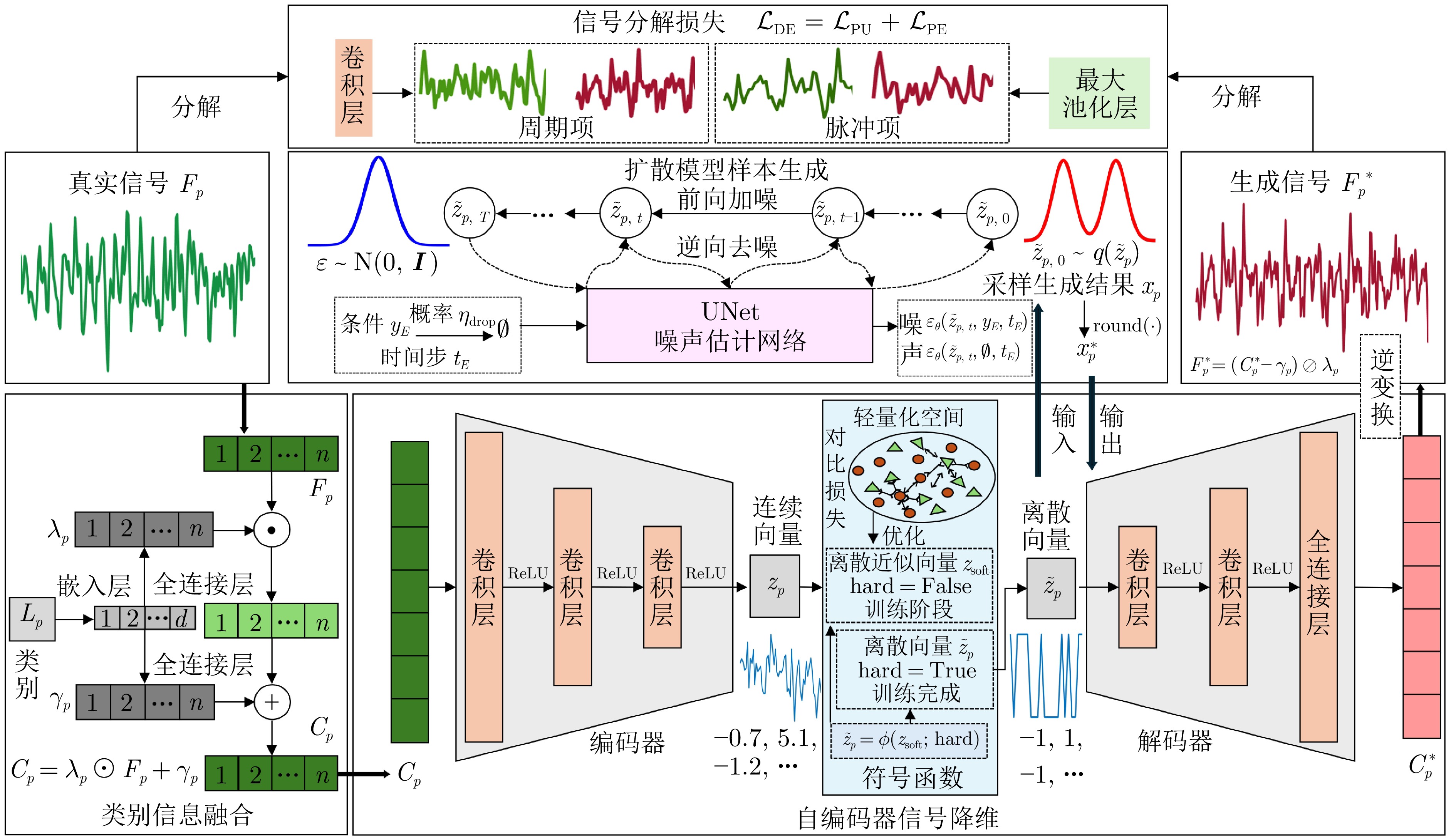
摘要: 深度学习模型为缓解数据不均衡问题提供了有效途径, 然而, 现有方法难以兼顾生成质量与计算效率, 例如生成对抗网络存在训练不稳定问题、扩散模型的计算复杂度较高. 为提高工业信号的可用性, 提出基于轻量化条件扩散模型的工业信号生成方法, 在保持扩散模型生成优势的同时显著提高训练效率, 并降低模型推理计算量. 该方法主要分为自编码器信号降维与扩散模型样本生成两个阶段. 阶段一基于自编码器建立原始信号的隐变量分布结果, 构建轻量化的低维空间, 以提高整体模型的计算效率; 阶段二通过条件扩散模型的马尔科夫链噪声推理过程, 对阶段一的输出结果进行重建, 以获取高质量的工业信号. 针对轻量化空间取值有限导致的类别混叠问题, 以聚合同类并区分异类为目标, 设计对比学习损失来提高空间中的类别区分度. 考虑到故障幅值分布特征表现为周期性衰减冲击, 提出分解损失函数来挖掘信号隐藏特征并提升生成样本质量. 在两种数据集上的实验结果表明, 该方法能够为工业系统提供可靠的数据支持.Abstract: Deep learning models provide an effective approach to alleviating the problem of data imbalance. However, generation quality and computational efficiency are difficult to balance in existing methods. For example, generative adversarial networks suffer from unstable training, while diffusion models require high computational complexity. To improve the usability of industrial signals, an industrial signal generation method based on a lightweight conditional diffusion model is proposed. The generation advantages of diffusion models are retained. Meanwhile, training efficiency is significantly improved, and the computational cost of model inference is reduced. The proposed method mainly consists of two stages: Signal dimensionality reduction using an autoencoder and sample generation using a diffusion model. In the first stage, the latent variable distribution results of the original signal are learned by an autoencoder. A lightweight low-dimensional space is then constructed to improve the computational efficiency of the overall model. In the second stage, the output result of the first stage is reconstructed through the Markov-chain-based noise inference process of a conditional diffusion model. High-quality industrial signals are thereby generated. The limited range of values in the lightweight space may cause class confusion. To address this problem, a contrastive learning loss is designed to aggregate samples from the same class and separate samples from different classes. Consequently, class discriminability in the lightweight space is improved. Fault amplitude distributions are characterized by periodic decaying impulses. Therefore, a decomposition loss function is proposed to capture hidden signal characteristics and improve the quality of generated samples. Experimental results on two datasets demonstrate that the proposed method can provide reliable data support for industrial systems.
-
Key words:
- generative model /
- neural network /
- diffusion model /
- autoencoder /
- contrastive learning
-
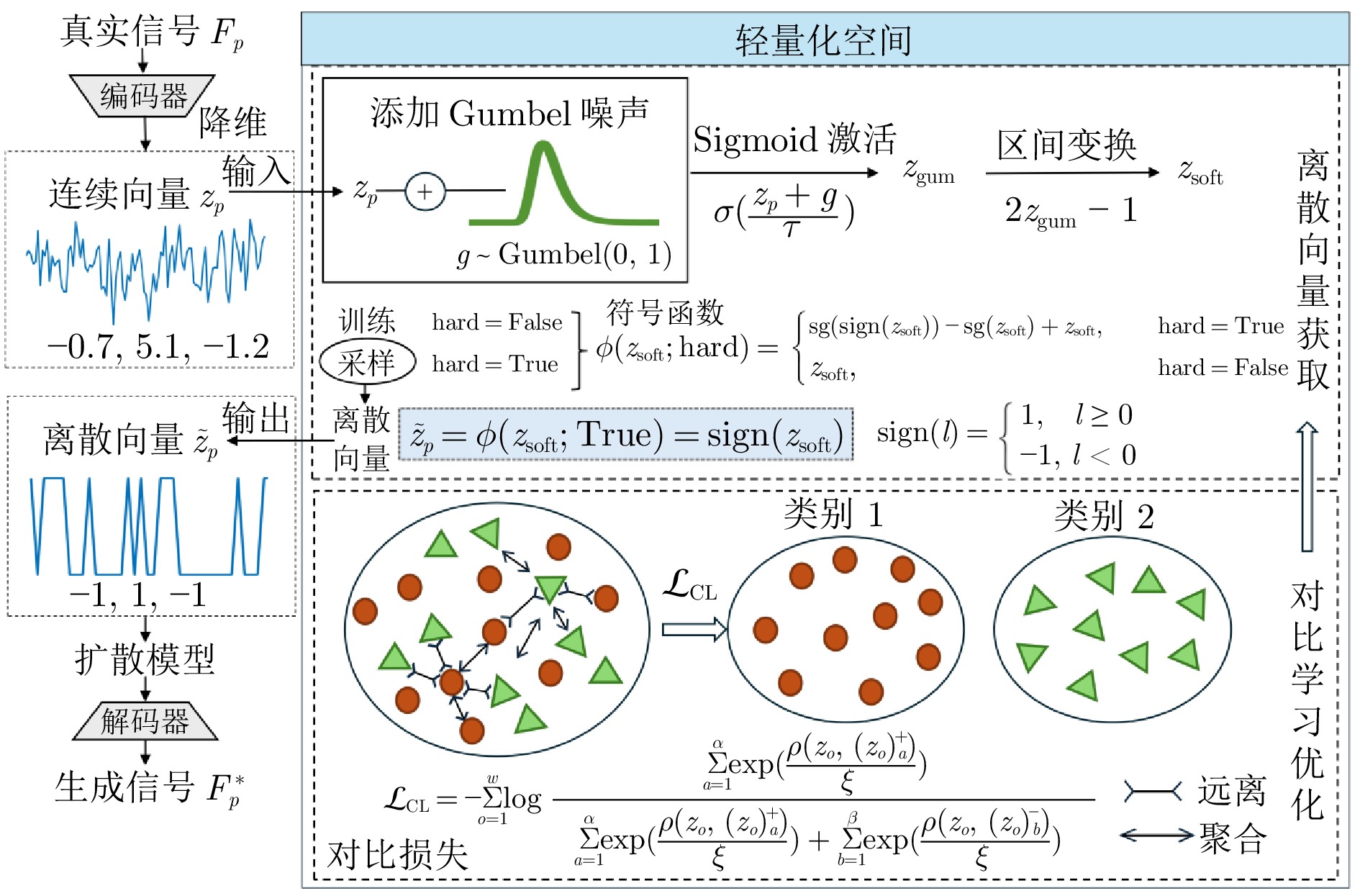
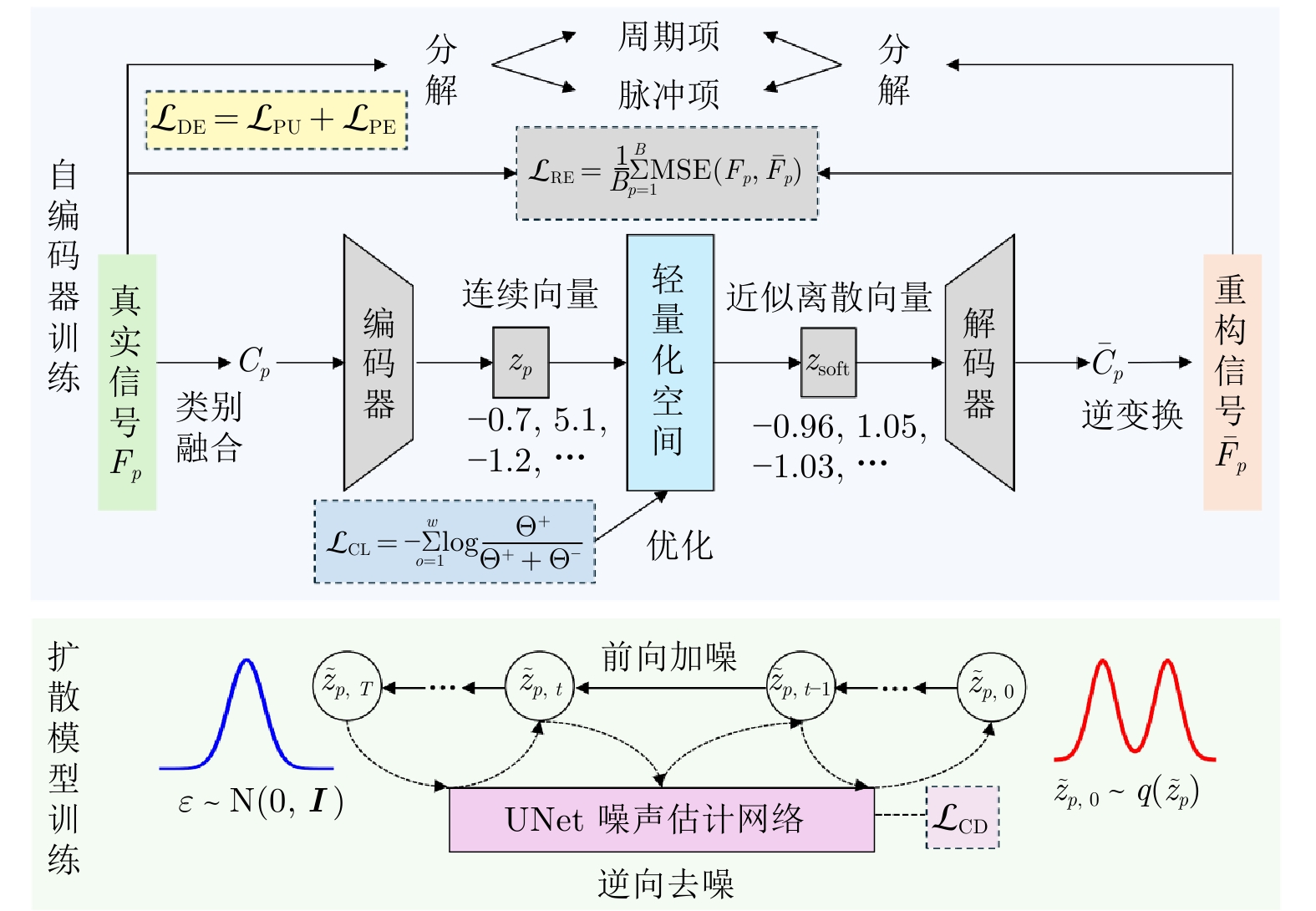
图 2 基于自编码器的轻量化空间信号降维
Fig. 2 Autoencoder-based signal dimensionality reduction in the lightweight space
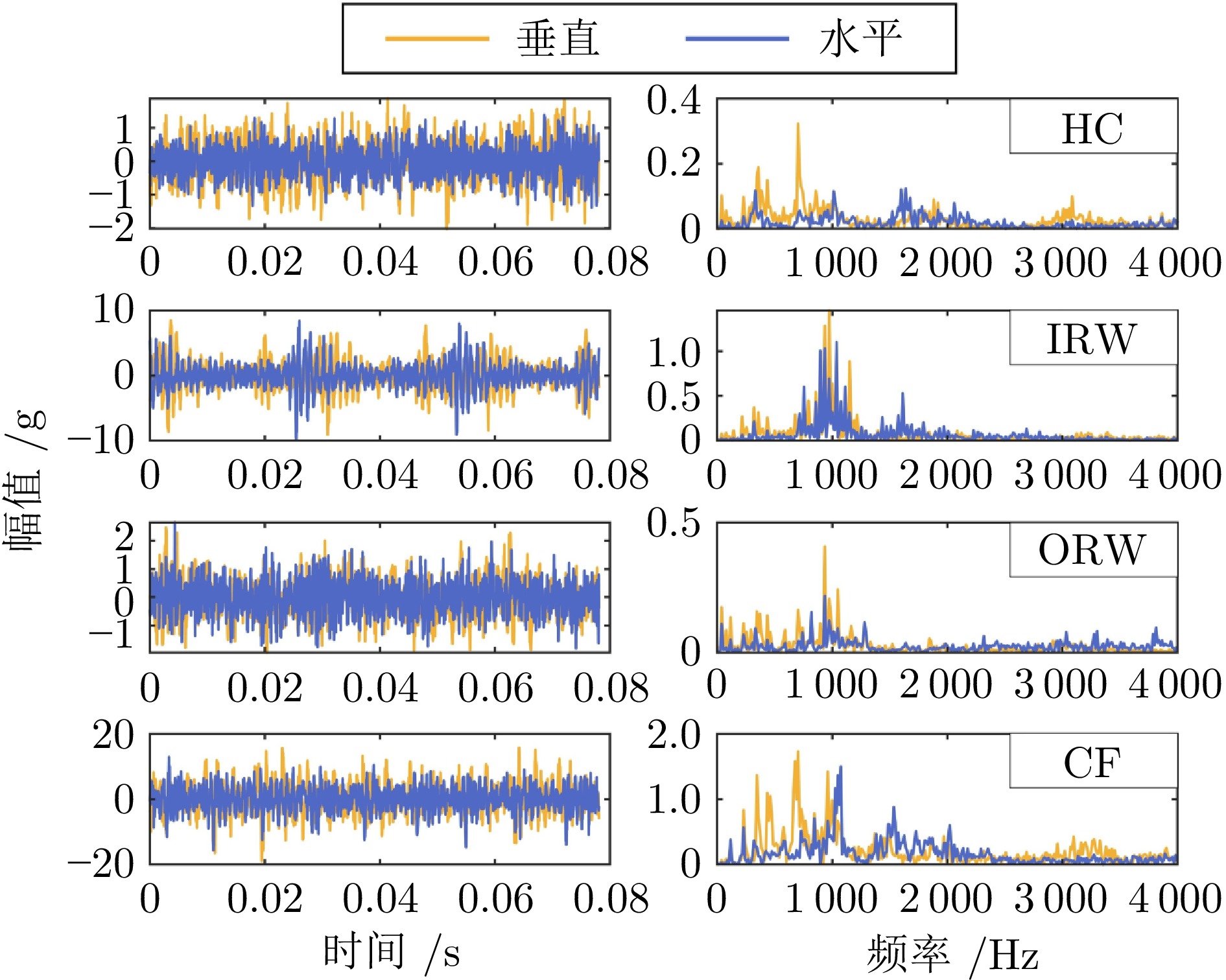
图 6 XJTU-SY数据集时频域波形
Fig. 6 Time- and frequency-domain waveforms of the XJTU-SY dataset
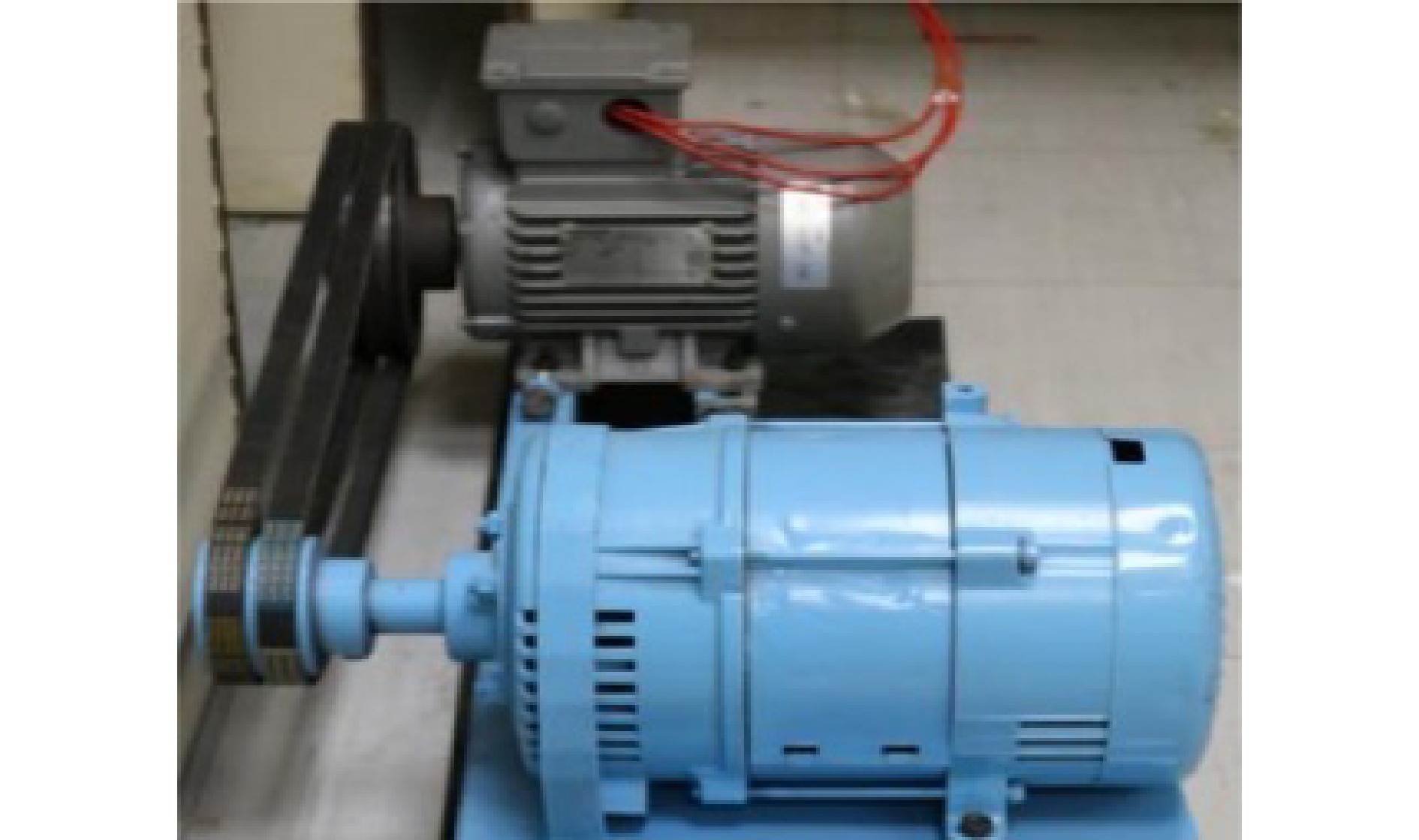
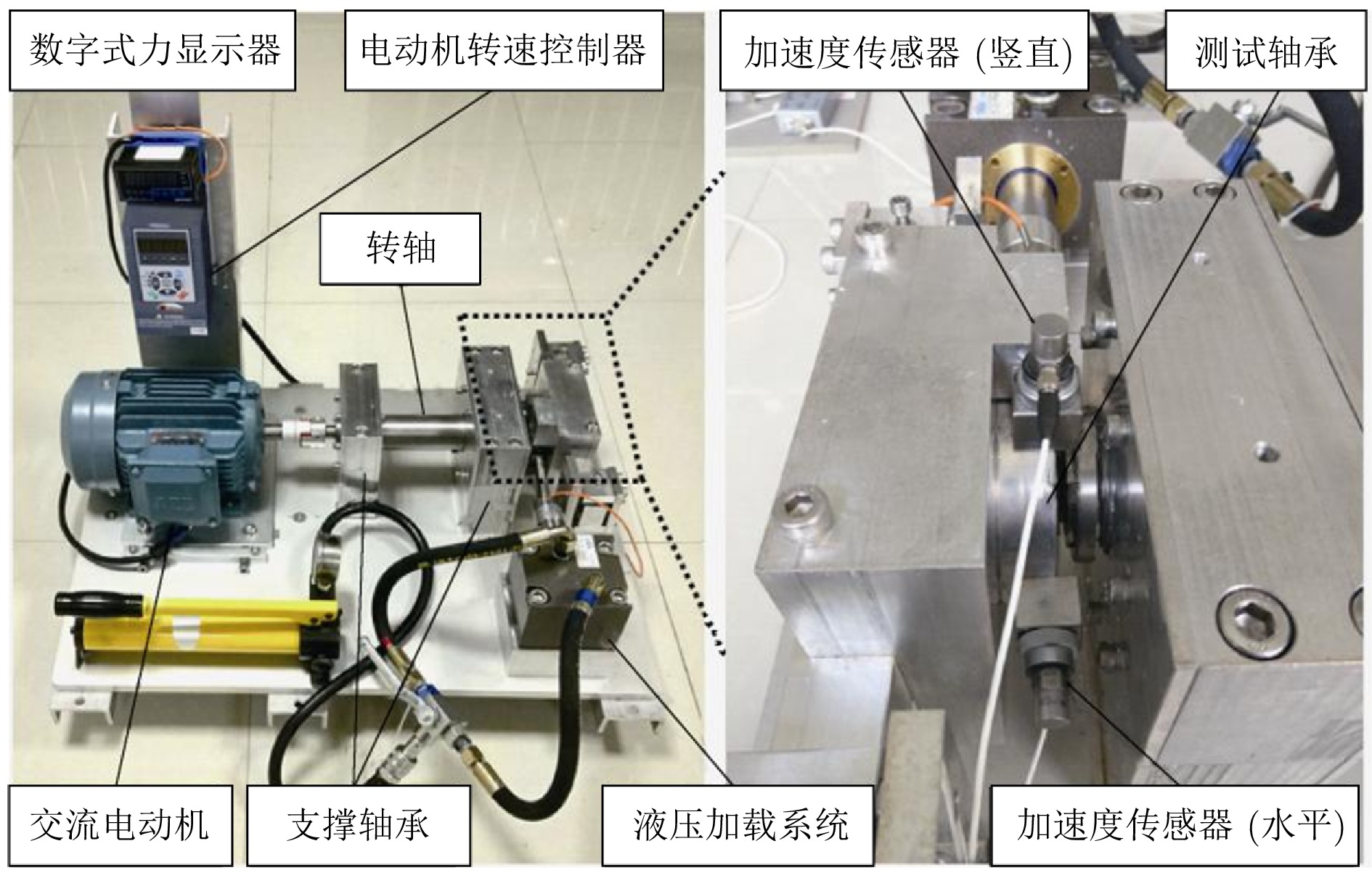
图 7 三轴轴承振动数据集实验平台
Fig. 7 Experimental platform for the triaxial bearing vibration dataset
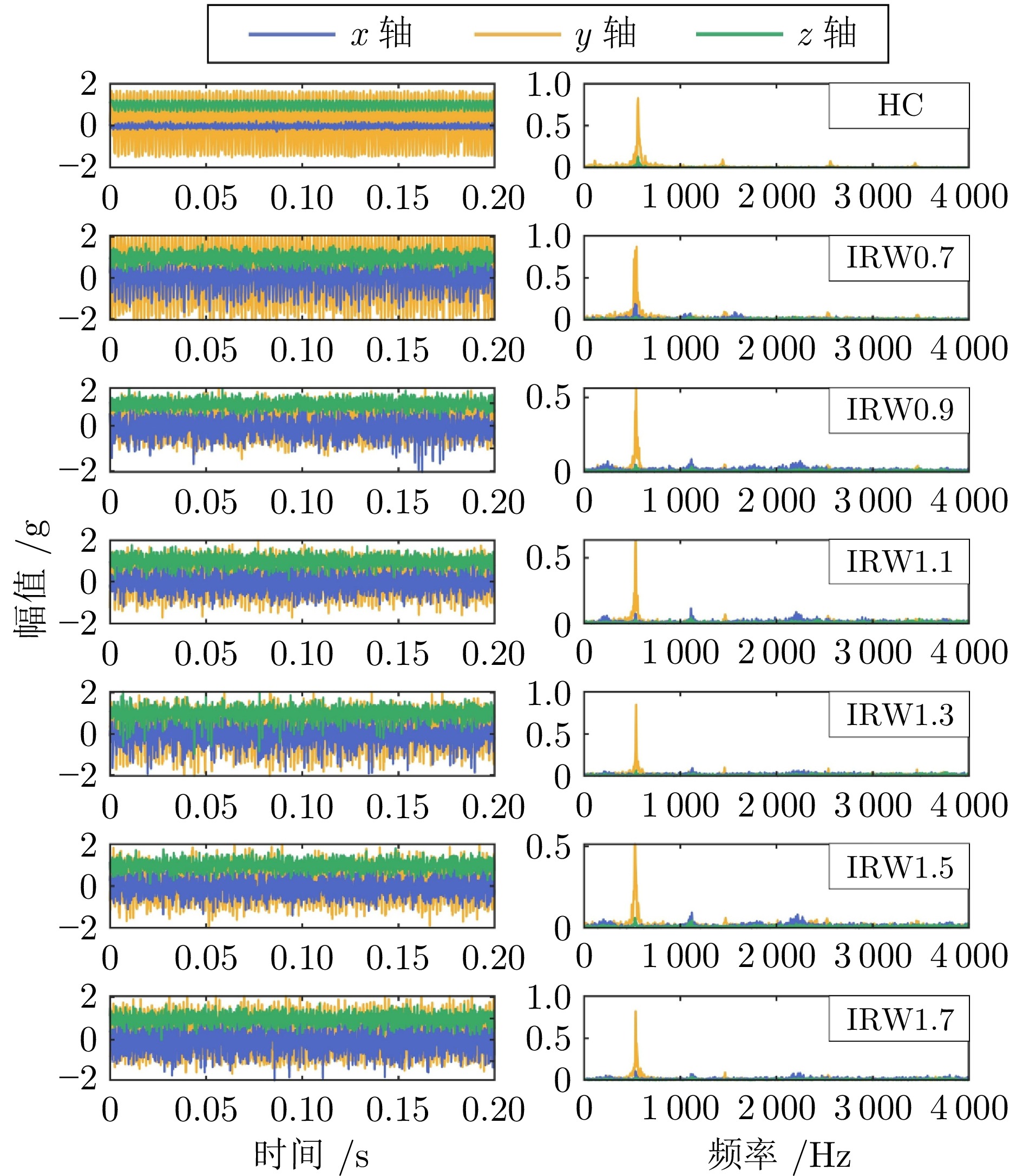
图 8 三轴轴承振动数据集时频域波形
Fig. 8 Time- and frequency-domain waveforms of the triaxial bearing vibration dataset
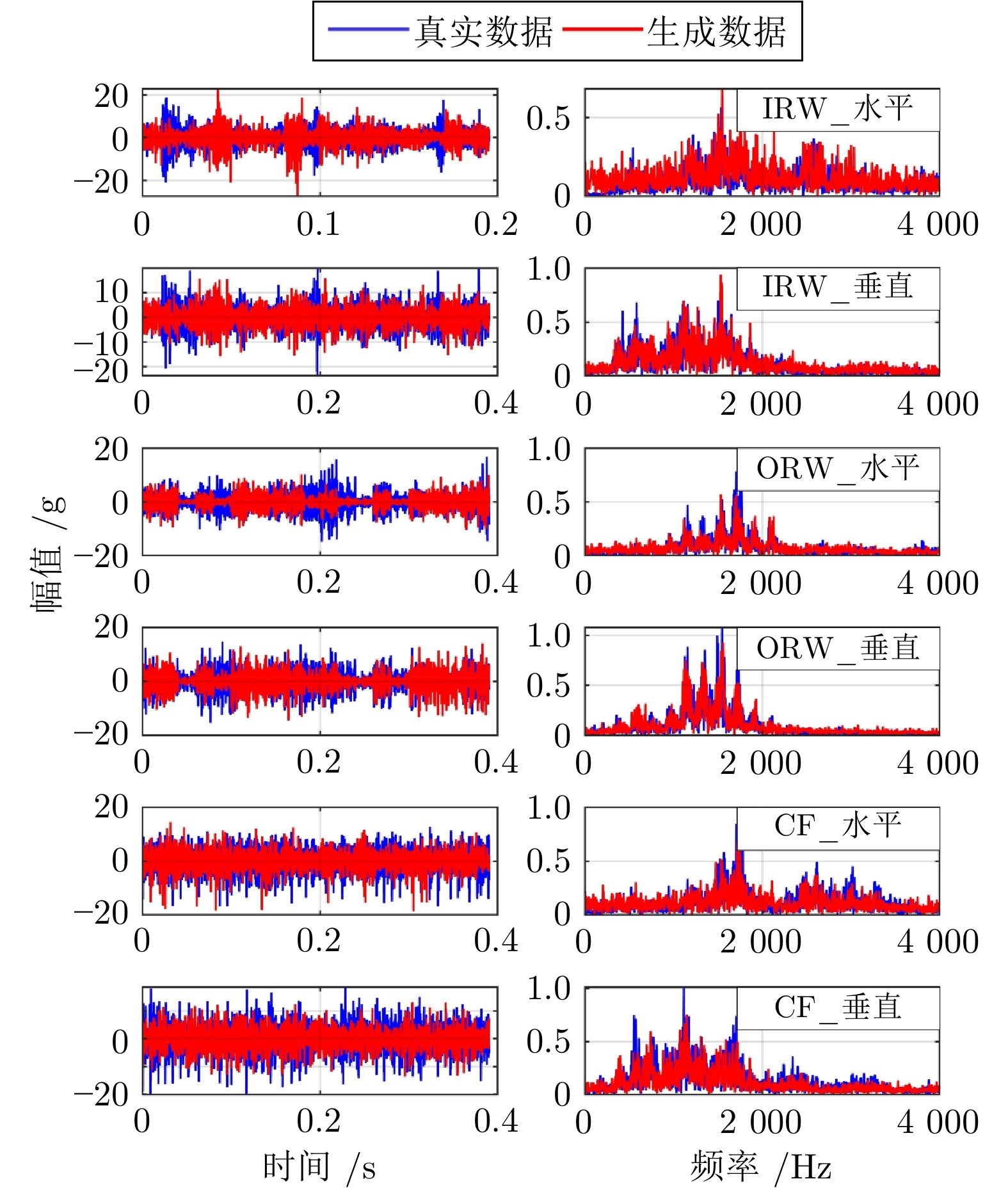
图 9 XJTU-SY数据集生成信号的时频域分析
Fig. 9 Time- and frequency-domain analysis of signals generated on the XJTU-SY dataset
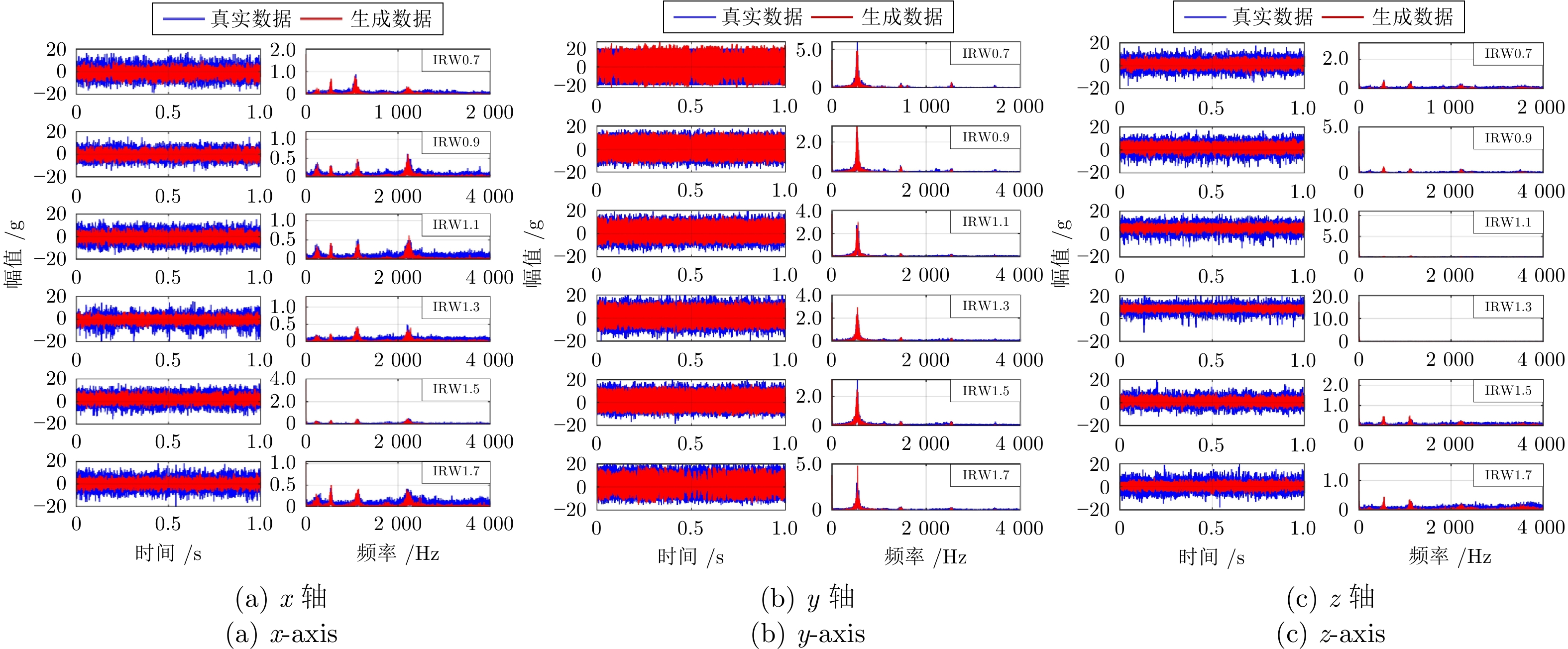
图 10 三轴轴承振动数据集生成信号的时频域分析
Fig. 10 Time- and frequency-domain analysis of signals generated on the triaxial bearing vibration dataset
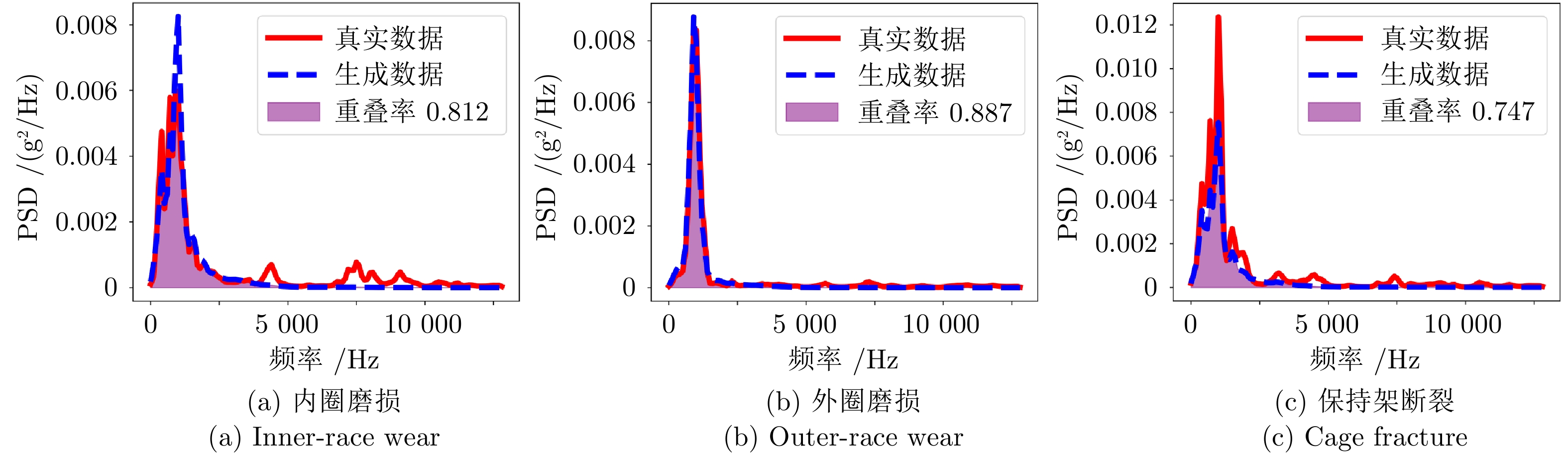
图 11 XJTU-SY数据集上生成信号与真实样本之间的PSD重叠度
Fig. 11 PSD overlap between signals generated and real samples on the XJTU-SY dataset
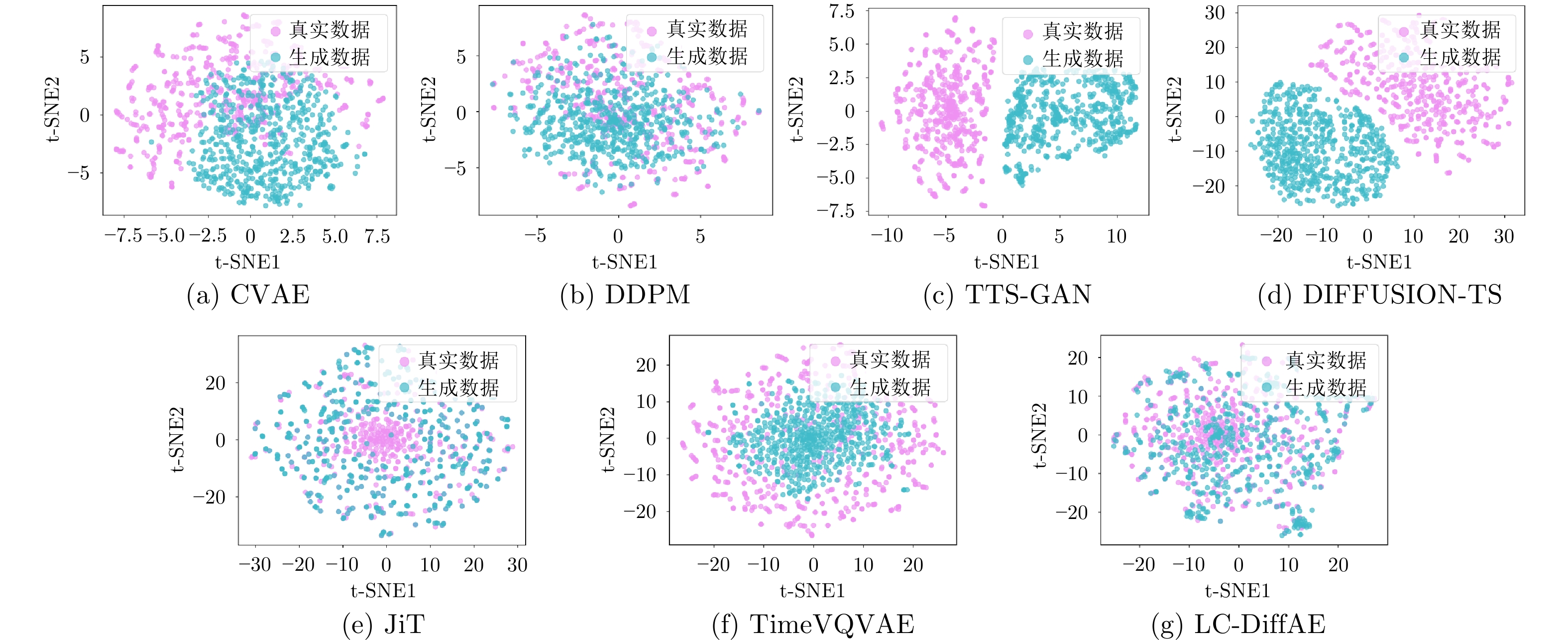
图 12 XJTU-SY数据集外圈磨损的t-SNE降维可视化
Fig. 12 t-SNE dimensionality reduction visualization of outer-race wear on the XJTU-SY dataset
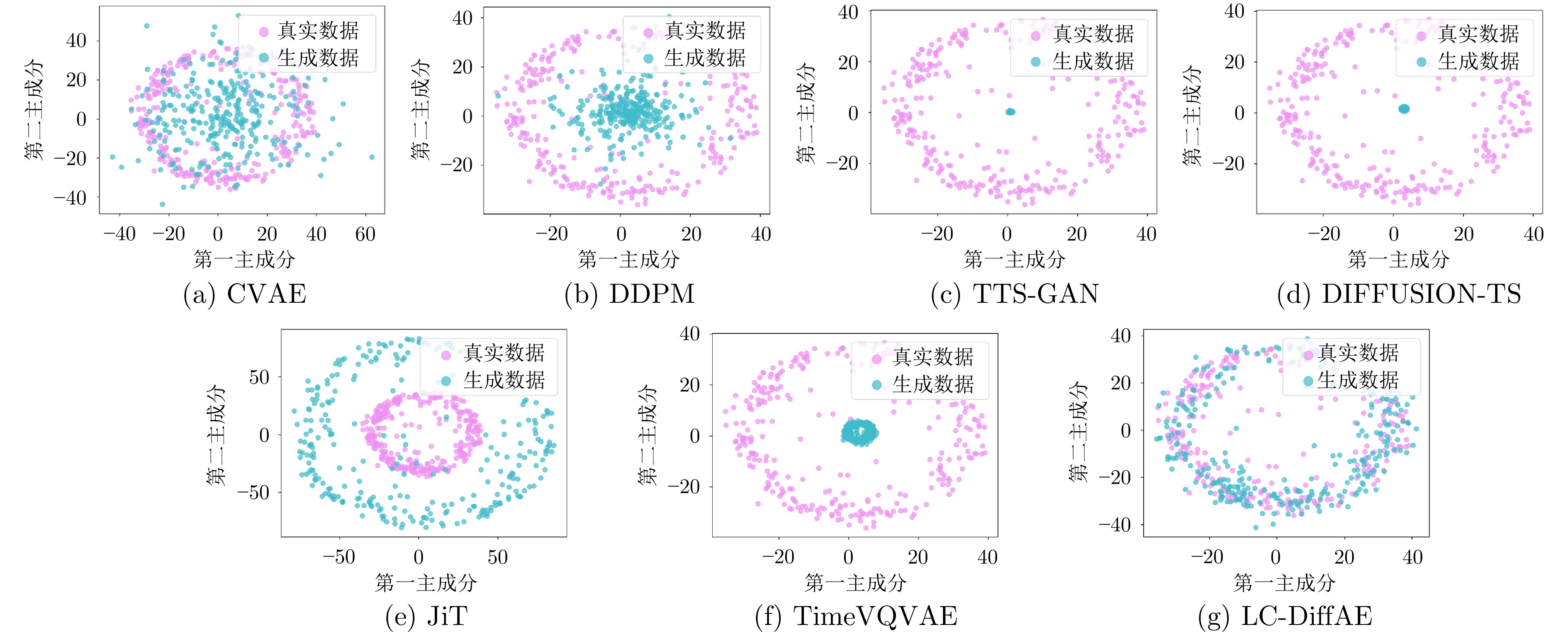
图 13 三轴轴承振动数据集内圈磨损的PCA降维可视化(损伤直径为1.1 mm)
Fig. 13 PCA dimensionality reduction visualization of inner-race wear on the triaxial bearing vibration dataset (damage diameter: 1.1 mm)
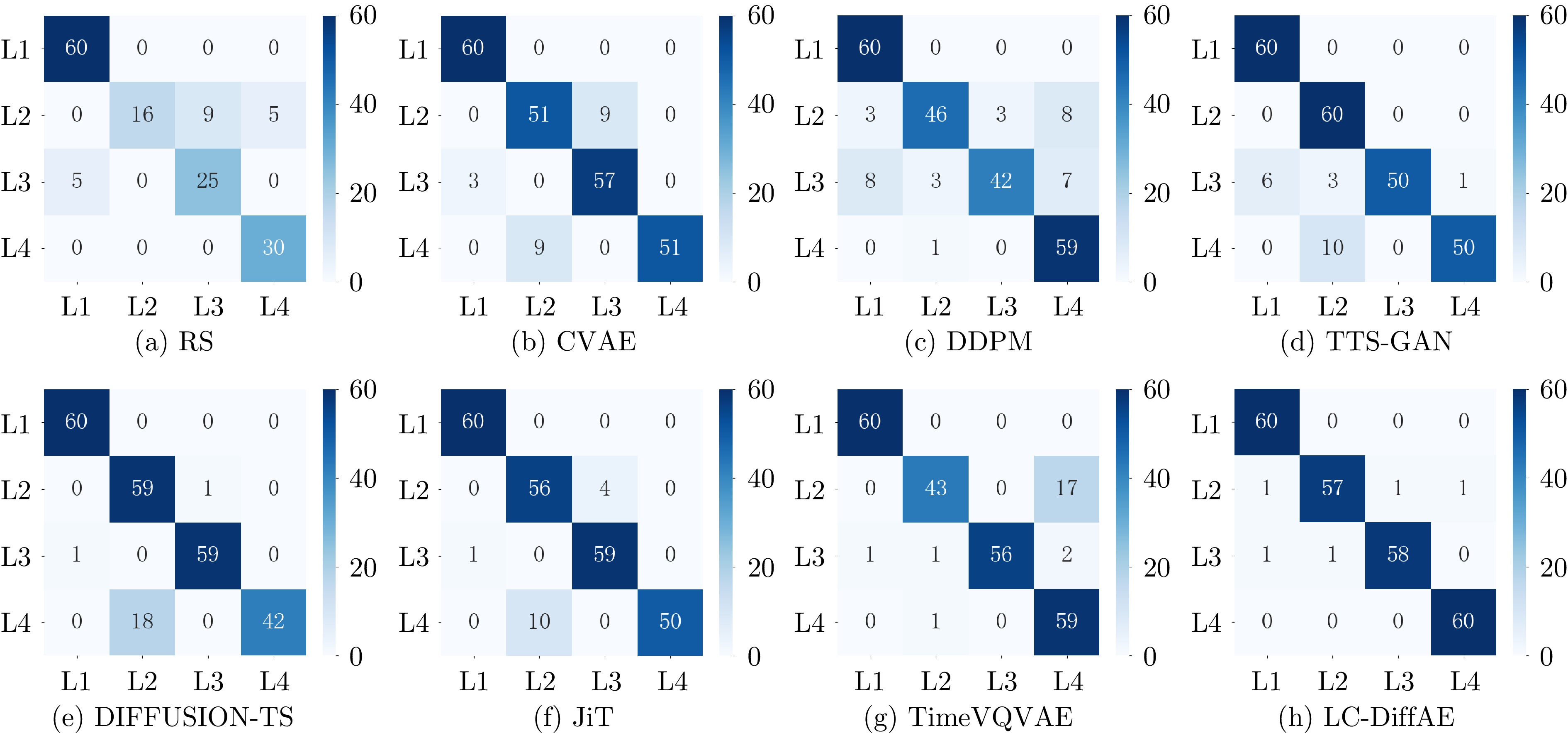
图 14 XJTU-SY数据集在1 : 2不均衡率下的混淆矩阵 (横轴: 预测类别, 纵轴: 真实类别)
Fig. 14 Confusion matrix for the XJTU-SY dataset at an imbalance ratio of 1 : 2 (horizontal axis: Predicted class, vertical axis: True class)
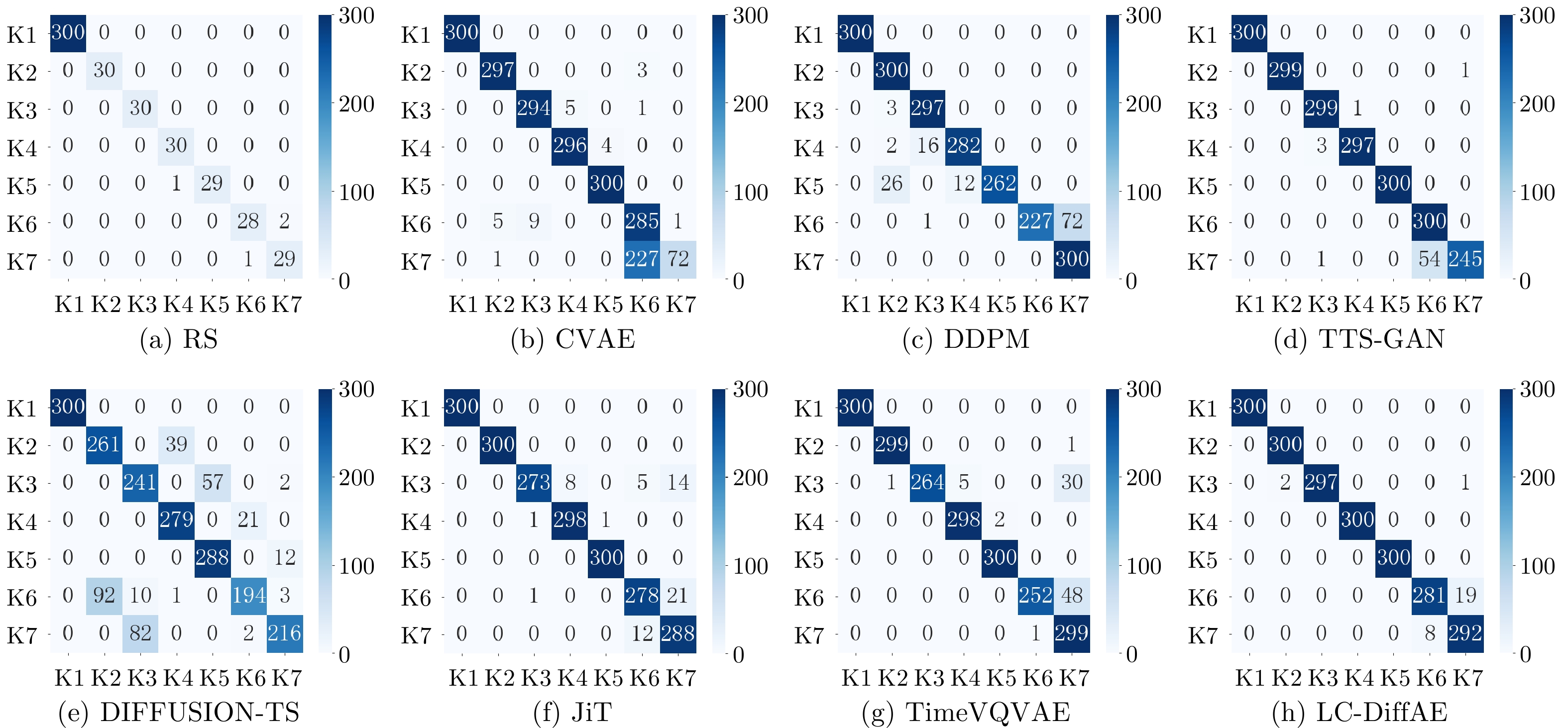
图 15 三轴轴承振动数据集在1 : 10不均衡率下的混淆矩阵 (横轴: 预测类别, 纵轴: 真实类别)
Fig. 15 Confusion matrix for the triaxial bearing vibration dataset at an imbalance ratio of 1 : 10 (horizontal axis: Predicted class, vertical axis: True class)
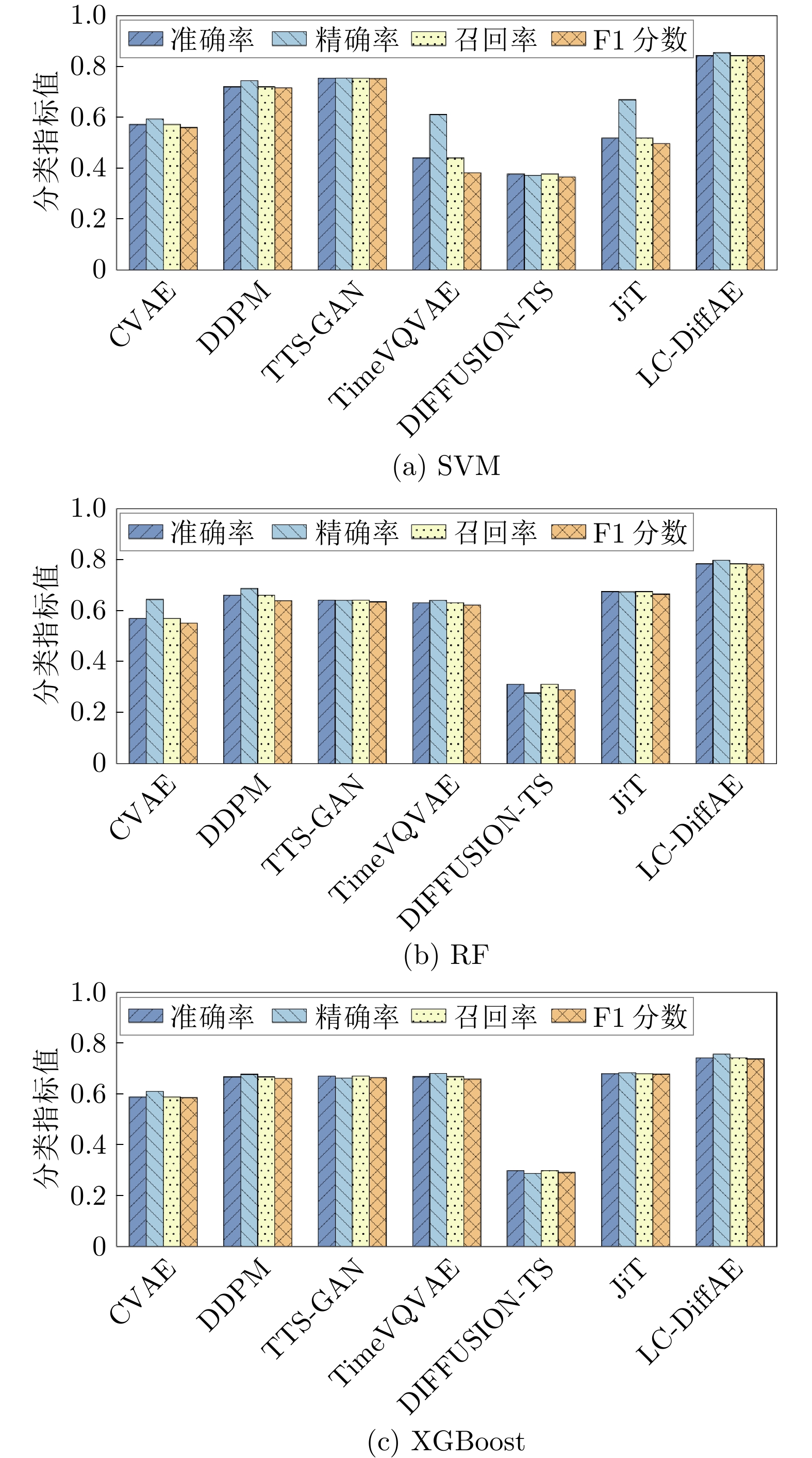
图 16 生成模型在不同分类器上的故障诊断结果
Fig. 16 Fault diagnosis results of generative models using different classifiers
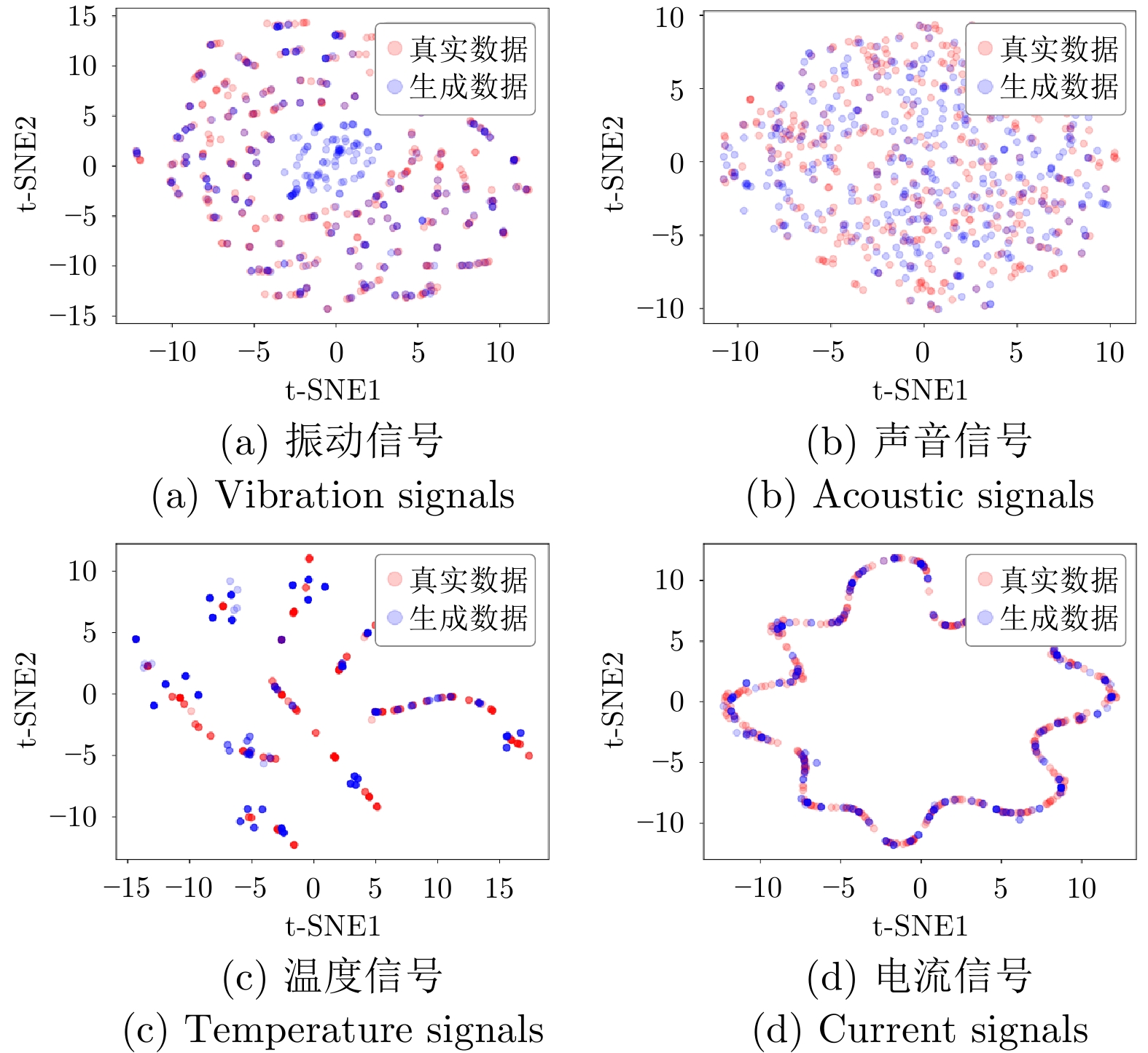
图 17 不同类型工业信号生成样本的t-SNE可视化结果
Fig. 17 t-SNE visualization results of different types of industrial signal generated samples
表 1 实验设置和参数对比
Table 1 Comparison of experimental settings and parameters
模型 组成模块 训练批次 训练轮次
($ \times\; 10^{3} $)学习率
($ \times\; 10^{-4} $)优化器 CVAE — 128 50 5 Adam DDPM — 64 5 20 AdamW TTS-GAN — 128 10 50 AdamW DIFFUSION-TS — 32 20 2 Adam JiT — 64 1 1 AdamW TimeVQVAE A1 32 5 50 AdamW A2 32 5 50 AdamW LC-DiffAE B1 128 20 2 Adam B2 128 10 3 AdamW 注: A1表示TimeVQVAE训练与码本生成, A2表示码本学习与数据生 成; B1表示自编码器样本降维, B2表示扩散模型样本生成.  下载: 导出CSV
表 2 相似性、多样性指标的表达式及值域
Table 2 Expressions and value ranges of similarity and diversity metrics
指标 类型 定义 表达式 值域 JSD$ \downarrow $ 相似性指标 计算$P(x)$、$Q(x)$和$M(x)$的KL散度平均值, 以评估分布差异 $ \text{JSD}(P\|Q) = \dfrac{\mathrm{KL}(P\|M)+\mathrm{KL}(Q\|M)}{2} $ $ [0,\;1] $ WD$ \downarrow $ 相似性指标 衡量将概率分布$P(x)$转化为另一个分布$Q(x)$所需的最小传输代价 $ \text{WD}(P,\;Q) = \left( \inf\limits_{\gamma\in\Gamma(P,\;Q)} \int \|x-y\|^{p}\,\; \mathrm{d}\gamma(x,\;y) \right)^{1/p} $ $ [0,\;+\infty) $ MMD$ \downarrow $ 相似性指标 一种基于核的非参数度量, 用于估计分布在再生核希尔伯特空间中的均值嵌入差异 $ \begin{gathered} \text{MMD}^{2}(P,\;Q) = \mathrm{E}_{x,\;x'\sim P} \left[k(x,\;x')\right] +\\\qquad\qquad \mathrm{E}_{y,\;y'\sim Q} \left[k(y,\;y')\right] - 2\mathrm{E}_{x\sim P,\;y\sim Q} \left[k(x,\;y)\right] \end{gathered} $ $ [0,\;+\infty) $ CS$ \downarrow $ 相似性指标 通过计算分布之间的交叉相关矩阵绝对误差, 衡量分布的一致性程度 $ \text{CS}(P,\;Q) = \dfrac{1}{{D^{2}_s}} \sum\limits_{i=1}^{D_s} \sum\limits_{j=1}^{D_s} \left| R_{P}(i,\;j)-R_{Q}(i,\;j) \right| $ $ [0,\;2] $ DS$ \downarrow $ 相似性指标 用于区分不同类型的数据分布, 以反映分布之间的相似性 $ \text{DS}(P,\;Q) = \left| \mathrm{accuracy}-0.5 \right| $ $ [0,\;0.5] $ ICD$ \uparrow $ 多样性指标 计算同一类别生成样本$x_i$与$x_j$之间的平均距离$d$ $ \text{ICD} = \dfrac{2}{N_s(N_s-1)} \sum\limits_{i<j} d(x_i,\;x_j) $ $ [0,\;1] $ BGS$ \uparrow $ 多样性指标 在距离上下界约束内, 通过贪心算法选择与已选样本集合$S$差异较大的样本 $ \text{BGS} = \dfrac{1}{|S|} \sum\limits_{x_i\in S} \left[ 1-d(x_i,\;x_j) \right] $ $ [0,\;1] $ MGS$ \uparrow $ 多样性指标 通过正交基向量$q_j$, 计算新样本相对于已有样本特征$z_i$的正交残差 $ \text{MGS} = \dfrac{1}{N_s} \sum\limits_{i=1}^{N_s} \left\| z_i- \sum\limits_{j=1}^{i-1} \left(q_j^{\mathrm{T}}z_i\right)q_j \right\|_{2} $ $ [0,\;1] $ 注: $ \downarrow $表示指标值越小, 分布间的相似程度越高; $ \uparrow $表示指标值越大, 生成样本的多样性越高.
下载: 导出CSV
表 3 相似性指标度量结果
Table 3 Similarity metric evaluation results
数据集 指标 CVAE DDPM TTS-GAN DIFFUSION-TS JiT TimeVQVAE LC-DiffAE XJTU-SY JSD 0.145 ± 0.021 0.241 ± 0.017 0.162 ± 0.013 0.602 ± 0.011 0.156 ± 0.008 0.350 ± 0.042 0.123 ± 0.013 WD 1.423 ± 0.010 5.600 ± 0.108 1.013 ± 0.017 2.784 ± 0.044 1.472 ± 0.020 2.355 ± 0.032 0.990 ± 0.020 MMD 0.073 ± 0.011 0.075 ± 0.007 0.280 ± 0.051 0.161 ± 0.012 0.042 ± 0.007 0.126 ± 0.012 0.017 ± 0.003 CS 0.011 ± 0.003 0.019 ± 0.003 0.039 ± 0.011 0.008 ± 0.002 0.004 ± 0.002 0.007 ± 0.002 0.009 ± 0.002 DS 0.287 ± 0.018 0.270 ± 0.019 0.438 ± 0.014 0.431 ± 0.022 0.096 ± 0.012 0.450 ± 0.026 0.149 ± 0.012 三轴轴承振动 JSD 0.452 ± 0.016 0.420 ± 0.013 0.421 ± 0.045 0.620 ± 0.019 0.227 ± 0.024 0.491 ± 0.043 0.225 ± 0.013 WD 3.715 ± 0.096 3.704 ± 0.071 3.670 ± 0.067 5.472 ± 0.084 2.971 ± 0.089 5.001 ± 0.076 1.423 ± 0.025 MMD 0.147 ± 0.005 0.077 ± 0.005 0.244 ± 0.005 0.226 ± 0.036 0.073 ± 0.014 0.229 ± 0.035 0.015 ± 0.003 CS 0.041 ± 0.012 0.026 ± 0.002 0.127 ± 0.013 0.009 ± 0.002 0.049 ± 0.013 0.036 ± 0.004 0.025 ± 0.007 DS 0.478 ± 0.012 0.312 ± 0.016 0.470 ± 0.011 0.480 ± 0.006 0.469 ± 0.013 0.490 ± 0.002 0.476 ± 0.005
下载: 导出CSV
表 4 不同模型生成样本与真实样本之间的分布重叠度比较
Table 4 Comparison of distribution overlap between generated and real samples from different models
模型 XJTU-SY 三轴轴承振动 PSD KDE PSD KDE CVAE 0.549 0.818 0.506 0.693 DDPM 0.391 0.618 0.430 0.580 TTS-GAN 0.311 0.823 0.333 0.508 DIFFUSION-TS 0.063 0.103 0.125 0.084 JiT 0.914 0.927 0.708 0.698 TimeVQVAE 0.184 0.282 0.025 0.272 LC-DiffAE 0.815 0.936 0.734 0.841
下载: 导出CSV
表 5 多样性指标定量评估结果
Table 5 Quantitative evaluation results of diversity metrics
模型 XJTU-SY 三轴轴承振动 ICD BGS MGS ICD BGS MGS CVAE 0.803 0.739 0.749 0.646 0.457 0.499 DDPM 0.921 0.776 0.732 0.744 0.674 0.757 TTS-GAN 0.122 0.094 0.203 0.009 0.001 0.093 DIFFUSION-TS 0.015 0.040 0.109 0.084 0.056 0.211 JiT 0.974 0.777 0.763 0.834 0.371 0.542 TimeVQVAE 0.881 0.778 0.786 0.809 0.474 0.652 LC-DiffAE 0.969 0.882 0.887 0.899 0.701 0.723
下载: 导出CSV
表 6 不同不均衡率下的分类结果
Table 6 Classification results under different imbalance ratios
不均
衡率数据集 指标 真实信号 CVAE DDPM TTS-GAN DIFFUSION-TS JiT TimeVQVAE LC-DiffAE 1 : 2 准确率 $0.871 \pm 0.030$ $0.914 \pm 0.015$ $0.847 \pm 0.038$ $0.921 \pm 0.017$ $0.896 \pm 0.040$ $0.936 \pm 0.016$ $0.910 \pm 0.010$ 0.974 ± 0.010 XJTU-
SY精确率 $0.873 \pm 0.021$ $0.922 \pm 0.018$ $0.850 \pm 0.043$ $0.928 \pm 0.013$ $0.920 \pm 0.017$ $0.944 \pm 0.014$ $0.917 \pm 0.011$ 0.974 ± 0.009 召回率 $0.839 \pm 0.038$ $0.914 \pm 0.015$ $0.847 \pm 0.038$ $0.921 \pm 0.017$ $0.896 \pm 0.040$ $0.936 \pm 0.016$ $0.910 \pm 0.010$ 0.974 ± 0.010 F1分数 $0.838 \pm 0.044$ $0.914 \pm 0.015$ $0.843 \pm 0.039$ $0.920 \pm 0.007$ $0.892 \pm 0.045$ $0.936 \pm 0.017$ $0.909 \pm 0.011$ 0.974 ± 0.010 准确率 $0.977 \pm 0.014$ $0.931 \pm 0.019$ $0.952 \pm 0.015$ $0.963 \pm 0.016$ $0.929 \pm 0.020$ $0.977 \pm 0.026$ $0.971 \pm 0.008$ 0.987 ± 0.012 三轴轴承
振动精确率 $0.974 \pm 0.016$ $0.951 \pm 0.007$ $0.963 \pm 0.011$ $0.967 \pm 0.012$ $0.932 \pm 0.018$ $0.978 \pm 0.016$ $0.974 \pm 0.005$ 0.987 ± 0.009 召回率 $0.974 \pm 0.016$ $0.931 \pm 0.019$ $0.952 \pm 0.015$ $0.963 \pm 0.016$ $0.929 \pm 0.020$ $0.977 \pm 0.013$ $0.971 \pm 0.008$ 0.987 ± 0.012 F1分数 $0.974 \pm 0.016$ $0.929 \pm 0.020$ $0.952 \pm 0.016$ $0.963 \pm 0.017$ $0.929 \pm 0.020$ $0.977 \pm 0.026$ $0.971 \pm 0.008$ 0.987 ± 0.014 1 : 5 准确率 $0.932 \pm 0.005$ $0.908 \pm 0.056$ $0.843 \pm 0.032$ $0.921 \pm 0.013$ $0.853 \pm 0.074$ $0.943 \pm 0.017$ $0.902 \pm 0.010$ 0.961 ± 0.010 XJTU-
SY精确率 $0.892 \pm 0.002$ $0.929 \pm 0.026$ $0.848 \pm 0.032$ $0.924 \pm 0.012$ $0.893 \pm 0.043$ $0.949 \pm 0.020$ $0.914 \pm 0.002$ 0.961 ± 0.010 召回率 $0.864 \pm 0.010$ $0.908 \pm 0.056$ $0.843 \pm 0.032$ $0.921 \pm 0.013$ $0.853 \pm 0.074$ $0.943 \pm 0.017$ $0.902 \pm 0.010$ 0.961 ± 0.010 F1分数 $0.867 \pm 0.015$ $0.902 \pm 0.064$ $0.841 \pm 0.032$ $0.920 \pm 0.012$ $0.833 \pm 0.091$ $0.943 \pm 0.009$ $0.900 \pm 0.011$ 0.960 ± 0.010 准确率 $0.973 \pm 0.018$ $0.924 \pm 0.010$ $0.954 \pm 0.022$ $0.956 \pm 0.018$ $0.893 \pm 0.024$ $0.970 \pm 0.009$ $0.966 \pm 0.013$ 0.988 ± 0.006 三轴轴承
振动精确率 $0.961 \pm 0.026$ $0.946 \pm 0.003$ $0.960 \pm 0.014$ $0.959 \pm 0.015$ $0.897 \pm 0.021$ $0.970 \pm 0.008$ $0.971 \pm 0.012$ 0.989 ± 0.009 召回率 $0.958 \pm 0.028$ $0.924 \pm 0.010$ $0.954 \pm 0.022$ $0.956 \pm 0.018$ $0.893 \pm 0.024$ $0.970 \pm 0.009$ $0.966 \pm 0.013$ 0.988 ± 0.006 F1分数 $0.958 \pm 0.029$ $0.918 \pm 0.013$ $0.953 \pm 0.012$ $0.955 \pm 0.020$ $0.893 \pm 0.023$ $0.970 \pm 0.009$ $0.965 \pm 0.021$ 0.988 ± 0.012 1 : 10 准确率 $0.950 \pm 0.030$ $0.908 \pm 0.005$ $0.869 \pm 0.035$ $0.886 \pm 0.044$ $0.861 \pm 0.054$ 0.961 ± 0.011 $0.916 \pm 0.008$ $0.952 \pm 0.015$ XJTU-
SY精确率 $0.871 \pm 0.053$ $0.919 \pm 0.011$ $0.871 \pm 0.035$ $0.896 \pm 0.040$ $0.893 \pm 0.032$ 0.966 ± 0.008 $0.924 \pm 0.005$ $0.952 \pm 0.008$ 召回率 $0.836 \pm 0.096$ $0.908 \pm 0.005$ $0.869 \pm 0.035$ $0.886 \pm 0.044$ $0.861 \pm 0.054$ 0.961 ± 0.011 $0.916 \pm 0.008$ $0.952 \pm 0.015$ F1分数 $0.818 \pm 0.126$ $0.907 \pm 0.005$ $0.867 \pm 0.037$ $0.884 \pm 0.043$ $0.845 \pm 0.068$ 0.960 ± 0.012 $0.915 \pm 0.008$ $0.952 \pm 0.011$ 准确率 $0.980 \pm 0.006$ $0.882 \pm 0.018$ $0.940 \pm 0.014$ $0.975 \pm 0.012$ $0.830 \pm 0.049$ $0.958 \pm 0.024$ $0.960 \pm 0.016$ 0.986 ± 0.006 三轴轴承
振动精确率 $0.961 \pm 0.010$ $0.917 \pm 0.012$ $0.949 \pm 0.010$ $0.978 \pm 0.009$ $0.835 \pm 0.051$ $0.962 \pm 0.017$ $0.966 \pm 0.014$ 0.987 ± 0.008 召回率 $0.955 \pm 0.014$ $0.882 \pm 0.018$ $0.940 \pm 0.014$ $0.975 \pm 0.012$ $0.830 \pm 0.049$ $0.958 \pm 0.024$ $0.960 \pm 0.016$ 0.986 ± 0.006 F1分数 $0.954 \pm 0.015$ $0.863 \pm 0.034$ $0.939 \pm 0.014$ $0.974 \pm 0.012$ $0.829 \pm 0.049$ $0.958 \pm 0.024$ $0.960 \pm 0.016$ 0.986 ± 0.009
下载: 导出CSV
表 7 各模型计算开销与生成性能对比
Table 7 Comparison of computational costs and generation performance among different models
模型 扩散模型 组成模块 训练时间(10轮) (s) 采样时间(s) 推理计算量(GFLOPs) 参数量(M) MMD PSD KDE 分类准确率 CVAE 否 — 0.068 1.680 0.002 1.221 0.073 0.549 0.818 0.908 DDPM 是 — 35.170 546.282 0.053 1.985 0.075 0.391 0.618 0.843 TTS-GAN 否 — 9.018 2.441 0.008 13.008 0.280 0.311 0.823 0.921 DIFFUSION-TS 是 — 3.140 2001.260 2.282 3.488 0.161 0.063 0.103 0.853 JiT 是 — 91.140 3953.101 9.273 129.722 0.042 0.914 0.927 0.943 A1 59.956 1.980 0.015 0.353 TimeVQVAE 否 A2 30.016 3.134 0.026 1.803 0.126 0.184 0.282 0.902 完整模型 89.972 5.114 0.041 2.156 B1 0.682 1.958 0.003 1.333 LC-DiffAE 是 B2 7.411 142.132 0.004 1.984 0.017 0.816 0.936 0.961 完整模型 8.093 144.090 0.007 3.317
下载: 导出CSV
表 8 消融实验结果
Table 8 Ablation study results
模型 JSD WD MMD PSD 分类准确率 1 : 2 1 : 5 1 : 10 A 0.123 0.990 0.017 0.816 0.974 0.961 0.952 B 0.554 2.956 0.238 0.035 0.923 0.919 0.925 $ \mathrm{B}^{\prime} $ 0.130 1.002 0.021 0.761 0.957 0.943 0.941 $ \mathrm{B}^{\prime\prime} $ 0.132 1.091 0.049 0.623 0.948 0.920 0.901 C 0.130 0.931 0.011 0.805 0.953 0.941 0.916 D 0.151 1.094 0.008 0.772 0.888 0.897 0.844 E 0.122 1.151 0.024 0.650 0.942 0.893 0.868 F 0.105 0.959 0.022 0.786 0.844 0.918 0.900
下载: 导出CSV
表 9 $ c $、$ \eta_{\mathrm{drop}} $和$ \xi $的敏感度分析结果
Table 9 Sensitivity analysis results for $ c $, $ \eta_{\mathrm{drop}} $ and $ \xi $
参数 指标 0.01 0.05 0.10 0.30 0.50 1.00 3.00 $ c $ JSD 0.083 0.082 0.082 0.082 0.082 0.082 0.083 WD 0.935 0.923 0.924 0.928 0.950 0.932 0.944 MMD 0.008 0.009 0.009 0.009 0.009 0.009 0.008 $ \eta_{\mathrm{drop}} $ JSD 0.084 0.083 0.082 0.083 0.085 — — WD 0.978 0.963 0.954 0.968 0.968 — — MMD 0.006 0.005 0.006 0.005 0.006 — — $ \xi $ JSD $ \times $ 0.082 0.082 0.083 0.081 0.082 0.082 WD $ \times $ 0.930 0.940 0.950 0.913 0.941 0.923 MMD $ \times $ 0.004 0.005 0.004 0.006 0.005 0.005 注: $ \times $表示模型训练异常; — 表示无对应结果.
下载: 导出CSV
表 10 分解损失与对比损失权重参数的敏感度分析结果
Table 10 Sensitivity analysis results for the weight parameters of the decomposition and contrastive losses
参数 指标 0.01 0.10 0.20 0.50 1.00 $ \omega_1 $ JSD 0.084 0.084 0.083 0.082 0.081 WD 0.975 0.977 0.950 0.932 0.923 MMD 0.006 0.005 0.005 0.006 0.005 $ \omega_2 $ JSD 0.082 0.083 0.084 0.082 0.083 WD 0.925 0.950 0.969 0.939 0.945 MMD 0.004 0.005 0.005 0.005 0.007
下载: 导出CSV
表 11 不同类型工业信号生成样本的质量评估结果
Table 11 Quality evaluation results for generated samples of different types of industrial signals
信号类型 JSD WD MMD PSD KDE ICD 振动 0.088 1.119 0.006 0.813 0.935 0.928 声音 0.095 1.754 0.014 0.849 0.985 0.956 温度 0.688 11.744 0.006 0.742 0.935 0.990 电流 0.070 0.495 0.009 0.978 0.980 0.979
下载: 导出CSV
-
[1] 许水清, 柴晖, 胡友强, 黄大荣, 张可, 柴毅. 高速列车牵引电机转子断条和速度传感器联合诊断方法. 自动化学报, 2023, 49(6): 1214−1227Xu Shui-Qing, Chai Hui, Hu You-Qiang, Huang Da-Rong, Zhang Ke, Chai Yi. Simultaneous fault diagnosis of broken rotor bar and speed sensor for traction motor in high-speed train. Acta Automatica Sinica, 2023, 49(6): 1214−1227 [2] Shangguan A Q, Xie G, Mu L X, Fei R, Hei X H. Reliability modeling: Combining self-healing characteristics and dynamic failure thresholds. Quality Technology & Quantitative Management, 2024, 21(3): 363−385 doi: 10.1080/16843703.2023.2202955 [3] Zhang T, Lin J Y, Jiao J, Zhang H, Li H. An interpretable latent denoising diffusion probabilistic model for fault diagnosis under limited data. IEEE Transactions on Industrial Informatics, 2024, 20(8): 10354−10365 doi: 10.1109/TII.2024.3393002 [4] Um T T, Pfister F M J, Pichler D, Endo S, Lang M, Hirche S, et al. Data augmentation of wearable sensor data for Parkinson's disease monitoring using convolutional neural networks. In: Proceedings of the 19th ACM International Conference on Multimodal Interaction. Glasgow, UK: ACM, 2017. 216–220 [5] Shangguan A Q, Xie G, Mu L X, Fei R, Hei X H. Abnormal samples oversampling for anomaly detection based on uniform scale strategy and closed area. IEEE Transactions on Knowledge and Data Engineering, 2023, 35(12): 11999−12011 [6] Ho J, Jain A, Abbeel P. Denoising diffusion probabilistic models. In: Proceedings of the 34th International Conference on Neural Information Processing Systems. Vancouver, Canada: Curran Associates Inc., 2020. 6840–6851 [7] 庞昭辰, 刘明, 张立宪, 曹喜滨, 段广仁. 基于条件扩散模型的卫星遥测数据缺失值插补方法. 自动化学报, 2025, 51(10): 2302−2312Pang Zhao-Chen, Liu Ming, Zhang Li-Xian, Cao Xi-Bin, Duan Guang-Ren. Conditional diffusion model-based imputation method for missing satellite telemetry data. Acta Automatica Sinica, 2025, 51(10): 2302−2312 [8] 石旭, 孙运莲, 骆岩林, 张鸿文. 基于时序感知潜在扩散模型的人体交互动作生成. 计算机学报, 2025, 48(9): 2226−2240Shi Xu, Sun Yun-Lian, Luo Yan-Lin, Zhang Hong-Wen. Human interaction generation based on temporal-aware latent diffusion model. Computer Journal, 2025, 48(9): 2226−2240 [9] van den Oord A, Vinyals O, Kavukcuoglu K. Neural discrete representation learning. In: Proceedings of the 31st International Conference on Neural Information Processing Systems. Long Beach, USA: Curran Associates Inc., 2017. 6309–6318 [10] Rombach R, Blattmann A, Lorenz D, Esser P, Ommer B. High-resolution image synthesis with latent diffusion models. In: Proceedings of the IEEE/CVF Conference on Computer Vision and Pattern Recognition. New Orleans, USA: IEEE/CVF, 2022. 10684–10695 [11] Shi M L, Wang H L, Zheng W Z, Yuan Z Y, Wu X S, Wang X T, et al. Latent diffusion model without variational autoencoder. In: Proceedings of the 14th International Conference on Learning Representations. Rio de Janeiro, Brazil: ICLR, 2026. [12] Page J, Niu X S, Wu K, Gai K. Boosting latent diffusion models via semantic-disentangled VAE. In: Proceedings of the 14th International Conference on Learning Representations. Rio de Janeiro, Brazil: ICLR, 2026. [13] Chawla N V, Bowyer K W, Hall L O, Kegelmeyer W P. SMOTE: Synthetic minority over-sampling technique. Journal of Artificial Intelligence Research, 2002, 16: 321−357 [14] Cui Y, Ma H, Saha T K. Improvement of power transformer insulation diagnosis using oil characteristics data preprocessed by SMOTEBoost technique. IEEE Transactions on Dielectrics and Electrical Insulation, 2014, 21(5): 2363−2373 [15] Shangguan A Q, Xie G, Fei R, Mu L X, Hei X H. Train wheel degradation generation and prediction based on the time series generation adversarial network. Reliability Engineering & System Safety, 2023, 229: Article No. 108816 [16] Yu Y N, Tang L H, Liu Z P, Xiang J W. A novel bearing fault data generation strategy combining physical modeling and CycleGAN variant for fault diagnosis without real samples. IEEE Transactions on Instrumentation and Measurement, 2025, 74: 1−17 [17] Li J S, Liu T, Wu X. Research on bearing vibration signal generation method based on filtering WGAN-GP with small samples. Proceedings of the Institution of Mechanical Engineers, Part C: Journal of Mechanical Engineering Science, 2023, 237(20): 4911−4929 [18] 易茜, 柳淳, 李聪波, 赵希坤, 易树平. 数据缺失下基于改进生成对抗填补网络的碳耗预测方法. 机械工程学报, 2023, 59(11): 264−275Yi Qian, Liu Chun, Li Cong-Bo, Zhao Xi-Kun, Yi Shu-Ping. Prediction method of hobbing carbon consumption based on improved generative adversarial imputation net with missing data. Journal of Mechanical Engineering, 2023, 59(11): 264−275 [19] Zhao D F, Liu S L, Gu D, Sun X, Wang L, Wei Y, et al. Enhanced data-driven fault diagnosis for machines with small and unbalanced data based on variational auto-encoder. Measurement Science and Technology, 2019, 31(3): Article No. 035004 [20] Huang F F, Zhang K, Li Z X, Zheng Q, Ding G F, Zhao M H, et al. A rolling bearing fault diagnosis method based on interactive generative feature space oversampling-based autoencoder under imbalanced data. Structural Health Monitoring, 2025, 24(2): 979−997 [21] Li T, Feng H S, Wang L Z, Zhu L, Xiong Z W, Huang H. Stimulating diffusion model for image denoising via adaptive embedding and ensembling. IEEE Transactions on Pattern Analysis and Machine Intelligence, 2024, 46(12): 8240−8257 [22] Ou Y, Esmaeilzehi A, Ahmad M O, Swamy M N S. UADiff: A deep underwater image enhancement network using generative diffusion prior and uncertainty-aware learning. IEEE Transactions on Geoscience and Remote Sensing, 2025, 63: 1−14 [23] Kim D, Shin C, Choi J, Jung D, Yoon S. Diffusion-stego: Training-free diffusion generative steganography via message projection. Information Sciences, 2025, 702: Article No. 122358 [24] 李豪, 郝文宁, 邹世辰, 谢晓宇. 基于Diffusion-Mamba和尺度不变损失的渐进式图像生成方法. 电子学报, 2025, 53(9): 3384−3396Li Hao, Hao Wen-Ning, Zou Shi-Chen, Xie Xiao-Yu. Progressive image synthesis method based on Diffusion-Mamba and scale-invariant loss. Acta Electronica Sinica, 2025, 53(9): 3384−3396 [25] Li X, Thickstun J, Gulrajani I, Liang P S, Hashimoto T B. Diffusion-LM improves controllable text generation. In: Proceedings of the 36th International Conference on Neural Information Processing Systems. New Orleans, USA: Curran Associates Inc., 2022. 4328–4343 [26] He Z F, Sun T X, Tang Q, Wang K N, Huang X J, Qiu X P. DiffusionBERT: Improving generative masked language models with diffusion models. In: Proceedings of the 61st Annual Meeting of the Association for Computational Linguistics (Volume 1: Long Papers). Toronto, Canada: Association for Computational Linguistics, 2023. 4521–4534 [27] Rasul K, Seward C, Schuster I, Vollgraf R. Autoregressive denoising diffusion models for multivariate probabilistic time series forecasting. In: Proceedings of the 38th International Conference on Machine Learning. Virtual Event: PMLR, 2021. 8857–8868 [28] Kong Z F, Ping W, Huang J J, Zhao K X, Catanzaro B. DiffWave: A versatile diffusion model for audio synthesis. In: Proceedings of the 9th International Conference on Learning Representations. Vienna, Austria: ICLR, 2021. [29] Yuan X Y, Qiao Y. Diffusion-TS: Interpretable diffusion for general time series generation. In: Proceedings of the 12th International Conference on Learning Representations. Vienna, Austria: ICLR, 2024. [30] 雷亚国, 韩天宇, 王彪, 李乃鹏, 闫涛, 杨军. XJTU-SY滚动轴承加速寿命试验数据集解读. 机械工程学报, 2019, 55(16): 1−6Lei Ya-Guo, Han Tian-Yu, Wang Biao, Li Nai-Peng, Yan Tao, Yang Jun. XJTU-SY rolling element bearing accelerated life test datasets: A tutorial. Journal of Mechanical Engineering, 2019, 55(16): 1−6 [31] Kumar D, Mehran S, Shaikh M Z, Hussain M, Chowdhry B S, Hussain T. Triaxial bearing vibration dataset of induction motor under varying load conditions. Data in Brief, 2022, 42: Article No. 108315 [32] Sohn K, Lee H, Yan X C, Lee H. Learning structured output representation using deep conditional generative models. In: Proceedings of the 29th International Conference on Neural Information Processing Systems. Montreal, Canada: Curran Associates Inc., 2015. 3483–3491 [33] Li X M, Metsis V, Wang H Y R, Ngu A H H. TTS-GAN: A Transformer-based time-series generative adversarial network. In: Proceedings of the International Conference on Artificial Intelligence in Medicine. Cham, Switzerland: Springer International Publishing, 2022. 133–143 [34] Li T H, He K M. Back to basics: Let denoising generative models denoise. arXiv preprint arXiv: 2511.13720, 2025. [35] Lee D, Malacarne S, Aune E. Vector quantized time series generation with a bidirectional prior model. In: Proceedings of the 26th International Conference on Artificial Intelligence and Statistics. Valencia, Spain: PMLR, 2023. 7665–7693 [36] Jung W, Kim S H, Yun S H, Bae J, Park Y H. Vibration, acoustic, temperature, and motor current dataset of rotating machine under varying operating conditions for fault diagnosis. Data in Brief, 2023, 48: Article No. 109049 -

 下载:
下载:

计量
- 文章访问数: 225
- HTML全文浏览量: 282
- PDF下载量: 13
- 被引次数: 0
