


Vision-Language-Action Models for Resource-constrained Embodied Intelligence: A Survey
-
摘要: 视觉−语言−动作(VLA)模型是实现具身智能的重要技术路径. 针对现有方法普遍依赖大规模数据与高算力平台, 难以适应边缘侧等资源受限场景的瓶颈, 提出覆盖“数据−模型−训练−部署”全周期的优化框架. 在数据层面, 剖析真实采集、仿真生成与视频迁移三类路径的协同优化机制; 在设计层面, 梳理轻量化架构、状态空间模型、分层双系统、条件计算及流匹配等高效模型技术; 在系统层面, 重点探讨输入侧剪枝、模型压缩、动态推理路径及软硬件协同优化等部署加速策略. 最后, 对资源受限VLA模型的未来研究方向与应用前景进行展望.
-
关键词:
- 具身智能 /
- 视觉−语言−动作模型 /
- 资源受限 /
- 高效模型设计 /
- 模型部署优化
Abstract: Vision-language-action (VLA) models constitute a fundamental technical pathway toward embodied intelligence. However, existing approaches are hindered by their heavy reliance on large-scale data and high-performance computing platforms, which limits deployment in resource-constrained settings such as edge devices. To address this, we propose a comprehensive optimization framework that spans the entire development cycle: Data, model, training, and deployment. At the data level, we analyze synergistic optimization mechanisms across three primary pathways: Real-world collection, simulation generation, and video transfer; At the design level, we systematically review efficient model techniques including lightweight architectures, state-space models, hierarchical dual systems, conditional computation, and flow matching; At the system level, key deployment acceleration strategies are explored, such as input pruning, model compression, dynamic inference paths, and hardware-software co-optimization. Finally, we discuss future research directions and application prospects for resource-constrained VLA models. -
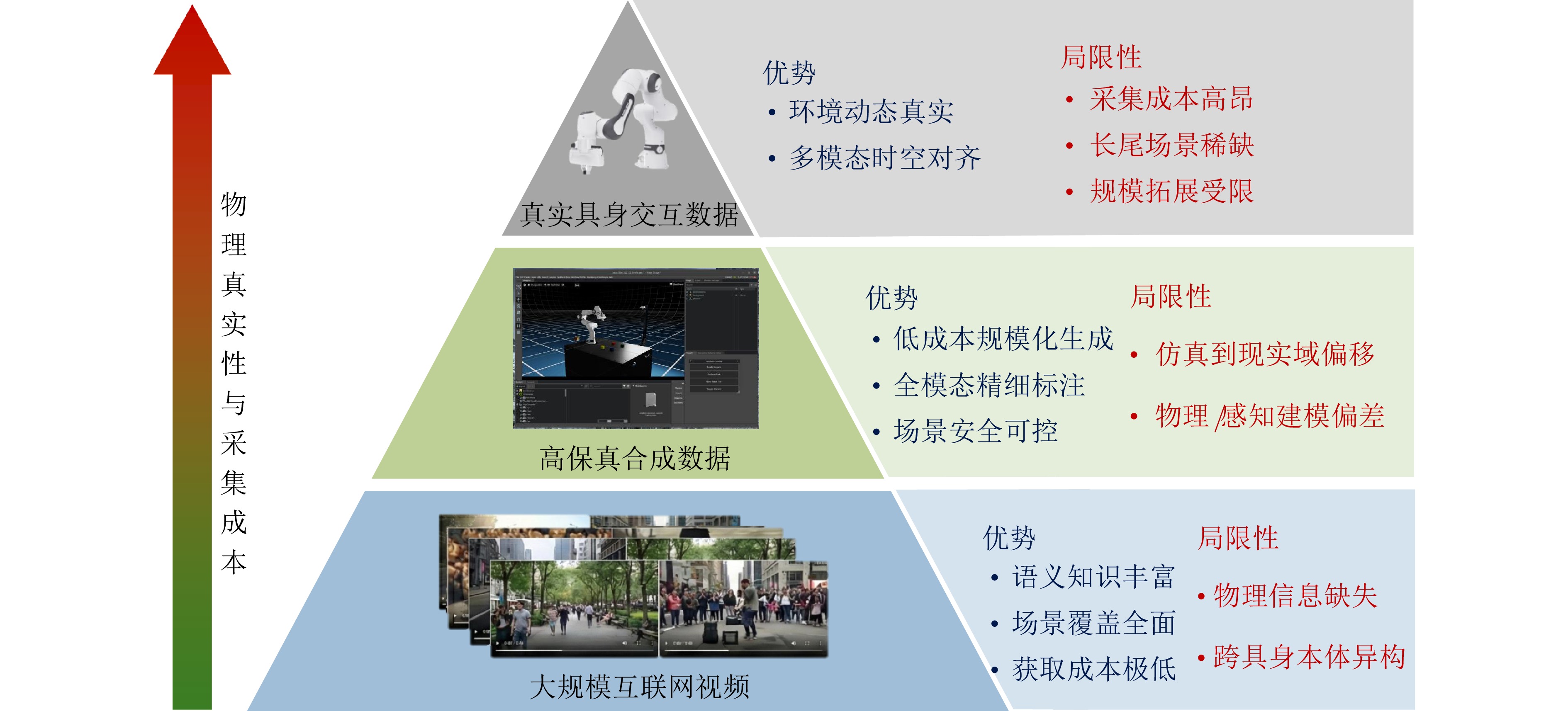
图 2 VLA模型训练数据的三类来源及其特性对比
Fig. 2 Comparison of three types of training data sources and their characteristics for VLA models
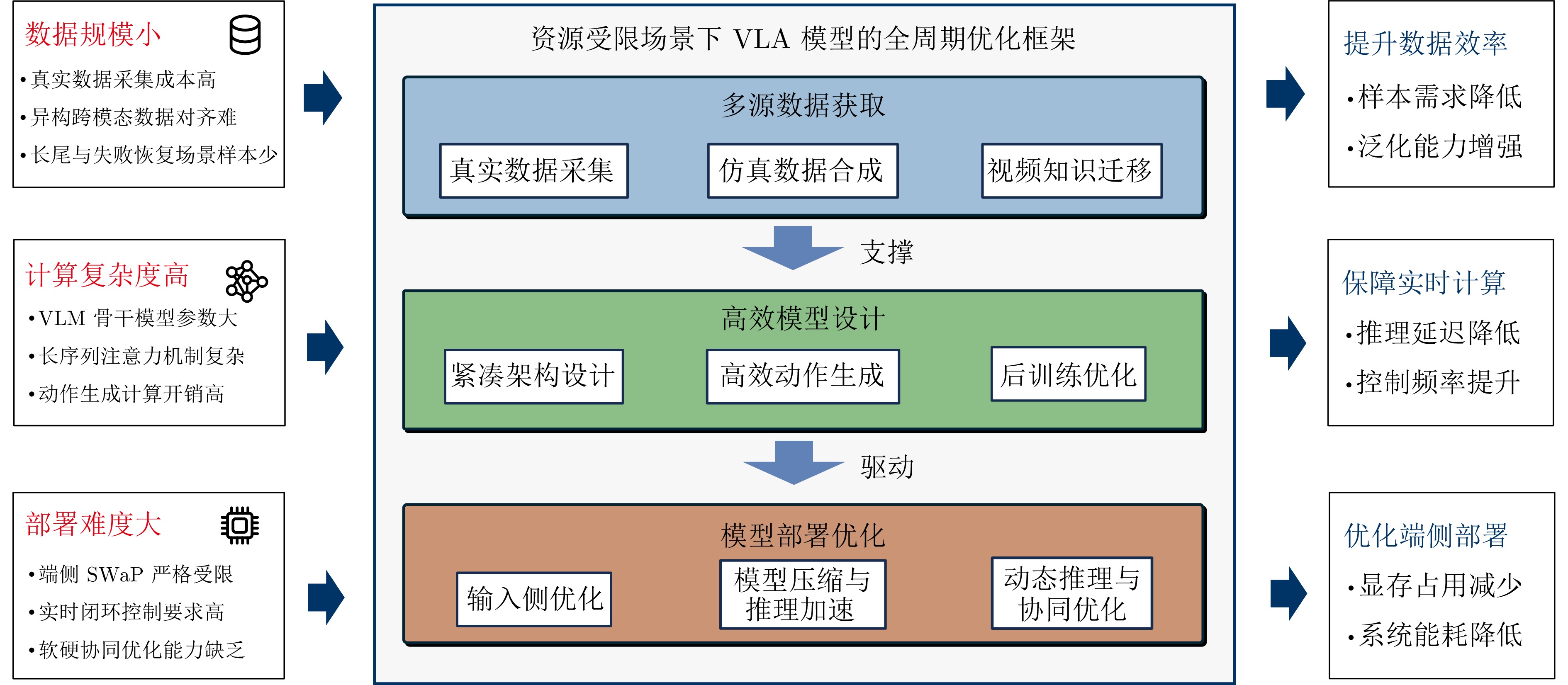
图 1 资源受限场景下VLA模型的全周期优化框架
Fig. 1 Full-lifecycle optimization framework for VLA models under resource-constrained settings
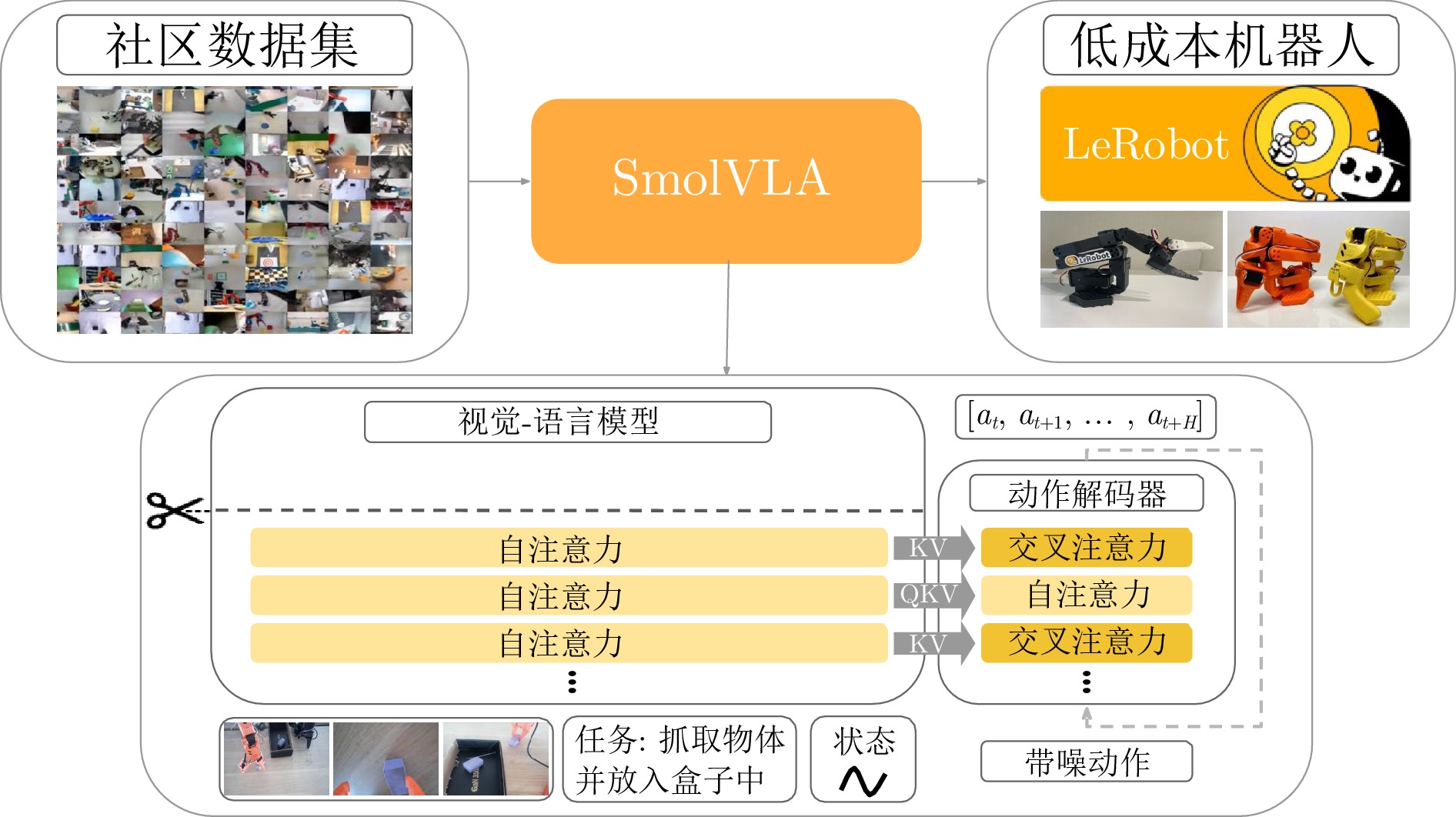
图 3 SmolVLA[19]开源生态与模型架构, 经许可转载自 文献 [19], ©arXiv, 2025
Fig. 3 The open-source ecosystem and model architecture of SmolVLA, reproduced with permission from reference [19], ©arXiv, 2025
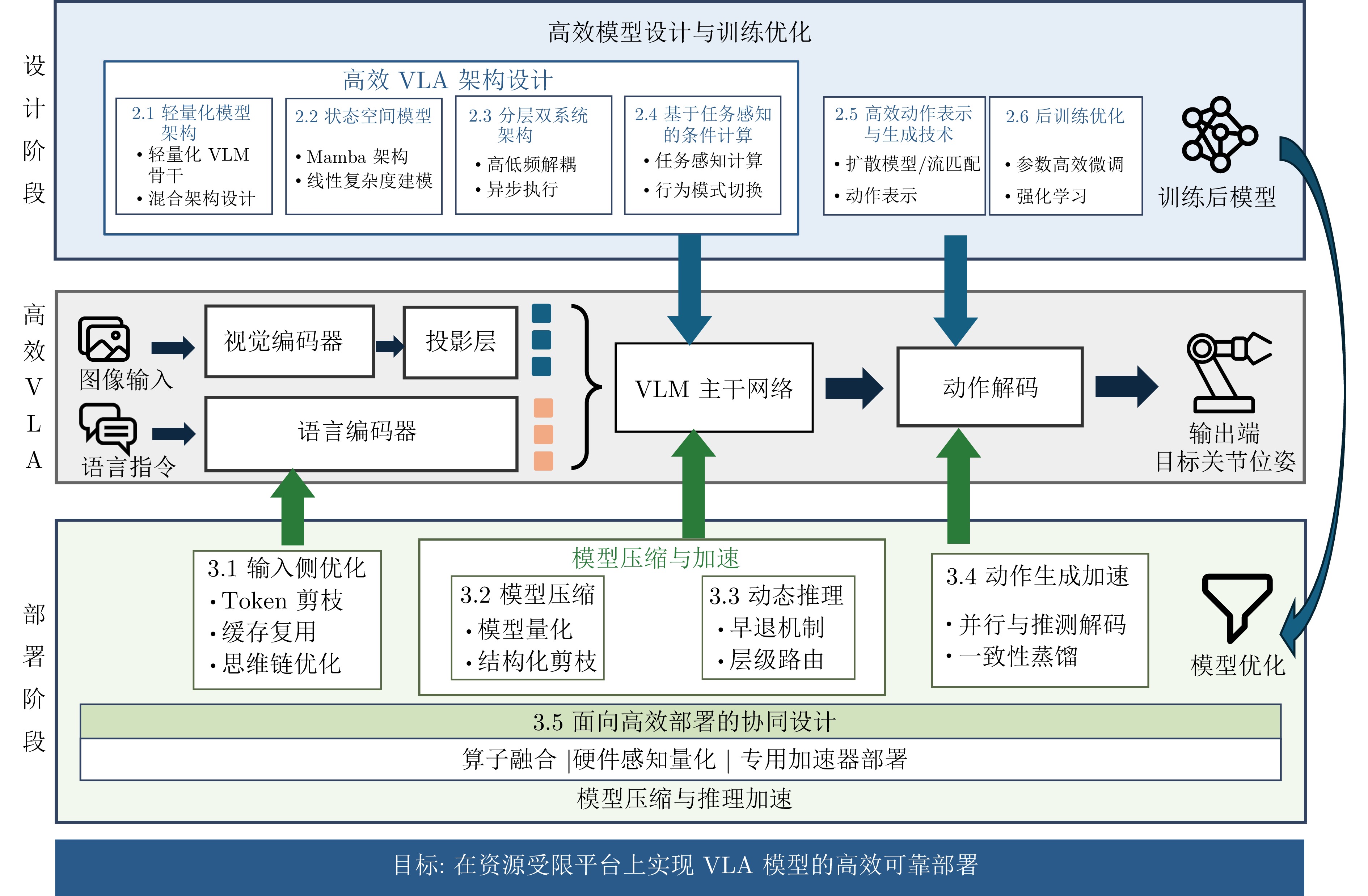
图 4 高效VLA模型的设计与部署优化技术框架
Fig. 4 Technical framework for efficient VLA model design and deployment optimization
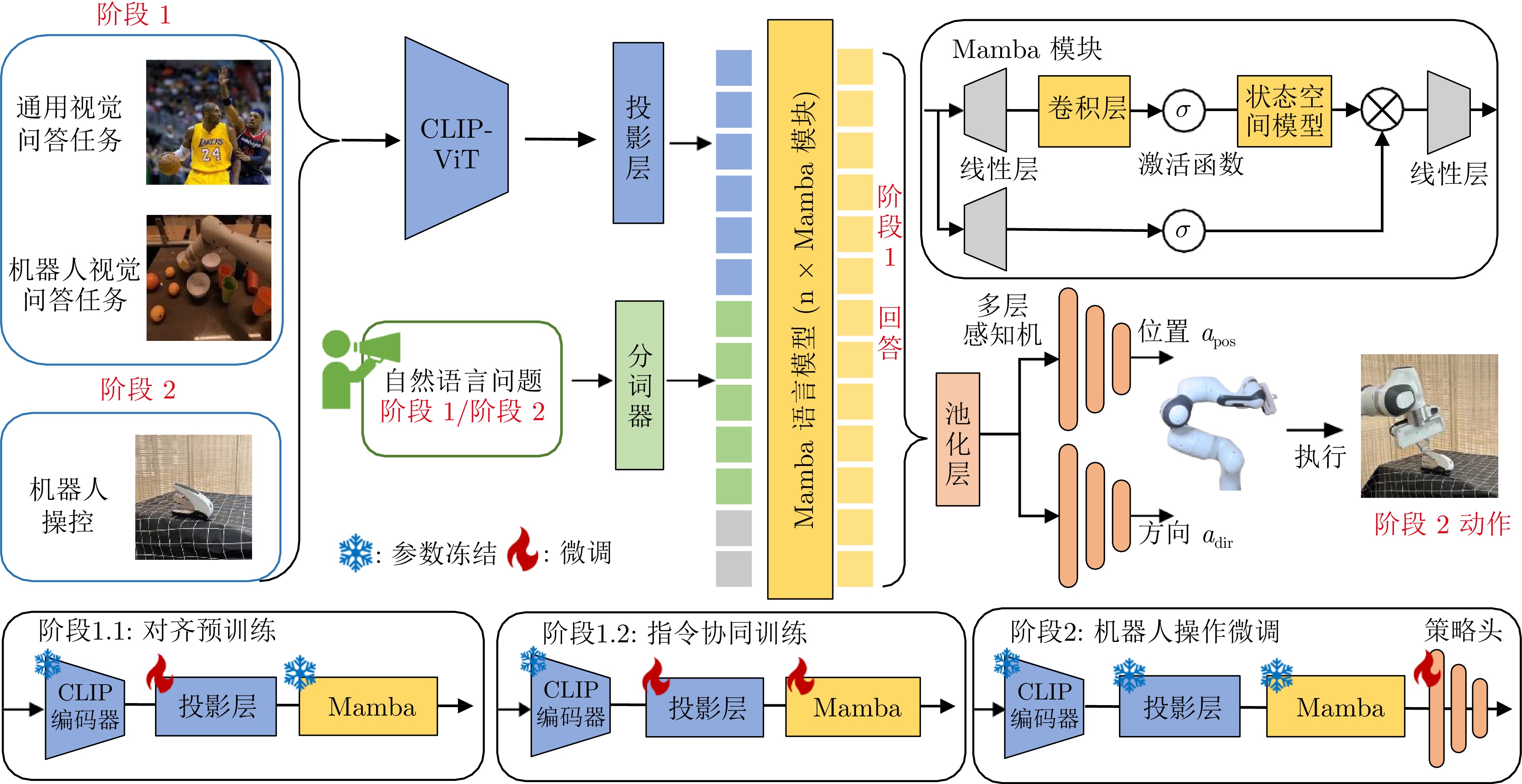
图 5 RoboMamba模型架构与训练流程示意图
Fig. 5 Schematic diagram of the RoboMamba model architecture and training pipeline
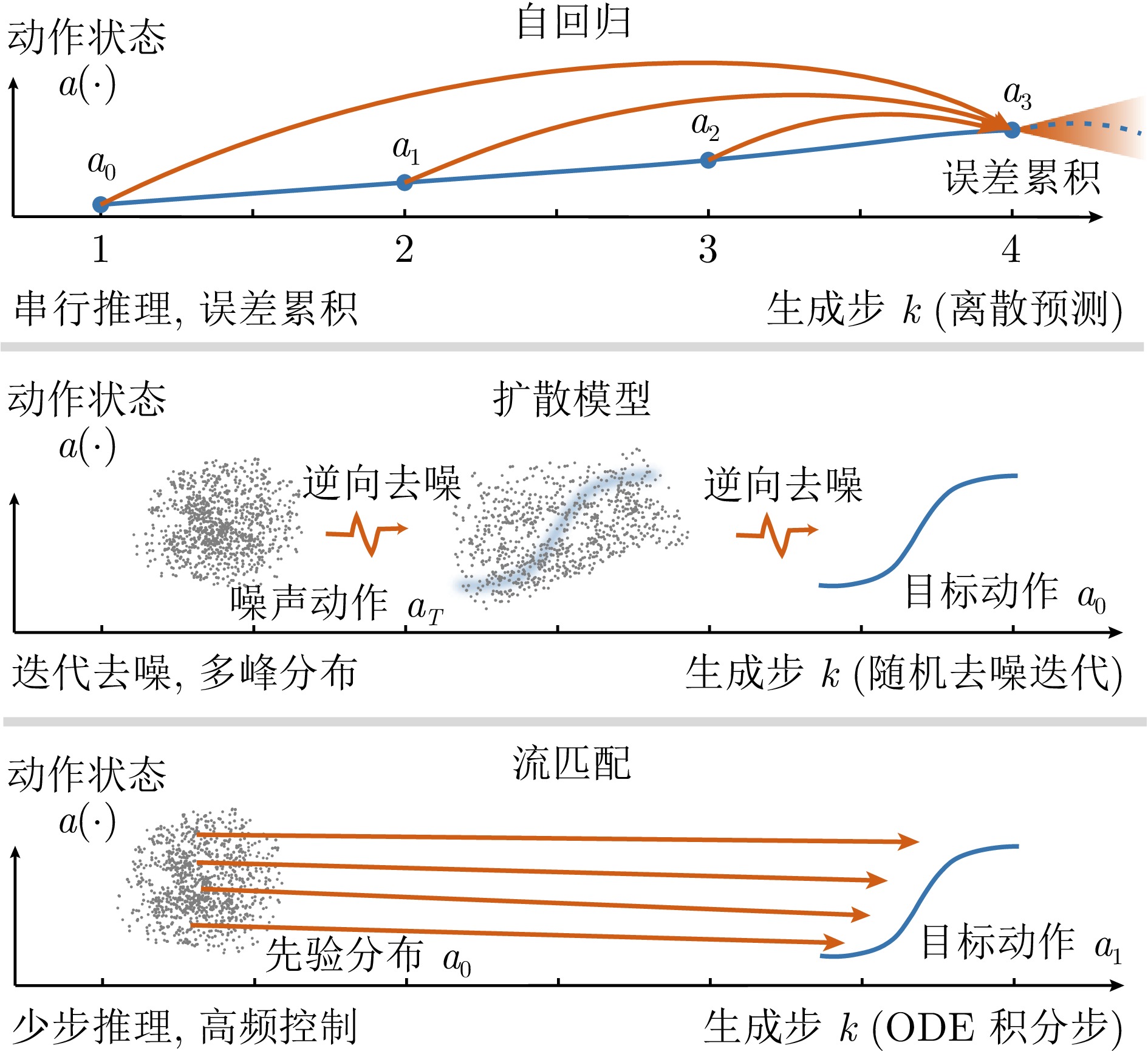
图 6 三种主流VLA动作生成范式对比
Fig. 6 Comparison of three mainstream VLA action generation paradigms
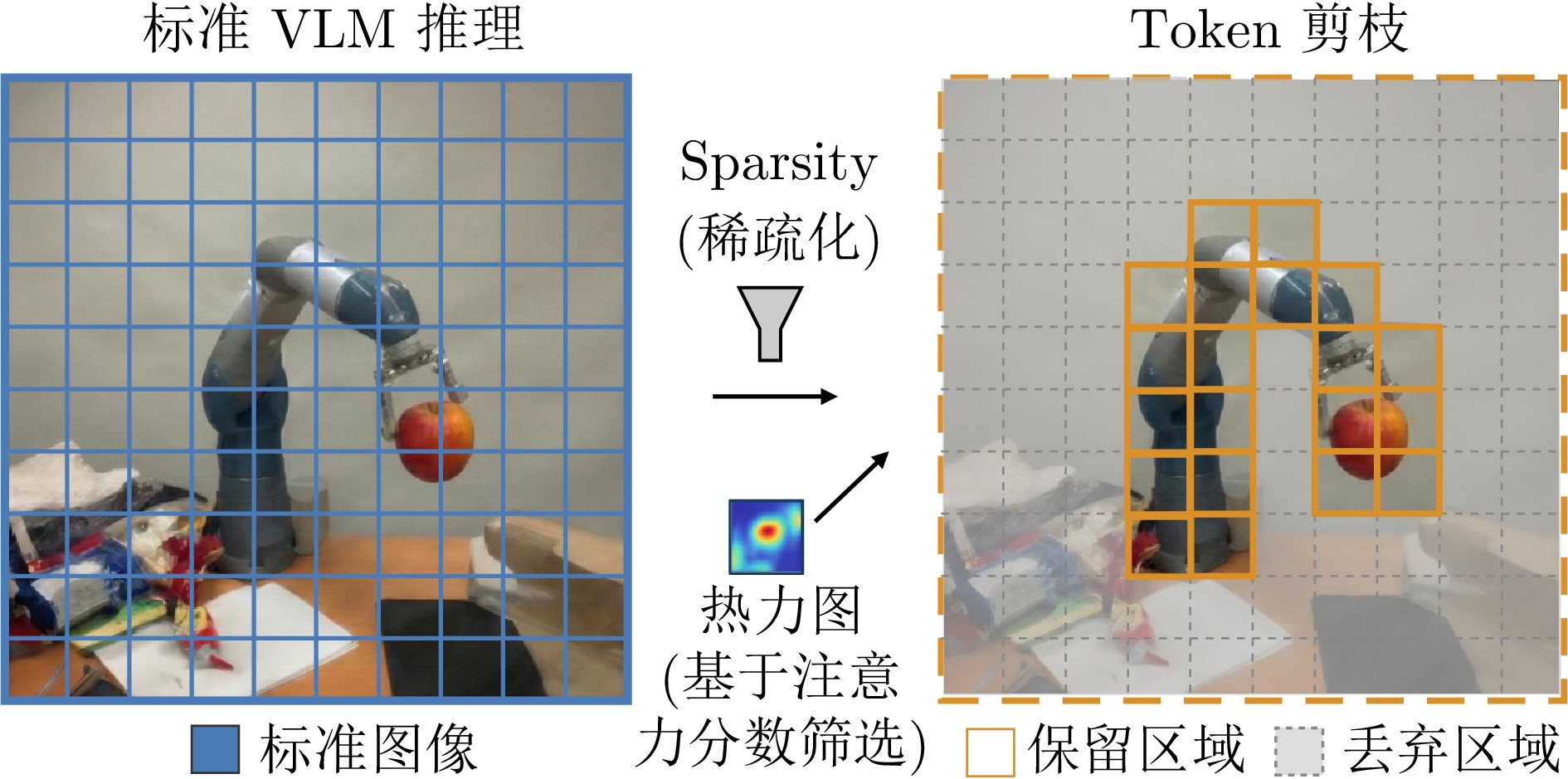
图 7 基于注意力热力图的视觉Token剪枝与稀疏化推理
Fig. 7 Visual Token pruning and sparse inference based on attention heatmap
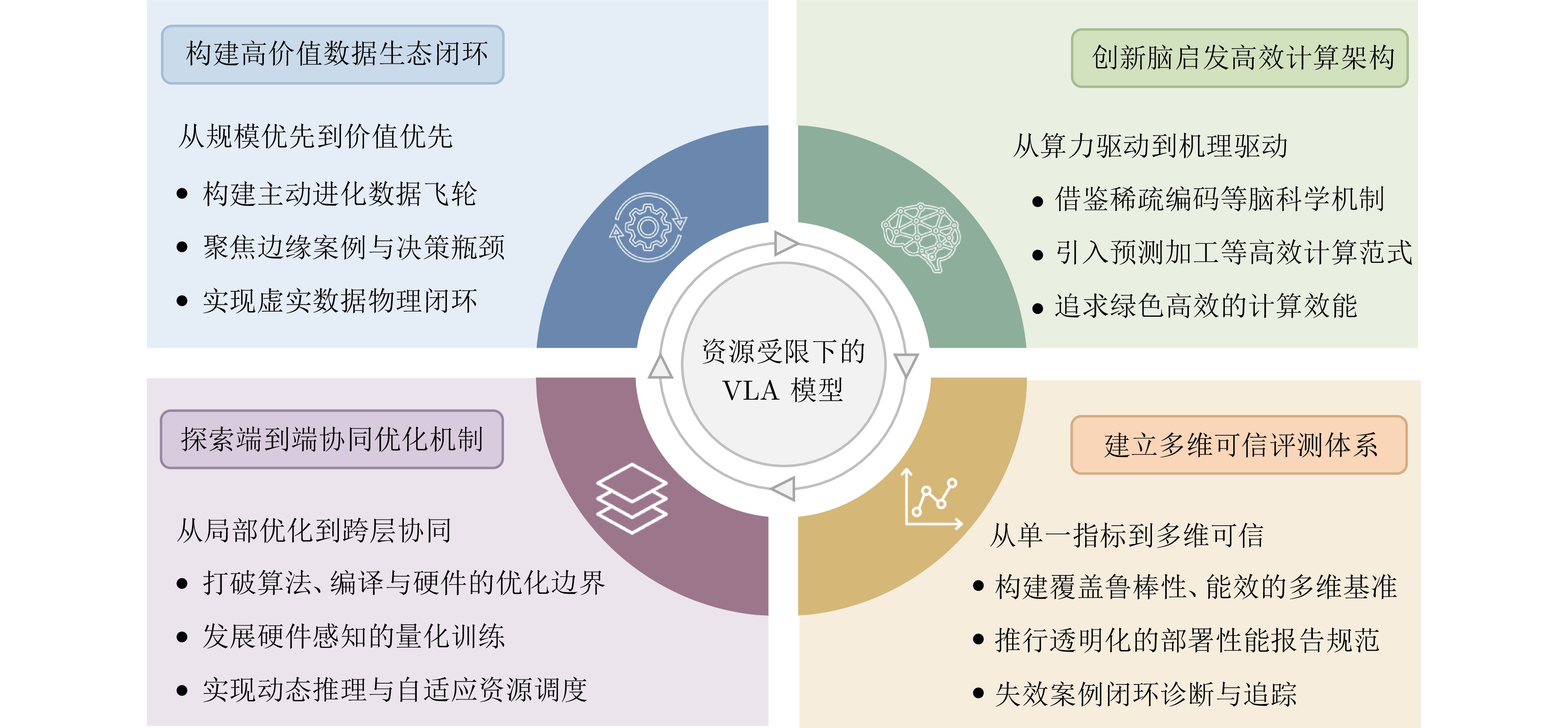
图 8 资源受限场景下VLA模型的未来研究展望
Fig. 8 Future research prospects for VLA models under resource-constrained settings
表 1 VLA模型相关综述对比
Table 1 Comparison of VLA model related surveys
综述 年份 研究主题 框架视角 主要贡献 Zhong等[8] 2025 动作表示机制 动作Token分类 提出VLA模型的动作Token分类框架 张慧等[9] 2025 VLA技术演进 历史与范式演化 回顾前VLA时代技术, 梳理三大建模范式 王文晟等[10] 2025 大模型具身智能 四级控制层级 构建需求−任务−规划−动作四级控制框架 Guan等[11] 2025 高效VLA模型 处理流程视角 从处理流程角度系统分类高效VLA技术 Yu等[12] 2025 高效VLA模型 数据−模型−训练 构建数据−模型−训练的高效VLA框架 Ma等[13] 2026 具身智能应用 组件−策略−规划分类 建立了涵盖基础组件、低层控制与高层规划的分类体系 本文 2026 资源受限条件 模型全生命周期 聚焦资源受限条件下的具身智能, 涵盖数据−模型−训练−部署全周期技术体系  下载: 导出CSV
表 2 面向VLA模型训练的代表性数据集总结
Table 2 Summary of representative datasets for VLA model training
分类 数据集 来源 规模 模态 主要特点 真实机器人操作数据 RT-1[14] 真实 130 K V、L、A 13台机械臂采集, 覆盖700余项任务 BridgeData V2[75] 真实 60 K V、L、A、D 5万条遥操作, 1万条自动策略轨迹 Open X-Emb.[4] 真实 1 M+ V、L、A 21家机构, 22种异构机器人, 统一数据格式 DROID[5] 真实 76 K V、L、A、D 564个开放场景, 分布式遥操作采集 RH20T[16] 真实 110 K V、L、A、T、F、S、D 11维多模态同步, 147项接触密集型任务 AGIBot World[21] 真实 1 M+ V、L、A、T 217项任务, 含失败恢复轨迹与子任务标注 RoboMIND[76] 真实 107 K V、L、A、D 4种平台, 479项任务, 含失败轨迹 真实−仿真混合数据 ARIO[77] 混合 3 M+ V、L、A、T、S 258种机器人, 32万项任务, 统一数据格式 MimicGen[30] 混合 50 K+ V、A 200条演示自动扩展至5万条轨迹 RoboCasa[32] 仿真 100 K V、A 大规模厨房场景仿真框架, 基于人工示教生成轨迹 NVIDIA Physical AI[78] 混合 320 K V、L、A、D、P 基于OpenUSD的工业级仿真资产库 RoboData[79] 混合 500 K V、L、A、D、C 整合9个开源数据集, 统一评测接口 人类操作视频数据 Ego4D[80] 视频 3 670 h V、L、S、E、I、D、P 74个地点, 3 670 h第一人称视频 EPIC-K-100[81] 视频 100 h V、L、S 厨房场景, 97类动作, 9万个片段 EgoExo4D[82] 视频 1 286 h V、L、E、S 第一/第三人称同步, 8个技能领域 HOT3D[83] 视频 13.88 h V、E、P 多视角3D手物交互标注 TACO[84] 视频 2.5 K V、D、P 2 500条双手工具操作, 高精度3D标注 HoloAssist[85] 视频 166 h V、L、E、I、S 7个模态同步, 人机协作场景 UniHand[64] 视频 150 M V、L、A 采用动捕、VR、RGB采集, 涵盖超过1.5亿运动指令对 专项任务数据 LIBERO[86] 仿真 6.5 K V、L、A 程序化生成机器人操作任务, 提供遥操作示教 REASSEMBLE[24] 真实 4.5 K V、L、A、F、S、C 涵盖事件相机与力觉采集, 接触密集装配任务 RoboCerebra[23] 仿真 1 K V、L、A、D 平均2 972步超长轨迹, 规划能力评测 BRMData[87] 真实 约500 V、A、D 双臂移动平台, 10个家居场景任务 注: V = 视觉, L = 语言, A = 动作, D = 深度, T = 触觉, F = 力觉, S = 音频, E = 眼动, I = IMU, C = 事件相机, P = 3D姿态/点云; 机器人数据多以轨 迹/样本数计, 人类操作视频数据多以时长计, 部分数据集以序列数或样本数计.
下载: 导出CSV
表 3 主流VLA模型关键指标对比
Table 3 Comparison of key metrics for mainstream VLA models
模型 参数量 主要训练数据规模 训练开销 推理性能 训练耗时 步数/Epoch 频率(Hz) 推理平台 RT-1[14] 35.00 M 13万条机器人轨迹 — 20万步 3 TPU v4 RT-2[88] 55.00 B 10亿对图文与机器人数据 — 8万步 1 ~ 3 TPU v5 Octo[89] 93.00 M 80万条混合轨迹 0.3万TPU h 30万步 30 RTX 4090 OpenVLA[90] 7.00 B 97万条机器人轨迹 2.15万A100 h 27轮次d 6 RTX 4090 $ \pi_0 $[91] 3.30 B 1万小时以上机器人数据 — 70万步 $ \leq $50 RTX 4090 GR00T N1[92] 2.20 B 5.9亿帧多源混合数据 5万H100 h 20万步a 10/120b L40 GraspVLA[40] 1.80 B 10亿帧合成抓取数据 — 12万步 5 L40s RoboMamba[93] 3.20 B 31万对图文与机器人数据 — 5万步 9 A100 UniVLA[42] 8.50 B 62.2万条多源视频 960 A100 h 2万余步 10 RTX 4090 SmolVLA[19] 0.45 B 2.3万条开源轨迹 3万GPU h 20万余步 30 消费级平台 TinyVLA[94] 1.30 B 500条微调轨迹 — — 71c A6000 FLOWER[95] 0.95 B 25万条混合轨迹 200 H100 h 36万步 311 RTX 4090 注: a代表预训练步数; b代表10 Hz (视觉语言模块)/120 Hz (动作策略模块); c代表原文指出单次推理延迟14 ms, 此处为换算得出的理论频率; d代 表原文明确指出训练轮次为27 Epochs, 未披露具体训练步数; “—”表示数据未披露.
下载: 导出CSV
表 4 典型边缘计算平台硬件规格对比
Table 4 Comparison of hardware specifications of typical edge computing platforms
平台 算力 内存 功耗 NVIDIA Jetson AGX Orin 275 TOPS 64 GB 15 ~ 60 W NVIDIA Jetson Orin NX 100 TOPS 16 GB 10 ~ 25 W Ascend 310B 20 TOPS 24 GB 8 W 移动端NPU 约35 TOPS 共享内存 5 ~ 15 W Raspberry Pi 5 无独立NPU 8 GB 约5 W
下载: 导出CSV
-
[1] Radford A, Kim J W, Hallacy C, Ramesh A, Goh G, Agarwal S, et al. Learning transferable visual models from natural language supervision. In: Proceedings of the 38th International Conference on Machine Learning. Virtual Event: PMLR, 2021. 8748−8763 [2] Li J N, Li D X, Savarese S, Hoi S. BLIP-2: Bootstrapping language-image pre-training with frozen image encoders and large language models. In: Proceedings of the 40th International Conference on Machine Learning. Honolulu, USA: PMLR, 2023. Article No. 814 [3] Liu H T, Li C Y, Wu Q Y, Lee Y J. Visual instruction tuning. In: Proceedings of the 37th International Conference on Neural Information Processing Systems. New Orleans, USA: Curran Associates Inc., 2023. Article No. 1516 [4] O'Neill A, Rehman A, Maddukuri A, Gupta A, Padalkar A, Lee A, et al. Open X-Embodiment: Robotic learning datasets and RT-X models: Open X-Embodiment collaboration. In: Proceedings of the IEEE International Conference on Robotics and Automation (ICRA). Yokohama, Japan: IEEE, 2024. 6892−6903 [5] Khazatsky A, Pertsch K, Nair S, Balakrishna A, Dasari S, Karamcheti S, et al. DROID: A large-scale in-the-wild robot manipulation dataset. In: Proceedings of the 20th International Conference on Robotics: Science and Systems. Delft, The Netherlands: Robotics: Science and Systems Foundation, 2024. [6] Oquab M, Darcet T, Moutakanni T, Vo H V, Szafraniec M, Khalidov V, et al. DINOv2: Learning robust visual features without supervision. Transactions on Machine Learning Research, 2024. [7] Zhai X H, Mustafa B, Kolesnikov A, Beyer L. Sigmoid loss for language image pre-training. In: Proceedings of the IEEE/CVF International Conference on Computer Vision (ICCV). Paris, France: IEEE, 2023. 11941−11952 [8] Zhong Y F, Bai F S, Cai S F, Huang X C, Chen Z, Zhang X W, et al. A survey on vision-language-action models: An action tokenization perspective. arXiv preprint arXiv: 2507.01925, 2025. [9] 张慧, 梁姝彤, 李明轩, 田永林, 葛经纬, 于慧, 等. 视觉−语言−动作模型综述: 从前史到前沿. 自动化学报, 2025, 51(9): 1922−1950 doi: 10.16383/j.aas.c250417Zhang Hui, Liang Shu-Tong, Li Ming-Xuan, Tian Yong-Lin, Ge Jing-Wei, Yu Hui, et al. Vision-language-action models: From the early foundations to the state-of-the-art. Acta Automatica Sinica, 2025, 51(9): 1922−1950 doi: 10.16383/j.aas.c250417 [10] 王文晟, 谭宁, 黄凯, 张雨浓, 郑伟诗, 孙富春. 基于大模型的具身智能系统综述. 自动化学报, 2025, 51(1): 1−19 doi: 10.16383/j.aas.c240542Wang Wen-Sheng, Tan Ning, Huang Kai, Zhang Yu-Nong, Zheng Wei-Shi, Sun Fu-Chun. Embodied intelligence systems based on large models: A survey. Acta Automatica Sinica, 2025, 51(1): 1−19 doi: 10.16383/j.aas.c240542 [11] Guan W L, Hu Q H, Li A S, Cheng J. Efficient vision-language-action models for embodied manipulation: A systematic survey. arXiv preprint arXiv: 2510.17111, 2025. [12] Yu Z S, Wang B, Zeng P P, Zhang H N, Zhang J, Wang Z, et al. A survey on efficient vision-language-action models. arXiv preprint arXiv: 2510.24795, 2025. [13] Ma Y E, Song Z X, Zhuang Y Z, Hao J Y, King I. A survey on vision-language-action models for embodied AI. IEEE Transactions on Neural Networks and Learning Systems, 2026, 37(7): 3031−3051 doi: 10.1109/TNNLS.2025.3650584 [14] Brohan A, Brown N, Carbajal J, Chebotar Y, Dabis J, Finn C, et al. RT-1: Robotics Transformer for real-world control at scale. In: Proceedings of the 19th International Conference on Robotics: Science and Systems. Daegu, Republic of Korea: Robotics: Science and Systems Foundation, 2023. [15] Vaswani A, Shazeer N, Parmar N, Uszkoreit J, Jones L, Gomez A N, et al. Attention is all you need. In: Proceedings of the 31st International Conference on Neural Information Processing Systems. Long Beach, USA: Curran Associates Inc., 2017. 6000−6010 [16] Fang H S, Fang H J, Tang Z Y, Liu J R, Wang C X, Wang J B, et al. RH20T: A comprehensive robotic dataset for learning diverse skills in one-shot. In: Proceedings of the IEEE International Conference on Robotics and Automation (ICRA). Yokohama, Japan: IEEE, 2024. 653−660 [17] Zhao T Z, Kumar V, Levine S, Finn C. Learning fine-grained bimanual manipulation with low-cost hardware. In: Proceedings of the 19th International Conference on Robotics: Science and Systems. Daegu, Republic of Korea: Robotics: Science and Systems Foundation, 2023. [18] Chi C, Xu Z J, Pan C E, Cousineau E, Burchfiel B, Feng S Y, et al. Universal manipulation interface: In-the-wild robot teaching without in-the-wild robots. In: Proceedings of the 20th International Conference on Robotics: Science and Systems. Delft, The Netherlands: Robotics: Science and Systems Foundation, 2024. [19] Shukor M, Aubakirova D, Capuano F, Kooijmans P, Palma S, Zouitine A, et al. SmolVLA: A vision-language-action model for affordable and efficient robotics. arXiv preprint arXiv: 2506.01844, 2025. [20] Jiang T, Yuan T Y, Liu Y C, Lu C H, Cui J N, Liu X, et al. Galaxea open-world dataset and G0 dual-system VLA model. arXiv preprint arXiv: 2509.00576, 2025. [21] Bu Q W, Cai J S, Chen L, Cui X Q, Ding Y, Feng S Y, et al. AgiBot World Colosseo: A large-scale manipulation platform for scalable and intelligent embodied systems. In: Proceedings of the IEEE/RSJ International Conference on Intelligent Robots and Systems (IROS). Hangzhou, China: IEEE, 2025. 3549−3556 [22] Jiang S, Li H N, Ren R C, Zhou Y M, Wang Z P, He B. Kaiwu: A multimodal manipulation dataset and framework for robot learning and human-robot interaction. IEEE Robotics and Automation Letters, 2025, 10(11): 11482−11489 doi: 10.1109/LRA.2025.3609615 [23] Han S H, Qiu B X, Liao Y, Huang S Y, Gao C, Yan S C, et al. RoboCerebra: A large-scale benchmark for long-horizon robotic manipulation evaluation. In: Proceedings of the 39th International Conference on Neural Information Processing Systems. San Diego, USA: Curran Associates Inc., 2025. [24] Sliwowski D, Jadav S, Stanovcic S, Orbik J, Heidersberger J, Lee D. Demonstrating REASSEMBLE: A multimodal dataset for contact-rich robotic assembly and disassembly. In: Proceedings of the 21st International Conference on Robotics: Science and Systems. Los Angeles, USA: Robotics: Science and Systems Foundation, 2025. [25] Mildenhall B, Srinivasan P P, Tancik M, Barron J T, Ramamoorthi R, Ng R. NeRF: Representing scenes as neural radiance fields for view synthesis. Communications of the ACM, 2022, 65(1): 99−106 doi: 10.1145/3503250 [26] Kerbl B, Kopanas G, Leimkühler T, Drettakis G. 3D Gaussian splatting for real-time radiance field rendering. ACM Transactions on Graphics (TOG), 2023, 42(4): Article No. 139 doi: 10.1145/3592433 [27] Li X H, Li J L, Zhang Z H, Zhang R, Jia F, Wang T C, et al. RoboGSim: A Real2Sim2Real robotic Gaussian splatting simulator. arXiv preprint arXiv: 2411.11839, 2024. [28] Abou-Chakra J, Rana K, Dayoub F, Sünderhauf N. Physically embodied Gaussian splatting: A visually learnt and physically grounded 3D representation for robotics. In: Proceedings of the 8th Conference on Robot Learning. Munich, Germany: PMLR, 2025. 513−530 [29] Han X S, Liu M H, Chen Y L, Yu J Q, Lyu X Y, Tian Y, et al. Re.3Sim: Generating high-fidelity simulation data via 3D-photorealistic real-to-sim for robotic manipulation. arXiv preprint arXiv: 2502.08645, 2025. [30] Mandlekar A, Nasiriany S, Wen B W, Akinola I, Narang Y, Fan L X, et al. MimicGen: A data generation system for scalable robot learning using human demonstrations. In: Proceedings of the 7th Conference on Robot Learning. Atlanta, USA: PMLR, 2023. 1820−1864 [31] Hua P, Liu M H, Macaluso A, Lin Y F, Zhang W N, Xu H Z, et al. GenSim2: Scaling robot data generation with multi-modal and reasoning LLMs. In: Proceedings of the 8th Conference on Robot Learning. Munich, Germany: PMLR, 2024. 5030−5066 [32] Nasiriany S, Maddukuri A, Zhang L C, Parikh A, Lo A, Joshi A, et al. RoboCasa: Large-scale simulation of household tasks for generalist robots. In: Proceedings of the 20th International Conference on Robotics: Science and Systems. Delft, The Netherlands: Robotics: Science and Systems Foundation, 2024. [33] Xue Z R, Deng S Y, Chen Z Y, Wang Y X, Yuan Z C, Xu H Z. DemoGen: Synthetic demonstration generation for data-efficient visuomotor policy learning. In: Proceedings of the 21st International Conference on Robotics: Science and Systems. Los Angeles, USA: Robotics: Science and Systems Foundation, 2025. [34] Johnnynunez. Genesis: A generative and universal physics engine for robotics and beyond [Online], available: https://forums.developer.nvidia.com/t/genesis-a-generative-and-universal-physics-engine-for-robotics-and-beyond/323946, February 27, 2025 [35] Mittal M, Yu C, Yu Q X, Liu J Z, Rudin N, Hoeller D, et al. Orbit: A unified simulation framework for interactive robot learning environments. IEEE Robotics and Automation Letters, 2023, 8(6): 3740−3747 doi: 10.1109/LRA.2023.3270034 [36] Tao S, Xiang F B, Shukla A, Qin Y Z, Hinrichsen X, Yuan X D, et al. ManiSkill3: GPU parallelized robot simulation and rendering for generalizable embodied AI. In: Proceedings of the 7th Robot Learning Workshop: Towards Robots with Human-Level Abilities. Virtual: ICLR, 2025. [37] Xiang F B, Qin Y Z, Mo K C, Xia Y K, Zhu H, Liu F C, et al. SAPIEN: A simulated part-based interactive environment. In: Proceedings of the IEEE/CVF Conference on Computer Vision and Pattern Recognition (CVPR). Seattle, USA: IEEE, 2020. 11094−11104 [38] Li Y Y, Du W X, Yu C, Li P H, Zhao Z H, Liu T Y, et al. Taccel: Scaling up vision-based tactile robotics via high-performance GPU simulation. arXiv preprint arXiv: 2504.12908, 2025. [39] Maddukuri A, Jiang Z Y, Chen L Y, Nasiriany S, Xie Y Q, Fang Y, et al. Sim-and-real co-training: A simple recipe for vision-based robotic manipulation. In: Proceedings of the 21st International Conference on Robotics: Science and Systems. Los Angeles, USA: Robotics: Science and Systems Foundation, 2025. [40] Deng S L, Yan M, Wei S L, Ma H X, Yang Y X, Chen J Y, et al. GraspVLA: A grasping foundation model pre-trained on billion-scale synthetic action data. arXiv preprint arXiv: 2505.03233, 2025. [41] Ha D, Schmidhuber J. Recurrent world models facilitate policy evolution. In: Proceedings of the 31st International Conference on Neural Information Processing Systems. Montréal, Canada: Curran Associates Inc., 2018. 2455−2467 [42] Bu Q W, Yang Y T, Cai J S, Gao S Y, Ren G H, Yao M Q, et al. UniVLA: Learning to act anywhere with task-centric latent actions. In: Proceedings of the 21st International Conference on Robotics: Science and Systems. Los Angeles, USA: Robotics: Science and Systems Foundation, 2025. [43] Bruce J, Dennis M D, Edwards A, Parker-Holder J, Shi Y G, Hughes E, et al. Genie: Generative interactive environments. In: Proceedings of the 41st International Conference on Machine Learning. Vienna, Austria: PMLR, 2024. 4603−4623 [44] Cen J, Yu C H, Yuan H J, Jiang Y M, Huang S T, Guo J Y, et al. WorldVLA: Towards autoregressive action world model. arXiv preprint arXiv: 2506.21539, 2025. [45] Zhen H Y, Qiu X W, Chen P H, Yang J C, Yan X, Du Y L, et al. 3D-VLA: A 3D vision-language-action generative world model. In: Proceedings of the 41st International Conference on Machine Learning. Vienna, Austria: PMLR, 2024. 61229−61245 [46] Liao Y, Zhou P F, Huang S Y, Yang D L, Chen S C, Jiang Y X, et al. Genie Envisioner: A unified world foundation platform for robotic manipulation. arXiv preprint arXiv: 2508.05635, 2025. [47] Zhang W Y, Liu H S, Qi Z K, Wang Y N, Yu X Q, Zhang J Z, et al. DreamVLA: A vision-language-action model dreamed with comprehensive world knowledge. arXiv preprint arXiv: 2507.04447, 2025. [48] NVIDIA. Cosmos world foundation model platform for physical AI. arXiv preprint arXiv: 2501.03575, 2025. [49] Xiao J J, Yang Y D, Chang X Y, Chen R H, Xiong F, Xu M, et al. World-Env: Leveraging world model as a virtual environment for VLA post-training. arXiv preprint arXiv: 2509.24948, 2025. [50] Wu P, Escontrela A, Hafner D, Goldberg K, Abbeel P. DayDreamer: World models for physical robot learning. In: Proceedings of the 6th Conference on Robot Learning. Auckland, New Zealand: PMLR, 2022. 2226−2240 [51] Hafner D, Yan W, Lillicrap T. Training agents inside of scalable world models. arXiv preprint arXiv: 2509.24527, 2025. [52] Chen D L, Moutakanni T, Chung W, Bang Y J, Ji Z W, Bolourchi A, et al. Planning with reasoning using vision language world model. arXiv preprint arXiv: 2509.02722, 2025. [53] Mendonca R, Bahl S, Pathak D. Structured world models from human videos. In: Proceedings of the 19th International Conference on Robotics: Science and Systems. Daegu, Republic of Korea: Robotics: Science and Systems Foundation, 2023. [54] Nair S, Rajeswaran A, Kumar V, Finn C, Gupta A. R3M: A universal visual representation for robot manipulation. In: Proceedings of the 6th Conference on Robot Learning. Auckland, New Zealand: PMLR, 2022. 892−909 [55] Radosavovic I, Xiao T T, James S, Abbeel P, Malik J, Darrell T. Real-world robot learning with masked visual pre-training. In: Proceedings of the 6th Conference on Robot Learning. Auckland, New Zealand: PMLR, 2022. 416−426 [56] Zeng J, Bu Q W, Wang B J, Xia W K, Chen L, Dong H, et al. Learning manipulation by predicting interaction. In: Proceedings of the 20th International Conference on Robotics: Science and Systems. Delft, The Netherlands: Robotics: Science and Systems Foundation, 2024. [57] Ko P C, Mao J Y, Du Y L, Sun S H, Tenenbaum J B. Learning to act from actionless videos through dense correspondences. In: Proceedings of the 12th International Conference on Learning Representations. Vienna, Austria: OpenReview.net, 2024. [58] van den Oord A, Vinyals O, Kavukcuoglu K. Neural discrete representation learning. In: Proceedings of the 31st International Conference on Neural Information Processing Systems. Long Beach, USA: Curran Associates Inc., 2017. 6309−6318 [59] Bahl S, Gupta A, Pathak D. Human-to-robot imitation in the wild. In: Proceedings of the 18th International Conference on Robotics: Science and Systems. New York, USA: Robotics: Science and Systems Foundation, 2022. [60] Allshire A, Choi H, Zhang J Y, McAllister D, Zhang A, Kim C M, et al. Visual imitation enables contextual humanoid control. arXiv preprint arXiv: 2505.03729, 2025. [61] Patel S, Mohan S, Mai H L, Jain U, Lazebnik S, Li Y Z. Robotic manipulation by imitating generated videos without physical demonstrations. arXiv preprint arXiv: 2507.00990, 2025. [62] Yang R H, Yu Q X, Wu Y C, Yan R, Li B R, Cheng A C, et al. EgoVLA: Learning vision-language-action models from egocentric human videos. arXiv preprint arXiv: 2507.12440, 2025. [63] Romero J, Tzionas D, Black M J. Embodied hands: Modeling and capturing hands and bodies together. ACM Transactions on Graphics (TOG), 2017, 36(6): Article No. 245 [64] Luo H, Feng Y C, Zhang W P, Zheng S P, Wang Y, Yuan H Q, et al. Being-H0: Vision-language-action pretraining from large-scale human videos. arXiv preprint arXiv: 2507.15597, 2025. [65] Cheang C L, Chen G Z, Jing Y, Kong T, Li H, Li Y F, et al. GR-2: A generative video-language-action model with web-scale knowledge for robot manipulation. arXiv preprint arXiv: 2410.06158, 2024. [66] Jiang Y M, Huang S T, Xue S K, Zhao Y X, Cen J, Leng S C, et al. RynnVLA-001: Using human demonstrations to improve robot manipulation. arXiv preprint arXiv: 2509.15212, 2025. [67] Bharadhwaj H, Dwibedi D, Gupta A, Tulsiani S, Doersch C, Xiao T, et al. Gen2Act: Human video generation in novel scenarios enables generalizable robot manipulation. In: Proceedings of the 9th Conference on Robot Learning. Seoul, Republic of Korea: PMLR, 2025. 3936−3951 [68] Xie H Z, Wen B C, Zheng J R, Chen Z X, Hong F Z, Diao H W, et al. DynamicVLA: A vision-language-action model for dynamic object manipulation. arXiv preprint arXiv: 2601.22153, 2026. [69] Black K, Galliker M Y, Levine S. Real-time execution of action chunking flow policies. In: Proceedings of the 39th International Conference on Neural Information Processing Systems. San Diego, USA: Curran Associates Inc., 2025. [70] Sendai K, Alvarez M, Matsushima T, Matsuo Y, Iwasawa Y. Leave no observation behind: Real-time correction for VLA action chunks. arXiv preprint arXiv: 2509.23224, 2025. [71] Sakr M, Zhang J Y, van der Loos H F M, Kulić D, Croft E. Consistency matters: Defining demonstration data quality metrics in robot learning from demonstration. ACM Transactions on Human-Robot Interaction, 2026, 15(2): Article No. 34 doi: 10.1145/3773904 [72] Belkhale S, Cui Y C, Sadigh D. Data quality in imitation learning. In: Proceedings of the 37th International Conference on Neural Information Processing Systems. New Orleans, USA: Curran Associates Inc., 2023. Article No. 3524 [73] Wu K, Liu N, Zhao Z, Qiu D, Li J M, Che Z P, et al. Learning from imperfect demonstrations with self-supervision for robotic manipulation. In: Proceedings of the IEEE International Conference on Robotics and Automation (ICRA). Atlanta, USA: IEEE, 2025. 16899−16906 [74] Hou M H, Hindriks K V, Eiben A E, Baraka K. Active robot curriculum learning from online human demonstrations. In: Proceedings of the 20th ACM/IEEE International Conference on Human-Robot Interaction (HRI). Melbourne, Australia: IEEE, 2025. 810−818 [75] Walke H R, Black K, Zhao T Z, Vuong Q, Zheng C Y, Hansen-Estruch P, et al. BridgeData V2: A dataset for robot learning at scale. In: Proceedings of the 7th Conference on Robot Learning. Atlanta, USA: PMLR, 2023. 1723−1736 [76] Wu K, Hou C K, Liu J M, Che Z P, Ju X Z, Yang Z Q, et al. RoboMIND: Benchmark on multi-embodiment intelligence normative data for robot manipulation. In: Proceedings of the 21st International Conference on Robotics: Science and Systems. Los Angeles, USA: Robotics: Science and Systems Foundation, 2025. [77] Wang Z Q, Zheng H, Nie Y S, Xu W J, Wang Q W, Ye H, et al. All Robots In One: A new standard and unified dataset for versatile, general-purpose embodied agents. arXiv preprint arXiv: 2408.10899, 2024. [78] NVIDIA Research. Physical AI [Online], available: https://research.nvidia.com/research-area/physical-ai, May 13, 2025 [79] Yan F, Liu F F, Huang Y Y, Guan Z C, Zheng L M, Zhong Y F, et al. RoboTron-Mani: All-in-one multimodal large model for robotic manipulation. In: Proceedings of the IEEE/CVF International Conference on Computer Vision (ICCV). Honolulu, USA: IEEE, 2025. 13707−13718 [80] Grauman K, Westbury A, Byrne E, Chavis Z, Furnari A, Girdhar R, et al. Ego4D: Around the world in 3,000 hours of egocentric video. In: Proceedings of the 25th IEEE/CVF Conference on Computer Vision and Pattern Recognition (CVPR). New Orleans, USA: IEEE, 2022. 18973−18990 [81] Damen D, Doughty H, Farinella G M, Furnari A, Kazakos E, Ma J, et al. Rescaling egocentric vision: Collection, pipeline and challenges for EPIC-KITCHENS-100. International Journal of Computer Vision, 2022, 130(1): 33−55 doi: 10.1007/s11263-021-01531-2 [82] Grauman K, Westbury A, Torresani L, Kitani K, Malik J, Afouras T, et al. Ego-Exo4D: Understanding skilled human activity from first- and third-person perspectives. In: Proceedings of the IEEE/CVF Conference on Computer Vision and Pattern Recognition (CVPR). Seattle, USA: IEEE, 2024. 19383−19400 [83] Banerjee P, Shkodrani S, Moulon P, Hampali S, Han S C, Zhang F, et al. HOT3D: Hand and object tracking in 3D from egocentric multi-view videos. In: Proceedings of the IEEE/CVF Conference on Computer Vision and Pattern Recognition (CVPR). Nashville, USA: IEEE, 2025. 7061−7071 [84] Liu Y, Yang H L, Si X, Liu L, Li Z P, Zhang Y X, et al. TACO: Benchmarking generalizable bimanual tool-action-object understanding. In: Proceedings of the IEEE/CVF Conference on Computer Vision and Pattern Recognition (CVPR). Seattle, USA: IEEE, 2024. 21740−21751 [85] Wang X, Kwon T, Rad M, Pan B W, Chakraborty I, Andrist S, et al. HoloAssist: An egocentric human interaction dataset for interactive AI assistants in the real world. In: Proceedings of the IEEE/CVF International Conference on Computer Vision (ICCV). Paris, France: IEEE, 2023. 20213−20224 [86] Liu B, Zhu Y F, Gao C K, Feng Y H, Liu Q, Zhu Y K, et al. LIBERO: Benchmarking knowledge transfer for lifelong robot learning. In: Proceedings of the 37th International Conference on Neural Information Processing Systems. New Orleans, USA: Curran Associates Inc., 2023. Article No. 1939 [87] Zhang T L, Li D J, Li Y H, Zeng Z C, Zhao L, Sun L, et al. Empowering embodied manipulation: A bimanual-mobile robot manipulation dataset for household tasks. arXiv preprint arXiv: 2405.18860, 2024. [88] Zitkovich B, Yu T H, Xu S C, Xu P, Xiao T, Xia F, et al. RT-2: Vision-language-action models transfer web knowledge to robotic control. In: Proceedings of the 7th Conference on Robot Learning. Atlanta, USA: PMLR, 2023. 2165−2183 [89] Ghosh D, Walke H, Pertsch K, Black K, Mees O, Dasari S, et al. Octo: An open-source generalist robot policy. In: Proceedings of the 20th International Conference on Robotics: Science and Systems. Delft, The Netherlands: Robotics: Science and Systems Foundation, 2024. [90] Kim M J, Pertsch K, Karamcheti S, Xiao T, Balakrishna A, Nair S, et al. OpenVLA: An open-source vision-language-action model. In: Proceedings of the 8th Conference on Robot Learning. Munich, Germany: PMLR, 2024. 2679−2713 [91] Black K, Brown N, Driess D, Esmail A, Equi M R, Finn C, et al. π0: A vision-language-action flow model for general robot control. In: Proceedings of the 21st International Conference on Robotics: Science and Systems. Los Angeles, USA: Robotics: Science and Systems Foundation, 2025. [92] NVIDIA. GR00T N1: An open foundation model for generalist humanoid robots. arXiv preprint arXiv: 2503.14734, 2025. [93] Liu J M, Liu M Z, Wang Z Y, An P J, Li X Q, Zhou K C, et al. RoboMamba: Efficient vision-language-action model for robotic reasoning and manipulation. In: Proceedings of the 38th International Conference on Neural Information Processing Systems. Vancouver, Canada: Curran Associates Inc., 2024. Article No. 1266 [94] Wen J J, Zhu Y C, Li J M, Zhu M J, Tang Z B, Wu K, et al. TinyVLA: Toward fast, data-efficient vision-language-action models for robotic manipulation. IEEE Robotics and Automation Letters, 2025, 10(4): 3988−3995 doi: 10.1109/LRA.2025.3544909 [95] Reuss M, Zhou H Y, Rühle M, Yaǧmurlu Ö E, Otto F, Lioutikov R. FLOWER: Democratizing generalist robot policies with efficient vision-language-flow models. In: Proceedings of the 9th Conference on Robot Learning. Seoul, Republic of Korea: PMLR, 2025. 3736−3761 [96] Microsoft Research. Phi-2: The surprising power of small language models [Online], available: https://www.microsoft.com/en-us/research/blog/phi-2-the-surprising-power-of-small-language-models/, December 12, 2023 [97] Zhu Y C, Zhu M J, Liu N, Xu Z Y, Peng Y X. LLaVA-Phi: Efficient multi-modal assistant with small language model. In: Proceedings of the 1st International Workshop on Efficient Multimedia Computing under Limited. Melbourne, Australia: ACM, 2024. 18−22 [98] Liang Z X, Li Y Z, Yang T S, Wu C Y, Mao S T, Pei L A, et al. Discrete diffusion VLA: Bringing discrete diffusion to action decoding in vision-language-action policies. arXiv preprint arXiv: 2508.20072, 2025. [99] Wang Y H, Ding P X, Li L X, Cui C, Ge Z R, Tong X Y, et al. VLA-Adapter: An effective paradigm for tiny-scale vision-language-action model. In: Proceedings of the 40th AAAI Conference on Artificial Intelligence. Singapore: AAAI Press, 2026. 18638−18646 [100] Gu A, Dao T. Mamba: Linear-time sequence modeling with selective state spaces. In: Proceedings of the 1st Conference on Language Modeling. Virtual Event: OpenReview.net, 2024. [101] Qiao Y Y, Yu Z, Zhao Z J, Chen S H, Sun M Z, Guo L T, et al. VL-Mamba: Exploring state space models for multimodal learning. In: Proceedings of the 4th Neural Information Processing Systems Efficient Natural Language and Speech Processing Workshop. Vancouver, Canada: PMLR, 2024. 102−113 [102] Li K C, Li X H, Wang Y, He Y N, Wang Y L, Wang L M, et al. VideoMamba: State space model for efficient video understanding. In: Proceedings of the 18th European Conference on Computer Vision. Milan, Italy: Springer, 2024. 237−255 [103] Xie F, Nie J H, Tan Y J, Zhang W K, Zhao H S. Mamba-Adaptor: State space model adaptor for visual recognition. In: Proceedings of the IEEE/CVF Conference on Computer Vision and Pattern Recognition (CVPR). Nashville, USA: IEEE, 2025. 20124−20134 [104] Park J, Park J, Xiong Z Y, Lee N, Cho J, Oymak S, et al. Can Mamba learn how to learn? A comparative study on in-context learning tasks. In: Proceedings of the 41st International Conference on Machine Learning. Vienna, Austria: PMLR, 2024. Article No. 1612 [105] Ye Z F, Xia K J, Fu Y G, Dong X, Hong J, Yuan X C, et al. LongMamba: Enhancing Mamba's long-context capabilities via training-free receptive field enlargement. In: Proceedings of the 13th International Conference on Learning Representations. Singapore: OpenReview.net, 2025. [106] Zhang J K, Guo Y J, Chen X Y, Wang Y J, Hu Y C, Shi C M, et al. HiRT: Enhancing robotic control with hierarchical robot Transformers. In: Proceedings of the 8th Conference on Robot Learning. Munich, Germany: PMLR, 2024. 933−946 [107] Shentu Y D, Wu P, Rajeswaran A, Abbeel P. From LLMs to actions: Latent codes as bridges in hierarchical robot control. In: Proceedings of the IEEE/RSJ International Conference on Intelligent Robots and Systems (IROS). Abu Dhabi, United Arab Emirates: IEEE, 2024. 8539−8546 [108] Bu Q W, Li H Y, Chen L, Cai J S, Zeng J, Cui H M, et al. Towards synergistic, generalized, and efficient dual-system for robotic manipulation. In: Proceedings of the 13th International Conference on Learning Representations. Singapore: OpenReview.net, 2025. [109] Cui C, Ding P X, Song W X, Bai S H, Tong X Y, Ge Z R, et al. OpenHelix: A short survey, empirical analysis, and open-source dual-system VLA model for robotic manipulation. arXiv preprint arXiv: 2505.03912, 2025. [110] Li M, Zhao Z, Che Z P, Liao F, Wu K, Xu Z Y, et al. SwitchVLA: Execution-aware task switching for vision-language-action models. arXiv preprint arXiv: 2506.03574, 2025. [111] Li Y, Meng Y, Sun Z W, Ji K Y, Tang C, Fan J J, et al. SP-VLA: A joint model scheduling and token pruning approach for VLA model acceleration. arXiv preprint arXiv: 2506.12723, 2025. [112] Lin F Q, Nai R Q, Hu Y D, You J C, Zhao J M, Gao Y. OneTwoVLA: A unified vision-language-action model with adaptive reasoning. arXiv preprint arXiv: 2505.11917, 2025. [113] Ho J, Jain A, Abbeel P. Denoising diffusion probabilistic models. In: Proceedings of the 34th International Conference on Neural Information Processing Systems. Vancouver, Canada: Curran Associates Inc., 2020. Article No. 574 [114] Lipman Y, Chen R T Q, Ben-Hamu H, Nickel M, Le M. Flow matching for generative modeling. In: Proceedings of the 11th International Conference on Learning Representations. Kigali, Rwanda: OpenReview.net, 2023. [115] Wang Y T, Zhu H Y, Liu M Y, Yang J G, Fang H S, He T. VQ-VLA: Improving vision-language-action models via scaling vector-quantized action tokenizers. In: Proceedings of the IEEE/CVF International Conference on Computer Vision (ICCV). Honolulu, USA: IEEE, 2025. 11089−11099 [116] Pertsch K, Stachowicz K, Ichter B, Driess D, Nair S, Vuong Q, et al. FAST: Efficient action tokenization for vision-language-action models. In: Proceedings of the 21st International Conference on Robotics: Science and Systems. Los Angeles, USA: Robotics: Science and Systems Foundation, 2025. [117] Hu E J, Shen Y L, Wallis P, Allen-Zhu Z, Li Y Z, Wang S A, et al. LoRA: Low-rank adaptation of large language models. In: Proceedings of the 10th International Conference on Learning Representations. Virtual Event: OpenReview.net, 2022. [118] Huang D C, Fang Z R, Zhang T L, Li Y H, Zhao L, Xia C H. CO-RFT: Efficient fine-tuning of vision-language-action models through chunked offline reinforcement learning. arXiv preprint arXiv: 2508.02219, 2025. [119] Zhang H Y, Zhuang Z F, Zhao H, Ding P X, Lu H C, Wang D L. ReinboT: Amplifying robot visual-language manipulation with reinforcement learning. In: Proceedings of the 42nd International Conference on Machine Learning. Vancouver, Canada: PMLR, 2025. 77254−77271 [120] Chen Y H, Tian S, Liu S G, Zhou Y T, Li H R, Zhao D B. ConRFT: A reinforced fine-tuning method for VLA models via consistency policy. In: Proceedings of the 21st International Conference on Robotics: Science and Systems. Los Angeles, USA: Robotics: Science and Systems Foundation, 2025. [121] Song Z R, Ouyang G X, Li M Z, Ji Y H, Wang C X, Xu Z X, et al. ManipLVM-R1: Reinforcement learning for reasoning in embodied manipulation with large vision-language models. In: Proceedings of the 40th AAAI Conference on Artificial Intelligence. Singapore: AAAI Press, 2026. 18558−18566 [122] Shu J Y, Lin Z W, Wang Y T. RFTF: Reinforcement fine-tuning for embodied agents with temporal feedback. arXiv preprint arXiv: 2505.19767, 2025. [123] Patel S, Yin X C, Huang W L, Garg S, Nayyeri H, Fei-Fei L, et al. A real-to-sim-to-real approach to robotic manipulation with VLM-generated iterative keypoint rewards. In: Proceedings of the IEEE International Conference on Robotics and Automation (ICRA). Atlanta, USA: IEEE, 2025. 8258−8266 [124] Zhang Z J, Zheng K Y, Chen Z R, Jang J, Li Y, Han S W, et al. GRAPE: Generalizing robot policy via preference alignment. In: Proceedings of the 13th International Conference on Learning Representations. Singapore: OpenReview.net, 2025. [125] Guo Y J, Zhang J K, Chen X Y, Ji X, Wang Y J, Hu Y C, et al. Improving vision-language-action model with online reinforcement learning. In: Proceedings of the IEEE International Conference on Robotics and Automation (ICRA). Atlanta, USA: IEEE, 2025. 15665−15672 [126] Mark M S, Gao T, Sampaio G G, Srirama M K, Sharma A, Finn C, et al. Policy-agnostic RL: Offline RL and online RL fine-tuning of any class and backbone. In: Proceedings of the 13th International Conference on Learning Representations. Singapore: OpenReview.net, 2025. [127] Li H Z, Zuo Y X, Yu J L, Zhang Y H, Yang Z H, Zhang K Y, et al. SimpleVLA-RL: Scaling VLA training via reinforcement learning. arXiv preprint arXiv: 2509.09674, 2025. [128] Xu S Y, Wang Y K, Xia C H, Zhu D H, Huang T, Xu C. VLA-Cache: Efficient vision-language-action manipulation via adaptive token caching. In: Proceedings of the 39th International Conference on Neural Information Processing Systems. San Diego, USA: Curran Associates Inc., 2025. [129] Tan X D, Yang Y X, Ye P, Zheng J L, Bai B Z, Wang X Y, et al. Think twice, act once: Token-aware compression and action reuse for efficient inference in vision-language-action models. arXiv preprint arXiv: 2505.21200, 2025. [130] Wang H Z, Xu J M, Xiang Y S, Pan J Y, Zhou Y K, Li Y L, et al. SpecPrune-VLA: Accelerating vision-language-action models via action-aware self-speculative pruning. arXiv preprint arXiv: 2509.05614, 2025. [131] Jiang T T, Jiang X F, Ma Y, Wen X, Li B L, Zhan K, et al. The better you learn, the smarter you prune: Towards efficient vision-language-action models via differentiable token pruning. arXiv preprint arXiv: 2509.12594, 2025. [132] Duan Z K, Zhang Y, Geng S K, Liu G W, Boedecker J, Lu C X X. Fast ECoT: Efficient embodied chain-of-thought via thoughts reuse. arXiv preprint arXiv: 2506.07639, 2025. [133] Chen W, Belkhale S, Mirchandani S, Pertsch K, Driess D, Mees O, et al. Training strategies for efficient embodied reasoning. In: Proceedings of the 9th Annual Conference on Robot Learning. Seoul, Republic of Korea: PMLR, 2025. 365−391 [134] Frantar E, Ashkboos S, Hoefler T, Alistarh D. OPTQ: Accurate quantization for generative pre-trained Transformers. In: Proceedings of the 11th International Conference on Learning Representations. Kigali, Rwanda: OpenReview.net, 2023. [135] Lin J, Tang J M, Tang H T, Yang S, Chen W M, Wang W C, et al. AWQ: Activation-aware weight quantization for on-device LLM compression and acceleration. In: Proceedings of the 7th Annual Conference on Machine Learning and Systems. Santa Clara, USA: mlsys.org, 2024. 87−100 [136] Xiao G X, Lin J, Seznec M, Wu H, Demouth J, Han S. SmoothQuant: Accurate and efficient post-training quantization for large language models. In: Proceedings of the 40th International Conference on Machine Learning. Honolulu, USA: PMLR, 2023. Article No. 1585 [137] Park S, Kim H, Jeon W, Yang J, Jeon B, Oh Y, et al. Quantization-aware imitation-learning for resource-efficient robotic control. arXiv preprint arXiv: 2412.01034, 2024. [138] Ma X Y, Fang G F, Wang X C. LLM-Pruner: On the structural pruning of large language models. In: Proceedings of the 37th International Conference on Neural Information Processing Systems. New Orleans, USA: Curran Associates Inc., 2023. Article No. 950 [139] Ashkboos S, Croci M L, Nascimento M G D, Hoefler T, Hensman J. SliceGPT: Compress large language models by deleting rows and columns. In: Proceedings of the 12th International Conference on Learning Representations. Vienna, Austria: OpenReview.net, 2024. [140] Xia M Z, Gao T Y, Zeng Z Y, Chen D Q. Sheared LLaMA: Accelerating language model pre-training via structured pruning. In: Proceedings of the 12th International Conference on Learning Representations. Vienna, Austria: OpenReview.net, 2024. [141] Jabbour J, Kim D K, Smith M, Patrikar J, Ghosal R, Wang Y H, et al. Don't run with scissors: Pruning breaks VLA models but they can be recovered. arXiv preprint arXiv: 2510.08464, 2025. [142] Yang Y T, Wang Y H, Wen Z C, Luo Z W, Zou C, Zhang Z P, et al. EfficientVLA: Training-free acceleration and compression for vision-language-action models. arXiv preprint arXiv: 2506.10100, 2025. [143] Chen Y X, Han Y X, Huang Y Z, Li X. RLRC: Reinforcement learning-based recovery for compressed vision-language-action models. IEEE Robotics and Automation Letters, 2026, 11(7): 8864−8871 doi: 10.1109/LRA.2026.3700379 [144] Fang H Y, Liu Y J, Du Y, Du L, Yang H R. SQAP-VLA: A synergistic quantization-aware pruning framework for high-performance vision-language-action models. arXiv preprint arXiv: 2509.09090, 2025. [145] Wang H Y, Xiong C Y, Wang R P, Chen X L. BitVLA: 1-bit vision-language-action models for robotics manipulation. arXiv preprint arXiv: 2506.07530, 2025. [146] Yue Y, Wang Y L, Kang B Y, Han Y Z, Wang S Z, Song S J, et al. DeeR-VLA: Dynamic inference of multimodal large language models for efficient robot execution. In: Proceedings of the 38th International Conference on Neural Information Processing Systems. Vancouver, Canada: Curran Associates Inc., 2024. Article No. 1803 [147] Mees O, Hermann L, Rosete-Beas E, Burgard W B. CALVIN: A benchmark for language-conditioned policy learning for long-horizon robot manipulation tasks. IEEE Robotics and Automation Letters, 2022, 7(3): 7327−7334 doi: 10.1109/LRA.2022.3180108 [148] Zhang R Y, Dong M H, Zhang Y, Heng L, Chi X W, Dai G L, et al. MoLe-VLA: Dynamic layer-skipping vision language action model via mixture-of-layers for efficient robot manipulation. In: Proceedings of the 40th AAAI Conference on Artificial Intelligence. Singapore: AAAI Press, 2026. 18764−18772 [149] Li Q X, Liang Y B, Wang Z Y, Luo L, Chen X, Liao M Z, et al. CogACT: A foundational vision-language-action model for synergizing cognition and action in robotic manipulation. arXiv preprint arXiv: 2411.19650, 2024. [150] Song W X, Chen J Y, Ding P X, Zhao H, Zhao W, Zhong Z D, et al. PD-VLA: Accelerating vision-language-action model integrated with action chunking via parallel decoding. In: Proceedings of the IEEE/RSJ International Conference on Intelligent Robots and Systems (IROS). Hangzhou, China: IEEE, 2025. 13162−13169 [151] Song W X, Chen J Y, Ding P X, Huang Y X, Zhao H, Wang D L, et al. CEED-VLA: Consistency vision-language-action model with early-exit decoding. arXiv preprint arXiv: 2506.13725, 2025. [152] Kim M J, Finn C, Liang P. Fine-tuning vision-language-action models: Optimizing speed and success. In: Proceedings of the 21st International Conference on Robotics: Science and Systems. Los Angeles, USA: Robotics: Science and Systems Foundation, 2025. [153] Wang S S, Yu R C, Yuan Z H, Yu C, Gao F, Wang Y, et al. Spec-VLA: Speculative decoding for vision-language-action models with relaxed acceptance. In: Proceedings of the Conference on Empirical Methods in Natural Language Processing. Suzhou, China: Association for Computational Linguistics, 2025. 26928−26940 [154] Dao T, Fu D Y, Ermon S, Rudra A, Ré C. FLASHATTENTION: Fast and memory-efficient exact attention with IO-awareness. In: Proceedings of the 36th International Conference on Neural Information Processing Systems. New Orleans, USA: Curran Associates Inc., 2022. Article No. 1189 [155] Kwon W, Li Z H, Zhuang S Y, Sheng Y, Zheng L M, Yu C H, et al. Efficient memory management for large language model serving with PagedAttention. In: Proceedings of the 29th Symposium on Operating Systems Principles. Koblenz, Germany: ACM, 2023. 611−626 [156] Yu G I, Jeong J S, Kim G W, Kim S, Chun B G. Orca: A distributed serving system for Transformer-based generative models. In: Proceedings of the 16th USENIX Symposium on Operating Systems Design and Implementation. Carlsbad, USA: USENIX Association, 2022. 521−538 [157] Xue H, Ren J J, Chen W D, Zhang G, Yuan F, Gu G Y, et al. Reactive diffusion policy: Slow-fast visual-tactile policy learning for contact-rich manipulation. In: Proceedings of the 21st International Conference on Robotics: Science and Systems. Los Angeles, USA: Robotics: Science and Systems Foundation, 2025. [158] Ma Y C, Zhou Y Z, Yang Y H, Wang T C, Fan H Q. Running VLAs at real-time speed. arXiv preprint arXiv: 2510.26742, 2025. [159] Xia C W, Zhao J C, Sun Q Q, Wang Z, Wen Y, Yu T, et al. Optimizing deep learning inference via global analysis and tensor expressions. In: Proceedings of the 29th ACM International Conference on Architectural Support for Programming Languages and Operating Systems. La Jolla, USA: ACM, 2024. 286−301 [160] Shao J R, Zhou X Y, Feng S Y, Hou B H, Lai R H, Jin H Y, et al. Tensor program optimization with probabilistic programs. In: Proceedings of the 36th International Conference on Neural Information Processing Systems. New Orleans, USA: Curran Associates Inc., 2022. Article No. 2593 [161] Yang Y Q, Jiao L, Xu Y D. A queueing theoretic perspective on low-latency LLM inference with variable token length. In: Proceedings of the 22nd International Symposium on Modeling and Optimization in Mobile, Ad Hoc, and Wireless Networks. Seoul, Republic of Korea: IEEE, 2024. 273−280 [162] Zhen R R, Li J T, Ji Y X, Yang Z L, Liu T, Xia Q R, et al. Taming the titans: A survey of efficient LLM inference serving. In: Proceedings of the 18th International Natural Language Generation Conference. Hanoi, Vietnam: Association for Computational Linguistics, 2025. 522−541 [163] Xin J, Tang R, Lee J, Yu Y L, Lin J. DeeBERT: Dynamic early exiting for accelerating BERT inference. In: Proceedings of the 58th Annual Meeting of the Association for Computational Linguistics. Virtual Event: Association for Computational Linguistics, 2020. 2246−2251 [164] Liu J, Dai G H, Xia H, Guo L D, Shi X S, Xu J M, et al. TSTC: Two-level sparsity tensor core enabling both algorithm flexibility and hardware efficiency. In: Proceedings of the IEEE/ACM International Conference on Computer Aided Design (ICCAD). San Francisco, USA: IEEE, 2023. 1−9 -

 下载:
下载:

计量
- 文章访问数: 796
- HTML全文浏览量: 236
- PDF下载量: 50
- 被引次数: 0
