


Personalized Learning Path Recommendation via Causality-inspired Debiasing and Hyperbolic Representation
-
摘要: 教育推荐系统在实际应用中主要面临三类挑战: 一是学生学习行为中普遍存在刷题效应和随机猜测等混淆因素, 易导致模型学习到虚假相关性而偏离隐含的因果机制; 二是知识点之间具有显著的层级依赖与先后结构, 传统欧氏表示难以有效刻画其内在层次关系; 三是现有方法在路径生成过程中忽略学习决策对学生知识状态的影响, 导致推荐路径连贯性不足. 为解决上述问题, 提出一种融合因果启发式去偏与双曲表示的个性化学习路径推荐框架(CHPLR), 通过两阶段建模实现因果去偏、层次建模与路径优化的协同优化. 在第一阶段, 构建学生—练习题—知识点异构图, 利用因果推断削弱刷题频率和随机猜测等混淆因素的干扰, 从而学习更加因果纯净的学生与知识表示; 在此基础上, 第二阶段将去偏后的图结构映射至双曲空间, 借助其天然的层次特性刻画知识点间的递进与依赖关系, 并结合反事实评估设计因果感知的路径规划策略, 在保证知识结构合理性的同时, 优先选择具有更高因果增益的学习序列, 从而提升整体学习效率. 在Junyi、ASSISTments与Math三个真实教育数据集上的实验结果表明,CHPLR在推荐准确率、路径质量及因果一致性等指标上均优于现有基准模型, 且消融实验与鲁棒性分析进一步验证了各模块的有效性与框架整体设计的合理性.Abstract: Educational recommender systems face three major challenges in practical applications. First, student learning behaviors are affected by confounding factors such as the practice effect and random guessing, which may lead models to learn spurious correlations rather than the underlying causal mechanisms. Second, knowledge concepts exhibit significant hierarchical dependencies and prerequisite relationships that are difficult to capture with conventional Euclidean representations. Third, existing methods overlook the impact of learning decisions on students’ knowledge states during path generation, resulting in insufficient coherence of recommended learning paths. To address these challenges, we propose a framework that integrates causality-inspired debiasing and hyperbolic representations(CHPLR). Through two-stage modeling, the framework jointly achieves causal debiasing, hierarchical modeling, and learning path optimization. In the first stage, we construct a student–question–knowledge heterogeneous graph and employ causal inference to mitigate the interference of confounding factors, such as the practice effect and random guessing, thereby learning causally purified representations of students and knowledge concepts. In the second stage, the debiased graph structure is mapped into hyperbolic space to capture the hierarchical dependencies and prerequisite relationships among knowledge concepts, while a causality-aware path planning strategy based on counterfactual evaluation prioritizes learning sequences with higher causal gains while maintaining the rationality of the knowledge structure, thereby improving learning efficiency. Experiments on three real-world educational datasets(Junyi, ASSISTments, and Math) show that CHPLR outperforms existing baseline models in recommendation accuracy, learning path quality, and causal consistency. Ablation experiments and robustness analyses further validate the effectiveness of each module and the rationality of the overall framework.1)
1 https://sites.google.com/site/ASSISTmentsdata/home/2009-2010-assistment-data2)2 https://www.zhixue.com3)3 https://pslcdatashop.web.cmu.edu/DatasetInfo?datasetId=1198 -
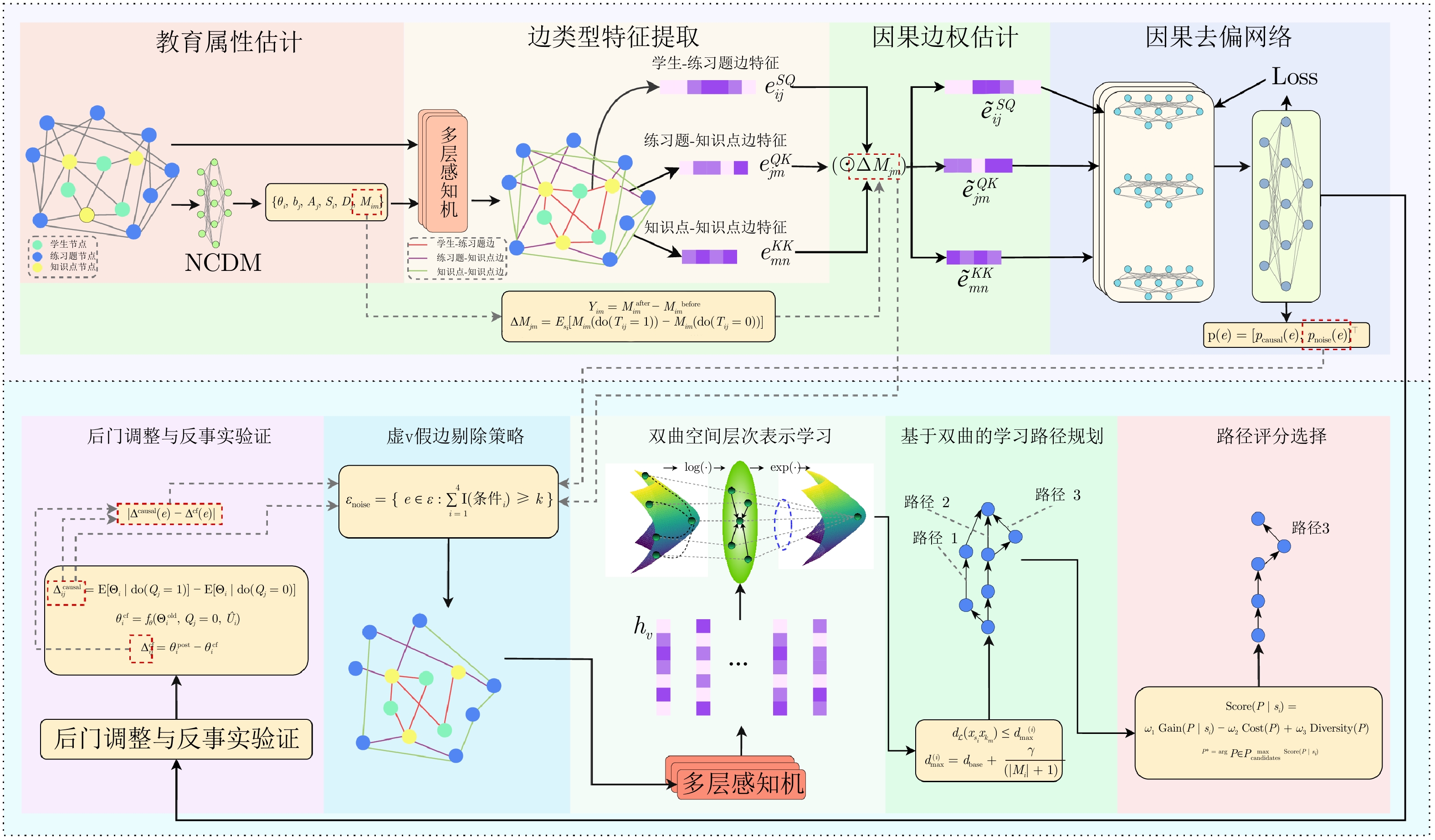
图 3 因果启发式去偏与双曲表示的个性化学习路径推荐框架
Fig. 3 Personalized learning path recommendation framework that integrates causality-inspired debiasing with hyperbolic representation

图 5 去噪前后的因果关系热力图和t-SNE分布
Fig. 5 Causal relationship heatmaps and t-SNE distributions before and after denoising
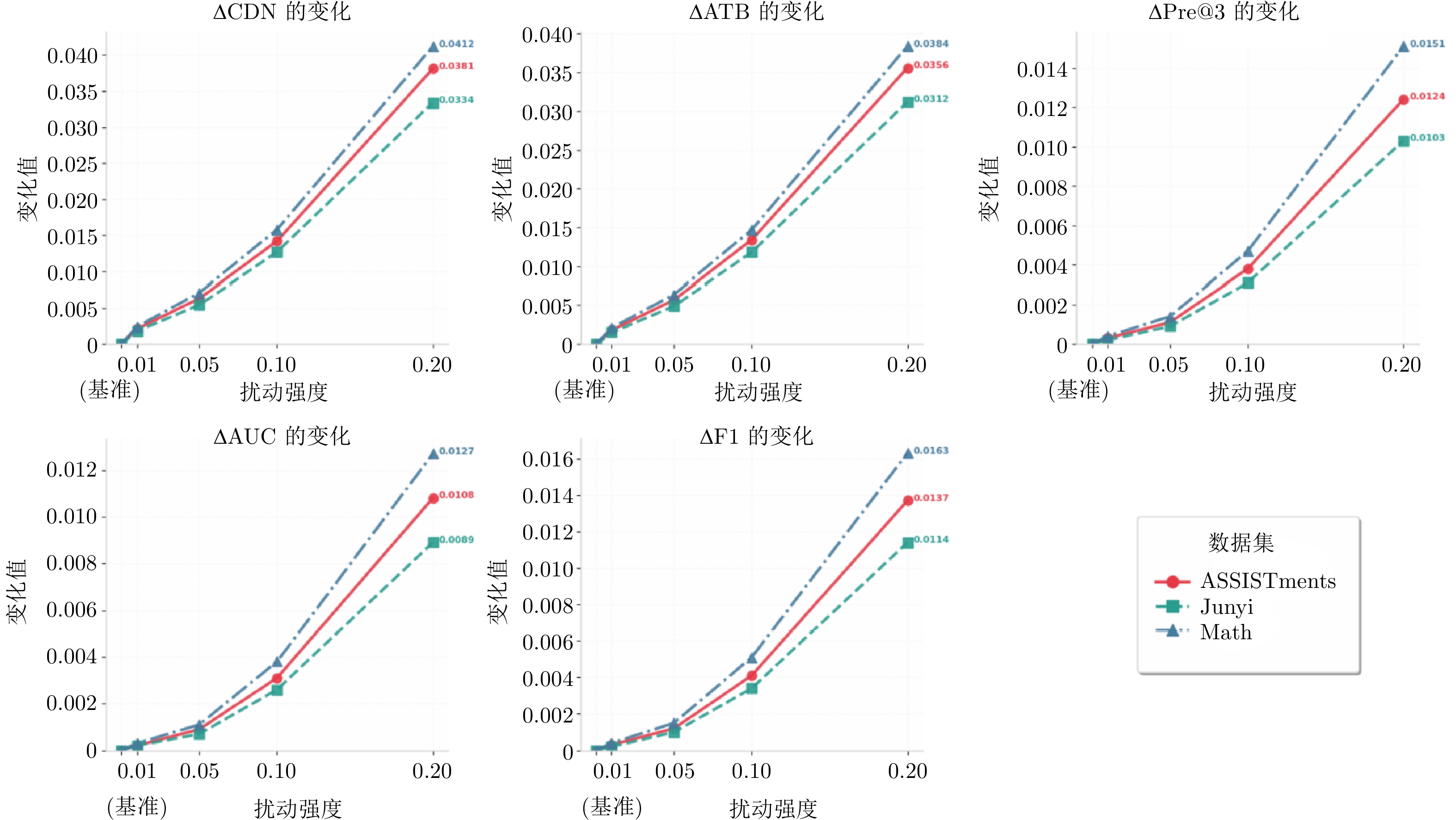
图 6 不同扰动强度$ \sigma$下各模块的误差传播情况
Fig. 6 Error propagation of each module under different perturbation intensities $ \sigma$
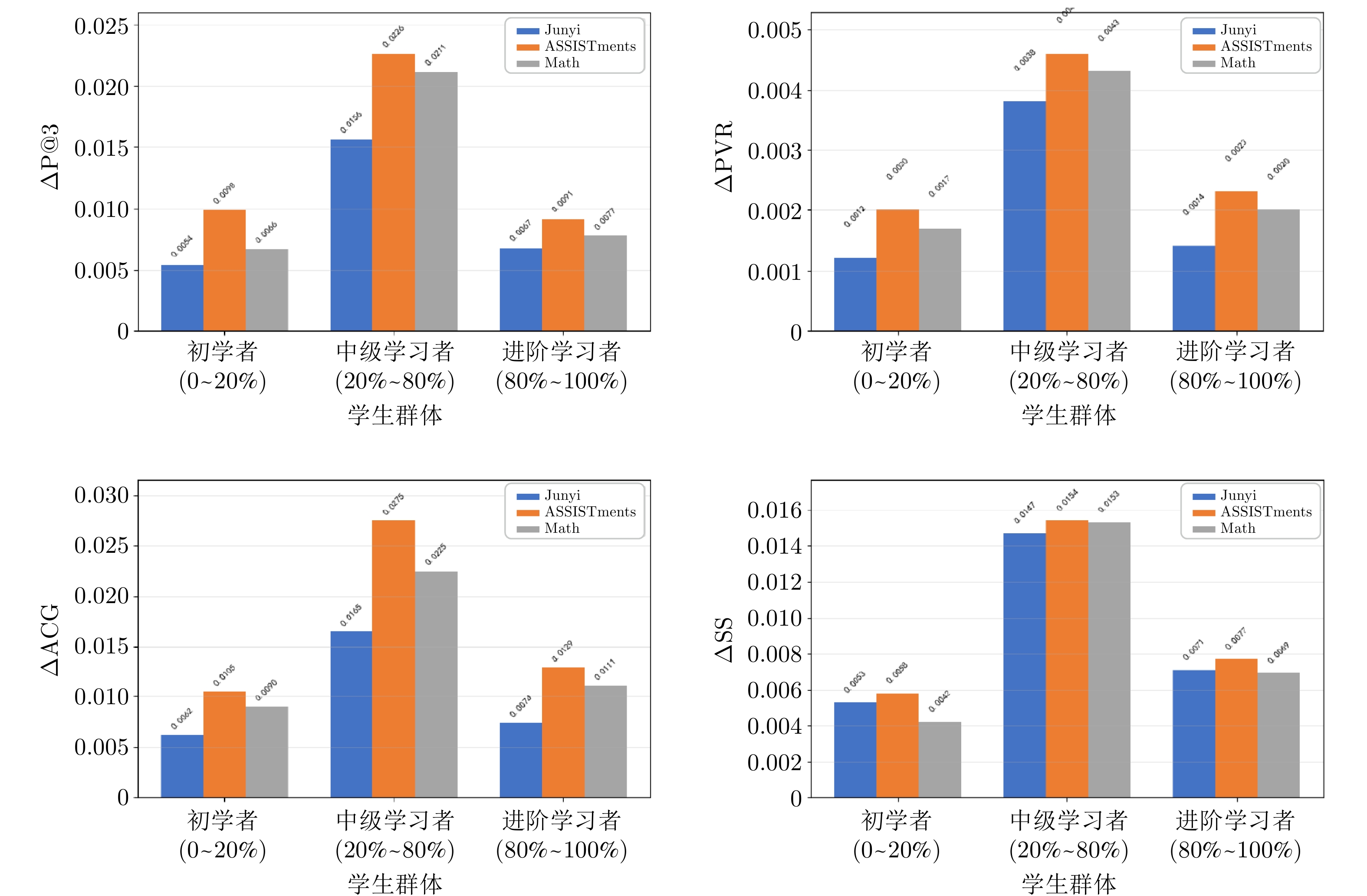
图 8 不同学习阶段学生群体上的性能变化情况
Fig. 8 Performance variation of student groups across different learning stages
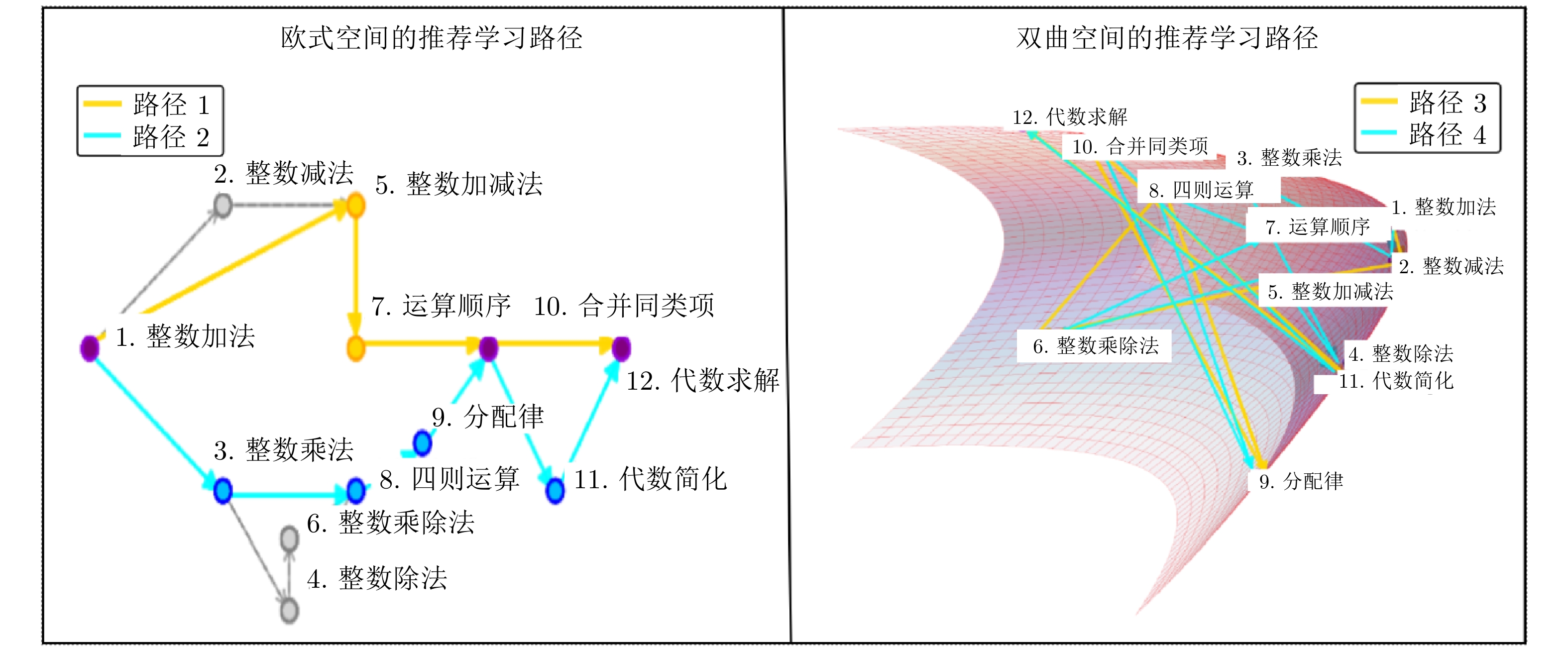
图 9 欧氏空间与双曲空间中的推荐学习路径示例
Fig. 9 Examples of recommended learning paths in Euclidean and hyperbolic spaces
表 1 数据集的基本统计信息
Table 1 Basic statistical information of the datasets
数据集 ASSISTments Math Junyi #学生 4163 10268 10,000 #练习练习题 17746 917495 835 #知识点 123 1488 835 #回答日志 324572 864722 353835  下载: 导出CSV
表 2 模型在Junyi数据集上的性能对比
Table 2 Performance comparison of models on Junyi dataset
模型 AUC ACC F1 LightGCN 0.8431 ±0.0053 0.7819 ±0.0049 0.7428 ±0.0056 EHGCN 0.8342 ±0.0057 0.7625 ±0.0051 0.7509 ±0.0048 KFGAN 0.8701 ±0.0042 0.8098 ±0.0039 0.7879 ±0.0045 DEKGCI 0.8794 ±0.0039 0.7987 ±0.0041 0.8251 ±0.0037 IDRMI 0.9008 ±0.0035 0.8519 ±0.0033 0.8129 ±0.0038 DHCF 0.8172 ±0.0064 0.7588 ±0.0059 0.7205 ±0.0067 HCCF 0.8549 ±0.0048 0.7926 ±0.0045 0.7604 ±0.0050 CHPLR 0.9099 ±0.0026 0.8681 ±0.0028 0.8523 ±0.0030
下载: 导出CSV
表 3 模型在ASSISTments数据集上的性能对比
Table 3 Performance comparison of models on ASSISTments dataset
模型 AUC ACC F1 LightGCN 0.7896 ±0.0062 0.7221 ±0.0058 0.6819 ±0.0065 EHGCN 0.7768 ±0.0068 0.7101 ±0.0061 0.6712 ±0.0070 KFGAN 0.8241 ±0.0051 0.7372 ±0.0054 0.7021 ±0.0058 DEKGCI 0.8052 ±0.0055 0.7238 ±0.0052 0.6831 ±0.0059 IDRMI 0.8491 ±0.0044 0.7728 ±0.0046 0.7398 ±0.0048 DHCF 0.7759 ±0.0075 0.7087 ±0.0069 0.6676 ±0.0077 HCCF 0.8131 ±0.0053 0.7252 ±0.0056 0.6923 ±0.0061 CHPLR 0.8407 ±0.0038 0.7979 ±0.0035 0.7691 ±0.0039
下载: 导出CSV
表 4 模型在Math数据集上的性能对比
Table 4 Performance comparison of models on Math dataset
模型 AUC ACC F1 LightGCN 0.7331 ±0.0081 0.6654 ±0.0075 0.6264 ±0.0084 EHGCN 0.7175 ±0.0090 0.6418 ±0.0082 0.6098 ±0.0093 KFGAN 0.7635 ±0.0068 0.6721 ±0.0072 0.6636 ±0.0069 DEKGCI 0.7438 ±0.0075 0.6632 ±0.0078 0.6493 ±0.0076 IDRMI 0.7989 ±0.0057 0.7078 ±0.0062 0.6551 ±0.0064 DHCF 0.7136 ±0.0096 0.6279 ±0.0089 0.6032 ±0.0098 HCCF 0.7389 ±0.0071 0.6648 ±0.0075 0.6271 ±0.0080 CHPLR 0.8011 ±0.0049 0.7172 ±0.0052 0.6988 ±0.0055
下载: 导出CSV
表 5 消融实验结果
Table 5 The results of ablation experiment
模型消融版本 AUC ACC F1 w/o CD&HR 0.7023 0.6892 0.6502 w/o CD 0.7432 0.7268 0.7116 w/o HR 0.7736 0.7418 0.7257 w/o OR 0.8079 0.7631 0.7214 CHPLR 0.8407 0.7979 0.7691
下载: 导出CSV
表 6 未观测混杂敏感性分析——潜在表示扰动
Table 6 Sensitivity analysis for unobserved confounders: Latent representation perturbation
混杂强度$\gamma$ $\Delta_{\text{ATE}}^{\text{conf}}$ $\Delta_{\text{CDN}}^{\text{conf}}$ FlipRate(%) $\Delta_{\text{Rec}}^{\text{conf}}$ 0(基准) 0 0 0 0 0.02 0.0031 0.0028 0.41 0.0008 0.05 0.0074 0.0065 0.97 0.0019 0.10 0.0163 0.0141 2.13 0.0047 0.15 0.0289 0.0247 3.86 0.0091
下载: 导出CSV
表 7 未观测混杂敏感性分析——边权扰动
Table 7 Sensitivity analysis for unobserved confounders: Edge weight perturbation
扰动范围$\rho$ $\Delta_{\text{ATE}}^{\text{conf}}$ $\Delta_{\text{CDN}}^{\text{conf}}$ FlipRate(%) $\Delta_{\text{Rec}}^{\text{conf}}$ 0(基准) 0 0 0 0 0.05 0.0024 0.0021 0.33 0.0006 0.10 0.0058 0.0051 0.79 0.0015 0.20 0.0134 0.0118 1.84 0.0038 0.30 0.0241 0.0213 3.27 0.0074
下载: 导出CSV
表 8 Bootstrap参数稳定性分析
Table 8 Bootstrap-based parameter stability analysis
数据集 $\overline{W}_{\theta}$ $\overline{W}_{{\cal{D}}}$ 相对宽度(%) Junyi 0.0331 0.0294 3.31 ASSISTments 0.0468 0.0387 4.68 Math 0.0517 0.0435 5.17
下载: 导出CSV
表 9 $ K$和$ \epsilon$的敏感性实验
Table 9 Sensitivity experiments on $ K$ and $ \epsilon$
实验组 $K$ $\epsilon$ AUC ACC ATE 变$K$-1 1 0.10 0.8868 0.8542 0.0305 变$K$-2 5 0.10 0.8996 0.8614 0.0312 变$K$-3 7 0.10 0.8891 0.8569 0.0317 变$\epsilon$-1 3 0.05 0.8975 0.8553 0.0308 变$\epsilon$-2 3 0.15 0.8958 0.8619 0.0313 变$\epsilon$-3 3 0.20 0.8927 0.8635 0.0321 基准 3 0.10 0.9099 0.8681 0.0332
下载: 导出CSV
表 10 m和$ \tau$的敏感性实验
Table 10 Sensitivity experiments on m and $ \tau$
实验组 $m$ $\tau$ 保留边比例 AUC ATE 变$m$-1 1 0.10 0.52 0.8631 0.0298 变$m$-2 2 0.10 0.68 0.8887 0.0315 变$m$-3 4 0.10 0.81 0.8692 0.0323 变$\tau$-1 3 0.05 0.82 0.8719 0.0311 变$\tau$-2 3 0.15 0.69 0.8896 0.0318 变$\tau$-3 3 0.20 0.63 0.8931 0.0306 基准 3 0.10 0.74 0.9099 0.0332
下载: 导出CSV
表 11 复杂度分析符号定义
Table 11 Symbol definitions for complexity analysis
符号 含义 $|{\cal{D}}|$ 答题记录总数 $|{S}|$, $|{Q}|$, $|{K}|$ 学生、练习题、知识点数量 $|{E}_{SQ}|$, $|{E}_{QK}|$, $|{E}_{KK}|$ 三类边数量 $|{E}|$ 总边数, $|{E}_{SQ}|+|{E}_{QK}|+|{E}_{KK}|$ $|{E}_{\text{pure}}|$ 因果净化后边数, $|{\cal{E}}_{\text{pure}}| \leq |{E}|$ $d_{\text{cog}}$ 认知诊断维度 $d$ 双曲嵌入维度 $d_h$ CDN与NCDM隐层维度 $L_{mlp}$ NCDM中MLP层数 $L$ 双曲图卷积层数 $K$ PSM近邻数($K=3$) $B$ 后门调整分层数($B=5$) $|{\cal{F}}_i|$ 学生$s_i$的学习前沿大小 $L_{\text{path}}$ 推荐路径长度 $|{\cal{N}}(s_i)|$ 学生$s_i$的邻居练习题数
下载: 导出CSV
表 12 各模块计算复杂度汇总
Table 12 Summary of computational complexity for each module
模块 时间复杂度 主要瓶颈 NCDM $\mathrm{O}(|{\cal{D}}| L_{mlp} d_h^2)$ 数据规模 PSM(优化) $\mathrm{O}(|{E}_{SQ}| \log|{S}| + |{E}_{QK}|)$ 边规模 后门调整+反事实 $\mathrm{O}(|{E}_{SQ}| d_{\text{cog}} + |{S}|)$ 边规模 CDN $\mathrm{O}(|{E}| d_h^2)$ 边规模 噪声边剔除 $\mathrm{O}(|{E}|)$ 边规模 双曲图卷积 $\mathrm{O}(L(|{E}_{\text{pure}}| d + |{V}| d^2))$ 图规模、维度 路径搜索(A*) $\mathrm{O}(|{\cal{F}}_i| L_{\text{path}} \log|{\cal{F}}_i|)$ 前沿大小 CATE验证 $\mathrm{O}(L_{\text{path}} |S_j| d_{\text{cog}})$ 路径长度 在线更新 $\mathrm{O}(|{\cal{N}}(s_i)| d + d_h^2)$ 邻居数 训练阶段总计 $\mathrm{O} \left(|{\cal{D}}| L_{mlp} d_h^2 + |{E}_{SQ}| \log|{S}| + |{E}| d_h^2 + L |{E}_{\text{pure}}| d + L |{V}| d^2\right)$ 推理阶段总计 $\mathrm{O} \left(|{K}| d + |{\cal{F}}_i| L_{\text{path}} \log|{\cal{F}}_i|\right)$ 在线更新总计 $\mathrm{O} \left(|{\cal{N}}(s_i)| d + d_h^2\right)$, 与全局图规模无关
下载: 导出CSV
-
[1] Feitosa R G F, Campos G A L d, Santos I d S, Gonçalves C H R, Serra A D B, Oliveira A R D, et al. Competency and Skill-Based Educational Recommendation System. Int J Artif Intell Educ, 2025, 35: 135−154 doi: 10.1007/s40593-024-00423-z [2] Liu G W, Ren M R, Guo L J, Li J, Ma M. Comprehensive exercise recommendation with practicality, generalizability, and versatility in AI-driven education. Information Processing & Management, 2025, 62(3): 104051 doi: 10.1016/j.ipm.2024.104051 [3] Machado A, Tenório K, Santos M M, Barros A P, Rodrigues L, Mello R F, et al. Workload perception in educational resource recommendation supported by artificial intelligence: a controlled experiment with teachers. Smart Learn.2025, Environ. https://doi.org/10.1186/s40561-025-00373-6 [4] Su Y, Yang X J, Lu J Y, Liu Y, Han Z, Shuanghong Shen, Zhenya Huang, Qi Liu. Multi-task Information Enhancement Recommendation model for educational Self-Directed Learning System. Expert Systems with Applications, 2024, 252(Part A): 124073 doi: 10.1016/j.eswa.2024.124073 [5] Meng C J, Pan C F, Li Z L, Zhou C, Cao X R, Zhu J. DFRP: A Dual-Track Feedback Recommendation System for Educational Resources. Proceedings of the Thirty-Third International Joint Conference on Artificial Intelligence, 20248741−8744 [6] Tang W, & D Ge. Research on Recommendation System of Online Chinese Learning Resources Based on Multiple Collaborative Filtering Algorithms (RSOCLR). International Journal of Human–Computer Interaction, 2025, 41(3): 1771−1781 doi: 10.1080/10447318.2023.2171536 [7] Zhai X W, Wang Y Y, Liang L W, Wang K Z, Pei F C, Fu Y J. Personalized e-learning resource recommendation using multimodal-enhanced collaborative filtering. Knowledge-Based Systems, 2025, 319: 113605 doi: 10.1016/j.knosys.2025.113605 [8] Xie F X. Intelligent Personalized Recommendation Method Based on Optimized Collaborative Filtering Algorithm in Primary and Secondary Education Resource System. IEEE Access, 2024, 12: 28860−28872 doi: 10.1109/ACCESS.2024.3365549 [9] Li S F, Liu X W, Tang X L, Chen X and Pu J H. MLKT4Rec: Enhancing Exercise Recommendation Through Multitask Learning With Knowledge Tracing. IEEE Transactions on Computational Social Systems, 2025, 12(4): 1458−1472 doi: 10.1109/TCSS.2024.3515254 [10] Lin Y X, Wu Z Y, Zheng Z T. Personalized Multi-objective Learning Path Recommendation via Hierarchical Reinforcement Learning and Knowledge Tracing. Advanced Intelligent Computing Technology and Applications. ICIC 2025. Lecture Notes in Computer Science, vol 15853. Springer, Singapore [11] Chen Q S, Huang K J, Zhou X, Luo W Q, Cui Y N, and Cheng G. Benchmarking Recommendation, Classification, and Tracing Based on Hugging Face Knowledge Graph. In Proceedings of the 48th International ACM SIGIR Conference on Research and Development in Information Retrieval. Association for Computing Machinery, 2025, 3433–3443 [12] Li Z X, Wang J D, Gu W, Yazdanpanah V, Shi L, Cristea A I, et al. TutorLLM: Customizing Learning Recommendations with Knowledge Tracing and Retrieval-Augmented Generation. INTERACT 2025. Lecture Notes in Computer Science, Springer, 2026, vol 16110 [13] Zhang F, Feng X G, Wang Y B. Personalized process–type learning path recommendation based on process mining and deep knowledge tracing. Knowledge-Based Systems, 2024, 303: 112431 doi: 10.1016/j.knosys.2024.112431 [14] Ouyang Y, Ye Z, Chen L Y, Wang H W, Zeng Y W. DRG: A dual relational graph framework for course recommendation. Neural Networks, 2026, 193: 107984 doi: 10.1016/j.neunet.2025.107984 [15] Nguyen T, Do D, Vi H, Vo K T, Ta T-T, Nguyen P, et al. HetGNN-KGAT: Enhancing Personalized Course Recommendation in MOOCs With Knowledge Graph Attention Networks. IEEE Access, 2025, 13: 192045−192068 doi: 10.1109/ACCESS.2025.3630894 [16] Zhang G D, Gao X Y, Ye H Y, Zhu J Y, Lin W Q, Wu Z Z, et al. Alireza Baghban, Optimizing learning paths: Course recommendations based on graph convolutional networks and learning styles. Applied Soft Computing, 2025, 175: 113083 doi: 10.1016/j.asoc.2025.113083 [17] Li Y, Liang Y, Li Q Q, Sun H M, Du W, Jiang Y, et al. Cross-loop contrast of heterogeneous graphs for interdisciplinary journal recommendation. Expert Systems with Applications, 2025, 265: 125949 doi: 10.1016/j.eswa.2024.125949 [18] Xiao X, Liu Y, Huang J Y, Jin A W, Shen Z W, Zhang C D. TIDRec: a novel triple-graph interactive distillation method for paper recommendation. Knowl Inf Syst, 2025, 67: 7757−7789 doi: 10.1007/s10115-025-02457-8 [19] Wu A P, Kuang K, Xiong R X and Wu F. 2025. Instrumental Variables in Causal Inference and Machine Learning: A Survey. ACM Comput.2025, Surv. 57, 11, Article 292, 36 pages [20] Pang B, Qiao T R, Walker C, Cunningham C, Koh Y S. CABIN: Debiasing Vision-Language Models Using Backdoor Adjustments. Proceedings of the Thirty-Fourth International Joint Conference on Artificial Intelligence Main Track, 2025484−492 [21] Su Y, Cheng Z Y, Luo P F, Wu J Z, Zhang L, Liu Q, et al. Time-and-Concept Enhanced Deep Multidimensional Item Response Theory for interpretable Knowledge Tracing. Knowledge-Based Systems, 2021, 218: 106819 doi: 10.1016/j.knosys.2021.106819 [22] Fang J P, Zhang G D, Cui Q, Tang C Z, Gu L H, Li L F, et al. Backdoor Adjustment via Group Adaptation for Debiased Coupon Recommendations. Proceedings of the AAAI Conference on Artificial Intelligence, 2024, 38(11): 11944−1195 doi: 10.1609/aaai.v38i11.29081 [23] Neopane O, Ramdas A, Singh A. Optimistic Algorithms for Adaptive Estimation of the Average Treatment Effect.Forty-second International Conference on Machine Learning.2025 [24] Kawamata Y, Motai R, Okada Y, Imakura A, Sakurai T. Estimation of conditional average treatment effects on distributed confidential data. Expert Systems with Applications, 2026, 296(Part C): 129066 [25] Zhu H H, Li T T, He P, Zhou J Y. Enhancing Automated Grading in Science Education through LLM-Driven Causal Reasoning and Multimodal Analysis. Proceedings of the Thirty-Fourth International Joint Conference on Artificial Intelligence Human-Centred AI, 202510352−10360 [26] Xu J Q, Wang L C, Boukhers Z, Indurkhya B, and Yang C. Q-Chain: A Causal-Aware Framework for Structural and Educational Question Generation. In Proceedings of the 2025 International Conference on Multimedia Retrieval. Association for Computing Machinery, 2025, 2083–2087. [27] Kitto K, Hicks B, Shum S B. Using causal models to bridge the divide between big data and educational theory. British Journal of Educational Technology, 2023, 54: 1095−1124 doi: 10.1111/bjet.13321 [28] Ramirez-Arellano A, Acosta-Gonzaga E, Bory-Reyes J, Hernández-Simón L M. Factors affecting student learning performance: A causal model in higher blended education. Journal of Computer Assisted Learning, 2018, 34: 807−815 doi: 10.1111/jcal.12289 [29] Xu Y Y, Zhang W J, Xu X W, Li B H and Zhang Y. Scalable and Effective Temporal Graph Representation Learning With Hyperbolic Geometry. IEEE Transactions on Neural Networks and Learning Systems, 2025, 36(4): 6080−6094 doi: 10.1109/TNNLS.2024.3394161 [30] Yang Y H, Wu L, Zhang K, Hong R C, Zhou H L, Zhang Z Q. Hyperbolic Graph Learning for Social Recommendation. IEEE Transactions on Knowledge and Data Engineering, 2024, 36(12): 8488−8501 doi: 10.1109/TKDE.2023.3343402 [31] Wang J H, Shi Y L, Yu H, Wang X J, Yan Z M, Kong F Y. Mixed-Curvature Manifolds Interaction Learning for Knowledge Graph-aware Recommendation. In Proceedings of the 46th International ACM SIGIR Conference on Research and Development in Information Retrieval. Association for Computing Machinery, 2023, 372–382 [32] Sun Z T, Harit A. RicciFlowRec: A Geometric Root Cause Recommender Using Ricci Curvature on Financial Graphs. In Proceedings of the Nineteenth ACM Conference on Recommender Systems. Association for Computing Machinery, 2025, 1284–1289 [33] Grover K, J. Gordon G, Faloutsos C. CurvGAD: Leveraging Curvature for Enhanced Graph Anomaly Detection.Forty-second International Conference on Machine Learning.2025 [34] C P Isiwu, L C Nnadi and Y Watanobe, From Prediction to Prescription: A Causal-AI for Personalized Learning Path Optimization in MOOCs, in IEEE Access, vol. 14, 2026, pp. 29105-29118 [35] Fan Y X, Tong M W, Li D T C. Learning path recommendation based on forgetting factors and knowledge graph awareness. Information Processing & Management, 2026, 63(2): Part A [36] Yu X S, Yang S S, Wang Z W, Song S Y, Ma H P, Cao Z G, et al. 2025. LIGHT: Enhancing Learning Path Recommendation via Knowledge Topology-Aware Sequence Optimization. In Proceedings of the 48th International ACM SIGIR Conference on Research and Development in Information Retrieval (SIGIR '25). Association for Computing Machinery, New York, NY, USA, 306–315. https://doi.org/10.1145/3726302.3730022 [37] Zhang G D, Gao X Y, Ye H Y, Zhu J Y, Lin W Q, Wu Z Z, et al. Alireza Baghban, Optimizing learning paths: Course recommendations based on graph convolutional networks and learning styles, Applied Soft Computing, 2025, Volume 175 [38] Xie X, Feng X. Personalized Learning Path Recommendation Based on Learner Profile and Knowledge Graph. Computing and Informatics, 2025, 44(4): 983−1008 doi: 10.31577/cai_2025_4_983 [39] Fu C S. Curriculum-Aware Cognitive Diagnosis via Graph Neural Networks. Information, 2025, 16(11): 996 doi: 10.3390/info16110996 [40] Yan C R, Mao X B, Wang Z J, Zhao X C, and Meng L L.Compensating Information and Capturing Modal Preferences in Multimodal Recommendation: A Dual-Path Representation Learning Framework. In Proceedings of the 34th ACM International Conference on Information and Knowledge Management (CIKM '25). Association for Computing Machinery, 2025, 3730–3739 [41] Shareef M P, Jose B R, Mathew J, Indeterminacy-Driven Trade-Off in Reinforcement Learning on Neutrosophic Fuzzy Hypergraphs for Explainable Item Recommendation With Path-Compliant Rewards, in IEEE Transactions on Emerging Topics in Computational Intelligence, vol. 10, no. 1, 2026, pp. 996-1008 [42] Zhang Y M, He Z Y, Lou Z B, Long H X, Gao F. Temporal knowledge graph recommendation with sequence-aware and path reasoning. Data & Knowledge Engineering, 2026, 161: 102522 doi: 10.1016/j.datak.2025.102522 [43] Liu Y C, Fu S X, Ren Q Q, Lv X F, Li J B. SKGRec: Unifying temporal dynamics and knowledge graphs for robust recommendations, Expert Systems with Applications, 2026, Volume 297, Part A, 2026, 129354 [44] Li X D, He Y, Li J, Zhu K, Chang J, Yu J H. Multi-representation space recommendation with graph contrastive learning. Expert Systems with Applications, 2026, 297(Part B): 129274 [45] Li D T C, Lu J Y, Wang Z H, Wang J X, Wang X G, Shi F B, Liu Y. Recommender system based on noise enhancement and multi-view graph contrastive learning. Applied Soft Computing, 2025, 177: 113220 doi: 10.1016/j.asoc.2025.113220 [46] Dang Y Z, Chen W Y, Pan Z Q, Duan Y X, Cai F, Chen H H. PEARL: A dual-layer graph learning for multimodal recommendation. Information Fusion, 2025, 122: 103168 doi: 10.1016/j.inffus.2025.103168 [47] Yang Z, Lin C, Qin Y B, Huang R Z, Chen Y P, Qin J W. JGC-IAGCL: Fusing joint graph convolution and intent-aware graph contrastive learning for explainable recommendation. Information Fusion, 2025, 123: 103258 doi: 10.1016/j.inffus.2025.103258 [48] Guo Z H, Song P, Feng C J, Yao K X, Liang J Y. Causal inference for alleviating confounding bias in multi-criteria rating recommendation. Information Processing & Management, 2026, 63(1): 104364 doi: 10.1016/j.ipm.2025.104364 [49] Xu H T, Xu Y B, Li C Z, and Zhuang F Z. 2025. Causal Structure Representation Learning of Unobserved Confounders in Latent Space for Recommendation. ACM Trans. Inf. Syst. 43, 6, 2025, Article 146, 29 pages [50] Liu X Y, Yuan J X, Zhou Y H, Li J L, Huang F R, and Ai W. CSRec: Rethinking Sequential Recommendation from A Causal Perspective. In Proceedings of the 48th International ACM SIGIR Conference on Research and Development in Information Retrieval (SIGIR '25). Association for Computing Machinery, 2025, 1562–1571 [51] Tu Y F, Hwang G J, Hu D P. Effects on the learning achievement, approaches to learning, and multi-stage reflection quality of students with different levels of digital self-efficacy in a data literacy course: An ARCS-based self-reflective online learning model. Computers & Education, 2025, 238: 105397 doi: 10.1016/j.compedu.2025.105397 [52] Cristea T S, Heikkinen S, Snijders C, Saqr M, Matzat U, Conijn R, Kleingeld A. Dynamics of self-regulated learning: The effectiveness of students’ strategies across course periods. Computers & Education, 2025, 228: 105233 doi: 10.1016/j.compedu.2025.105233 [53] De Jong D, Dexter S. Experiential learning through simulations in fully online asynchronous courses: Exploring the role of self-debriefing. The Internet and Higher Education, 2025, 65: 100976 doi: 10.1016/j.iheduc.2024.100976 [54] Liu S Q, Kong W Z, Liu Z, Sun J W, Liu S Y Y, Gašević D. Dual-view cross attention enhanced semi-supervised learning method for discourse cognitive engagement classification in online course discussions. Expert Systems with Applications, 2025, 278: 127339 doi: 10.1016/j.eswa.2025.127339 [55] Nedim Slijepcevic, Wanju Huang. Evaluating the impact of online course development and teaching certificate academy on university faculty teaching practices through student learning experiences and faculty perceptions. The Internet and Higher Education, 2025, 67: 101020 doi: 10.1016/j.iheduc.2025.101020 [56] Nanda van der Stap, Theo van den Bogaart, Stan van Ginkel, Ebrahim Rahimi, Johan Versendaal. Towards teaching strategies addressing online learning in blended learning courses for adult-learners. Computers & Education, 2024, 219: 105103 doi: 10.1016/j.compedu.2024.105103 [57] Dong Z A, Chen J Y, W F. Knowledge Is Power: Harnessing Large Language Models for Enhanced Cognitive Diagnosis. Proceedings of the AAAI Conference on Artificial Intelligence, 2025, 39(1): 164−172 doi: 10.1609/aaai.v39i1.31992 [58] Wang X H, Ma W Y, Guo L, Jiang H R, Liu F G, Xu C D. HGNN: Hyperedge-based graph neural network for MOOC Course Recommendation. Information Processing & Management, 2022, 59(3): 102938 doi: 10.1016/j.ipm.2022.102938 [59] Zhang G D, Gao X Y, Ye H Y, Zhu J Y, Lin W Q, Wu Z Z, et al. Alireza Baghban, Optimizing learning paths: Course recommendations based on graph convolutional networks and learning styles. Applied Soft Computing, 2025, 175: 113083 doi: 10.1016/j.asoc.2025.113083 [60] Fan Y X, Tong M W, Li D T C. Learning path recommendation based on forgetting factors and knowledge graph awareness. Information Processing & Management, 2026, 63(2, Part A): 104393 doi: 10.1016/j.ipm.2025.104393 [61] Han W K, Lin W, Hu L Y, Dai Z L, Zhou Y Y, Li M Z, et al. Contrastive Cross-Course Knowledge Tracing via Concept Graph Guided Knowledge Transfer. Proceedings of the Thirty-Fourth International Joint Conference on Artificial Intelligence Main Track, 20257401−7409 [62] Huang Q H, Chen J J, Enhancing academic performance prediction with temporal graph networks for massive open online courses Journal of Big Data, 2024, Vol. 11, article number 52 [63] Fettach Y, Bahaj A, Ghogho M. JobEdKG: An uncertain knowledge graph-based approach for recommending online courses and predicting in-demand skills based on career choices. Engineering Applications of Artificial Intelligence, 2024, 131: 107779 doi: 10.1016/j.engappai.2023.107779 [64] Yang Y, Zhang C B, Song X, Dong Z, Zhu H S, and Li W J. Contextualized Knowledge Graph Embedding for Explainable Talent Training Course Recommendation. ACM Trans. Inf. Syst. 42, 2, 2023, Article 33, 27 pages [65] S. Carvalho D, A. Santos P, S. Melo F. Reinforcement learning in convergently non-stationary environments: Feudal hierarchies and learned representations. Artificial Intelligence, 2025, 347: 104382 doi: 10.1016/j.artint.2025.104382 [66] Ma K, Du T Y, Zhu Q, Wen X Y, Huang J S, Yang X B, Daoqiang Zhang. Hyper-network curvature: A new representation method for high-order brain network analysis. Pattern Recognition, 2026, 172(Part A): 112397 [67] Fu X C, Wang J, Sun Q Y, Yuan H N, Li J X, Li X X. Discrete Curvature Graph Information Bottleneck. Proceedings of the AAAI Conference on Artificial Intelligence, 2025, 39(16): 16666−16673 doi: 10.1609/aaai.v39i16.33831 [68] Mei Z Y, Bi X, Li D G, Xia W, Yang F, Wu H. DHHNN: A Dynamic Hypergraph Hyperbolic Neural Network based on variational autoencoder for multimodal data integration and node classification. Information Fusion, 2025, 119: 103016 doi: 10.1016/j.inffus.2025.103016 [69] Berg P, Buecher L, Michele B, Pham M-T, Chapel L, Courty N. Multi-Prototype Hyperbolic Learning Guided by Class Hierarchy. Int J Comput Vis, 2025, 133: 7969−7984 doi: 10.1007/s11263-025-02571-8 [70] Gao Y X, Zhang F W, Zhang Z, Min X S, Zhuang F Z. Mixed-Curvature Multi-Modal Knowledge Graph Completion. Proceedings of the AAAI Conference on Artificial Intelligence, 2025, 39(11): 11699−11707 doi: 10.1609/aaai.v39i11.33273 [71] Lin Y G, Chen H, Zhou X Z, Zhang W, You H Y, Lin F, Pengcheng Wu. Evolutionary reinforcement learning for explainable recommendation on knowledge graph. Applied Soft Computing, 2026, 188: 114380 doi: 10.1016/j.asoc.2025.114380 [72] Xu H T, Xu Y B, L H Y, W E. Flow-based Time-aware Causal Structure Learning for Sequential Recommendation. Proceedings of the Thirty-Fourth International Joint Conference on Artificial Intelligence Main Track, 20253498−3506 [73] Yu D N, Li Q, Huang S R, Cao J, Xu G D. Large Language Models Meet Causal Inference: Semantic-Rich Dual Propensity Score for Sequential Recommendation. IEEE Transactions on Knowledge and Data Engineering, 2025, 37(11): 6494−6505 doi: 10.1109/TKDE.2025.3606149 [74] Luo H S, Wu Y Q, Chen Y W, Zhuang F Z, and Wang D Q. CDC: Causal Domain Clustering for Multi-Domain Recommendation. In Proceedings of the 48th International ACM SIGIR Conference on Research and Development in Information Retrieval (SIGIR '25). Association for Computing Machinery, 2025, 1840–1849. [75] Yang F, Zhou Y, Peng D L. A generic long-tail alleviation framework for session-based recommendation combining weight diversity and causal analysis. Expert Systems with Applications, 2025, 291: 128509 doi: 10.1016/j.eswa.2025.128509 [76] Chen W X, Chen L, Ni Y X, and Zhao Y H. Causality-Inspired Fair Representation Learning for Multimodal Recommendation. ACM Trans. Inf. Syst.2025, 43, 6, Article 153, 29 pages [77] Outemzabet L, Gaud N, Bertaux A, Nicolle C, Gerart S, Vachenc S. Harnessing Heterogeneous Information Networks: A systematic literature review. Computer Science Review, 2024, 52: 100633 doi: 10.1016/j.cosrev.2024.100633 [78] Lin T Q J, Song K S, Jiang Z R, Kang Y Y, Yuan W K, Li X R, et al. Towards human-like perception: Learning structural causal model in heterogeneous graph. Information Processing & Management, 2024, 61(2): 103600 doi: 10.1016/j.ipm.2023.103600 [79] Dong J N, Zhang Q G, Huang X, Duan K Y, Tan Q Y, Jiang Z M. Hierarchy-Aware Multi-Hop Question Answering over Knowledge Graphs. In Proceedings of the ACM Web Conference 2023. Association for Computing Machinery, New York, NY, USA, 2519–2527. [80] Li A T, Chen S S, Li Z X, Qu J F, Yue Z A, Liu J P. A Hierarchy-aware Entity Alignment Method for Educational Knowledge Graphs. Database Systems for Advanced Applications. DASFAA 2024. Lecture Notes in Computer Science, vol 14853 [81] Gao H P, Yang F N, Yang Y J, Wang Y. Hierarchy Knowledge Graph for Parameter-Efficient Entity Embedding. Proceedings of the Thirty-Fourth International Joint Conference on Artificial Intelligence Main Track, 20252811−2819 [82] Wang F, Liu Q, Chen E H, Huang Z Y, Yin Y, Wang S J. NeuralCD: A General Framework for Cognitive Diagnosis, in IEEE Transactions on Knowledge and Data Engineering, 2023, vol. 35, no. 8, pp. 8312-8327 [83] Ibeling D, Icard T. Comparing Causal Frameworks: Potential Outcomes, Structural Models, Graphs, and Abstractions. Advances in Neural Information Processing Systems, 2023, 36: 80130−80141 [84] Gao Q, Wu X Y, Ding J, Yuan B, Wang Y J, Shu R Z. An Improved A-Star Algorithm for Path Planning in Robot-Assisted Long Bone Fracture Reduction. 2025 IEEE/RSJ International Conference on Intelligent Robots and Systems (IROS), 20255881−5886 [85] F.Kurz C, Krzywinski M, Altman N. Propensity score matching. Nature Methods, 2024, 21: 1770−1772 doi: 10.1038/s41592-024-02405-4 [86] He X N, Deng K, Wang X, Li Y, Zhang Y D, and Wang M. LightGCN: Simplifying and powering graph convolution network for recommendation. in Proc. 43rd Int. ACM SIGIR Conf. Res. Develop. Inf. Retrieval, 2020, pp. 639–648 [87] Li X K, Guo R H, Chen J W, Hu Y P, Qu M X, Jiang B. Effective hybrid graph and hypergraph convolution network for collaborative filtering. Neural Comput & Applic, 2023, 35: 2633−2646 doi: 10.1007/s00521-022-07735-y [88] Li S Y, Feng Y F, Ji R G, Zhao X B, Tang W W, Gao Y. Dual Channel Hypergraph Collaborative Filtering. In Proceedings of the 26th ACM SIGKDD International Conference on Knowledge Discovery & Data Mining (KDD '20). Association for Computing Machinery, 2020, 2020–2029 [89] Xia L H, Huang C, Xu Y, Zhao J S, Yin D W, Huang J. Hypergraph Contrastive Collaborative Filtering. Proceedings of the 45th International ACM SIGIR Conference on Research and Development in Information Retrieval, 2022 [90] Wang W, Shen X X, Yi B L, Zhang H Y, Liu J F, Dai C. Knowledge-aware fine-grained attention networks with refined knowledge graph embedding for personalized recommendation. Expert Systems with Applications, 2024, 249(Part B): 123710 doi: 10.1016/j.eswa.2024.123710 [91] Yang Y J, Zeng Z Y, Jiang S Y, Chen M, Shang R R. DEKGCI: A double-ended recommendation model for integrating knowledge graph and user–item interaction graph. J Supercomput, 2024, 80: 24781−24800 doi: 10.1007/s11227-024-06344-x [92] Yang Y J, Peng X C, Chen M, Liu S Y Y. An explainable graph-based course recommendation model based on multiple interest factors. Expert Systems with Applications, 2025, 264: 125889 doi: 10.1016/j.eswa.2024.125889 -

 下载:

计量
- 文章访问数: 11
- HTML全文浏览量: 6
- 被引次数: 0
