


-
摘要: 大气湍流是由大气折射率随机起伏引起的复杂光学退化现象, 通常导致成像过程中产生几何畸变、模糊及闪烁等问题, 严重制约远距离成像系统的视觉质量与机器感知性能. 本文系统综述基于深度学习的大气湍流抑制研究, 详细探讨基于卷积神经网络、生成对抗网络、Transformer、扩散模型以及 Mamba 的多种核心方法, 并从建模能力、鲁棒性与计算效率等方面对各类代表性方法进行对比分析. 最后, 围绕复杂场景、实时处理、高分辨率成像等关键问题进行总结与展望, 为未来研究提供参考.Abstract: Atmospheric turbulence is a complex optical degradation phenomenon caused by random fluctuations in the atmospheric refractive index, which typically leads to geometric distortions, blur, and scintillation during the imaging process, thereby severely degrading the visual quality and machine perception performance of long-range imaging systems. This paper presents a systematic review of deep-learning based research on atmospheric turbulence mitigation. We comprehensively investigate multiple core methodologies utilizing convolutional neural network, generative adversarial network, Transformer, diffusion models, and Mamba, and comparatively analyze these representative approaches in terms of modeling capability, robustness, and computational efficiency. Finally, we summarize key challenges and outline future research directions, including complex scenarios, real-time processing, and high-resolution imaging, to provide references for future research.
-
Key words:
- atmospheric turbulence /
- turbulence mitigation /
- deep learning /
- image restoration
-
图 1 大气湍流引起的主要视觉效应
Fig. 1 Illustration of the main visual effects caused by atmospheric turbulence
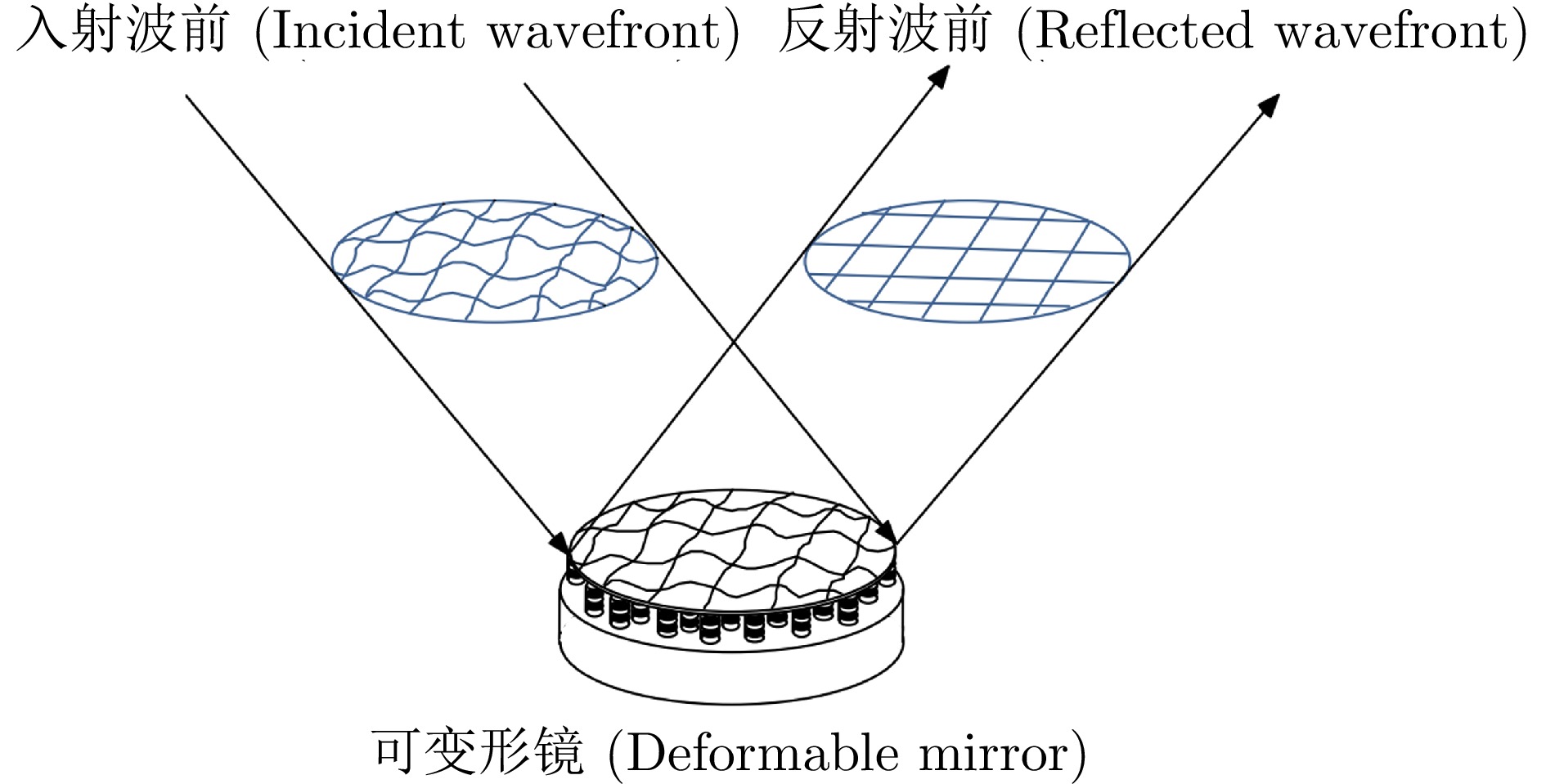
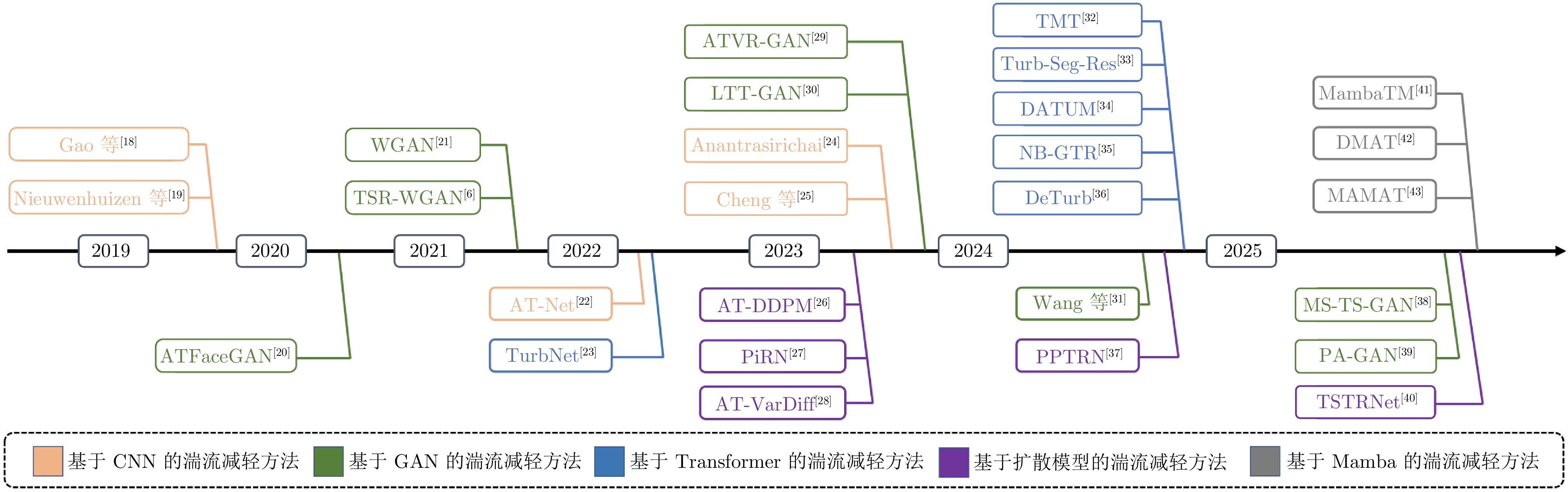
图 3 基于深度学习的大气湍流抑制方法发展历程
Fig. 3 Development history of deep learning-based turbulence mitigation methods
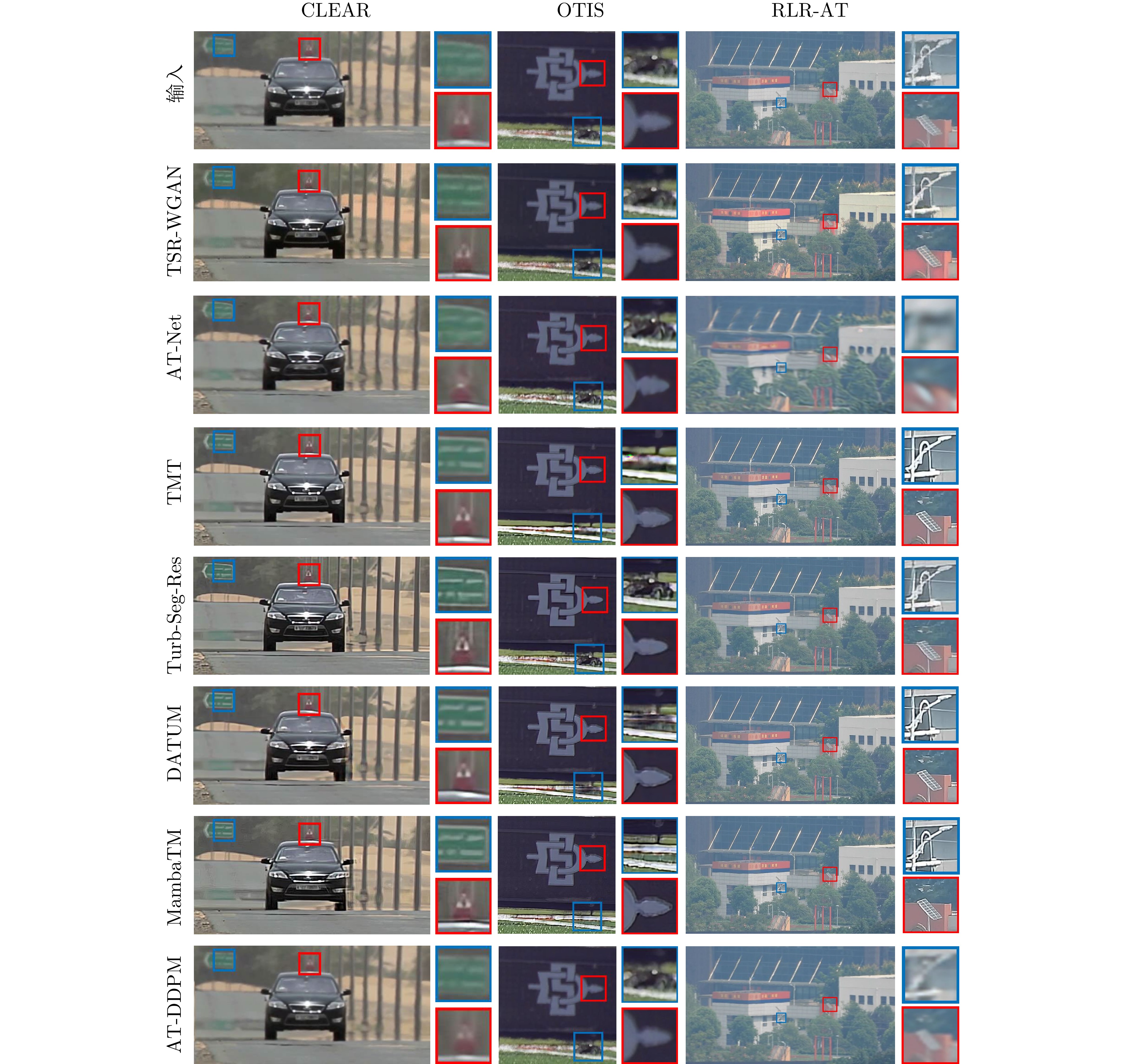
图 4 部分基于深度学习的方法(TSR-WGAN[6]、AT-Net[22]、TMT[32]、Turb-Seg-Res[33]、DATUM[34]、MambaTM[41]、AT-DDPM[26])在CLEAR[55]、OTIS[56]和RLR-AT[57]数据集上的可视化结果
Fig. 4 Visual results of representative deep learning-based methods(TSR-WGAN[6]、AT-Net[22]、TMT[32]、Turb-Seg-Res[33]、DATUM[34]、MambaTM[41]、AT-DDPM[26]) on the CLEAR[55]、OTIS[56] and RLR-AT[57] datasets
表 1 大气湍流抑制方法分类
Table 1 Classification of atmospheric turbulence suppression methods
一级分类 二级分类 代表工作 基于硬件的方法 基于自适应光学技术的方法 COAT (1976)[7]、Vorontsov 等(1997)[8]、Le Roux (2004)[9]、Deformable mirror (2012)[10]、LSPV+ 7 (2014)[11] 基于软件的方法 基于传统图像处理的方法 LRF (2009)[12,13]、DT-CWT (2012)[14]、Zhu 等(2012)[15]、Oreifej 等(2013)[16]、Halder 等(2015)[17] 基于深度学习的方法 Gao 等(2019)[18]、Nieuwenhuizen 等(2019)[19]、ATFaceGAN (2020)[20]、WGAN (2021)[21]、TSR-WGAN (2021)[6]、AT-Net (2022)[22]、TurbNet (2022)[23]、Anantrasirichai (2023)[24]、Cheng 等(2023)[25]、AT-DDPM (2023)[26]、PiRN (2023)[27]、AT-VarDiff (2023)[28]、ATVR-GAN (2023)[29]、LTT-GAN (2023)[30]、Wang 等(2024)[31]、TMT (2024)[32]、Turb-Seg-Res (2024)[33]、DATUM (2024)[34]、NB-GTR (2024)[35]、DeTurb (2024)[36]、PPTRN (2024)[37]、MS-TS-GAN (2025)[38]、PA-GAN (2025)[39]、TSTRNet (2025)[40]、MambaTM (2025)[41]、DMAT (2025)[42]、MAMAT (2025)[43]  下载: 导出CSV
表 2 常用的代表性真实大气湍流数据集
Table 2 Commonly used representative real atmospheric turbulence datasets
数据集 序列名称 帧数 分辨率(像素) 序列描述 Building和Chimney[54] Building 100 237 $ \times $ 237 静态场景、真实数据 Chimney 100 237 $ \times $ 237 静态场景、真实数据 CLEAR[55] Car 163 512 $ \times $ 256 动态场景、真实数据 Monument 100 512 $ \times $ 512 静态场景、真实数据 Barcode 100 1 024 $ \times $ 1 024 静态场景、合成数据 Books 99 1 024 $ \times $ 1 024 静态场景、合成数据 Boxes 100 320 $ \times $ 240 静态场景、合成数据 CarBack 100 256 $ \times $ 256 静态场景、合成数据 CarFront 99 512 $ \times $ 512 静态场景、合成数据 Faces 96 512 $ \times $ 512 静态场景、合成数据 Plant 100 512 $ \times $ 512 静态场景、合成数据 Toys 96 1 200 $ \times $ 800 静态场景、合成数据 Van 159 480 $ \times $ 384 动态场景、真实数据 Men 100 640 $ \times $ 480 动态场景、真实数据 Number plate 264 256 $ \times $ 256 静态场景、真实数据 OTIS[56] Door 300 520 $ \times $ 520 静态场景、真实数据 Pattern 100 113 $ \times $ 117、109 $ \times $ 113、152 $ \times $ 157 等 静态场景、真实数据 TSR-WGAN[6] 街景、纪录片片段 100 1 920 $ \times $ 1 080 动态场景、真实数据 TurbNet Benchmark Datasets[23] Heat Chamber 100 400 $ \times $ 400 静态场景、真实数据 Turbulence Text 100 440 $ \times $ 440 静态场景、真实数据 RLR-AT[57] 文本、车辆、建筑、桥梁等 800 1 920 $ \times $ 1 080 静态场景、真实数据
下载: 导出CSV
表 3 基于深度学习的大气湍流抑制方法性能对比(评价指标: PSNR↑/SSIM↑/LPIPS↓)
Table 3 Performance comparison of deep-learning based atmospheric turbulence mitigation methods (evaluation metrics: PSNR↑/SSIM↑/LPIPS↓)
类型 方法 CLEAR OTIS TMT CelebA COCO Heat Chamber Places CNN Gao 等[18] – – – – – – – Nieuwenhuizen 等[19] – – – – – – – AT-Net[22] 18.0400 /0.7730 /0.4720 15.6500 /0.5930 /0.4830 – 25.3100 /0.8100 /–– – 20.8600 /0.6030 /0.5180 Anantrasirichai[24] – – – – – – – Cheng 等[25] – – – – – – – GAN ATFaceGAN[20] – – – 21.7700 /0.6633 /0.5868 – – – WGAN[21] – – – – – – – TSR-WGAN[6] 24.7300 /0.8090 /0.1300 16.8700 /0.7100 /0.2280 26.3262 /0.7957 /0.2606 – – – 24.9900 /0.7630 /0.2490 ATVR-GAN[29] – – – – – – – LTT-GAN[30] 20.9980 /0.8200 /–10.2670 /0.4190 /–– 20.9600 /0.6042 /0.2906 – 19.5860 /0.6740 /–– Wang 等[31] – – – – – – – MS-TS-GAN[38] – – – – – – – PA-GAN[39] – – – – – – – Transformer TurbNet[23] 19.3800 /0.7360 /0.4110 15.0800 /0.6840 /0.4530 24.2229 /0.7149 /0.4445 24.9160 /0.7680 /–– 19.3186 /0.6812 /0.3533 22.7600 /0.6842 /–TMT[32] 25.5900 /0.8220 /0.1220 15.1700 /0.6110 /0.3290 27.7419 /0.8318 /0.2475 – 23.3320 /0.6540 /0.3480 – 25.9400 /0.7950 /0.2020 DATUM[34] 26.4600 /0.8380 /0.0960 24.6500 /0.8270 /0.2040 28.6006 /0.8441 /0.2245 – 23.0920 /0.6440 /0.3560 – 27.0000 /0.7870 /0.1980 Turb-Seg-Res[33] 28.0900 /0.9350 /–– – – – – – DeTurb[36] 26.9900 /0.8470 /0.0880 24.5300 /0.8410 /0.1280 – – – – 27.1700 /0.8270 /0.1700 NB-GTR[35] – – – – – – 25.0000 /0.8199 /–DDPM AT-DDPM[26] 20.0590 /0.7260 /–10.1880 /0.4210 /–– 22.4100 /0.6262 /0.3223 – 19.4010 /0.6570 /––/–/ 0.2150 PiRN[27] 21.6070 /0.8080 /–10.1990 /0.4150 /–– 27.2350 /0.8100 /–– 20.5900 /0.7115 /–– AT-VarDiff[28] – – – – – – – PPTRN[37] – – – – – 19.4260 /0.6793 /0.3440 – TSTRNet[40] 21.7460 /0.7910 /–10.3090 /0.4320 /–– 27.7120 /0.8190 /–– 25.1690 /0.8210 /–– Manba MambaTM[41] – – 28.9049 /0.8561 /0.1996 – – – – DMAT[42] – – – – 23.8410 /0.6710 /0.3730 – – MAMAT[43] – – – – 30.9900 /0.6514 /–– –
下载: 导出CSV
表 4 基于深度学习的大气湍流抑制方法的效率、输入条件与开源情况对比
Table 4 Comparison of efficiency, input setting and open-source availability of deep learning-based atmospheric turbulence mitigation methods
类型 方法 推理速度或参数量 输入条件 开源情况 CNN Gao 等[18] 1638.4k 像素/s (Nvidia Tesla P100-PCIE GPU) 支持单帧和多帧 未开源 Nieuwenhuizen 等[19] 原论文未报告 多帧 未开源 AT-Net[22] 参数量: 7.01 M 单帧 https://github.com/rajeevyasarla/AT-Net Anantrasirichai[24] 11520k 像素/s (原论文未说明GPU信息) 多帧 未开源 Cheng 等[25] 100.6k 像素/s (原论文未说明GPU信息) 多帧 未开源 GAN ATFaceGAN[20] 参数量: 68.70 M 单帧 未开源 WGAN[21] 原论文未报告 多帧 未开源 TSR-WGAN[6] 参数量: 46.28 M 多帧 https://doi.org/ 10.24433 /CO.3517894.v1ATVR-GAN[29] 原论文未报告 多帧 未开源 LTT-GAN[30] 参数量: 741.4 M 单帧 未开源 Wang 等[31] 原论文未报告 单帧 未开源 MS-TS-GAN[38] 原论文未报告 多帧 未开源 PA-GAN[39] 原论文未报告 多帧 未开源 Transformer TurbNet[23] 参数量: 26.60 M 单帧 https://github.com/VITA-Group/TurbNet TMT[32] 参数量: 26.04 M 多帧 https://xg416.github.io/TMT DATUM[34] 参数量: 5.754 M 多帧 https://xg416.github.io/DATUM Turb-Seg-Res[33] 参数量: $ \sim $30 M 多帧 https://riponcs.github.io/TurbSegRes DeTurb[36] 参数量: 58.79 M 多帧 未开源 NB-GTR[35] 原论文未报告 双帧(一张 RGB 图像
和一张窄带图像)未开源 DDPM AT-DDPM[26] 参数量: 25.98 M 单帧 http://github.com/Nithin-GK/AT-DDPM PiRN[27] 参数量: 74.25 M 单帧 https://github.com/VITA-Group/PiRN AT-VarDiff[28] 原论文未报告 单帧 未开源 PPTRN[37] 原论文未报告 单帧 未开源 TSTRNet[40] 参数量: 262.93 M 单帧 未开源 Mamba MambaTM[41] 参数量: 6.904 M 多帧 https://github.com/xg416/MambaTM DMAT[42] 参数量: 2.8 M 多帧 https://github.com/pui-nantheera/DMAT MAMAT[43] 原论文未报告 多帧 未开源
下载: 导出CSV
表 5 面向工程应用的大气湍流抑制方法选型指南
Table 5 Engineering-oriented method selection guideline for atmospheric turbulence mitigation
场景特征 典型应用 主要挑战 推荐方法范式 推荐理由 近距离、动态、实时 安防/交通监控($ \sim $1 km) 轻度畸变、
实时性要求高CNN/Mamba 计算开销低 远距离、动态、实时/离线 远距离侦察/目标检测
(3 $ \sim $ 10 km)强非刚性畸变与模糊 Mamba/Transformer 具备更强分布建模与细节恢复能力 远距离、静态、离线 特定目标恢复
(人脸恢复、车牌识别等)强结构先验 GAN/扩散模型 依托生成先验提升感知质量 远距离、静态、离线 天文观测(10 km+) 极强湍流、
严重信息缺失扩散模型 凭借稳定反向去噪过程与强大生成先验弥补信息缺失
下载: 导出CSV
-
[1] 夏振华. 湍流中的多态现象. 科学通报, 2019, 64(4): 373−383Xia Zhen-Hua. Multiple states in turbulence. Chinese Science Bulletin, 2019, 64(4): 373−383 [2] Wyngaard J C. Atmospheric turbulence. Annual Review of Fluid Mechanics, 1992, 24(1): 205−234 doi: 10.1146/annurev.fl.24.010192.001225 [3] Kolmogorov A N. The local structure of turbulence in incompressible viscous fluid for very large Reynolds numbers. Proceedings of the Royal Society of London. Series A: Mathematical and Physical Sciences, 1991, 434(1890): 9-13 [4] Tatarski V I. Wave Propagation in a Turbulent Medium. New York: Courier Dover Publications, 2016. [5] Schwartzman A, Alterman M, Zamir R, Schechner Y Y. Turbulence-induced 2d correlated image distortion. In: Proceedings of 2017 IEEE International Conference on Computational Photography (ICCP). Stanford, USA: IEEE, 2017. 1-13 [6] Jin D, Chen Y, Lu Y, Chen J, Wang P, Liu Z, et al. Neutralizing the impact of atmospheric turbulence on complex scene imaging via deep learning. Nature Machine Intelligence, 2021, 3(10): 876−884 doi: 10.1038/s42256-021-00392-1 [7] Pearson J E. Atmospheric turbulence compensation using coherent optical adaptive techniques. Applied Optics, 1976, 15(3): 622−631 doi: 10.1364/AO.15.000622 [8] Vorontsov M A, Carhart G W, Ricklin J C. Adaptive phase-distortion correction based on parallel gradient-descent optimization. Optics Letters, 1997, 22(12): 907−909 doi: 10.1364/OL.22.000907 [9] Le Roux B, Conan J M, Kulcsár C, Raynaud H F, Mugnier L M, Fusco T. Optimal control law for classical and multiconjugate adaptive optics. Journal of the Optical Society of America A, 2004, 21(7): 1261−1276 doi: 10.1364/JOSAA.21.001261 [10] Steinbock M J. Implementation of branch-point tolerant wavefront reconstructor for strong turbulence compensation[Master thesis], Air Force Institute of Technology, USA, 2012 [11] Steinbock M J, Hyde M W, Schmidt J D. LSPV+ 7, a branch-point-tolerant reconstructor for strong turbulence adaptive optics. Applied Optics, 2014, 53(18): 3821−3831 doi: 10.1364/AO.53.003821 [12] Fried D L. Probability of getting a lucky short-exposure image through turbulence. Journal of the Optical Society of America, 1978, 68(12): 1651−1658 doi: 10.1364/JOSA.68.001651 [13] Aubailly M, Vorontsov M A, Carhart G W, Valley M T. Automated video enhancement from a stream of atmospherically-distorted images: the lucky-region fusion approach. Proceedings of SPIE, DOI: 10.1117/12.828332 [14] Anantrasirichai N, Achim A, Bull D, Kingsbury N. Mitigating the effects of atmospheric distortion using DT-CWT fusion. In: Proceedings of 2012 19th IEEE International Conference on Image Processing. Orlando, USA: IEEE, 2012. 3033-3036 [15] Zhu X, Milanfar P. Removing atmospheric turbulence via space-invariant deconvolution. IEEE Transactions on Pattern Analysis and Machine Intelligence, 2012, 35(1): 157−170 doi: 10.1109/tpami.2012.82 [16] Oreifej O, Li X, Shah M. Simultaneous video stabilization and moving object detection in turbulence. IEEE Transactions on Pattern Analysis and Machine Intelligence, 2013, 35(2): 450−462 [17] Halder K K, Tahtali M, Anavatti S G. Geometric correction of atmospheric turbulence-degraded video containing moving objects. Optics Express, 2015, 23(4): 5091−5101 doi: 10.1364/OE.23.005091 [18] Gao J, Anantrasirichai N, Bull D. Atmospheric turbulence removal using convolutional neural network. arXiv preprint arXiv: 1912.11350, 2019. [19] Nieuwenhuizen R, Schutte K. Deep learning for software-based turbulence mitigation in long-range imaging. In: Proceedings of Technologies for Optical Countermeasures XVI. Strasbourg, France: SPIE, 2019. 111660I [20] Lau C P, Souri H, Chellappa R. ATFaceGAN: Single face image restoration and recognition from atmospheric turbulence. In: Proceedings of the 15th IEEE International Conference on Automatic Face and Gesture Recognition (FG 2020). Buenos Aires, Argentina: IEEE, 2020. 32-39 [21] Chak W H, Lau C P, Lui L M. Subsampled turbulence removal network. arXiv preprint arXiv: 1807.04418, 2018. [22] Yasarla R, Patel V M. Learning to restore images degraded by atmospheric turbulence using uncertainty. arXiv preprint arXiv: 2207.03447, 2022. [23] Mao Z, Jaiswal A, Wang Z, et al. Single frame atmospheric turbulence mitigation: A benchmark study and a new physics-inspired transformer model. In: Proceedings of European Conference on Computer Vision. Cham, Switzerland: Springer Nature Switzerland, 2022. 430-446 [24] Anantrasirichai N. Atmospheric turbulence removal with complex-valued convolutional neural network. Pattern Recognition Letters, 2023, 171: 69−75 doi: 10.1016/j.patrec.2023.05.017 [25] Cheng J, Zhu W, Li J, et al. Restoration of atmospheric turbulence-degraded short-exposure image based on convolution neural network. Photonics, 2023, 10(6): 666 doi: 10.3390/photonics10060666 [26] Nair N G, Mei K, Patel V M. At-ddpm: Restoring faces degraded by atmospheric turbulence using denoising diffusion probabilistic models. In: Proceedings of IEEE/CVF Winter Conference on Applications of Computer Vision. Waikoloa, USA: IEEE, 2023. 3434-3443 [27] Jaiswal A, Zhang X, Chan S H, et al. Physics-driven turbulence image restoration with stochastic refinement. In: Proceedings of IEEE/CVF International Conference on Computer Vision. Paris, France: IEEE, 2023. 12170-12181 [28] Wang X, López-Tapia S, Katsaggelos A K. Atmospheric turbulence correction via variational deep diffusion. In: Proceedings of 2023 IEEE 6th International Conference on Multimedia Information Processing and Retrieval (MIPR). Miami, USA: IEEE, 2023. 1-4 [29] Ettedgui B, Yitzhaky Y. Atmospheric turbulence degraded video restoration with recurrent GAN (ATVR-GAN). Sensors, 2023, 23(21): 8815 doi: 10.3390/s23218815 [30] Mei K, Patel V M. Ltt-gan: Looking through turbulence by inverting gans. IEEE Journal of Selected Topics in Signal Processing, 2023, 17(3): 587−598 doi: 10.1109/JSTSP.2023.3238552 [31] Wang X J, López-Tapia S, Katsaggelos A K. Real-world atmospheric turbulence correction via domain adaptation. In: Proceedings of 2024 IEEE International Conference on Image Processing (ICIP). Abu Dhabi, United Arab Emirates: IEEE, 2024. [32] Zhang X, Mao Z, Chimitt N, et al. Imaging through the atmosphere using turbulence mitigation transformer. IEEE Transactions on Computational Imaging, 2024, 10: 115−128 doi: 10.1109/TCI.2024.3354421 [33] Saha R K, Qin D, Li N, et al. Turb-Seg-Res: A segment-then-restore pipeline for dynamic videos with atmospheric turbulence. In: Proceedings of IEEE/CVF Conference on Computer Vision and Pattern Recognition. Seattle, USA: IEEE, 2024. 25286-25296 [34] Zhang X, Chimitt N, Chi Y, et al. Spatio-temporal turbulence mitigation: A translational perspective. In: Proceedings of IEEE/CVF Conference on Computer Vision and Pattern Recognition. Seattle, USA: IEEE, 2024. 2889-2899 [35] Xia Y, Zhou C, Zhu C, et al. NB-GTR: Narrow-band guided turbulence removal. In: Proceedings of IEEE/CVF Conference on Computer Vision and Pattern Recognition. Seattle, USA: IEEE, 2024. 24934-24943 [36] Zou Z, Anantrasirichai N. Deturb: Atmospheric turbulence mitigation with deformable 3d convolutions and 3d swin transformers. In: Proceedings of Asian Conference on Computer Vision. Hanoi, Vietnam: Springer, 2024. 904-921 [37] Sun G, Ma Q, Zhang L, et al. Probabilistic prior driven attention mechanism based on diffusion model for imaging through atmospheric turbulence. arXiv preprint arXiv: 2411.10321, 2024. [38] Lu Y, Li Z, Qi D, et al. Research on turbulence-removal optical imaging based on multi-scale GAN and sequential images. Scientific Reports, 2025. [39] Yuan Z, Meng P, Yin W, et al. Turbulence mitigation in optical imaging using pyramid attention GAN. Optics & Laser Technology, 2025, 188: 112880 doi: 10.1016/j.optlastec.2025.112880 [40] Wu Y, Cheng K, Chai T, et al. Boosting restoration of turbulence-degraded images with state space conditional diffusion. IEEE Transactions on Signal Processing, 2025. [41] Zhang X, Chimitt N, Wang X, et al. Learning phase distortion with selective state space models for video turbulence mitigation. In: Proceedings of Computer Vision and Pattern Recognition Conference. Nashville, USA: IEEE, 2025. 2127-2138 [42] Hill P, Liu Z, Achim A, et al. Dmat: an end-to-end framework for joint atmospheric turbulence mitigation and object detection. In: Proceedings of IEEE/CVF Winter Conference on Applications of Computer Vision. Waikoloa, USA: IEEE, 2026. 2690-2699 [43] Hill P, Liu Z, Anantrasirichai N. MAMAT: 3D mamba-based atmospheric turbulence removal and its object detection capability. In: Proceedings of 2025 IEEE International Conference on Advanced Visual and Signal-Based Systems (AVSS). Krakow, Poland: IEEE, 2025. 1-6 [44] LeCun Y, Bengio Y, Hinton G. Deep learning. Nature, 2015, 521(7553): 436−444 doi: 10.1038/nature14539 [45] Dong C, Loy C C, He K, Tang X. Image super-resolution using deep convolutional networks. IEEE Transactions on Pattern Analysis and Machine Intelligence, 2015, 38(2): 295−307 doi: 10.5220/0006618901590165 [46] Kim J, Lee J K, Lee K M. Accurate image super-resolution using very deep convolutional networks. In: Proceedings of IEEE Conference on Computer Vision and Pattern Recognition. Las Vegas, USA: IEEE, 2016. 1646-1654 [47] Lim B, Son S, Kim H, Nah S, Lee K M. Enhanced deep residual networks for single image super-resolution. In: Proceedings of IEEE Conference on Computer Vision and Pattern Recognition Workshops. Honolulu, USA: IEEE, 2017. 136-144 [48] Cai B, Xu X, Jia K, Qing C, Tao D. Dehazenet: An end-to-end system for single image haze removal. IEEE Transactions on Image Processing, 2016, 25(11): 5187−5198 doi: 10.1109/TIP.2016.2598681 [49] Li B, Peng X, Wang Z, Xu J, Feng D. Aod-net: All-in-one dehazing network. In: Proceedings of IEEE International Conference on Computer Vision. Venice, Italy: IEEE, 2017. 4770-4778 [50] Fu X, Huang J, Ding X, Liao Y, Paisley J. Clearing the skies: A deep network architecture for single-image rain removal. IEEE Transactions on Image Processing, 2017, 26(6): 2944−2956 doi: 10.1109/TIP.2017.2691802 [51] Anantrasirichai N, Bull D. Artificial intelligence in the creative industries: a review. Artificial Intelligence Review, 20211−68 [52] Vint D, Di Caterina G, Soraghan J, Lamb R, Humphreys D. Analysis of deep learning architectures for turbulence mitigation in long-range imagery. In: Proceedings of Artificial Intelligence and Machine Learning in Defense Applications Ⅱ. Online: SPIE, 2020. 1154303 [53] Zamir S W, Arora A, Khan S, et al. Restormer: Efficient transformer for high-resolution image restoration. In: Proceedings of IEEE/CVF Conference on Computer Vision and Pattern Recognition. New Orleans, USA: IEEE, 2022. 5728-5739 [54] Hirsch M, Sra S, Schölkopf B, et al. Efficient filter flow for space-variant multiframe blind deconvolution. In: Proceedings of 2010 IEEE Computer Society Conference on Computer Vision and Pattern Recognition. San Francisco, USA: IEEE, 2010. 607-614 [55] Anantrasirichai N, Achim A, Kingsbury N G, et al. Atmospheric turbulence mitigation using complex wavelet-based fusion. IEEE Transactions on Image Processing, 2013, 22(6): 2398−2408 doi: 10.1109/TIP.2013.2249078 [56] Gilles J, Ferrante N B. Open turbulent image set (OTIS). Pattern Recognition Letters, 2017, 86: 38−41 doi: 10.1016/j.patrec.2016.12.020 [57] Xu S, Sun R, Chang Y, et al. Long-range turbulence mitigation: A large-scale dataset and a coarse-to-fine framework. In: Proceedings of European Conference on Computer Vision. Cham, Switzerland: Springer Nature Switzerland, 2024. 311-329 [58] Wang Z, Bovik A C, Sheikh H R, et al. Image quality assessment: from error visibility to structural similarity. IEEE Transactions on Image Processing, 2004, 13(4): 600−612 doi: 10.1109/TIP.2003.819861 [59] Arbelaez P, Maire M, Fowlkes C, et al. Contour detection and hierarchical image segmentation. IEEE Transactions on Pattern Analysis and Machine Intelligence, 2010, 33(5): 898−916 [60] Soomro K, Zamir A R, Shah M. Ucf101: A dataset of 101 human actions classes from videos in the wild. arXiv preprint arXiv: 1212.0402, 2012. [61] Huynh-Thu Q, Ghanbari M. Scope of validity of PSNR in image/video quality assessment. Electronics Letters, 2008, 44(13): 800−801 doi: 10.1049/el:20080522 [62] Tatarski V I, Silverman R A, Chako N. Wave propagation in a turbulent medium. 1961. [63] Lane R G, Glindemann A, Dainty J C. Simulation of a Kolmogorov phase screen. Waves in Random Media, 1992, 2(3): 209 doi: 10.1088/0959-7174/2/3/003 [64] Noll R J. Zernike polynomials and atmospheric turbulence. Journal of the Optical Society of America, 1976, 66(3): 207−211 doi: 10.1364/JOSA.66.000207 [65] Chimitt N, Chan S H. Simulating anisoplanatic turbulence by sampling intermodal and spatially correlated Zernike coefficients. Optical Engineering, 2020, 59(8): 083101−083101 doi: 10.1117/1.oe.59.8.083101 [66] Mao Z, Chimitt N, Chan S H. Accelerating atmospheric turbulence simulation via learned phase-to-space transform. In: Proceedings of IEEE/CVF International Conference on Computer Vision. Montreal, Canada: IEEE, 2021. 14759-14768 [67] Chimitt N, Zhang X, Mao Z, et al. Real-time dense field phase-to-space simulation of imaging through atmospheric turbulence. IEEE Transactions on Computational Imaging, 2022, 8: 1159−1169 doi: 10.1109/TCI.2022.3226293 [68] Zhang R, Isola P, Efros A A, et al. The unreasonable effectiveness of deep features as a perceptual metric. In: Proceedings of IEEE Conference on Computer Vision and Pattern Recognition. Salt Lake City, USA: IEEE, 2018. 586-595 [69] Heusel M, Ramsauer H, Unterthiner T, et al. Gans trained by a two time-scale update rule converge to a local nash equilibrium. Advances in Neural Information Processing Systems, 2017, 30 [70] Mittal A, Soundararajan R, Bovik A C. Making a “completely blind” image quality analyzer. IEEE Signal Processing Letters, 2012, 20(3): 209−212 doi: 10.1109/lsp.2012.2227726 [71] Mittal A, Moorthy A K, Bovik A C. No-reference image quality assessment in the spatial domain. IEEE Transactions on Image Processing, 2012, 21(12): 4695−4708 doi: 10.1109/TIP.2012.2214050 -

 下载:
下载:

计量
- 文章访问数: 413
- HTML全文浏览量: 487
- 被引次数: 0
