


-
摘要: 针对仿生扑翼飞行机器人传统气动布局“单段式扑动翼+差动尾翼”中存在的转向效率低、横纵向控制耦合的问题, 借鉴鸟类通过展合翅膀实现快速滚转的行为, 提出一种翅翼形态布局与鸟类相仿的扑翼飞行机器人设计方案. 与仅通过差动尾翼获得滚转和俯仰力矩的传统气动布局不同, 提出的展合翼设计方案通过控制翅膀的展合角度提供不同程度的滚转力矩. 由于尾翼仅负责提供俯仰力矩, 滚转力矩完全由展合翼提供, 因此该方案可以实现扑翼飞行机器人的横纵向状态解耦. 同时, 又因为尾翼和展合翼可以独立控制, 该方案也实现扑翼飞行机器人的横纵向控制解耦, 提高扑翼飞行机器人的运动仿真度和转向控制效率. 在设计过程中, 首先参考鹰科鸟类翅膀骨骼结构, 确定展合机构设计方案; 其次, 在前期研究基础上, 进行翅翼参数确定, 建立展合翼物理模型, 再通过气动仿真明确展合翼控制翼面的运动范围, 并通过缩比风洞实验验证展合翼的气动性能; 最后, 以传统扑翼飞行机器人传统气动布局为比较对象, 通过最小绕圆半径飞行实验, 验证展合翼气动布局的机动性.Abstract: To address the problems of low steering efficiency and coupled lateral and longitudinal control in the traditional aerodynamic layout of bionic flapping-wing robots (single-segment flapping-wing + differential tail), a design for a flapping-wing robot system with a folding-wing similar to that of birds is proposed, which achieve high-maneuverability flight by extending and folding their wings. Unlike traditional flapping-wing robots, which obtain roll and pitch moments solely through differential tail, the folding wing design proposed can provide varying degrees of roll moment by controlling the folding angle. Since the tail is only responsible for providing pitch torque, while the roll torque is entirely provided by the folding-wing, this design can achieve decoupling of the lateral and longitudinal states of the flapping-wing robot. Furthermore, because the tail and the folding-wing can be controlled independently, this design also achieves decoupling of the lateral and longitudinal control of the flapping-wing robot, making its flight pattern closer to that of a real bird and improving the steering control efficiency of the flapping-wing robot. In the design process, the skeletal structure of the wings of eagles was referenced first to determine the design scheme of the flapping mechanism. Secondly, the wing parameters were determined based on preliminary research. A physical model of the folding-wing was established and the range of motion of its control surfaces was determined through aerodynamic simulation. The aerodynamic performance of the wing was subsequently verified through wind tunnel experiments. Finally, to verify the maneuverability of the folding-wing aerodynamic layout, a minimum circular radius experiment was conducted in the field, using the differential tail commonly found in traditional flapping-wing robots as a point of comparison.
-
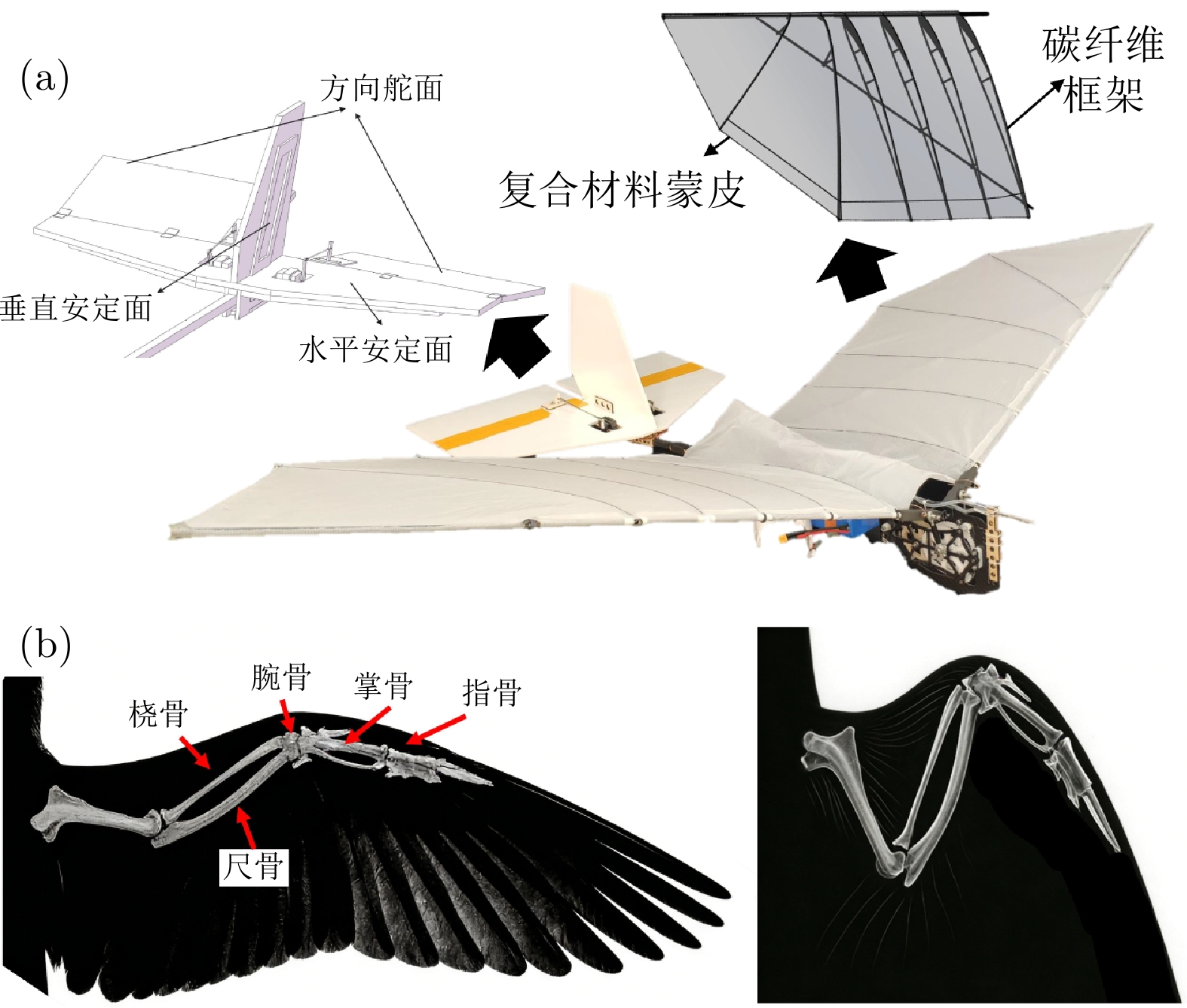
图 1 传统气动布局与鸟类翅膀骨骼((a)“单段式扑动翼+差动尾翼”气动布局; (b)鸟类骨骼展开图(左)与收合图(右))
Fig. 1 Traditional aerodynamic design and the bone structure of bird wings ((a) The aerodynamic design of single-stage flapping-wing and differential tail; (b) Bird wing in extended (left) and contracted (right))
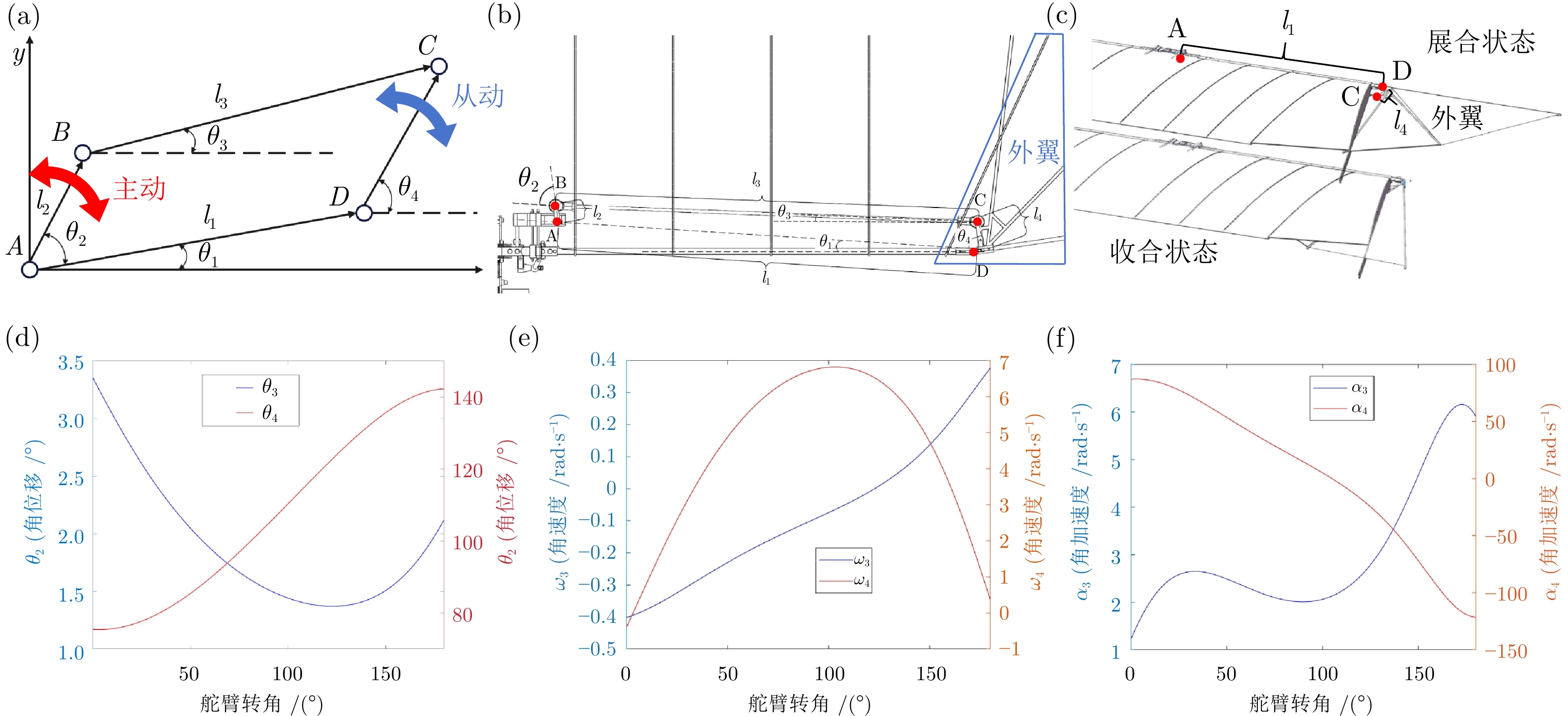
图 2 展合机构设计与运动分析((a)展合机构原理图; (b)舵机驱动的展合机构设计图; (c)展合翼设计图; (d)展合机构角度变化曲线; (e)展合机构角速度变化曲线; (f)展合机构角加速度变化曲线)
Fig. 2 Design and motion analysis of folding structure((a) Schematic diagram of folding structure; (b) Folding structure drived by servo motor; (c) Folding-wing design; (d) Angular displacement variation graphs; (e) Angular velocity variation graphs; (f) Angular acceleration variation graphs)
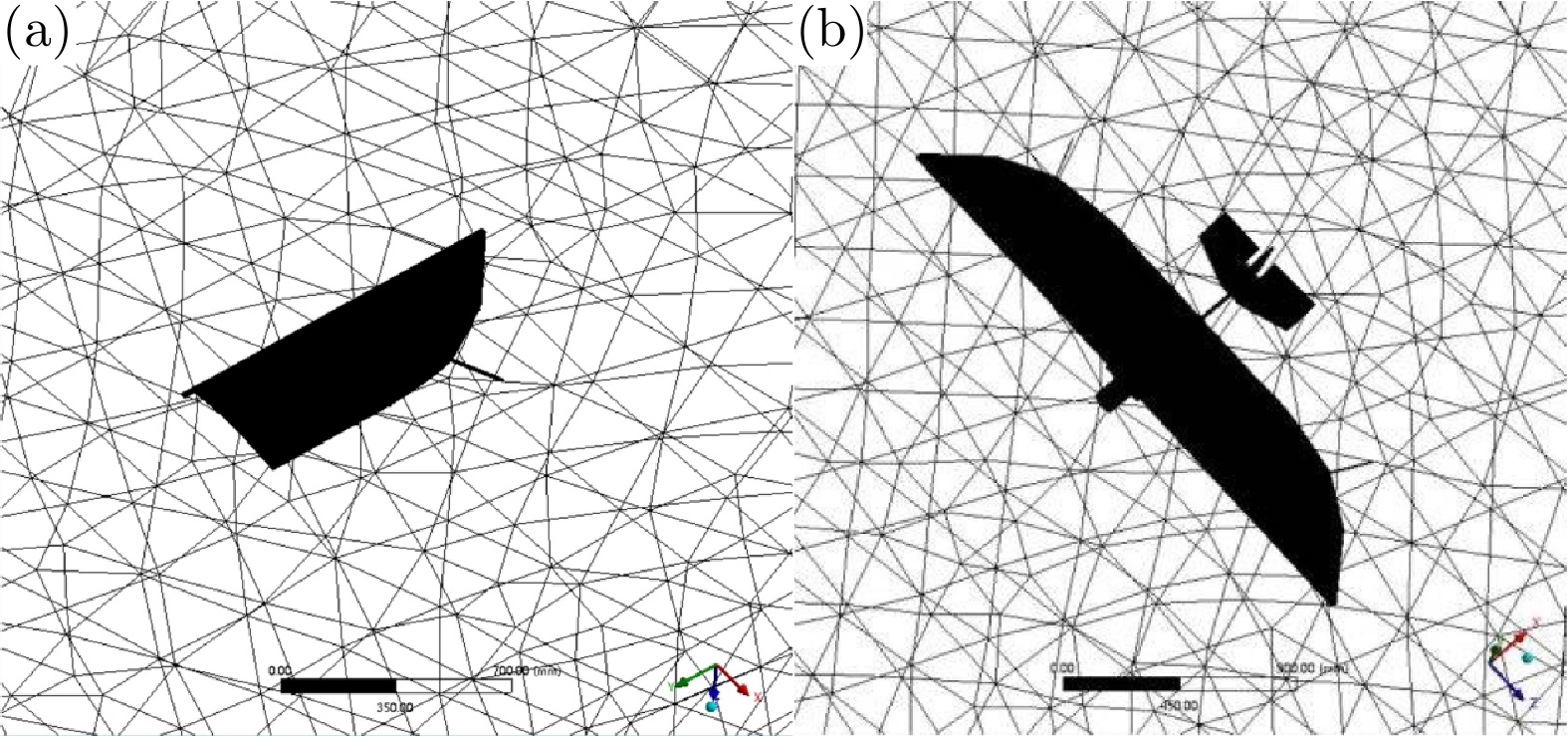
图 3 流体域网格划分((a)展合翼; (b)传统布局的扑翼飞行机器人)
Fig. 3 Fluid domain gridding((a) Folding wing; (b) Flapping wing robot with the traditional aerodynamic design)
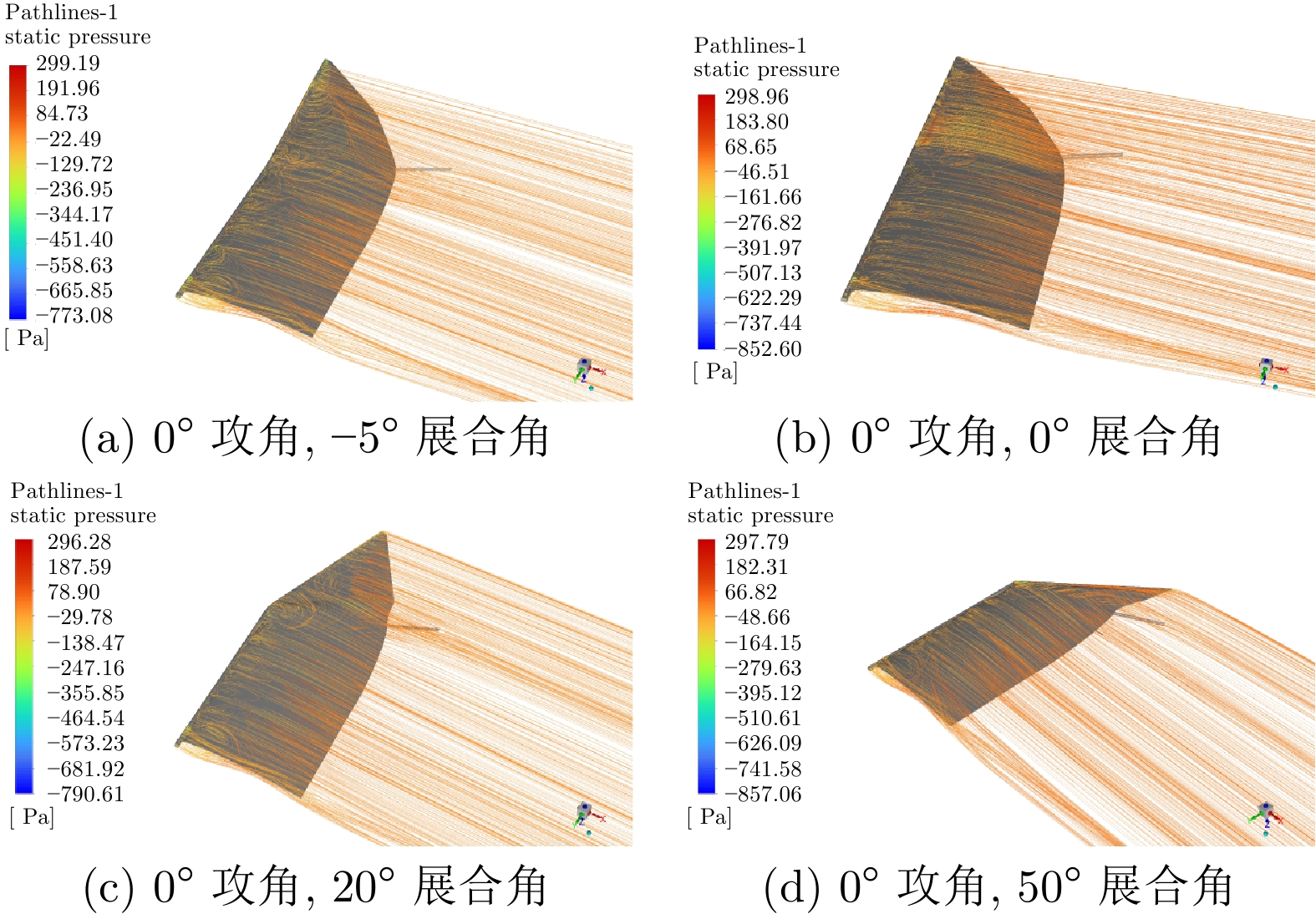
图 4 $ 0^{\circ} $攻角下不同展合角的压力流线图
Fig. 4 Pressure streamline diagrams at $ 0^{\circ} $ angle of attack for different folding angles((a) Folding angle of $ -5^{\circ} $; (b) Folding angle of $ 0^{\circ} $; (c) Folding angle of $ 20^{\circ} $; (d) Folding angle of $ 50^{\circ} $)
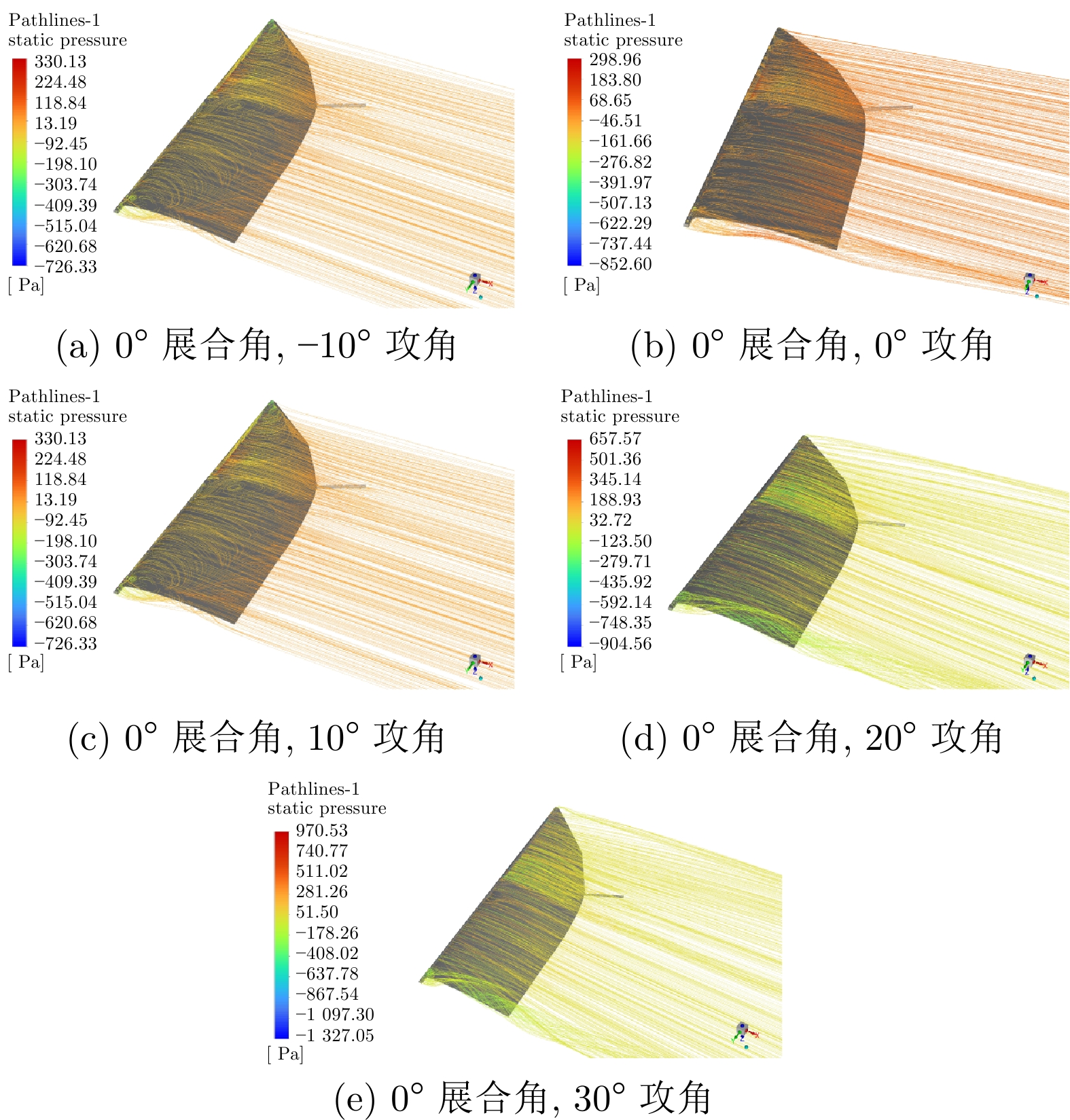
图 5 $ 0^{\circ} $展合角下不同攻角的压力流线图
Fig. 5 Pressure streamline diagrams at different angles of attack with a $ 0^{\circ} $ folding angle((a) Angle of attack of $ -10^{\circ} $; (b) Angle of attack of $ 0^{\circ} $; (c) Angle of attack of $ 10^{\circ} $; (d) Angle of attack of $ 20^{\circ} $; (e) Angle of attack of $ 30^{\circ} $)
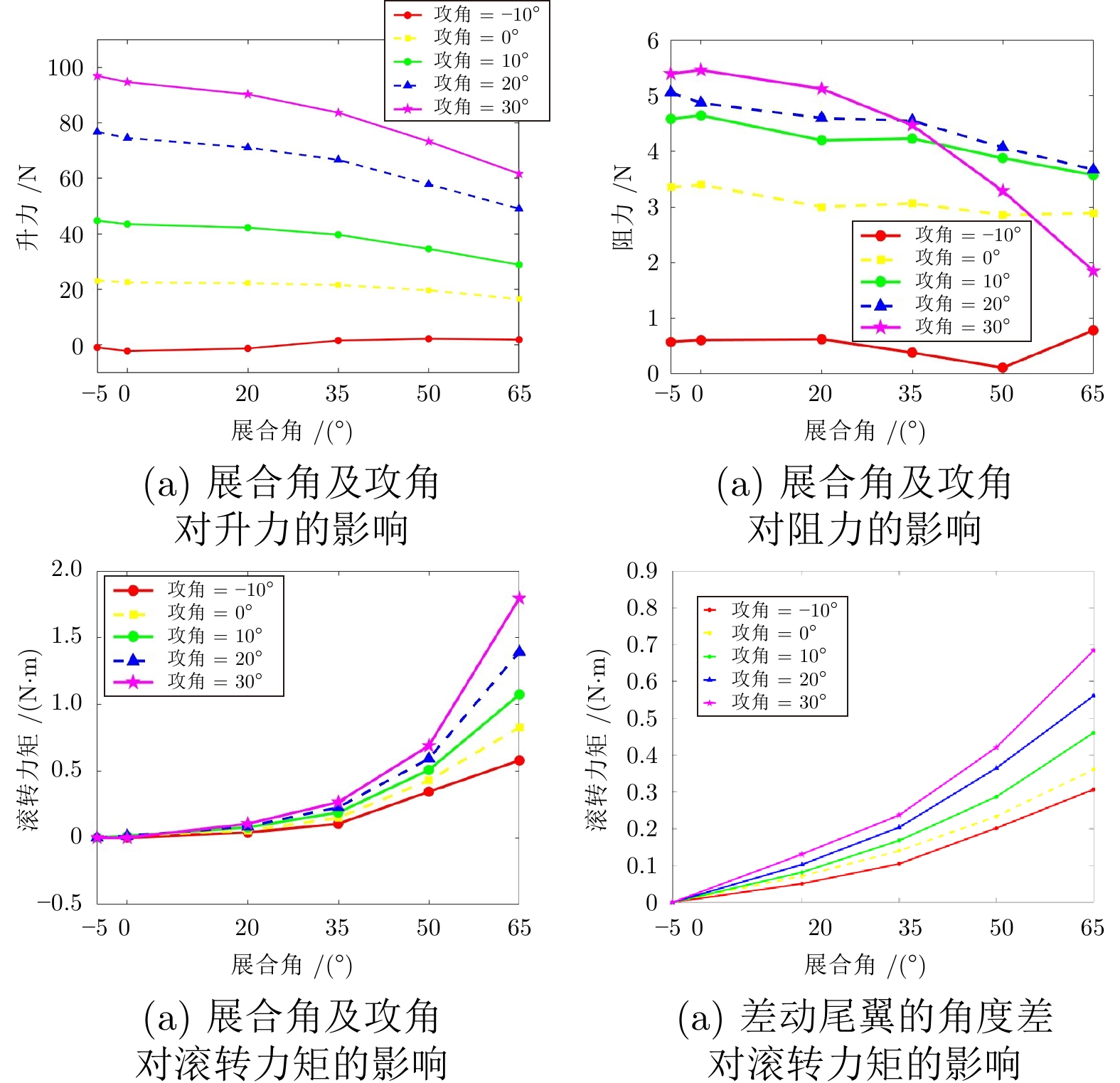
图 6 展合翼与差动尾翼的气动力分析与对比
Fig. 6 Aerodynamic analysis and comparison of folding-wing and differential tailplane((a) Effect of folding angle and angle of attack on lift; (b) Effect of folding angle and angle of attack on drag; (c) Effect of folding angle and angle of attack on roll moment; (d) Effect of differential tailplane angle difference on roll moment)
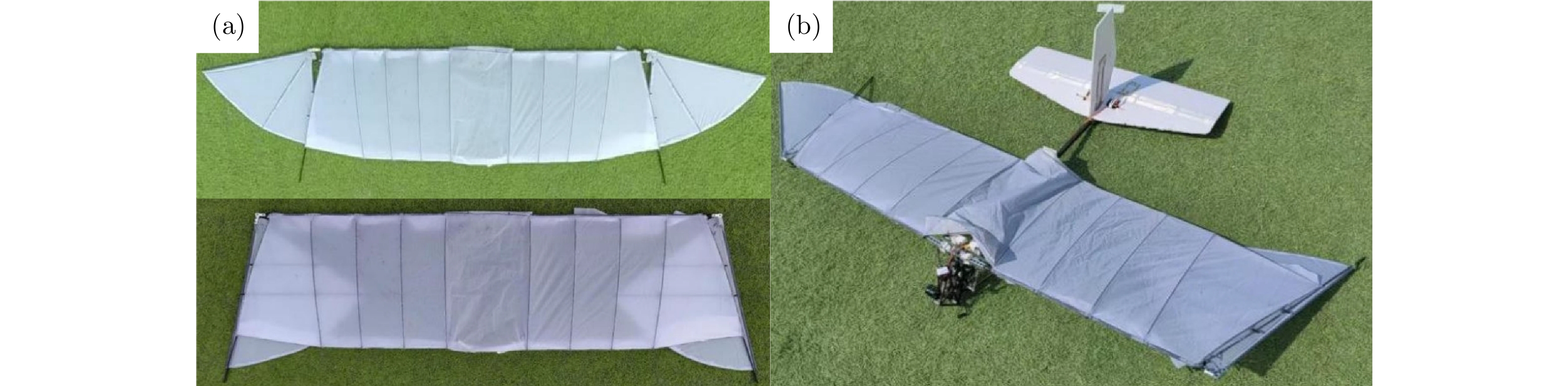
图 7 展合翼与实验平台实物图((a)展合翼展开状态(上图)与收合状态(下图); (b) “展合翼+升降舵尾翼”的实验平台)
Fig. 7 Folding wing and experimental platform((a) Open state(top) and close state(bottom) of folding wing; (b) Experimental platform of “folding wing + elevator tailplane”)
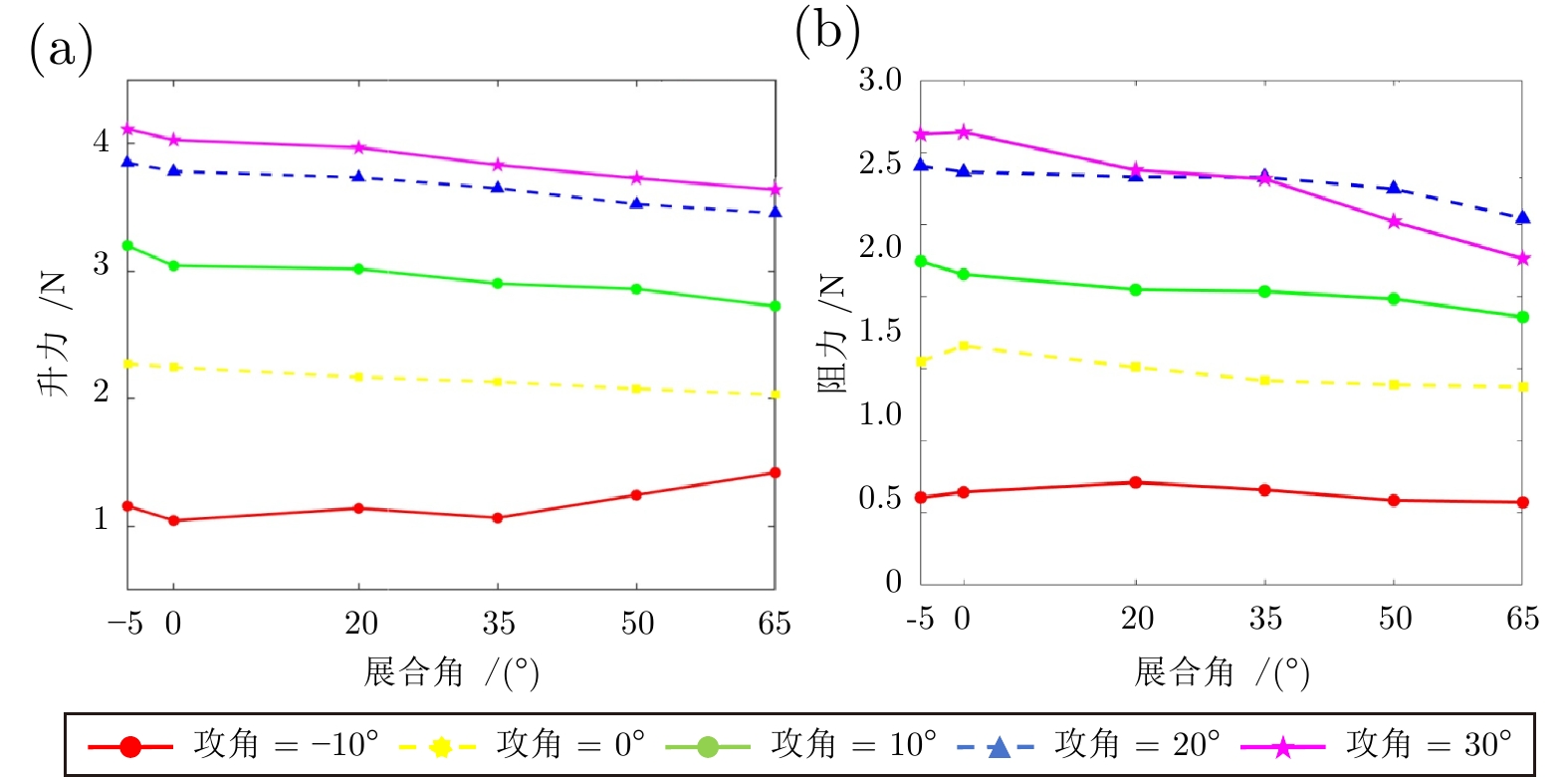
图 9 风洞实验中不同展合角和攻角的升阻力曲线((a)升力曲线; (b)阻力曲线)
Fig. 9 The lift-drag curves of different folding angles and attack angles in the wind tunnel experiment((a) Lift curve; (b) Drag curve)
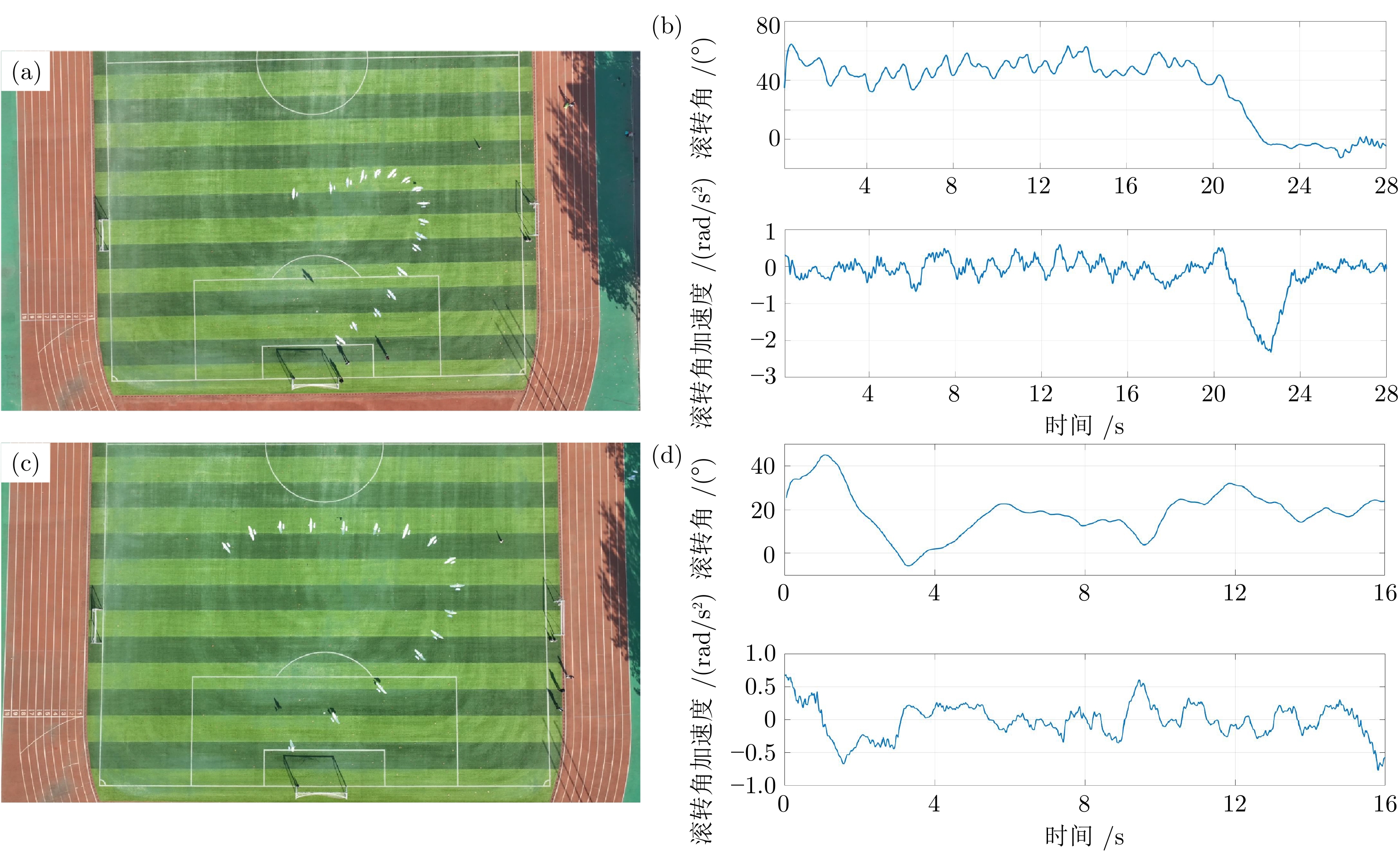
图 10 飞行试验((a)展合翼机器人飞行实验; (b)展合翼滚转角曲线与滚转角加速度曲线; (c)差动尾翼飞行实验; (d)差动尾翼滚转角曲线与滚转角加速度曲线)
Fig. 10 Flight experiment((a) Flight test of the folding-wing robot; (b) Roll angle curve and roll acceleration curve of the folding wing; (c) Flight test of the differential-tail robot; (d) Roll angle curve and roll acceleration curve of the differential tail)
表 1 展合机构设计参数
Table 1 Design parameters of the folding-structure
状态 状态描述 值(mm) 机架($ l_1 $) 由前期研究成果确定 583 舵机摇臂($ l_2 $) 采用商品舵机原装摇臂, 长度不可调节 20 连杆($ l_3 $) 通过公式计算得到 590 摇臂($ l_4 $) 外翼突出部分, 一般为$ l_2 $的两倍 40  下载: 导出CSV
表 2 展合翼参数
Table 2 Parameters of the folding-wing
参数 面积($ {\rm{m}}^2 $) 外翼面积($ {\rm{m}}^2 $) 翼展(m) 质量(g) 翼型 参数值 0.642 0.372 2.18 342 AG27
下载: 导出CSV
表 3 展合翼仿真实验参数
Table 3 Simulation experiment parameters of the folding wing
状态 状态值 展合角$ { \theta} (^\circ) $ $ -5 $、$ 0 $、$ 20 $、$ 35 $、$ 50 $、$ 65 $ 攻角$ \alpha (^\circ) $ $ -10 $、$ 0 $、$ 10 $、$ 20 $、$ 30 $ 风速$ V ({\rm{m}}/{\rm{s}}) $ $ 22 $ 空气密度$ \rho ({\rm{kg}}\cdot{\rm{m}}^{-3}) $ $ 1.225 $
下载: 导出CSV
表 4 传统扑翼飞行机器人仿真实验参数
Table 4 Simulation experiment parameters of common flapping wing robot
状态 状态值 舵面夹角$ {\theta_t} (^\circ) $ $ 0 $、$ 20 $、$ 35 $、$ 50 $、$ 65 $ 攻角$ \alpha (^\circ) $ $ -10 $、$ 0 $、$ 10 $、$ 20 $、$ 30 $ 风速$ V ({\rm{m}}/{\rm{s}}) $ $ 22 $ 空气密度$ \rho ({\rm{kg}}\cdot{\rm{m}}^{-3}) $ $ 1.225 $
下载: 导出CSV
-
[1] 钱辰, 方勇纯, 李友朋. 面向扑翼飞行控制的建模与奇异摄动分析. 自动化学报, 2022, 48(2): 434−443 doi: 10.16383/j.aas.c190858Qian Chen, Fang Yong-Chun, Li You-Peng. Control oriented modeling and singular perturbation analysis in flapping-wing flight. Acta Automatica Sinica, 2022, 48(2): 434−443 doi: 10.16383/j.aas.c190858 [2] 贺威, 丁施强, 孙长银. 扑翼飞行器的建模与控制研究进展. 自动化学报, 2017, 43(5): 685−696 doi: 10.16383/j.aas.2017.c160581He Wei, Ding Shi-Qiang, Sun Chang-Yin. Research progress on modeling and control of flapping-wing air vehicles. Acta Automatica Sinica, 2017, 43(5): 685−696 doi: 10.16383/j.aas.2017.c160581 [3] 王久斌, 贺威, 孟亭亭, 邹尧, 付强. 基于高仿生形态布局的仿鸽扑翼飞行机器人系统设计. 自动化学报, 2024, 50(2): 308−319 doi: 10.16383/j.aas.c220836Wang Jiu-Bin, He Wei, Meng Ting-Ting, Zou Yao, Fu Qiang. System design of dove-like flapping-wing flying robot based on highly bionic morphological layout. Acta Automatica Sinica, 2024, 50(2): 308−319 doi: 10.16383/j.aas.c220836 [4] 金龙, 李嘉昌, 常振强, 卢经纬, 程龙. 基于ACP理论的微型扑翼飞行器的姿态控制. 自动化学报, 2023, 49(12): 2532−2543 doi: 10.16383/j.aas.c210646Jin Long, Li Jia-Chang, Chang Zhen-Qiang, Lu Jing-Wei, Cheng Long. Attitude control for flapping wing micro aerial vehicle based on ACP theory. Acta Automatica Sinica, 2023, 49(12): 2532−2543 doi: 10.16383/j.aas.c210646 [5] Liang J, Buzzatto J, Liarokapis M. A tailsitter UAV based on bioinspired, tendon-driven, shape-morphing wings with aerofoil-shaped artificial feathers. In: Proceedings of 2023 IEEE/RSJ International Conference on Intelligent Robots and Systems (IROS). Detroit, USA: IEEE, 2023. 4750-4756 [6] Wu X, He W, Wang Q, Meng T, He X, Fu Q. A long-endurance flapping-wing robot based on mass distribution and energy consumption method. IEEE Transactions on Industrial Electronics, 2022, 70(8): 8215−8224 doi: 10.1109/tie.2022.3213905 [7] Wüest V, Jeger S, Feroskhan M, Ajanic E, Bergonti F, Floreano D. Agile perching maneuvers in birds and morphing-wing drones. Nature Communications, 2024, 15(1): 8330−8412 doi: 10.1038/s41467-024-52369-4 [8] Ajanic E, Feroskhan M, Mintchev S, Noca F, Floreano D. Bioinspired wing and tail morphing extends drone flight capabilities. Science Robotics, 2020, 5(47): 2897−2910 doi: 10.1126/scirobotics.abc2897 [9] Ajanic E, Feroskhan M, Wüest V, Floreano D. Sharp turning maneuvers with avian-inspired wing and tail morphing. Communications Engineering, 2022, 1(1): 34−46 doi: 10.1038/s44172-022-00035-2 [10] Jeger S, Wüest V, Toumieh C, Floreano D. Adaptive morphing of wing and tail for stable, resilient, and energy-efficient flight of avian-inspired drones. npj Robotics, 2024, 2(1): 8−22 doi: 10.1038/s44182-024-00015-y [11] Chang E, Chin D D, Lentink D. Bird-inspired reflexive morphing enables rudderless flight. Science Robotics, 2024, 9(96): 4535−4547 doi: 10.1126/scirobotics.ado4535 [12] Deetjen M, Chin D D, Heers A M, Tobalske B W, Lentink D. Small deviations in kinematics and body form dictate muscle performances in the finely tuned avian downstroke. Elife, 2024, 12(1): 89968−89980 doi: 10.7554/elife.89968.2.sa1 [13] Chang E, Matloff L Y, Stowers A K, Lentink D. Soft biohybrid morphing wings with feathers underactuated by wrist and finger motion. Science Robotics, 2020, 5(38): 1246−1260 doi: 10.1126/scirobotics.aay1246 [14] Matloff L Y, Chang E, Feo T J, Jeffries L, Stowers A K, Thomson C, et al. How flight feathers stick together to form a continuous morphing wing. Science, 2020, 367(6475): 293−297 doi: 10.1126/science.aaz3358 [15] Savastano E, Perez-Sanchez V, Arrue B C, Ollero A. High-performance morphing wing for large-scale bio-inspired unmanned aerial vehicles. IEEE Robotics and Automation Letters, 2022, 7(3): 8076−8083 doi: 10.1109/LRA.2022.3185389 [16] Chen A, Song B, Wang Z, Xue D, Liu K. A novel actuation strategy for an agile bioinspired FWAV performing a morphing-coupled wingbeat pattern. IEEE Transactions on Robotics, 2022, 39(1): 452−469 doi: 10.1109/tro.2022.3189812 [17] Ma D, Song B, Gao S, Xue D, Xuan J. Designing efficient bird-like flapping-wing aerial vehicles: Insights from aviation perspective. Bioinspiration & Biomimetics, 2024, 19(6): 611−619 [18] Chen A, Song B, Liu K, Wang Z, Xue D, Qi H. Flapping-wing robot achieves bird-style self-takeoff by adopting reconfigurable mechanisms. Science Advances, 2025, 11(36): 465−480 [19] Kang X, Lu X, Zhu Y, Li B. Single-drive segmented morphing wing aerial vehicle based on rigid-flexible metamorphic mechanism. IEEE/ASME Transactions on Mechatronics, 2025, 31(1): 932−942 doi: 10.1109/tmech.2025.3599439/mm1 [20] Chu L, Gu F, Du X, He Y. Design and analysis of morphing wing UAV adopted to harsh environment based on “Frigate bird”. In: Proceedings of 2022 IEEE International Conference on Robotics and Biomimetics (ROBIO). Xishuangbanna, China: IEEE, 2022. 1295-1300 [21] Cai Y, Su G, Zhao J Feng S. The coupled wing morphing of ornithopters improves attitude control and agile flight. Machines, 2024, 12(7): 486−497 doi: 10.3390/machines12070486 [22] Kim T, Hong I, Im S, Rho S, Kim M, Roh Y, et al. Wing-strain-based flight control of flapping-wing drones through reinforcement learning. Nature Machine Intelligence, 2024, 6(9): 992−1005 doi: 10.1038/s42256-024-00893-9 [23] Ci H, Guo Z. Design of stiffness-variable dielectric elastomer wing based on seagull characteristics and its application in avian flight bionics. International Journal of Smart and Nano Materials, 2024, 15(4): 855−880 doi: 10.1080/19475411.2024.2414292 [24] Han Z, Liu Z, Wang J, He W. Fault-tolerant control for flexible structures with partial output constraint. IEEE Transactions on Automatic Control, 2024, 69(4): 2668−2675 doi: 10.1109/TAC.2023.3337110 [25] Zhang D, Kong L, He W, Yu X. Fixed-time control for a flexible smart structure with actuator failure: A broad learning system approach. IEEE Transactions on Cybernetics, 2024, 54(7): 4322−4334 doi: 10.1109/TCYB.2023.3271314 [26] Meng T, Guo B, Huang H, He W. Iterative learning control for a flexible wing system under iteration-varying disturbances and references. IEEE Transactions on Aerospace and Electronic Systems, 2024, 60(5): 5973−5981 doi: 10.1109/TAES.2024.3403788 -

 下载:

计量
- 文章访问数: 8
- HTML全文浏览量: 9
- 被引次数: 0
