


Research on Data-driven Intelligent Optimal Operation Method for Municipal Solid Waste Incineration Process
-
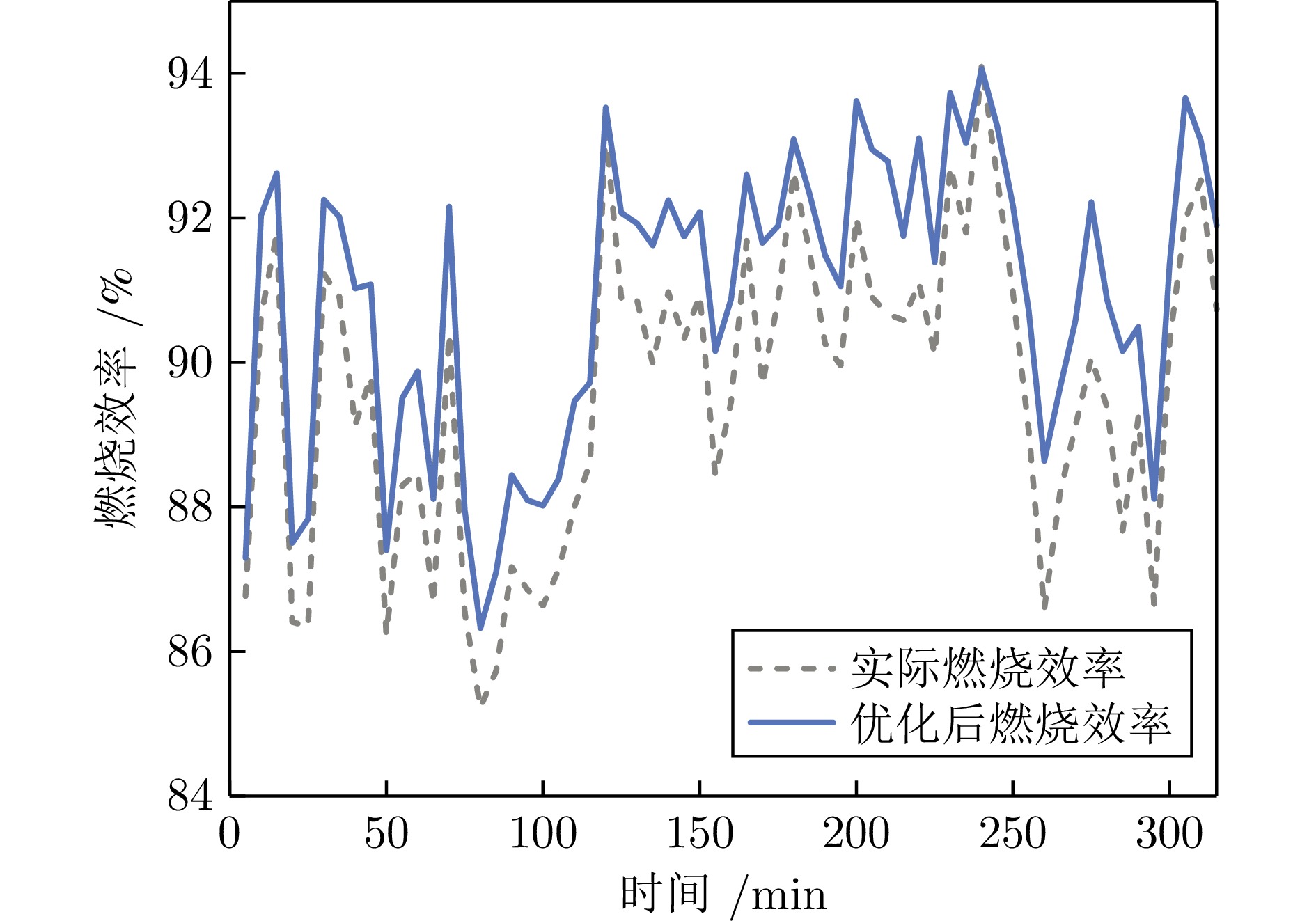
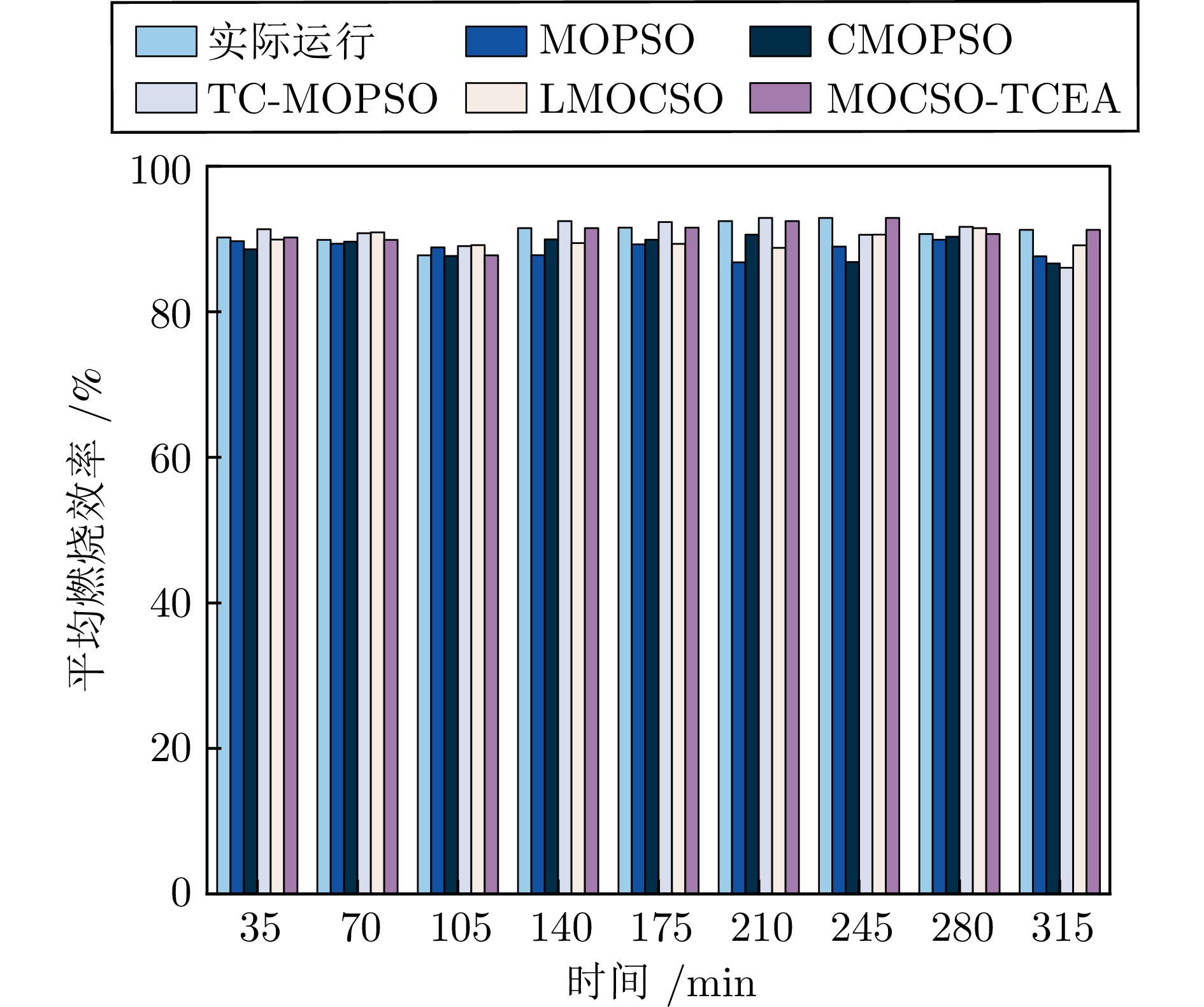
摘要: 城市固废焚烧过程优化运行的目标是确保固体废弃物充分完全燃烧的前提下, 实现烟气污染物的稳定达标排放. 由于焚烧过程中不同工艺环节耦合关联、运行指标相互冲突, 实际生产过程难以稳定、高效、绿色运行. 为此, 提出一种数据驱动的智能优化运行方法. 首先, 采用自组织径向基函数神经网络建立运行指标模型, 实现对运行性能的在线评价; 其次, 提出改进的多目标竞争群优化算法, 引入三方竞争机制和外部档案, 增强全局搜索能力并保持解集多样性, 从而高效获取决策变量的Pareto解集; 然后, 结合熵权法和TOPSIS法确定工艺参数的最佳设定值; 最后, 通过实际工业运行数据对所提方法进行验证, 实验结果表明, 该方法能够使燃烧效率平均提高2.83%, 并有效降低了关键污染物排放浓度.
-
关键词:
- 城市固废焚烧过程 /
- 烟气污染物 /
- 燃烧效率 /
- 多目标优化 /
- 多目标竞争群优化算法
Abstract: The objective of optimal operation of the municipal solid waste incineration process is to maintain flue gas pollutant emissions consistently within regulatory limits while ensuring complete combustion of solid waste. However, coupling among different process stages during incineration and conflicts among operational indicators make it challenging to achieve stable, efficient, and environmentally friendly operation in the actual production process. To address this issue, a data-driven intelligent optimal operation method is proposed. First, a self-organizing radial basis function neural network is employed to establish operational index models, enabling online evaluation of operational performance; Second, an improved multi-objective competitive swarm optimization algorithm is developed by introducing a tripartite competition mechanism and an external archive to enhance global search capability and maintain solution diversity, thereby efficiently obtaining the Pareto solution set of the decision variables; Then, the entropy weight method and the technique for order preference by similarity to an ideal solution (TOPSIS) are combined to determine the optimal settings of process parameters; Finally, the proposed method is validated using actual industrial operating data. Experimental results show that the proposed method can increase combustion efficiency by 2.83% on average while effectively reducing the concentrations of key pollutant emissions. -
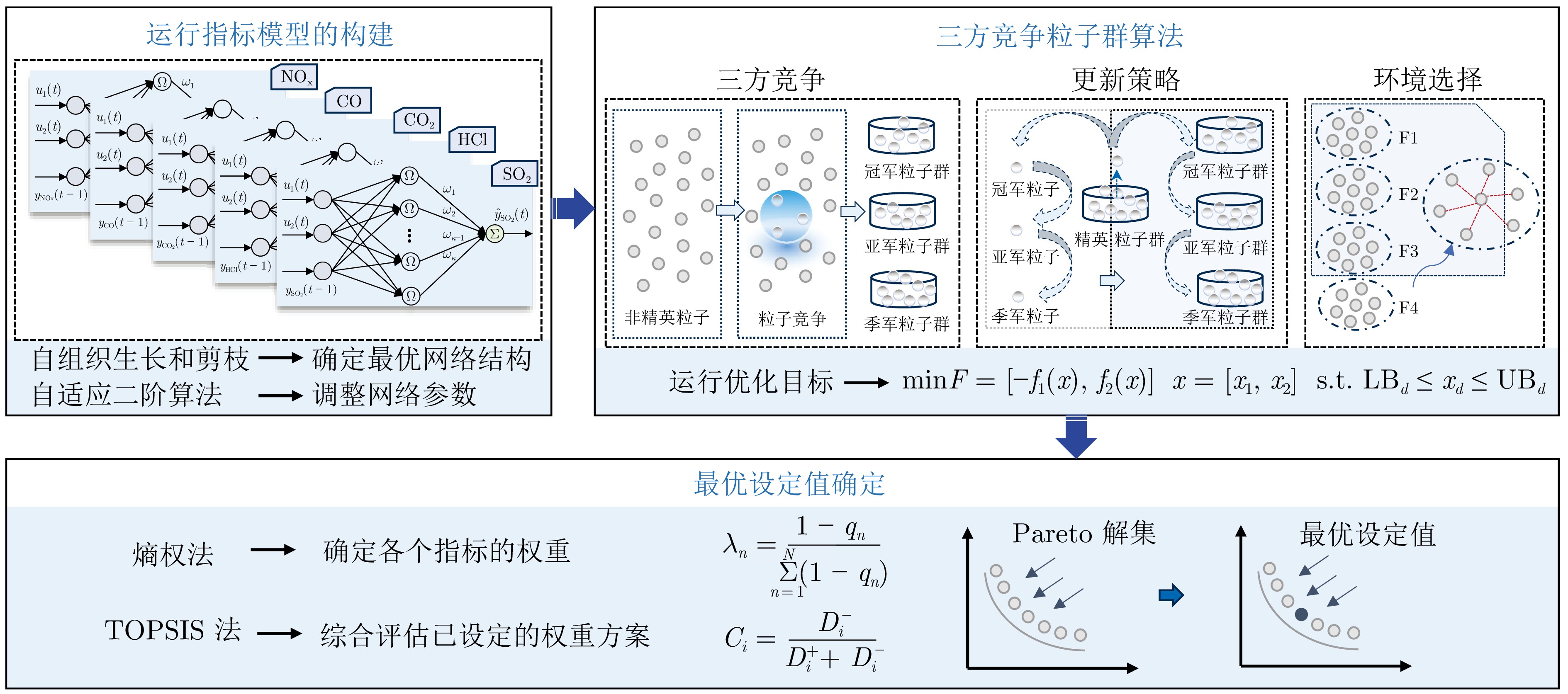
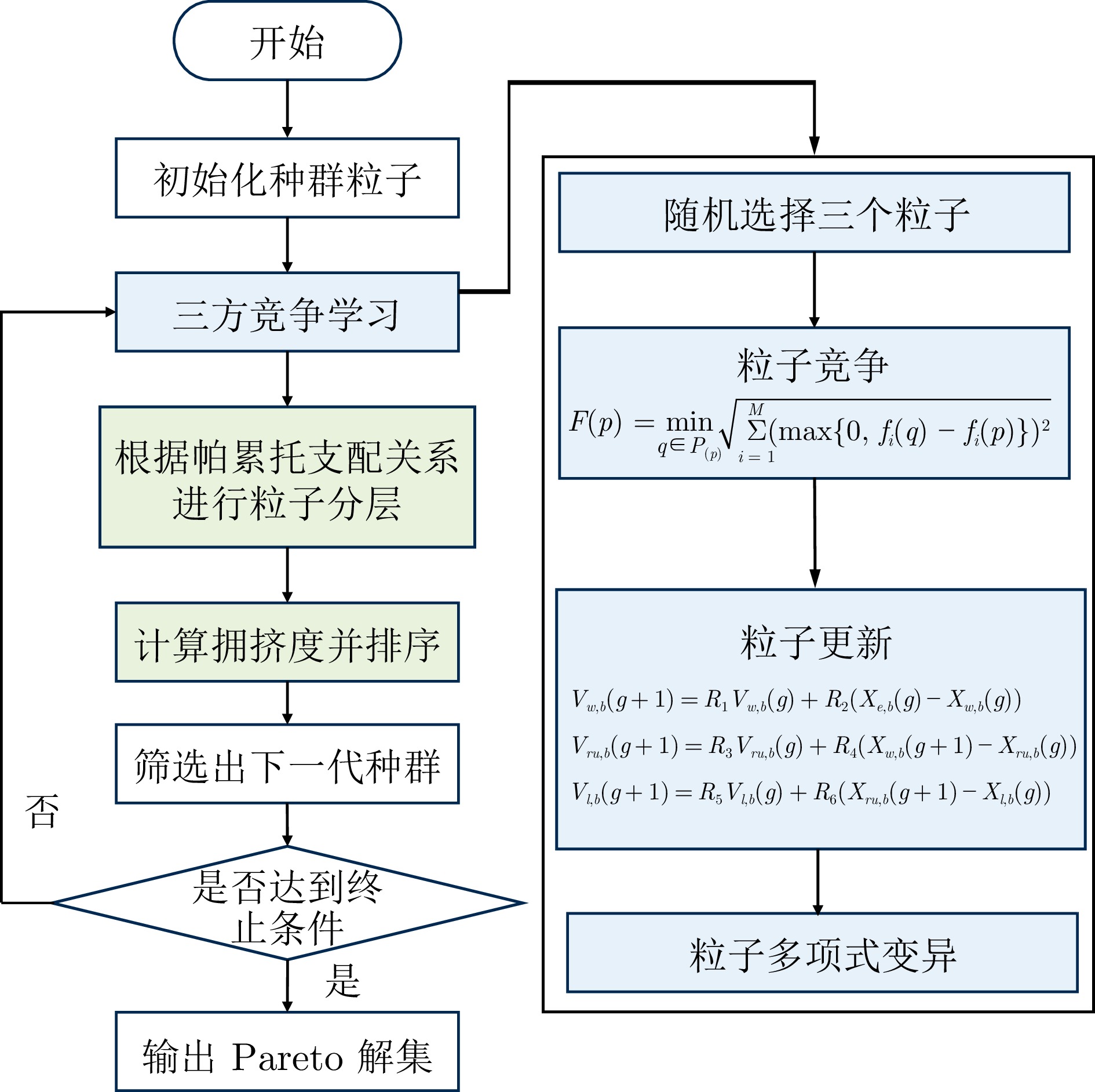
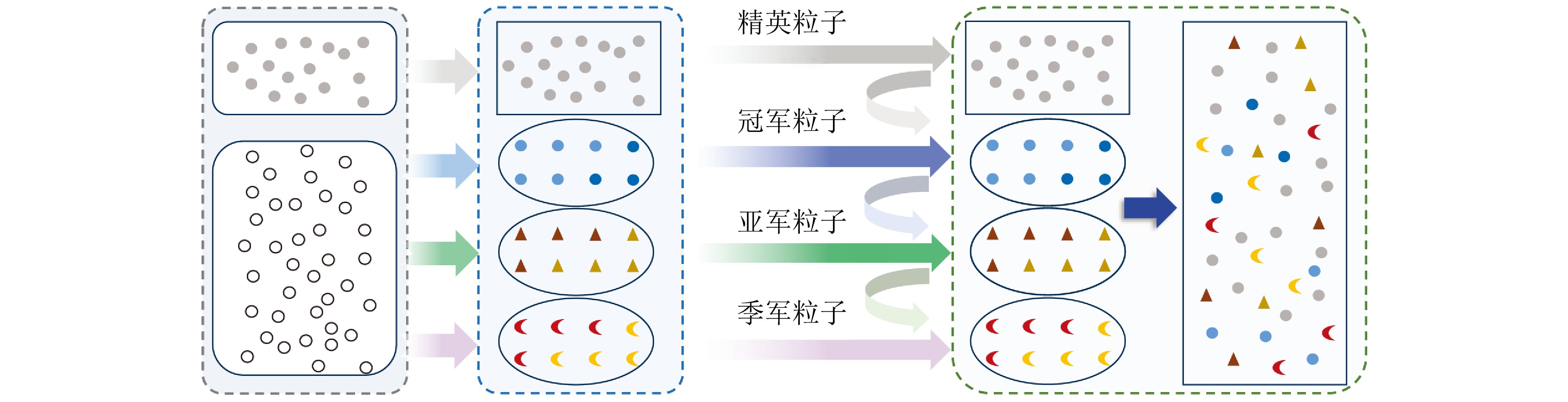
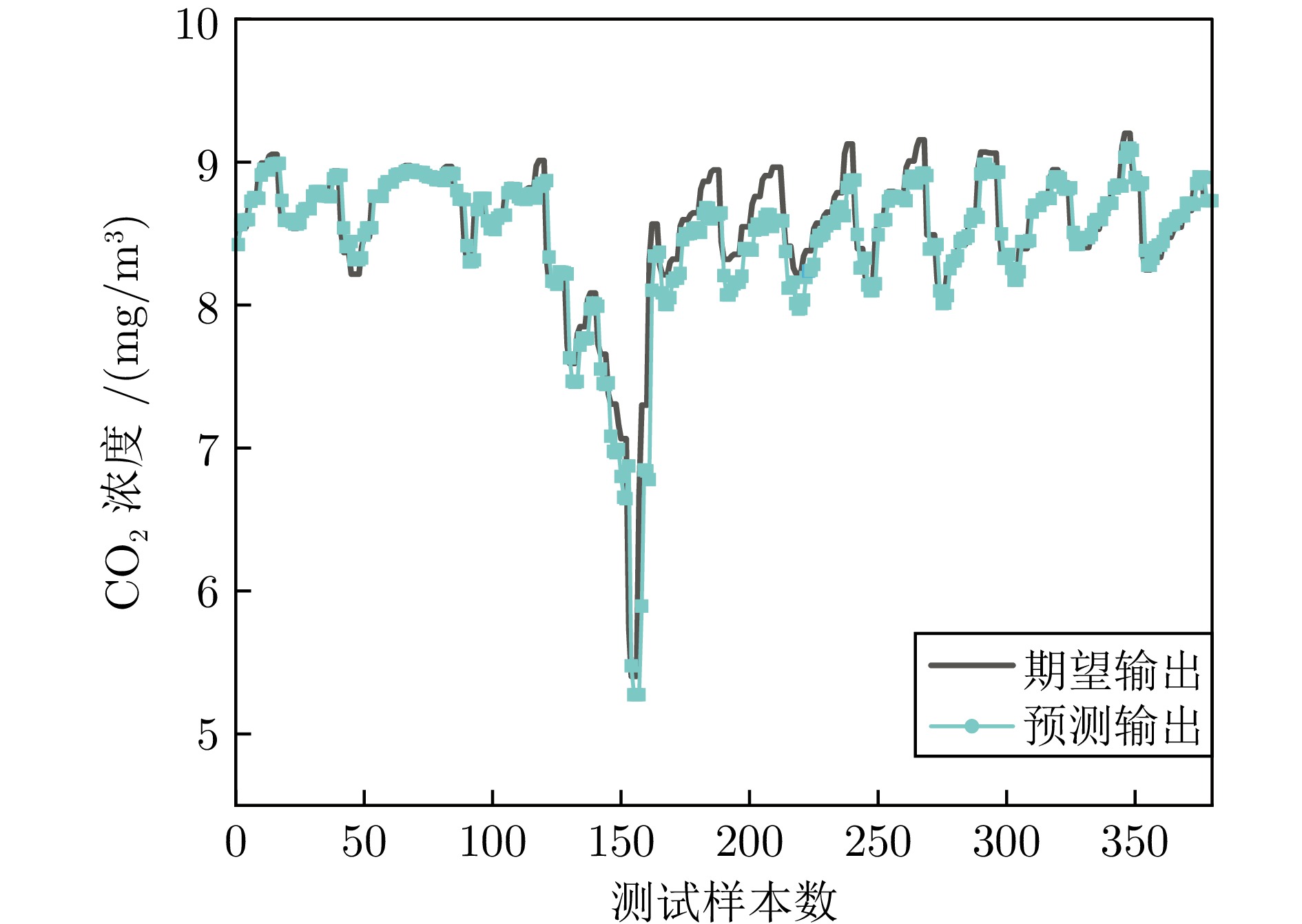
图 2 数据驱动的MSWI过程智能优化运行方法框架
Fig. 2 The framework for data-driven intelligent optimal operation method of MSWI process
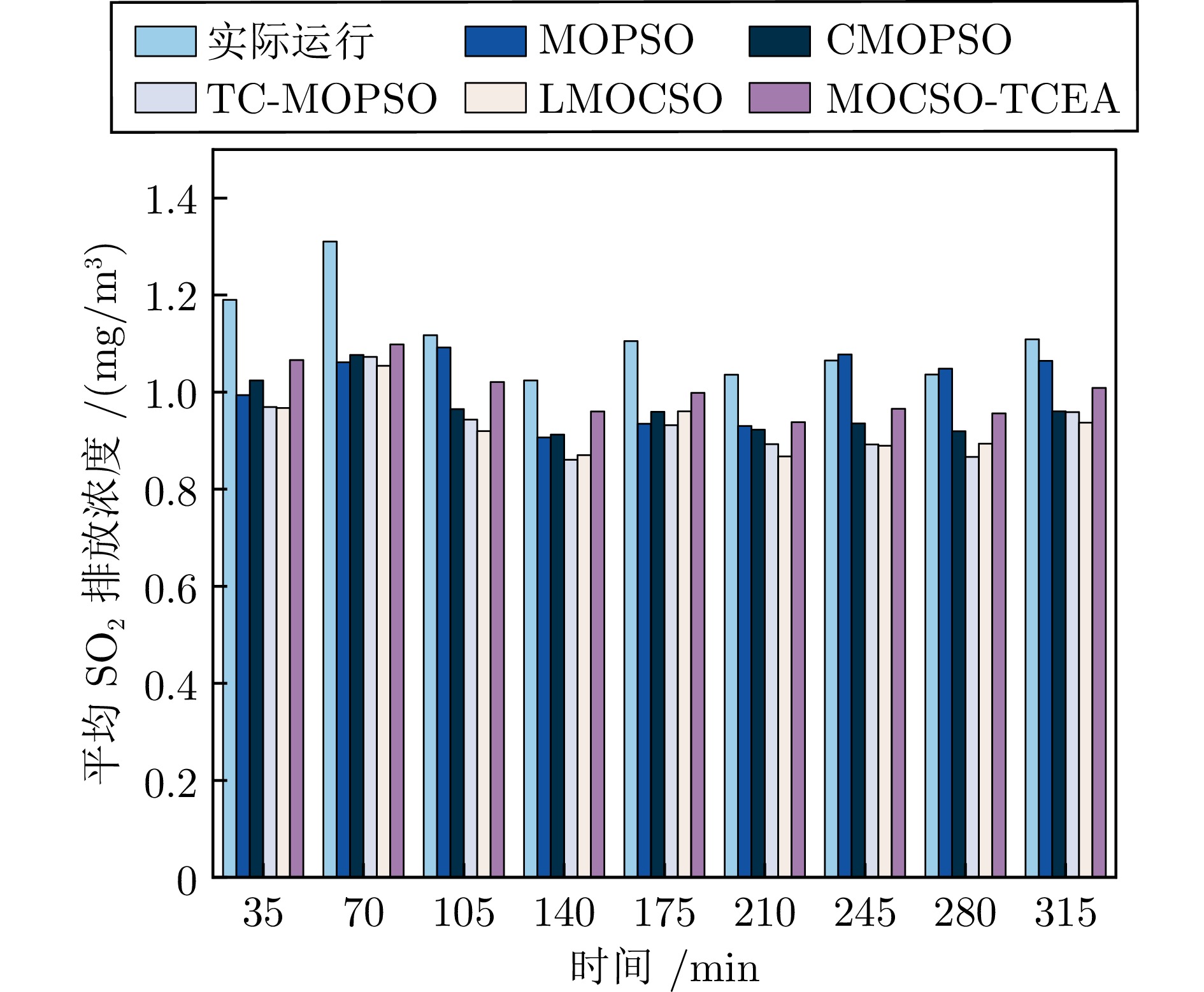
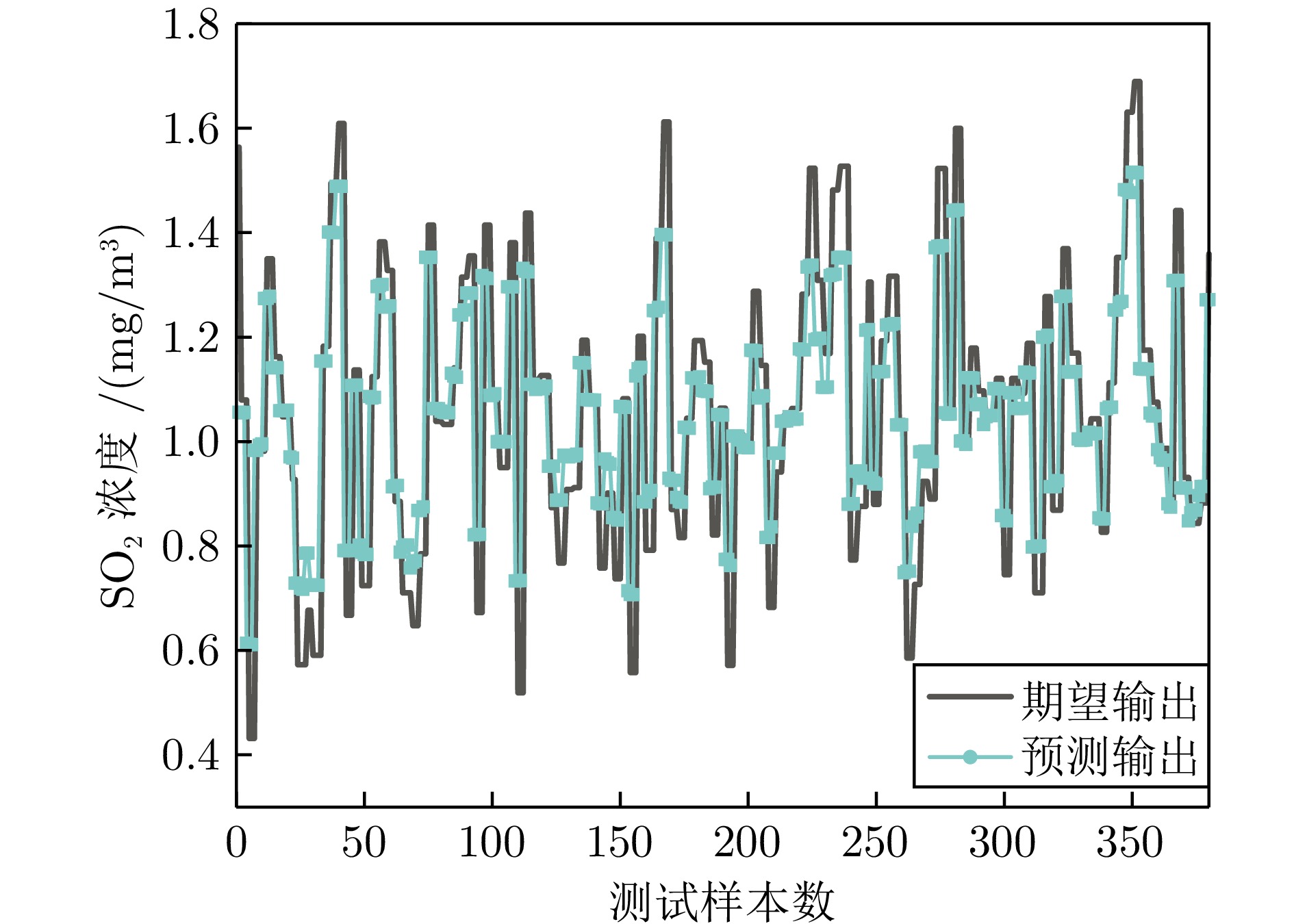
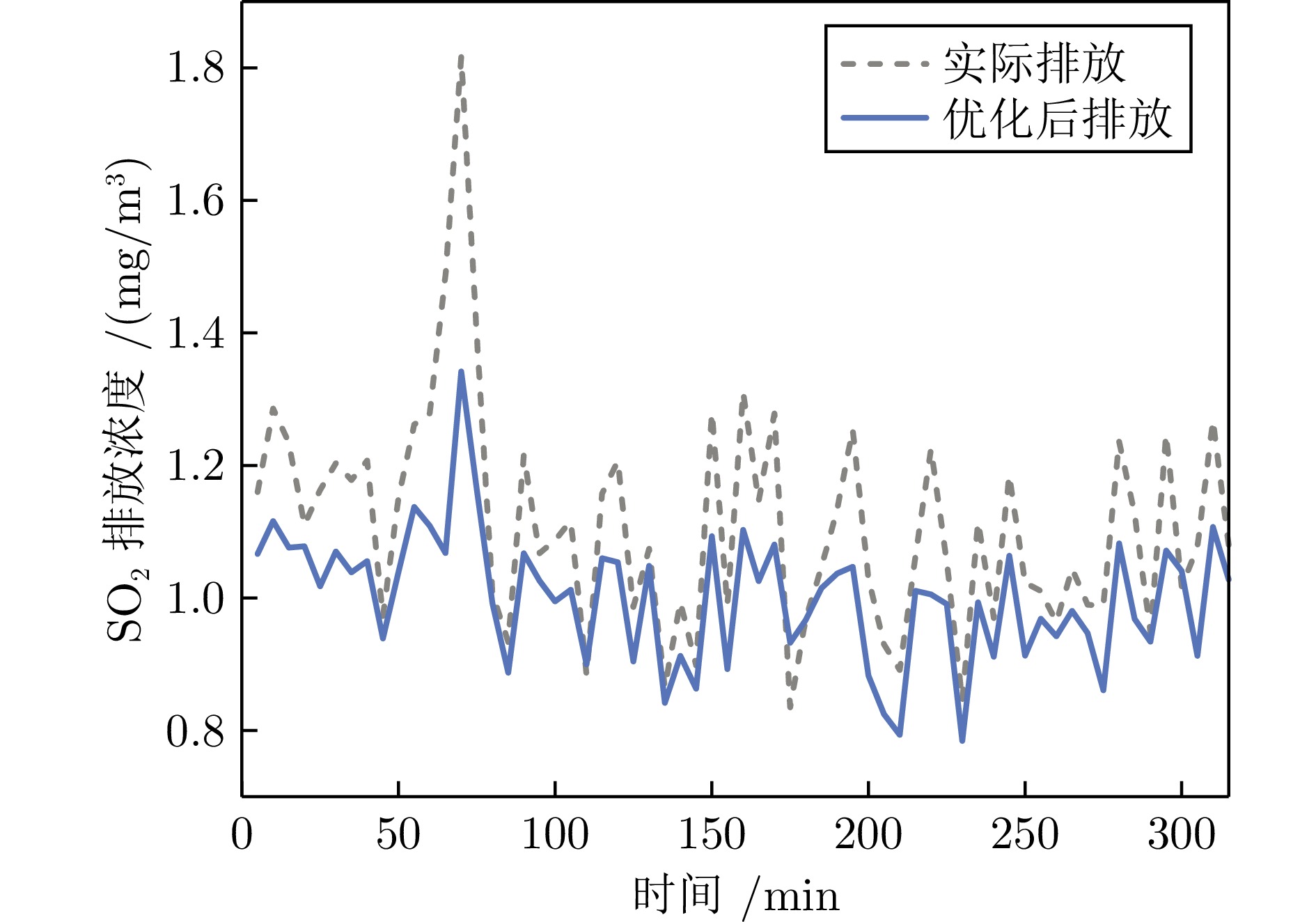
图 22 不同算法对SO2排放的优化结果
Fig. 22 Optimization results of SO2 emissions using different algorithms
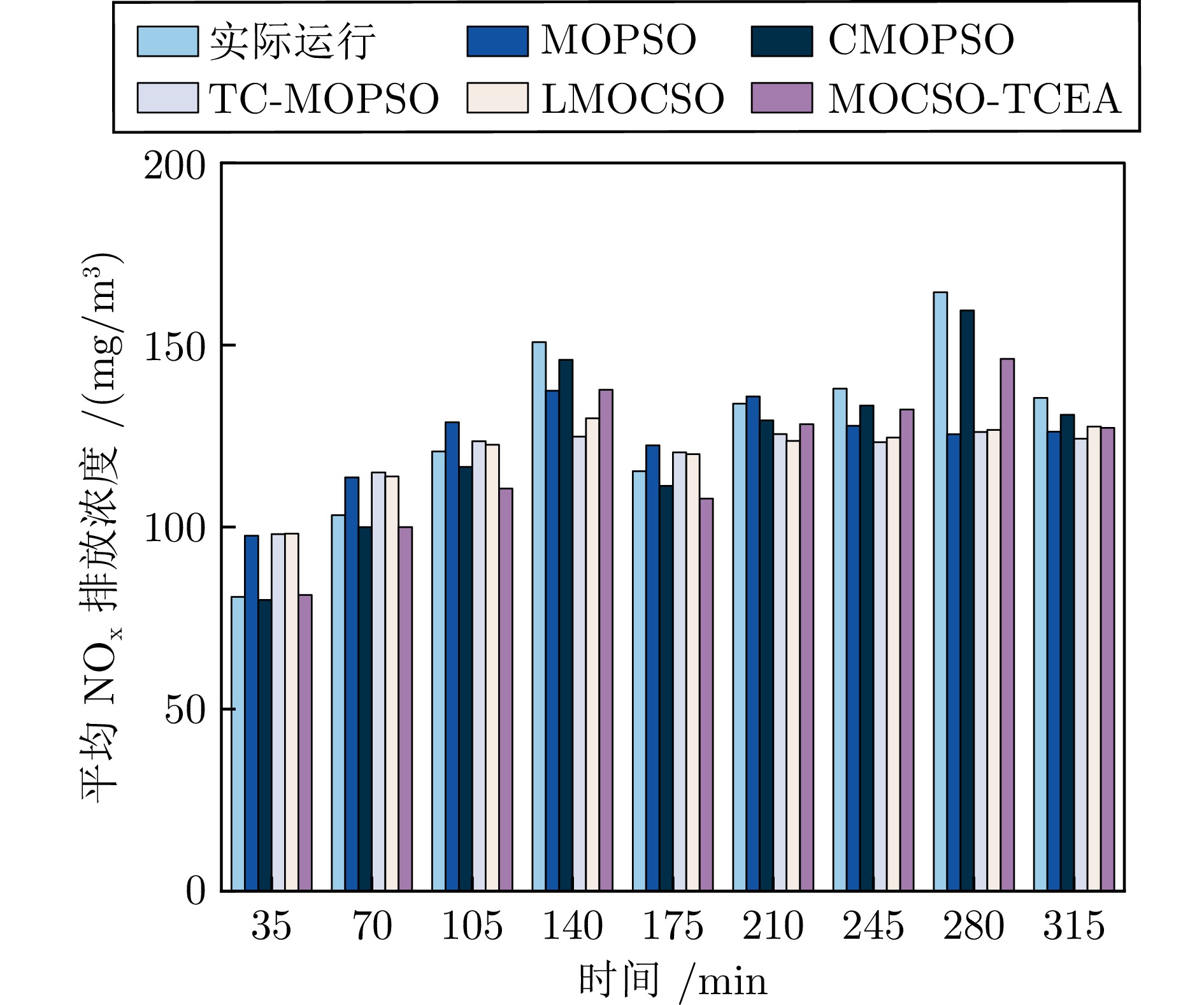
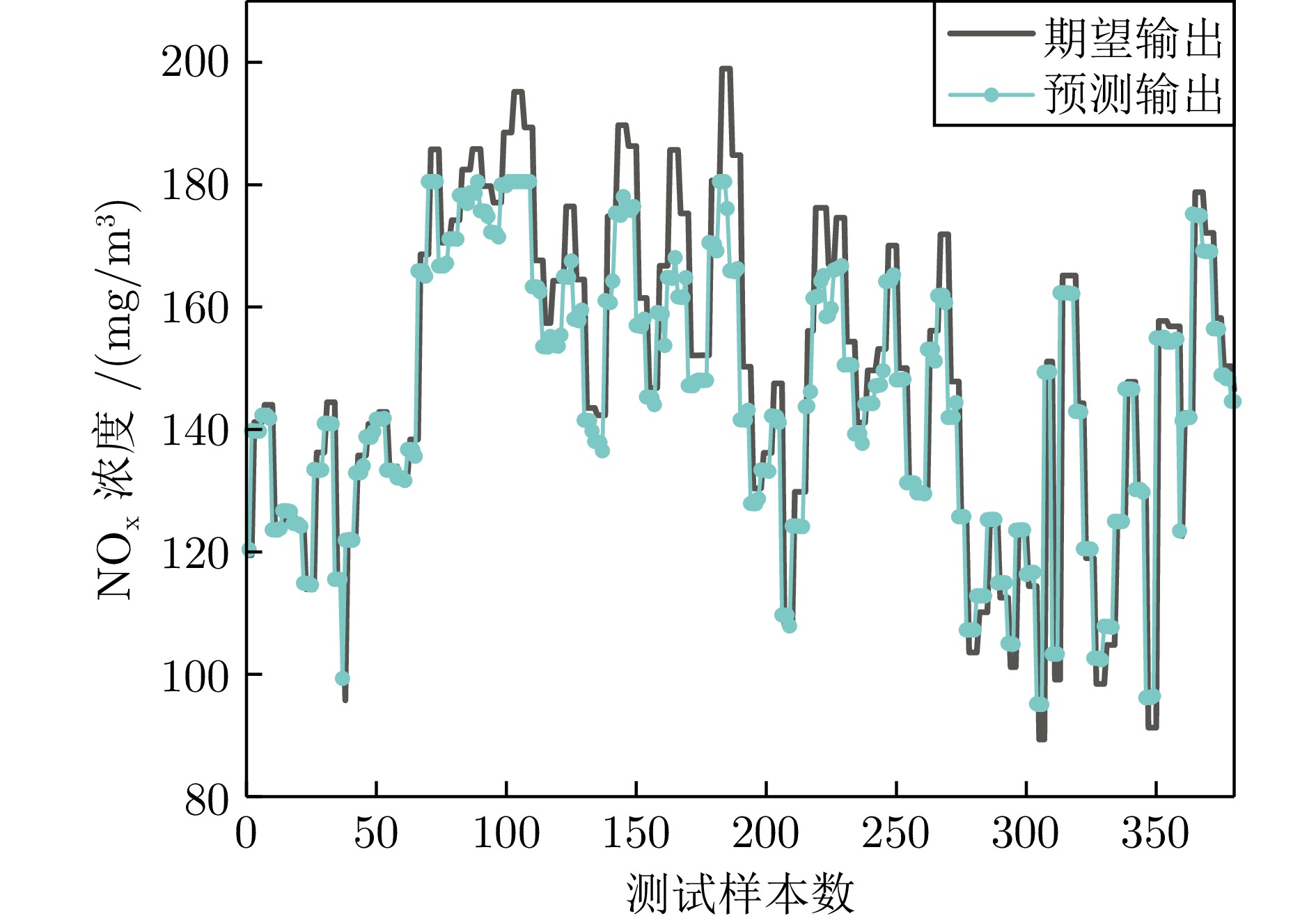
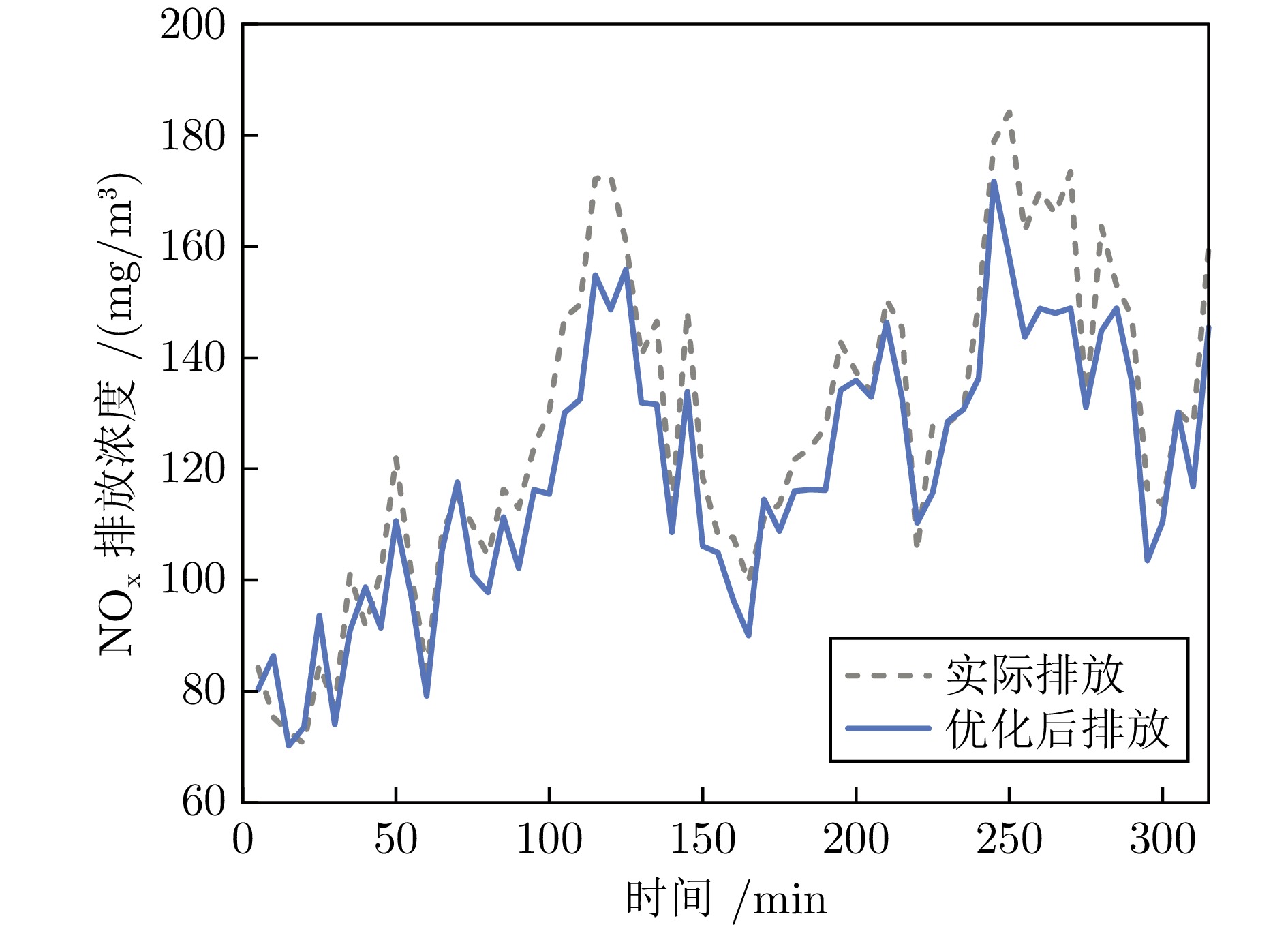
图 19 不同算法对$ {\rm{NOx}} $排放的优化结果
Fig. 19 Optimization results of NOX emissions using different algorithms
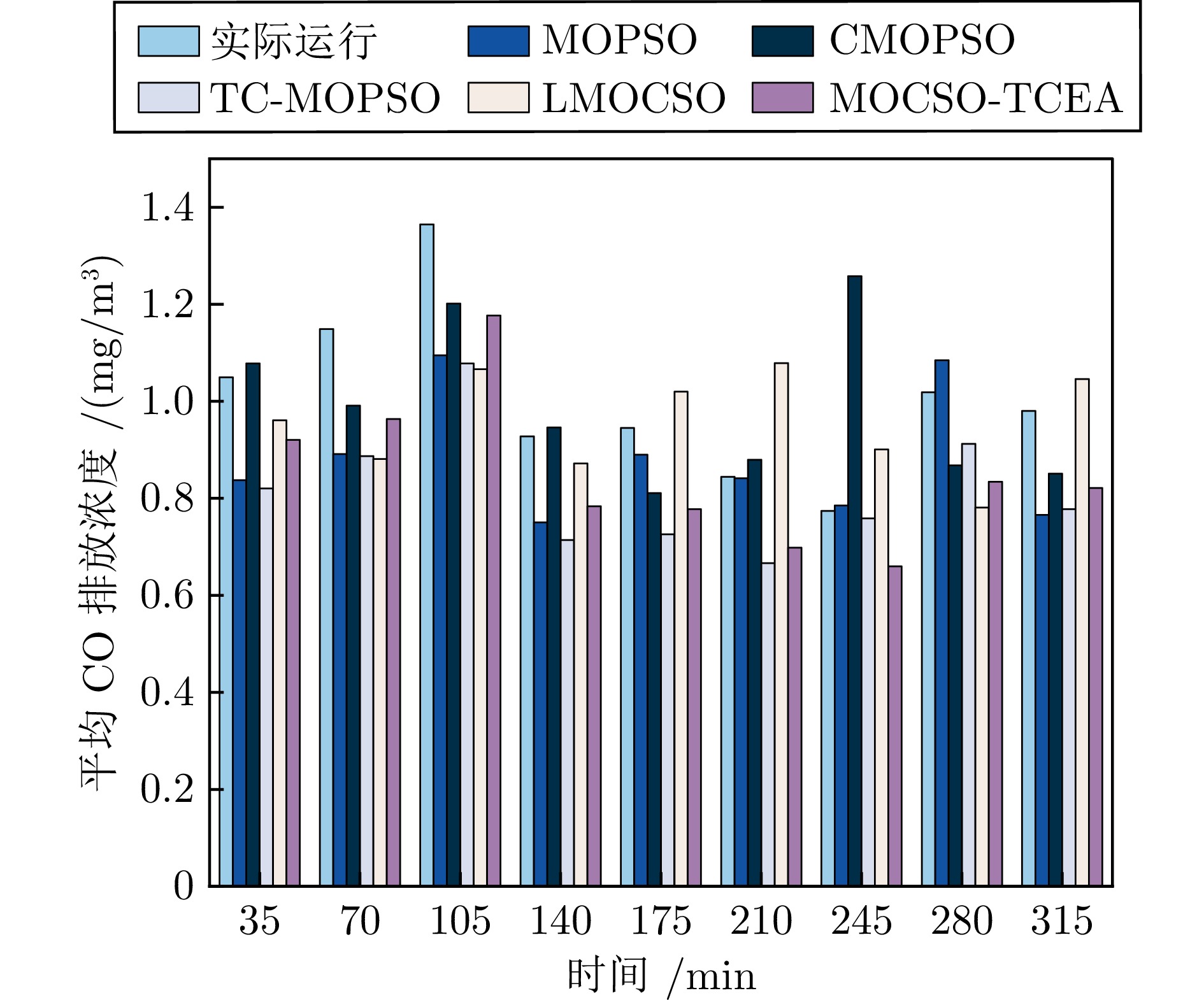
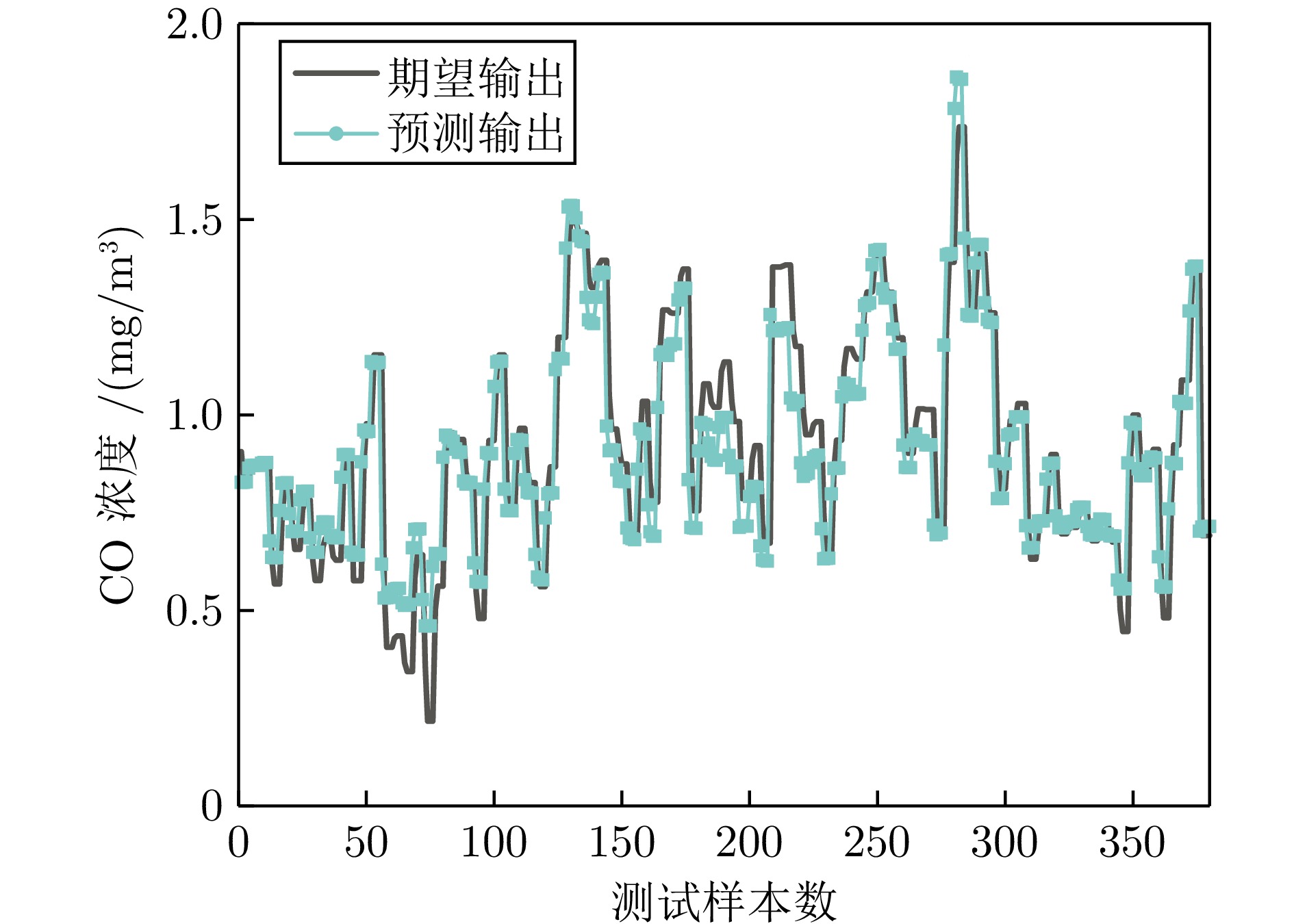
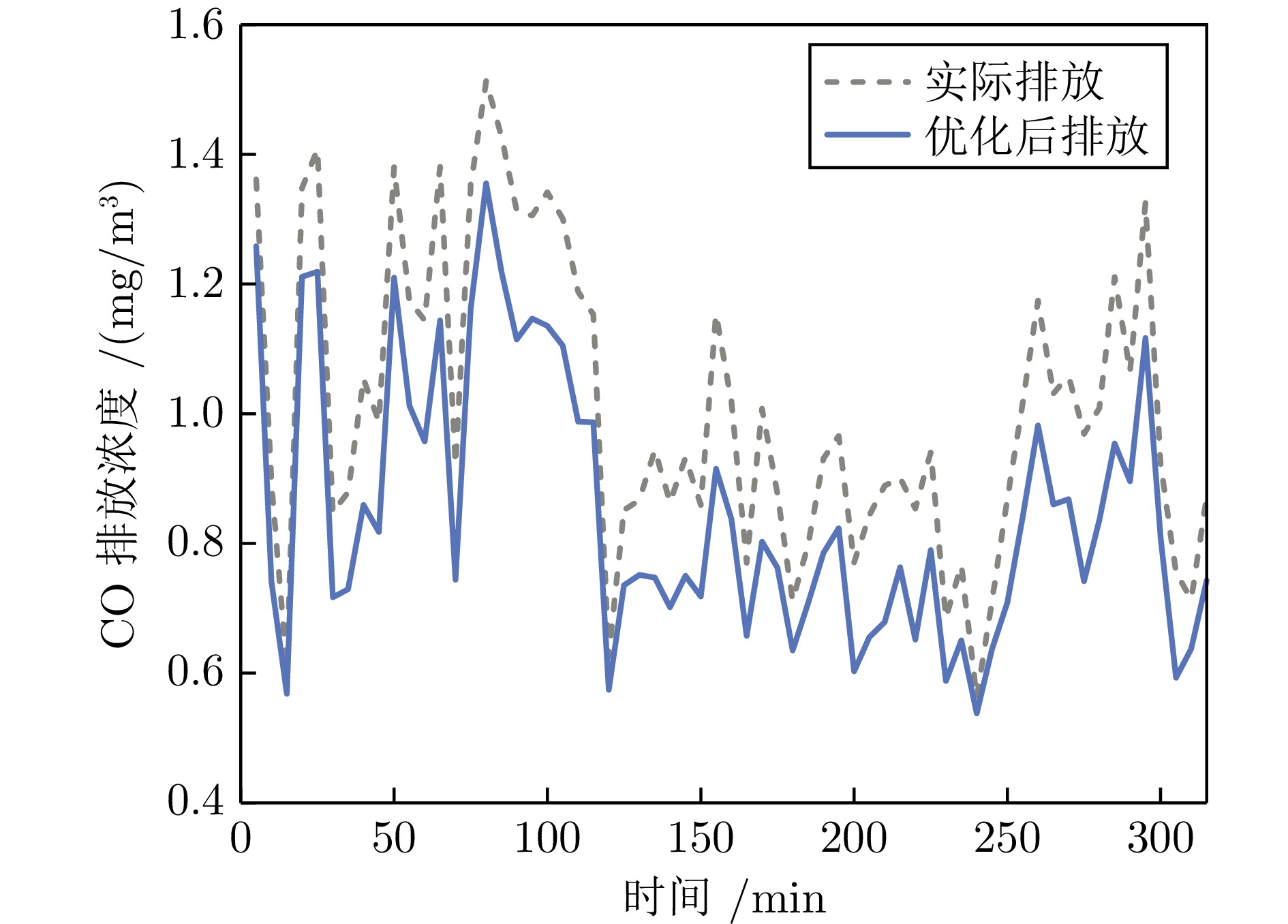
图 20 不同算法对CO排放的优化结果
Fig. 20 Optimization results of CO emissions using different algorithms
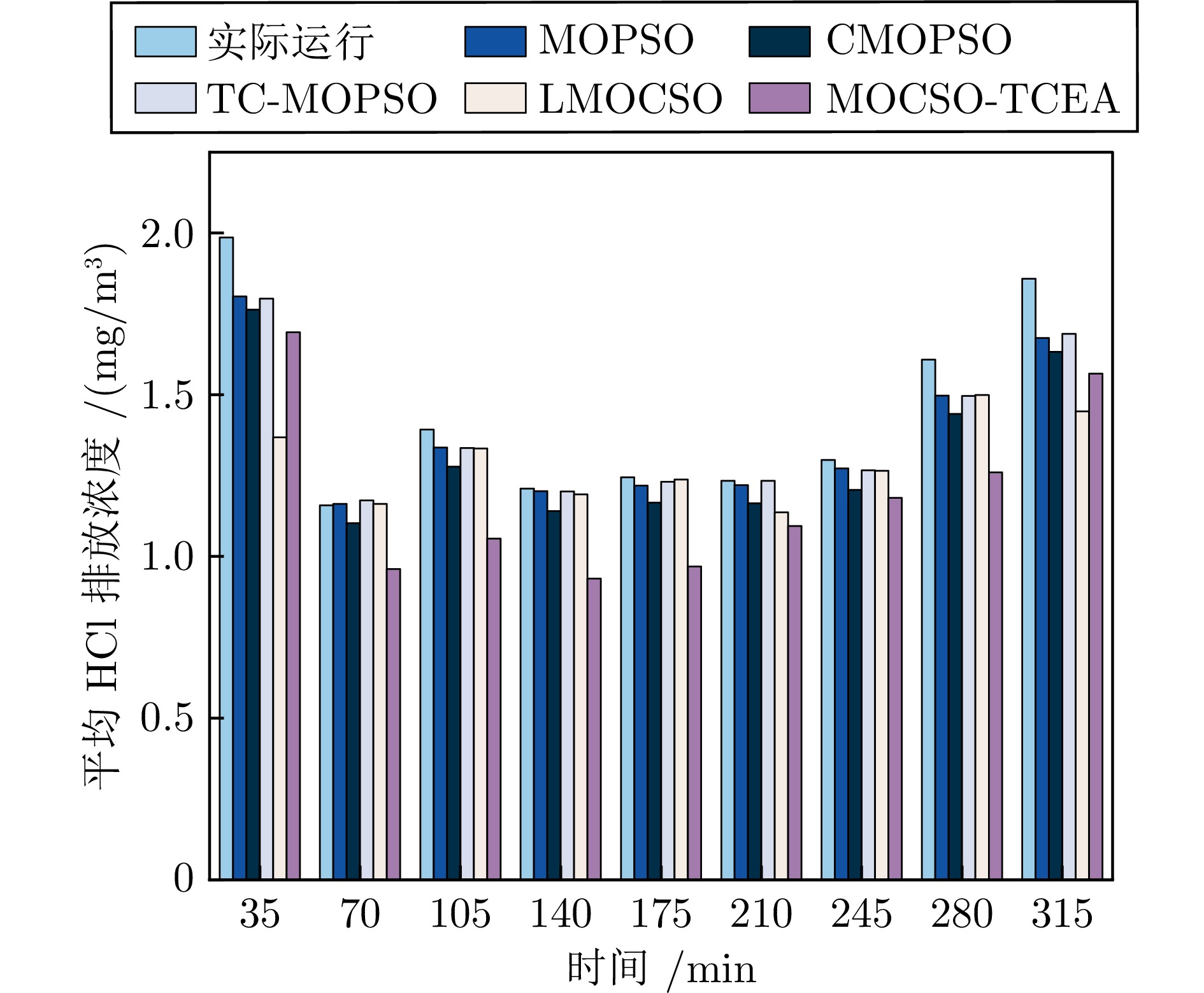
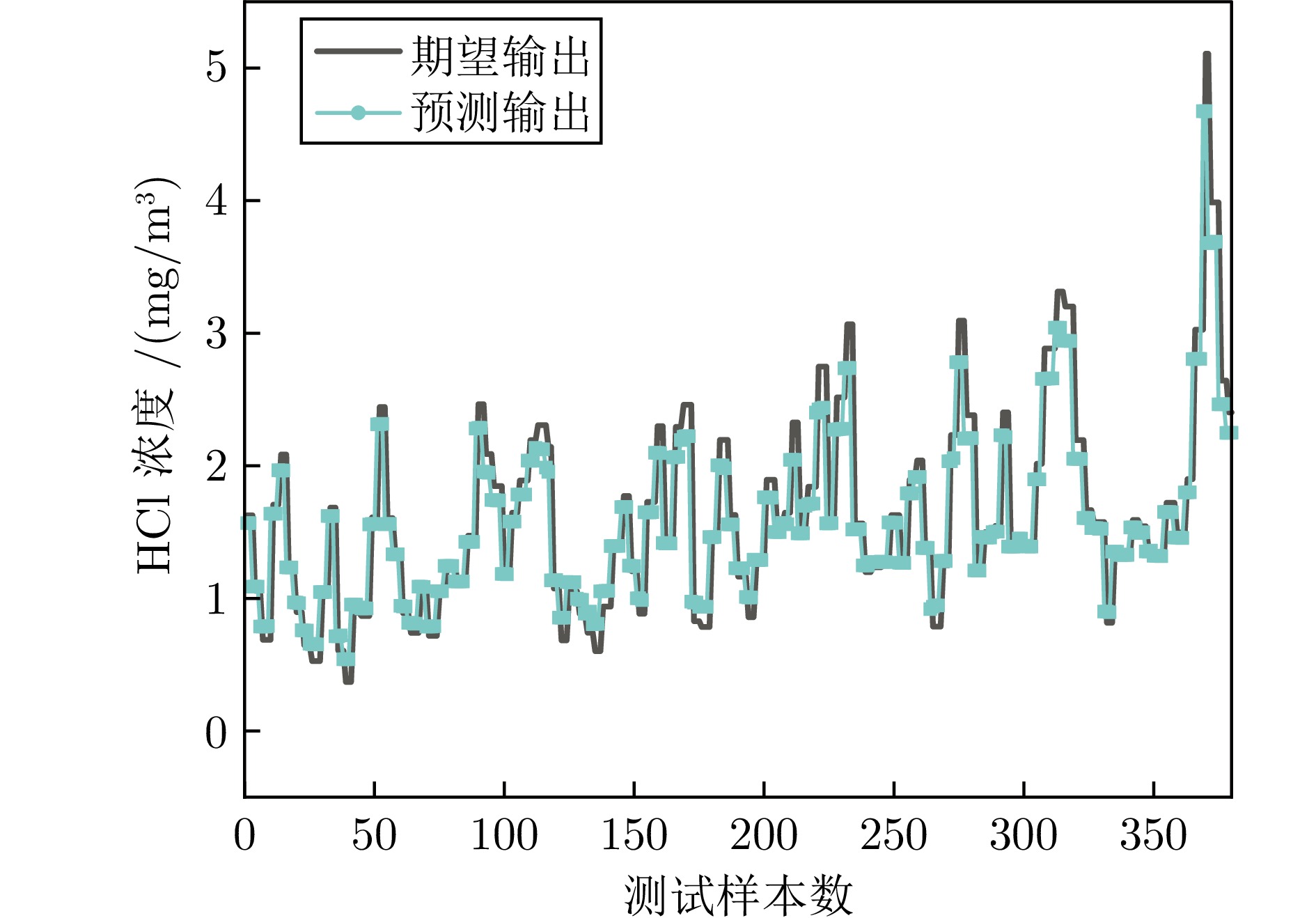
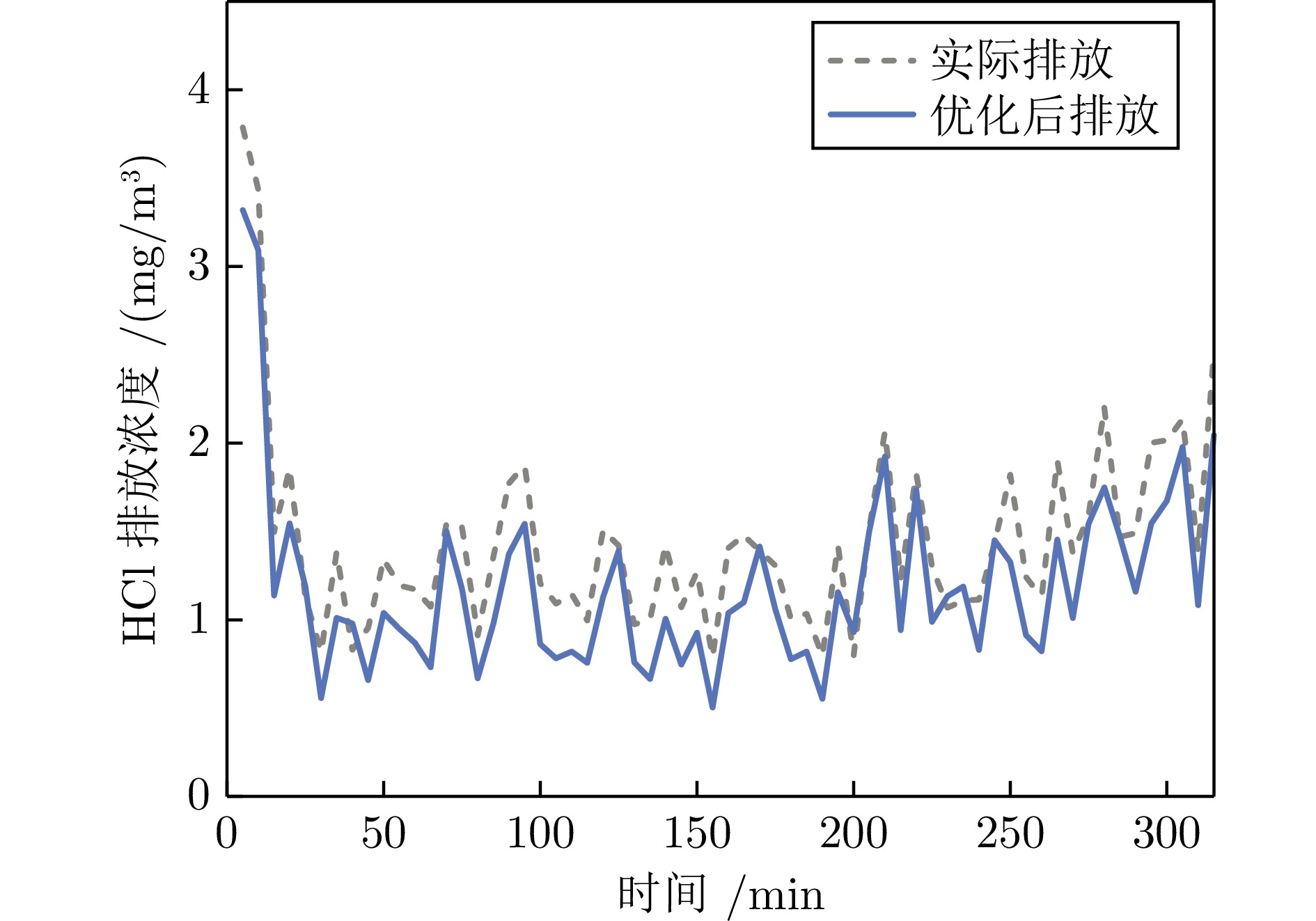
图 21 不同算法对HCl排放的优化结果
Fig. 21 Optimization results of HCl emissions using different algorithms
表 1 不同指标模型精度
Table 1 Accuracy of different index models
方法 $ {\rm{NOx}} $指标模型 CO指标模型 CO2指标模型 HCl指标模型 SO2指标模型 RMSE MAPE (%) RMSE MAPE (%) RMSE MAPE (%) RMSE MAPE (%) RMSE MAPE (%) BPNN 11.7989 3.9137 0.1366 11.3613 0.3977 3.2011 0.3671 15.5164 0.1931 13.8249 LSSVR 11.8521 4.4624 0.1345 10.2154 0.1997 1.4177 0.3394 14.2453 0.1921 13.3522 Kriging 10.7350 4.0389 0.1241 10.0990 0.1833 1.2684 0.3493 13.9170 0.1920 13.9610 RBF 11.7980 4.1628 0.1343 11.8330 0.2065 1.6988 0.3597 14.4680 0.1932 14.9450 SORBF 10.9680 4.4638 0.1332 11.5451 0.1701 1.1853 0.3421 14.1181 0.1923 13.6821  下载: 导出CSV
表 2 不同算法优化结果均值比较
Table 2 Comparison of mean optimization results using different algorithms
不同优化算法 燃烧效率
(%)$ {\rm{NOx}} $排放
(mg/m3)CO排放
(mg/m3)HCl排放
(mg/m3)SO2排放
(mg/m3)实际运行 88.4119 126.9786 1.0059 1.4432 1.1104 MOPSO 88.6989 123.9315 0.8823 1.3767 1.0121 CMOPSO 88.9132 122.9780 0.9870 1.3216 0.9639 TC-MOPSO 90.7973 120.1451 0.8155 1.3801 0.9320 LMOCSO 89.8754 120.7970 0.9561 1.2936 0.9288 MOCSO-TCEA 90.9180 119.0503 0.8484 1.1900 1.0013
下载: 导出CSV
-
[1] 联合国环境规划署, 国际固体废弃物协会. 2024年全球废物管理展望[Online], available: https://wedocs.unep.org/items/36e16872-2f02-4447-a3c1-c939bf50ea92, 2026-06-23United Nations Environment Programme, International Solid Waste Association. Global waste management outlook 2024: Beyond an age of waste — Turning rubbish into a resource[Online], available: https://wedocs.unep.org/items/36e16872-2f02-4447-a3c1-c939bf50ea92, June 23, 2026 [2] 乔俊飞, 蒙西, 汤云涛. 双碳目标下城市固废焚烧过程智能优化控制研究进展及展望. 中国科学基金, 2024, 38(4): 593−602 doi: 10.16262/j.cnki.1000-8217.20240605.001Qiao Jun-Fei, Meng Xi, Tang Yun-Tao. Perspectives on intelligent optimized control of municipal solid waste incineration process under dual carbon target. Science Foundation in China, 2024, 38(4): 593−602 doi: 10.16262/j.cnki.1000-8217.20240605.001 [3] 中华人民共和国住房和城乡建设部. 2023年中国城市建设状况公报[Online], available: http://www.sduwa.org.cn/uploads/other/2024/11/24110810171243463.pdf, 2026-06-23Ministry of Housing and Urban-Rural Development of the People's Republic of China. Bulletin on the status of China's urban construction in 2023[Online], available: http://www.sduwa.org.cn/uploads/other/2024/11/24110810171243463.pdf, June 23, 2026 [4] Hendo A H, Sanaye S. Simultaneous economic and exergetic optimization of a municipal solid waste incineration plant for sustainable power generation. Energy, 2024, 293: Article No. 130713 doi: 10.1016/j.energy.2024.130713 [5] Mayanti B, Songok J, Helo P. Multi-objective optimization to improve energy, economic and environmental life cycle assessment in waste-to-energy plant. Waste Management, 2021, 127: 147−157 doi: 10.1016/j.wasman.2021.04.042 [6] Liang Z Y, Ma X Q. Mathematical modeling of MSW combustion and SNCR in a full-scale municipal incinerator and effects of grate speed and oxygen-enriched atmospheres on operating conditions. Waste Management, 2010, 30(12): 2520−2529 doi: 10.1016/j.wasman.2010.05.006 [7] Zheng M F, Sun J K, Gong L Z, Fan Y M, Tu J Y, Dong J L. Optimization of secondary air operation parameters of waste incineration boiler based on response surface methodology. Applied Thermal Engineering, 2024, 236: Article No. 121763 doi: 10.1016/j.applthermaleng.2023.121763 [8] Zanoelo E F, Meleiro L A C. A dynamic optimization procedure for non-catalytic nitric oxide reduction in waste incineration plants. Chemical Engineering Science, 2007, 62(23): 6851−6864 doi: 10.1016/j.ces.2007.08.056 [9] Nasserzadeh V, Swithenbank J, Scott D, Jones B. Design optimization of a large municipal solid waste incinerator. Waste Management, 1991, 11(4): 249−261 doi: 10.1016/0956-053x(91)90072-d [10] Yang X C, Liao Y F, Ma X Q, Zhou J P. Effects of air supply optimization on NOx reduction in a structurally modified municipal solid waste incinerator. Applied Thermal Engineering, 2022, 201: Article No. 117706 doi: 10.1016/j.applthermaleng.2021.117706 [11] Mondal P, Samanta S, Zaman S A, Ghosh S. Municipal solid waste fired combined cycle plant: Techno-economic performance optimization using response surface methodology. Energy Conversion and Management, 2021, 237: Article No. 114133 doi: 10.1016/j.enconman.2021.114133 [12] 栗三一, 乔俊飞, 李文静, 顾锞. 污水处理决策优化控制. 自动化学报, 2018, 44(12): 2198−2209 doi: 10.16383/j.aas.2018.c170257Li San-Yi, Qiao Jun-Fei, Li Wen-Jing, Gu Ke. Advanced decision and optimization control for wastewater treatment plants. Acta Automatica Sinica, 2018, 44(12): 2198−2209 doi: 10.16383/j.aas.2018.c170257 [13] 黄肖玲, 柴天佑. 粒子群优化算法在大型选矿企业原料采购计划中的应用. 自动化学报, 2009, 35(5): 632−636 doi: 10.3724/SP.J.1004.2009.00632Huang Xiao-Ling, Chai Tian-You. Particle swarm optimization for raw material purchasing plan in large scale ore dressing plant. Acta Automatica Sinica, 2009, 35(5): 632−636 doi: 10.3724/SP.J.1004.2009.00632 [14] 刘继, 张小平, 张瑞瑞. 基于FTC的BBMC调速控制策略及参数优化. 自动化学报, 2020, 46(2): 332−341 doi: 10.16383/j.aas.c180767Liu Ji, Zhang Xiao-Ping, Zhang Rui-Rui. BBMC speed control strategy and parameter optimization based on FTC. Acta Automatica Sinica, 2020, 46(2): 332−341 doi: 10.16383/j.aas.c180767 [15] Cui Y Y, Meng X, Qiao J F. Multi-condition operational optimization with adaptive knowledge transfer for municipal solid waste incineration process. Expert Systems With Applications, 2024, 238: Article No. 121783 doi: 10.1016/j.eswa.2023.121783 [16] Habibollahzade A, Houshfar E, Ahmadi P, Behzadi A, Gholamian E. Exergoeconomic assessment and multi-objective optimization of a solar chimney integrated with waste-to-energy. Solar Energy, 2018, 176: 30−41 doi: 10.1016/j.solener.2018.10.016 [17] Houshfar E. Thermodynamic analysis and multi-criteria optimization of a waste-to-energy plant integrated with thermoelectric generator. Energy Conversion and Management, 2020, 205: Article No. 112207 doi: 10.1016/j.enconman.2019.112207 [18] Özahi E, Tozlu A. Optimization of an adapted Kalina cycle to an actual municipal solid waste power plant by using NSGA-Ⅱ method. Renewable Energy, 2020, 149: 1146−1156 doi: 10.1016/j.renene.2019.10.102 [19] Pan M Z, Chen X T, Li X Y. Multi-objective analysis and optimization of cascade supercritical CO2 cycle and organic Rankine cycle systems for waste-to-energy power plant. Applied Thermal Engineering, 2022, 214: Article No. 118882 doi: 10.1016/j.applthermaleng.2022.118882 [20] Wang T Z, Tang J, Xia H, Yang C L, Yu W, Qiao J F. Data-driven multi-objective intelligent optimal control of municipal solid waste incineration process. Engineering Applications of Artificial Intelligence, 2024, 137: Article No. 109157 doi: 10.1016/j.engappai.2024.109157 [21] Anderson S R, Kadirkamanathan V, Chipperfield A, Sharifi V, Swithenbank J. Multi-objective optimization of operational variables in a waste incineration plant. Computers & Chemical Engineering, 2005, 29(5): 1121−1130 doi: 10.1016/j.compchemeng.2004.12.001 [22] 崔莺莺, 蒙西, 乔俊飞. 城市固废焚烧过程风量智能优化设定方法. 控制与决策, 2023, 38(02): 318−326 doi: 10.13195/j.kzyjc.2021.1182Cui Ying-Ying, Meng Xi, Qiao Jun-Fei. The intelligent optimization setting method of air flow for municipal solid wastes incineration process. Control and Decision, 2023, 38(02): 318−326 doi: 10.13195/j.kzyjc.2021.1182 [23] 蒙西, 侯启正, 乔俊飞. 基于多目标粒子群算法的城市固废焚烧过程智能操作优化. 自动化学报, 2024, 50(12): 2462−2473 doi: 10.16383/j.aas.c240044Meng Xi, Hou Qi-Zheng, Qiao Jun-Fei. Intelligent operational optimization of municipal solid waste incineration process based on multi-objective particle swarm algorithm. Acta Automatica Sinica, 2024, 50(12): 2462−2473 doi: 10.16383/j.aas.c240044 [24] Li Z H, Yao S C, Chen D, Li L Q, Lu Z M, Liu W, et al. Multi-parameter co-optimization for NOx emissions control from waste incinerators based on data-driven model and improved particle swarm optimization. Energy, 2024, 306: Article No. 13247 doi: 10.1016/j.energy.2024.132477 [25] Qiao J F, Cui Y Y, Meng X. Dynamic multi-objective operation optimization of municipal solid waste incineration process based on transfer learning. IEEE Transactions on Automation Science and Engineering, 2024, 22: 9338 doi: 10.1109/tase.2024.3505846 [26] Cheng R, Jin Y C. A competitive swarm optimizer for large scale optimization. IEEE Transactions on Cybernetics, 2014, 45(2): 191−204 [27] Shang Q X, Tan M Z, Hu R, Huang Y X, Qian B, Feng L. A multi-stage competitive swarm optimization algorithm for solving large-scale multi-objective optimization problems. Expert Systems With Applications, 2025, 260: Article No. 125411 doi: 10.1016/j.eswa.2024.125411 [28] Huang C, Song Y J, Ma H J, Zhou X B, Deng W. A multiple level competitive swarm optimizer based on dual evaluation criteria and global optimization for large-scale optimization problem. Information Sciences, 2025, 708: Article No. 122068 doi: 10.1016/j.ins.2025.122068 [29] Huang W M, Ding H X, Qiao J F. Large-scale and knowledge-based dynamic multiobjective optimization for MSWI process using adaptive competitive swarm optimization. IEEE Transactions on Systems, Man, and Cybernetics: Systems, 2023, 54(1): 379 doi: 10.1109/tsmc.2023.3308922 [30] 黄卫民, 蒙西, 乔俊飞. 城市固废焚烧过程动态协同优化方法. 中国科学: 信息科学, 2025, 55(5): 1200−1220Huang wei-Min, Meng Xi, Qiao Jun-Fei. A dynamic cooperative optimization method for municipal solid waste incineration process. Scientia Sinica Informationis, 2025, 55(5): 1200−1220 [31] Qiao J F, Huang W M, Meng X. Data-driven dynamic multiobjective optimization with response to stochastic changes for municipal solid waste incineration process. IEEE Transactions on Evolutionary Computation, 2025, 30(4): 1615 doi: 10.1109/tevc.2025.3592956/mm1 [32] Tan S T, Ho W S, Hashim H, Lee C T, Taib M R, Ho C S. Energy, economic and environmental (3E) analysis of waste-to-energy (WTE) strategies for municipal solid waste (MSW) management in Malaysia. Energy Conversion and Management, 2015, 102: 111−120 doi: 10.1016/j.enconman.2015.02.010 [33] Maphuhla N G, Oyedeji O O. From trash to treasure: Systematic evaluation of potential and efficiency of waste-to-energy incineration for electricity generation. Waste, MDPI, 2025, 3(4): Article No. 39 [34] 乔俊飞, 郭子豪, 汤健. 面向城市固废焚烧过程的二噁英排放浓度检测方法综述. 自动化学报, 2020, 46(6): 1063−1089 doi: 10.16383/j.aas.c190005Qiao Jun-Fei, Guo Zi-Hao, Tang Jian. Dioxin emission concentration measurement approaches for municipal solid wastes incineration process: A survey. Acta Automatica Sinica, 2020, 46(6): 1063−1089 doi: 10.16383/j.aas.c190005 [35] 白良成. 生活垃圾焚烧处理工程技术. 北京: 中国建筑工业出版社, 2021.Bai Liang-Cheng. Engineering Technology for Incineration Treatment of Municipal Solid Waste. Beijing: China Architecture & Building Press, 2021. [36] 中华人民共和国生态环境部. GB18485-2014生活垃圾焚烧污染控制标准. 北京: 中国环境科学出版社, 2014.Ministry of Ecology and Environment of the People's Republic of China. GB18485-2014 Standard for Pollution Control on the Municipal Solid Waste Incineration. Beijing: China Environmental Science Press, 2014. [37] Meng X, Rozycki P, Qiao J F, Wilamowski B. M. Nonlinear system modeling using RBF networks for industrial application. IEEE Transactions on Industrial Informatics, 2017, 14(3): 931−940 doi: 10.1109/tii.2017.2734686 [38] Qiao J F, Zhou J L, Meng X. A multitask learning model for the prediction of NOx emissions in municipal solid waste incineration processes. IEEE Transactions on Instrumentation and Measurement, 2022, 72: 1−14 doi: 10.1109/tim.2022.3225056 [39] Meng X, Zhang Y, Qiao J F. An adaptive task-oriented RBF network for key water quality parameters prediction in wastewater treatment process. Neural Computing and Applications, 2021, 33(17): 11401−11414 doi: 10.1007/s00521-020-05659-z [40] Rumelhart D E, Hinton G E, Williams R J. Learning representations by back-propagating errors. Nature, 1986, 323(6088): 533−536 doi: 10.1038/323533a0 [41] Smola A, Sch lkopf B. A tutorial on support vector machines. Statistics and Computing, 2004, 14(3): 199−222 doi: 10.1023/b:stco.0000035301.49549.88 [42] Sacks J, Welch W J, Mitchell T J, Wynn H P. Design and analysis of computer experiments. Statistical Science, 1989, 4(4): 409−423 doi: 10.1214/ss/1177012413 [43] Coello C A C, Lechuga M S. MOPSO: A proposal for multiple objective particle swarm optimization. In: Proceedings of the 2002 Congress on Evolutionary Computation. Honolulu, USA: IEEE, 2002. 1051-1056 [44] Zhang X Y, Zheng X T, Cheng R, Qiu J F, Jin Y C. A competitive mechanism based multi-objective particle swarm optimizer with fast convergence. Information Sciences, 2018, 427: 63−76 doi: 10.1016/j.ins.2017.10.037 [45] Han F, Zheng M P, Ling Q H. An improved multiobjective particle swarm optimization algorithm based on tripartite competition mechanism. Applied Intelligence, 2022, 52(5): 5784−5816 doi: 10.1007/s10489-021-02665-z [46] Tian Y, Zheng X T, Zhang X Y, Jin Y C. Efficient large-scale multiobjective optimization based on a competitive swarm optimizer. IEEE Transactions on Cybernetics, 2019, 50(8): 3696−3708 doi: 10.1109/tcyb.2019.2906383 -

 下载:

计量
- 文章访问数: 13
- HTML全文浏览量: 12
- 被引次数: 0
