


Physics-informed Enhanced Dual-branch ResNet Fault Diagnosis for the Variable-speed Rolling Bearings
-
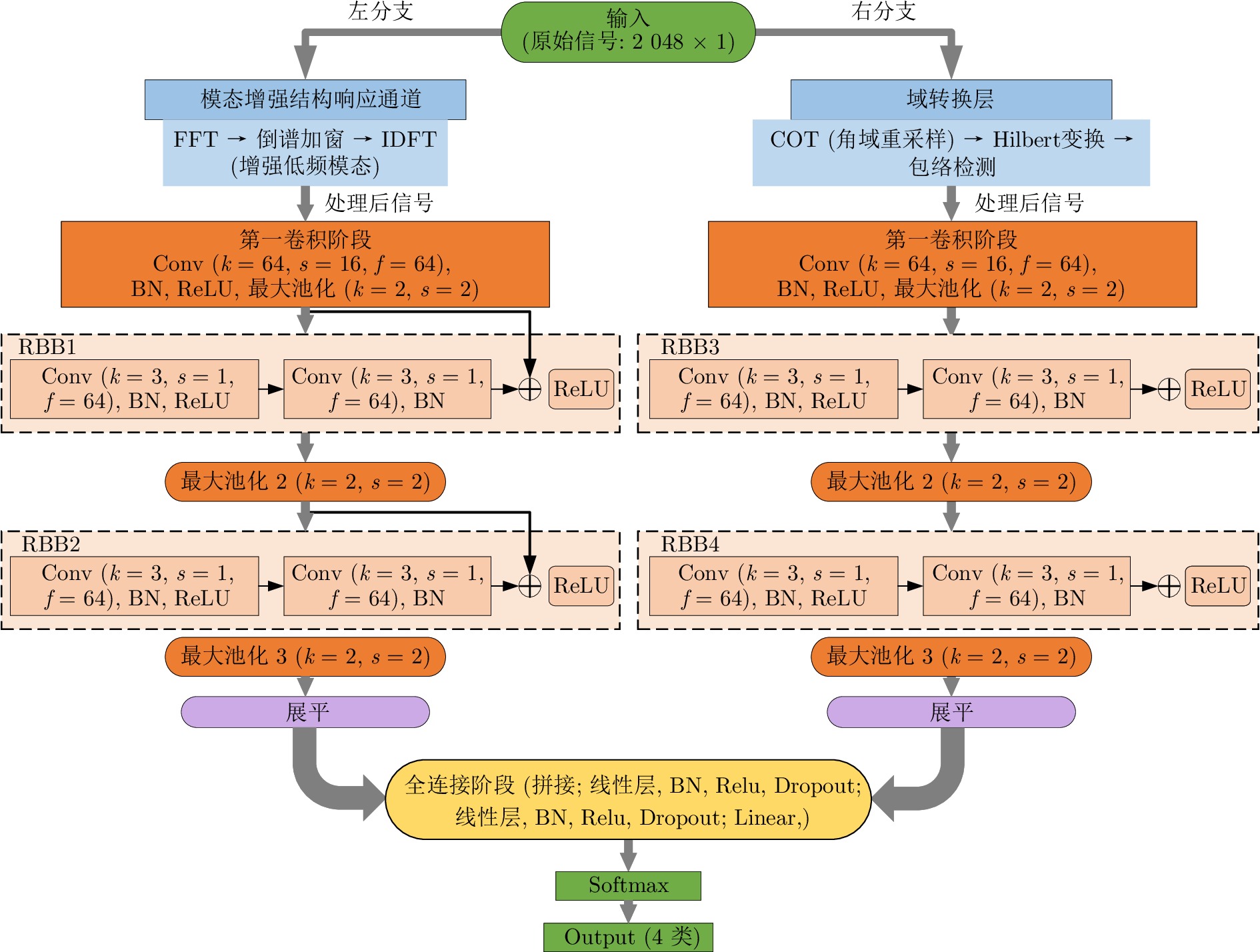
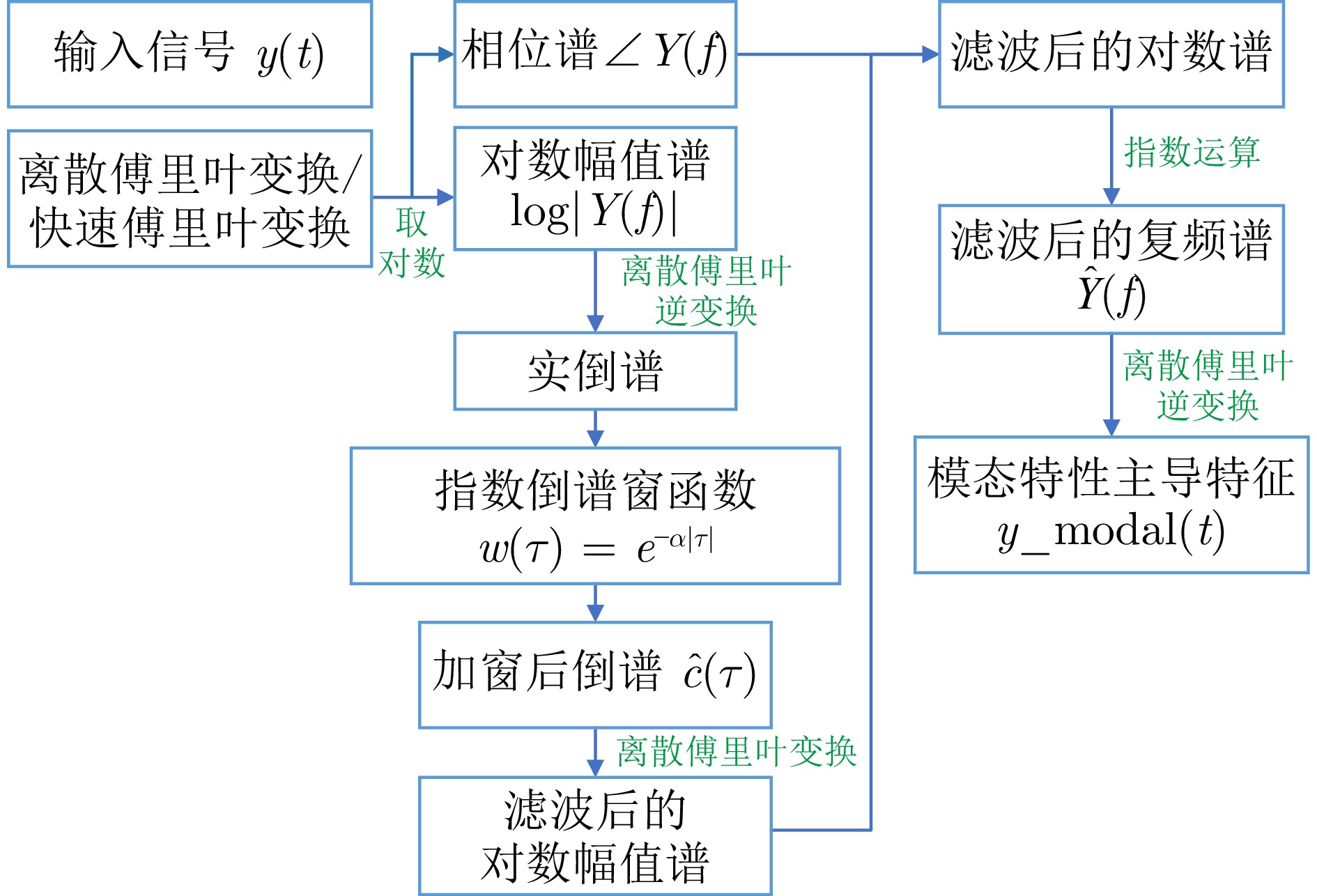
摘要: 在变速工况下的滚动轴承故障诊断中, 特征频率随转速漂移导致的跨工况特征失稳以及深度学习模型缺乏物理一致性, 是导致诊断精度下降和泛化能力不足的关键问题. 针对这一问题, 提出一种融合双分支特征提取与物理约束的物理增强双分支残差网络(PEDB-ResNet)和基于PEDB-ResNet的前后端双物理增强的故障诊断算法. 在前端通过构建倒谱模态与角域冲击调制双增强的双通道结构, 强化了结构模态与阶次冲击特征, 在后端网络训练中设计特征阶次先验的谱约束损失和基于时变接触刚度模型的TVCS-PINN动力学残差损失, 实现双物理一致性约束, 从而获取符合轴承动力学的潜在特征表示, 进一步提高了故障诊断模型的约束性和可解释性. 在KAIST变速轴承数据集上的实验表明, PEDB-ResNet在诊断准确率、稳定性及变工况泛化能力方面均显著优于已有PIResNet、ResNet与CNN, 消融研究进一步验证了双分支结构与物理损失项的有效性.Abstract: In rolling bearing fault diagnosis under variable-speed operating conditions, cross-working-condition feature instability caused by the drift of characteristic frequencies with rotational speed and the lack of physical consistency in deep learning models are key issues leading to reduced diagnostic accuracy and insufficient generalization capability. To address these issues, a physics-enhanced dual-branch residual network (PEDB-ResNet) integrating dual-branch feature extraction and physical constraints, together with a fault diagnosis algorithm based on PEDB-ResNet with dual physical enhancement at both the front end and back end, is proposed. At the front end, a dual-channel structure incorporating cepstral modal enhancement and angular-domain impact modulation enhancement is constructed to strengthen structural modal features and order-related impact features. During back-end network training, a spectral constraint loss incorporating feature-order priors and a TVCS-PINN dynamic residual loss based on a time-varying contact stiffness model are designed to enforce dual physical consistency constraints, thereby obtaining latent feature representations consistent with bearing dynamics and further improving the consistency and interpretability of the fault diagnosis model. Experiments on the KAIST variable-speed bearing dataset demonstrate that PEDB-ResNet significantly outperforms the existing PIResNet, ResNet, and CNN in terms of diagnostic accuracy, stability, and generalization capability under variable operating conditions. Ablation studies further verify the effectiveness of the dual-branch structure and the physics loss terms.
-
表 1 PEDB-ResNet参数设置
Table 1 Parameter settings of PEDB-ResNet
层类型 卷积核尺寸/
步长卷积核
数量填充 输出尺寸
(宽度$ \times $深度)输入 – – 否 – 模态增强结构响应通道 – – 否 – 域变换层 – – 否 $ {{2\,\;048}}\,\;\times\,\;{{1}} $ 卷积层1 $ 64 \times 1/16 \times 1 $ 64 是 $ {{128}}\,\;\times\,\;{{64}} $ 池化层1 $ 2 \times 1/2 \times 1 $ 64 否 $ {{64}}\,\;\times\,\;{{64}} $ RBB1中的卷积层2 $ 3 \times 1/1 \times 1 $ 64 是 $ {{64}}\,\;\times\,\;{{64}} $ RBB1中的卷积层3 $ 3 \times 1/1 \times 1 $ 64 是 $ {{64}}\,\;\times\,\;{{64}} $ 池化层2 $ 2 \times 1/2 \times 1 $ 64 否 $ {{32}}\,\;\times\,\;{{64}} $ RBB2中的卷积层4 $ 3 \times 1/1 \times 1 $ 64 是 $ {{32}}\,\;\times\,\;{{64}} $ RBB2中的卷积层5 $ 3 \times 1/1 \times 1 $ 64 是 $ {{32}}\,\;\times\,\;{{64}} $ 池化层3 $ 2 \times 1/2 \times 1 $ 64 否 $ {{16}}\,\;\times\,\;{{64}} $ 展平与拼接 – – 否 $ {{2\,\;048}}\,\;\times\,\;{{1}} $ 全连接层1 – – 否 $ {{256}}\,\;\times\,\;{{1}} $ 全连接层2 – – 否 $ {{32}}\,\;\times\,\;{{1}} $ 全连接层3 – – 否 $ {{4}}\,\;\times\,\;{{1}} $ Softmax分类层 – – 否 $ 4 $  下载: 导出CSV
表 2 消融实验性能比较
Table 2 Performance comparison of ablation experiments
模型 Acc Prec Rec F1 PEDB-ResNet 98.22 98.23 98.22 98.21 模型A 98.00 98.01 98.00 97.99 模型B 97.38 97.43 97.43 97.37 模型C 97.68 97.62 97.66 97.62
下载: 导出CSV
表 3 各模型在变速工况轴承任务上的性能比较
Table 3 Performance comparison of various models under variable-speed bearing operation conditions
模型 Acc Prec Rec F1 PEDB-ResNet 98.22 98.23 98.22 98.21 PIResNet 97.06 97.12 97.06 97.04 ResNet 84.96 85.83 84.96 85.02 1D-CNN 72.45 77.45 72.45 70.89
下载: 导出CSV
-
[1] 谢刚, 韩秦, 聂晓音, 石慧, 张晓红, 田娟. 基于两阶段域泛化学习框架的轴承故障诊断方法. 自动化学报, 2024, 50(11): 2271−2285 doi: 10.16383/j.aas.c230716Xie Gang, Han Qin, Nie Xiao-Yin, Shi Hui, Zhang Xiao-Hong, Tian Juan. A two-stage domain generalization learning framework for fault diagnosis of bearings. Acta Automatica Sinica, 2024, 50(11): 2271−2285 doi: 10.16383/j.aas.c230716 [2] 陈俊英, 席月芸, 李朝阳. 多尺度局部特征和Transformer全局学习融合的发动机剩余寿命预测. 自动化学报, 2024, 50(9): 1818−1830 doi: 10.16383/j.aas.c230634Chen Jun-Ying, Xi Yue-Yun, Li Zhao-Yang. Prediction of aeroengine remaining life by combining multi-scale local features and Transformer global learning. Acta Automatica Sinica, 2024, 50(9): 1818−1830 doi: 10.16383/j.aas.c230634 [3] Chang L L, Dong W, Yang J B, Sun X Y, Xu X B, Xu X J, et al. Hybrid belief rule base for regional railway safety assessment with data and knowledge under uncertainty. Information Sciences, 2020, 518: 376−395 doi: 10.1016/j.ins.2019.12.035 [4] Liao Y X, Huang R Y, Li J P, Chen Z Y, Li W H. Deep semisupervised domain generalization network for rotary machinery fault diagnosis under variable speed. IEEE Transactions on Instrumentation and Measurement, 2020, 69(10): 8064−8075 doi: 10.1109/tim.2020.2992829 [5] Herwig N, Borghesani P, Smith W, Peng Z. Signal processing- and physics-informed neural network for explainable bearing condition monitoring. Mechanical Systems and Signal Processing, 2025, 235: Article No. 112925 doi: 10.1016/j.ymssp.2025.112925 [6] Wang Z K, Xu Z F, Cai C, Wang X D, Xu J Z, Shi K Z, et al. Rolling bearing fault diagnosis method using time-frequency information integration and multi-scale TransFusion network. Knowledge-Based Systems, 2024, 284: Article No. 111344 doi: 10.1016/j.knosys.2023.111344 [7] Lian J J, Liu Z, Wang H J, Dong X F. Adaptive variational mode decomposition method for signal processing based on mode characteristic. Mechanical Systems and Signal Processing, 2018, 107: 53−77 doi: 10.1016/j.ymssp.2018.01.019 [8] Wang H, Wang W, Yan J, Fu C, Liu W. Measurement and prediction of micronewton class thrust of electric propulsion based on the torsional pendulum and machine learning technique. IEEE Transactions on Instrumentation and Measurement, 2023, 72: 1−14 doi: 10.1109/tim.2022.3225035 [9] Vos K, Peng Z, Jenkins C, Shahriar M R, Borghesani P, Wang W. Vibration-based anomaly detection using LSTM/SVM approaches. Mechanical Systems and Signal Processing, 2022, 169: Article No. 108752 doi: 10.1016/j.ymssp.2021.108752 [10] Wang B, Hu X. Fault diagnosis technique based on multi-domain features and RelifF-Bayes-KNN in rolling bearing. Nonlinear Dynamics, 2025, 113: 12985−13000 doi: 10.1007/s11071-024-10212-x [11] Guo Z, Du W L, Li C, Guo X B, Liu Z P. Fault diagnosis of rotating machinery with high-dimensional imbalance samples based on wavelet random forest. Measurement, 2025, 248: Article No. 116936 doi: 10.1016/j.measurement.2025.116936 [12] Wang X, Mao D, Li X. Bearing fault diagnosis based on vibro-acoustic data fusion and 1DCNN network. Measurement, 2021, 173: Article No. 108518 doi: 10.1016/j.measurement.2020.108518 [13] Chen X, Zhang B, Gao D. Bearing fault diagnosis base on multi-scale CNN and LSTM model. Journal of Intelligent Manufacturing, 2021, 32(4): 971−987 doi: 10.1007/s10845-020-01600-2 [14] Wang X, Jiang H, Mu M, Dong Y. A trackable multi-domain collaborative generative adversarial network for rotating machinery fault diagnosis. Mechanical Systems and Signal Processing, 2025, 224: Article No. 111950 doi: 10.1016/j.ymssp.2024.111950 [15] Ding Y, Jia M, Zhuang J, Cao Y, Zhao X, Lee C G. Deep imbalanced domain adaptation for transfer learning fault diagnosis of bearings under multiple working conditions. Reliability Engineering & System Safety, 2023, 230: Article No. 108890 doi: 10.1016/j.ress.2022.108890 [16] Xiao Y, Shao H D, Wang J, Yan S, Liu B. Bayesian variational Transformer: A generalizable model for rotating machinery fault diagnosis. Mechanical Systems and Signal Processing, 2024, 207: Article No. 110936 doi: 10.1016/j.ymssp.2023.110936 [17] Wang H, Liu R, Ding S X, Hu Q, Li Z, Zhou H, et al. Causal-trivial attention graph neural network for fault diagnosis of complex industrial processes. IEEE Transactions on Industrial Informatics, 2024, 20(2): 1987−1996 doi: 10.1109/TII.2023.3282979 [18] Jain P H, Bhosle S P, Keche A J, Desavale R G. A dynamic model of outer race defective bearing considering the unbalanced shaft-bearing system with experimental simulation. Journal of Tribology, 2024, 146(1): Article No. 014301 doi: 10.1115/1.4062689 [19] Yan Q S, Hu T, Wu P, Dai D W, Gu S H, Dong W, et al. Efficient image enhancement with a diffusion-based frequency prior. IEEE Transactions on Circuits and Systems for Video Technology, 2025, 35(9): 8452−8465 doi: 10.1109/TCSVT.2025.3549351 [20] Karniadakis G E, Kevrekidis I G, Lu L, Perdikaris P, Wang S, Yang L. Physics-informed machine learning. Nature Reviews Physics, 2021, 3(6): 422−440 doi: 10.1038/s42254-021-00314-5 [21] Jin X W, Cai S Z, Li H, Karniadakis G E. NSFnets (Navier-Stokes flow nets): Physics-informed neural networks for the incompressible Navier-Stokes equations. Journal of Computational Physics, 2021, 426: Article No. 109951 doi: 10.1016/j.jcp.2020.109951 [22] Patel Y, Mons V, Marquet O, Rigas G. Turbulence model augmented physics-informed neural networks for mean-flow reconstruction. Physical Review Fluids, 2024, 9(3): Article No. 034605 doi: 10.1103/physrevfluids.9.034605 [23] Lim J, Psaltis D. MaxwellNet: Physics-driven deep neural network training based on Maxwell's equations. APL Photonics, 2022, 7(1): Article No. 011301 doi: 10.1063/5.0071616 [24] Zheng H L, Yang Y T, Yin J C, Li Y Q, Wang R X, Xu M Q. Deep domain generalization combining a priori diagnosis knowledge toward cross-domain fault diagnosis of rolling bearing. IEEE Transactions on Instrumentation and Measurement, 2021, 70: 1−11 doi: 10.1109/tim.2020.3016068 [25] Ni Q, Ji J C, Halkon B, Feng K, Nandi A K. Physics-informed residual network (PIResNet) for rolling element bearing fault diagnostics. Mechanical Systems and Signal Processing, 2023, 200: Article No. 110544 doi: 10.1016/j.ymssp.2023.110544 [26] Sadoughi M, Hu C. Physics-based convolutional neural network for fault diagnosis of rolling element bearings. IEEE Sensors Journal, 2019, 19(11): 4181−4192 doi: 10.1109/JSEN.2019.2898634 [27] Li T F, Zhao Z B, Sun C, Cheng L, Chen X F, Yan R Q, et al. WaveletKernelNet: An interpretable deep neural network for industrial intelligent diagnosis. IEEE Transactions on Systems, Man, and Cybernetics: Systems, 2022, 52(4): 2302−2312 doi: 10.1109/TSMC.2020.3048950 [28] Lu H, Nemani V P, Barzegar V, Allen C, Hu C, Laflamme S, et al. A physics-informed feature weighting method for bearing fault diagnostics. Mechanical Systems and Signal Processing, 2023, 191: Article No. 110171 doi: 10.1016/j.ymssp.2023.110171 [29] Chen X F, Ma M, Zhao Z B, Zhai Z, Mao Z. Physics-informed deep neural network for bearing prognosis with multisensory signals. Journal of Dynamics, Monitoring and Diagnostics, 2022, 1(4): 200−207 doi: 10.37965/jdmd.2022.54 [30] Raissi M, Perdikaris P, Karniadakis G E. Physics-informed neural networks: A deep learning framework for solving forward and inverse problems involving nonlinear partial differential equations. Journal of Computational Physics, 2019, 378: 686−707 doi: 10.1016/j.jcp.2018.10.045 [31] Shen S, Lu H, Sadoughi M, Hu C, Nemani V P, Thelen A, et al. A physics-informed deep learning approach for bearing fault detection. Engineering Applications of Artificial Intelligence, 2021, 103: Article No. 104295 doi: 10.1016/j.engappai.2021.104295 [32] Yucesan Y A, Viana F A C. A physics-informed neural network for wind turbine main bearing fatigue. International Journal of Prognostics and Health Management, 2020, 11: Article No. 003 doi: 10.36001/ijphm.2020.v11i1.2594 [33] He G Y, Zhao Y X, Yan C L. MFLP-PINN: A physics-informed neural network for multiaxial fatigue life prediction. European Journal of Mechanics - A/Solids, 2023, 98: Article No. 104889 doi: 10.1016/j.euromechsol.2022.104889 [34] Chen Y J, Rao M, Feng K, Zuo M J. Physics-informed LSTM hyperparameters selection for gearbox fault detection. Mechanical Systems and Signal Processing, 2022, 171: Article No. 108907 doi: 10.1016/j.ymssp.2022.108907 [35] Randall R B, Antoni J. Rolling element bearing diagnostics–A tutorial. Mechanical Systems and Signal Processing, 2011, 25(2): 485−520 doi: 10.1016/j.ymssp.2010.07.017 -

 下载:

计量
- 文章访问数: 13
- HTML全文浏览量: 15
- 被引次数: 0
