


Cognition-enhanced visual target search method for a UAV embodied agent in urban space
-
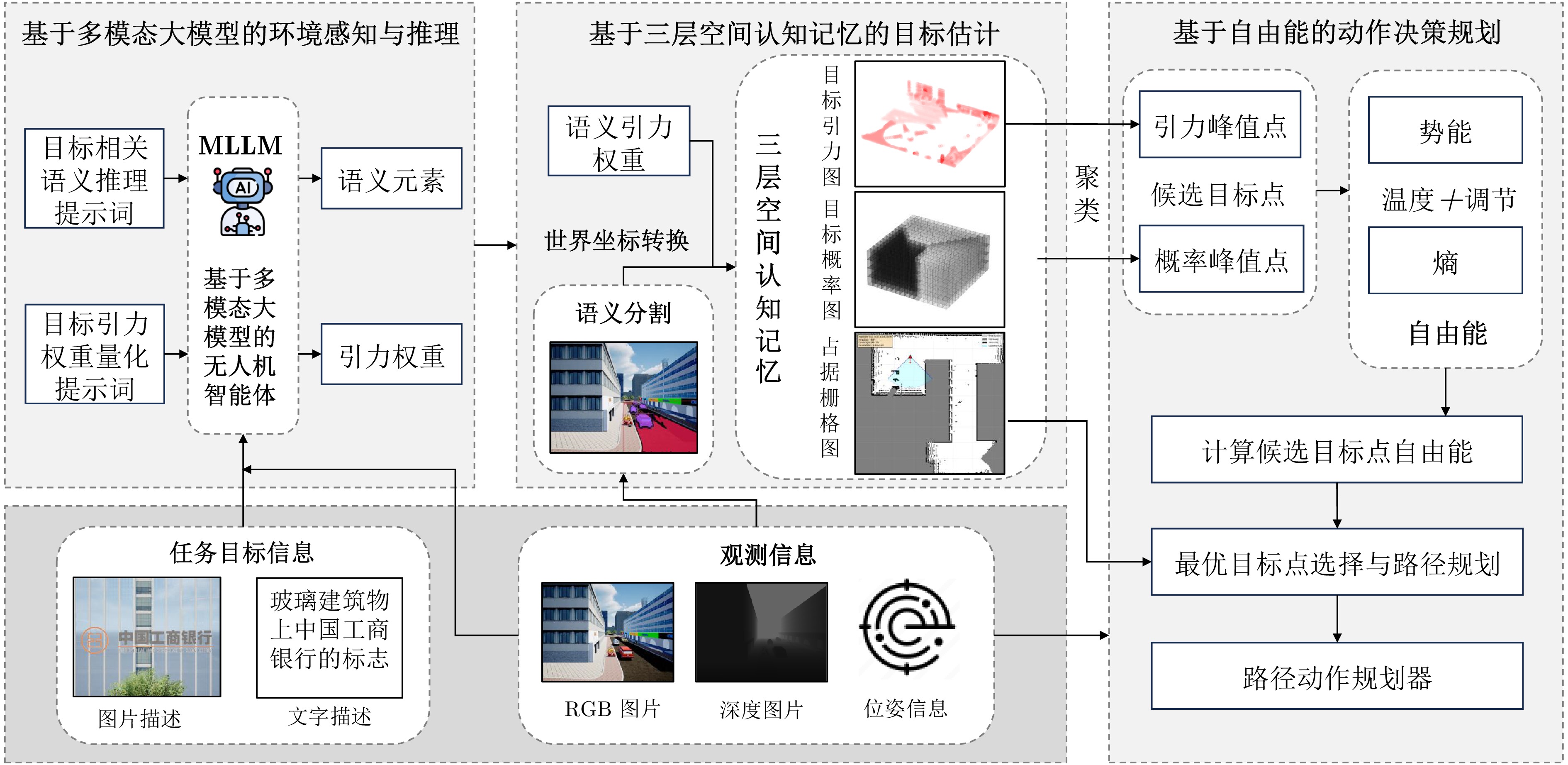
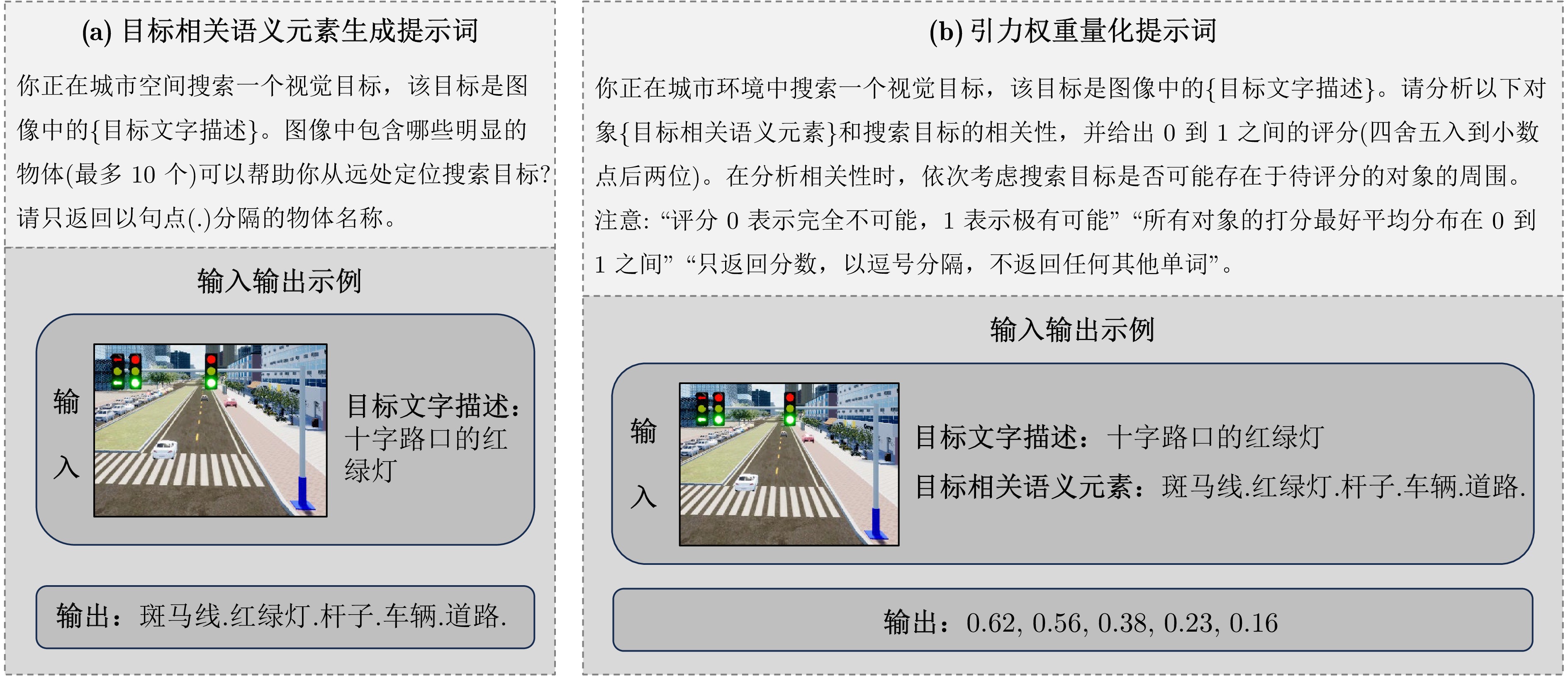
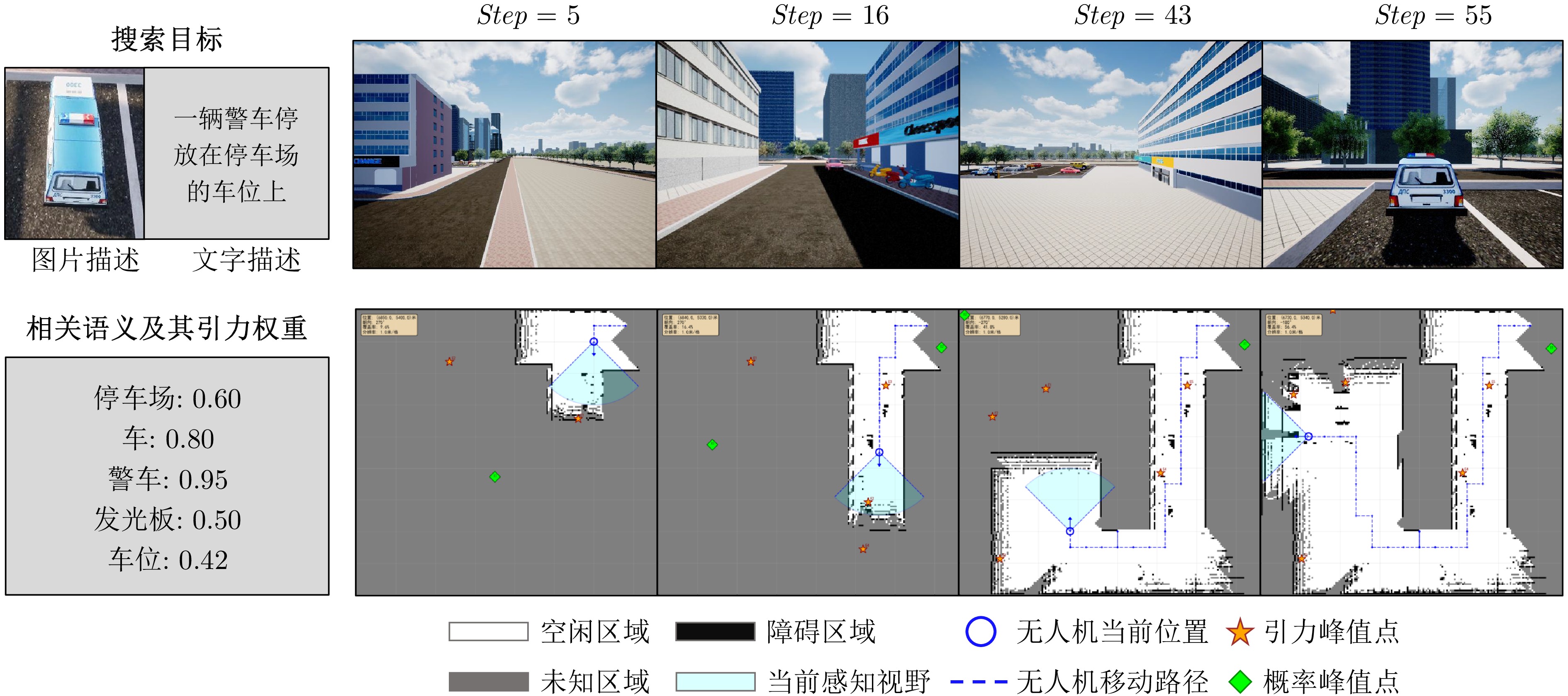
摘要: 无人机自主搜索算法正经历深刻转型, 从传统的概率估计、元启发式与深度强化学习方法, 向新兴的具身智能体范式演进. 现有面向目标搜索的无人机具身智能体研究面临着物体语义价值难量化、城市环境准确认知难形成以及探索与开发动作规划难平衡等挑战. 针对上述挑战, 提出一种利用视觉线索推理增强认知的具身目标搜索方法(LVCREC). 该方法将多模态大模型蕴含的视觉语义知识转化为搜索任务中的空间共现先验, 构建语义线索价值编码机制, 量化目标相关语义实体对目标位置推断的"引力"权重. 在此基础上, 通过对人类脑区在认知空间和价值编码过程中的机理映射, 构建由目标引力图、目标概率图和占据栅格图组成的三层空间认知记忆, 分别表征任务语义价值、目标位置不确定性和物理可达性约束. 进一步地, 将自由能原理重构为面向目标搜索任务的探索-开发决策机制, 实现动作策略的自适应平衡. 在CityAVOS数据集上, LVCREC各项指标均优于现有的基线算法, 其中成功率平均提升33.97%, 平均搜索步数降低31.47%.Abstract: Autonomous search algorithms for unmanned aerial vehicles (UAVs) are undergoing a profound transition from traditional probabilistic estimation, meta-heuristic, and deep reinforcement learning methods toward embodied agents. Existing research on embodied UAV agents for target search faces challenges in quantifying object semantic value, forming accurate cognitive representations of urban environments, and balancing exploration and exploitation in action planning. To address these challenges, an embodied target search method, leveraging visual cue reasoning to enhance cognition (LVCREC), is proposed. The method transforms the visual-semantic knowledge embedded in multimodal large language models into spatial co-occurrence priors for search tasks and establishes a semantic cue value encoding mechanism to quantify the “attraction” weights of target-related semantic entities for inferring the target location. On this basis, by mapping the mechanisms of human brain regions involved in spatial cognition and value encoding, a three-layer spatial cognitive memory is constructed, consisting of a target attraction map, a target probability map, and an occupancy grid map, which respectively represent task-oriented semantic value, target-location uncertainty, and physical reachability constraints. Furthermore, the free-energy principle is reformulated into an exploration-exploitation decision-making mechanism for target search, enabling an adaptive balance of action policies. On the CityAVOS dataset, LVCREC outperforms existing baseline algorithms across all metrics, achieving an average improvement of 33.97% in success rate and a reduction of 31.47% in average search steps.
-
表 1 LVCREC与基线算法的性能对比
Table 1 Performance comparison between LVCREC and baseline algorithms
方法 简单任务 困难任务 全部任务 SR(%)$ \uparrow $ MSS(步)$ \downarrow $ SPL(%)$ \uparrow $ NE(m)$ \downarrow $ SR(%)$ \uparrow $ MSS(步)$ \downarrow $ SPL(%)$ \uparrow $ NE(m)$ \downarrow $ SR(%)$ \uparrow $ MSS(步)$ \downarrow $ SPL(%)$ \uparrow $ NE(m)$ \downarrow $ Human 87.37 17.61 76.43 22.49 68.33 19.15 68.19 48.16 78.30 18.34 72.51 34.71 RE 10.30 49.35 6.90 89.00 5.05 74.40 2.47 182.94 7.93 60.97 4.90 131.41 FBE 13.64 39.47 10.04 97.48 8.07 59.57 6.34 195.98 11.07 48.62 8.33 142.33 L3MVN 26.82 34.51 21.54 87.89 7.13 59.90 4.02 187.06 17.87 46.05 13.57 132.90 STMR 32.68 34.25 23.86 66.07 20.96 57.24 13.23 121.09 27.35 44.70 19.03 91.33 WMNav 20.62 38.54 18.05 75.06 7.75 72.45 5.10 146.07 14.82 54.02 12.20 106.99 AOA-F 24.77 38.62 18.53 61.28 10.29 66.17 6.55 158.29 17.87 51.74 12.83 107.48 PRPSearcher 66.32 28.85 49.82 43.62 38.31 42.89 29.76 90.67 53.50 35.26 40.57 64.86 APEX 45.24 41.78 28.63 59.94 19.75 55.44 14.79 119.39 33.10 48.28 22.04 88.25 LVCREC 69.83 24.76 53.49 42.33 41.41 42.06 31.49 83.61 56.91 32.62 43.49 61.09  下载: 导出CSV
表 2 三层空间认知记忆消融实验
Table 2 Ablation experiment on three-layer spatial cognitive memory
方法 简单任务 困难任务 全部任务 SR(%)$ \uparrow $ MSS(步)$ \downarrow $ SPL(%)$ \uparrow $ NE(m)$ \downarrow $ SR(%)$ \uparrow $ MSS(步)$ \downarrow $ SPL(%)$ \uparrow $ NE(m)$ \downarrow $ SR(%)$ \uparrow $ MSS(步)$ \downarrow $ SPL(%)$ \uparrow $ NE(m)$ \downarrow $ LVCREC 69.83 24.76 53.49 42.33 41.41 42.06 31.49 83.61 56.91 32.62 43.49 61.09 LVCREC (去除目标引力图) 26.42 38.77 20.76 85.19 9.84 56.12 6.33 186.89 18.88 46.66 14.20 131.42 LVCREC (去除目标概率图) 60.07 30.19 46.88 51.29 22.89 58.61 14.32 122.28 43.17 43.11 32.08 83.56
下载: 导出CSV
表 3 动作规划策略消融实验
Table 3 Ablation experiment on different action planning strategies
方法 SR(%)$ \uparrow $ MSS(步)$ \downarrow $ SPL(%)$ \uparrow $ NE(m)$ \downarrow $ LVCREC 56.91 32.62 43.49 61.09 LVCREC (贪心开发) 36.67 45.10 25.76 97.04 LVCREC (贪心探索) 31.68 51.81 19.55 112.05 LVCREC (最近邻) 34.15 49.12 21.87 104.01
下载: 导出CSV
表 4 自由能参数实验结果
Table 4 Experimental results with different free energy parameters
$ \lambda $ $ \beta $ SR(%)$ \uparrow $ MSS(步)$ \downarrow $ SPL(%)$ \uparrow $ NE(m)$ \downarrow $ 1.00 0.0 20.25 49.33 15.07 129.16 0.5 44.03 41.78 33.69 92.06 1.0 52.69 32.56 42.46 62.62 1.5 50.77 31.87 42.13 63.66 0.75 0.0 24.83 49.03 17.21 121.69 0.5 43.81 39.62 33.57 90.41 1.0 51.06 33.47 41.78 64.89 1.5 56.91 32.62 43.49 61.09 0.50 0.0 32.62 45.49 25.10 113.47 0.5 25.07 47.75 21.57 120.48 1.0 27.19 47.56 22.77 119.06 1.5 38.62 42.18 29.97 100.60
下载: 导出CSV
表 5 多模态大模型实验结果
Table 5 Experimental results with different MLLMs
MLLM 全部任务 SR(%)$ \uparrow $ MSS(步)$ \downarrow $ SPL(%)$ \uparrow $ NE(m)$ \downarrow $ GPT-4o 56.91 32.62 43.49 61.09 Qwen-VL-Max 54.11 32.89 42.89 64.61 GLM-4V-Plus 52.08 31.47 43.04 63.33
下载: 导出CSV
-
[1] She R, Ouyang Y. Efficiency of UAV-based last-mile delivery under congestion in low-altitude air. Transportation Research Part C: Emerging Technologies, 2021, 122: 102878 doi: 10.1016/j.trc.2020.102878 [2] Zhao N, Lu W, Sheng M, et al. UAV-assisted emergency networks in disasters. IEEE Wireless Communications, 2019, 26(1): 45−51 doi: 10.1109/mwc.2018.1800160 [3] Li J, Ye D H, Kolsch M, et al. Fast and robust UAV to UAV detection and tracking from video. IEEE Transactions on Emerging Topics in Computing, 2022, 10(3): 1519−1531 doi: 10.1109/TETC.2021.3104555 [4] Bertuccelli L F, How J P. Search for dynamic targets with uncertain probability maps. In: 2006 American Control Conference. IEEE, 2006: 737-742 [5] Wang Y, Zhang M X, Zheng Y J. A hyper-heuristic method for UAV search planning. In: International Conference on Swarm Intelligence. Cham: Springer International Publishing, 2017: 454-464 [6] Luo Q, Luan T H, Shi W, et al. Deep reinforcement learning based computation offloading and trajectory planning for multi-UAV cooperative target search. IEEE Journal on Selected Areas in Communications, 2023, 41(2): 504−520 doi: 10.1109/jsac.2022.3228558 [7] Duan J, Yu S, Tan H L, et al. A survey of embodied AI: From simulators to research tasks. IEEE Transactions on Emerging Topics in Computational Intelligence, 2022, 6(2): 230−244 doi: 10.1109/tetci.2022.3141105 [8] 孙长银, 袁心, 王远大, 柳文章. 具身智能自主无人系统技术. 自动化学报, 2025, 51(4): 762−777 doi: 10.16383/j.aas.c240456Sun C Y, Yuan X, Wang Y D, et al. Embodied intelligence autonomous unmanned systems technology. Acta Automatica Sinica, 2025, 51(4): 762−777 doi: 10.16383/j.aas.c240456 [9] 沈甜雨, 陶子锐, 王亚东, 张庭祯, 刘宇航, 王兴霞, 杨静, 李志伟, 陈龙, 王坤峰, 王飞跃. 具身智能研究的关键问题: 自主感知、行动与进化. 自动化学报, 2025, 51(1): 43−71 doi: 10.16383/j.aas.c240364Shen T Y, Tao Z R, Wang Y D, et al. Key problems of embodied intelligence research: Autonomous perception, action, and evolution. Acta Automatica Sinica, 2025, 51(1): 43−71 doi: 10.16383/j.aas.c240364 [10] Schultz W, Dayan P, Montague P R. A neural substrate of prediction and reward. Science, 1997, 275(5306): 1593−1599 doi: 10.1126/science.275.5306.1593 [11] Padoa-Schioppa C, Assad J A. Neurons in the orbitofrontal cortex encode economic value. Nature, 2006, 441(7090): 223−226 doi: 10.1038/nature04676 [12] Zhang D, Yu Y, Dong J, et al. MM-LLMs: Recent advances in multimodal large language models. arXiv preprint arXiv: 2401.13601, 2024 [13] Koopman B O. The theory of search. Ⅱ. Target detection. Operations Research, 1956, 4(5): 503−531 [14] Bernardo J M, Smith A F M. Bayesian theory. New York: Wiley, 1994: 586 [15] Stone L D, Keller C M, Kratzke T M, et al. Search for the wreckage of Air France Flight AF 447. Statistical Science, 2014, 29(1): 69−80 doi: 10.1214/13-STS420 [16] Zhao Y, Chen B, Zhu Z, et al. Searching the diffusive source in an unknown obstructed environment by cognitive strategies with forbidden areas. Building and Environment, 2020, 186: 107349 doi: 10.1016/j.buildenv.2020.107349 [17] Hutchinson M, Oh H, Chen W H. Entrotaxis as a strategy for autonomous search and source reconstruction in turbulent conditions. Information Fusion, 2018, 42: 179−189 doi: 10.1016/j.inffus.2017.10.009 [18] Lin H, Yang X, Wen G, et al. Fast UAV Object-Searching in Large-Scale and Complex Environments. IEEE Transactions on Cybernetics, 2025, 55(6): 2993−3004 doi: 10.1109/TCYB.2025.3556744 [19] Bottarelli L, Bicego M, Blum J, et al. Orienteering-based informative path planning for environmental monitoring. Engineering Applications of Artificial Intelligence, 2019, 77: 46−58 doi: 10.1016/j.engappai.2018.09.015 [20] Binney J, Krause A, Sukhatme G S. Informative path planning for an autonomous underwater vehicle. In: 2010 IEEE International Conference on Robotics and Automation. IEEE, 2010: 4791-4796 [21] Hitz G, Galceran E, Garneau M È, et al. Adaptive continuous-space informative path planning for online environmental monitoring. Journal of Field Robotics, 2017, 34(8): 1427−1449 doi: 10.1002/rob.21722 [22] Dang T, Papachristos C, Alexis K. Autonomous exploration and simultaneous object search using aerial robots. In: 2018 IEEE Aerospace Conference. IEEE, 2018: 1-7 [23] Wang C, Cheng J, Chi W, et al. Semantic-aware informative path planning for efficient object search using mobile robot. IEEE Transactions on Systems, Man, and Cybernetics: Systems, 2021, 51(8): 5230−5243 doi: 10.1109/TSMC.2019.2946646 [24] Meera A A, Popović M, Millane A, et al. Obstacle-aware adaptive informative path planning for UAV-based target search. In: 2019 International Conference on Robotics and Automation (ICRA). IEEE, 2019: 718-724 [25] François-Lavet V, Henderson P, Islam R, et al. An introduction to deep reinforcement learning. Foundations and Trends® in Machine Learning, 2018, 11(3-4): 219−354 doi: 10.1561/2200000071 [26] Wu C, Ju B, Wu Y, et al. UAV autonomous target search based on deep reinforcement learning in complex disaster scene. IEEE Access, 2019, 7: 117227−117245 doi: 10.1109/ACCESS.2019.2933002 [27] Wu J, Sun Y, Li D, et al. An adaptive conversion speed Q-learning algorithm for search and rescue UAV path planning in unknown environments. IEEE Transactions on Vehicular Technology, 2023, 72(12): 15391−15404 doi: 10.1109/TVT.2023.3297837 [28] Zhao Y, Chen B, Wang X H, et al. A deep reinforcement learning based searching method for source localization. Information Sciences, 2022, 588: 67−81 doi: 10.1016/j.ins.2021.12.041 [29] 刘华平, 郭迪, 孙富春, 张新钰. 基于形态的具身智能研究: 历史回顾与前沿进展. 自动化学报, 2023, 49(6): 1131−1154 doi: 10.16383/j.aas.c220564Liu H P, Guo D, Sun F C, et al. Morphology-based embodied intelligence: Historical retrospect and research progress. Acta Automatica Sinica, 2023, 49(6): 1131−1154 doi: 10.16383/j.aas.c220564 [30] 王文晟, 谭宁, 黄凯, 张雨浓, 郑伟诗, 孙富春. 基于大模型的具身智能系统综述. 自动化学报, 2025, 51(1): 1−19 doi: 10.16383/j.aas.c240542Wang W S, Tan N, Huang K, et al. Embodied intelligence systems based on large models: A survey. Acta Automatica Sinica, 2025, 51(1): 1−19 doi: 10.16383/j.aas.c240542 [31] Hou Y, Zhao J, Zhang R, et al. UAV swarm cooperative target search: A multi-agent reinforcement learning approach. IEEE Transactions on Intelligent Vehicles, 2024, 9(1): 568−578 doi: 10.1109/TIV.2023.3316196 [32] Gan S K, Sukkarieh S. Multi-UAV target search using explicit decentralized gradient-based negotiation. In: 2011 IEEE International Conference on Robotics and Automation. IEEE, 2011: 751-756 [33] Chaplot D S, Gandhi D P, Gupta A, et al. Object goal navigation using goal-oriented semantic exploration. Advances in Neural Information Processing Systems, 2020, 33: 4247−4258 [34] Majumdar A, Aggarwal G, Devnani B, et al. ZSON: Zero-shot object-goal navigation using multimodal goal embeddings. Advances in Neural Information Processing Systems, 2022, 35: 32340−32352 [35] Sun X, Chen P, Fan J, et al. FGPrompt: fine-grained goal prompting for image-goal navigation. Advances in Neural Information Processing Systems, 2023, 36: 12054−12073 [36] Liu S, Zhang H, Qi Y, et al. AerialVLN: Vision-and-language navigation for UAVs. In: Proceedings of the IEEE/CVF International Conference on Computer Vision, 2023: 15384-15394 [37] Gao C, Zhao B, Zhang W, et al. EmbodiedCity: A benchmark platform for embodied agent in real-world city environment. arXiv preprint arXiv: 2410.09604, 2024 [38] Cai Z, Cardenas C R, Leo K, et al. Neusis: A compositional neuro-symbolic framework for autonomous perception, reasoning, and planning in complex UAV search missions. IEEE Robotics and Automation Letters, 2025, 10(9): 9502−9509 doi: 10.1109/lra.2025.3592098 [39] Döschl B, Kiam J J. Say-REAPEx: An LLM-Modulo UAV online planning framework for search and rescue. In: 2nd CoRL Workshop on Learning Effective Abstractions for Planning. 2024. [40] Yin H, Xu X W, Zhao L Q, et al. UniGoal: Towards universal zero-shot goal-oriented navigation. In: Proceedings of the IEEE/CVF Conference on Computer Vision and Pattern Recognition, 2025: 19057-19066 [41] Wu P Y, Mu Y, Wu B X, et al. VoroNav: Voronoi-based zero-shot object navigation with large language model. arXiv preprint arXiv: 2401.02695, 2024 [42] Yin H, Xu X W, Wu Z Y, et al. SG-Nav: Online 3D scene graph prompting for LLM-based zero-shot object navigation. Advances in Neural Information Processing Systems, 2024, 37: 5285−5307 [43] Luo Y M, Zhuang Z X, Pan N, et al. Star-searcher: A complete and efficient aerial system for autonomous target search in complex unknown environments. IEEE Robotics and Automation Letters, 2024, 9(5): 4329−4336 doi: 10.1109/LRA.2024.3379840 [44] Sun J W, Wu J, Ji Z, et al. A survey of object goal navigation. IEEE Transactions on Automation Science and Engineering, 2025, 22: 2292−2308 doi: 10.1109/TASE.2024.3378010 [45] Tolman E C. Cognitive maps in rats and men. Psychological Review, 1948, 55(4): 189 doi: 10.1037/h0061626 [46] Friston K. The free-energy principle: a unified brain theory?. Nature Reviews Neuroscience, 2010, 11(2): 127−138 doi: 10.1038/nrn2787 [47] Epstein R A, Patai E Z, Julian J B, et al. The cognitive map in humans: spatial navigation and beyond. Nature Neuroscience, 2017, 20(11): 1504−1513 doi: 10.1038/nn.4656 [48] Farzanfar D, Spiers H J, Moscovitch M, et al. From cognitive maps to spatial schemas. Nature Reviews Neuroscience, 2023, 24(2): 63−79 doi: 10.1038/s41583-022-00655-9 [49] Ren T, Liu S, Zeng A, et al. Grounded SAM: Assembling open-world models for diverse visual tasks. arXiv preprint arXiv: 2401.14159, 2024 [50] Jing L, Guo M. Weighted DBSCAN algorithm for discovery of spatial features in industries management. In: 2021 IEEE 4th Advanced Information Management, Communicates, Electronic and Automation Control Conference (IMCEC). IEEE, 2021, 4: 383-386 [51] Masson J B. Olfactory searches with limited space perception. Proceedings of the National Academy of Sciences, 2013, 110(28): 11261−11266 doi: 10.1073/pnas.1221091110 [52] Shah S, Dey D, Lovett C, et al. AirSim: High-fidelity visual and physical simulation for autonomous vehicles. In: Field and service robotics: Results of the 11th international conference. Cham: Springer International Publishing, 2018: 621-635 [53] Ji Y, Zhu Z, Zhao Y, et al. Towards Autonomous UAV Visual Object Search in City Space: Benchmark and Agentic Methodology. In: Proceedings of the AAAI Conference on Artificial Intelligence (AAAI). 2026, 40(22): 18342-18350 [54] Yamauchi B. A frontier-based approach for autonomous exploration. In: Proceedings 1997 IEEE International Symposium on Computational Intelligence in Robotics and Automation CIRA'97. IEEE, 1997: 146-151 [55] Yu B, Kasaei H, Cao M. L3MVN: Leveraging large language models for visual target navigation. In: 2023 IEEE/RSJ International Conference on Intelligent Robots and Systems (IROS). IEEE, 2023: 3554-3560 [56] Gao Y, Wang Z, Jing L, et al. Aerial vision-and-language navigation via semantic-topo-metric representation guided LLM reasoning. arXiv preprint arXiv: 2410.08500, 2024 [57] Nie D, Guo X, Duan Y, et al. WMNav: Integrating vision-language models into world models for object goal navigation. In: 2025 IEEE/RSJ International Conference on Intelligent Robots and Systems (IROS). IEEE, 2025: 2392-2399 [58] Xiao J, Sun Y, Shao Y, et al. UAV-ON: A benchmark for open-world object goal navigation with aerial agents. In: Proceedings of the 33rd ACM International Conference on Multimedia (ACM-MM). 2025: 13023-13029 [59] Zhang D, Chen P, Xia X, et al. APEX: A Decoupled Memory-based Explorer for Asynchronous Aerial Object Goal Navigation. arXiv preprint arXiv: 2602.00551, 2026 -


 下载:

计量
- 文章访问数: 14
- HTML全文浏览量: 6
- 被引次数: 0
