


基于自监督辅助CLIP与Transformer自注意力的提示引导式弱监督语义分割方法
doi: 10.16383/j.aas.c250762 cstr: 32138.14.j.aas.c250762
Prompt-guided Weakly Supervised Semantic Segmentation Method Based on Self-supervised Auxiliary CLIP and Transformer Self-attention
-
摘要: 针对传统图像级标注的弱监督语义分割方法仍依赖目标数据集的图像级标注, 进而难以获取精细空间监督信号的问题, 提出一种无需目标域标注的自监督对比语言−图像预训练提示引导方法. 主要解决三个问题: 一是传统弱监督缺乏像素级空间约束; 二是初始伪标签受限于分类特征的传导偏差; 三是预训练特征与分割任务存在语义失配. 对此, 提出三点解决方案: 1)设计自监督提示学习机制, 替代传统固定的文本模板, 利用跨模态注意力动态生成包含图像上下文的可学习提示向量; 2)提出基于损失响应梯度的动态裁剪策略, 利用深度神经网络的“早期记忆效应”过滤高梯度的噪声区域, 优化伪标签边界精度; 3)构建基于Transformer自注意力的类感知亲和图, 增强分割结果的空间一致性. 在PASCAL VOC 2012和MS COCO 2014数据集上的实验结果表明, 所提方法在未见目标域标注的设定下, mIoU指标优于现有的无人工标注弱监督语义分割方法, 且在边界保持与背景抑制方面具有显著优势.Abstract: To address the problem that traditional weakly supervised semantic segmentation methods relying on image-level annotations of target datasets still fail to obtain fine-grained spatial supervision signals, this paper proposes a self-supervised contrastive language-image pre-training prompt-guided method that requires no target domain annotations. This paper mainly tackles three key issues: First, the lack of pixel-level spatial constraints in traditional supervision methods; second, the limitation of initial pseudo-labels due to the propagation bias of classification features; third, the semantic mismatch between pre-trained features and segmentation tasks. In response to these problems, three corresponding solutions are proposed. 1) A self-supervised prompt learning mechanism is designed to replace traditional fixed text templates. By using cross-modal attention to dynamically generate learnable prompt vectors containing image context. 2) A dynamic clipping strategy based on loss response gradients is put forward. It filters out high-gradient noise regions by utilizing the “early memory effect” of deep neural networks, thus optimizing the boundary accuracy of pseudo-labels. 3) A class-aware affinity graph based on Transformer self-attention is constructed to enhance the spatial consistency of segmentation results. Experimental results on PASCAL VOC 2012 and MS COCO 2014 datasets show that, under the setting without target domain annotations, the proposed method outperforms existing label-free weakly supervised semantic segmentation methods in terms of mIoU metric, and has significant advantages in boundary preservation and background suppression.
-
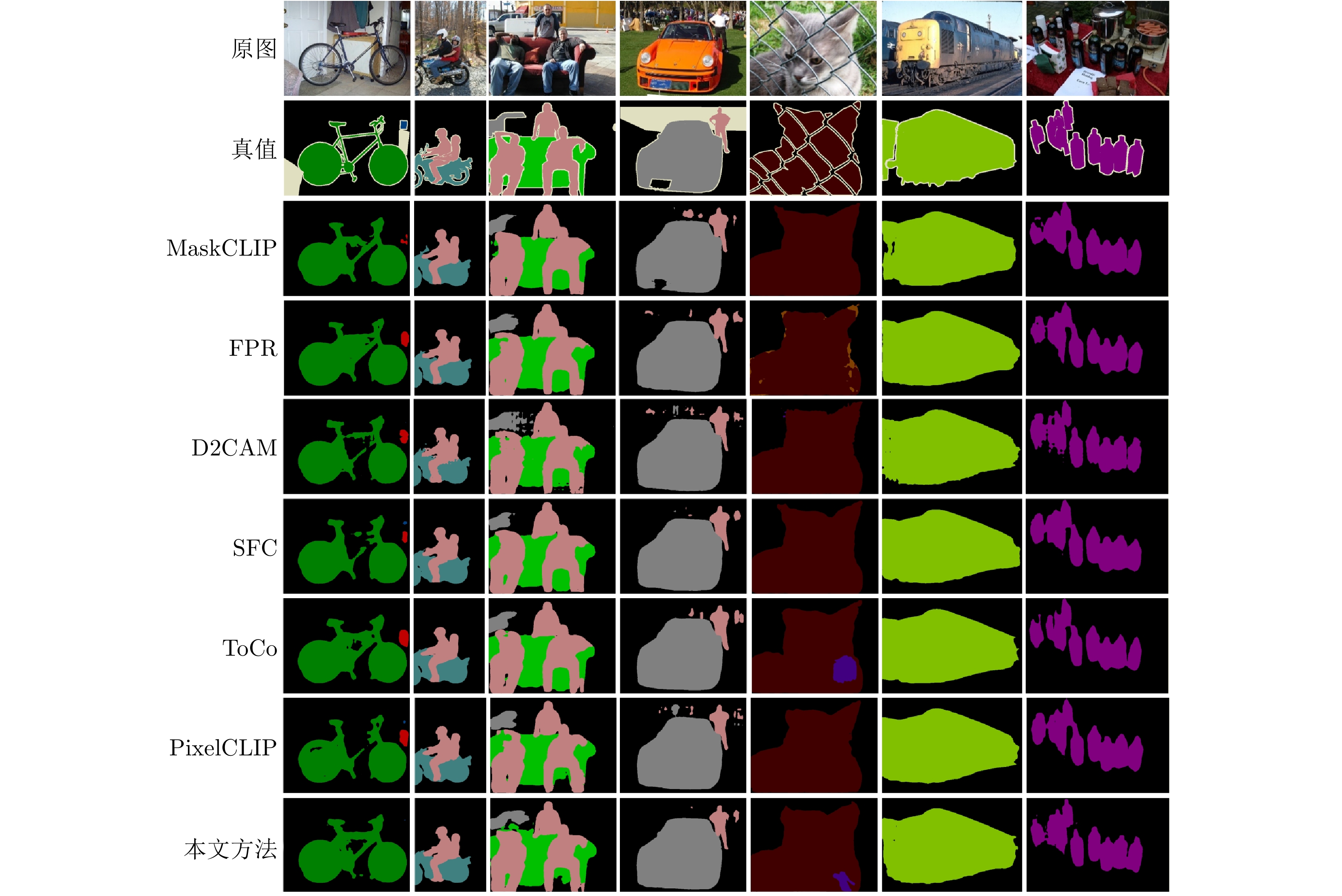
图 4 不同方法在PASCAL VOC 2012验证集上的分割可视化对比
Fig. 4 Segmentation visualization comparison of different methods on the PASCAL VOC 2012 validation set
表 1 CLIP泛化能力综合评估(%)
Table 1 Comprehensive evaluation of CLIP generalization capabilities (%)
 下载: 导出CSV
表 2 PASCAL VOC 2012训练集上的CAM及对应伪真实掩码评估(%)
Table 2 CAM and corresponding pseudo-ground truth mask evaluation on the PASCAL VOC 2012 training set (%)
下载: 导出CSV
表 3 PASCAL VOC 2012数据集mIoU实验(%)
Table 3 mIoU experiment on the PASCAL VOC 2012 dataset (%)
方法 框架 验证集 测试集 SEAM[64] ResNet38 64.5 65.7 AdvCAM[65] ResNet101 68.1 68.0 OC-CSE[66] ResNet38 68.4 68.2 VWE[67] ResNet101 70.6 70.7 CLIMS[57] ResNet101 70.4 70.0 SIPE[68] ResNet101 68.8 69.7 W-OoD[69] ResNet38 70.7 70.1 AMN[70] ResNet101 69.5 69.6 ViT-PCM[71] ResNet101 70.3 70.9 文献[32]方法 ResNet38 70.9 71.7 ToCo[72] ViT-B 69.8 70.5 D2CAM[73] ResNet101 71.2 70.7 FPR[59] ResNet101 70.3 70.1 SFC[5] ResNet38 70.2 71.4 CLIP-ES[58] ResNet38 68.9 70.0 MaskCLIP[63] ViT-PCM 67.3 69.5 MaskCLIP+[63] ViT-PCM 65.1 70.0 PixelCLIP[1] ConvNeXt-B 67.2 — 文献[74]方法 ResNet101 71.1 70.9 文献[75]方法 ResNet50 70.7 71.5 本文方法 ViT-B 71.3 71.7
下载: 导出CSV
表 4 MS COCO 2014数据集mIoU实验(%)
Table 4 mIoU experiment on the MS COCO 2014 dataset (%)
方法 框架 验证集 SEAM[64] ResNet38 31.9 AdvCAM[65] ResNet101 33.9 OC-CSE[66] ResNet38 36.4 VWE[67] ResNet101 36.2 CLIMS[57] ResNet101 — SIPE[68] ResNet101 43.6 W-OoD[69] ResNet38 41.5 AMN[70] ResNet101 44.7 ViT-PCM[71] ResNet101 45.0 文献[32]方法 ResNet38 44.8 ToCo[72] ViT-B 41.3 D2CAM[73] ResNet101 44.0 FPR[59] ResNet101 45.6 SFC[5] ResNet38 45.9 CLIP-ES[58] ResNet38 44.6 MaskCLIP[63] ViT-PCM — MaskCLIP+[63] ViT-PCM — PixelCLIP[1] ConvNeXt-B — 文献[74]方法 ResNet101 41.5 文献[75]方法 ResNet50 41.3 本文方法 ViT-B 45.1
下载: 导出CSV
表 6 不同模块对PASCAL VOC 2012验证集性能的影响
Table 6 Impact of different modules on the perfor-mance of the PASCAL VOC 2012 validation set
模型设置 提示策略 CAM细化 梯度裁剪 mIoU (%) Baseline — × × 64.9 Baseline 静态提示 × × 66.2 Baseline (细化+裁剪) 静态提示 √ √ 70.2 本文方法 动态提示 × × 67.2 本文方法 动态提示 √ × 69.8 本文方法 动态提示 √ √ 71.3
下载: 导出CSV
-
[1] 郭子麟, 吴东岳, 高常鑫, 桑农. 基于图像特定分类器的弱监督语义分割. 自动化学报, 2025, 51(6): 1191−1204Guo Zi-Lin, Wu Dong-Yue, Gao Chang-Xin, Sang Nong. Image-specific classifiers for weakly supervised semantic segmentation. Acta Automatica Sinica, 2025, 51(6): 1191−1204 [2] 杨大伟, 迟津生, 毛琳. 多重边界参考的弱监督语义分割网络. 计算机辅助设计与图形学学报, 2025, 37(1): 120−128Yang Da-Wei, Chi Jin-Sheng, Mao Lin. Weakly supervised semantic segmentation network with multiple boundary references. Journal of Computer-aided Design & Computer Graphics, 2025, 37(1): 120−128 [3] 周凯, 于莲芝. 融合注意力机制的弱监督语义分割自激活方法. 电子科技, 2025, 38(4): 80−86 doi: 10.16180/j.cnki.issn1007-7820.2025.04.012Zhou Kai, Yu Lian-Zhi. Self-activated learning method for weakly supervised semantic segmentation integrating attention mechanism. Electronic Science & Technology, 2025, 38(4): 80−86 doi: 10.16180/j.cnki.issn1007-7820.2025.04.012 [4] 冯兴杰, 南博公. 基于对抗学习和一致性正则的半监督语义分割方法. 计算机应用与软件, 2025, 42(1): 182−188Feng Xing-Jie, Nan Bo-Gong. Semi-supervised semantic segmentation method based on adversarial learning and consistent regularization. Computer Applications and Software, 2025, 42(1): 182−188 [5] Zhao X Q, Tang F L, Wang X Y, Xiao J M. SFC: Shared feature calibration in weakly supervised semantic segmentation. In: Proceedings of the 38th AAAI Conference on Artificial Intelligence. Vancouver, Canada: AAAI Press, 2024. 7525−7533 [6] Na J, Ha J W, Chang H J, Han D, Hwang W. Switching temporary teachers for semi-supervised semantic segmentation. In: Proceedings of the 37th International Conference on Neural Information Processing Systems. New Orleans, USA: Curran Associates Inc., 2024. Article No. 1754 [7] Zhou T F, Wang W G. Prototype-based semantic segmentation. IEEE Transactions on Pattern Analysis and Machine Intelligence, 2024, 46(10): 6858−6872 doi: 10.1109/TPAMI.2024.3387116 [8] Tan C C, Tao R S, Liu H, Gu G H, Wu B Y, Zhao Y, et al. C2P-CLIP: Injecting category common prompt in CLIP to enhance generalization in deepfake detection. In: Proceedings of the 39th AAAI Conference on Artificial Intelligence. Philadelphia, USA: AAAI Press, 2025. 7184−7192 [9] 侯雨爽, 孔雨秋, 张立和, 尹宝才. 基于实体信息的弱监督指称图像分割方法. 计算机辅助设计与图形学学报, 2026, 38(3): 553−562Hou Yu-Shuang, Kong Yu-Qiu, Zhang Li-He, Yin Bao-Cai. Weakly-supervised referring image segmentation based on entity information. Journal of Computer-aided Design & Computer Graphics, 2026, 38(3): 553−562 [10] Yang K C, Gu T C, An X, Jiang H Q, Dai X Z, Feng Z Y, et al. CLIP-CID: Efficient CLIP distillation via cluster-instance discrimination. In: Proceedings of the 39th AAAI Conference on Artificial Intelligence. Philadelphia, USA: AAAI Press, 2025. 21974−21982 [11] Yuan B, Zhao D P. A survey on continual semantic segmentation: Theory, challenge, method and application. IEEE Transactions on Pattern Analysis and Machine Intelligence, 2024, 46(12): 10891−10910 doi: 10.1109/TPAMI.2024.3446949 [12] Shi M, Lin S W, Yi Q M, Weng J, Luo A W, Zhou Y C. Lightweight context-aware network using partial-channel transformation for real-time semantic segmentation. IEEE Transactions on Intelligent Transportation Systems, 2024, 25(7): 7401−7416 doi: 10.1109/TITS.2023.3348631 [13] Shan J H, Jiang W, Huang Y, Yuan D D, Liu Y H. Unmanned aerial vehicle (UAV)-based pavement image stitching without occlusion, crack semantic segmentation, and quantification. IEEE Transactions on Intelligent Transportation Systems, 2024, 25(11): 17038−17053 doi: 10.1109/TITS.2024.3424525 [14] Zhou T F, Wang W G. Cross-image pixel contrasting for semantic segmentation. IEEE Transactions on Pattern Analysis and Machine Intelligence, 2024, 46(8): 5398−5412 doi: 10.1109/TPAMI.2024.3367952 [15] Xie B, Cao J L, Xie J, Khan F S, Pang Y W. SED: A simple encoder-decoder for open-vocabulary semantic segmentation. In: Proceedings of the IEEE/CVF Conference on Computer Vision and Pattern Recognition (CVPR). Seattle, USA: IEEE, 2024. 3426−3436 [16] Zhang B C, Zhang P, Dong X Y, Zang Y H, Wang J Q. Long-CLIP: Unlocking the long-text capability of CLIP. In: Proceedings of the 18th European Conference on Computer Vision (ECCV). Milan, Italy: Springer, 2024. 310−325 [17] Sun Z Y, Fang Y, Wu T, Zhang P, Zang Y H, Kong S, et al. Alpha-CLIP: A CLIP model focusing on wherever you want. In: Proceedings of the IEEE/CVF Conference on Computer Vision and Pattern Recognition (CVPR). Seattle, USA: IEEE, 2024. 13019−13029 [18] Yu C Y, Liu X H, Wang Y Q, Zhang P P, Lu H C. TF-CLIP: Learning text-free CLIP for video-based person re-identification. In: Proceedings of the 38th AAAI Conference on Artificial Intelligence. Vancouver, Canada: AAAI Press, 2024. 6764−6772 [19] Zhu L H, Wang X G, Feng J P, Cheng T H, Li Y Y, Jiang B, et al. WeakCLIP: Adapting CLIP for weakly-supervised semantic segmentation. International Journal of Computer Vision, 2025, 133(3): 1085−1105 doi: 10.1007/s11263-024-02224-2 [20] Smeu S, Oneata E, Oneata D. DeCLIP: Decoding CLIP representations for deepfake localization. In: Proceedings of the IEEE/CVF Winter Conference on Applications of Computer Vision (WACV). Tucson, USA: IEEE, 2025. 149−159 [21] Singha M, Jha A, Banerjee B. GOPro: Generate and optimize prompts in CLIP using self-supervised learning. arXiv preprint arXiv: 2308.11605, 2023. [22] Lim J Y, Lim K M, Lee C P, Tan Y X. SSL-ProtoNet: Self-supervised learning prototypical networks for few-shot learning. Expert Systems With Applications, 2024, 238: Article No. 122173. doi: 10.1016/j.eswa.2023.122173 [23] Zhang K X, Wen Q S, Zhang C L, Cai R Y, Jin M, Liu Y, et al. Self-supervised learning for time series analysis: Taxonomy, progress, and prospects. IEEE Transactions on Pattern Analysis and Machine Intelligence, 2024, 46(10): 6775−6794 doi: 10.1109/TPAMI.2024.3387317 [24] Chen H Y, Li W B, Gu J J, Ren J J, Sun H Z, Zou X Y, et al. Low-res leads the way: Improving generalization for super-resolution by self-supervised learning. In: Proceedings of the IEEE/CVF Conference on Computer Vision and Pattern Recognition (CVPR). Seattle, USA: IEEE, 2024. 25857−25867 [25] Gui J, Chen T, Zhang J, Cao Q, Sun Z N, Luo H, et al. A survey on self-supervised learning: Algorithms, applications, and future trends. IEEE Transactions on Pattern Analysis and Machine Intelligence, 2024, 46(12): 9052−9071 doi: 10.1109/TPAMI.2024.3415112 [26] Zhang B F, Yu S Y, Wei Y C, Zhao Y, Xiao J M. Frozen CLIP: A strong backbone for weakly supervised semantic segmentation. In: Proceedings of the IEEE/CVF Conference on Computer Vision and Pattern Recognition (CVPR). Seattle, USA: IEEE, 2024. 3796−3806 [27] Yang X B, Gong X J. Foundation model assisted weakly supervised semantic segmentation. In: Proceedings of the IEEE/CVF Winter Conference on Applications of Computer Vision (WACV). Waikoloa, USA: IEEE, 2024. 512−521 [28] Xie J H, Deng S H, Hou X X, Luo Z C, Shen L L, Huang Y W, et al. CLIMS++: Cross language image matching with automatic context discovery for weakly supervised semantic segmentation. International Journal of Computer Vision, 2025, 133(8): 5569−5588 doi: 10.1007/s11263-025-02442-2 [29] Yang Z W, Fu K X, Duan M H, Qu L H, Wang S, Song Z J. Separate and conquer: Decoupling co-occurrence via decomposition and representation for weakly supervised semantic segmentation. In: Proceedings of the IEEE/CVF Conference on Computer Vision and Pattern Recognition (CVPR). Seattle, USA: IEEE, 2024. 3606−3615 [30] Wu Y C, Ye X C, Yang K Q, Li J D, Li X Q. DuPL: Dual student with trustworthy progressive learning for robust weakly supervised semantic segmentation. In: Proceedings of the IEEE/CVF Conference on Computer Vision and Pattern Recognition (CVPR). Seattle, USA: IEEE, 2024. 3534−3543 [31] Wu W Y, Dai T H, Chen Z H, Huang X W, Ma F, Xiao J M. Generative prompt controlled diffusion for weakly supervised semantic segmentation. Neurocomputing, 2025, 638: Article No. 130103 doi: 10.1016/j.neucom.2025.130103 [32] Yoon S H, Kwon H, Kim H, Yoon K J. Class tokens infusion for weakly supervised semantic segmentation. In: Proceedings of the IEEE/CVF Conference on Computer Vision and Pattern Recognition (CVPR). Seattle, USA: IEEE, 2024. 3595−3605 [33] Wu W Y, Qiu X L, Song S Q, Chen Z H, Huang X W, Ma F, et al. Prompt categories cluster for weakly supervised semantic segmentation. In: Proceedings of the IEEE/CVF Conference on Computer Vision and Pattern Recognition Workshops (CVPRW). Nashville, USA: IEEE, 2025. 3189−3198 [34] Krizhevsky A, Sutskever I, Hinton G E. ImageNet classification with deep convolutional neural networks. In: Proceedings of the 26th International Conference on Neural Information Processing Systems. Lake Tahoe, USA: Curran Associates Inc., 2012. 1097−1105 [35] Li F F, Fergus R, Perona P. Learning generative visual models from few training examples: An incremental Bayesian approach tested on 101 object categories. In: Proceedings of the Conference on Computer Vision and Pattern Recognition Workshop. Washington, USA: IEEE, 2004. Article No. 178 [36] Parkhi O M, Vedaldi A, Zisserman A, Jawahar C V. Cats and dogs. In: Proceedings of the IEEE Conference on Computer Vision and Pattern Recognition. Providence, USA: IEEE, 2012. 3498−3505 [37] Krause J, Stark M, Deng J, Li F F. 3D object representations for fine-grained categorization. In: Proceedings of the IEEE International Conference on Computer Vision Workshops. Sydney, Australia: IEEE, 2013. 554−561 [38] Nilsback M E, Zisserman A. Automated flower classification over a large number of classes. In: Proceedings of the 6th Indian Conference on Computer Vision, Graphics & Image Processing. Bhubaneswar, India: IEEE, 2008. 722−729 [39] Bossard L, Guillaumin M, van Gool L. Food-101——Mining discriminative components with random forests. In: Proceedings of the 13th European Conference on Computer Vision (ECCV). Zurich, Switzerland: Springer, 2014. 446−461 [40] Maji S, Rahtu E, Kannala J, Blaschko M, Vedaldi A. Fine-grained visual classification of aircraft. arXiv preprint arXiv: 1306.5151, 2013. [41] Xiao J X, Hays J, Ehinger K A, Oliva A, Torralba A. SUN database: Large-scale scene recognition from abbey to zoo. In: Proceedings of the IEEE Computer Society Conference on Computer Vision and Pattern Recognition. San Francisco, USA: IEEE, 2010. 3485−3492. [42] Cimpoi M, Maji S, Kokkinos I, Mohamed S, Vedaldi A. Describing textures in the wild. In: Proceedings of the IEEE Conference on Computer Vision and Pattern Recognition. Columbus, USA: IEEE, 2014. 3606−3613 [43] Recht B, Roelofs R, Schmidt L, Shankar V. Do ImageNet classifiers generalize to ImageNet? In: Proceedings of the 36th International Conference on Machine Learning (ICML). Long Beach, USA: PMLR, 2019. 5389−5400 [44] Wang H H, Ge S W, Xing E P, Lipton Z C. Learning robust global representations by penalizing local predictive power. In: Proceedings of the 33rd International Conference on Neural Information Processing Systems. Vancouver, Canada: Curran Associates Inc., 2019. Article No. 943 [45] Hendrycks D, Zhao K, Basart S, Steinhardt J, Song D. Natural adversarial examples. In: Proceedings of the IEEE/CVF Conference on Computer Vision and Pattern Recognition (CVPR). Nashville, USA: IEEE, 2021. 15257−15266 [46] Hendrycks D, Basart S, Mu N, Kadavath S, Wang F, Dorundo E, et al. The many faces of robustness: A critical analysis of out-of-distribution generalization. In: Proceedings of the IEEE/CVF International Conference on Computer Vision (ICCV). Montreal, Canada: IEEE, 2021. 8320−8329 [47] Everingham M, van Gool L, Williams C K I, Winn J, Zisserman A. The PASCAL visual object classes (VOC) challenge. International Journal of Computer Vision, 2010, 88(2): 303−338 doi: 10.1007/s11263-009-0275-4 [48] Lin T Y, Maire M, Belongie S, Hays J, Perona P, Ramanan D, et al. Microsoft COCO: Common objects in context. In: Proceedings of the 13th European Conference on Computer Vision (ECCV). Zurich, Switzerland: Springer, 2014. 740−755 [49] Jo S, Yu I J, Kim K. RecurSeed and EdgePredictMix: Single-stage learning is sufficient for weakly-supervised semantic segmentation. arXiv preprint arXiv: 2204.06754, 2022. [50] Radford A, Kim J W, Hallacy C, Ramesh A, Goh G, Agarwal S, et al. Learning transferable visual models from natural language supervision. In: Proceedings of the 38th International Conference on Machine Learning (ICML). Virtual Event: PMLR, 2021. 8748−8763 [51] Mu N, Kirillov A, Wagner D, Xie S N. SLIP: Self-supervision meets language-image pre-training. In: Proceedings of the 17th European Conference on Computer Vision (ECCV). Tel Aviv, Israel: Springer, 2022. 529−544 [52] Zhou K Y, Yang J K, Loy C C, Liu Z W. Learning to prompt for vision-language models. International Journal of Computer Vision, 2022, 130(9): 2337−2348 doi: 10.1007/s11263-022-01653-1 [53] Zhou K Y, Yang J K, Loy C C, Liu Z W. Conditional prompt learning for vision-language models. In: Proceedings of the IEEE/CVF Conference on Computer Vision and Pattern Recognition (CVPR). New Orleans, USA: IEEE, 2022. 16795−16804 [54] Khattak M U, Rasheed H, Maaz M, Khan S, Khan F S. MaPLe: Multi-modal prompt learning. In: Proceedings of the IEEE/CVF Conference on Computer Vision and Pattern Recognition (CVPR). Vancouver, Canada: IEEE, 2023. 19113−19122 [55] Bose S, Jha A, Fini E, Singha M, Ricci E, Banerjee B. StyLIP: Multi-scale style-conditioned prompt learning for CLIP-based domain generalization. In: Proceedings of the IEEE/CVF Winter Conference on Applications of Computer Vision (WACV). Waikoloa, USA: IEEE, 2024. 5530−5540 [56] Xu L, Ouyang W L, Bennamoun M, Boussaid F, Xu D. Multi-class token Transformer for weakly supervised semantic segmentation. In: Proceedings of the IEEE/CVF Conference on Computer Vision and Pattern Recognition (CVPR). New Orleans, USA: IEEE, 2022. 4300−4309 [57] Xie J H, Hou X X, Ye K, Shen L L. CLIMS: Cross language image matching for weakly supervised semantic segmentation. In: Proceedings of the IEEE/CVF Conference on Computer Vision and Pattern Recognition (CVPR). New Orleans, USA: IEEE, 2022. 4473−4482 [58] Lin Y Q, Chen M H, Wang W X, Wu B X, Li K, Lin B B, et al. CLIP is also an efficient segmenter: A text-driven approach for weakly supervised semantic segmentation. In: Proceedings of the IEEE/CVF Conference on Computer Vision and Pattern Recognition (CVPR). Vancouver, Canada: IEEE, 2023. 15305−15314 [59] Cheng B W, Misra I, Schwing A G, Kirillov A, Girdhar R. Masked-attention mask Transformer for universal image segmentation. In: Proceedings of the IEEE/CVF Conference on Computer Vision and Pattern Recognition (CVPR). New Orleans, USA: IEEE, 2022. 1280−1289 [60] Gao X R, Liu W F. CLIP as auxiliary supervisor for weakly supervised semantic segmentation. In: Proceedings of the International Conference on New Trends in Computational Intelligence (NTCI). Qingdao, China: IEEE, 2024. 21−26 [61] Wu F W, He J X, Yin Y F, Hao Y B, Huang G, Cheng L C. Masked collaborative contrast for weakly supervised semantic segmentation. In: Proceedings of the IEEE/CVF Winter Conference on Applications of Computer Vision (WACV). Waikoloa, USA: IEEE, 2024. 851−860 [62] Luo H L, Zeng Z. Enhancing weakly supervised semantic segmentation through multi-class token attention learning. The Journal of Supercomputing, 2025, 81(1): Article No. 74 doi: 10.1007/s11227-024-06618-4 [63] Shin H, Kim C, Hong S, Cho S, Arnab A, Seo P H, et al. Towards open-vocabulary semantic segmentation without semantic labels. In: Proceedings of the 38th International Conference on Neural Information Processing Systems. Vancouver, Canada: Curran Associates Inc., 2024. Article No. 290 [64] Shao Q Q, Yu L J, Guo Y T, Xie X C, Zou J P, Li L. Weakly supervised semantic segmentation of PolSAR image based on improved SEAM. Journal of Physics: Conference Series, 2023, 2456(1): Article No. 012003 doi: 10.1088/1742-6596/2456/1/012003 [65] Duan R J, Ma X J, Wang Y S, Bailey J, Qin A K, Yang Y. Adversarial camouflage: Hiding physical-world attacks with natural styles. In: Proceedings of the IEEE/CVF Conference on Computer Vision and Pattern Recognition (CVPR). Seattle, USA: IEEE, 2020. 997−1005 [66] Kweon H, Yoon S H, Kim H, Park D, Yoon K J. Unlocking the potential of ordinary classifier: Class-specific adversarial erasing framework for weakly supervised semantic segmentation. In: Proceedings of the IEEE/CVF International Conference on Computer Vision (ICCV). Montreal, Canada: IEEE, 2021. 6974−6983 [67] Ru L X, Du B, Wu C. Learning visual words for weakly-supervised semantic segmentation. In: Proceedings of the 30th International Joint Conference on Artificial Intelligence (IJCAI). Montreal, Canada: ijcai.org, 2021. 982−988 [68] Chen Q, Yang L X, Lai J H, Xie X H. Self-supervised image-specific prototype exploration for weakly supervised semantic segmentation. In: Proceedings of the IEEE/CVF Conference on Computer Vision and Pattern Recognition (CVPR). New Orleans, USA: IEEE, 2022. 4278−4288 [69] Lee J, Oh S J, Yun S, Choe J, Kim E, Yoon S R. Weakly supervised semantic segmentation using out-of-distribution data. In: Proceedings of the IEEE/CVF Conference on Computer Vision and Pattern Recognition (CVPR). New Orleans, USA: IEEE, 2022. 16876−16885 [70] Li Y Q, Tuncel E, Chen J. Optimal tracking over an additive white noise feedback channel. In: Proceedings of the 7th Asian Control Conference. Hong Kong, China: IEEE, 2009. 501−506 [71] Rossetti S, Zappia D, Sanzari M, Schaerf M, Pirri F. Max pooling with vision Transformers reconciles class and shape in weakly supervised semantic segmentation. In: Proceedings of the 17th European Conference on Computer Vision (ECCV). Tel Aviv, Israel: Springer, 2022. 446−463 [72] Ru L X, Zheng H L, Zhan Y B, Du B. Token contrast for weakly-supervised semantic segmentation. In: Proceedings of the IEEE/CVF Conference on Computer Vision and Pattern Recognition (CVPR). Vancouver, Canada: IEEE, 2023. 3093−3102 [73] Wang C W, Xu R T, Xu S B, Meng W L, Zhang X P. Treating pseudo-labels generation as image matting for weakly supervised semantic segmentation. In: Proceedings of the IEEE/CVF International Conference on Computer Vision (ICCV). Paris, France: IEEE, 2023. 755−765 [74] Xu M D, Zhang Z, Wei F Y, Lin Y T, Cao Y, Hu H, et al. A simple baseline for open-vocabulary semantic segmentation with pre-trained vision-language model. In: Proceedings of the 17th European Conference on Computer Vision (ECCV). Tel Aviv, Israel: Springer, 2022. 736−753 [75] Ding J, Xue N, Xia G S, Dai D X. Decoupling zero-shot semantic segmentation. In: Proceedings of the IEEE/CVF Conference on Computer Vision and Pattern Recognition (CVPR). New Orleans, USA: IEEE, 2022. 11573−11582 -

 下载:
下载:

计量
- 文章访问数: 323
- HTML全文浏览量: 337
- PDF下载量: 30
- 被引次数: 0
