


Dynamic Performance Balancing-based Meta-learning Cooperative Obstacle Avoidance Control for Unmanned Aerial Vehicle Swarms
-
摘要: 针对无人机集群在突发环境变化下易出现性能退化的问题, 提出一种基于动态性能均衡的元学习控制方法, 以实现集群系统高效、可靠的在线自适应协同控制. 首先, 基于无人机不确定动力学模型, 结合轨迹跟踪、集群协同与动态障碍物规避等多重约束, 构建一类能够有效抵御系统不确定性与外部扰动的自适应控制策略. 其次, 为解决瞬态响应与稳态精度之间的性能冲突, 并克服传统优化算法计算耗时高的局限, 构建元学习控制架构. 该方法通过离线训练习得具备强泛化能力的初始化参数, 使系统在线仅需利用少量历史数据和单步梯度更新, 即可实现毫秒级自适应并快速收敛至满足动态性能均衡要求的最优增益. 实验结果验证了该方法在动态障碍物及剧烈环境变化场景下的显著适应能力, 实现了兼具鲁棒性、安全性与高性能的协同控制.Abstract: To address the issue of performance degradation in unmanned aerial vehicle (UAV) swarms under abrupt environmental changes, a meta-learning control method based on dynamic performance balancing is proposed to achieve efficient, reliable, and online adaptive cooperative control for swarm systems. First, based on the uncertain dynamic model of UAV and incorporating multiple constraints such as trajectory tracking, swarm cooperation, and dynamic obstacle avoidance, an adaptive control strategy is constructed to effectively counteract system uncertainties and external disturbances. Second, to resolve the performance conflict between transient response and steady-state accuracy, and to overcome the limitations of high computational cost in traditional optimization algorithms, a meta-learning control architecture is constructed. By learning initialization parameters with strong generalization capabilities through offline training, this method enables the system to achieve millisecond-level adaptation and rapidly converge to optimal gains that satisfy dynamic performance balancing requirements online, utilizing only a small amount of historical data and a single-step gradient update. Experimental results demonstrate the significant adaptability of this method in scenarios involving dynamic obstacles and drastic environmental changes, realizing cooperative control that balances robustness, safety, and high performance.
-
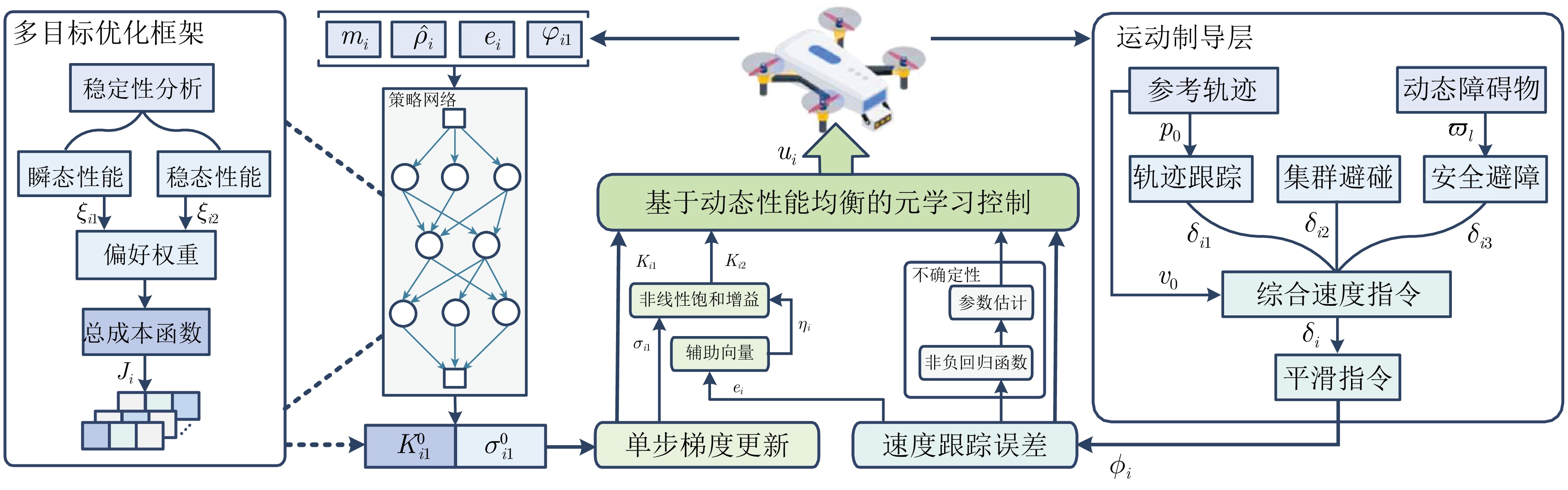
图 1 基于动态性能均衡的元学习控制框架
Fig. 1 Dynamic performance balancing-based meta-learning control framework
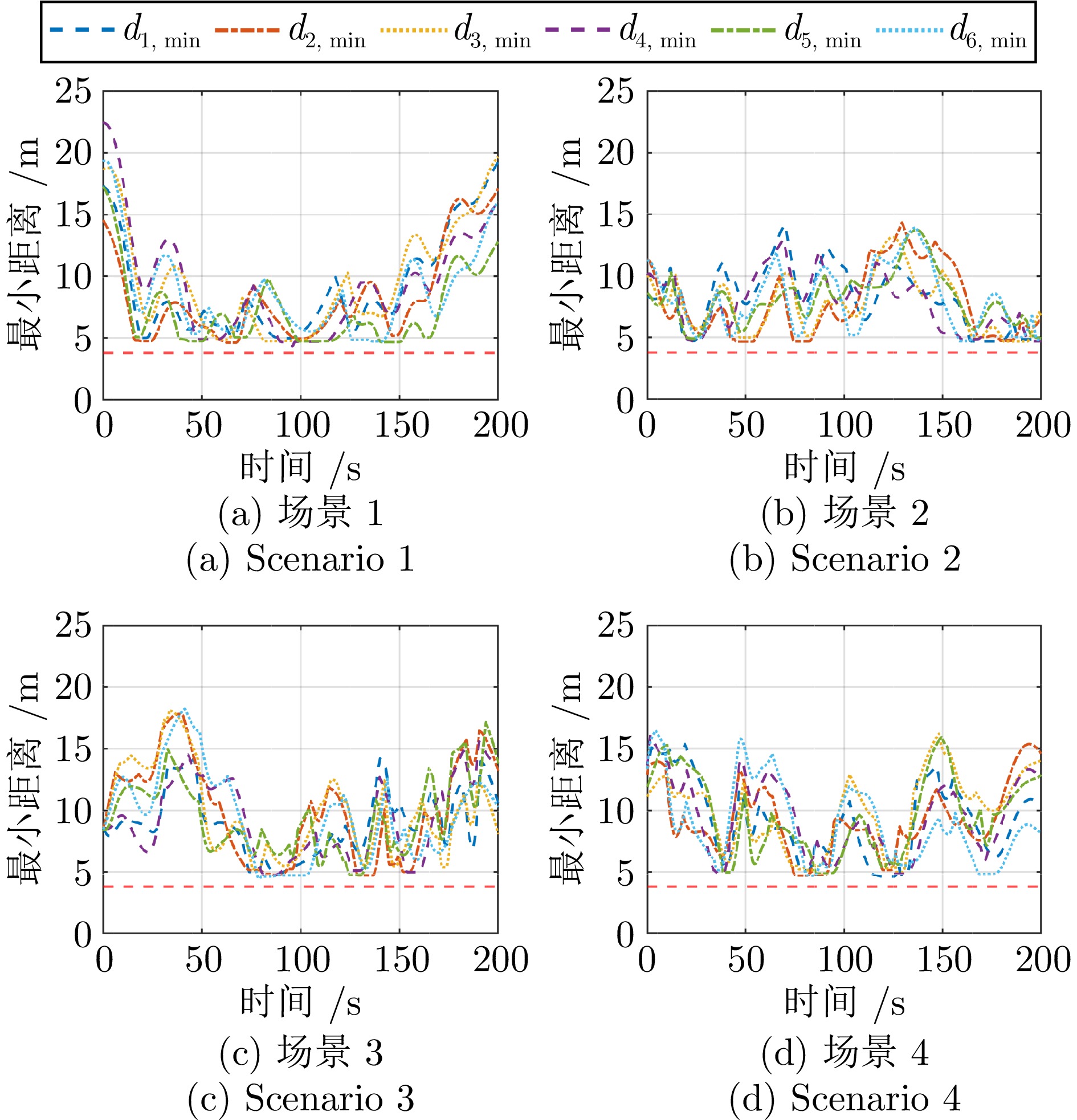
图 6 四种不同场景下无人机与障碍物的最小距离
Fig. 6 Minimum distance between UAVs and obstacles in four different scenarios
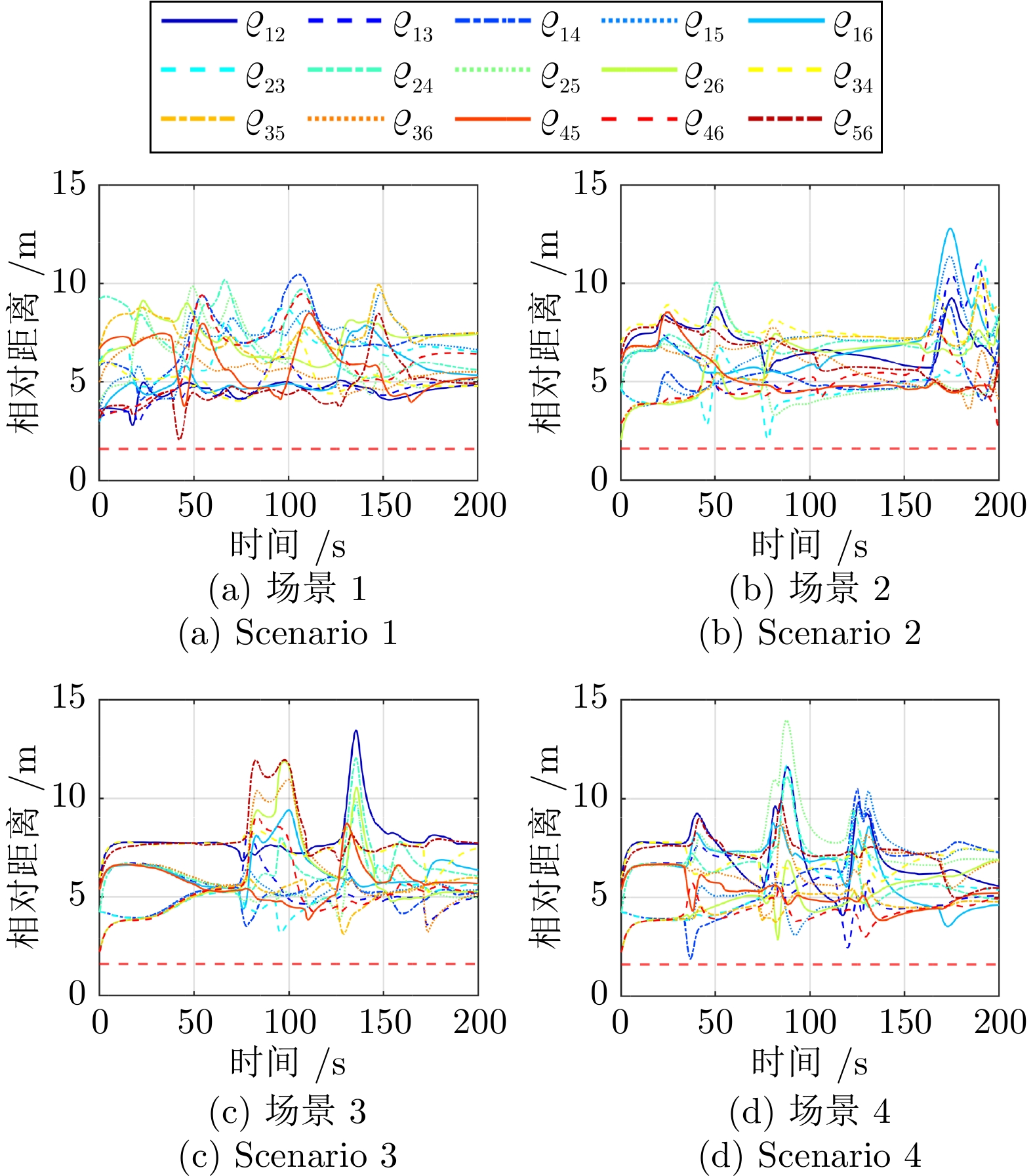
图 7 四种不同场景下无人机之间的相对距离
Fig. 7 Relative distances between UAVs in four different scenarios
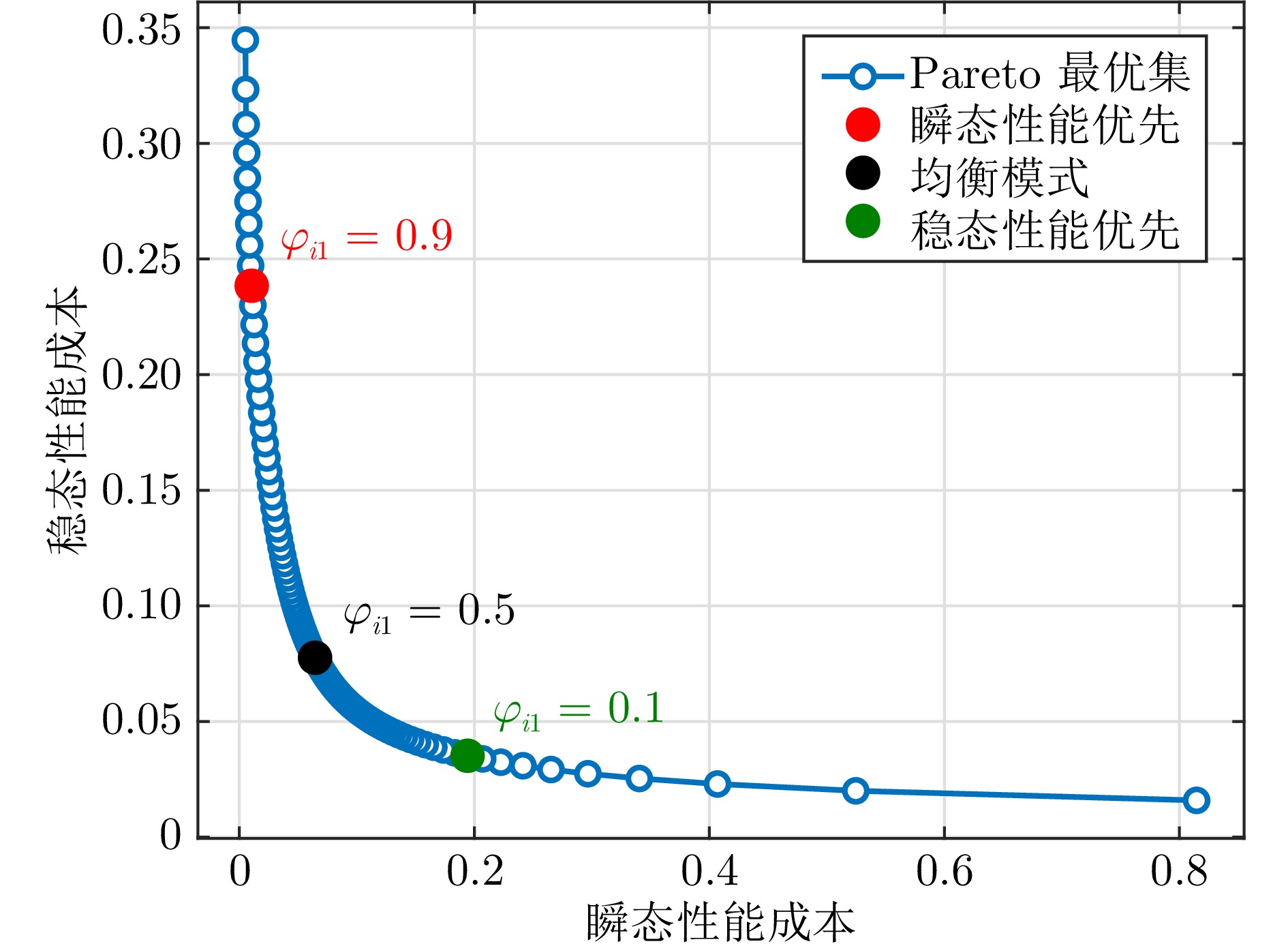
图 8 性能均衡优化前沿与不同偏好模式
Fig. 8 Performance balancing optimization front and different preference modes
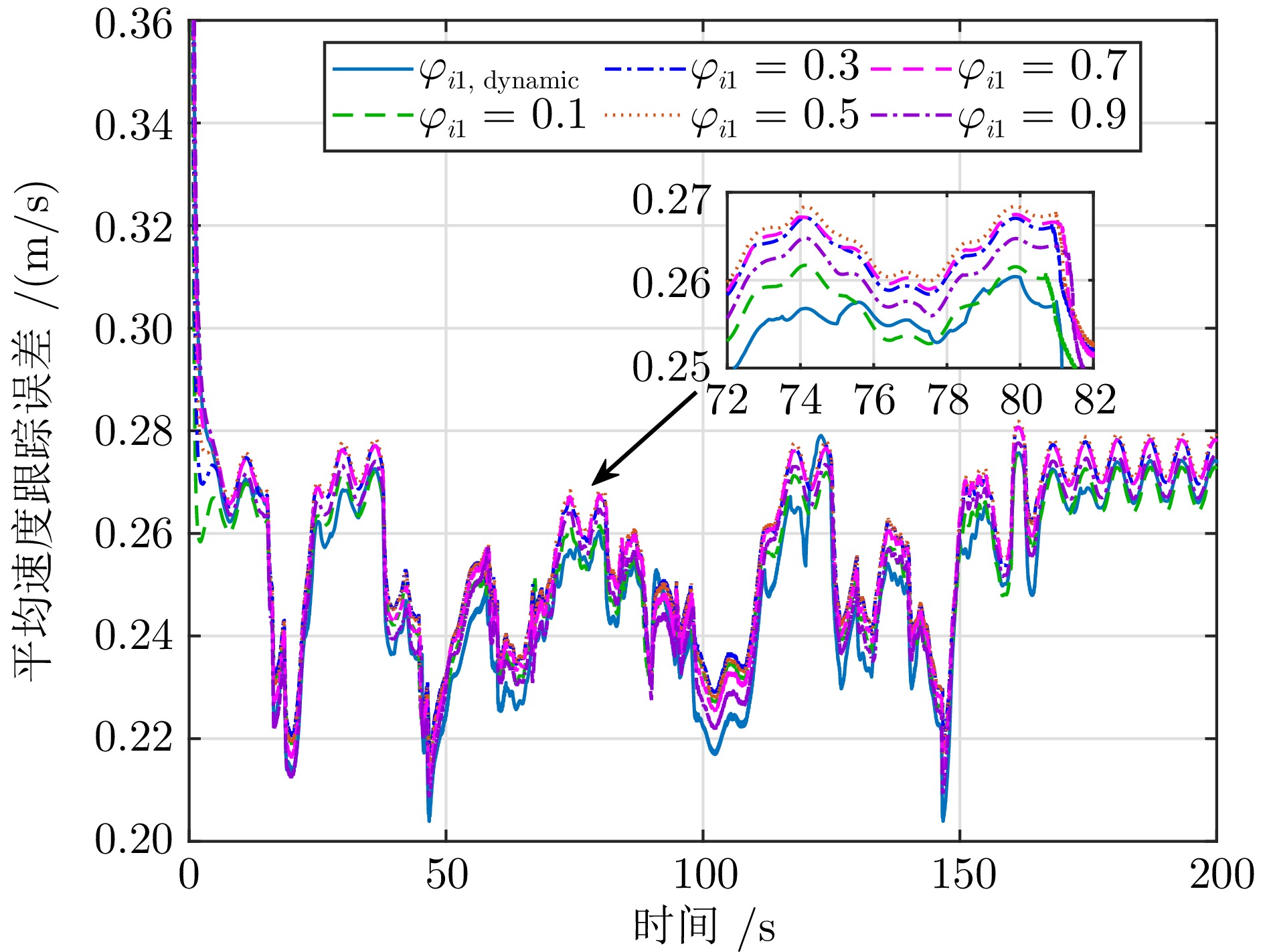
图 9 不同性能偏好权重下的平均速度跟踪误差$ E $
Fig. 9 Average velocity tracking errors $ E $ under different performance preference weights
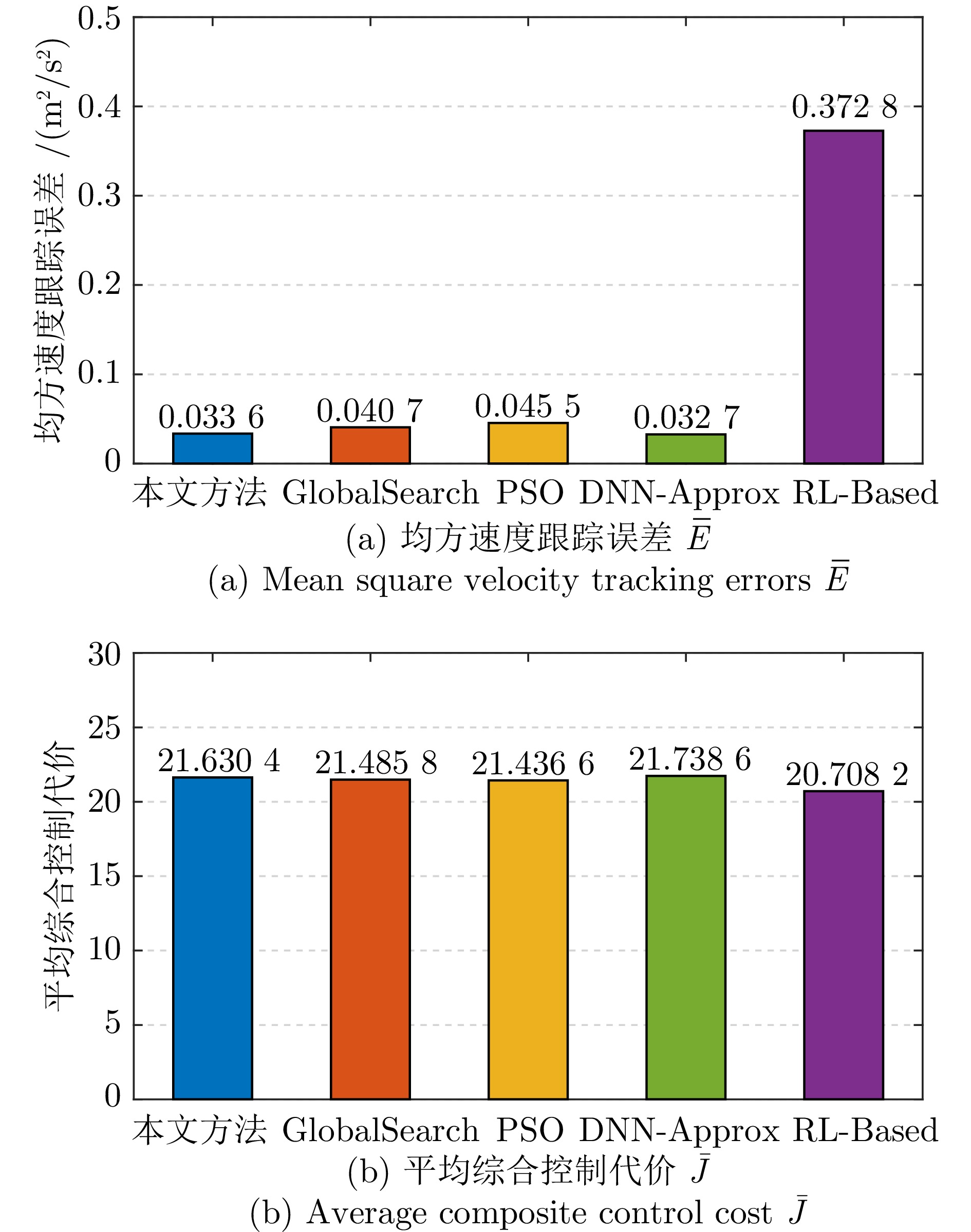
图 10 不同控制策略下的跟踪误差与控制代价对比
Fig. 10 Comparison of tracking errors and control cost under different control strategies
表 1 不同算法的详细性能指标对比
Table 1 Detailed performance comparison of different algorithms
算法类别 具体算法 离线训练(h) 平均在线运行(ms) 增益偏差$ K_{i1}^{\ast} $ (%) 增益偏差$ \sigma_{i1}^{\ast} $ (%) 成本偏差$ J_{i} $ (%) 数值优化 Interior-Point – $ 4.9075 $ $ 0.0239 $ $ 0.0803 $ $ 0.0002 $ GlobalSearch – $ 33.5051 $ $ 0.0006 $ $ 0.0004 $ $ 0.0001 $ 智能优化 GA – $ 5.9168 $ $ 9.1923 $ $ 11.2837 $ $ 4.9725 $ PSO – $ 2.1998 $ $ 6.2027 $ $ 7.9811 $ $ 1.4366 $ 深度学习 TD3 $ 5.47 $ $ 0.1669 $ $ 12.6858 $ $ 59.9160 $ $ 80.4839 $ DNN-Approx $ 0.08 $ $ 0.0446 $ $ 54.5770 $ $ 1.5930 $ $ 74.0157 $ 元学习 本文方法 $ 5.13 $ $ 1.6741 $ $ 5.6621 $ $ 4.4997 $ $ 0.6341 $  下载: 导出CSV
-
[1] 李忠奎, 王俊杰, 张云奕, 张硕, 国萌, 孙志勇. 集群协同任务规划的形式逻辑方法: 综述与展望. 自动化学报, 2025, 51(10): 2211−2231 doi: 10.16383/j.aas.c250223Li Zhong-Kui, Wang Jun-Jie, Zhang Yun-Yi, Zhang Shuo, Guo Meng, Sun Zhi-Yong. Formal logic-based cooperative task planning for multi-robot systems: Survey of recent advances and future directions. Acta Automatica Sinica, 2025, 51(10): 2211−2231 doi: 10.16383/j.aas.c250223 [2] Xu T, Yi X J, Wen G H. Distributed fuzzy formation control of multi-UAV systems with directed communication networks. IEEE Transactions on Fuzzy Systems, 2025, 33(10): 3582−3594 doi: 10.1109/TFUZZ.2025.3597215 [3] 温广辉, 余星火, 黄廷文, 周艳. 模型参数不确定下多无人艇系统固定时间二分编队跟踪控制. 自动化学报, 2025, 51(3): 669−677 doi: 10.16383/j.aas.c240473Wen Guang-Hui, Yu Xing-Huo, Huang Ting-Wen, Zhou Yan. Fixed-time bipartite formation tracking control for multi-USV systems with uncertain model parameters. Acta Automatica Sinica, 2025, 51(3): 669−677 doi: 10.16383/j.aas.c240473 [4] Cheng M, Liu H, Wen G H, Lewis F L. Multiquadrotor differential graphical containment game with noncooperative active leaders subject to external disturbances. IEEE Transactions on Automatic Control, 2026, 71(1): 490−495 doi: 10.1109/TAC.2025.3591619 [5] Ren Z M, Liu H, Wen G H, Lü J H. Event-triggered data-driven security formation control for quadrotors under denial-of-service attacks and communication faults. IEEE Transactions on Cybernetics, 2025, 55(11): 5226−5236 doi: 10.1109/TCYB.2024.3467178 [6] Xu B Y, Dai Y F, Suleman A, Shi Y. Distributed fault-tolerant control of multi-UAV formation for dynamic leader tracking: A Lyapunov-based MPC framework. Automatica, 2025, 175: Article No. 112179 doi: 10.1016/j.automatica.2025.112179 [7] Yang H J, Sun S P, Xia Y Q, Li P. Digital twin-based obstacle avoidance for unmanned aerial vehicles using feedforward-feedback control. IEEE Transactions on Vehicular Technology, 2025, 74(6): 8721−8733 doi: 10.1109/TVT.2025.3536776 [8] Du Z X, Zhang H, Wang Z P, Yan H C. Model predictive formation tracking-containment control for multi-UAVs with obstacle avoidance. IEEE Transactions on Systems, Man, and Cybernetics: Systems, 2024, 54(6): 3404−3414 doi: 10.1109/TSMC.2024.3354893 [9] Liu B W, Wang Y X, Mofid O, Mobayen S, Khooban M H. Barrier function-based backstepping fractional-order sliding mode control for quad-rotor unmanned aerial vehicle under external disturbances. IEEE Transactions on Aerospace and Electronic Systems, 2024, 60(1): 716−728 doi: 10.1109/TAES.2023.3328801 [10] Pang W, Zhu D Q, Sun C Y. Multi-AUV formation reconfiguration obstacle avoidance algorithm based on affine transformation and improved artificial potential field under ocean currents disturbance. IEEE Transactions on Automation Science and Engineering, 2024, 21(2): 1469−1487 doi: 10.1109/TASE.2023.3245818 [11] Zhang X Y, Zong H, Wu W H. Cooperative obstacle avoidance of unmanned system swarm via reinforcement learning under unknown environments. IEEE Transactions on Instrumentation and Measurement, 2025, 74: Article No. 7500615 doi: 10.1109/tim.2024.3522370 [12] Wang D, Chen H M, Lao S H, Drew S. Efficient path planning and dynamic obstacle avoidance in edge for safe navigation of USV. IEEE Internet of Things Journal, 2024, 11(6): 10084−10094 doi: 10.1109/JIOT.2023.3325234 [13] Yu Y J, Chen C, Guo J, Chadli M, Xiang Z R. Adaptive formation control for unmanned aerial vehicles with collision avoidance and switching communication network. IEEE Transactions on Fuzzy Systems, 2024, 32(3): 1435−1445 doi: 10.1109/TFUZZ.2023.3327114 [14] 方浩, 赵欣悦, 陈杰. 无人飞行器集群自主控制: 预设性能驱动的安全编队控制. 自动化学报, 2025, 51(5): 931−941 doi: 10.16383/j.aas.c240603Fang Hao, Zhao Xin-Yue, Chen Jie. Autonomous control of unmanned aerial vehicle swarms: Prescribed performance driven safety formation control. Acta Automatica Sinica, 2025, 51(5): 931−941 doi: 10.16383/j.aas.c240603 [15] 王耀南, 华和安, 张辉, 钟杭, 樊叶心, 梁鸿涛, 等. 性能函数引导的无人机集群深度强化学习控制方法. 自动化学报, 2025, 51(5): 905−916 doi: 10.16383/j.aas.c240519Wang Yao-Nan, Hua He-An, Zhang Hui, Zhong Hang, Fan Ye-Xin, Liang Hong-Tao, et al. Performance function-guided deep reinforcement learning control for UAV swarm. Acta Automatica Sinica, 2025, 51(5): 905−916 doi: 10.16383/j.aas.c240519 [16] Zhao X M, Cui Z R, Dong F F, Chen Y H, Huang J. Fuzzy game-theoretic control design for unmanned ground swarm systems: An integrated method. IEEE Transactions on Fuzzy Systems, 2026, 34(2): 368−381 doi: 10.1109/TFUZZ.2025.3625991 [17] Liu J L, Liu Z H, Li Y, Tian E G, Peng C. Privacy-protected formation control for unmanned surface vehicles: A neural predictor-based noncooperative game framework. IEEE Transactions on Vehicular Technology, DOI: 10.1109/TVT.2026.3651837.10.1109/TVT.2026.3651837 [18] Liu J L, Dong Y H, Zha L J, Xie X P, Tian E G. Reinforcement learning-based tracking control for networked control systems with DoS attacks. IEEE Transactions on Information Forensics and Security, 2024, 19: 4188−4197 doi: 10.1109/TIFS.2024.3376250 [19] Liu J L, Zhang N, Zha L J, Xie X P, Tian E G. Reinforcement learning-based decentralized control for networked interconnected systems with communication and control constraints. IEEE Transactions on Automation Science and Engineering, 2024, 21(3): 4674−4685 doi: 10.1109/TASE.2023.3300917 [20] Hou P, Huang Y, Zhu H B, Lu Z H, Huang S C, Yang Y, et al. Distributed DRL-based intelligent over-the-air computation in unmanned aerial vehicle swarm-assisted intelligent transportation system. IEEE Internet of Things Journal, 2024, 11(21): 34382−34397 doi: 10.1109/JIOT.2024.3418882 [21] Zhou Z H, Tang J, Feng W M, Zhao N, Yang Z T, Wong K K. Optimized routing protocol through exploitation of trajectory knowledge for UAV swarms. IEEE Transactions on Vehicular Technology, 2024, 73(10): 15499−15512 doi: 10.1109/TVT.2024.3405733 [22] Jia R H, Fu Q Y, Zheng Z L, Zhang G L, Li M L. Energy and time trade-off optimization for multi-UAV enabled data collection of IoT devices. IEEE/ACM Transactions on Networking, 2024, 32(6): 5172−5187 doi: 10.1109/TNET.2024.3450489 [23] Liu X B, Wang Y, Gao H, Ngai E C, Zhang B, Wang C H, et al. A coverage-aware task allocation method for UAV-assisted mobile crowd sensing. IEEE Transactions on Vehicular Technology, 2024, 73(7): 10642−10654 doi: 10.1109/TVT.2024.3374719 [24] Li K X, Liu J J, Gu X, Yang Y D, Chang C, Chen H P, et al. Dynamic decision-making of UAV swarm based on constrained multi-objective optimization under incomplete interference information. Chinese Journal of Aeronautics, 2026, 39(7): Article No. 103846 doi: 10.1016/j.cja.2025.103846 [25] Peng C D, Wu Z X, Huang X M, Wu Y, Kang J W, Huang Q, et al. Joint energy and completion time difference minimization for UAV-enabled intelligent transportation systems: A constrained multi-objective optimization approach. IEEE Transactions on Intelligent Transportation Systems, 2024, 25(10): 14040−14053 doi: 10.1109/TITS.2024.3395993 [26] Li C L, Deng C Y, Zhang Y, Wan S H. Federated meta-learning based computation offloading approach with energy-delay tradeoffs in UAV-assisted VEC. IEEE Transactions on Mobile Computing, 2025, 24(10): 10978−10991 doi: 10.1109/TMC.2025.3573278 [27] Zhang Y, Wen L, Huang Y H, Sun S M, Bing Z S, He W, Knoll A. Meta-learning-based safety-critical control in multi-obstacles environments. IEEE Transactions on Automation Science and Engineering, 2025, 22: 15299−15313 doi: 10.1109/TASE.2025.3565524 [28] Wei M X, Zheng L X, Wu Y, Mei R D, Cheng H. Meta-learning enhanced model predictive contouring control for agile and precise quadrotor flight. IEEE Transactions on Robotics, 2025, 41: 3590−3608 doi: 10.1109/TRO.2025.3567491 [29] Ye F Y, Lin B J, Yue Z X, Zhang Y, Tsang I W. Multi-objective meta-learning. Artificial Intelligence, 2024, 335: Article No. 104184 doi: 10.1016/j.artint.2024.104184 [30] Li S X, Pang Y S, Huang Z R, Chu X H. An offline-online learning framework combining meta-learning and reinforcement learning for evolutionary multi-objective optimization. Swarm and Evolutionary Computation, 2025, 97: Article No. 102037 doi: 10.1016/j.swevo.2025.102037 [31] Zhang Z Z, Wu Z Y, Zhang H, Wang J H. Meta-learning-based deep reinforcement learning for multiobjective optimization problems. IEEE Transactions on Neural Networks and Learning Systems, 2023, 34(10): 7978−7991 doi: 10.1109/TNNLS.2022.3148435 [32] Ma Q, Jin P, Lewis F L. Guaranteed cost attitude tracking control for uncertain quadrotor unmanned aerial vehicle under safety constraints. IEEE/CAA Journal of Automatica Sinica, 2024, 11(6): 1447−1457 doi: 10.1109/JAS.2024.124317 -

 下载:
下载:

计量
- 文章访问数: 386
- HTML全文浏览量: 334
- 被引次数: 0
