


-
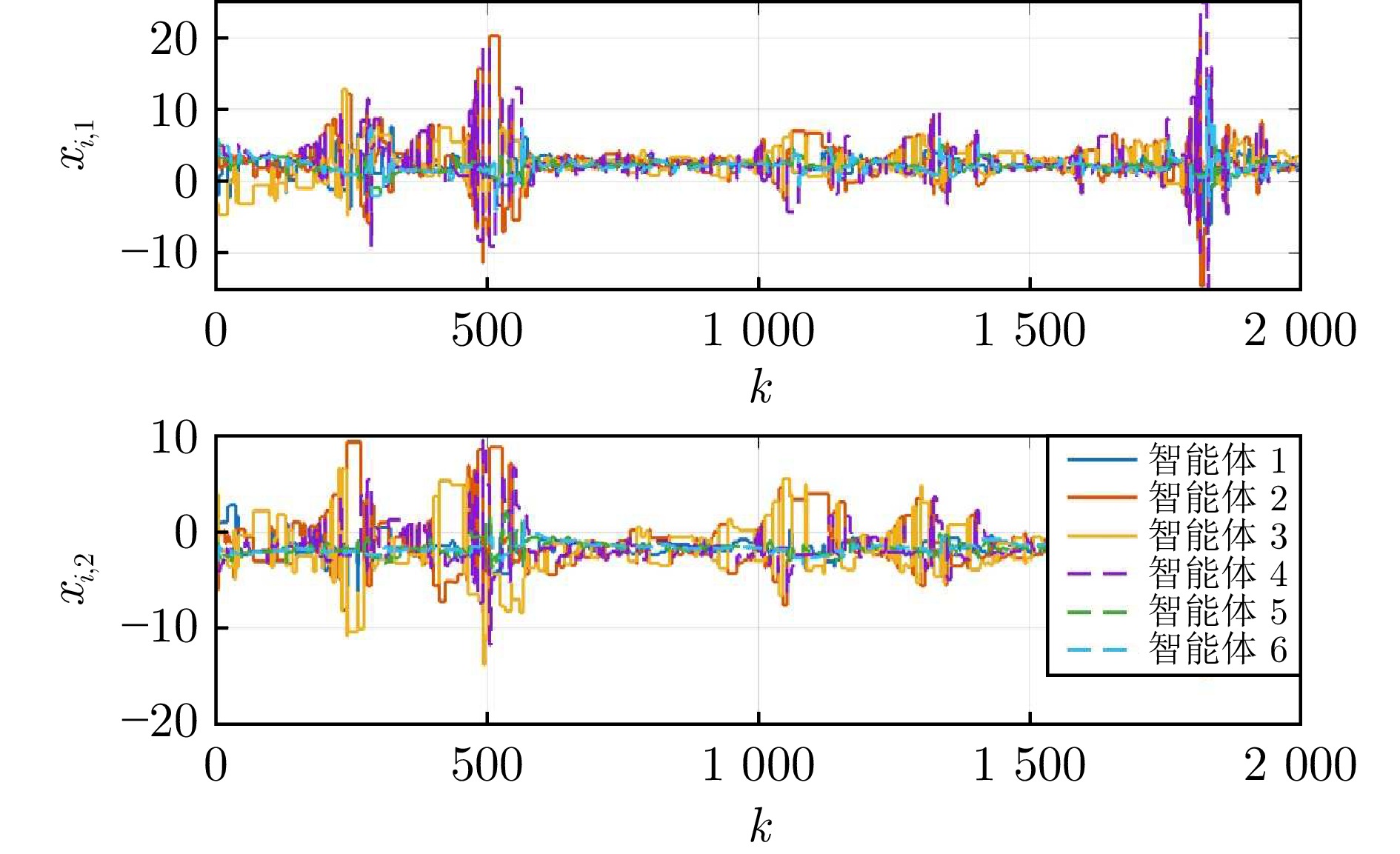
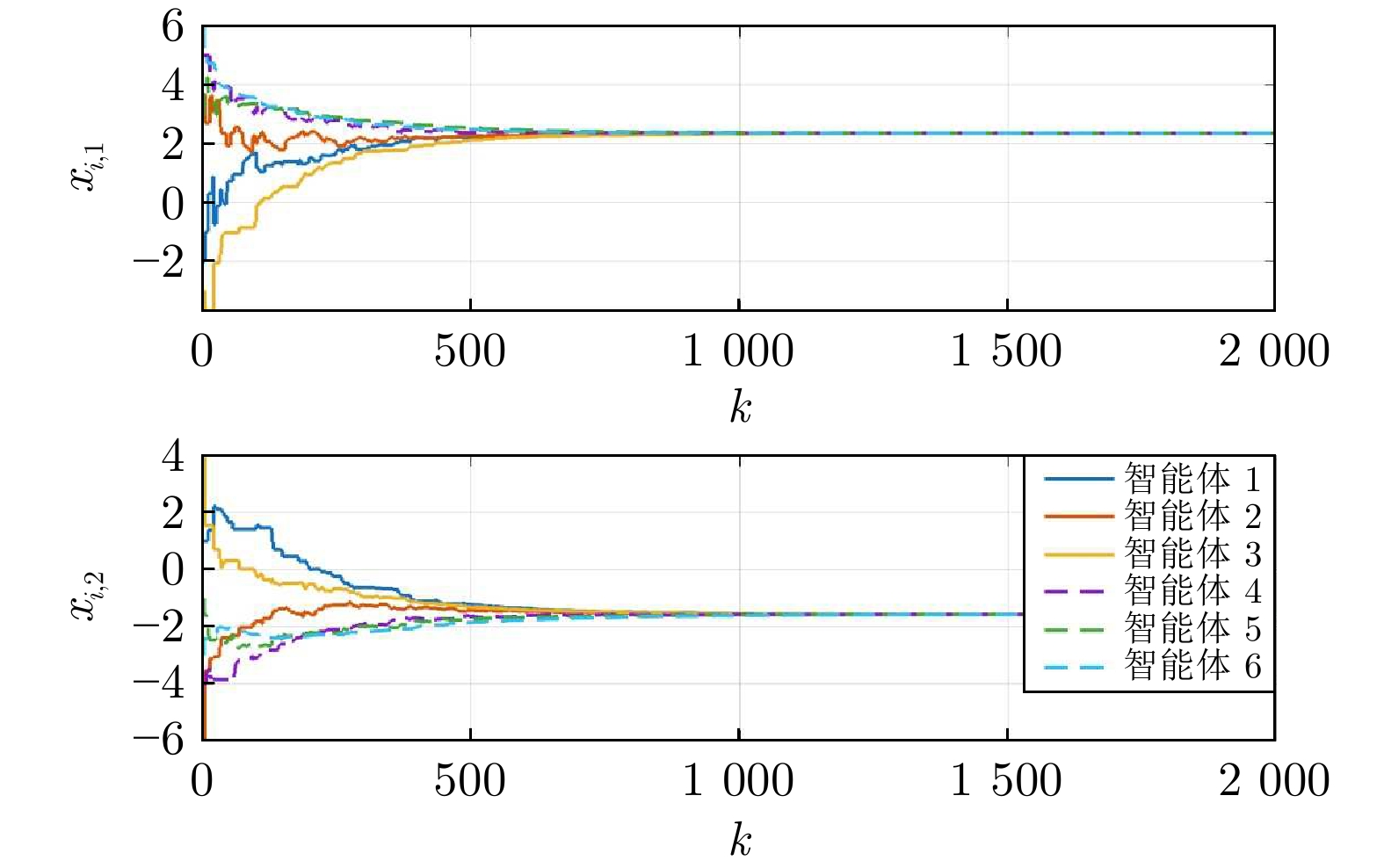
摘要: 研究了混杂多智能体系统在矩阵权重网络上的随机一致性问题. 针对此类系统, 提出一种基于采样信息的分布式随机一致性协议, 该协议采用异步成对更新机制, 有效降低了通信与计算需求. 利用期望图理论和随机矩阵稳定性分析, 推出系统达到随机一致性的充分必要条件, 该条件与采样周期和期望拉普拉斯矩阵的零空间有关. 特别地, 当反馈增益相同时, 给出系统达到随机平均一致性的充要条件. 此外, 通过分析误差系统的二阶矩收敛性, 借助马尔科夫不等式, 导出其收敛速度的$\epsilon$-一致性时间的解析上界. 最后, 数值仿真验证了所提协议的可行性与理论结果的有效性.
-
关键词:
- 随机一致性 /
- 混杂多智能体系统 /
- 矩阵权重 /
- $ \epsilon $-一致性时间 /
- 随机算法
Abstract: This paper investigates the randomized consensus problem for hybrid multiagent systems on matrix-weighted networks. For such systems, this paper proposes a distributed randomized consensus protocol based on sampled information, which employs an asynchronous pairwise update mechanism to effectively reduce communication and computational demand. By leveraging expected graph theory and stochastic matrix stability analysis, necessary and sufficient conditions are derived for the system to achieve consensus in expectation, which are related to the sampling period and the null space of the expected Laplacian matrix. Specifically, when the feedback gains are identical, necessary and sufficient conditions are provided for achieving randomized average consensus. Furthermore, by analyzing the second-moment convergence of the error system and using Markov's inequality, an analytical upper bound for the $\epsilon$-consensus time is derived to characterize its convergence speed. Finally, numerical simulations validate the feasibility of the proposed protocol and the effectiveness of the theoretical results. -
表 1 符号说明
Table 1 Notations
符号 含义 $\bf{Z}^{+}$ 正整数集 $\bf{R}^{+}$ 正实数集 $\bf{R}^d$ $d$维实列向量的集合 $I_d$ $d \times d$ 单位矩阵 $\boldsymbol{1}_N$ 元素全为1的$N$维列向量 $\boldsymbol{0}$ 元素全为0的向量 $\mathbf{0}_{d \times d}$ 元素全为0的矩阵 $\| \cdot \|$ 欧几里得范数 ${\cal{I}}_M$ 整数集合$\{1,\; \cdots,\; M\}$ ${\cal{I}}_N \setminus {\cal{I}}_M$ 整数集合$\{M+1,\; \cdots,\; N\}$ ${\cal{N}}(Q)$ 矩阵$Q$的零空间 ${\rm{range}}(Q)$ 矩阵$Q$的值域 ${\rm{diag}}\{\cdot\}$ 对角矩阵 ${\rm{blkdiag}}\{\cdot\}$ 分块对角矩阵 $\lambda_i(E)$ 矩阵$E$的第$i$个特征值 $\otimes$ 克罗内克积  下载: 导出CSV
-
[1] Mu B, Zhang K, Xiao F, Shi Y. Event-based rendezvous control for a group of robots with asynchronous periodic detection and communication time delays. IEEE Transactions on Cybernetics, 2019, 49(7): 2642−2651 doi: 10.1109/TCYB.2018.2831684 [2] 段志生, 吕跃祖, 段培虎, 杨莹, 王金枝, 温光辉. 多智能体系统协同互估计与控制一体化框架. 自动化学报, 2025, 51(10): 2359−2370Duan Zhi-Sheng, Lv Yue-Zu, Duan Pei-Hu, Yang Ying, Wang Jin-Zhi, Wen Guang-Hui. Integrated framework for cooperative mutual estimation and control in multi-agent systems. Acta Automatica Sinica, 2025, 51(10): 2359−2370 [3] 鞠锴, 冒泽慧, 姜斌, 马亚杰. 基于势博弈的异构多智能体系统任务分配和重分配. 自动化学报, 2022, 48(10): 2416−2428 doi: 10.16383/j.aas.c220003Ju Kai, Mao Ze-Hui, Jiang Bin, Ma Ya-Jie. Task allocation and reallocation for heterogeneous multi-agent systems based on potential game. Acta Automatica Sinica, 2022, 48(10): 2416−2428 doi: 10.16383/j.aas.c220003 [4] 游秀, 张红, 梁吉业. 通信链路故障下高阶非匹配非线性MAS领导跟随一致性. 自动化学报, 2025, 51(6): 1320−1328You Xiu, Zhang Hong, Liang Ji-Ye. Leader-following consensus for high-order unmatched nonlinear multi-agent systems with communication link faults. Acta Automatica Sinica, 2025, 51(6): 1320−1328 [5] 袁洋, 段海滨, 魏晨. 无人机/无人艇异构协同固定时间预设性能演化控制. 自动化学报, 2025, 51(5): 1052−1066Yuan Yang, Duan Hai-Bin, Wei Chen. Heterogeneous cooperative fixed-time prescribed performance evolution control for unmanned aerial/surface vehicles. Acta Automatica Sinica, 2025, 51(5): 1052−1066 [6] 赖轩, 曲延云, 谢源, 裴玉龙. 基于拓扑一致性对抗互学习的知识蒸馏. 自动化学报, 2023, 49(1): 102−110Lai Xuan, Qu Yan-Yun, Xie Yuan, Pei Yu-Long. Topology-guided adversarial deep mutual learning for knowledge distillation. Acta Automatica Sinica, 2023, 49(1): 102−110 [7] Tian Y, Liu C. Consensus of multi-agent systems with diverse input and communication delays. IEEE Transactions on Automatic Control, 2008, 53(9): 2122−2128 doi: 10.1109/TAC.2008.930184 [8] Zhu W, Cheng D. Leader-following consensus of second-order agents with multiple time-varying delays. Automatica, 2010, 46(12): 1994−1999 doi: 10.1016/j.automatica.2010.08.003 [9] Singh B, Sen A, Sahoo S R. Min-consensus for heterogeneous higher-order integrators under switching digraph. IEEE Control Systems Letters, 2020, 4(3): 560−565 doi: 10.1109/LCSYS.2020.2973594 [10] Zheng Y, Ma J, Wang L. Consensus of hybrid multi-agent systems. IEEE Transactions on Neural Networks and Learning Systems, 2018, 29(4): 1359−1365 doi: 10.1109/TNNLS.2017.2651402 [11] Su H, Wang X, Chen X, Zeng Z. Second-order consensus of hybrid multiagent systems. IEEE Transactions on Systems, Man, and Cybernetics: Systems, 2021, 51(10): 6503−6512 doi: 10.1109/TSMC.2019.2963089 [12] Wang X, Su H. Consensus of hybrid multi-agent systems by event-triggered/self-triggered strategy. Applied Mathematics and Computation, 2019, 359: 490−501 doi: 10.1016/j.amc.2019.04.079 [13] Su H, Wang X, Zeng Z. Consensus of second-order hybrid multiagent systems by event-triggered strategy. IEEE Transactions on Cybernetics, 2020, 50(11): 4648−4657 doi: 10.1109/TCYB.2019.2948209 [14] Teel A R, Subbaraman A, Sferlazza A. Stability analysis for stochastic hybrid systems: A survey. Automatica, 2014, 50(10): 2435−2456 doi: 10.1016/j.automatica.2014.08.006 [15] Friedkin N E, Proskurnikov A V, Tempo R, Parsegov S E. Network science on belief system dynamics under logic constraints. Science, 2016, 354(6310): 321−326 doi: 10.1126/science.aag2624 [16] Parsegov S E, Proskurnikov A V, Tempo R, Friedkin N E. Novel multidimensional models of opinion dynamics in social networks. IEEE Transactions on Automatic Control, 2017, 62(5): 2270−2285 doi: 10.1109/TAC.2016.2613905 [17] Miao S, Su H. Consensus of different-order switched multi-agent systems on matrix-weighted networks. Applied Mathematics and Computation, 2026, 508: Article No.129610 doi: 10.1016/j.amc.2025.129610 [18] Su H, Chen J, Yang Y, Rong Z. The bipartite consensus for multi-agent systems with matrix-weight-based signed network. IEEE Transactions on Circuits and Systems Ⅱ: Express Briefs, 2020, 67(10): 2019−2023 doi: 10.1109/TCSII.2019.2943245 [19] Trinh M H, van Nguyen C, Lim Y H, Ahn H S. Matrix-weighted consensus and its applications. Automatica, 2018, 89: 415−419 doi: 10.1016/j.automatica.2017.12.024 [20] Miao S, Su H. Bipartite consensus for second-order multiagent systems with matrix-weighted signed network. IEEE Transactions on Cybernetics, 2022, 52(12): 13038−13047 doi: 10.1109/TCYB.2021.3097056 [21] Miao S, Su H. Behaviors of matrix-weighted networks with antagonistic interactions. Applied Mathematics and Computation, 2024, 467: Article No. 128490 doi: 10.1016/j.amc.2023.128490 [22] Su H, Miao S. Consensus on directed matrix-weighted networks. IEEE Transactions on Automatic Control, 2023, 68(4): 2529−2535 doi: 10.1109/TAC.2022.3184630 [23] Miao S, Su H, Chen S. Matrix-weighted consensus of second-order discrete-time multi-agent systems. IEEE Transactions on Neural Networks and Learning Systems, 2024, 35(3): 3539−3548 doi: 10.1109/TNNLS.2022.3194010 [24] Miao S, Su H. Consensus of matrix-weighted hybrid multiagent systems. IEEE Transactions on Cybernetics, 2023, 53(1): 668−678 doi: 10.1109/TCYB.2022.3172750 [25] Miao S, Su H. Second-order hybrid consensus of multi-agent systems with matrix-weighted networks. IEEE Transactions on Network Science and Engineering, 2022, 9(6): 4338−4348 [26] Le-Phan N M, Trinh M H, Nguyen P D. Randomized matrix weighted consensus. IEEE Transactions on Network Science and Engineering, 2024, 11(4): 3536−3549 doi: 10.1109/TNSE.2024.3376643 -

 下载:
下载:

图(2) / 表(1)
计量
- 文章访问数: 248
- HTML全文浏览量: 137
- PDF下载量: 87
- 被引次数: 0
