


Prediction of Operating Status for Flue-gas Desulfurization Equipment Based on Deep Fuzzy Inference Model
-
摘要: 烟气脱硫处理是聚焦污染防治、实现节能减排的重要举措, 其设备的安全、稳定运行直接影响着经济社会可持续发展与居民生命健康. 然而, 长期运行下的烟气脱硫设备往往不可避免地出现故障且难以预测, 进而导致连锁反应甚至事故. 鉴于此, 提出一种基于深度模糊推理模型(DFIM)的烟气脱硫设备运行状态预测方法. 首先, 构建数据驱动的深度模糊信念网络, 通过模糊特征学习算法将传感器获取的原始数据映射为抗干扰的模糊语义特征, 并实现模糊特征的预测输出; 其次, 建立推理门控层, 进一步对输出模糊特征进行识别, 并聚焦设备故障模式; 然后, 结合操作经验和运行环境, 针对设备运行状态和故障模式, 给出处置方案; 最后, 以实际烟气脱硫系统循环泵内浆液pH值和轴承温度为设备运行状态变量, 测试DFIM在烟气脱硫设备运行状态预测中的有效性. 实验结果表明所提出的DFIM在预测精度、稳定性与快速性等方面均优于现有方法, 对设备运维与管理具有重要的指导意义.Abstract: Flue-gas desulfurization treatment is an important measure to focus on pollution prevention and achieve energy conservation and emission reduction. The safe and stable operation of flue-gas desulfurization equipment directly affects the sustainable development of the economy and society as well as the life and health of residents. However, under long-term operation, faults often inevitably occur in this equipment, which are difficult to be predicted and thus lead to a chain reaction and even accidents. In view of these problems, this paper proposes a deep fuzzy inference model (DFIM)-based method to predict the operating status of flue-gas desulfurization equipment. First, a data-driven deep fuzzy belief network is constructed and trained using a fuzzy feature learning algorithm, which can map the raw data obtained from the sensor into anti-interference fuzzy semantic features and further give predicted outputs of fuzzy features. Second, an inference gating layer is designed to recognize the output fuzzy features, focusing on the fault modes of flue-gas desulfurization equipment. Third, according to the operational experience and operating environment as well as fault modes of the equipment, the disposal plan is then provided. Finally, taking the pH of the slurry in the circulating pump and the temperature of the circulating pump bearing as the variables of the equipment operating status, the effectiveness of DFIM in the prediction of the operating status of flue-gas desulfurization equipment is tested. The experimental results show that the proposed DFIM outperforms the existing methods in terms of prediction accuracy, stability, rapidity and other aspects, which has important guiding significance for the operation and maintenance as well as management of the operating equipment.
-
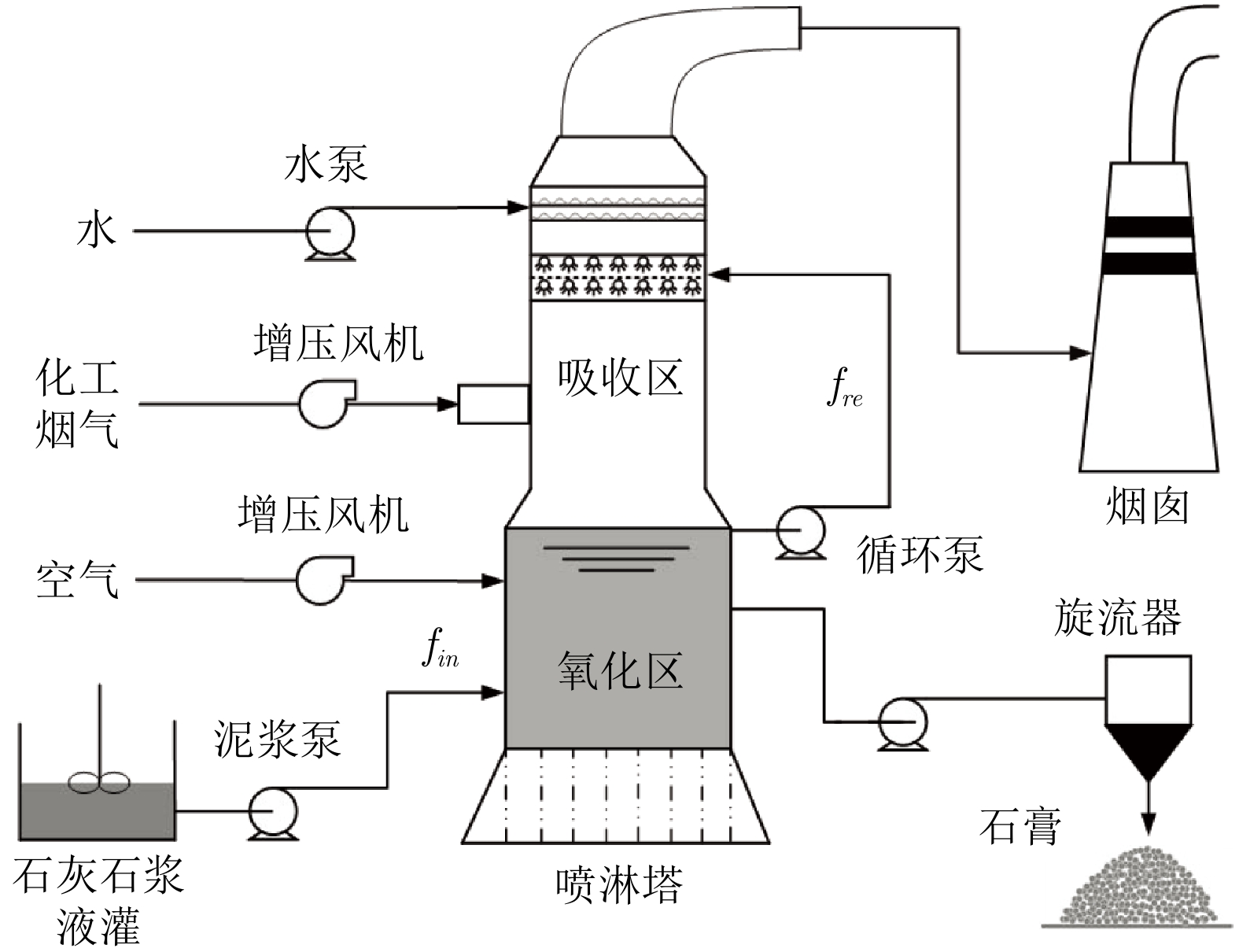
图 1 烟气脱硫流程图
注: $f_{re} $为回流流量, $f_{in} $为输入流量.
Fig. 1 Flow chart of flue-gas desulfurization
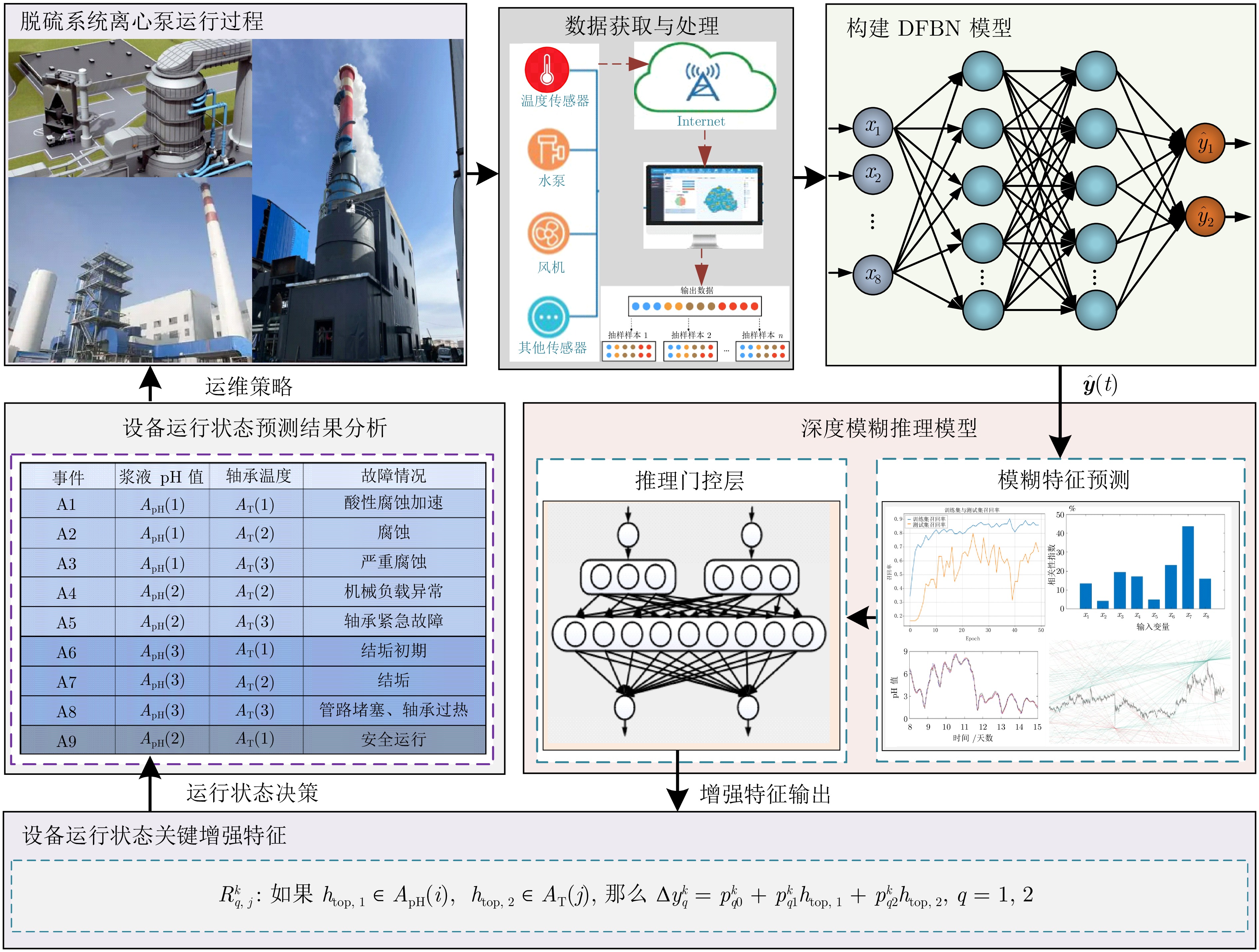
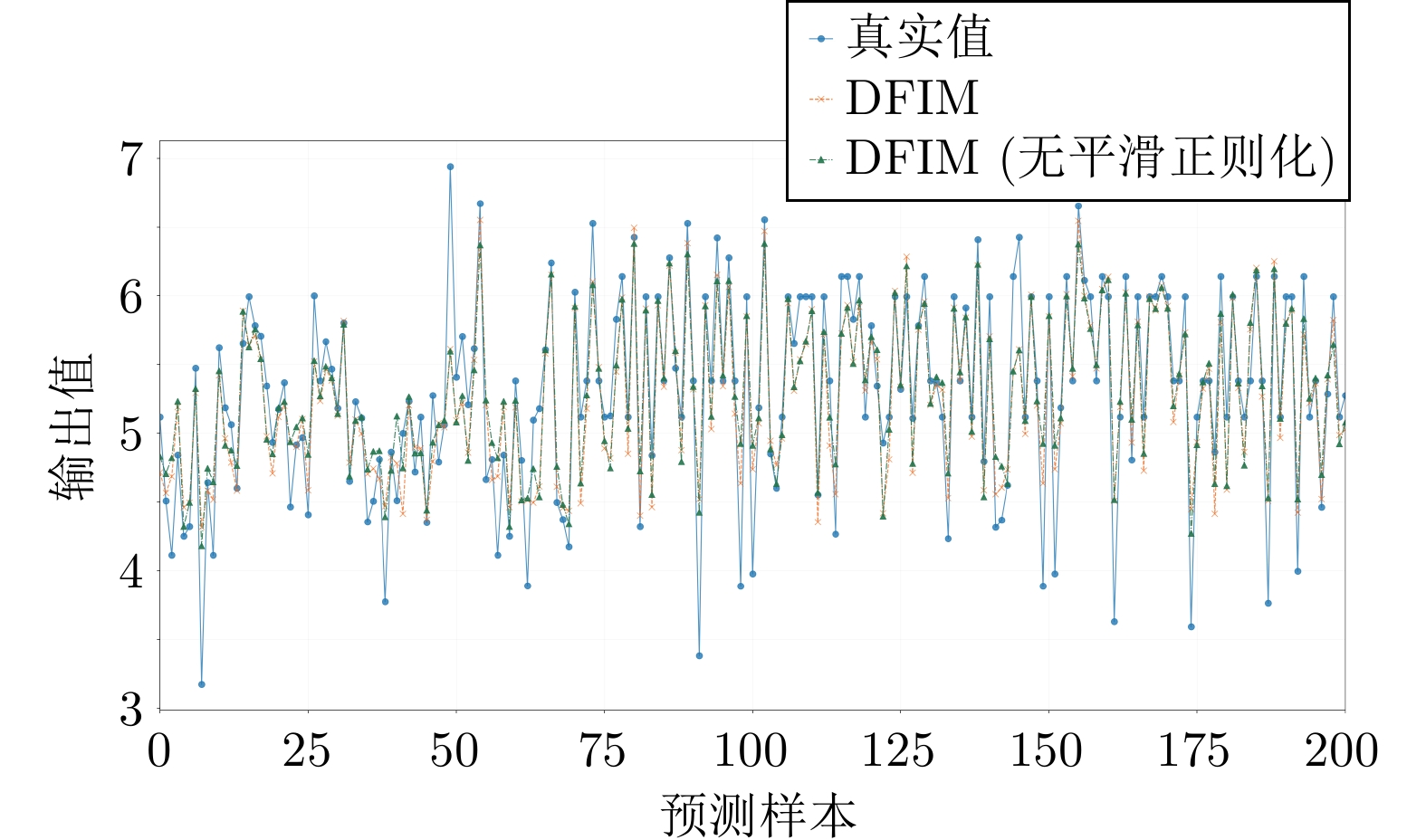
图 2 基于DFIM的烟气脱硫设备运行状态预测
Fig. 2 Prediction of operating status for flue-gas desulfurization equipment based on DFIM
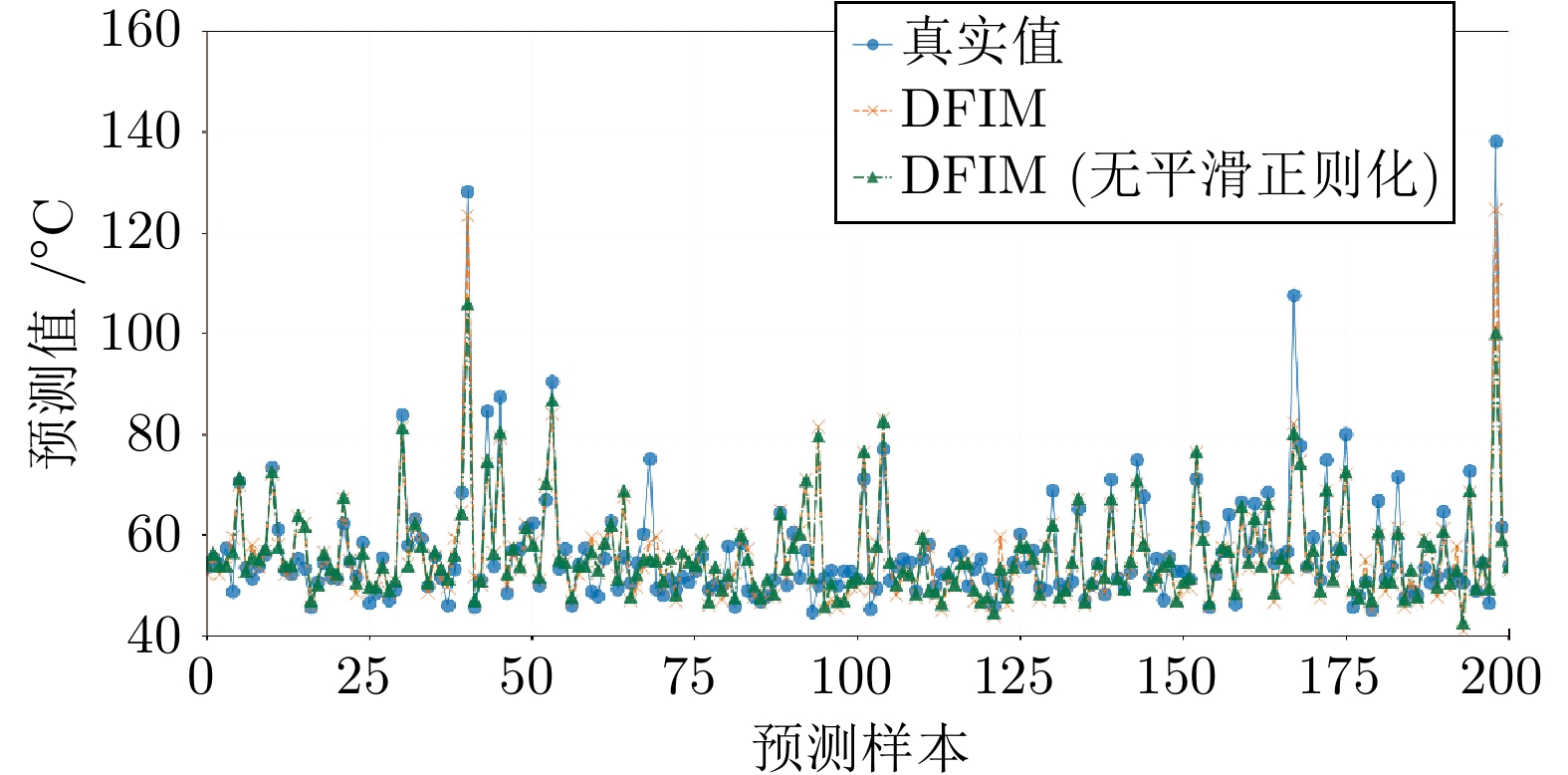
图 8 模型对轴承温度的预测结果对比
Fig. 8 Comparison of the prediction results of the model for bearing temperature
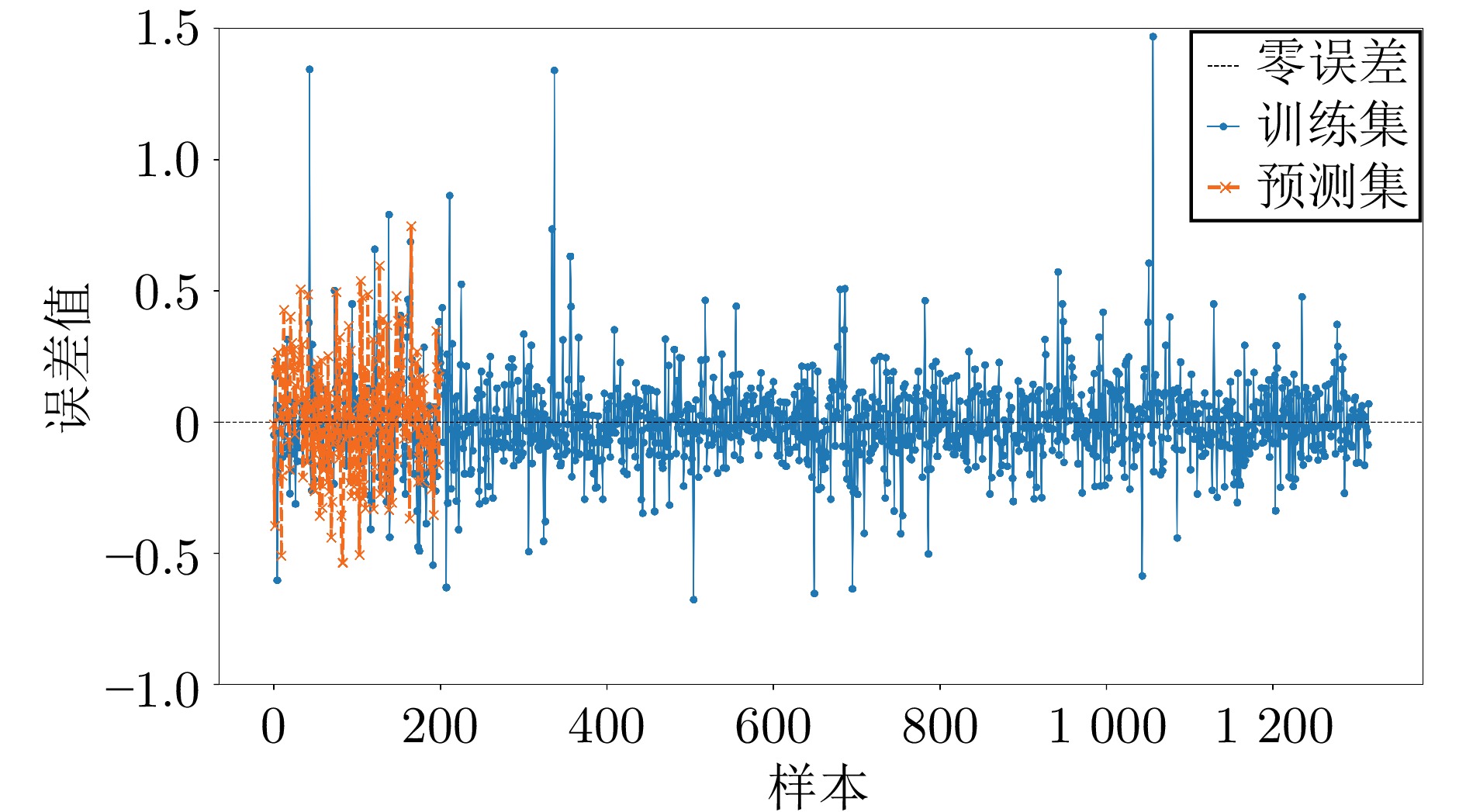
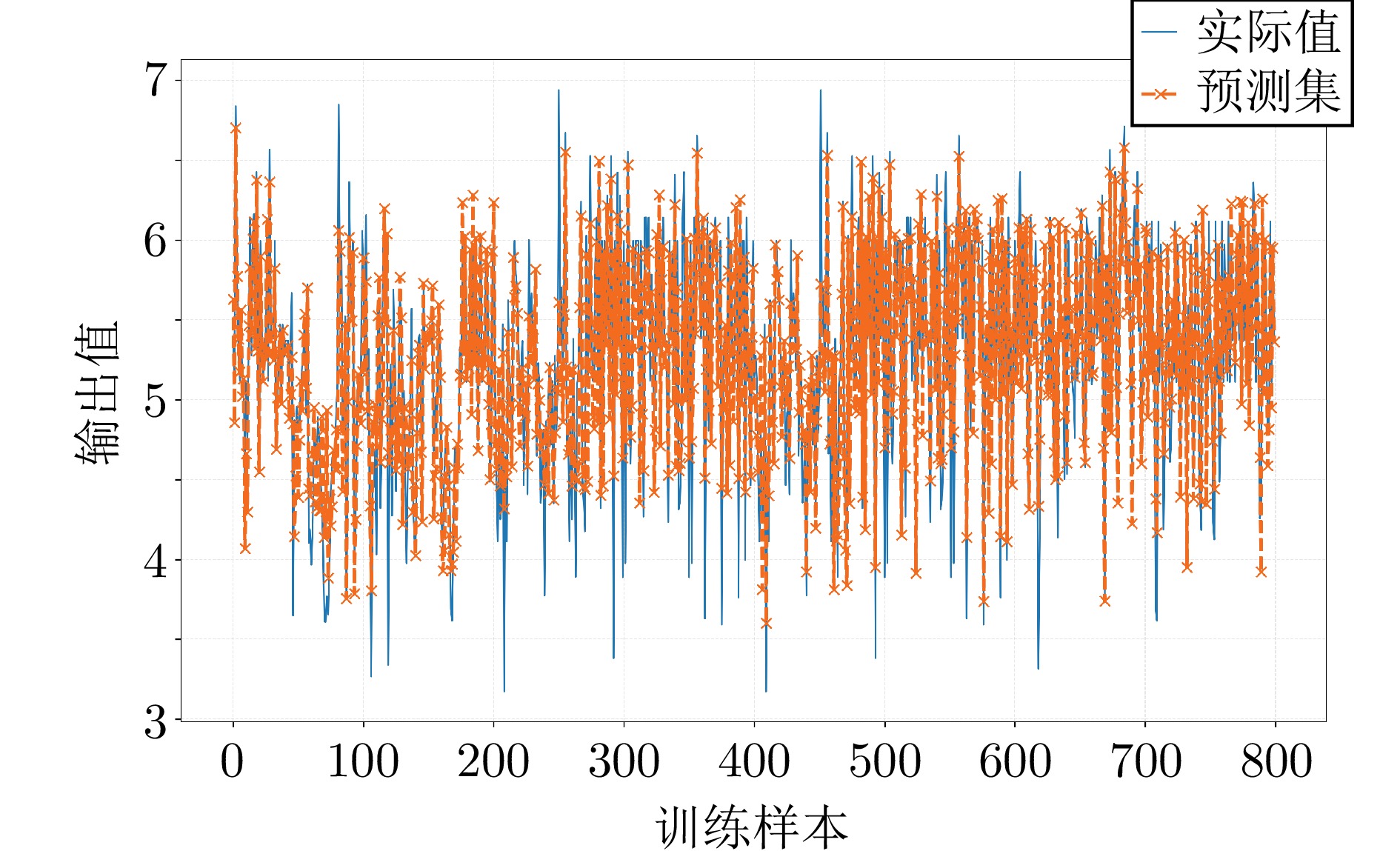
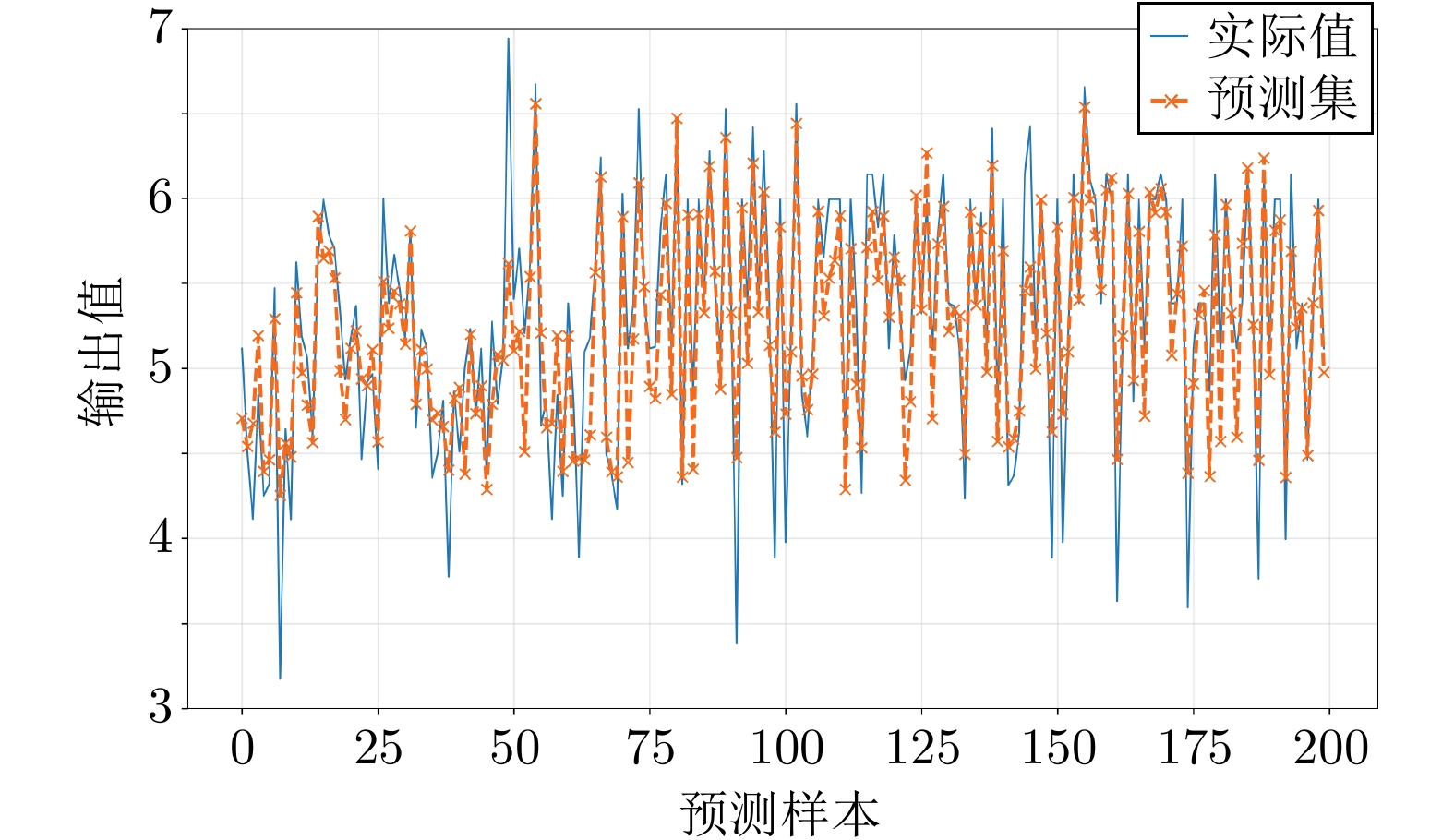
图 9 DFIM对pH的训练误差与预测误差对比
Fig. 9 Comparison of training errors and prediction errors for pH using DFIM
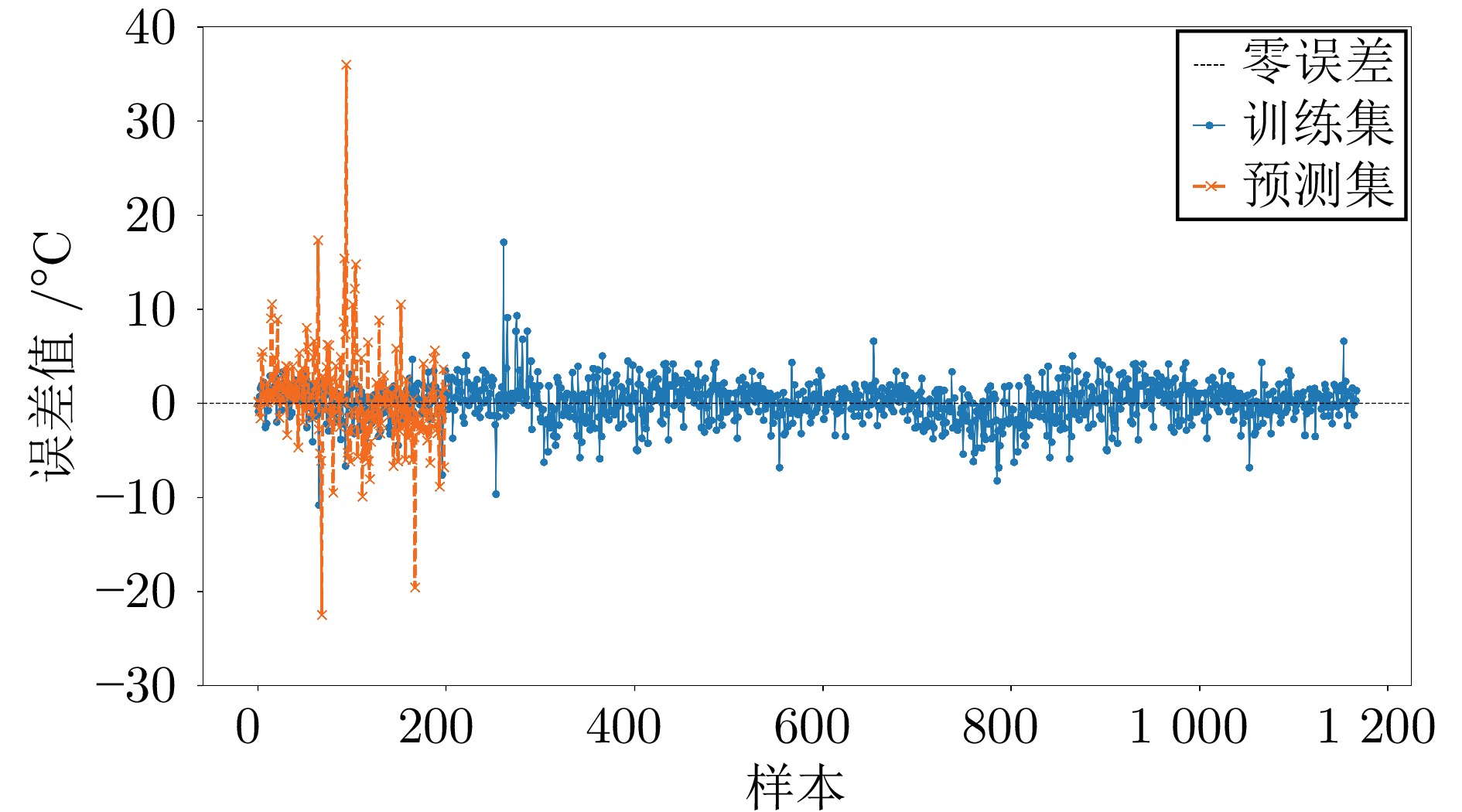
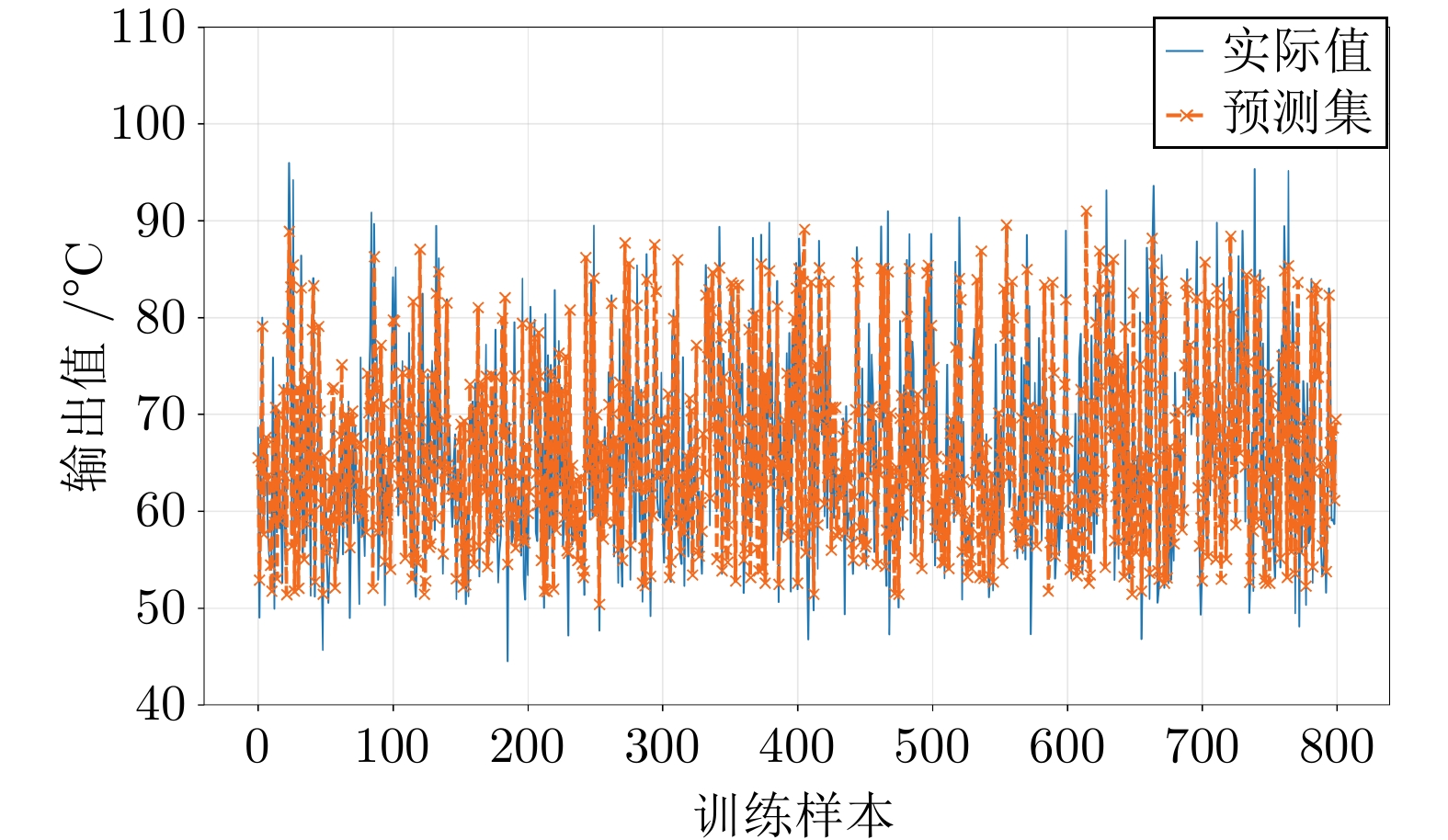
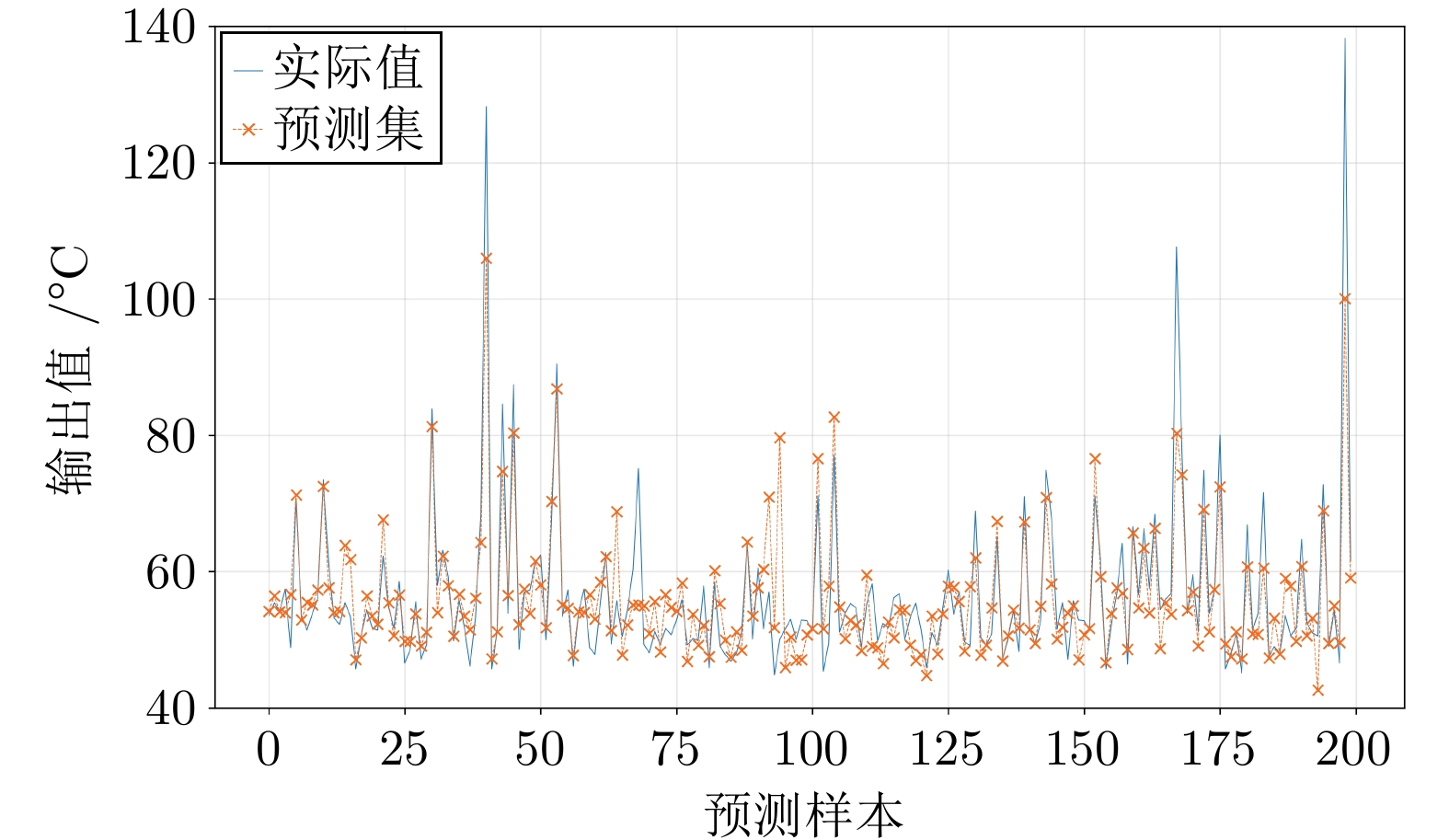
图 10 DFIM对轴承温度的训练误差与预测误差对比
Fig. 10 Comparison of training errors and prediction errors for bearing temperature using DFIM
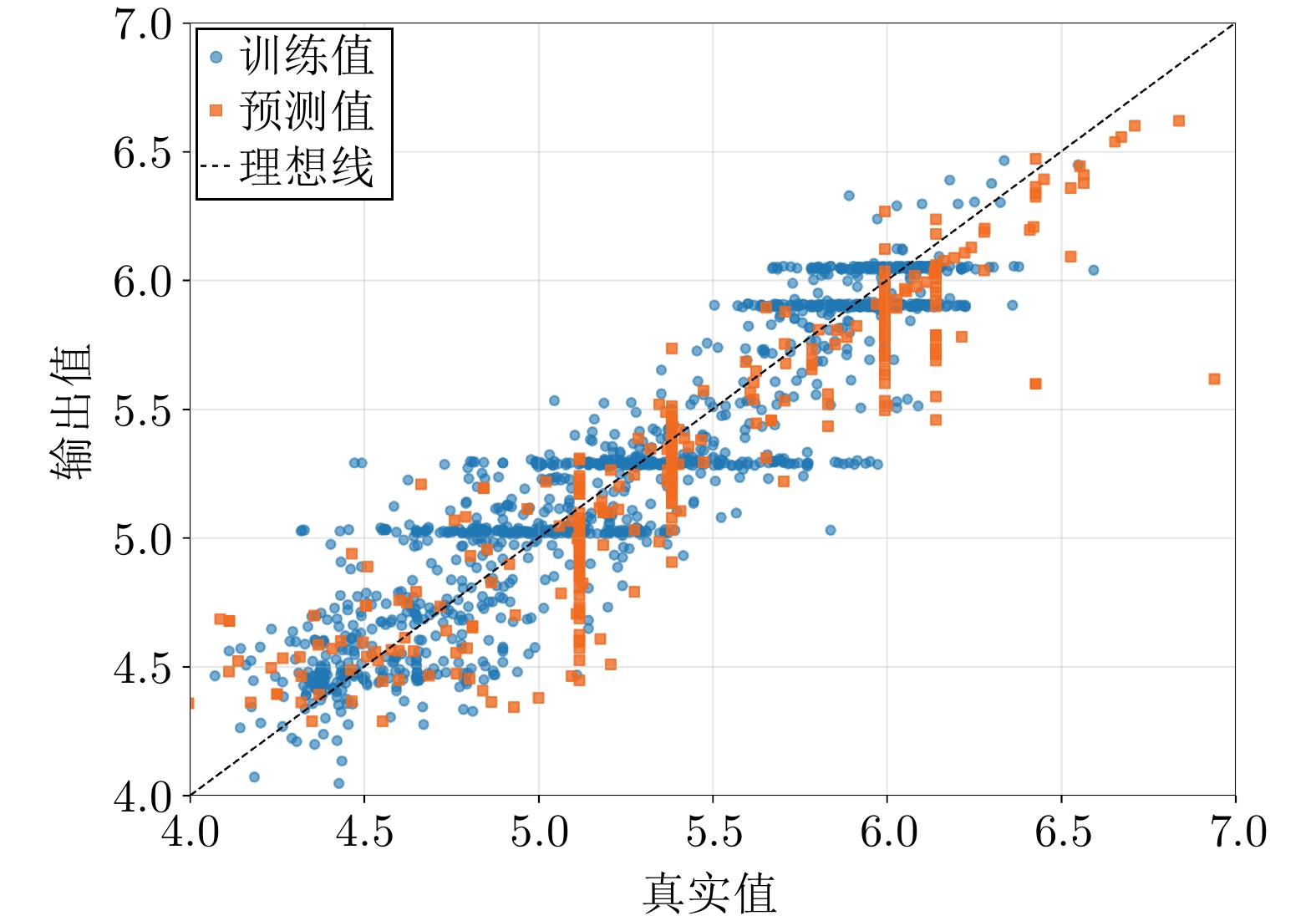
图 11 DFIM对pH在训练集与预测集上的散点图
Fig. 11 Scatter plot of the training and prediction sets for pH using DFIM
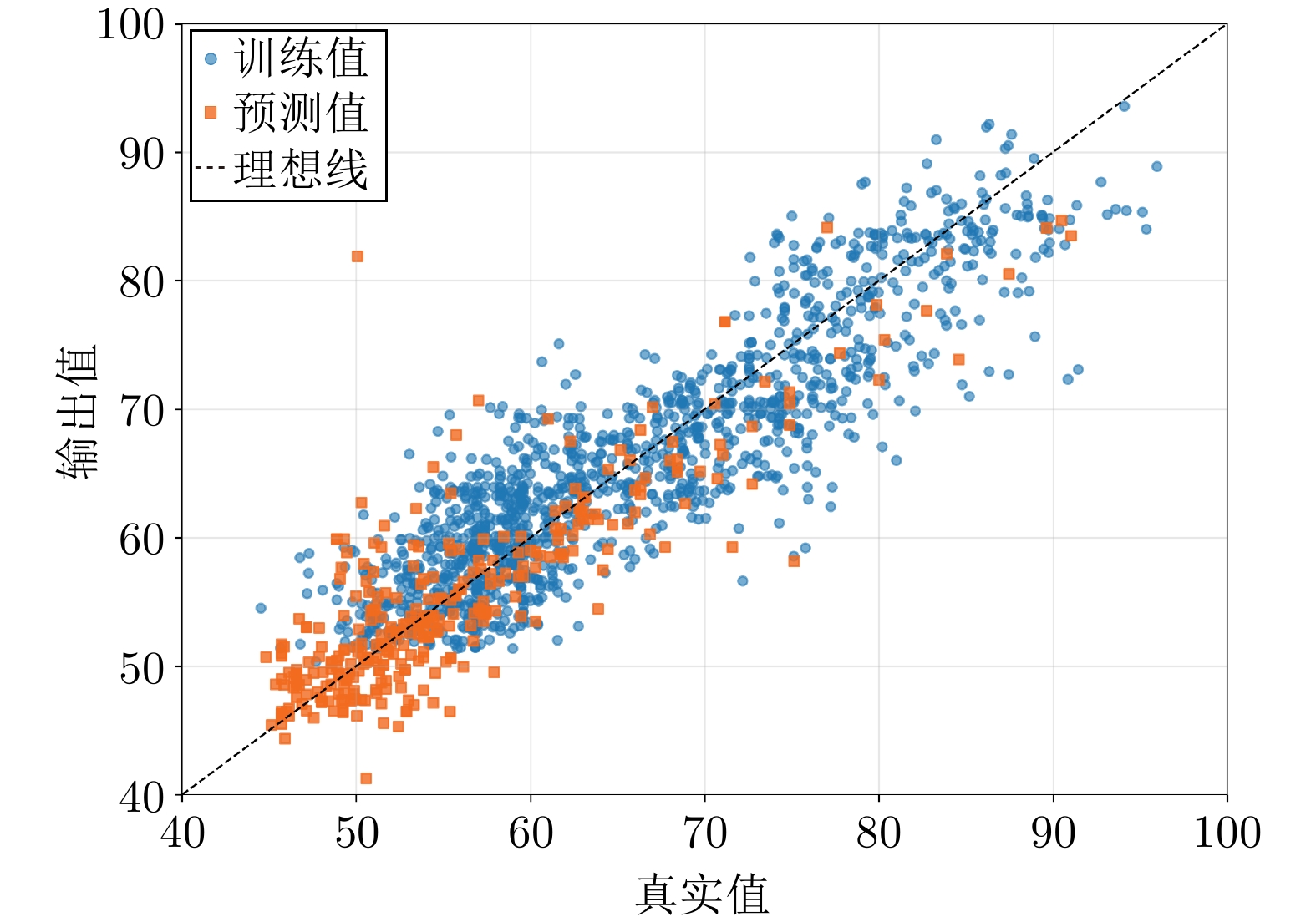
图 12 DFIM对轴承温度在训练集与预测集上的散点图
Fig. 12 Scatter plot of the training and prediction sets for bearing temperature using DFIM
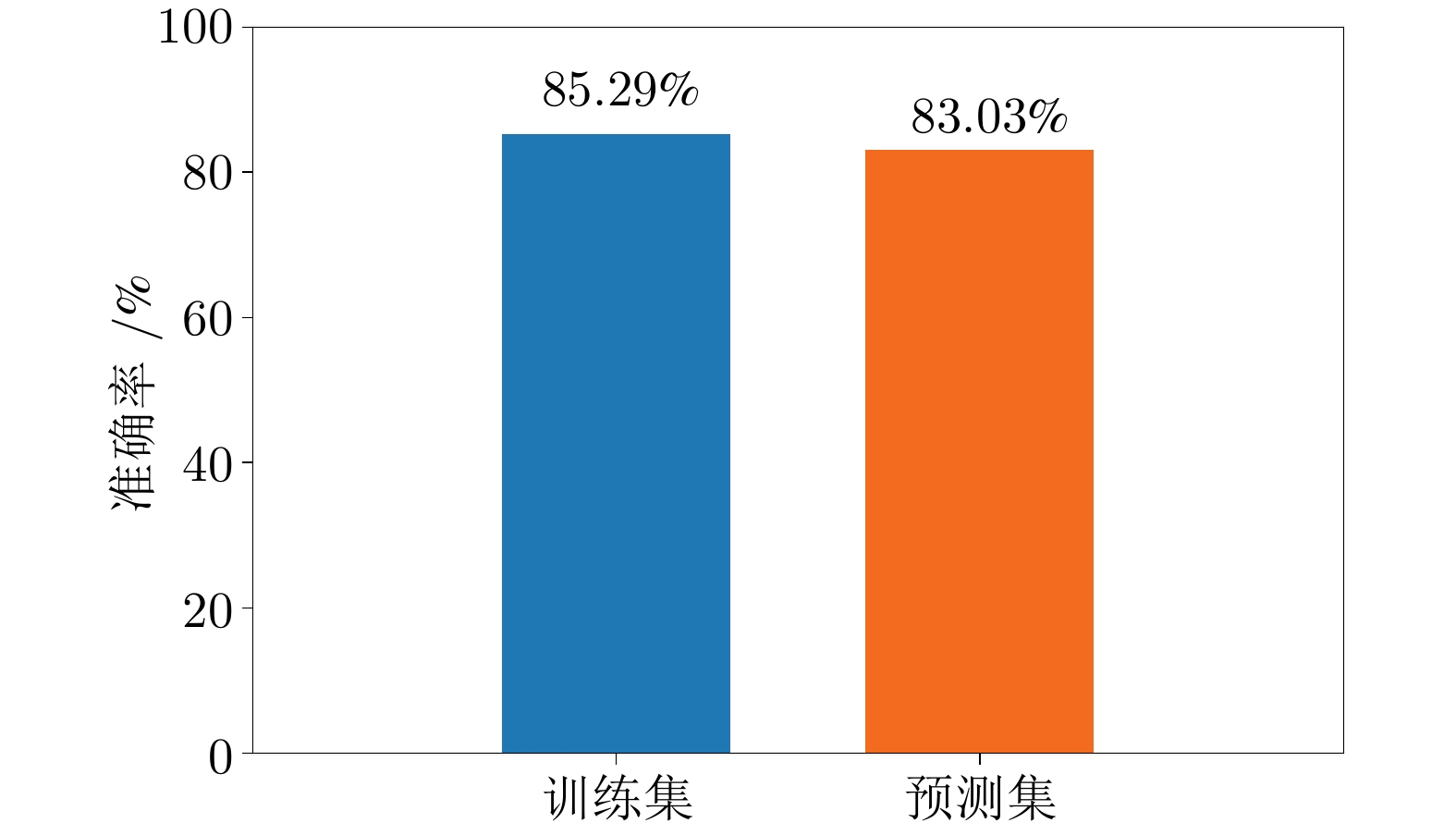
图 13 DFIM建议运维策略与故障事件匹配的准确率
Fig. 13 Accuracy rate of matching operation and maintenance strategies suggested by DFIM with fault events
表 1 离心泵运行状态关联变量
Table 1 Correlation variables of the operating status of centrifugal pump
标号 单位 相关特征变量 x1 r/min 电机转速 x2 ℃ 入口浆液温度 x3 m3/h 浆液流量 x4 % 出口阀门开度 x5 ℃ 烟气温度 x6 A 泵运行电流 x7 mm/s 泵振动值 x8 kPa 入口压力 y1 — 浆液pH值 y2 ℃ 轴承温度  下载: 导出CSV
表 2 事件定义
Table 2 Event definitions
事件 浆液pH值 轴承温度 故障情况 A1 $A_{{\rm{pH}}}(1)$ $A_{{\rm{T}}}(1)$ 酸性腐蚀加速 A2 $A_{{\rm{pH}}}(1)$ $A_{{\rm{T}}}(2)$ 腐蚀 A3 $A_{{\rm{pH}}}(1)$ $A_{{\rm{T}}}(3)$ 严重腐蚀 A4 $A_{{\rm{pH}}}(2)$ $A_{{\rm{T}}}(2)$ 机械负载异常 A5 $A_{{\rm{pH}}}(2)$ $A_{{\rm{T}}}(3)$ 轴承紧急故障 A6 $A_{{\rm{pH}}}(3)$ $A_{{\rm{T}}}(1)$ 结垢初期 A7 $A_{{\rm{pH}}}(3)$ $A_{{\rm{T}}}(2)$ 结垢 A8 $A_{{\rm{pH}}}(3)$ $A_{{\rm{T}}}(3)$ 管路堵塞、轴承过热 A9 $A_{{\rm{pH}}}(2)$ $A_{{\rm{T}}}(1)$ 安全运行
下载: 导出CSV
表 3 运维建议
Table 3 Operation and maintenance suggestions
运维建议 情况 ${\rm{Adv}}_1$ 调整浆液配方, 添加石灰石等碱性物质, 将pH值回调至正常范围, 抑制酸性腐蚀. ${\rm{Adv}}_2$ 降低设备负载, 必要时停机, 避免腐蚀扩散, 检查关键部件的腐蚀深度, 更换受损部件. ${\rm{Adv}}_3$ 检查浆液流量、电机转速是否超出范围, 补充润滑油, 减少摩擦导致的负载增加. ${\rm{Adv}}_4$ 立即停机, 切断电源, 防止轴承过热烧毁; 拆解轴承组件, 检查是否存在滚珠碎裂、保持架断裂等故障, 排查轴承过热原因. ${\rm{Adv}}_5$ 调整浆液成分, 降低pH值至临界结垢点以下, 抑制碳酸钙/硫酸钙结垢, 对喷淋层喷嘴、浆液管道进行低压冲洗. ${\rm{Adv}}_6$ 维持当前运行参数, 定期记录关键指标.
下载: 导出CSV
表 4 DFIM与其他模型对设备状态的预测结果对比
Table 4 Comparison results for predicting equipment states of DFIM and other models
参数 模型 MAE R2 浆液pH值 DFIM 0.12 ± 0.05 0.89 ± 0.07 DFIM (无平滑正则化) 0.16 ± 0.09 0.83 ± 0.09 DBN 0.24 ± 0.05 0.63 ± 0.11 LSTMNN 0.21 ± 0.08 0.66 ± 0.13 SOFNN 0.18 ± 0.10 0.71 ± 0.15 FNN 0.20 ± 0.09 0.67 ± 0.14 RBFNN 0.23 ± 0.06 0.65 ± 0.12 BPNN 0.26 ± 0.12 0.62 ± 0.19 轴承温度(°C) DFIM 2.28 ± 0.52 0.87 ± 0.12 DFIM (无平滑正则化) 5.38 ± 0.74 0.81 ± 0.14 DBN 7.63 ± 0.61 0.56 ± 0.17 LSTMNN 7.15 ± 0.76 0.59 ± 0.18 SOFNN 6.87 ± 0.82 0.64 ± 0.21 FNN 6.95 ± 0.79 0.62 ± 0.20 RBFNN 7.49 ± 0.73 0.58 ± 0.16 BPNN 8.34 ± 0.96 0.54 ± 0.24
下载: 导出CSV
表 5 DFIM预测结果与触发的运维建议
Table 5 DFIM prediction results and triggered operation and maintenance suggestions
pH值 温度(°C) 事件 运维建议 执行情况 6.1 52.87 A6 ${\rm{Adv}}_5$ 执行冲洗1次 5.7 74.98 A5 ${\rm{Adv}}_4$ 触发2次, 人工确认后停机1次 4.8 48.03 A1 ${\rm{Adv}}_1$ 在pH值低于$B_{\mathrm{pH,\;low}}(t)$时执行3次 4.9 72.67 A3 ${\rm{Adv}}_2$ 触发1次, 人工确认后停机0次 5.4 46.60 A9 ${\rm{Adv}}_6$ 多次触发, 作为正常运行建议 5.7 61.89 A4 ${\rm{Adv}}_3$ 在负载异常预警下执行润滑补充2次
下载: 导出CSV
-
[1] Wang G M, Li X Y, Gu K, Chen H, Han H G, Qiao J F. Neurodynamics-driven model predictive control with soft-measurement for desulfurization system. IEEE Transactions on Automation Science and Engineering, 2025, 22: 19546−19554 doi: 10.1109/TASE.2025.3594118 [2] 田昊, 汤健, 夏恒, 王天峥, 余文, 乔俊飞. 基于IT2FBLS强化学习PID的MSWI过程炉膛温度控制. 自动化学报, 2025, 51(7): 1626−1641Tian Hao, Tang Jian, Xia Heng, Wang Tian-Zheng, Yu Wen, Qiao Jun-Fei. Furnace temperature control using IT2FBLS-based reinforcement learning PID for MSWI process. Acta Automatica Sinica, 2025, 51(7): 1626−1641 [3] Wang G M, Chen H, Han H G, Bi J, Qiao J F, Tirkolaee E. Predicting water quality with nonstationarity: Event-triggered deep fuzzy neural network. IEEE Transactions on Fuzzy Systems, 2024, 32(5): 2690−2699 doi: 10.1109/TFUZZ.2024.3354919 [4] 李欣怡, 王功明, 王自鹏, 乔俊飞. 基于事件触发的污水处理过程水质智能预测研究. 化工学报, 2025, 76(6): 2828−2837Li Xin-Yi, Wang Gong-Ming, Wang Zi-Peng, Qiao Jun-Fei. Research on intelligent prediction of water quality in sewage treatment process based on event triggering. CIESC Journal, 2025, 76(6): 2828−2837 [5] 李征, 庄铠泽, 赵东杰, 宋燕星, 王功明. 事件驱动的深度信念网络软测量模型设计方法. 化工学报, 2025, 76(4): 1693−1701Li Zheng, Zhuang Kai-Ze, Zhao Dong-Jie, Song Yan-Xing, Wang Gong-Ming. Design method of event-driven deep belief network soft-sensing model. CIESC Journal, 2025, 76(4): 1693−1701 [6] Yuan X F, Qi S B, Wang Y L. Stacked enhanced auto-encoder for data-driven soft sensing of quality variable. IEEE Transactions on Instrumentation and Measurement, 2020, 69(10): 7953−7961 doi: 10.1109/TIM.2020.2985614 [7] 王功明, 乔俊飞, 关丽娜, 贾庆山. 深度信念网络研究现状与展望. 自动化学报, 2021, 47(1): 35−49Wang Gong-Ming, Qiao Jun-Fei, Guan Li-Na, Jia Qing-Shan. Review and prospect on deep belief network. Acta Automatica Sinica, 2021, 47(1): 35−49 [8] 韩红桂, 王玉爽, 刘峥, 孙浩源, 乔俊飞. 知识和数据驱动的污水处理反硝化脱氮过程协同优化控制. 自动化学报, 2024, 50(6): 1221−1233Han Hong-Gui, Wang Yu-Shuang, Liu Zheng, Sun Hao-Yuan, Qiao Jun-Fei. Knowledge-data-driven cooperative optimal control for wastewater treatment denitrification process. Acta Automatica Sinica, 2024, 50(6): 1221−1233 [9] Yi H, Su Z G, Wang P H. Closed-loop shaping-based active disturbance rejection control with delay robustness and application to wet desulfurization process. IEEE Transactions on Industrial Electronics, 2024, 71(6): 6117−6127 doi: 10.1109/TIE.2023.3290252 [10] Wang G M, Zhao Y D, Liu C X, Qiao J F. Data-driven robust adaptive control with deep learning for wastewater treatment process. IEEE Transactions on Industrial Informatics, 2024, 20(1): 149−157 doi: 10.1109/TII.2023.3257296 [11] Yang W W, Tang J, Tian H, Yu W, Qiao J F. Flue gas oxygen content control based on interval type-2 fuzzy broad learning system and PID for MSWI process. IEEE Transactions on Automation Science and Engineering, 2025, 22: 15473−15487 doi: 10.1109/TASE.2025.3563863 [12] 朱霁霖, 桂卫华, 蒋朝辉, 陈致蓬, 方怡静. 基于料面视频图像分析的高炉异常状态智能感知与识别. 自动化学报, 2024, 50(7): 1345−1362 doi: 10.16383/j.aas.c230674Zhu Ji-Lin, Gui Wei-Hua, Jiang Zhao-Hui, Chen Zhi-Peng, Fang Yi-Jing. Intelligent perception and recognition of blast furnace anomalies via burden surface video image analysis. Acta Automatica Sinica, 2024, 50(7): 1345−1362 doi: 10.16383/j.aas.c230674 [13] 黄如意, 李霁蒲, 王震, 夏景演, 陈祝云, 李巍华. 基于多任务学习的工业设备智能诊断与预测方法. 中国科学: 技术科学, 2022, 52(1): 123−137Huang Ru-Yi, Li Ji-Pu, Wang Zhen, Xia Jing-Yan, Chen Zhu-Yun, Li Wei-Hua. Intelligent diagnostic and prognostic method based on multitask learning for industrial equipment. Scientia Sinica Technologica, 2022, 52(1): 123−137 [14] Emroozi V, Kazemi M, Doostparast M, Pooya A. Improving industrial maintenance efficiency: A holistic approach to integrated production and maintenance planning with human error optimization. Process Integration and Optimization for Sustainability, 2024, 8: 539−564 doi: 10.1007/s41660-023-00374-3 [15] Liu S, Zhong W Q, Chen X, Sun L, Yang L K. Multi-objective economic model predictive control using utopia-tracking for the wet flue gas desulphurization system. Chinese Journal of Chemical Engineering, 2023, 54: 343−352 doi: 10.1016/j.cjche.2022.03.014 [16] Wang Q Y, Zhao H, Zhao Q L, Hou J, Tian S L, Li Y J, et al. Prediction of SO2 emission concentration in industrial flue gas based on deep learning: The ammonia desulfurization system of the Yunnan aluminum carbon plant as the research object. Process Safety and Environmental Protection, 2024, 185: 340−349 doi: 10.1016/j.psep.2024.03.042 [17] Chen H S, Liu H, Chu X N, Liu Q X, Xue D Y. Anomaly detection and critical SCADA parameters identification for wind turbines based on LSTM-AE neural network. Renewable Energy, 2021, 172: 829−840 doi: 10.1016/j.renene.2021.03.078 [18] 伍小龙, 姜韦宇, 韩红桂, 李佟, 赵德政. 基于随机事件代理模型的污水处理鼓风机轴承温度智能预测. 中国科学: 技术科学, 2025, 55(5): 879−892 doi: 10.1360/SST-2024-0251Wu Xiao-Long, Jiang Wei-Yu, Han Hong-Gui, Li Tong, Zhao De-Zheng. Intelligent prediction of wastewater treatment blower bearing temperature based on random event agent model. Scientia Sinica Technologica, 2025, 55(5): 879−892 doi: 10.1360/SST-2024-0251 [19] 陈俊英, 席月芸, 李朝阳. 多尺度局部特征和Transformer全局学习融合的发动机剩余寿命预测. 自动化学报, 2024, 50(9): 1818−1830 doi: 10.16383/j.aas.c230634Chen Jun-Ying, Xi Yue-Yun, Li Zhao-Yang. Prediction of aeroengine remaining life by combining multi-scale local features and Transformer global learning. Acta Automatica Sinica, 2024, 50(9): 1818−1830 doi: 10.16383/j.aas.c230634 [20] Han H G, Sun C X, Wu X L, Yang H Y, Zhao N, Li J, et al. Dynamic-static model for monitoring wastewater treatment processes. Control Engineering Practice, 2023, 132: Article No. 105424 doi: 10.1016/j.conengprac.2022.105424 [21] Han H G, Wang J Q, Liu Z, Yang H Y, Qiao J F. Self-organizing robust fuzzy neural network for nonlinear system modeling. IEEE Transactions on Neural Networks and Learning Systems, 2025, 36(1): 911−923 doi: 10.1109/TNNLS.2023.3334150 [22] Menegatti D, Giuseppi A, Pietrabissa A. Tractable data-driven model predictive control using one-step neural networks predictors. IEEE Transactions on Automation Science and Engineering, 2025, 22: 6740−6751 doi: 10.1109/TASE.2024.3453668 [23] Wang G M, Jia Q S, Zhou M C, Bi J, Qiao J F. Soft-sensing of wastewater treatment process via deep belief network with event-triggered learning. Neurocomputing, 2021, 436: 103−113 doi: 10.1016/j.neucom.2020.12.108 [24] Wang G M, Jia Q S, Qiao J F, Bi J, Liu C X. A sparse deep belief network with efficient fuzzy learning framework. Neural Networks, 2020, 121: 430−440 doi: 10.1016/j.neunet.2019.09.035 [25] Bandara K, Bergmeir C, Hewamalage H. LSTM-MSNet: Leveraging forecasts on sets of related time series with multiple seasonal patterns. IEEE Transactions on Neural Networks and Learning Systems, 2021, 32(4): 1586−1599 doi: 10.1109/TNNLS.2020.2985720 [26] Rivest F, Kohar R. A new timing error cost function for binary time series prediction. IEEE Transactions on Neural Networks and Learning Systems, 2020, 31(1): 174−185 doi: 10.1109/TNNLS.2019.2900046 [27] Li Y H, Anastasiu D C. MC-ANN: A mixture clustering-based attention neural network for time series forecasting. IEEE Transactions on Pattern Analysis and Machine Intelligence, 2025, 47(8): 6888−6899 doi: 10.1109/TPAMI.2025.3565224 -

 下载:
下载:

计量
- 文章访问数: 336
- HTML全文浏览量: 246
- PDF下载量: 38
- 被引次数: 0
