


Simulation Method for Rare-earth Extraction and Separation Processes Based on Multi-branch Regression Generative Adversarial Networks
-
摘要: 针对基于萃取机理的稀土萃取工艺流程模拟难以吻合实际萃取生产工况的问题, 提出一种基于多分支回归生成对抗网络的稀土萃取分离流程模拟方法, 实现稀土萃取分离各级萃取槽稀土元素组分含量的精准计算. 首先, 针对稀土萃取生产现场有效样本数量较少的问题, 采用生成对抗网络(GAN)构造生成对抗模型, 依据稀土萃取工艺串级分离特点, 使用多分支深层网络构造GAN的生成器, 逐级学习萃取级间数据的深层特征; 提出判别器与回归器的浅层特征共享机制, 回归器复用判别器首层卷积特征以提升预测性能, 并通过回归一致性约束以生成更真实的样本; 根据多分支网络结构特点, 设计一种递归渐进式对抗训练策略, 固定前一分支子GAN模型学习到的网络参数并作为下一分支子GAN的共同特征, 各分支子GAN内部生成器、判别器、回归器三者循环对抗训练, 在保证模型稳定收敛的同时, 精准捕捉级间耦合特征. 仿真结果表明了本文所提方法的有效性.Abstract: To address the problem that the flow simulation of rare-earth extraction process based on extraction mechanism hardly conforms to actual extraction production conditions, a simulation method for rare-earth extraction and separation processes based on multi-branch regression generative adversarial networks is proposed to achieve accurate calculation of rare-earth element component concentrations in each stage of rare-earth extraction and separation. First, in view of the limited number of effective samples in the rare-earth extraction production site, a generative adversarial networks (GAN) is adopted to construct a generative adversarial model. According to the cascade separation characteristics of the rare-earth extraction process, a multi-branch deep network is used to construct the generator of the GAN, learning deep features of inter-stage extraction data level by level; A shallow feature sharing mechanism between discriminator and regressor is proposed, the regressor reuses the first-layer convolutional features of the discriminator to improve prediction performance, and a regression consistency constraint is introduced to generate more realistic samples; In view of the structural characteristics of multi-branch networks, a recursive progressive adversarial training strategy is designed. The network parameters learned by the previous branch sub-GAN model are fixed and serve as common features for the next branch sub-GAN. Within each branch sub-GAN, the generator, discriminator, and regressor undergo cyclic adversarial training, ensuring stable model convergence while accurately capturing inter-stage coupling features. Simulation results demonstrate the effectiveness of the proposed method.
-
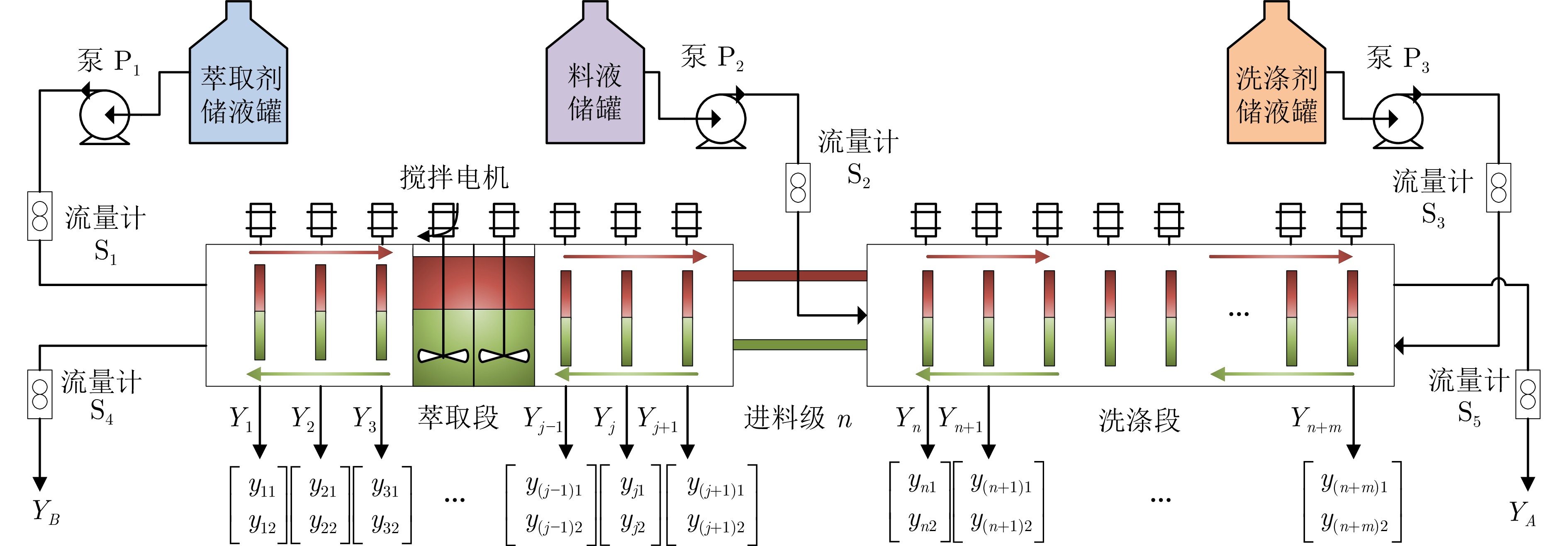
图 1 稀土串级萃取分离工艺流程图
Fig. 1 Flowchart of rare-earth cascade extraction and separation process
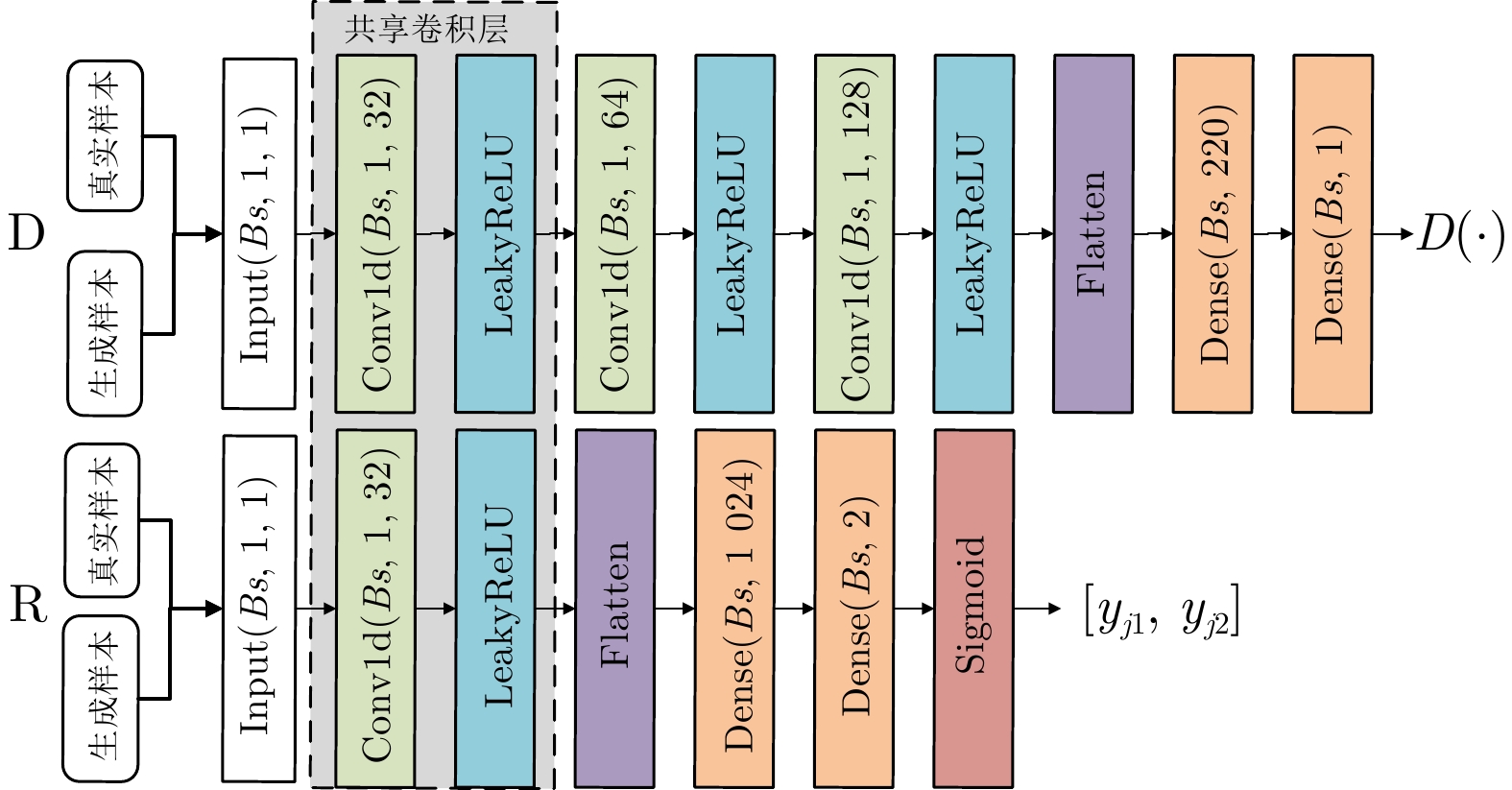
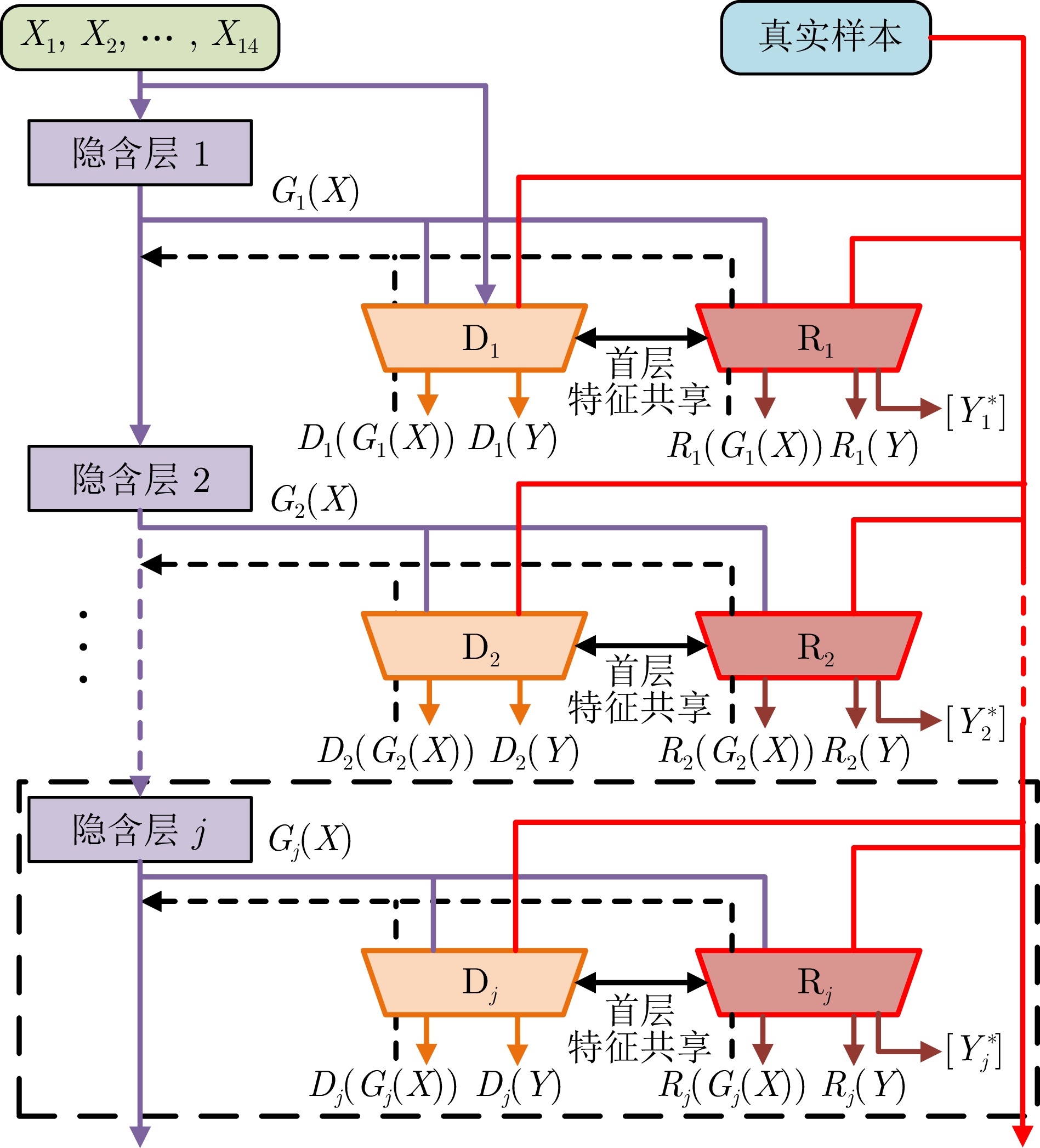
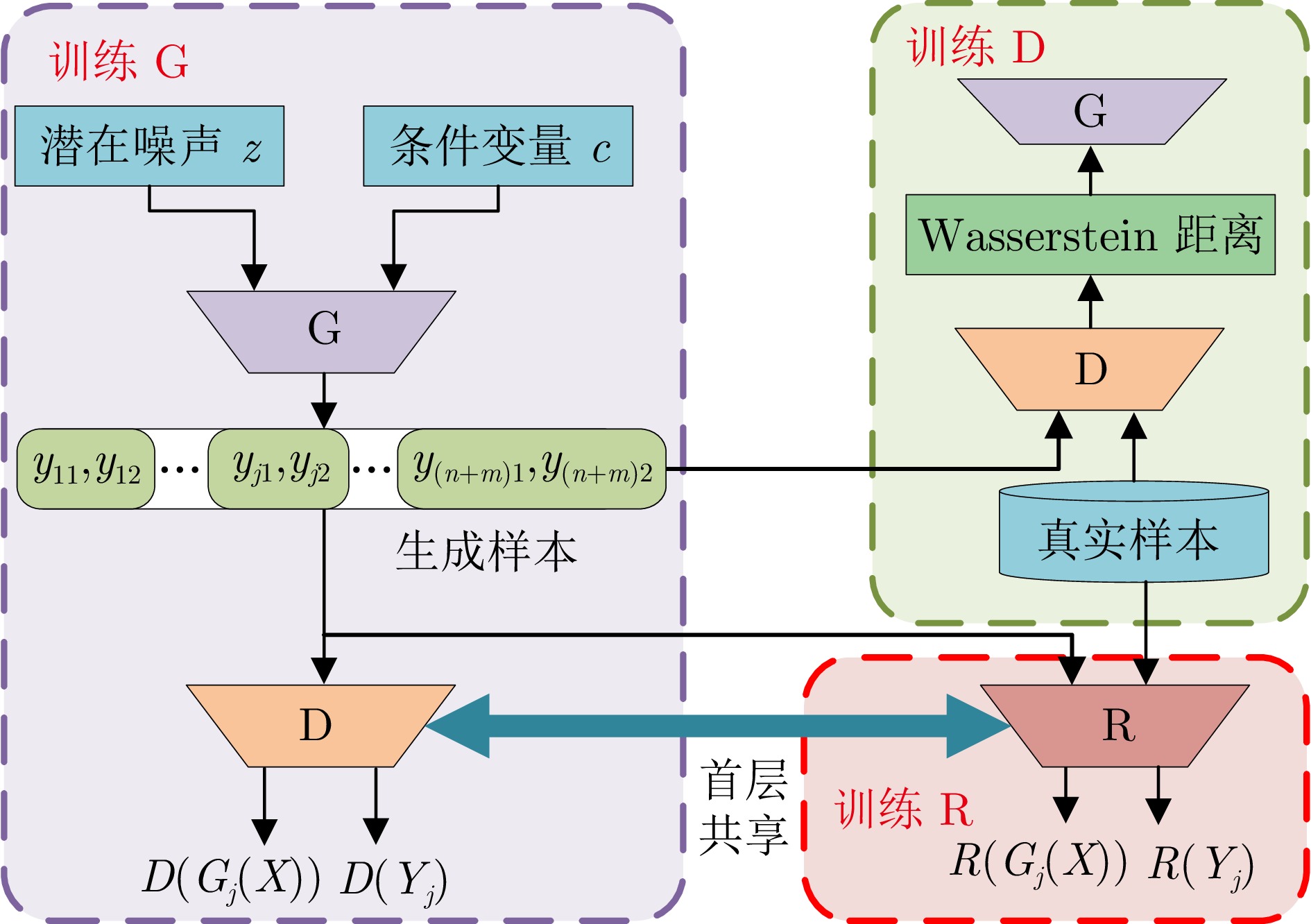
图 5 判别器(D)和回归器(R)网络结构图
Fig. 5 Network structure diagram of discriminator (D) and regressor (R)
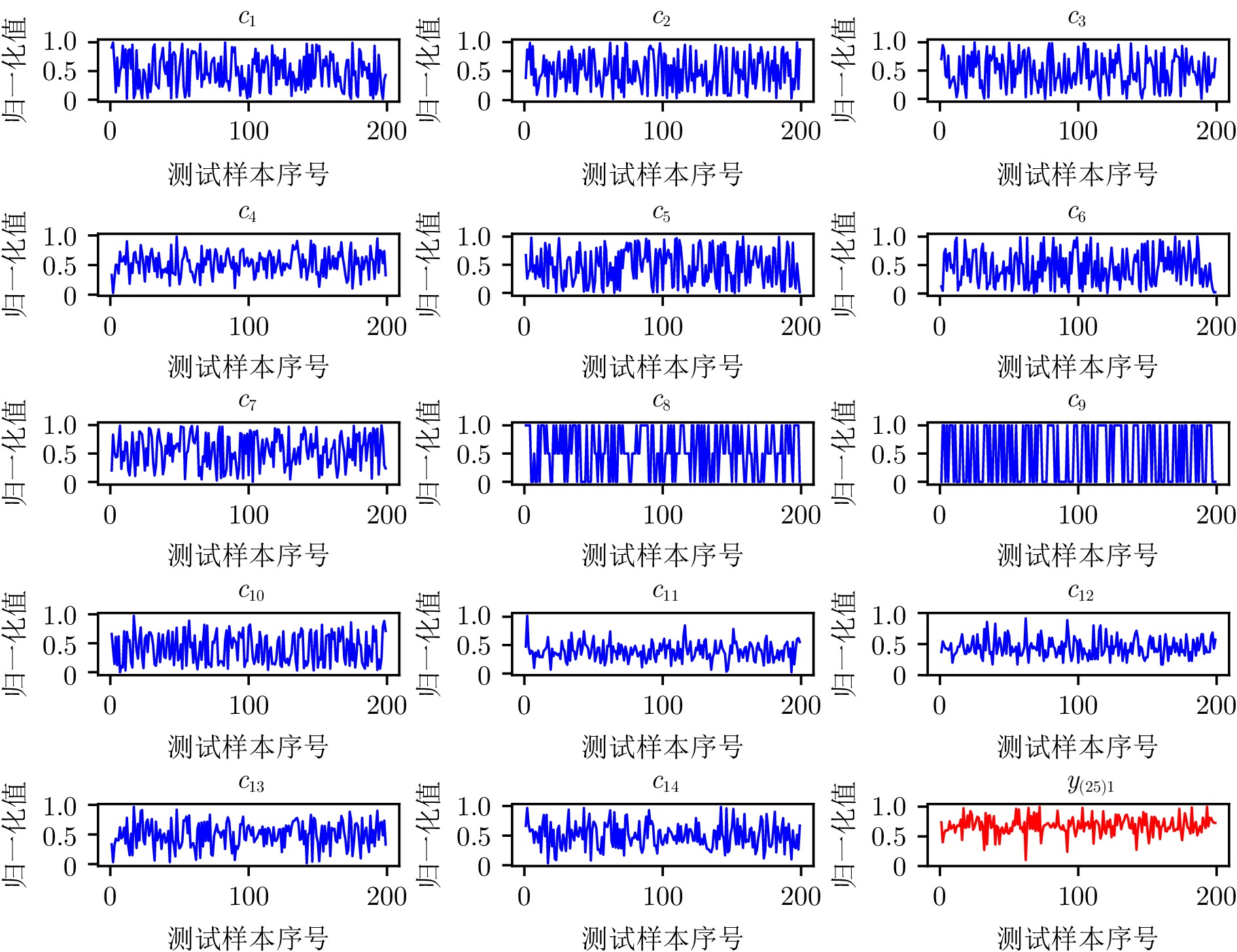
图 8 输入变量$c$与输出数据${y_{(25)1}}$分布趋势图
Fig. 8 Distribution trend chart of input variable $c$ and output data ${y_{(25)1}}$
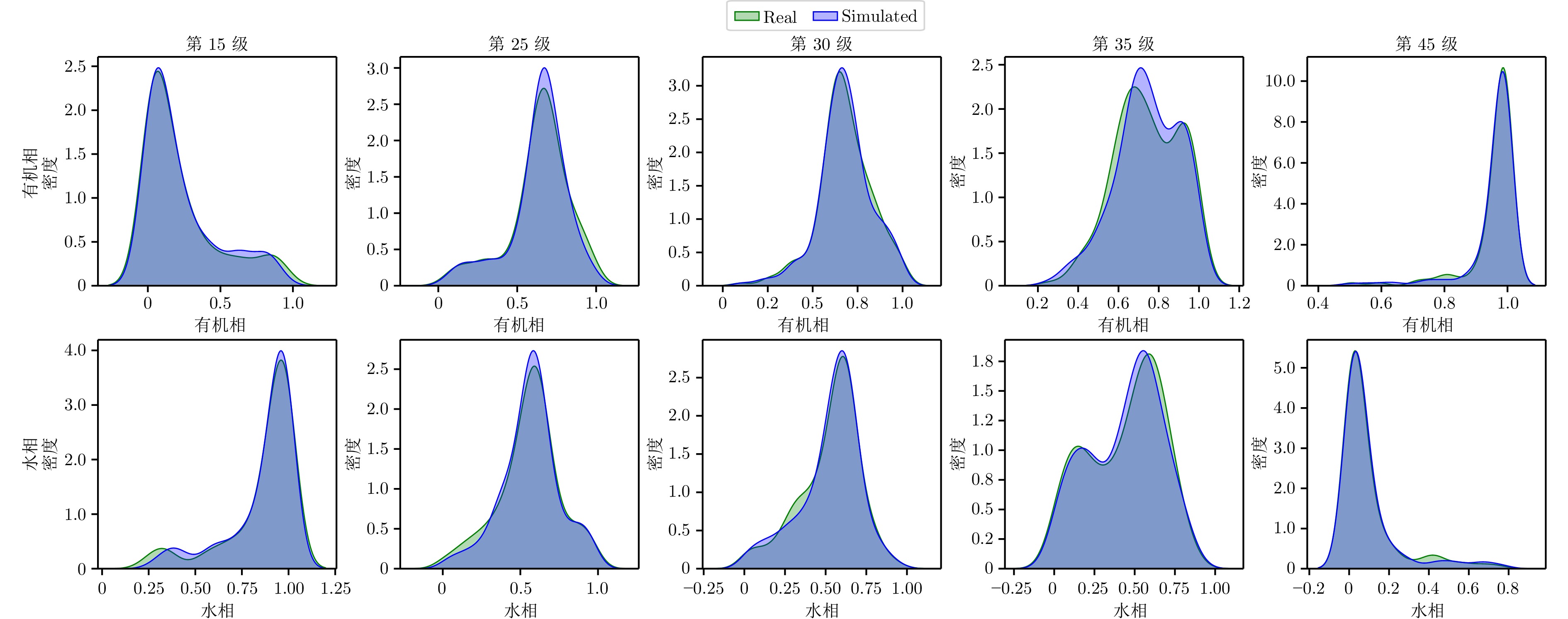
图 10 测试集上各萃取级真实值与模拟值的概率密度分布对比
Fig. 10 Comparison of probability density distributions between real values and simulated values for each extraction level on the test set
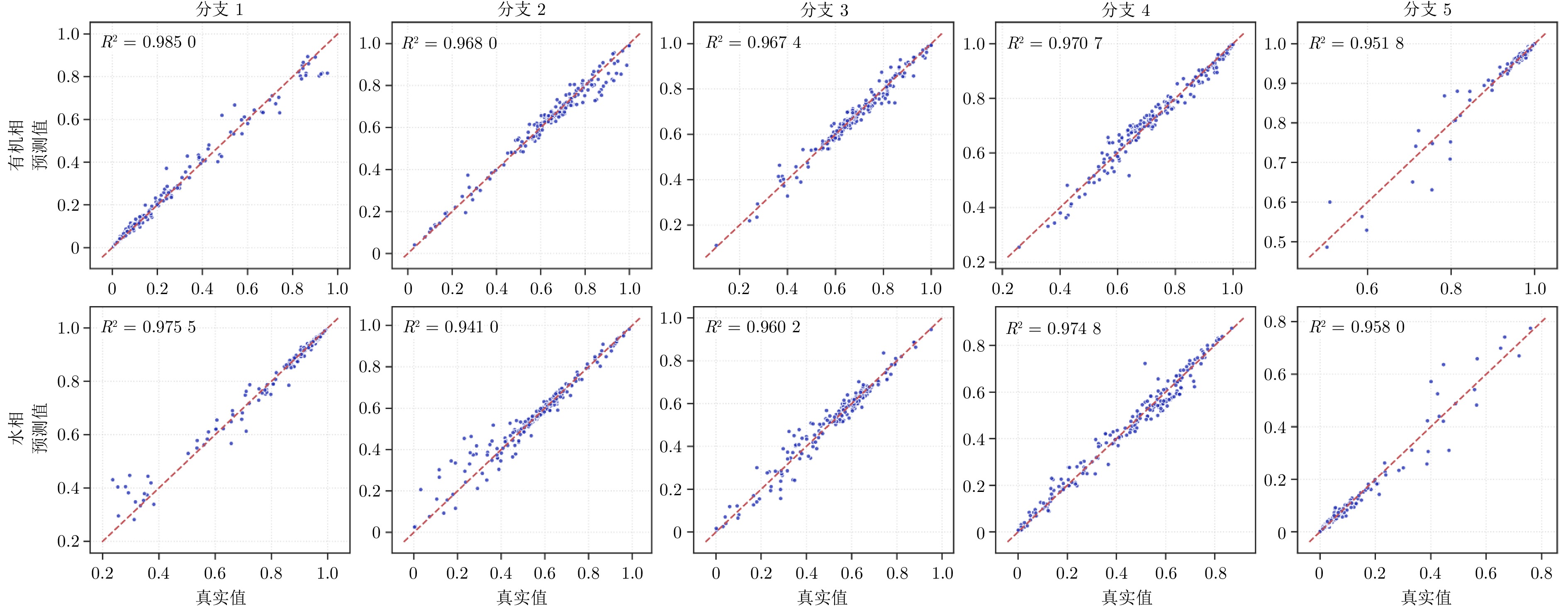
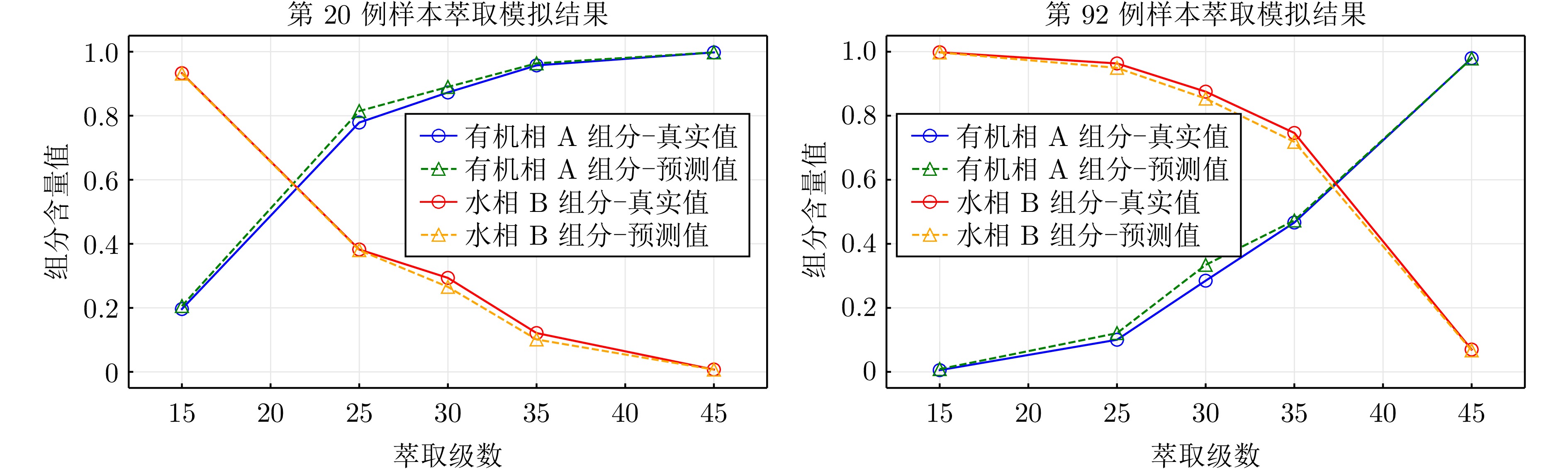
图 11 各分支的真实值与预测值散点拟合图
Fig. 11 Scatter fitting plot of real values and predicted values for each branch
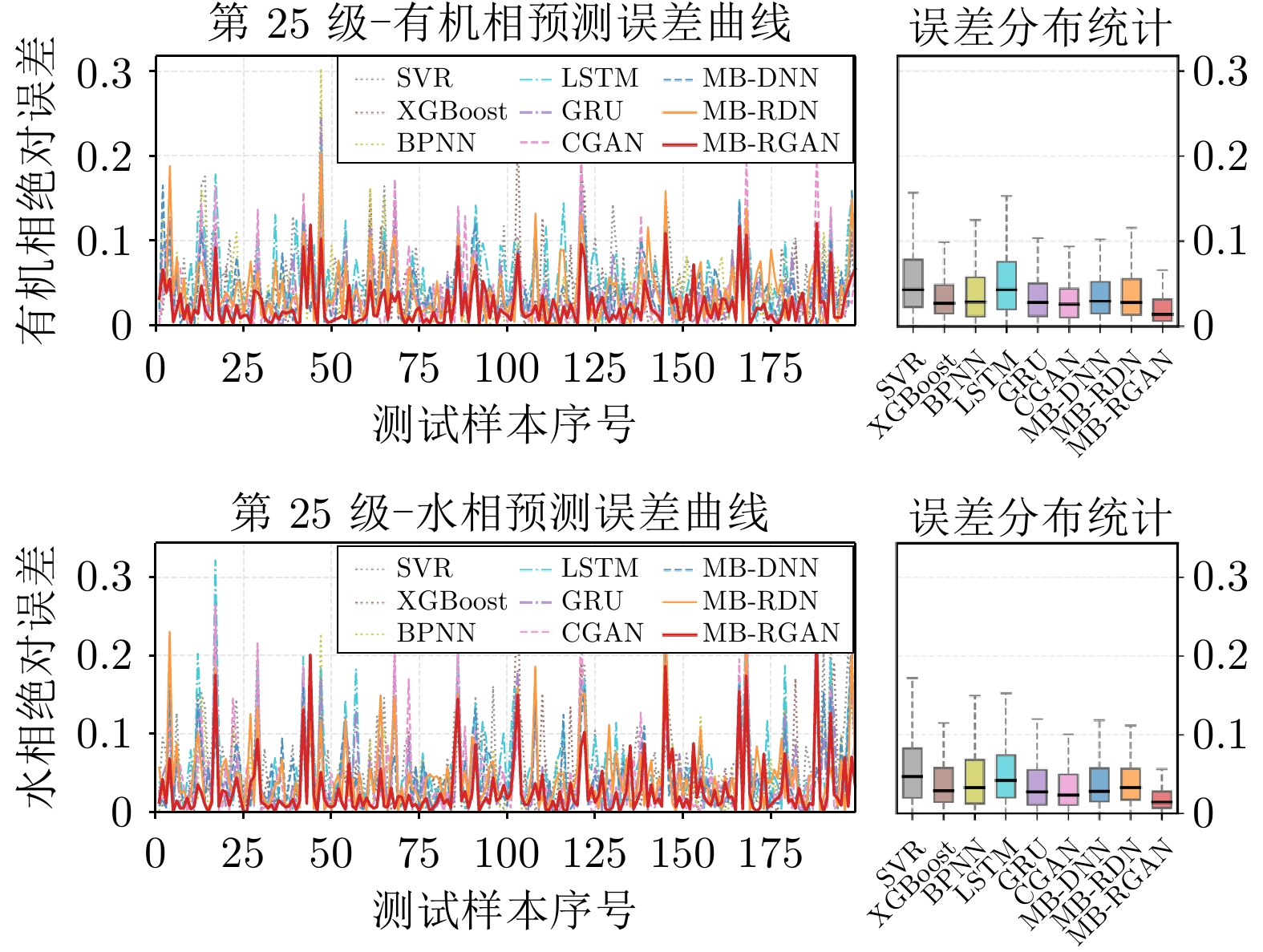
图 14 第25级各模型预测绝对误差及误差分布统计对比
Fig. 14 Comparison of prediction absolute error and error distribution statistics for each model at the 25th stage
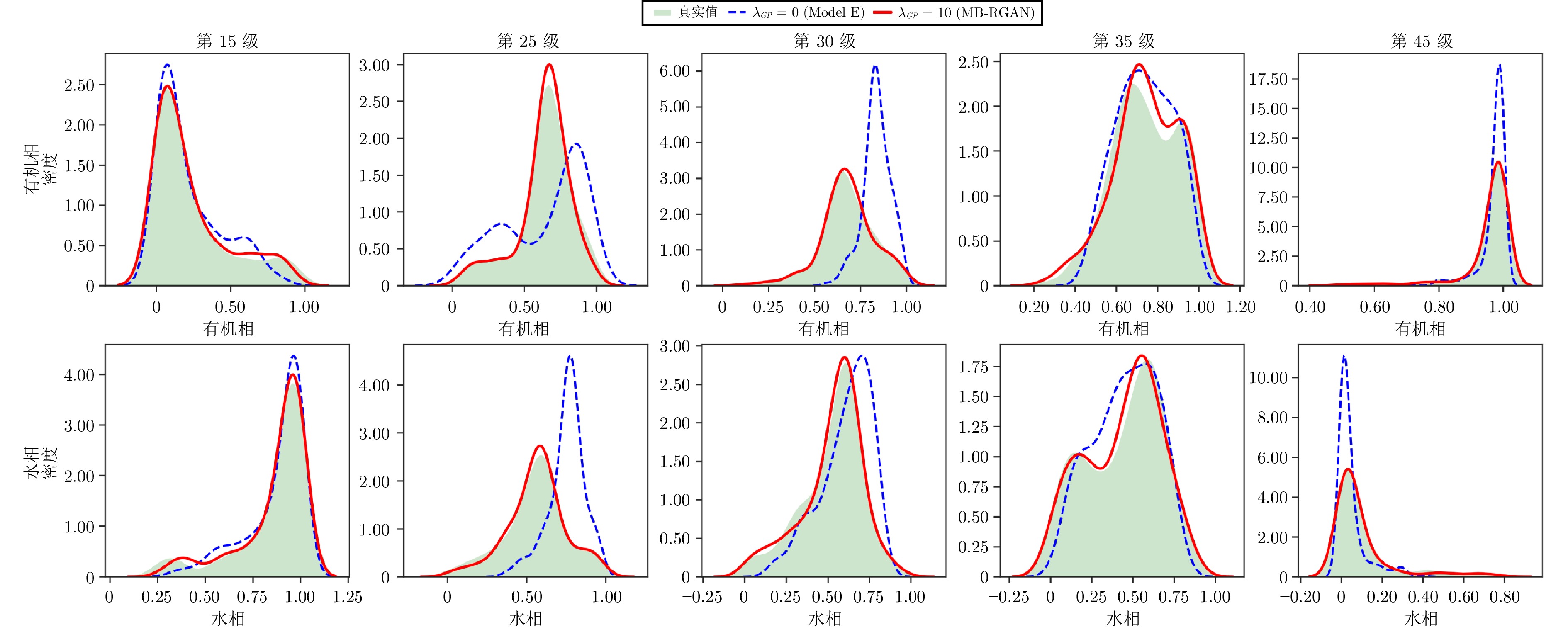
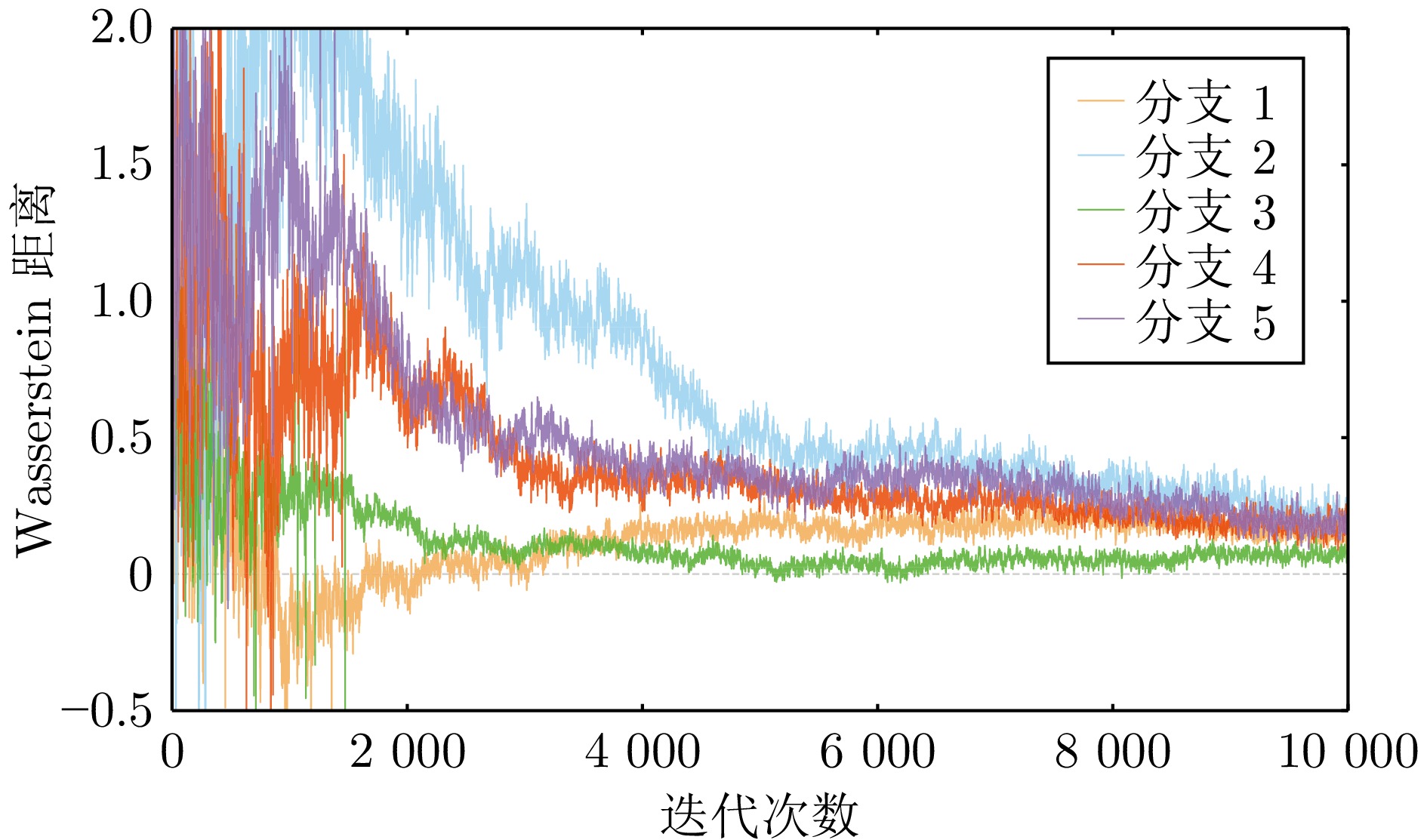
图 17 不同梯度惩罚系数下的组分分布核密度估计曲线对比
Fig. 17 Comparison of kernel density estimation curves for component distributions under different gradient penalty coefficients
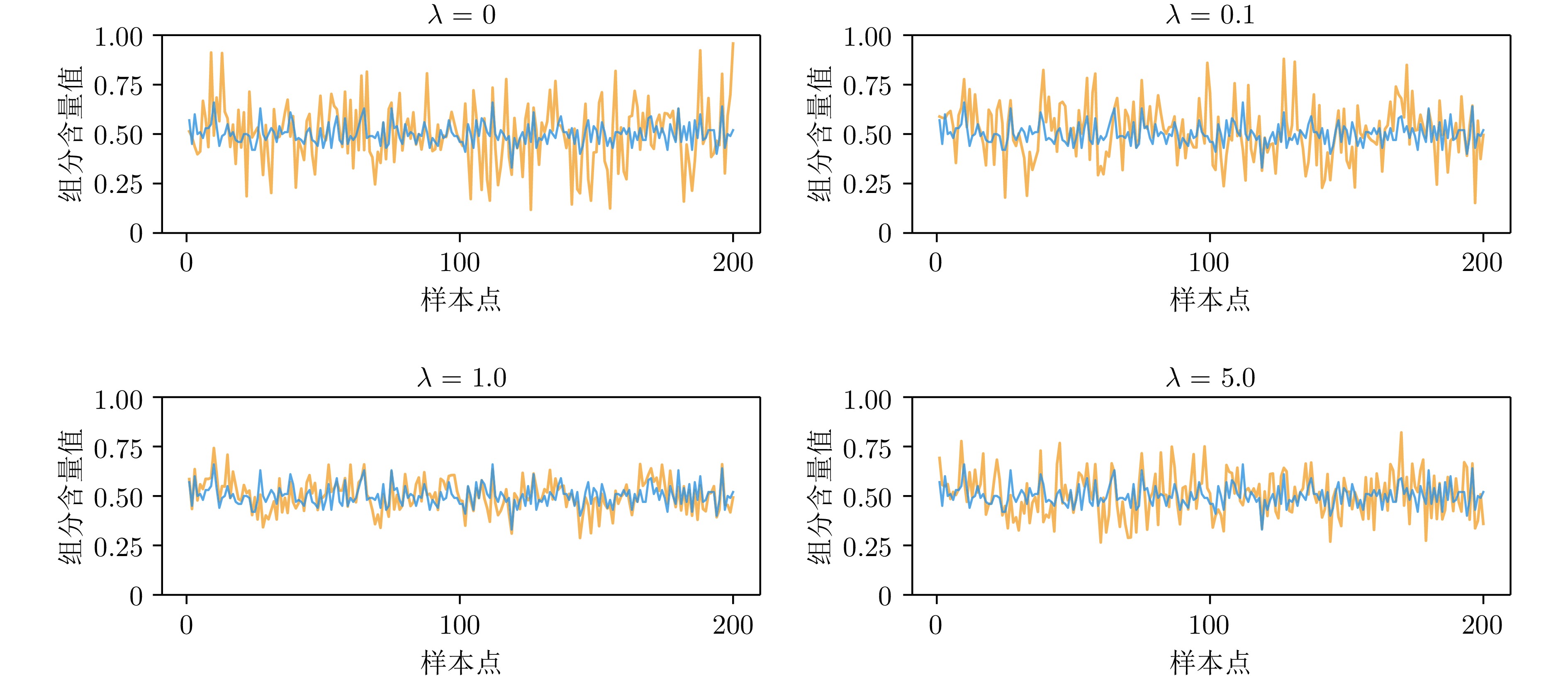
图 18 超参数$\lambda $对生成组分含量样本质量的影响
Fig. 18 The influence of the hyperparameter $\lambda $ on the quality of the generated component concentration samples
表 1 工艺输入变量
Table 1 Process input variables
输入变量 物理意义描述 $c_1$ La元素组分含量 $c_2$ Ce元素组分含量 $c_3$ Pr元素组分含量 $c_4$ Nd元素组分含量 $c_5$ Ce/La元素间分离系数 $c_6$ Pr/Ce元素间分离系数 $c_7$ Nd/Pr元素间分离系数 $c_8$ 主产品出口模式 $c_9$ 进料模式 $c_{10}$ 萃取剂流量 $c_{11}$ 洗涤剂流量 $c_{12}$ 进料级数 $c_{13}$ 有机相出口分数 $c_{14}$ 水相出口分数  下载: 导出CSV
表 2 各模型最佳超参数设置
Table 2 Optimal hyperparameter settings for each model
模型 关键参数 SVR 惩罚系数 $C=1$, 核系数 $\gamma=0.1$, 不敏感区宽度 $\epsilon=0.01$ XGBoost 学习率 $lr=0.05$, 子采样率 $S=0.8$, 最大深度: 5 BPNN 隐藏层单元数: 64, 学习率 $lr=0.001$ LSTM 隐层神经元数: 128, 学习率 $lr=0.01$, Dropout: 0.2 GRU 隐层神经元数: 128, 学习率 $lr=0.01$, Dropout: 0.2 CGAN 生成器学习率 $lr_G=0.000\; 2$, 判别器学习率 $lr_D=0.000 \;2$, ${L}_1$范数权重 $\lambda_{L1}=10$ MB-DNN 隐层神经元数: 64, 学习率 $lr=0.001$, Dropout: 0.2 MB-RDN 隐层神经元数: 64, 学习率 $lr=0.001$, Dropout: 0.2 MB-RGAN 生成器学习率 $ \eta_G=0.000 \;1$, 判别器学习率 $ \eta_D=0.000\; 1$, 回归器学习率 $ \eta_R=0.001$, $\lambda_{GP}=10$, $\lambda_1=\lambda_2=1$
下载: 导出CSV
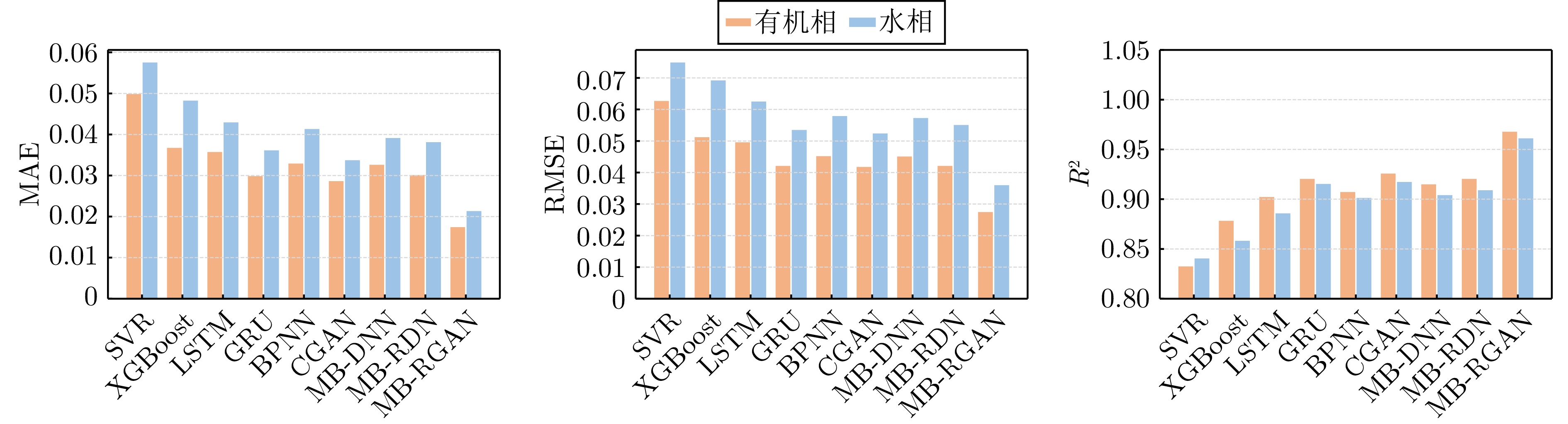
表 3 不同模型在测试集上的性能指标对比
Table 3 Comparison of performance metrics of different models on the test set
模型 组分 平均MAE 平均RMSE 平均$R^2$ SVR 有机相 0.050 0 0.062 9 0.833 1 水相 0.057 7 0.075 1 0.841 2 XGBoost 有机相 0.036 9 0.051 4 0.879 0 水相 0.048 4 0.069 4 0.858 9 LSTM 有机相 0.035 9 0.049 8 0.902 9 水相 0.043 1 0.062 7 0.886 5 GRU 有机相 0.030 0 0.042 3 0.921 1 水相 0.036 3 0.053 7 0.916 0 BPNN 有机相 0.033 1 0.045 4 0.907 9 水相 0.041 5 0.058 1 0.902 0 CGAN 有机相 0.028 8 0.042 0 0.926 4 水相 0.033 9 0.052 6 0.918 0 MB-DNN 有机相 0.032 8 0.045 3 0.915 6 水相 0.039 3 0.057 5 0.904 8 MB-RDN 有机相 0.030 3 0.042 3 0.921 1 水相 0.038 3 0.055 3 0.909 7 MB-RGAN 有机相 0.017 6 0.027 7 0.968 5 水相 0.021 5 0.036 2 0.961 9
下载: 导出CSV
表 4 模型计算复杂度与推理效率对比
Table 4 Comparison of model computational complexity and inference efficiency
模型 参数量 单样本推理耗时(ms) SVR N/A 1.01 XGBoost N/A 15.08 LSTM 148 682 18.99 GRU 114 634 19.64 BPNN 18 762 5.37 CGAN 57 354 4.99 MB-DNN 104 426 5.80 MB-RDN 172 682 7.79 MB-RGAN (G) 18 890 N/A MB-RGAN (Total) 461 233 26.10
下载: 导出CSV
表 5 消融实验变体模型设置
Table 5 Setting of the ablation experiment variant models
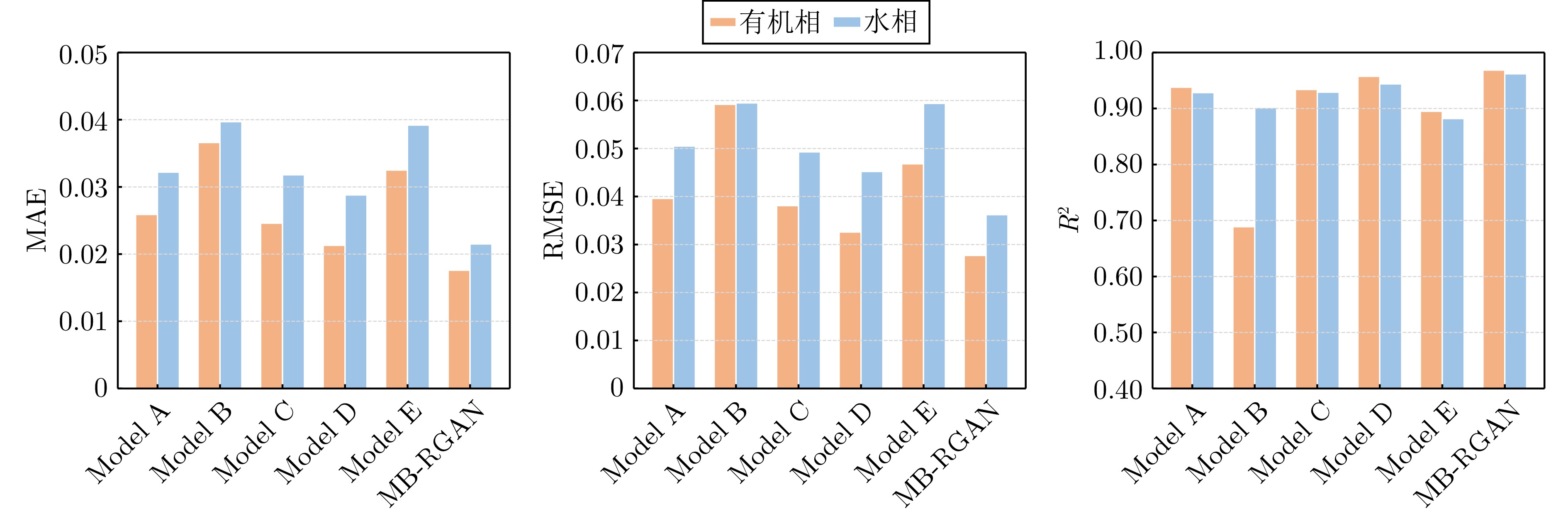
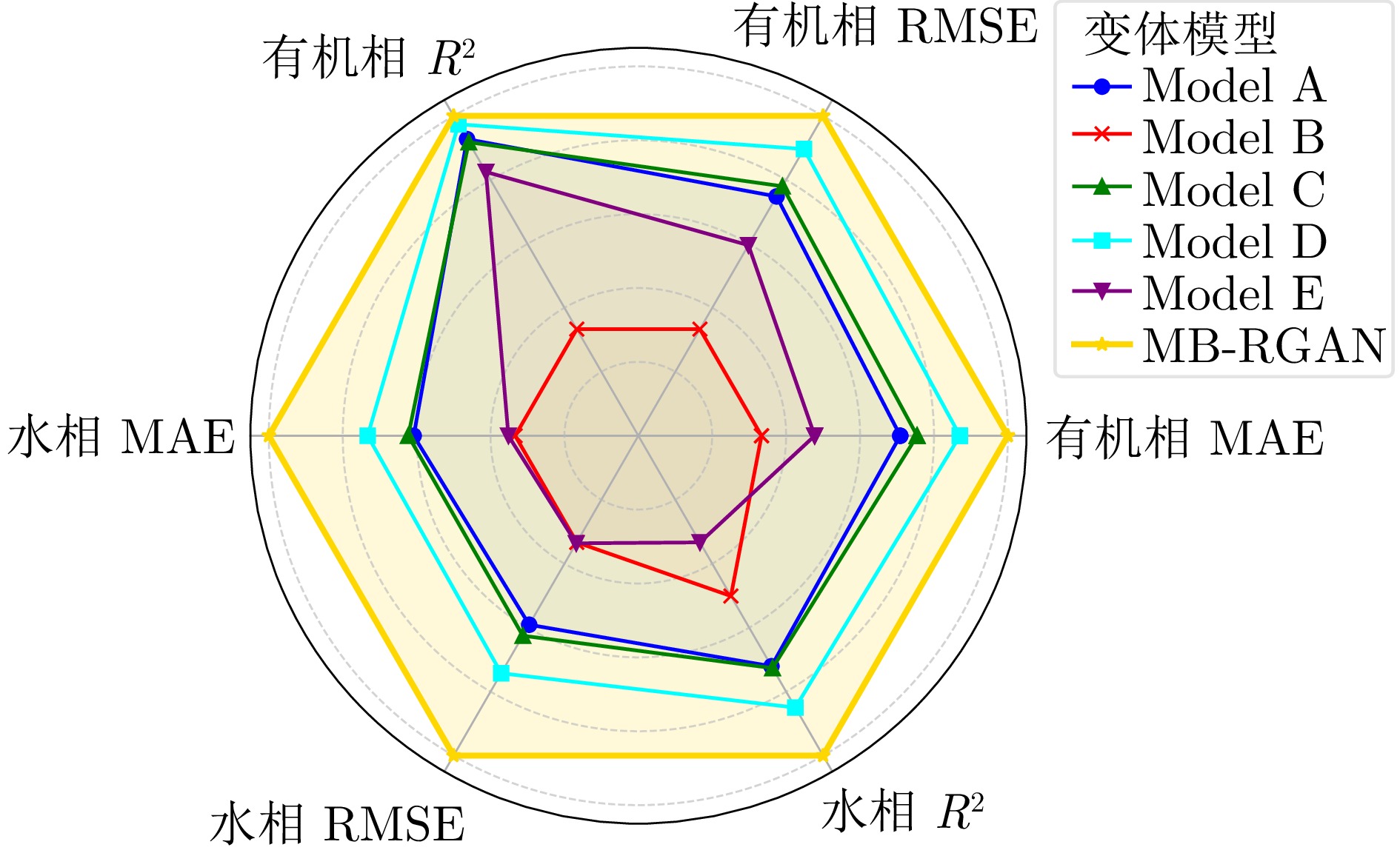
模型编号 核心变动描述 损失函数/训练策略 Model A 移除多分支结构, 仅在网络末端输出预测值 带梯度惩罚项的Wasserstein距离损失 + 回归一致性/递归训练 Model B 移除回归器R, 移除回归一致性约束 带梯度惩罚项的Wasserstein距离损失/递归训练 Model C 移除首层特征共享, D与R独立提取特征 带梯度惩罚项的Wasserstein距离损失 + 回归一致性/递归训练 Model D 移除递归训练, 所有层同时更新 全局端到端(end-to-end)训练 Model E 移除梯度惩罚项, 设定$\lambda_{GP}=0$ 无约束Wasserstein距离损失/递归训练 MB-RGAN 完整模型, 保留所有改进模块 带梯度惩罚项的Wasserstein距离损失 + 回归一致性/递归训练
下载: 导出CSV
表 6 不同变体模型的消融实验结果对比
Table 6 Comparison of ablation experiment results for different variant models
模型变体 组分 平均MAE 平均RMSE 平均$R^2$ Model A 有机相 0.025 9 0.039 6 0.938 0 水相 0.032 2 0.050 5 0.928 4 Model B 有机相 0.036 6 0.059 2 0.688 9 水相 0.039 7 0.059 5 0.902 1 Model C 有机相 0.024 6 0.038 1 0.934 0 水相 0.031 8 0.049 3 0.929 1 Model D 有机相 0.021 3 0.032 6 0.957 5 水相 0.028 8 0.045 2 0.943 9 Model E 有机相 0.032 5 0.046 8 0.895 0 水相 0.039 2 0.059 4 0.882 0 MB-RGAN 有机相 0.017 6 0.027 7 0.968 5 水相 0.021 5 0.036 2 0.961 9
下载: 导出CSV
-
[1] 冯宗玉, 王猛, 赵龙胜, 徐旸, 张永奇, 黄小卫. 稀土元素萃取分离提纯技术发展现状与展望. 中国稀土学报, 2021, 39(3): 469−478 doi: 10.11785/S1000-4343.20210310Feng Zong-Yu, Wang Meng, Zhao Long-Sheng, Xu Yang, Zhang Yong-Qi, Huang Xiao-Wei. Development status and prospect of rare earth extraction and separation technology. Journal of the Chinese Society of Rare Earths, 2021, 39(3): 469−478 doi: 10.11785/S1000-4343.20210310 [2] 徐光宪, 李标国, 严纯华. 串级萃取理论的进展及其在稀土工艺中的应用. 稀土, 1985(1): 56−67Xu Guang-Xian, Li Biao-Guo, Yan Chun-Hua. Progress on theory of counter current extraction and its applications in rare earth separation processes. Chinese Rare Earths, 1985(1): 56−67 [3] 吴声, 廖春生, 贾江涛, 严纯华. 多组分多出口稀土串级萃取静态优化设计研究(I)静态设计算法. 中国稀土学报, 2004, 22(1): 17−21 doi: 10.3321/j.issn:1000-4343.2004.01.003Wu Sheng, Liao Chun-Sheng, Jia Jiang-Tao, Yan Chun-Hua. Static design for multiple components and multiple outlets rare earth countercurrent extraction (I): Algorithm of static design. Journal of the Chinese Society of Rare Earths, 2004, 22(1): 17−21 doi: 10.3321/j.issn:1000-4343.2004.01.003 [4] 吴声, 廖春生, 贾江涛, 严纯华. 多组份多出口稀土串级萃取静态优化设计研究(Ⅱ)静态程序设计及动态仿真验证. 中国稀土学报, 2004, 22(2): 171−176 doi: 10.3321/j.issn:1000-4343.2004.02.001Wu Sheng, Liao Chun-Sheng, Jia Jiang-Tao, Yan Chun-Hua. Static design for multi-component and multi-outlet rare earth counter-current extraction (Ⅱ): Static design and its verification. Journal of the Chinese Society of Rare Earths, 2004, 22(2): 171−176 doi: 10.3321/j.issn:1000-4343.2004.02.001 [5] 朱建勇, 杨辉, 陆荣秀, 徐芳萍, 余运俊. 基于静态设定和动态补偿的铈镨/钕萃取过程药剂量优化控制. 自动化学报, 2019, 45(6): 1186−1197 doi: 10.16383/j.aas.c170666Zhu Jian-Yong, Yang Hui, Lu Rong-Xiu, Xu Fang-Ping, Yu Yun-Jun. Static setting and dynamic compensation based optimal control for the flow rate of the reagent in CePr/Nd extraction process. Acta Automatica Sinica, 2019, 45(6): 1186−1197 doi: 10.16383/j.aas.c170666 [6] 杨辉, 柴天佑. 串级萃取分离组分含量软测量及应用. 有色冶金设计与研究, 2003(S1): 129−134Yang Hui, Chai Tian-You. Concatenation extraction separation constituent content soft measurement and application. Nonferrous Metallurgical Design and Research, 2003(S1): 129−134 [7] Lyon K L, Utgikar V P, Greenhalgh M R. Dynamic modeling for the separation of rare earth elements using solvent extraction: Predicting separation performance using laboratory equilibrium data. Industrial & Engineering Chemistry Research, 2017, 56(4): 1048−1056 doi: 10.1021/acs.iecr.6b04009 [8] Srivastava V, Werner J, Honaker R. Design of multi-stage solvent extraction process for separation of rare earth elements. Mining, 2023, 3(3): 552−578 doi: 10.3390/mining3030031 [9] Ryu K H, Lee C, Lee G G, Jo S, Sung S W. Modeling and simulation of solvent extraction processes for purifying rare earth metals with PC88A. Korean Journal of Chemical Engineering, 2013, 30(10): 1946−1953 doi: 10.1007/s11814-013-0135-3 [10] Yun C Y, Lee C, Lee G G, Jo S, Sung S W. Modeling and simulation of multicomponent solvent extraction processes to purify rare earth metals. Hydrometallurgy, 2016, 159: 40−45 doi: 10.1016/j.hydromet.2015.11.001 [11] 常智舵, 吴声, 程福祥, 廖春生, 严纯华. 稀土萃取分离中混合澄清槽的仿真模拟系统. 中国稀土学报, 2023, 41(3): 623−630 doi: 10.11785/S1000-4343.20230318Chang Zhi-Duo, Wu Sheng, Cheng Fu-Xiang, Liao Chun-Sheng, Yan Chun-Hua. Simulation system of mixer-settlers in rare earth extraction separation. Journal of the Chinese Society of Rare Earths, 2023, 41(3): 623−630 doi: 10.11785/S1000-4343.20230318 [12] 陆荣秀, 饶运春, 杨辉, 朱建勇, 杨刚. 基于改进即时学习算法的镨/ 钕元素组分含量预测. 控制理论与应用, 2020, 37(8): 1846−1854 doi: 10.7641/CTA.2020.90479Lu Rong-Xiu, Rao Yun-Chun, Yang Hui, Zhu Jian-Yong, Yang Gang. Prediction of Pr/Nd component content based on improved just-in-time learning algorithm. Control Theory & Applications, 2020, 37(8): 1846−1854 doi: 10.7641/CTA.2020.90479 [13] Giles A E, Aldrich C, van J S J. Modelling of rare earth solvent extraction with artificial neural nets. Hydrometallurgy, 1996, 43(1): 241−255 doi: 10.1016/0304-386x(95)00098-2 [14] Ma L, Wang M, Peng K. A two-phase soft sensor modeling framework for quality prediction in industrial processes with missing data. Journal of Process Control, 2023, 129: Article No. 103061 doi: 10.1016/j.jprocont.2023.103061 [15] Anitha M, Singh H. Artificial neural network simulation of rare earths solvent extraction equilibrium data. Desalination, 2008, 232(1−3): 59−70 doi: 10.1016/j.desal.2007.10.037 [16] Teerapittayanon S, McDanel B, Kung H T. BranchyNet: Fast inference via early exiting from deep neural networks. arXiv preprint arXiv: 1709.01686, 2017. [17] Goodfellow I J, Pouget-Abadie J, Mirza M, Xu B, Warde-Farley D, Ozair S, et al. Generative adversarial nets. Advances in Neural Information Processing Systems, 2014: 2672−2680 [18] Zhang K. On mode collapse in generative adversarial networks. In: Proceedings of International Conference on Artificial Neural Networks. Virtual Event: Springer International Publishing, 2021. 563−574 [19] Mirza M, Osindero S. Conditional generative adversarial nets. arXiv preprint arXiv: 1411.1784, 2014. [20] Mohammadzadeh M, Ghadami A, Taheri A, Behzadipour S. cGAN-based high dimensional IMU sensor data generation for enhanced human activity recognition in therapeutic activities. Biomedical Signal Processing and Control, 2025, 103: Article No. 107476 doi: 10.1016/j.bspc.2024.107476 [21] Isola P, Zhu J Y, Zhou T, Efros A A. Image-to-image translation with conditional adversarial networks. In: Proceedings of the IEEE Conference on Computer Vision and Pattern Recognition. Honolulu, HI, USA: IEEE, 2017. 1125−1134 [22] Tavolara T E, Niazi M K K, Arole V, Chen W, Frankel W, Gurcan M N. A modular cGAN classification framework: Application to colorectal tumor detection. Scientific Reports, 2019, 9(1): Article No. 18969 doi: 10.1038/s41598-019-55257-w [23] Aggarwal K, Kirchmeyer M, Yadav P, Keerthi S S, Gallinari P. Benchmarking regression methods: A comparison with CGAN. arXiv preprint arXiv: 1905.12868, 2019. [24] Megahed M, Mohammed A. Multi-GANs with shared generator: An approach for handling mode collapse issue. In: Proceedings of the 6th International Conference on Computing and Informatics (ICCI). Cairo, Egypt: IEEE, 2024. 483−489 [25] 郑念祖, 丁进良. 基于Regression GAN的原油总氢物性预测方法. 自动化学报, 2018, 44(5): 915−921Zheng Nian-Zu, Ding Jin-Liang. Regression GAN based prediction for physical properties of total hydrogen in crude oil. Acta Automatica Sinica, 2018, 44(5): 915−921 [26] Barnett S A. Convergence problems with generative adversarial networks (GANs). arXiv preprint arXiv: 1806.11382, 2018. [27] Gulrajani I, Ahmed F, Arjovsky M, Dumoulin V, Courville A C. Improved training of Wasserstein GANs. arXiv preprint arXiv: 1704.00028, 2017. [28] Basak D, Pal S, Patranabis D C. Support vector regression. Neural Information Processing Letters and Reviews, 2007, 11(10): 203−224 [29] Chen T, Guestrin C. XGBoost: A scalable tree boosting system. In: Proceedings of the 22nd ACM SIGKDD International Conference on Knowledge Discovery and Data Mining. San Francisco, CA, USA: ACM, 2016. 785−794 [30] Hochreiter S, Schmidhuber J. Long short-term memory. Neural Computation, 1997, 9(8): 1735−1780 doi: 10.1162/neco.1997.9.8.1735 [31] Chung J, Gulcehre C, Cho K H, Bengio Y. Empirical evaluation of gated recurrent neural networks on sequence modeling. arXiv preprint arXiv: 1412.3555, 2014. [32] Rumelhart D E, Hinton G E, Williams R J. Learning representations by back-propagating errors. Nature, 1986, 323(6088): 533−536 doi: 10.1038/323533a0 [33] 朱建勇, 王伟, 杨辉, 徐芳萍, 陆荣秀. 基于多分支残差深层网络的稀土萃取流程模拟. 控制理论与应用, 2022, 39(12): 2242−2253 doi: 10.7641/CTA.2022.11057Zhu Jian-Yong, Wang Wei, Yang Hui, Xu Fang-Ping, Lu Rong-Xiu. Process simulation of rare earth extraction based on multi-branch residual deep network. Control Theory & Applications, 2022, 39(12): 2242−2253 doi: 10.7641/CTA.2022.11057 -

 下载:
下载:

计量
- 文章访问数: 452
- HTML全文浏览量: 302
- PDF下载量: 74
- 被引次数: 0
