


Fuzzy Broad Model Predictive Control Based on Hybrid-driven and Gradient Optimization
-
摘要: 模型预测控制(MPC)是广泛应用于各类工业过程的先进过程控制策略. 深度神经网络能够提升传统MPC性能, 但存在计算复杂度高和过拟合风险. 在MPC中采用常规粒子群优化(PSO)虽具备全局搜索能力, 却因计算消耗和初始解依赖等问题难以满足实时控制需求. 针对上述问题, 提出基于混合驱动和梯度优化的模糊宽度MPC. 首先, 采用区间二型模糊宽度学习系统构建预测模型, 增强非线性建模和不确定性处理能力. 其次, 在滚动优化过程中, 引入梯度下降与PSO的协同策略, 以确保快速收敛并提升全局搜索性能, 同时利用系统样本数据库和粒子档案数据库构建知识−数据驱动的代理模型以降低计算消耗. 最后, 设计操纵变量基线求解策略以提高控制输出的安全性和可靠性. 通过典型非线性系统和实际城市固废焚烧过程控制的仿真实验, 验证了所提方法的有效性.Abstract: Model predictive control (MPC) is an advanced process control strategy widely applied across various industrial processes. Although deep neural networks have been used to enhance traditional MPC performance, they often suffer from high computational complexity and the risk of overfitting. While the application of conventional particle swarm optimization (PSO) in MPC offers global search capabilities, it struggles to meet real-time control requirements due to excessive computational overhead and strong dependency on initial solutions. To address these challenges, this paper proposes a novel fuzzy broad model predictive control approach based on hybrid-driven and gradient optimization. Firstly, an interval type-2 fuzzy broad learning system is employed to construct the predictive model, thereby enhancing nonlinear modeling and uncertainty handling capabilities. Secondly, during the rolling optimization process, a hybrid strategy combining gradient descent and PSO is introduced to ensure fast convergence while improving global search performance. In addition, a knowledge-data-driven surrogate model is built by leveraging the system sample database and particle archive database to significantly reduce computational consumption. Finally, a baseline solving strategy for manipulated variables is designed to improve the safety and reliability of control outputs. The effectiveness of the proposed method is verified through simulation experiments on typical nonlinear systems and actual municipal solid waste incineration process.
-
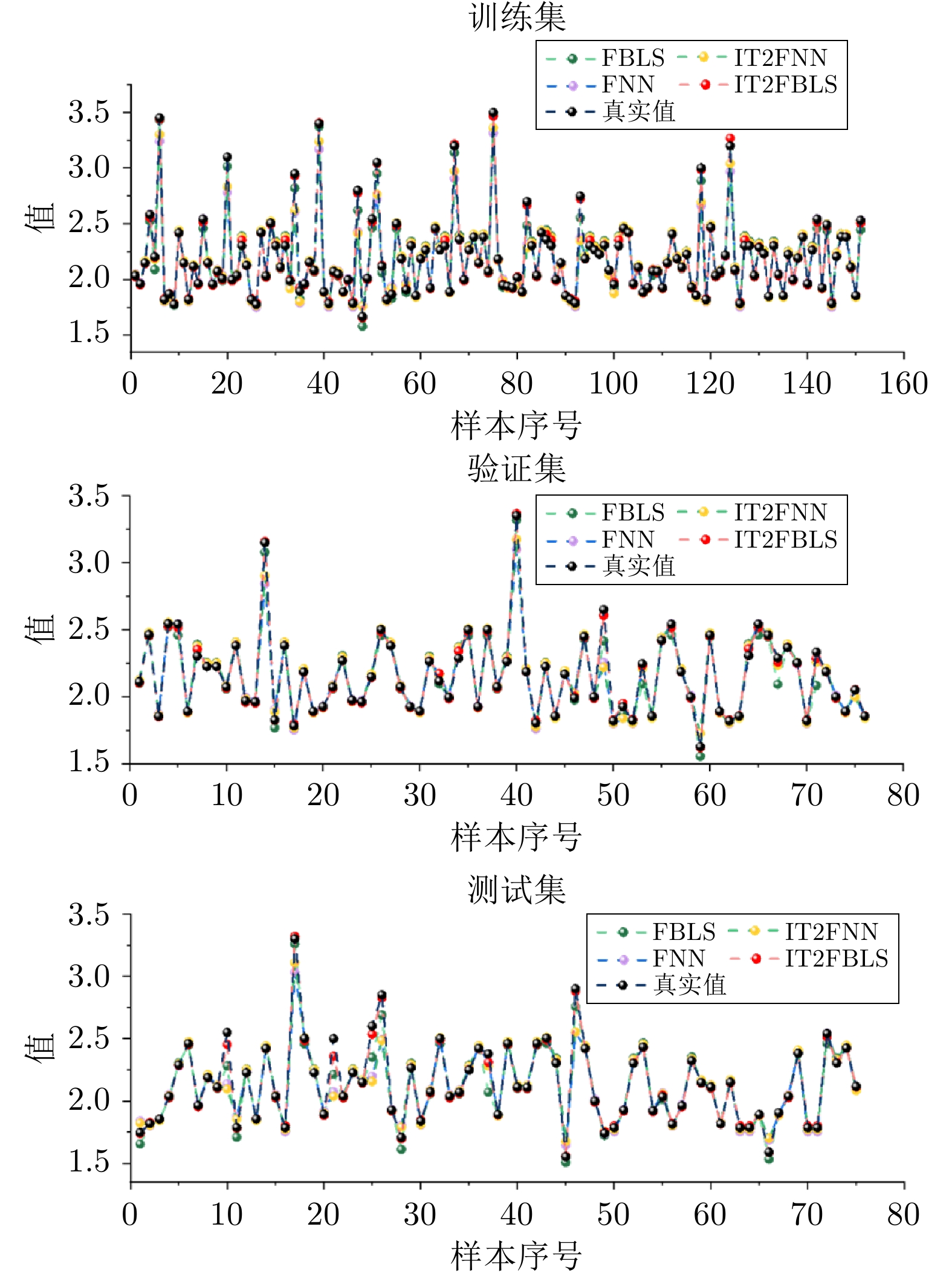
图 4 数值仿真实验中预测模型的拟合曲线图
Fig. 4 Fitting curve diagram of the prediction model in the numerical simulation experiment
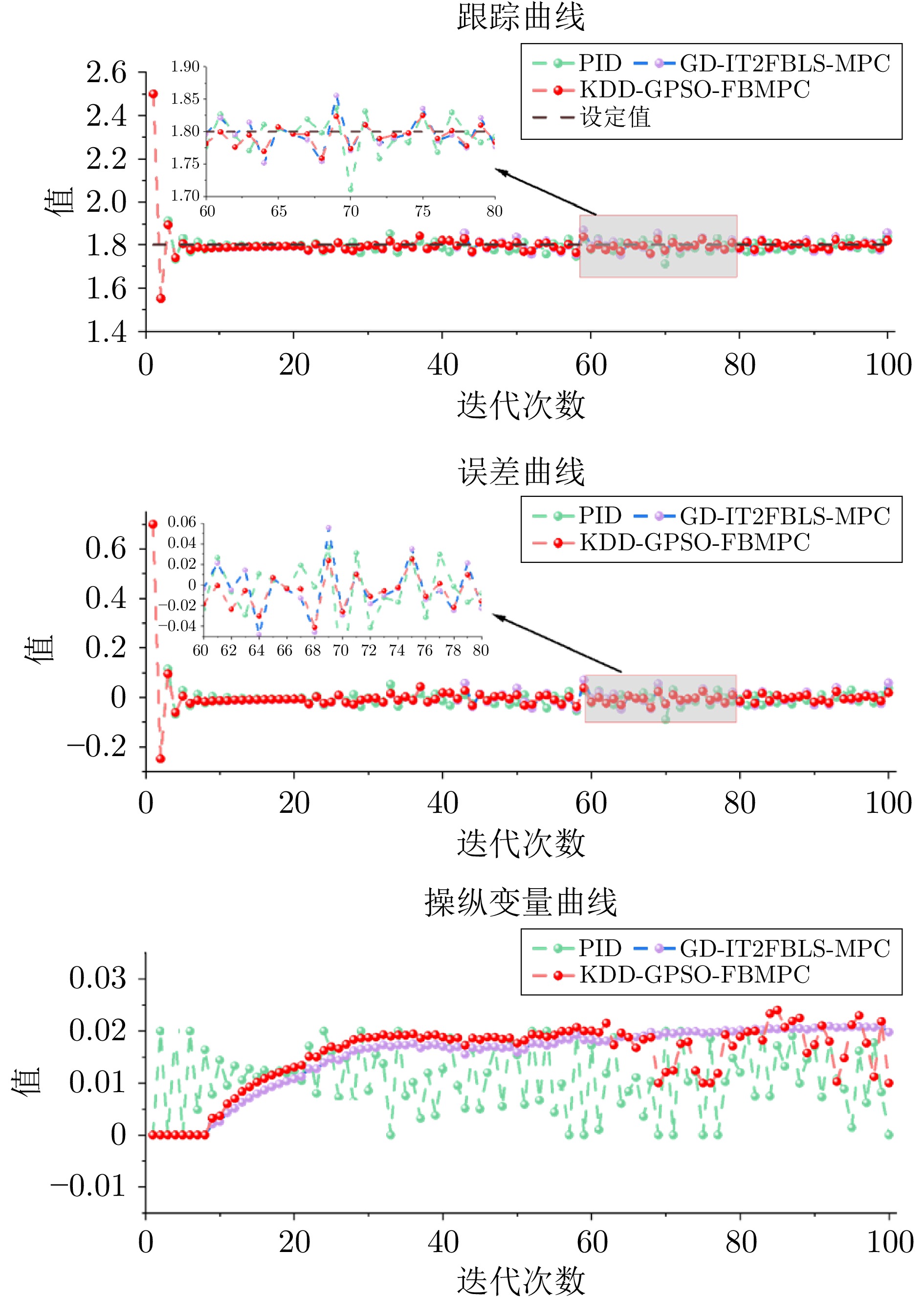
图 5 数值仿真实验中案例1的跟踪、误差与MV曲线
Fig. 5 Tracking, error and MV curves of case 1 in the numerical simulation experiment
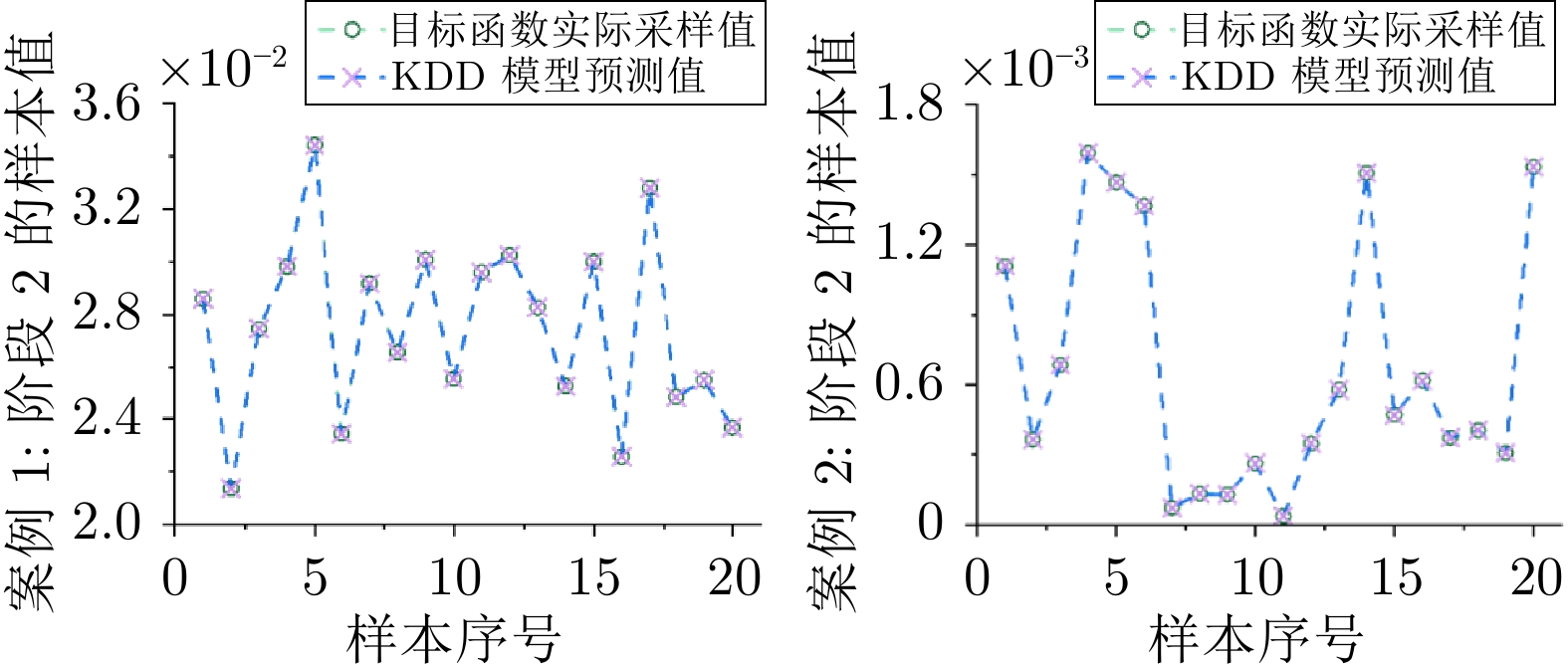
图 6 数值仿真实验中案例1和案例2的KDD模型拟合曲线
Fig. 6 KDD model fitting curves of case 1 and case 2 in the numerical simulation experiment
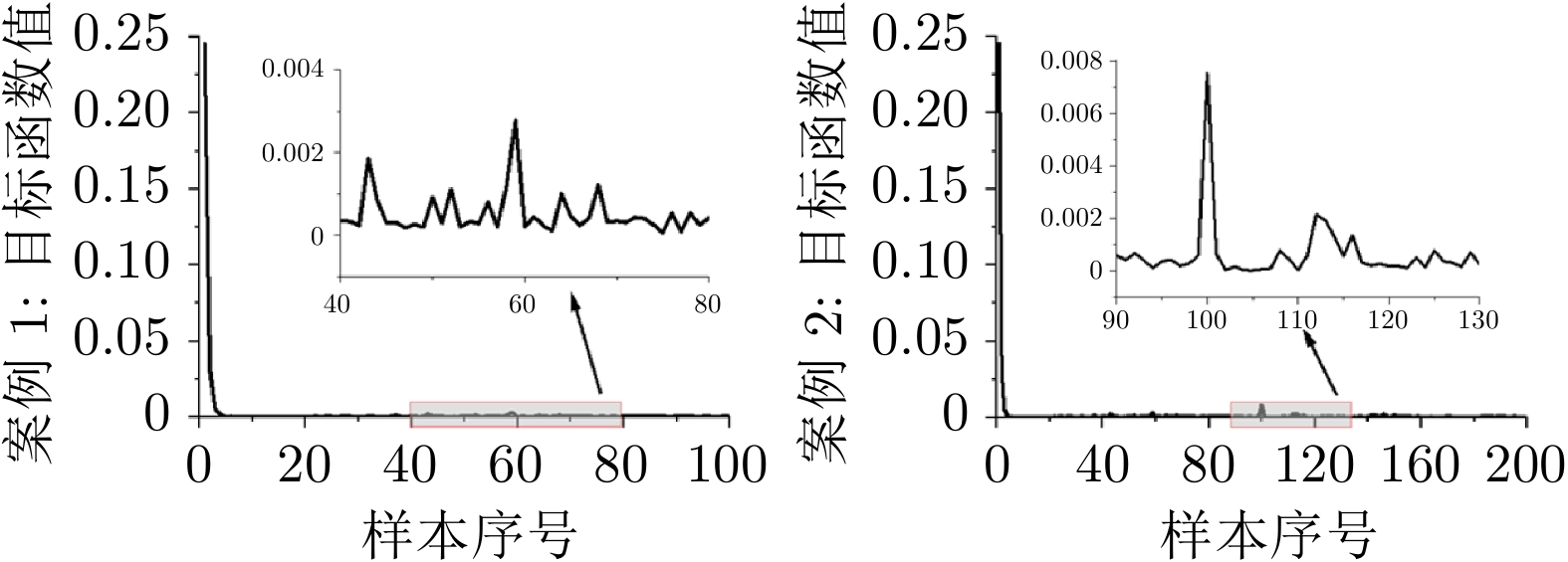
图 7 数值仿真实验中案例1和案例2的目标函数下降曲线
Fig. 7 Objective function descent curves of case 1 and case 2 in the numerical simulation experiment
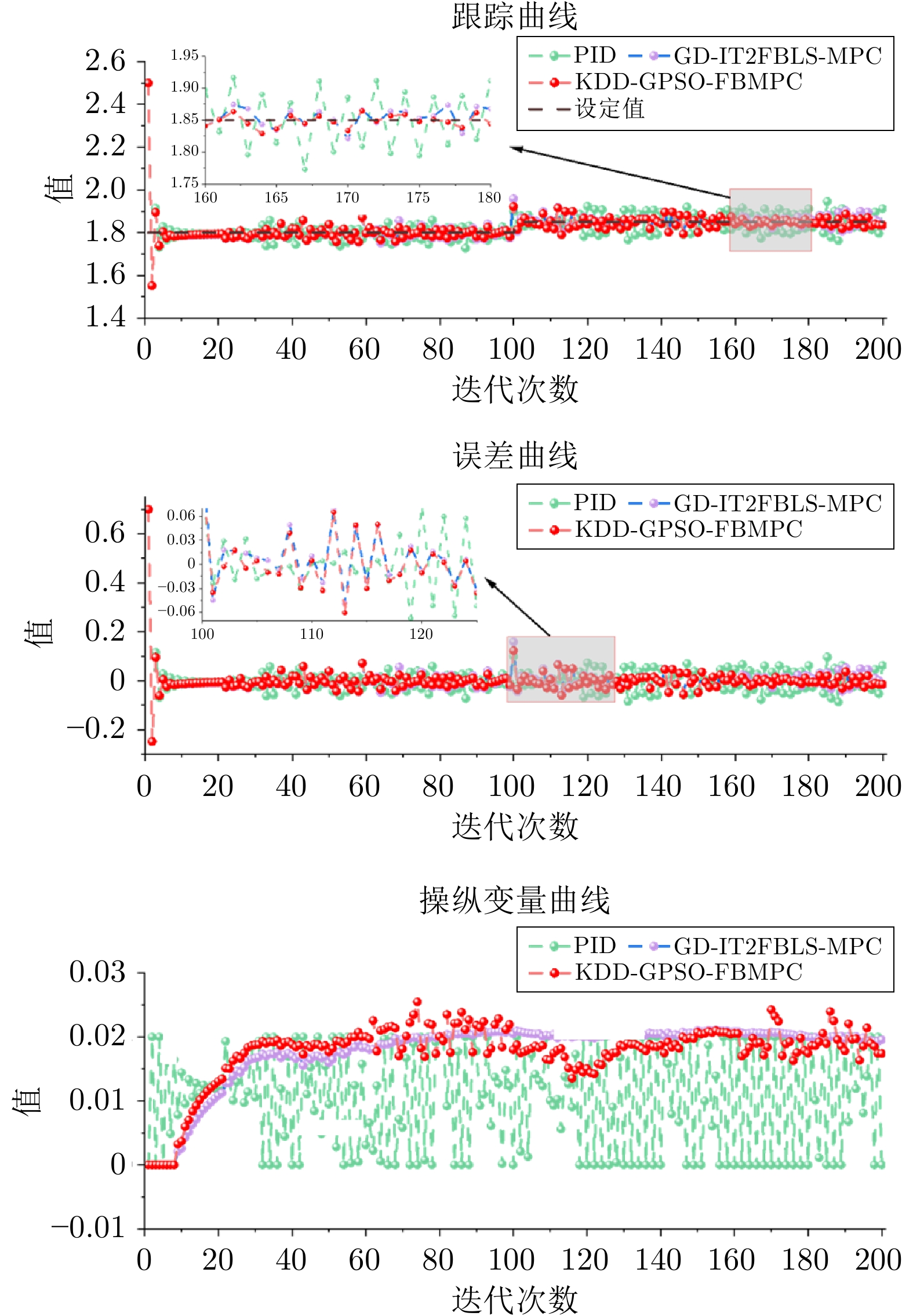
图 8 数值仿真实验中案例2的跟踪、误差与MV曲线
Fig. 8 Tracking, error and MV curves of case 2 in the numerical simulation experiment
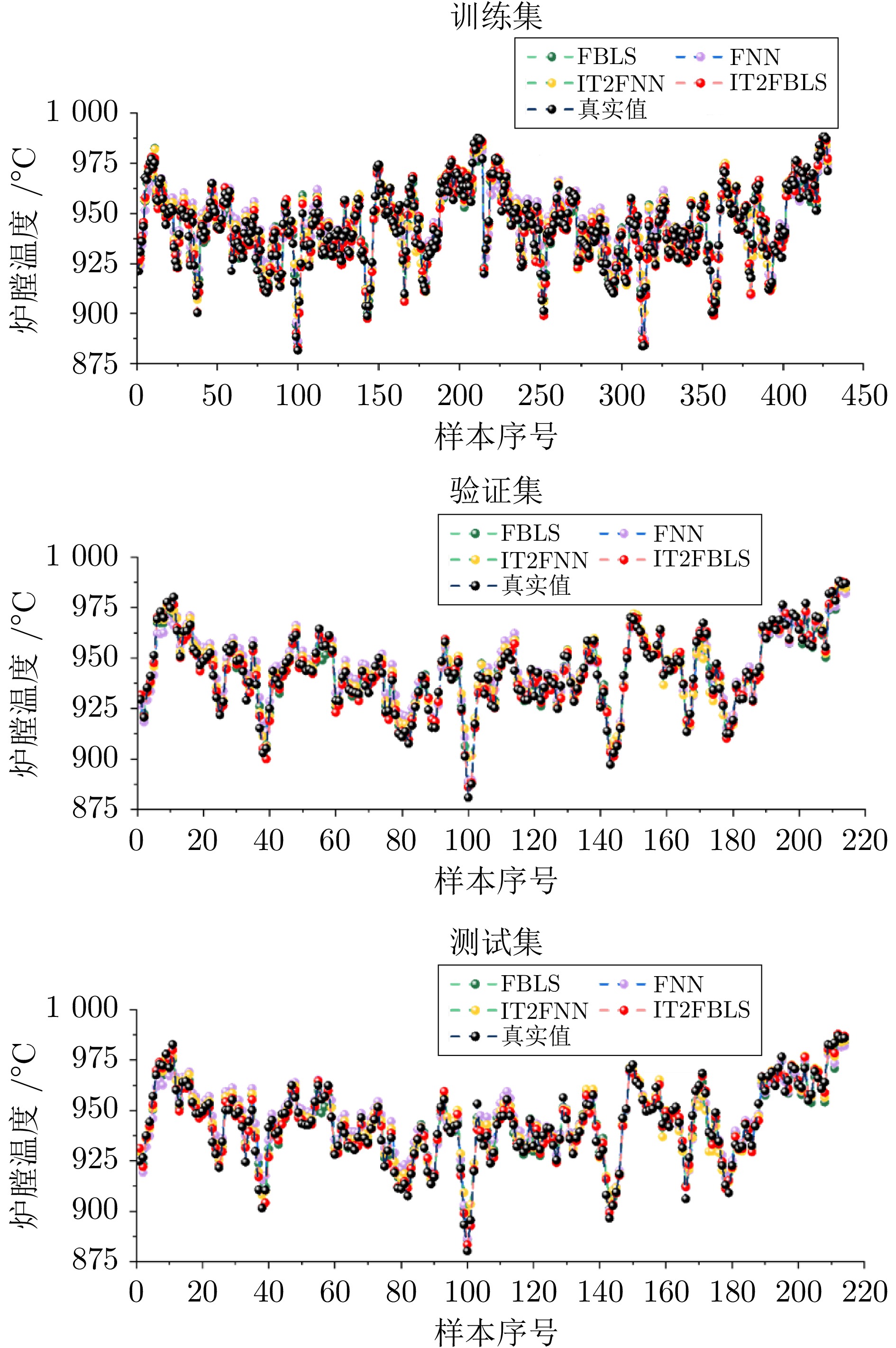
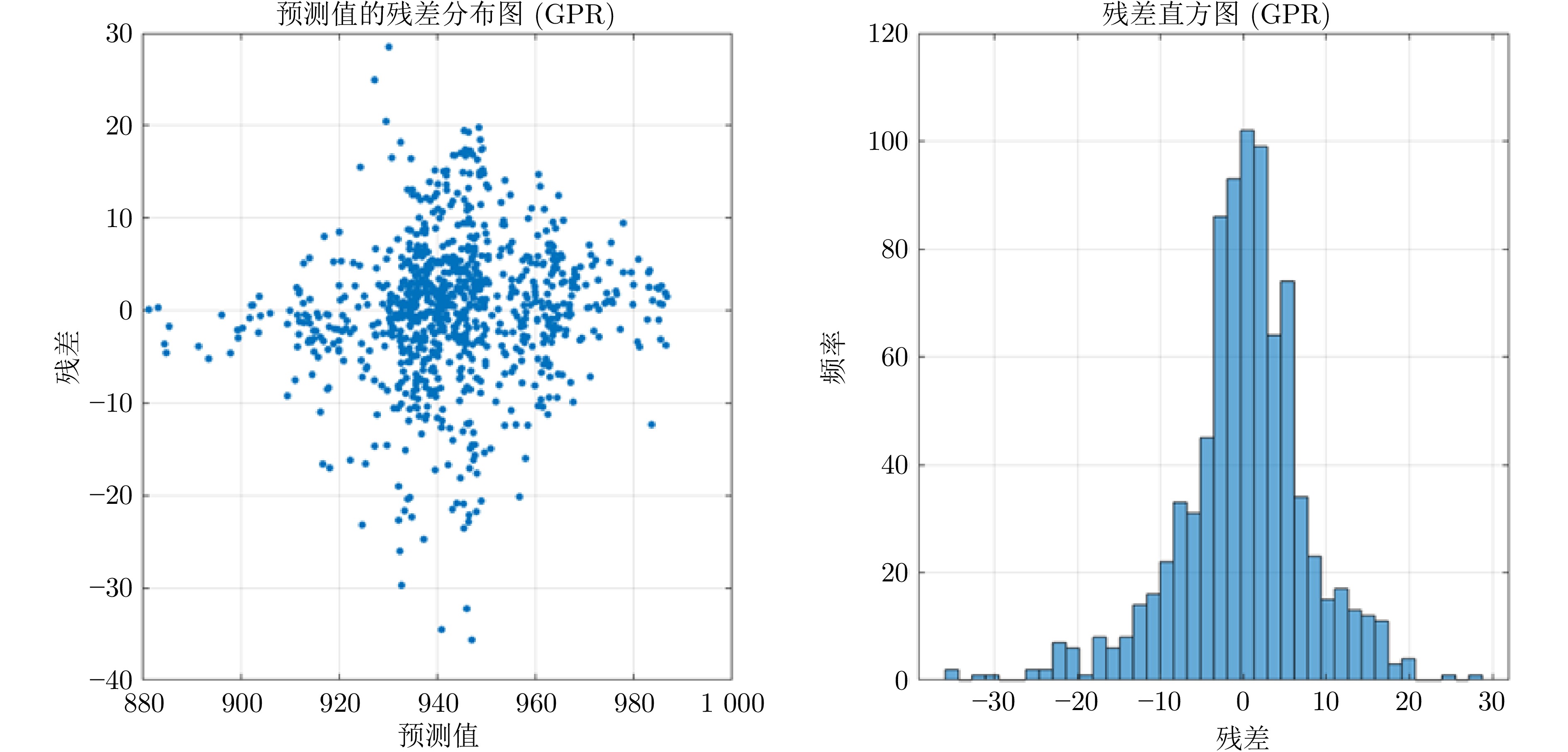
图 10 MSWI过程预测模型拟合曲线对比
Fig. 10 Comparison of fitting curves of MSWI process prediction models
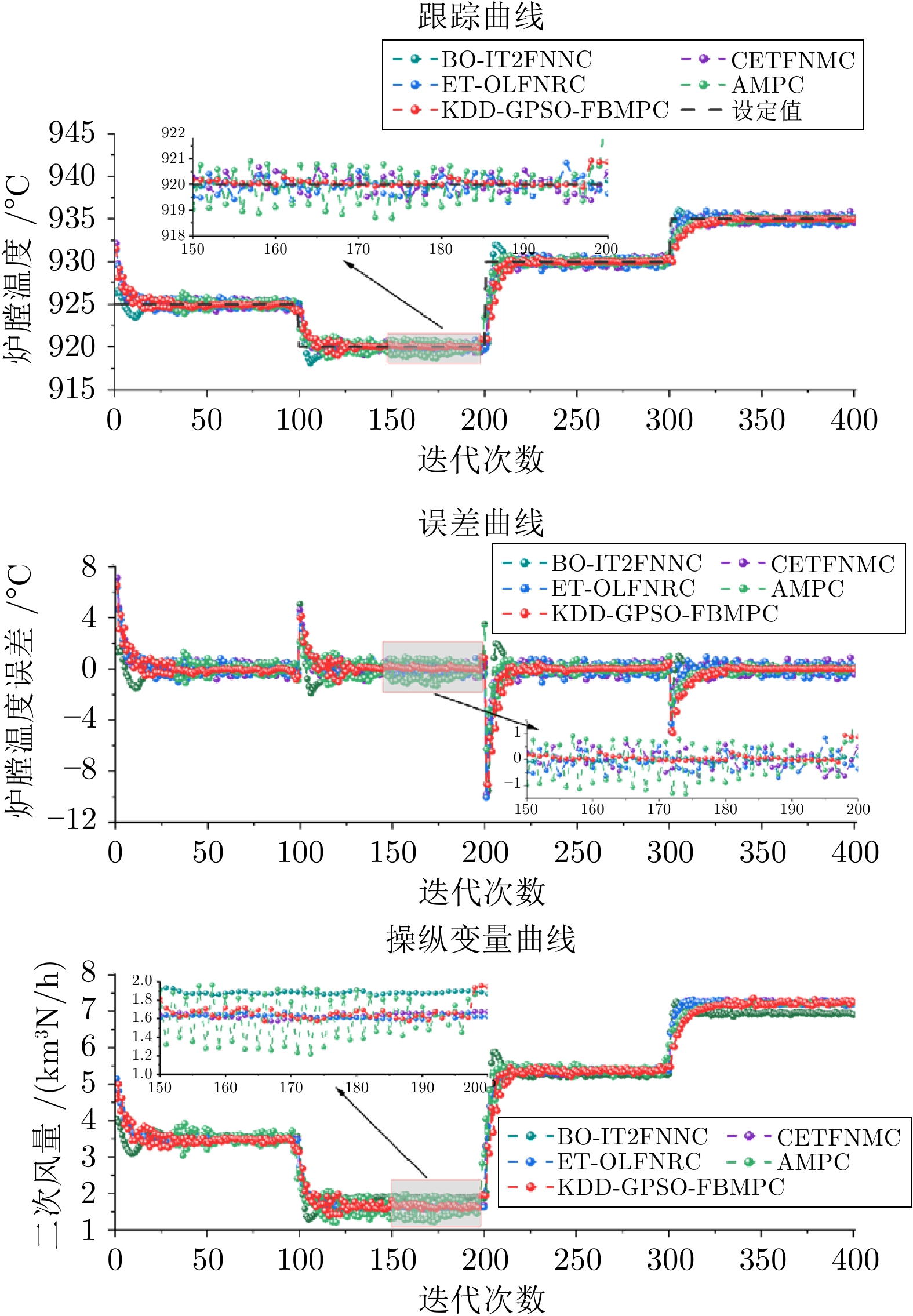
图 11 MSWI过程案例3的跟踪、误差与MV曲线
Fig. 11 Tracking, error and MV curves of case 3 in MSWI process
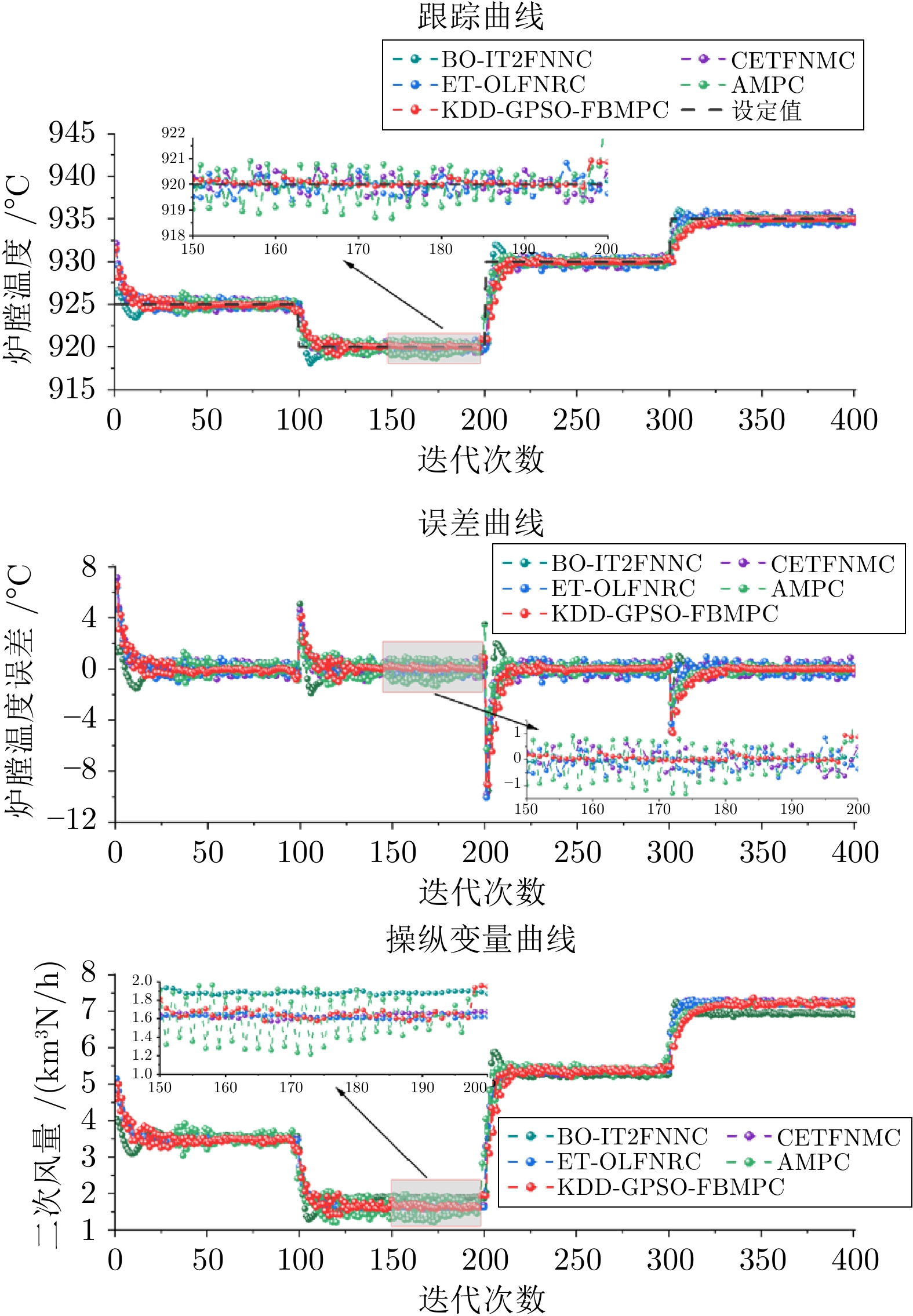
图 14 MSWI过程案例4的跟踪、误差与MV曲线
Fig. 14 Tracking, error and MV curves of case 4 in MSWI process
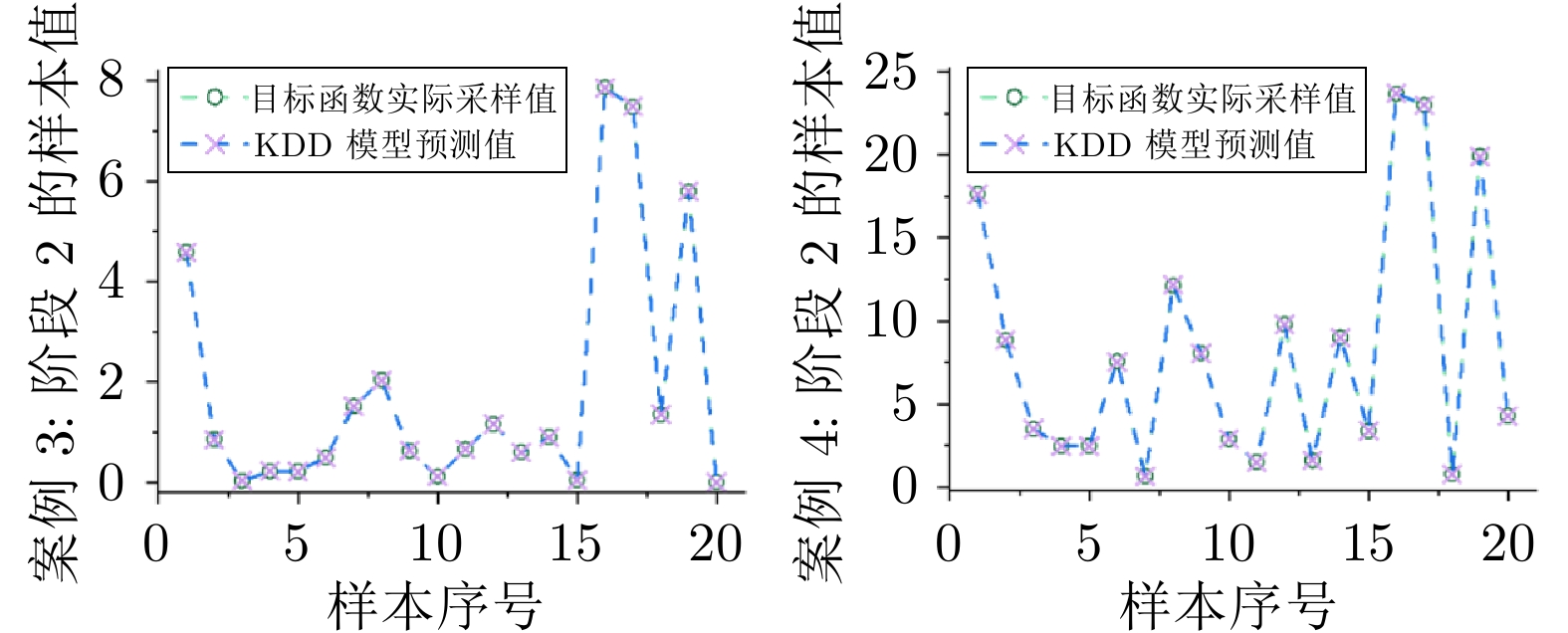
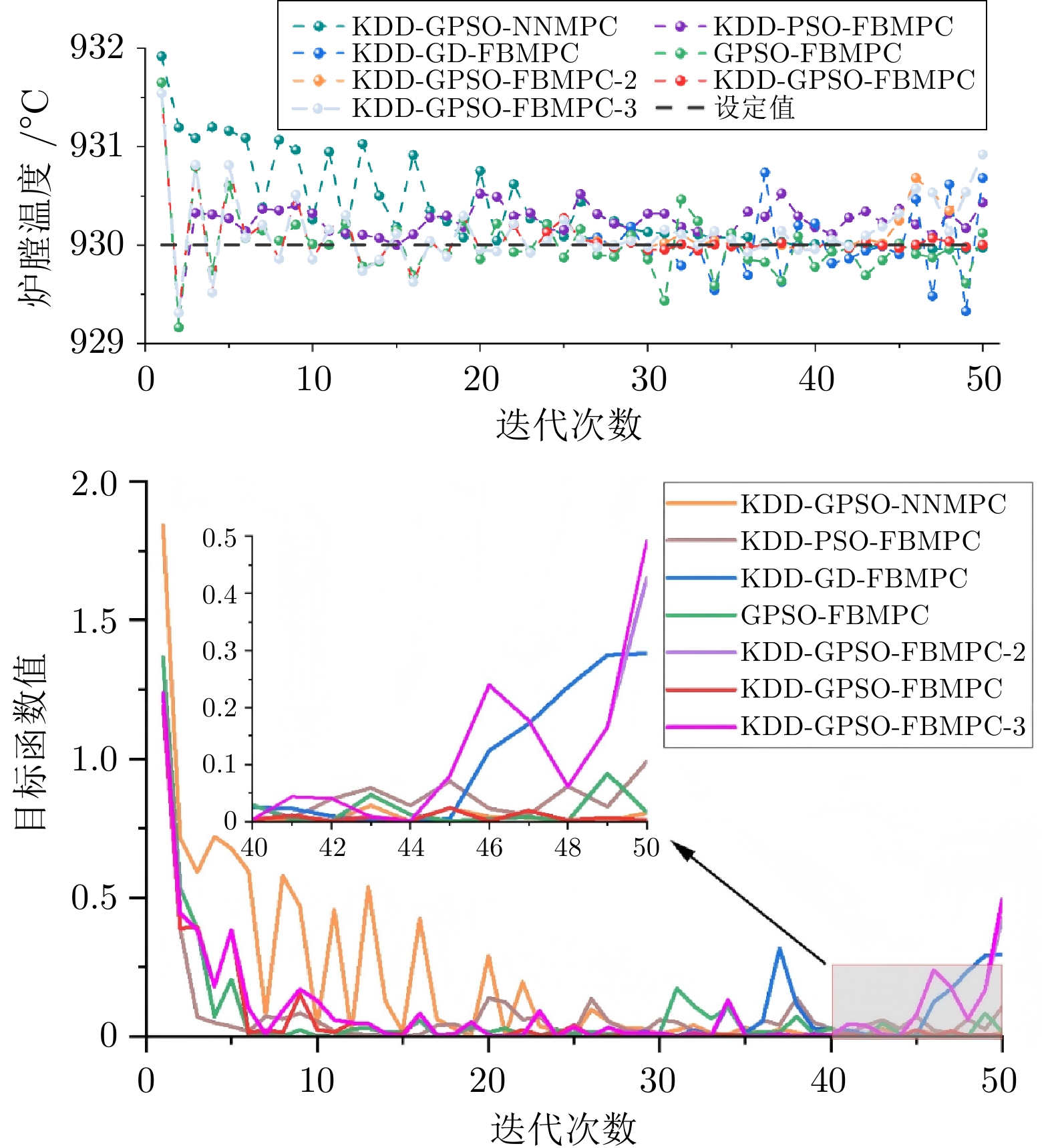
图 12 MSWI过程案例3与案例4的KDD模型的拟合曲线
Fig. 12 Fitting curves of KDD model of case 3 and case 4 in MSWI process
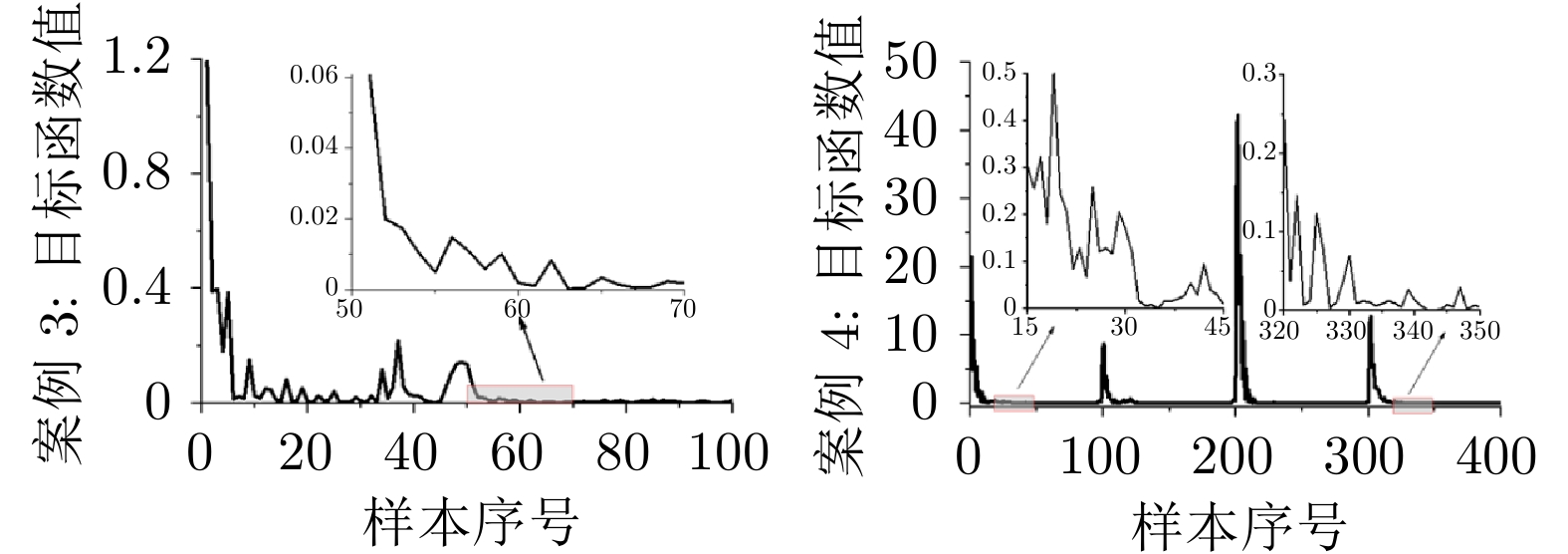
图 13 MSWI过程案例3与案例4的目标函数下降曲线
Fig. 13 Objective function descent curves of case 3 and case 4 in MSWI process
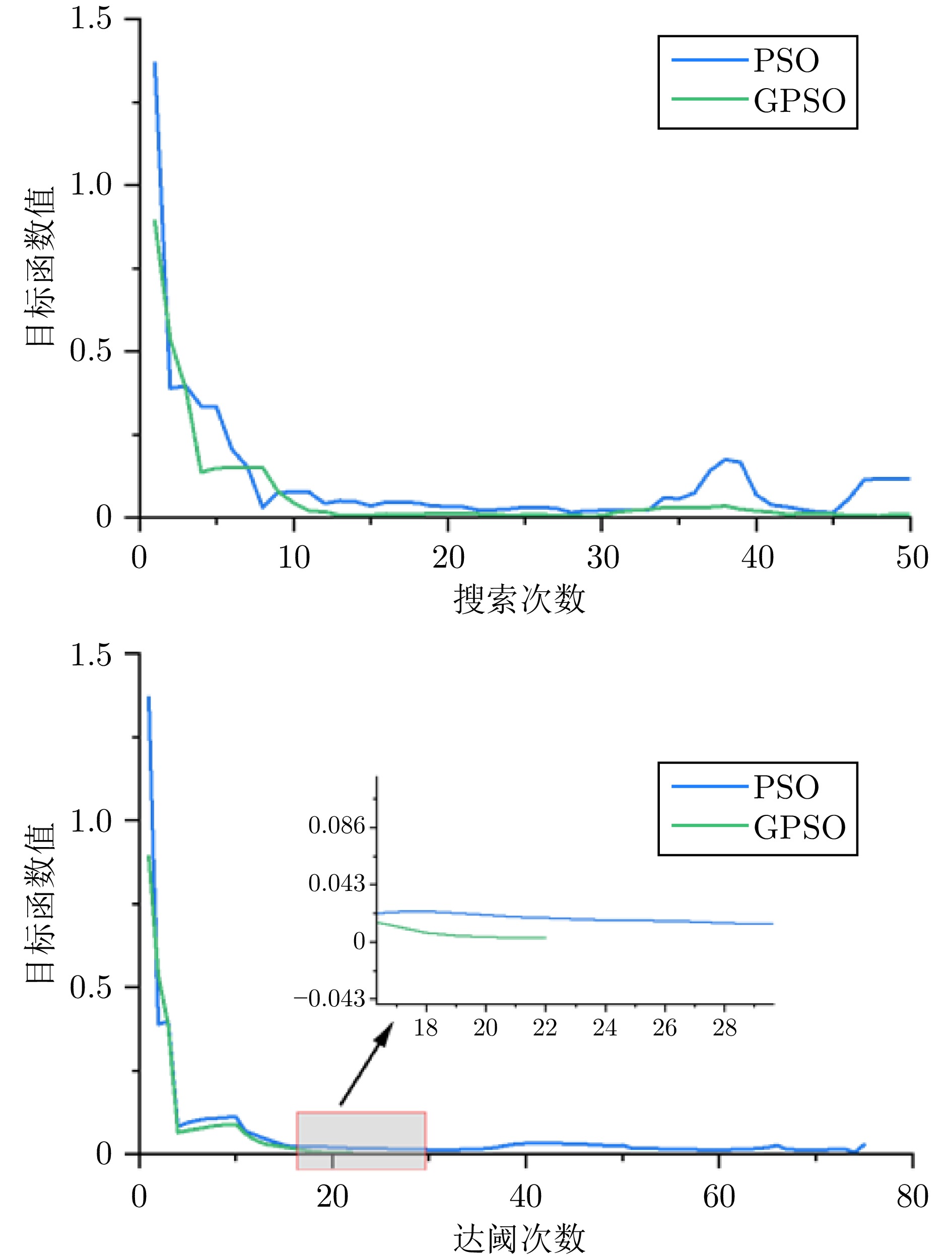
图 16 PSO和GPSO的收敛特性对比
Fig. 16 Comparison of convergence characteristics between PSO and GPSO
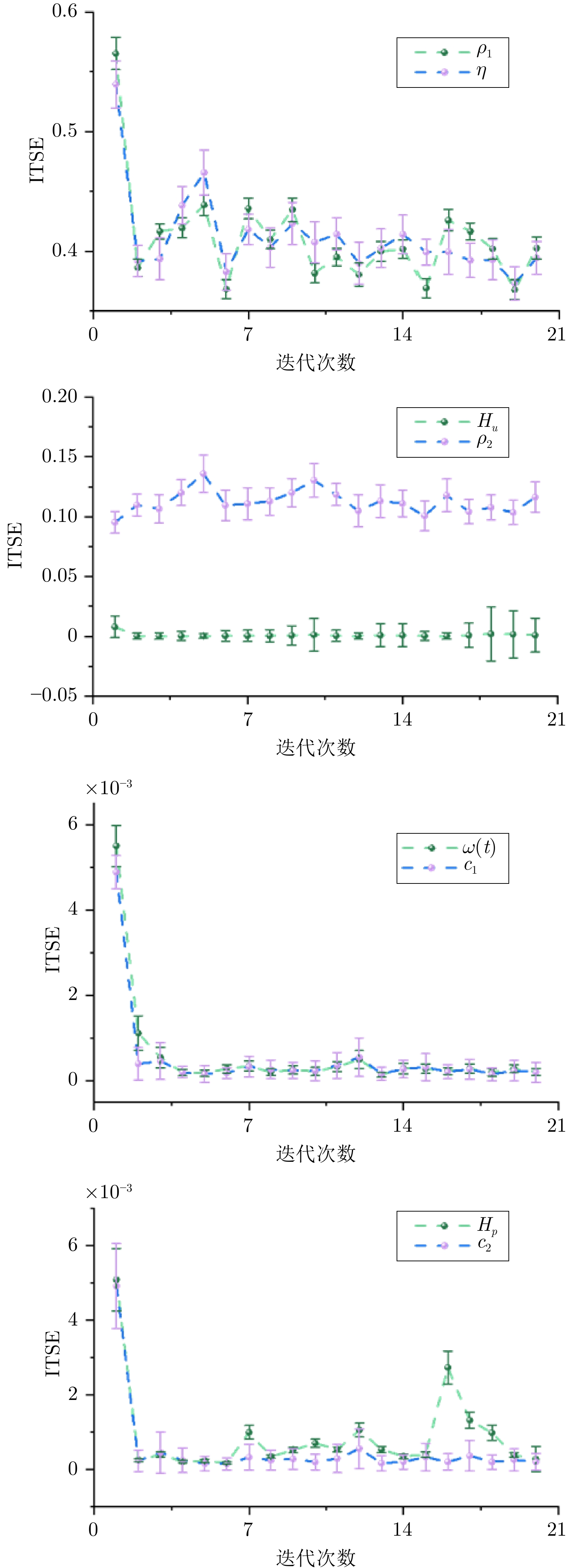
图 17 KDD-GPSO-FBMPC算法超参数分析曲线
Fig. 17 KDD-GPSO-FBMPC algorithm hyperparameter analysis curves
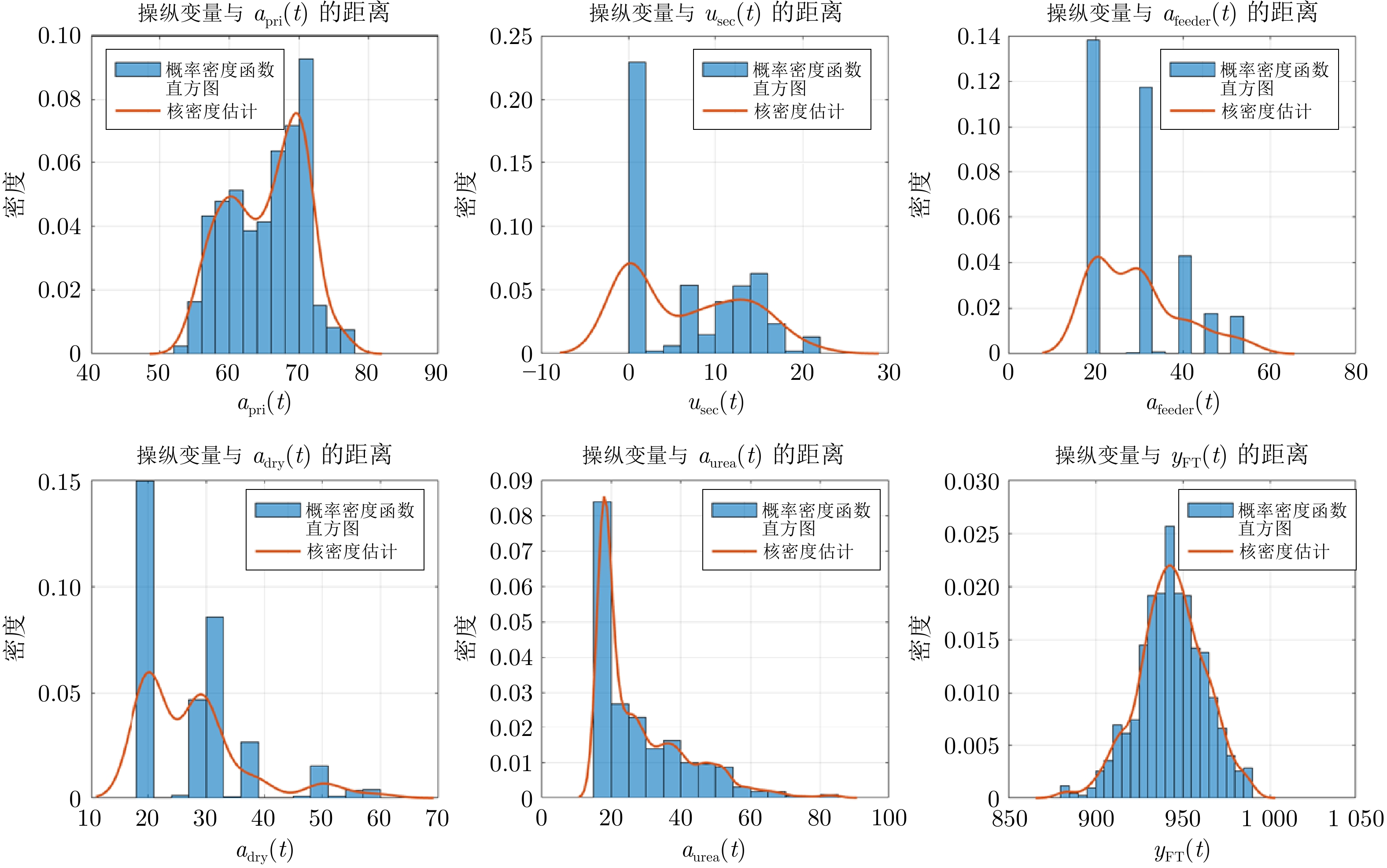
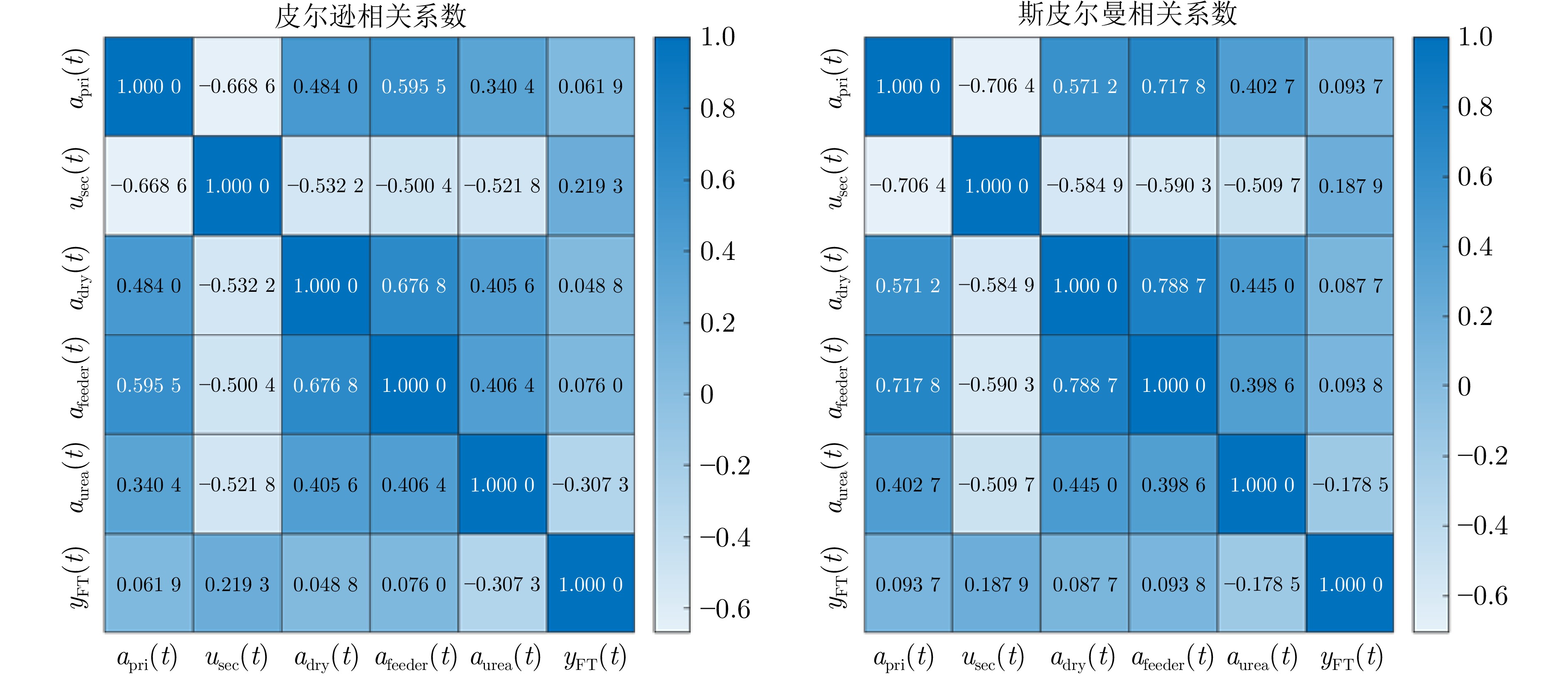
B1 操纵变量与被控变量的互相关图
B1 Cross-correlation plots between manipulated variable and controlled variable
表 1 文献中的系统知识和粒子分布知识对比
Table 1 Comparison of system knowledge and particle distribution knowledge in literature
文献 知识描述对象 知识来源 知识描述内容与应用领域 性能提升 [44] 非线性控制系统 控制系统的源域数据 知识用于构建基于FNN的知识驱动模型, 以补充数据驱动模型的网络结构; 污水处理过程最优控制 从知识驱动模型中提取结构知识, 以补充数据驱动模型的网络结构信息, 解决在线数据不足的问题 [45] 系统的历史操作信息 知识用于自适应初始化策略, 以动态预设KDD优化控制的参数, 提高对非线性系统变化的适应性; 污水处理过程最优控制 引入知识后, 算法能够更快地响应系统操作需求的变化, 提高了系统的动态优化能力和响应速度 [46] 控制系统的专家操作经验 知识包括多个操作模型和子控制器, 通过数据共享和知识驱动机制改善控制精度; 污水处理过程切换控制 引入知识后, 算法能够更有效地处理信息不足的问题, 提高了控制的准确性和系统的稳定性 [47] 专家经验和操作规则 知识用于指导控制器采取补救措施, 消除污泥膨胀;污水处理过程污泥膨胀的自愈控制 引入知识后, 算法能够及时准确地调节操作变量, 实现从污泥膨胀中的自我恢复与安全稳定运行 [48] 已学习的多任务自回归模型 从已建模的自回归模型中提取高炉过程的非线性动态; 工业高炉炼铁过程中的熔铁、质量指数的在线估计和控制 通过从已建模的自回归模型中提取知识, 提高新模型对数据波动的鲁棒性、提高模型的准确性和控制性能 [49] 专家经验、领域知识、操作知识 与工业实际过程数据结合, 设计混合智能高级反馈控制方法; 矿物加工操作中的磨矿回路控制 通过数据与知识结合可以很容易地构建出复杂的工业过程以及智能控制方法的设计 [40] PSO优化算法 多目标的全局最优粒子的当前和历史非支配解的分布信息 多目标粒子群优化算法中全局最优值的选择; 基准函数和锌电解优化问题 粒子分布知识的引入为多目标PSO算法在基准函数和锌电解优化问题上的性能进行了显著改进 [37] 精英粒子的当前和历史位置信息 基于FNN的知识提取方法、知识评估机制和知识重构策略; 软件项目调度、路径规划、污水工业过程 知识的引入提高了粒子的适应动态环境能力以及种群的搜索性能 [50] 不同任务间的最优粒子的当前和历史位置信息 不同任务之间决策空间维度; 不同情况下的知识转移问题、基准优化问题与污水处理工程 通过知识迁移可以并行解决多个优化问题, 利用任务之间的知识转移提高优化效率 [51] 目标空间和决策空间 在知识迁移中识别和度量不利于种群进化的知识; 特征选择、符号回归等基准优化问题 对不利于种群的知识进行处理, 在抑制负迁移和提高收敛性能方面作用显著  下载: 导出CSV
表 2 数值仿真实验中预测模型性能指标对比
Table 2 Comparison of performance indicators of the prediction models in the numerical simulation experiment
模型 数据集 RMSE MAE R2 IT2FBLS 训练集 $ 1.666\;8\times10^{-2} $ $ 1.094\;6\times10^{-2} $ $ 9.976\;5\times10^{-1} $ 验证集 $ 1.762\;3\times10^{-2} $ $ 1.156\;0\times10^{-2} $ $ 9.966\;0\times10^{-1} $ 测试集 $ 2.452\;1\times10^{-2} $ $ 1.256\;2\times10^{-2} $ $ 9.941\;8\times10^{-1} $ FBLS 训练集 $ 4.741\;8\times10^{-2} $ $ 2.943\;7\times10^{-2} $ $ 9.809\;8\times10^{-1} $ 验证集 $ 5.868\;7\times10^{-2} $ $ 3.335\;2\times10^{-2} $ $ 9.622\;8\times10^{-1} $ 测试集 $ 7.528\;9\times10^{-2} $ $ 3.931\;3\times10^{-2} $ $ 9.451\;4\times10^{-1} $ IT2FNN 训练集 $ 8.537\;3\times10^{-2} $ $ 4.145\;0\times10^{-2} $ $ 9.383\;5\times10^{-1} $ 验证集 $ 6.784\;8\times10^{-2} $ $ 3.320\;7\times10^{-2} $ $ 9.495\;9\times10^{-1} $ 测试集 $ 1.143\;2\times10^{-1} $ $ 5.070\;7\times10^{-2} $ $ 8.735\;2\times10^{-1} $ FNN 训练集 $ 9.015\;2\times10^{-2} $ $ 4.017\;9\times10^{-2} $ $ 9.312\;6\times10^{-1} $ 验证集 $ 6.940\;9\times10^{-2} $ $ 2.980\;5\times10^{-2} $ $ 9.472\;4\times10^{-1} $ 测试集 $ 1.097\;2\times10^{-1} $ $ 4.741\;6\times10^{-2} $ $ 8.834\;9\times10^{-1} $
下载: 导出CSV
表 3 数值仿真实验中案例1和案例2的控制性能指标对比
Table 3 Comparison of control performance indicators of case 1 and case 2 in the numerical simulation experiment
案例 控制器 ITSE IAE Devmax 时间 (s) 案例1 PID 8.2000 × 10−33.6100 × 10−27.0000 × 10−16.1900 × 10−1GD-IT2FBLS-MPC 3.8000 × 10−33.1500 × 10−27.0000 × 10−14.8416 × 100KDD-GPSO-FBMPC 2.1000 × 10−32.6503 × 10−27.0000 × 10−11.3651 × 101案例2 PID 1.1800 × 10−23.8400 × 10−27.0000 × 10−11.3140 × 100GD-IT2FBLS-MPC 7.8000 × 10−32.7300 × 10−27.0000 × 10−19.5155 × 100KDD-GPSO-FBMPC 4.9000 × 10−32.2367 × 10−27.0000 × 10−12.7572 × 101
下载: 导出CSV
表 4 MSWI过程预测模型指标对比
Table 4 Comparison of indicators of MSWI process prediction models
模型 数据集 RMSE MAE R2 IT2FBLS 训练集 3.2470 × 1002.5153 × 1009.7098 × 10−1验证集 3.2974 × 1002.5141 × 1009.7013 × 10−1测试集 3.4554 × 1002.5692 × 1009.6730 × 10−1FBLS 训练集 4.1178 × 1023.1869 × 1009.5333 × 10−1验证集 4.0783 × 1003.2040 × 1009.5431 × 10−1测试集 4.2255 × 1003.3709 × 1009.5111 × 10−1IT2FNN 训练集 4.6324 × 1003.5122 × 1009.4093 × 10−1验证集 4.6063 × 1003.4569 × 1009.4172 × 10−1测试集 4.8139 × 1003.6823 × 1009.3654 × 10−1FNN 训练集 5.9173 × 1004.8588 × 1009.0362 × 10−1验证集 5.7912 × 1004.7234 × 1009.0787 × 10−1测试集 5.9673 × 1004.8703 × 1009.0249 × 10−1
下载: 导出CSV
表 5 MSWI过程案例3与案例4的性能指标对比
Table 5 Performance indicators comparison of case 3 and case 4 in MSWI process
案例 控制器 ITSE IAE Devmax 时间 (s) 案例3 BO-IT2FNNC 2.8575 × 10−23.2800 × 10−13.9205 × 1008.4221 × 101CETFNMC 2.7355 × 10−23.2389 × 10−11.7313 × 1004.4747 × 10−1ET-OLFNRC 2.3614 × 10−22.4989 × 10−11.7313 × 1004.5439 × 10−1AMPC 2.6500 × 10−22.4801 × 10−11.6234 × 1001.0777 × 101KDD-GPSO-FBMPC 1.7213 × 10−21.7063 × 10−11.5438 × 1003.4101 × 101案例4 BO-IT2FNNC 4.3274 × 1005.4350 × 10−19.9399 × 1002.7355 × 101CETFNMC 4.0002 × 1005.5863 × 10−19.8047 × 1001.5080 × 101ET-OLFNRC 4.0314 × 1005.5171 × 10−19.8612 × 1001.5170 × 101AMPC 3.1669 × 1005.4212 × 10−16.5438 × 1003.8423 × 101KDD-GPSO-FBMPC 2.3457 × 1004.3130 × 10−16.5438 × 1001.8524 × 102
下载: 导出CSV
表 7 GPSO和PSO的收敛特性对比
Table 7 Comparison of convergence characteristics between GPSO and PSO
条件 $J_{\text{mean}}(t)$ $J_{\text{max}}(t)$ $J_{\text{min}}(t)$ 时间 (s) 实验a 50 s PSO ( 5.2533 $\pm$0.0321 ) × 10−45.2878 × 10−45.0412 × 10−4— GPSO ( 3.8422 $\pm$0.0212 ) × 10−44.0951 × 10−43.6325 × 10−4— 实验b $e=0.5$ PSO ( 3.1542 $\pm$0.0092 ) × 10−43.2423 × 10−43.0423 × 10−287 GPSO ( 3.1389 $\pm$0.0013 ) × 10−43.2254 × 10−43.0544 × 10−222
下载: 导出CSV
表 6 消融实验的性能指标对比
Table 6 Comparison of performance indicators of ablation experiments
控制器 ITSE IAE Devmax 时间 (s) BTF KDD-GPSO-NNMPC 2.5915 × 10−23.7724 × 10−11.9193 × 1001.9933 × 10111 KDD-PSO-FBMPC 2.1640 × 10−22.9156 × 10−11.5438 × 1004.8757 × 10136 KDD-GD-FBMPC 3.0979 × 10−22.9064 × 10−11.5438 × 1004.2719 × 100— GPSO-FBMPC 1.3500 × 10−22.3275 × 10−11.6534 × 1004.8139 × 10213 KDD-GPSO-FBMPC-3 2.8987 × 10−22.5930 × 10−11.6607 × 1002.4587 × 101— KDD-GPSO-FBMPC-2 2.4870 × 10−22.3819 × 10−11.5438 × 1002.6560 × 101— KDD-GPSO-FBMPC 4.8272 × 10−31.7440 × 10−11.5438 × 1002.6893 × 1016
下载: 导出CSV
-
[1] Schwenzer M, Ay M, Bergs T, Abel D. Review on model predictive control: An engineering perspective. The International Journal of Advanced Manufacturing Technology, 2021, 117(5−6): 1327−1349 doi: 10.1007/s00170-021-07682-3 [2] 楼嗣威, 张徐杰, 杨越麟, 李逸, 赵雨辰, 杨春节. 高炉炼铁过程故障检测与诊断综述: 回顾, 现状与展望. 自动化学报, 2025, 51(8): 1739−1759 doi: 10.16383/j.aas.c240660Lou Si-Wei, Zhang Xu-Jie, Yang Yue-Lin, Li Yi, Zhao Yu-Chen, Yang Chun-Jie. Review of fault detection and diagnosis research in blast furnace ironmaking process: Retrospective, status, and prospects. Acta Automatica Sinica, 2025, 51(8): 1739−1759 doi: 10.16383/j.aas.c240660 [3] 栗三一, 乔俊飞, 李文静, 顾锞. 污水处理决策优化控制. 自动化学报, 2018, 44(12): 2198−2209 doi: 10.16383/j.aas.2018.c170257Li San-Yi, Qiao Jun-Fei, Li Wen-Jing, Gu Ke. Advanced decision and optimization control for wastewater treatment plants. Acta Automatica Sinica, 2018, 44(12): 2198−2209 doi: 10.16383/j.aas.2018.c170257 [4] Han H G, Liu Z, Hou Y, Qiao J F. Data-driven multiobjective predictive control for wastewater treatment process. IEEE Transactions on Industrial Informatics, 2020, 16(4): 2767−2775 doi: 10.1109/TII.2019.2940663 [5] 汤健, 田昊, 余文, 乔俊飞. 城市固废焚烧过程神经网络控制研究综述. 自动化学报, 2025, 51(9): 1951−1973 doi: 10.16383/j.aas.c240604Tang Jian, Tian Hao, Yu Wen, Qiao Jun-Fei. A review of neural network control in municipal solid waste incineration processes. Acta Automatica Sinica, 2025, 51(9): 1951−1973 doi: 10.16383/j.aas.c240604 [6] 孙剑, 蒙西, 乔俊飞. 城市固废焚烧过程烟气含氧量自适应预测控制. 自动化学报, 2023, 49(11): 2338−2349Sun Jian, Meng Xi, Qiao Jun-Fei. Adaptive predictive control of oxygen content in flue gas for municipal solid waste incineration process. Acta Automatica Sinica, 2023, 49(11): 2338−2349 [7] Piga D, Forgione M, Formentin S, Bemporad A. Performance-oriented model learning for data-driven MPC design. IEEE Control Systems Letters, 2019, 3(3): 577−582 doi: 10.1109/LCSYS.2019.2913347 [8] 汤健, 夏恒, 余文, 乔俊飞. 城市固废焚烧过程智能优化控制研究现状与展望. 自动化学报, 2023, 49(10): 2019−2059 doi: 10.16383/j.aas.c220810Tang Jian, Xia Heng, Yu Wen, Qiao Jun-Fei. Research status and prospects of intelligent optimization control for municipal solid waste incineration process. Acta Automatica Sinica, 2023, 49(10): 2019−2059 doi: 10.16383/j.aas.c220810 [9] Han H G, Wang C Y, Sun H Y, Yang H Y, Qiao J F. Iterative learning model predictive control with fuzzy neural network for nonlinear systems. IEEE Transactions on Fuzzy Systems, 2023, 31(9): 3220−3234 doi: 10.1109/TFUZZ.2023.3245656 [10] Fu S J, Sun H Y, Liu Z, Han H G, Zhang Y. Model predictive control for nonlinear systems with two-time scales. IEEE Transactions on Automation Science and Engineering, 2024, 21(4): 5088−5098 doi: 10.1109/TASE.2023.3308078 [11] Demir R, Yildiz R, Gani A. Model predictive controlled IM drive based on IT2FNN controller. Power Electronics and Drives, 2023, 8(1): 368−379 doi: 10.2478/pead-2023-0024 [12] Han H G, Wang C Y, Sun H Y, Qiao J F. Data-based robust model predictive control for wastewater treatment process. Journal of Process Control, 2022, 118: 115−125 doi: 10.1016/j.jprocont.2022.08.013 [13] Zhang W G, Li H R, Li Y Q, Liu H L, Chen Y M, Ding X M. Application of deep learning algorithms in geotechnical engineering: A short critical review. Artificial Intelligence Review, 2021, 54(8): 5633−5673 doi: 10.1007/s10462-021-09967-1 [14] Han H G, Liu Z, Liu H X, Qiao J F, Chen C L P. Type-2 fuzzy broad learning system. IEEE Transactions on Cybernetics, 2022, 52(10): 10352−10363 doi: 10.1109/TCYB.2021.3070578 [15] 邓志诚, 孙辉, 赵嘉, 王晖, 吕莉, 谢海华. 方波触发勘探与开发的粒子群优化算法. 自动化学报, 2022, 48(12): 3042−3061 doi: 10.16383/j.aas.c190842Deng Zhi-Cheng, Sun Hui, Zhao Jia, Wang Hui, Lv Li, Xie Hai-Hua. Particle swarm optimization with square wave triggered exploration and exploitation. Acta Automatica Sinica, 2022, 48(12): 3042−3061 doi: 10.16383/j.aas.c190842 [16] 王闯, 韩非, 申雨轩, 李学贵, 董宏丽. 基于事件触发的全信息粒子群优化器及其应用. 自动化学报, 2023, 49(4): 891−903 doi: 10.16383/j.aas.c200621Wang Chuang, Han Fei, Shen Yu-Xuan, Li Xue-Gui, Dong Hong-Li. Full-information particle swarm optimizer based on event-triggering strategy and its applications. Acta Automatica Sinica, 2023, 49(4): 891−903 doi: 10.16383/j.aas.c200621 [17] 季新芳, 张勇, 巩敦卫, 郭一楠, 孙晓燕. 异构集成代理辅助的区间多模态粒子群优化算法. 自动化学报, 2024, 50(9): 1831−1853Ji Xin-Fang, Zhang Yong, Gong Dun-Wei, Guo Yi-Nan, Sun Xiao-Yan. Interval multimodal particle swarm optimization algorithm assisted by heterogeneous ensemble surrogate. Acta Automatica Sinica, 2024, 50(9): 1831−1853 [18] 高开来, 丁进良. 蒸馏与换热协同的约束多目标在线操作优化方法. 自动化学报, 2019, 45(9): 1679−1690 doi: 10.16383/j.aas.c180717Gao Kai-Lai, Ding Jin-Liang. A constrained multi-objective online operation optimization method of collaborative distillation and heat exchanger network. Acta Automatica Sinica, 2019, 45(9): 1679−1690 doi: 10.16383/j.aas.c180717 [19] Tian J, Hou M D, Bian H L, Li J Q. Variable surrogate model-based particle swarm optimization for high-dimensional expensive problems. Complex & Intelligent Systems, 2023, 9(4): 3887−3935 doi: 10.1007/s40747-022-00910-7 [20] Yuan Y L, Hu C M, Li L, Xu J, Hou X H. Efficient slope reliability analysis using a surrogate-assisted normal search particle swarm optimization algorithm. Journal of Computational Design and Engineering, 2024, 11(1): 173−194 doi: 10.1093/jcde/qwae003 [21] Kalita D J, Singh V P, Kumar V. A lightweight knowledge-based PSO for SVM hyper-parameters tuning in a dynamic environment. The Journal of Supercomputing, 2023, 79(16): 18777−18799 doi: 10.1007/s11227-023-05385-y [22] Huang K K, Tang Y W, Liu X Y, Wu D H, Yang C H, Gui W H. Knowledge-informed neural network for nonlinear model predictive control with industrial applications. IEEE Transactions on Systems, Man, and Cybernetics: Systems, 2024, 54(4): 2241−2253 doi: 10.1109/TSMC.2023.3341031 [23] Shaheen M A M, Hasanien H M, Alkuhayli A. A novel hybrid GWO-PSO optimization technique for optimal reactive power dispatch problem solution. Ain Shams Engineering Journal, 2021, 12(1): 621−630 doi: 10.1016/j.asej.2020.07.011 [24] Li H, Fu J, Chai T Y. Hybrid intelligent dynamic optimization of switched systems. IEEE Transactions on Artificial Intelligence, 2023, 4(6): 1679−1690 doi: 10.1109/TAI.2022.3225366 [25] Wang R, Hao K R, Chen L, Wang T, Jiang C L. A novel hybrid particle swarm optimization using adaptive strategy. Information Sciences, 2021, 579: 231−250 doi: 10.1016/j.ins.2021.07.093 [26] Wang F, Zhang H, Li K S, Lin Z Y, Yang J, Shen X L. A hybrid particle swarm optimization algorithm using adaptive learning strategy. Information Sciences, 2018, 436−437: 162−177 doi: 10.1016/j.ins.2018.01.027 [27] Varaee H, Hamzehkolaei N S, Safari M. A hybrid generalized reduced gradient-based particle swarm optimizer for constrained engineering optimization problems. Journal of Soft Computing in Civil Engineering, 2021, 5(2): 86−119 [28] Zhao X L, Hwang J N, Fang Z J, Wang G Z. Gradient-based adaptive particle swarm optimizer with improved extremal optimization. Applied Intelligence, 2018, 48(12): 4646−4659 doi: 10.1007/s10489-018-1228-9 [29] Lu W F, Cai B Y, Gu R. Improved particle swarm optimization based on gradient descent method. In: Proceedings of the 4th International Conference on Computer Science and Application Engineering. Sanya, China: Association for Computing Machinery, 2020. Article No. 12 [30] An H, Chen J Y. The magnetic levitation ball position control with fuzzy neural network based on particle swarm algorithm. In: Proceedings of the 37th Chinese Control Conference. Wuhan, China: IEEE, 2018. 2788−2793 [31] You X X, Zhang M Y, Niu Z W. A dynamic adaptive hybrid surrogate-assisted particle swarm optimization algorithm for complex system design optimization. Engineering Computations, 2022, 39(7): 2505−2531 [32] 梁正平, 黄锡均, 李燊钿, 王喜瑜, 朱泽轩. 基于剪枝堆栈泛化的离线数据驱动进化优化. 自动化学报, 2023, 49(6): 1306−1325 doi: 10.16383/j.aas.c220387Liang Zheng-Ping, Huang Xi-Jun, Li Shen-Tian, Wang Xi-Yu, Zhu Ze-Xuan. Offline data driven evolutionary optimization based on pruning stacked generalization. Acta Automatica Sinica, 2023, 49(6): 1306−1325 doi: 10.16383/j.aas.c220387 [33] Yang Q T, Zhan Z H, Li Y, Zhang J. Social learning particle swarm optimization with two-surrogate collaboration for offline data-driven multiobjective optimization. In: Proceedings of the Genetic and Evolutionary Computation Conference. Massachusetts, USA: Association for Computing Machinery, 2022. 49−57 [34] Zhang Y, Ji X F, Gao X Z, Gong D W, Sun X Y. Objective-constraint mutual-guided surrogate-based particle swarm optimization for expensive constrained multimodal problems. IEEE Transactions on Evolutionary Computation, 2023, 27(4): 908−922 doi: 10.1109/TEVC.2022.3182810 [35] 孙超利, 李贞, 金耀初. 模型辅助的计算费时进化高维多目标优化. 自动化学报, 2022, 48(4): 1119−1128Sun Chao-Li, Li Zhen, Jin Yao-Chu. Surrogate-assisted expensive evolutionary many-objective optimization. Acta Automatica Sinica, 2022, 48(4): 1119−1128 [36] Yu H B, Kang L, Tan Y, Sun C L, Zeng J C. Truncation-learning-driven surrogate assisted social learning particle swarm optimization for computationally expensive problem. Applied Soft Computing, 2020, 97: Article No. 106812 doi: 10.1016/j.asoc.2020.106812 [37] 涂静正, 温晓婧, 陈彩莲, 关新平. 基于边缘计算的工业视频网络智能感知: 挑战与进展. 自动化学报, 2025, 51(8): 1715−1738 doi: 10.16383/j.aas.c240668Tu Jing-Zheng, Wen Xiao-Jing, Chen Cai-Lian, Guan Xin-Ping. Edge computing based intelligent perception for industrial video network: Challenge and progress. Acta Automatica Sinica, 2025, 51(8): 1715−1738 doi: 10.16383/j.aas.c240668 [38] 丁炜超, 孙立烨, 罗飞, 顾春华, 董文波. 面向复杂可行域约束多目标优化问题的双种群协同进化算法. 自动化学报, 2025, 51(9): 2037−2057Ding Wei-Chao, Sun Li-Ye, Luo Fei, Gu Chun-Hua, Dong Wen-Bo. Two-population co-evolutionary algorithm for constrained multi-objective optimization problems in complex feasible domains. Acta Automatica Sinica, 2025, 51(9): 2037−2057 [39] Han H G, Liu Y C, Zhang L L, Liu H X, Yang H Y, Qiao J F. Knowledge reconstruction for dynamic multi-objective particle swarm optimization using fuzzy neural network. International Journal of Fuzzy Systems, 2023, 25(5): 1853−1868 doi: 10.1007/s40815-023-01477-2 [40] Bai X, Han H G, Zhang L L, Zhang L, Hou Y, Zhang Y. A distribution-knowledge-guided assessment strategy for multiobjective particle swarm optimization. Information Sciences, 2023, 648: Article No. 119603 doi: 10.1016/j.ins.2023.119603 [41] Sun L J, Ji Y J, Zhu X Y, Peng T. Process knowledge-based random forest regression for model predictive control on a nonlinear production process with multiple working conditions. Advanced Engineering Informatics, 2022, 52: Article No. 101561 doi: 10.1016/j.aei.2022.101561 [42] Han H G, Liu Z, Liu H X, Qiao J F. Knowledge-data-driven model predictive control for a class of nonlinear systems. IEEE Transactions on Systems, Man, and Cybernetics: Systems, 2021, 51(7): 4492−4504 doi: 10.1109/TSMC.2019.2937002 [43] Lorenzen M, Cannon M, Allgöwer F. Robust MPC with recursive model update. Automatica, 2019, 103: 461−471 doi: 10.1016/j.automatica.2019.02.023 [44] Han H G, Zhang Y, Sun H Y, Liu Z, Qiao J F. Data-knowledge-driven multiobjective integrated optimal control for nonlinear systems. IEEE Transactions on Systems, Man, and Cybernetics: Systems, 2024, 54(11): 6789−6801 doi: 10.1109/TSMC.2024.3443996 [45] Han H G, Wang Y S, Liu Z, Sun H Y, Qiao J F. Knowledge-data driven optimal control for nonlinear systems and its application to wastewater treatment process. IEEE Transactions on Cybernetics, 2024, 54(10): 6132−6144 doi: 10.1109/TCYB.2024.3404624 [46] Han H G, Liu H X, Qiao J F. Knowledge-data-driven flexible switching control for wastewater treatment process. IEEE Transactions on Control Systems Technology, 2022, 30(3): 1116−1129 doi: 10.1109/TCST.2021.3095849 [47] Liu Z, Han H G, Qiao J F, Ma Z Y. Knowledge-guided adaptive neuro-fuzzy self-healing control for sludge bulking in wastewater treatment process. IEEE Transactions on Fuzzy Systems, 2024, 32(5): 3226−3236 doi: 10.1109/TFUZZ.2024.3369422 [48] Zhou P, Guo D W, Wang H, Chai T Y. Data-driven robust M-LS-SVR-based NARX modeling for estimation and control of molten iron quality indices in blast furnace ironmaking. IEEE Transactions on Neural Networks and Learning Systems, 2018, 29(9): 4007−4021 doi: 10.1109/TNNLS.2017.2749412 [49] Zhou P, Lu S W, Yuan M, Chai T Y. Survey on higher-level advanced control for grinding circuits operation. Powder Technology, 2016, 288: 324−338 doi: 10.1016/j.powtec.2015.11.010 [50] Han H G, Bai X, Yang H Y, Hou Y, Qiao J F. Multitask particle swarm optimization with dynamic transformation. IEEE Transactions on Emerging Topics in Computing, 2023, 11(3): 749−763 doi: 10.1109/TETC.2023.3268182 [51] Han H G, Bai X, Han H Y, Hou Y, Qiao J F. Self-adjusting multitask particle swarm optimization. IEEE Transactions on Evolutionary Computation, 2022, 26(1): 145−158 doi: 10.1109/TEVC.2021.3098523 [52] Begian M B, Melek W W, Mendel J M. Stability analysis of type-2 fuzzy systems. In: Proceedings of the IEEE International Conference on Fuzzy Systems. Hong Kong, China: IEEE, 2008. 947−953 [53] Noriega J R, Wang H. A direct adaptive neural-network control for unknown nonlinear systems and its application. IEEE Transactions on Neural Networks, 1998, 9(1): 27−34 doi: 10.1109/72.655026 [54] Neal R M. Bayesian Learning for Neural Networks. New York: Springer, 1996. [55] Rasmussen C E. Gaussian processes in machine learning. Advanced Lectures on Machine Learning. Berlin: Springer, 2004. 63−71 [56] Lu Y W, Mo Y L. Safe and efficient switching controller design for partially observed linear-Gaussian systems. IFAC-PapersOnLine, 2023, 56(2): 1704−1709 doi: 10.1016/j.ifacol.2023.10.1877 [57] Rasmussen C E, Williams C K I. Gaussian Processes for Machine Learning. Cambridge: MIT Press, 2005. [58] Ramirez J, Yu W. Reinforcement learning from expert demonstrations with application to redundant robot control. Engineering Applications of Artificial Intelligence, 2023, 119: Article No. 105753 doi: 10.1016/j.engappai.2022.105753 [59] Han H G, Fu S J, Sun H Y, Qiao J F. Data-driven model-predictive control for nonlinear systems with stochastic sampling interval. IEEE Transactions on Systems, Man, and Cybernetics: Systems, 2023, 53(5): 3019−3030 doi: 10.1109/TSMC.2022.3220550 [60] Han H G, Sun C X, Wu X L, Yang H Y, Qiao J F. Training fuzzy neural network via multiobjective optimization for nonlinear systems identification. IEEE Transactions on Fuzzy Systems, 2022, 30(9): 3574−3588 doi: 10.1109/TFUZZ.2021.3119108 [61] Liu Y, Passino K M, Polycarpou M M. Stability analysis of M-dimensional asynchronous swarms with a fixed communication topology. IEEE Transactions on Automatic Control, 2003, 48(1): 76−95 doi: 10.1109/TAC.2002.806657 [62] Kadirkamanathan V, Selvarajah K, Fleming P J. Stability analysis of the particle dynamics in particle swarm optimizer. IEEE Transactions on Evolutionary Computation, 2006, 10(3): 245−255 doi: 10.1109/TEVC.2005.857077 [63] Han H G, Wu X L, Zhang L, Tian Y, Qiao J F. Self-organizing RBF neural network using an adaptive gradient multiobjective particle swarm optimization. IEEE Transactions on Cybernetics, 2019, 49(1): 69−82 doi: 10.1109/TCYB.2017.2764744 [64] Glorot X, Bengio Y. Understanding the difficulty of training deep feedforward neural networks. In: Proceedings of the 13th International Conference on Artificial Intelligence and Statistics. Sardinia, Italy: PMLR, 2010. 249−256 [65] Deng Y, Ren Z Q, Kong Y Y, Bao F, Dai Q H. A hierarchical fused fuzzy deep neural network for data classification. IEEE Transactions on Fuzzy Systems, 2017, 25(4): 1006−1012 doi: 10.1109/TFUZZ.2016.2574915 [66] Taherkhani M, Safabakhsh R. A novel stability-based adaptive inertia weight for particle swarm optimization. Applied Soft Computing, 2016, 38: 281−295 doi: 10.1016/j.asoc.2015.10.004 [67] Tian H, Tang J, Xia H, Yu W, Qiao J F. Bayesian optimization-based interval type-2 fuzzy neural network for furnace temperature control. IEEE Transactions on Industrial Informatics, 2025, 21(1): 505−514 doi: 10.1109/TII.2024.3453383 [68] Xia H, Tang J, Aljerf L. Dioxin emission prediction based on improved deep forest regression for municipal solid waste incineration process. Chemosphere, 2022, 294: Article No. 133716 doi: 10.1016/j.chemosphere.2022.133716 [69] Ding H X, Qiao J F, Huang W M, Yu T. Cooperative event-triggered fuzzy-neural multivariable control with multitask learning for municipal solid waste incineration process. IEEE Transactions on Industrial Informatics, 2024, 20(1): 765−774 doi: 10.1109/TII.2023.3264108 [70] Ding H X, Qiao J F, Huang W M, Yu T. Event-triggered online learning fuzzy-neural robust control for furnace temperature in municipal solid waste incineration process. IEEE Transactions on Automation Science and Engineering, 2024, 21(2): 1201−1213 doi: 10.1109/TASE.2023.3294420 [71] 阿戈斯顿·恩德雷·埃本, 詹姆斯·爱德华·史密斯. 进化计算导论. 北京: 国防工业出版社, 2021.Eiben A E, Smith J E. Introduction to Evolutionary Computing. Beijing: National Defense Industry Press, 2021. -

 下载:
下载:

计量
- 文章访问数: 678
- HTML全文浏览量: 151
- PDF下载量: 193
- 被引次数: 0
