


Adaptive Disturbance Rejection for Mixed Relative Degree Heterogeneous Multi-agent Systems With Switching Topology
-
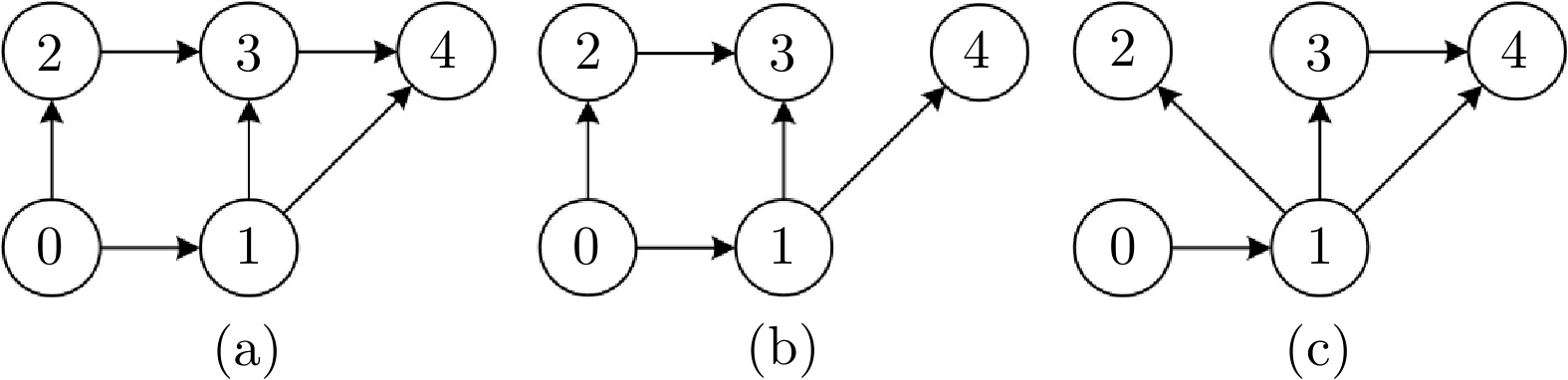
摘要: 针对不确定扰动下具有混合相对阶的异构多智能体系统, 提出一种新的分布式自适应扰动抑制控制方法, 实现切换拓扑下领导者−跟随者输出一致性. 首先, 通过引入局部输出跟踪误差, 将领导者−跟随者全局输出一致性问题转化为相邻智能体局部输出一致性问题; 然后, 针对系统参数和扰动已知的情况, 基于智能体系统控制−扰动相对阶匹配条件, 提出一种基于高阶微分邻居信息的分布式标称扰动抑制控制器. 基于此, 针对因混合相对阶差异而导致控制器中的高阶微分邻居信号难以直接获取的问题, 提出基于高阶滑模微分器的精确估计方法, 突破了传统控制设计对系统相对阶一致性的依赖, 解决了固定/切换拓扑下局部−全局输出一致性; 进而, 针对系统参数和扰动不确定的情况, 进行分布式自适应扰动抑制控制器设计, 实现切换拓扑下的领导者−跟随者输出一致性以及期望的扰动补偿. 所设计的控制方法不仅能够在不依赖全局智能体信息及领导者信息的前提下, 确保整个智能体系统的闭环稳定性、实现跟随者对领导者的输出跟踪, 而且能达到期望的扰动抑制效果. 与常规的自适应一致性控制方案相比, 还具备处理具有混合相对阶特性的异构多智能体系统的能力. 最后, 仿真研究验证了所设计控制方案的有效性.Abstract: A novel distributed adaptive disturbance rejection control scheme is developed for heterogeneous multi-agent systems with mixed relative degree under uncertain disturbance to achieve leader-follower output consensus under switching topology. First, a local output tracking error is introduced to transform the global leader-follower output consensus problem into a local output consensus problem between neighboring agents. Then, assuming known system parameters and disturbances, a distributed nominal high-order differential neighbor-sharing information based disturbance rejection controller is designed, based on the agent system control-disturbance relative degree matching condition. Based on this, a high-order sliding mode differentiator based precise estimation method is proposed to address the problem of difficulty in directly obtaining high-order differential neighbor-sharing signals in controllers due to mixed relative order differences. This method breaks through the traditional control design′s dependence on system relative order consistency and solves the problem of local-global output consistency in fixed/switching topologies. Furthermore, for the case where the system parameters and disturbances are uncertain, a distributed adaptive disturbance rejection controller is designed to achieve desired disturbance compensation and leader-follower output consensus under switching topology. The proposed control method can not only ensure closed-loop stability of the entire agent system and achieve leader-follower output consensus, without relying on global agent or leader information, but also achieve the expected disturbance rejection. Compared with conventional adaptive consensus control schemes, it also has the ability to handle the mixed relative order characteristics of heterogeneous multi-agent systems. Finally, the effectiveness of the proposed control scheme is verified through simulations.1)
1 1式(3)是一种混合域表示形式, 这是在自适应控制中常见的系统表达方式[41]. -
[1] Bao G, Ma L, Yi X. Recent advances on cooperative control of heterogeneous multi-agent systems subject to constraints: A survey. Systems Science and Control Engineering, 2022, 10(1): 539−551 doi: 10.1080/21642583.2022.2074169 [2] Ma Y J, Jiang B, Wang J, Gong J Y. Adaptive fault-tolerant formation control for heterogeneous UAVs-UGVs systems with multiple actuator faults. IEEE Transactions on Aerospace and Electronic Systems, 2023, 59(5): 6705−6716 [3] Canese L, Cardarilli G C, Di N L, Fazzolari R, Giardino D, Re M, et al. Multi-agent reinforcement learning: A review of challenges and applications. Applied Sciences, 2021, 11(11): 1−25 [4] Amirkhani A, Barshool A H. Consensus in multi-agent systems: A review. Artificial Intelligence Review, 2022, 22(5): 3897−3935 [5] Bhusal R, Subbarao K. Consensus of cooperative unmanned systems with nonuniform time-varying delays. Journal of Guidance, Control, and Dynamics, 2022, 45(9): 1724−1731 doi: 10.2514/1.G006703 [6] Wei H L, Liu C X, Shi Y. A robust distributed MPC framework for multi-agent consensus with communication delays. IEEE Transactions on Automatic Control, 2024, 69(11): 7418−7432 doi: 10.1109/TAC.2024.3389075 [7] Liang H J, Yang S F, Li T S, Zhang H G. Distributed adaptive cooperative control for human-in-the-loop heterogeneous UAV-UGV systems with prescribed performance. IEEE Transactions on Intelligent Vehicles, 2024, 9(11): 6915−6925 [8] 刘建刚, 杨胜杰. 具有容性负载的直流微电网系统分布式协同控制. 自动化学报, 2020, 46(4): 1283−1290 doi: 10.16383/j.aas.c190018Liu Jian-Gang, Yang Sheng-Jie. Distributed cooperative control of DC micro-grid systems with capacitive loads. Acta Automatica Sinica, 2020, 46(4): 1283−1290 doi: 10.16383/j.aas.c190018 [9] Yang R H, Liu L, Feng G. Cooperative output tracking of unknown heterogeneous linear systems by distributed event-triggered adaptive control. IEEE Transactions on Cybernetics, 2020, 52(1): 3−15 [10] Zadeh H N, Naseri R, Menhaj M B, Suratgar A A. Heterogeneous unknown multiagent systems of different relative degrees: A distributed optimal coordination design. IEEE Systems Journal, 2024, 18(3): 1570−1580 doi: 10.1109/JSYST.2024.3417255 [11] Cao X Y, Zhang C H, Zhao D D, Sun B, Li Y. Event-triggered consensus control of continuous-time stochastic multi-agent systems. Automatica, 2022, 137(3): 22−29 [12] Lin W L, Peng G S, Fu Z W, Chen T, Gu Z H. Consensus of fractional-order multi-agent systems via event-triggered pinning impulsive control. Neurocomputing, 2022, 494(10): 409−417 [13] Leng H, Wu Z Y, Zhao Y. Group consensus in second-order multi-agent systems with nonlinear dynamics. International Journal of Modern Physics, 2021, 32(5): Article No. 2150071 doi: 10.1142/S0129183121500716 [14] Yi J, Li J, Zhang Z. Fixed-time connectivity-preserving consensus of periodically disturbed nonlinear multi-agent systems with limited communication ranges. ISA Transactions, 2023, 138(6): 291−300 [15] Zhang Z, Chen S M, Zheng Y S. Fully distributed scaled consensus tracking of high-order multiagent systems with time delays and disturbances. IEEE Transactions on Industrial Informatics, 2022, 18(1): 305−314 doi: 10.1109/TII.2021.3069207 [16] Wang G, Wang X, Li S. Sliding-mode consensus algorithms for disturbed second-order multi-agent systems. Journal of the Franklin Institute, 2018, 355(15): 7443−7465 doi: 10.1016/j.jfranklin.2018.07.027 [17] Du C L, Li F B, Yang C H. An improved homogeneous polynomial approach for adaptive sliding-mode control of Markov jump systems with actuator faults. IEEE Transactions on Automatic Control, 2019, 65(3): 955−969 [18] Li Z K, Duan Z S, Xie L H, Liu X D. Distributed robust control of linear multi-agent systems with parameter uncertainties. International Journal of Control, 2012, 85(8): 1039−1050 doi: 10.1080/00207179.2012.674644 [19] Li X, Soh Y C, Xie L H. Output-feedback protocols without controller interaction for consensus of homogeneous multi-agent systems: A unified robust control view. Automatica, 2017, 81: 37−45 doi: 10.1016/j.automatica.2017.03.001 [20] Valcher M E, Misra P. On the stabilizability and consensus of positive homogeneous multi-agent dynamical systems. IEEE Transactions on Automatic Control, 2014, 59(7): 1936−1941 doi: 10.1109/TAC.2013.2294621 [21] 张冬梅, 欧琳琳, 孟莉, 王辛刚. 具有多图拓扑结构的同类智能体LQR控制. 自动化学报, 2013, 39(6): 913−919 doi: 10.1016/S1874-1029(13)60059-2Zhang Dong-Mei, Ou Lin-Lin, Meng Li, Wang Xin-Gang. LQR control for homogeneous agents with multi-graph topology. Acta Automatica Sinica, 2013, 39(6): 913−919 doi: 10.1016/S1874-1029(13)60059-2 [22] 王澄, 刘德荣, 魏庆来, 赵冬斌, 夏振超. 带有储能设备的智能电网电能迭代自适应动态规划最优控制. 自动化学报, 2014, 40(9): 1984−1990 doi: 10.3724/SP.J.1004.2014.01984Wang Cheng, Liu De-Rong, Wei Qing-Lai, Zhao Dong-Bin, Xia Zhen-Chao. Iterative adaptive dynamic programming approach to power optimal control for smart grid with energy storage devices. Acta Automatica Sinica, 2014, 40(9): 1984−1990 doi: 10.3724/SP.J.1004.2014.01984 [23] Zhang L P, Zhang H S, Xie L H. Distributed leaderless optimal output consensus of heterogeneous multi-agent systems. Journal of Systems Science and Complexity, 2025, 38(2): 671−690 doi: 10.1007/s11424-025-4528-2 [24] Ren Y X, Wang Q S, Duan Z S. Optimal leader-following consensus control of multi-agent systems: A neural network based graphical game approach. IEEE Transactions on Network Science and Engineering, 2022, 9(5): 3590−3601 doi: 10.1109/TNSE.2022.3185019 [25] Goel R, Grag T, Roy S B. Closed-loop reference model based distributed MRAC using cooperative initial excitation and distributed reference input estimation. IEEE Transactions on Control of Network Systems, 2022, 9(1): 37−49 doi: 10.1109/TCNS.2022.3141015 [26] Peng Z H, Dan W, Zhang H W, Sun G, Wang H. Distributed model reference adaptive control for cooperative tracking of uncertain dynamical multi-agent systems. IET Control Theory and Applications, 2013, 7(8): 1079−1087 doi: 10.1049/iet-cta.2012.0765 [27] Gong J Y, Ma Y J, Jiang B, Zhang Y M, Guo L. An adaptive fault-tolerant control scheme for heterogeneous multiagent systems. IEEE Transactions on Systems, Man, and Cybernetics: Systems, 2025, 55(2): 1264−1276 [28] Ren Y H, Zhou W N, Li Z W, Liu L, Sun Y Q. Prescribed-time leader-following consensus for stochastic second-order multi-agent systems subject to actuator failures via sliding mode control strategy. Neurocomputing, 2021, 425: 82−95 doi: 10.1016/j.neucom.2020.10.103 [29] Su Y, Huang J. Cooperative output regulation of linear multi-agent systems by output feedback. Systems and Control Letters, 2012, 61(12): 1248−1253 doi: 10.1016/j.sysconle.2012.09.005 [30] Li G Q, Wang L. Adaptive output consensus of heterogeneous nonlinear multiagent systems: A distributed dynamic compensator approach. IEEE Transactions on Automatic Control, 2022, 68(4): 2483−2489 [31] Guo J, Zhang Y J, Zhang J F. Distributed output feedback indirect MRAC of continuous-time multiagent linear systems. SIAM Journal on Control and Optimization, 2025, 63(3): 1616−1640 doi: 10.1137/23M1620107 [32] 陈世明, 化俞新, 祝振敏, 赖强. 邻域交互结构优化的多智能体快速蜂拥控制算法. 自动化学报, 2015, 41(12): 2092−2099 doi: 10.16383/j.aas.2015.c150254Chen Shi-Ming, Hua Yu-Xin, Zhu Zhen-Min, Lai Qiang. Fast flocking algorithm for multi-agent systems by optimizing local interactive topology. Acta Automatica Sinica, 2015, 41(12): 2092−2099 doi: 10.16383/j.aas.2015.c150254 [33] Gohokar V N, Khedkar M K, Dhole G M. Formulation of distribution reconfiguration problem using network topology: A generalized approach. Electric Power Systems Research, 2004, 69(2): 304−310 [34] Valcher M E, Zorzan I. On the consensus of homogeneous multi-agent systems with arbitrarily switching topology. Automatica, 2017, 84(1): 79−85 [35] Zhang H G, Cai Y L, Wang Y C, Su H G. Adaptive bipartite event-triggered output consensus of heterogeneous linear multiagent systems under fixed and switching topologies. IEEE Transactions on Neural Networks and Learning Systems, 2020, 31(11): 4816−4830 doi: 10.1109/TNNLS.2019.2958107 [36] Tang W Y, Wu J, Liu N, Mo H H. Distributed data driven control for multi-agent consensus with unknown system dynamics. Journal of the Franlin Institute, 2021, 358(14): 7013−7031 doi: 10.1016/j.jfranklin.2021.07.017 [37] Hu H, Huo S, Zhang Y. Adaptive fully distributed anti-disturbance containment control for heterogeneous multi-agent systems. International Journal of Systems Science, 2023, 54(1): 73−86 doi: 10.1080/00207721.2022.2103199 [38] Stepanyan V, Hovakimyan N. Adaptive disturbance rejection controller for visual tracking of a maneuvering target. Journal of Guidance, Control, and Dynamics, 2007, 30(4): 1090−1106 doi: 10.2514/1.25034 [39] Wen L Y, Tao G, Yang H, Yang Y. Aircraft turbulence compensation using adaptive multivariable disturbance rejection techniques. Journal of Guidance, Control, and Dynamics, 2015, 38(5): 954−963 doi: 10.2514/1.G000658 [40] Dong M, Tao G, Wen L Y, Jiang B. Adaptive sensor fault detection for rail vehicle suspension systems. IEEE Transactions on Vehicular Technology, 2019, 68(8): 7552−7565 doi: 10.1109/TVT.2019.2926225 [41] Tao G. Adaptive Control Design and Analysis. New York: John Wiley and Sons, 2003. [42] 文利燕, 陶钢, 姜斌, 杨杰. 非线性动态突变系统的多模型自适应执行器故障补偿设计. 自动化学报, 2022, 48(1): 207−222 doi: 10.16383/j.aas.c200318Wen Li-Yan, Tao Gang, Jiang Bin, Yang Jie. A multiple-model based adaptive actuator failure compensation scheme for nonlinear systems with dynamic mutations. Acta Automatica Sinica, 2022, 48(1): 207−222 doi: 10.16383/j.aas.c200318 [43] Baldi S, Yuan S, Paolo F. Output synchronizaiton of unknown heterogeneous agents via distributed model reference adaptation. IEEE Transactions on Control of Network Systems, 2018, 6(2): 515−525 [44] Rosa M R. Adaptive synchronization for heterogeneous multi-agent systems with switching topologies. Machines, 2018, 6(1): 1−18 doi: 10.3390/machines6010001 [45] Song G, Tao G. Adaptive leader-following state consensus of multiagent systems with switching topology. International Journal of Adaptive Control and Signal Processing, 2018, 32(10): 1508−1528 doi: 10.1002/acs.2926 [46] 刘宇, 文利燕, 姜斌, 马亚杰, 崔玉康. 切换拓扑下异构多智能体系统自适应输出一致性. 上海交通大学学报, 2024, 58(11): 1805−1815 doi: 10.16183/j.cnki.jsjtu.2024.221Liu Yu, Wen Li-Yan, Jiang Bin, Ma Ya-Jie, Cui Yu-Kang. Adaptive output consencus of heterogeneous multi-agent system with switching topology. Journal of Shanghai Jiao Tong University, 2024, 58(11): 1805−1815 doi: 10.16183/j.cnki.jsjtu.2024.221 [47] Levant A. Higher-order sliding modes, differentiation and output-feedback control. International Journal of Control, 2003, 76(9): 924−941 -

 下载:
下载:

图(5)
计量
- 文章访问数: 709
- HTML全文浏览量: 499
- PDF下载量: 121
- 被引次数: 0
