


-
摘要:
无偏(静差)模型预测控制(Model predictive control, MPC)的设计目标是使被控变量渐近地跟踪设定值, 这类控制方法直接关系到闭环系统的跟踪性能和抗扰性能.由于可以有效处理不可测扰动、模型失配等, 无偏MPC具有很强的工程应用价值, 但是在理论方面并没有得到充分重视.近30年来, 围绕无偏MPC的原理、分析和设计展开了一系列的研究工作, 并取得了系统性的研究成果.当前的一些研究结果大多分散在不同的参考文献中, 缺少全面的梳理和呈现.本文的主要工作包括回顾常见无偏控制方法, 综述当前无偏MPC的研究进展, 并探讨一些潜在的研究方向.
Abstract:The goal of offset-free MPC (Model predictive control) is to drive the controlled variables to the desired setpoints asymptotically. Due to the ability to cope with unmeasured disturbances and/or model mismatch, offset-free control strategies are directly related to the tracking performance and disturbance rejection performance. Offset-free MPC is fundamental for practical implementation, however, is often overlooked in academic researches. Great achievements have been made in the area of offset-free MPC over the last three decades. The existing results scatter in many academic papers and books, and there are few systemic discussions. This paper aims to shed some light on the theory and design of offset-free MPC, including common offset-free control strategies, current research activities, and some possible directions in the future.
-
Key words:
- Model predictive control /
- offset-free control /
- tracking control /
- disturbance modeling /
- disturbance observer
1) 本文责任编委 诸兵 -
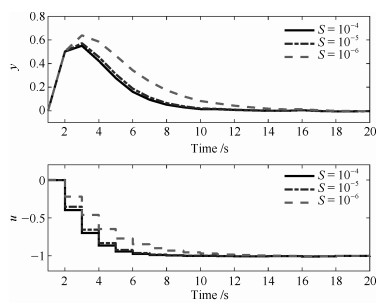
图 4 $S$对系统抗扰能力的影响(输出扰动模型+输出扰动)
Fig. 4 Disturbance rejection performance with different $S$ (output disturbance model + output disturbance)
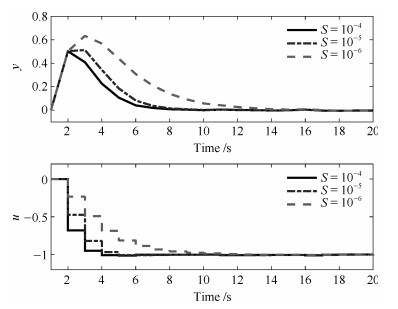
图 5 $S$对系统抗扰能力的影响(输入扰动模型+输入扰动)
Fig. 5 Disturbance rejection performance with different $S$ (input disturbance model + input disturbance)
-
[1] 席裕庚, 李德伟, 林姝.模型预测控制—现状与挑战.自动化学报, 2013, 39(3): 222-236 doi: 10.3724/SP.J.1004.2013.00222Xi Yu-Geng, Li De-Wei, Lin Shu. Model predictive control—status and challenges. Acta Automatica Sinica, 2013, 39(3): 222-236 doi: 10.3724/SP.J.1004.2013.00222 [2] Shinskey F G. Feedback Controllers for the Process Industries. New York: McGraw-Hill Professional, 1994. 117-119 [3] Lundström P, Lee J H, Morari M, Skogestad S. Limitations of dynamic matrix control. Computers & Chemical Engineering, 1995, 19(4): 409-421 http://cn.bing.com/academic/profile?id=f784b1919df2f28bf79ef45d9c4c572f&encoded=0&v=paper_preview&mkt=zh-cn [4] Muske K R, Badgwell T A. Disturbance modeling for offset-free linear model predictive control. Journal of Process Control, 2002, 12(5): 617-632 http://www.wanfangdata.com.cn/details/detail.do?_type=perio&id=a53bce47218139e3782ace29d6d5a1bf [5] Aström K J, Hägglund T. PID Controllers: Theory, Design and Tuning (Second edition). USA: Instrument Society of America, 1995. 80-92 [6] Garcia C E, Morari M. Internal model control. A unifying review and some new results. Industrial & Engineering Chemistry Process Design & Development, 1982, 21(2): 308-323 doi: 10.1021-i200017a016/ [7] Morari M, Zafiriou E. Robust Process Control. Englewood Cliffs, NJ: Prentice-Hall, 1989. [8] 席裕庚.预测控制.第2版.北京:国防工业出版社, 2013Xi Yu-Geng. Predictive Control (Second edition). Beijing: National Defense Industry Press, 2013. [9] Maeder U, Morari M. Offset-free reference tracking with model predictive control. Automatica, 2010, 46(9): 1469-1476 http://www.wanfangdata.com.cn/details/detail.do?_type=perio&id=82a599115d96619621990f520aa8e59a [10] Young P C, Willems J C. An approach to the linear multivariable servomechanism problem. International Journal of Control, 1972, 15(5): 961-979 doi: 10.1080/00207177208932211 [11] Franklin G F, Powell J D, Workman M L. Digital Control of Dynamic Systems (Third edition). Menlo Park, CA: Addison Wesley Longman Publishing Co., Inc., 1998. 322-336 [12] Johnson C D. Accomodation of external disturbances in linear regulator and servomechanism problems. IEEE Transactions on Automatic Control, 1971, 16(6): 635-644 doi: 10.1109/TAC.1971.1099830 [13] Davison E J, Smith H W. Pole assignment in linear time-invariant multivariable systems with constant disturbances. Automatica, 1971, 7(4): 489-498 doi: 10.1016/0005-1098(71)90099-9 [14] Kwakernaak H, Sivan R. Linear Optimal Control Systems. New York: John Wiley & Sons, Inc., 1972. 278-279 [15] Richalet J, Rault A, Testud J L, Papon J. Model predictive heuristic control: applications to industrial processes. Automatica, 1978, 14(5): 413-428 doi: 10.1016-0005-1098(78)90001-8/ [16] Cutler C R, Ramaker B L. Dynamic matrix control: a computer control algorithm. In: Proceedings of the 1980 Joint Automatic Control Conference. San Francisco, USA, 1980. [17] Garcia C E, Morshedi A M. Quadratic programming solution of dynamic matrix control (QDMC). Chemical Engineering Communications, 1986, 46(1-3): 73-87 doi: 10.1080/00986448608911397 [18] Clarke D W, Mohtadi C. Properties of generalized predictive control. Automatica, 1989, 25(6): 859-875 doi: 10.1016/0005-1098(89)90053-8 [19] Marquis P, Broustail J. SMOC, a bridge between state space and model predictive controllers: application to the automation of a hydrotreating unit. IFAC Proceedings Volumes, 1988, 21(4): 37-45 doi: 10.1016/B978-0-08-035735-5.50010-3 [20] Rawlings J B. Tutorial overview of model predictive control. IEEE Control Systems, 2000, 20(3): 38-52 http://cn.bing.com/academic/profile?id=80dc0712a8ee58d18b9749b8224d9743&encoded=0&v=paper_preview&mkt=zh-cn [21] Li S F, Lim K Y, Fisher D G. A state space formulation for model predictive control. AIChE Journal, 1989, 35(2): 241-249 doi: 10.1002/aic.690350208 [22] Ricker N L. Model predictive control with state estimation. Industrial & Engineering Chemistry Research, 1990, 29(3): 374-382 http://d.old.wanfangdata.com.cn/OAPaper/oai_doaj-articles_af2ad960e2e7be4856a2fd53c7dba86d [23] Kwon W H, Byun D G. Receding horizon tracking control as a predictive control and its stability properties. International Journal of Control, 1989, 50(5): 1807-1824 doi: 10.1080/00207178908953467 [24] Rawlings J B, Muske K R. The stability of constrained receding horizon control. IEEE Transactions on Automatic Control, 1993, 38(10): 1512-1516 doi: 10.1109/9.241565 [25] Muske K R, Rawlings J B. Model predictive control with linear models. AIChE Journal, 1993, 39(2): 262-287 doi: 10.1002/aic.690390208 [26] Lee J H, Morari M, Garcia C E. State-space interpretation of model predictive control. Automatica, 1994, 30(4): 707-717 doi: 10.1016/0005-1098(94)90159-7 [27] Wang L P. A tutorial on model predictive control: using a linear velocity-form model. Developments in Chemical Engineering & Mineral Processing, 2004, 12(5-6): 573-614 http://cn.bing.com/academic/profile?id=57d01df231d6ee94633e98e901047a90&encoded=0&v=paper_preview&mkt=zh-cn [28] Froisy J B. Model predictive control—building a bridge between theory and practice. Computers & Chemical Engineering, 2006, 30(10-12): 1426-1435 https://academic.oup.com/her/article/15/2/125/550414 [29] Morari M, Maeder U. Nonlinear offset-free model predictive control. Automatica, 2012, 48(9): 2059-2067 doi: 10.1016/j.automatica.2012.06.038 [30] Akesson J, Hagander P. Integral action — a disturbance observer approach. In: Proceedings of the 2003 European Control Conference (ECC). Cambridge, UK: IEEE, 2015. 2577-2582 [31] Rao C V, Wright S J, Rawlings J B. Application of interior-point methods to model predictive control. Journal of Optimization Theory & Applications, 1998, 99(3): 723-757 http://cn.bing.com/academic/profile?id=37dc2572a182e4eb56569ba6ef573176&encoded=0&v=paper_preview&mkt=zh-cn [32] Prett D M, García C E. Fundamental Process Control. Stoneham, MA: Butterworths, 1988 [33] Betti G, Farina M, Scattolini R. A robust MPC algorithm for offset-free tracking of constant reference signals. IEEE Transactions on Automatic Control, 2013, 58(9): 2394-2400 doi: 10.1109/TAC.2013.2254011 [34] Maciejowski J M. Predictive Control with Constraints. Englewood Cliffs: Prentice-Hall, 2002 [35] González A H, Adam E J, Marchetti J L. Conditions for offset elimination in state space receding horizon controllers: a tutorial analysis. Chemical Engineering & Processing: Process Intensification, 2008, 47(12): 2184-2194 http://cn.bing.com/academic/profile?id=b39d1d783d51ed52a7998aacb43bc963&encoded=0&v=paper_preview&mkt=zh-cn [36] Betti G, Farina M, Scattolini R. An MPC algorithm for offset-free tracking of constant reference signals. In: Proceedings of the 51st IEEE Conference on Decision and Control. Maui, HI, USA: IEEE, 2012. 5182-5187 [37] Tatjewski P. Advanced Control of Industrial Processes. London: Springer Verlag, 2007. 176-197 [38] Tatjewski P. Disturbance modeling and state estimation for offset-free predictive control with state-space process models. International Journal of Applied Mathematics & Computer Science, 2014, 24(2): 313-323 http://cn.bing.com/academic/profile?id=6e8857562a4802d30d390cba6f9aed9c&encoded=0&v=paper_preview&mkt=zh-cn [39] Zou T. Offset-free strategy by double-layered linear model predictive control. Journal of Applied Mathematics, 2012, 2012: Article ID 808327 [40] 吴明光, 钱积新.基于多目标分层的预测控制定态优化技术.化工学报, 2005, 56(1): 105-109 doi: 10.3321/j.issn:0438-1157.2005.01.019Wu Ming-Guang, Qian Ji-Xin. Multi-objective and layered steady-state optimization method of model predictive control. Journal of Chemical Industry and Engineering, 2005, 56(1): 105-109 doi: 10.3321/j.issn:0438-1157.2005.01.019 [41] 邹涛, 丁宝苍, 张瑞.模型预测控制工程应用导论.北京:化学工业出版社, 2010.Zou Tao, Ding Bao-Cang, Zhang Rui. MPC: an Introduction to Industrial Applications. Beijing: Chemical Industry Press, 2010. [42] Rawlings J B, Amrit R. Optimizing process economic performance using model predictive control. In: Proceedings of the 2009 Nonlinear Model Predictive Control. Lecture Notes in Control & Information Sciences. Berlin, Heidelberg: Springer, 2009, 384: 119-138 [43] Rao C V, Rawlings J B. Steady states and constraints in model predictive control. AIChE Journal, 1999, 45(6): 1266-1278 doi: 10.1002/aic.690450612 [44] 丁宝苍.工业预测控制.北京:机械工业出版社, 2016.Ding Bao-Cang. Industrial Predictive Control. Beijing: China Machine Press, 2016. [45] Rajamani M R, Rawlings J B, Qin S J. Achieving state estimation equivalence for misassigned disturbances in offset-free model predictive control. AIChE Journal, 2009, 55(2): 396-407 doi: 10.1002/aic.11673 [46] Badgwell T A, Muske K R. Disturbance model design for linear model predictive control. In: Proceedings of the 2002 American Control Conference. Anchorage, USA: IEEE, 2002. 1621-1625 [47] Pannocchia G, Rawlings J B. Disturbance models for offset-free model predictive control. AIChE Journal, 2003, 49(2): 426-437 doi: 10.1002/aic.690490213 [48] Maeder U, Borrelli F, Morari M. Linear offset-free model predictive control. Automatica, 2009, 45(10): 2214-2222 doi: 10.1016/j.automatica.2009.06.005 [49] Pannocchia G. Offset-free tracking MPC: a tutorial review and comparison of different formulations. In: Proceedings of the 2015 European Control Conference. Linz, Austria: IEEE, 2015. 527-532 [50] Wang H K, Xu Z H, Zhao J, Jiang A P. An optimal filter based MPC for systems with arbitrary disturbances. Chinese Journal of Chemical Engineering, 2017, 25(5): 632-640 doi: 10.1016/j.cjche.2016.09.011 [51] Wang H K, Zhao J, Xu Z H, Shao Z J. Input and state estimation for linear systems with a rank-deficient direct feedthrough matrix. ISA Transactions, 2015, 57: 57-62 doi: 10.1016/j.isatra.2015.02.005 [52] Aström K J. Introduction to Stochastic Control Theory. London: Academic Press, 1970. [53] Davison E J. The output control of linear time-invariant multivariable systems with unmeasurable arbitrary disturbances. IEEE Transactions on Automatic Control, 1972, 17(5): 621-630 doi: 10.1109/TAC.1972.1100084 [54] Davison E J, Smith H W. A note on the design of industrial regulators: integral feedback and feedforward controllers. Automatica, 1974, 10(3): 329-332 doi: 10.1016/0005-1098(74)90044-2 [55] Francis B A, Wonham W M. The internal model principle of control theory. Automatica, 1976, 12(5): 457-465 doi: 10.1016/0005-1098(76)90006-6 [56] Rawlings J B, Mayne D Q. Model Predictive Control: Theory and Design. Boston, MA, USA: Addison-Wesley Longman Publishing Co., Inc., 2006. [57] Geromel J C, Bernussou J, Garcia G. $H_2$ and $H{_\infty}$ robust filtering for discrete-time linear systems. SIAM Journal on Control & Optimization, 2000, 38(5): 1353-1368 [58] Speyer J L, Chung W H. Stochastic Processes, Estimation, and Control. Philadelphia: Society for Industrial and Applied Mathematics, 2008 [59] Box G P, Jenkins G M. Time Series Analysis: Forecasting and Control. San Francisco, CA, USA: Holden-Day, 1970 [60] Brockwell P J, Davis R A. Time Series: Theory and Methods. New York, USA: Springer-Verlag, 1987 [61] Odelson B J, Rajamani M R, Rawlings J B. A new autocovariance least-squares method for estimating noise covariances. Automatica, 2006, 42(2): 303-308 doi: 10.1016/j.automatica.2005.09.006 [62] Lima F V, Rajamani M R, Soderstrom T A, et al. Covariance and state estimation of weakly observable systems: application to polymerization processes. IEEE Transactions on Control Systems Technology, 2013, 42(4): 1249-1257. http://cn.bing.com/academic/profile?id=53a79c0373636eafc52382190236fc75&encoded=0&v=paper_preview&mkt=zh-cn [63] Rajamani M R, Rawlings J B. Estimation of the disturbance structure from data using semidefinite programming and optimal weighting. Automatica, 2009, 45(1): 142-148 doi: 10.1016/j.automatica.2008.05.032 [64] Wang H K, Zhao J, Xu Z H, Shao Z J. Linear offset-free model predictive control: a minimum-variance unbiased filter based approach. In: Proceedings of the 52nd IEEE Conference on Decision and Control. Florence, Italy: IEEE, 2013. 782-786 [65] Shead L R E, Muske K R, Rossiter J A. Conditions for which linear MPC converges to the correct target. Journal of Process Control, 2010, 20(10): 1243-1251 doi: 10.1016/j.jprocont.2010.09.001 [66] Davison E J. The robust control of a servomechanism problem for linear time-invariant multivariable systems. IEEE Transactions on Automatic Control, 1976, 21(1): 25-34 doi: 10.1109/TAC.1976.1101137 [67] Johnson C. Further study of the linear regulator with disturbances—the case of vector disturbances satisfying a linear differential equation. IEEE Transactions on Automatic Control, 1970, 15(2): 222-228 doi: 10.1109/TAC.1970.1099406 [68] Wonham W M. Tracking and regulation in linear multivariable systems. SIAM Journal on Control, 1973, 11(3): 424-437 doi: 10.1137/0311035 [69] Wonham W M, Pearson J B. Regulation and internal stabilization in linear multivariable systems. SIAM Journal on Control, 1974, 12(1): 5-18 doi: 10.1137/0312002 [70] Pearson J, Shields R, Staats P. Robust solutions to linear multivariable control problems. IEEE Transactions on Automatic Control, 1974, 19(5): 508-517 doi: 10.1109/TAC.1974.1100679 [71] Francis B, Sebakhy O A, Wonham W M. Synthesis of multivariable regulators: the internal model principle. Applied Mathematics and Optimization, 1974, 1(1): 64-86 http://cn.bing.com/academic/profile?id=58970e1b229940be8283923ba7e068cf&encoded=0&v=paper_preview&mkt=zh-cn [72] Qin S J, Badgwell T A. A survey of industrial model predictive control technology. Control Engineering Practice, 2003, 11(7): 733-764 doi: 10.1016/S0967-0661(02)00186-7 [73] Pannocchia G, Bemporad A. Combined design of disturbance model and observer for offset-free model predictive control. IEEE Transactions on Automatic Control, 2007, 52(6): 1048-1053 doi: 10.1109/TAC.2007.899096 [74] 王浩坤.无偏模型预测控制的若干理论和方法研究[博士学位论文], 浙江大学, 中国, 2015 http://cdmd.cnki.com.cn/Article/CDMD-10335-1015305300.htmWang Hao-Kun. Theories and Methods for Offset-Free Model Predictive Control [Ph. D. dissertation], Zhejiang University, China, 2015 http://cdmd.cnki.com.cn/Article/CDMD-10335-1015305300.htm [75] 钱积新, 赵均, 徐祖华.预测控制.北京:化学工业出版社, 2007.Qian Ji-Xin, Zhao Jun, Xu Zu-Hua. Predictive Control. Beijing: Chemical Industry Press, 2007. [76] Sun Z J, Zhao Y, Qin S J. Improving industrial MPC performance with data-driven disturbance modeling. In: Proceedings of the 50th IEEE Conference on Decision and Control and European Control Conference. Orlando, USA: IEEE, 2011. 1922-1927 [77] Pannocchia G. Robust model predictive control with guaranteed setpoint tracking. Journal of Process Control, 2004, 14(8): 927-937 doi: 10.1016/j.jprocont.2004.03.001 [78] Äström K J, Wittenmark B. Computer-Controlled Systems: Theory and Design, (Third edition). Englewood Cliffs, N.J.: Prentice Hall, 1996. [79] 钱积新.控制理论研究中的几个挑战性的问题.控制工程, 2005, 12(3): 193-195 doi: 10.3969/j.issn.1671-7848.2005.03.001Qian Ji-Xin. Some challenging problems in research on control theory. Control Engineering of China, 2005, 12(3): 193-195 doi: 10.3969/j.issn.1671-7848.2005.03.001 [80] Hovd M. Improved target calculation for model predictive control. Modeling, Identification and Control, 2007, 28(3): 81-86 doi: 10.4173/mic.2007.3.3 [81] Rawlings J B, Bonne D, Jorgensen J B, Venkat A N, Jorgensen S B. Unreachable setpoints in model predictive control. IEEE Transactions on Automatic Control, 2008, 53(9): 2209-2215 doi: 10.1109/TAC.2008.928125 [82] Limon D, Alvarado I, Alamo T, Camacho E F. MPC for tracking piecewise constant references for constrained linear systems. Automatica, 2008, 44(9): 2382-2387 doi: 10.1016/j.automatica.2008.01.023 [83] Gilbert E G, Kolmanovsky I, Tan K T. Discrete-time reference governors and the nonlinear control of systems with state and control constraints. International Journal of Robust and Nonlinear Control, 1995, 5(5): 487-504 doi: 10.1002/rnc.4590050508 [84] Rossiter J A, Kouvaritakis B, Gossner J R. Feasibility and stability results for constrained stable generalized predictive control. Automatica, 1995, 31(6): 863-877 doi: 10.1016/0005-1098(94)00166-G [85] Bemporad A, Casavola A, Mosca E. Nonlinear control of constrained linear systems via predictive reference management. IEEE Transactions on Automatic Control, 1997, 42(3): 340-349 doi: 10.1109/9.557577 [86] Wang H K, Zhao J, Xu Z H, Shao Z J. Model predictive control for Hammerstein systems with unknown input nonlinearities. Industrial & Engineering Chemistry Research, 2014, 53(18): 7714-7722 http://www.wanfangdata.com.cn/details/detail.do?_type=perio&id=f7559988503aab59e5d0d19aabf9e767 [87] Wang H K, Jiang A P. An active fault-tolerant MPC for systems with partial actuator failures. In: Proceedings of the 11th Asian Control Conference. Gold Coast, Australia: IEEE, 2017. 1614-1619 [88] Lima F V, Rawlings J B. Nonlinear stochastic modeling to improve state estimation in process monitoring and control. AIChE Journal, 2011, 57(4): 996-1007 doi: 10.1002/aic.12308 [89] Zagrobelny M A, Rawlings J B. Practical improvements to autocovariance least-squares. AIChE Journal, 2015, 61(6): 1840-1855 doi: 10.1002/aic.14771 [90] Mehra R. Approaches to adaptive filtering. IEEE Transactions on Automatic Control, 1972, 17(5): 693-698 doi: 10.1109/TAC.1972.1100100 [91] Mehra R. On the identification of variances and adaptive Kalman filtering. IEEE Transactions on Automatic Control, 1970, 15(2): 175-184 doi: 10.1109/TAC.1970.1099422 [92] Myers K, Tapley B. Adaptive sequential estimation with unknown noise statistics. IEEE Transactions on Automatic Control, 1976, 21(4): 520-523 doi: 10.1109/TAC.1976.1101260 [93] Bodizs L, Srinivasan B, Bonvin D. On the design of integral observers for unbiased output estimation in the presence of uncertainty. Journal of Process Control, 2011, 21(3): 379-390 doi: 10.1016/j.jprocont.2010.11.015 [94] 陈虹.模型预测控制.北京:科学出版社, 2013.Chen Hong. Model Predictive Control. Beijing: Science Press, 2013. [95] Mohammadkhani M, Bayat F, Jalali A A. Two-stage observer based offset-free MPC. ISA Transactions, 2015, 57: 136-143 doi: 10.1016/j.isatra.2015.02.015 [96] Mayne D Q. Model predictive control: recent developments and future promise. Automatica, 2014, 50(12): 2967-2986 doi: 10.1016/j.automatica.2014.10.128 [97] Pannocchia G, Kerrigan E C. Offset-free receding horizon control of constrained linear systems. AIChE Journal, 2005, 51(12): 3134-3146 doi: 10.1002/aic.10626 [98] Ding B C, Zou T, Pan H G. A discussion on stability of offset-free linear model predictive control. In: Proceedings of the 24th Chinese Control and Decision Conference. Taiyuan, China: IEEE, 2012. 80-85 [99] Kassmann D E, Badgwell T A, Hawkins R B. Robust steady-state target calculation for model predictive control. AIChE Journal, 2000, 46(5): 1007-1024 doi: 10.1002/aic.690460513 [100] Seborg D E, Edgar T F, Mellichamp D A. Process Dynamics and Control (Second edition). New York: John Wiley & Sons, Inc., 2004. [101] Tatjewski P. Advanced control and on-line process optimization in multilayer structures. Annual Reviews in Control, 2008, 32(1): 71-85 doi: 10.1016/j.arcontrol.2008.03.003 [102] Darby M L, Nikolaou M, Jones J, Nicholson D. RTO: an overview and assessment of current practice. Journal of Process Control, 2011, 21(6): 874-884 doi: 10.1016/j.jprocont.2011.03.009 [103] Würth L, Hannemann R, Marquardt W. A two-layer architecture for economically optimal process control and operation. Journal of Process Control, 2011, 21(3): 311-321 doi: 10.1016/j.jprocont.2010.12.008 [104] Zanin A C, Tvrzská de Gouvêa M, Odloak D. Integrating real-time optimization into the model predictive controller of the FCC system. Control Engineering Practice, 2002, 10(8): 819-831 doi: 10.1016/S0967-0661(02)00033-3 [105] Adetola V, Guay M. Integration of real-time optimization and model predictive control. Journal of Process Control, 2010, 20(2): 125-133 doi: 10.1016/j.jprocont.2009.09.001 [106] Alvarez L A, Odloak D. Robust integration of real time optimization with linear model predictive control. Computers & Chemical Engineering, 2010, 34(12): 1937-1944 doi: 10.1016-j.compchemeng.2010.06.017/ [107] Helbig A, Abel O, Marquardt W. Structural concepts for optimization based control of transient processes. In: Nonlinear Model Predictive Control. Progress in Systems and Control Theory. Basel: Birkhäuser Verlag, 2000. 295-311 [108] Morari M, Arkun Y, Stephanopoulos G. Studies in the synthesis of control structures for chemical processes: Part Ⅰ: Formulation of the problem. Process decomposition and the classification of the control tasks. Analysis of the optimizing control structures. AIChE Journal, 1980, 26(2): 220-232 doi: 10.1002/aic.690260205 [109] Pannocchia G, Gabiccini M, Artoni A. Offset-free MPC explained: novelties, subtleties, and applications. IFAC-PapersOnLine, 2015, 48(23): 342-351 doi: 10.1016/j.ifacol.2015.11.304 -

 下载:
下载:

计量
- 文章访问数: 3857
- HTML全文浏览量: 2590
- PDF下载量: 1043
- 被引次数: 0
